NJ Spotlight News
NJ Spotlight News: July 3, 2025
7/3/2025 | 26m 51sVideo has Closed Captions
Watch as the NJ Spotlight News team breaks down today’s top stories.
We bring you what’s relevant and important in New Jersey news and our insight. Watch as the NJ Spotlight News team breaks down today’s top stories.
Problems playing video? | Closed Captioning Feedback
Problems playing video? | Closed Captioning Feedback
NJ Spotlight News is a local public television program presented by THIRTEEN PBS
NJ Spotlight News
NJ Spotlight News: July 3, 2025
7/3/2025 | 26m 51sVideo has Closed Captions
We bring you what’s relevant and important in New Jersey news and our insight. Watch as the NJ Spotlight News team breaks down today’s top stories.
Problems playing video? | Closed Captioning Feedback
How to Watch NJ Spotlight News
NJ Spotlight News is available to stream on pbs.org and the free PBS App, available on iPhone, Apple TV, Android TV, Android smartphones, Amazon Fire TV, Amazon Fire Tablet, Roku, Samsung Smart TV, and Vizio.
Providing Support for PBS.org
Learn Moreabout PBS online sponsorshipMajor funding for NJ Spotlight News is provided in part by NJM Insurance Group, serving the insurance needs of residents and businesses for more than 100 years.
Horizon Blue Cross Blue Shield of New Jersey, an independent licensee of the Blue Cross and Blue Shield Association, and by the PSCG Foundation.
Tonight on NJ Spotlight News, all eyes on Washington as President Trump's big beautiful bill gets a final vote.
Everything was an absolute disaster under the Biden-Harris radical woke progressive Democrat regime.
And we took the best effort that we could in one big beautiful bill to fix as much of it as we could.
Also on the federal chomping block is some of NOAA's cutting edge climate related research, including a lab at Princeton.
Ending some of the other research that NOAA performs through its research labs would be a tremendous loss for American science, but maybe more importantly, it's a tremendous loss for the American people.
Plus, with offshore wind projects stalling, there's now talk of developing nuclear energy in the state to meet clean energy goals.
All systems seem go for this, that this will happen in Oyster Creek, you know, the first part of the next decade.
It's going to start to happen there.
So I think the way we stand now, this is a done deal.
And just in time for a weekend of record holiday travel, the price at the pump is dropping.
NJ Spotlight News begins right now.
♪ ♪ >> From NJ PBS Studios, this is NJ Spotlight News with Brianna Vanozzi.
>> Good evening and thanks for joining us on this Thursday night.
I'm Brianna Vanozzi.
Let's begin with a few of today's top stories.
First, the 4th of July travel rush is well underway.
With the holiday falling on a Friday, a lot of people are taking advantage of the long weekend.
AAA says we'll see record traffic on the roads this year compared to last, thanks in part to gas prices cooling off.
National gas prices during the weekend could reach their lowest level for a July 4th holiday since 2021.
The cost for a gallon will run you $3.14 in New Jersey, two cents lower than the national average, according to AAA.
The agency predicts a record 72 million Americans will be traveling for the holiday, 2 million right here in New Jersey, with the bulk of people going by car.
That's about 2% more than were on the roads for the last 4th of July.
And if you do have plans that require you to get out of town, it's best to leave early.
The worst time to hit the road on Friday is between 12 and 7 p.m., and if you're headed home from a trip on Sunday, avoid the rush between 12 and 6.
Yeah, and in addition to those travelers hitting the road, the Port Authority is anticipating more than 2 million passengers will travel through the region's airports between today and Monday.
Amid the busy travel weekend, airport workers rallied today outside Terminal C to protest what they say is a plan by United Airlines to gut labor standards for 600 cabin cleaners and lift truck drivers.
Their union, 32BJSCIU, says United has brought in its own subsidiary called United Ground Express as their new contractor and that they're not honoring current labor standards negotiated with the old one.
The union says United is ending employer-paid health care and cutting back hours, converting about 80 percent of staff to part-time, and claims the new contractor isn't honoring terms, giving workers immigration legal support.
Now, according to 32BJ, a number of workers are here in the U.S. under humanitarian parole from countries like Haiti and Venezuela and have lost their work authorization, leaving them at risk for deportation.
In response, a spokesperson for United said they've made conditional job offers to current employees at $25 an hour and they're communicating with workers to make sure they understand their options.
Also tonight, a July 4th victory for President Trump.
The House narrowly passed Republicans' massive tax cuts and spending package known as the "One Big Beautiful Bill" in a 218-214 vote.
Only two House Republicans voted against it, they were not from New Jersey, and it now heads to President Trump's desk for his signature.
The $3.4 trillion package extends the president's signature 2017 tax cuts, boosts border and homeland security funding, slashes safety net programs like Medicaid and food stamps, increases the state and local tax deduction known as SALT, and raises the debt ceiling by $5 trillion.
The final vote was delayed multiple times.
House Minority Leader Hakeem Jeffries spoke against the bill for a record-breaking 8 hours 44 minutes, but it was no match for President Trump and House Speaker Mike Johnson, who spent most of the last 24 hours meeting with and speaking to GOP holdouts to get them to change their votes.
It was an effort that ended up paying off.
Senior Political Correspondent David Cruz has the details, plus how the bill affects New Jersey.
Let's understand who is doing you in.
People on the other side of the aisle.
House Minority Leader Hakeem Jeffries was left to play the role of last man standing, aware that he was just one congressman employing a filibuster tactic, trying to hold back a majority that itself went through its own fight to bring the President's bill to the House floor.
All we need are four Republicans to join us, to show John McCain levels of courage.
The controversial bill, which represents the administration's major domestic initiative, cuts a trillion dollars from the federal Medicaid program.
Over 360,000 in New Jersey are expected to lose coverage as a result.
Almost $300 billion in cuts to SNAP, that's food stamps, impacting 800,000 state residents enrolled in that program, all while slashing over $4 trillion in taxes for mostly the well-to-do, a dichotomy that had Democrats howling in opposition and fearing for what's next, especially but not exclusively for those on the margins.
When people lose health care coverage, right, that means they're not going and getting preventative care.
It means they're not going to see their doctor, right?
So more often than not, they will end up at hospitals and emergency rooms.
And so you're going to see the cost shift to hospitals, and especially in a place like Hudson County, you have a lot of these safety net hospitals.
So it's going to be harder from an operational perspective for them because you're going to have more uninsured people coming in for their health care, right?
So that means everyone that's on private insurance is going to see their premiums go up, right?
It means that the providers are going to have to charge more to make up for the less reimbursements that they're getting through Medicaid.
Cuts to food assistance programs and tightening restrictions to qualify for programs like it will also disproportionately hit poor and working class people.
Laura Waddell is the director of the Health Care Program for New Jersey Citizen Action.
These people just make $1,300 to $1,800 per month, and they're targeting these folks with work requirements, now requiring them to pay co-pays for doctor's visits.
There's nothing fiscally responsible about creating $5 trillion in debt and the deficit only to allow for $4.5 trillion in tax breaks for billionaires.
On ground level, that means a looming fiscal crisis for people like Teresa Luoni, a Baskin Ridge mom to two autistic children.
I mean, clearly it looks like we're heading to living in a country where money matters the most.
The citizens don't matter.
What the people want doesn't matter because this bill is incredibly unpopular with the citizens, right?
And we have people calling, having protests outside of our representatives' offices, and then we're being told they'll just have to get over it.
Until victory is won.
I yield back.
The parties yielded after almost nine hours of filibuster, giving Speaker Mike Johnson a chance to mock the minority leader and trash Democrats' arguments.
You know, Ronald Reagan said one time that no speech should be longer than 20 minutes, and unlike the Democrat leader, I'm going to honor my colleague's time and be a little more brief than that.
I just want to say something that many of us learned when we were children, we were taught, you know, it takes a lot longer to build a lie than to tell the simple truth.
A famous author once wrote that the truth does not change according to our ability to stomach it.
For Democrats, the taste of this big, beautiful bill is hard to stomach.
For Republicans and the president they follow, the sweetness of the victory left them very satisfied today.
Ben Cruz, NJ Spotlight News.
Well, even those within the president's inner circle reportedly doubted the massive bill would make it over the finish line in time for the holiday, but the vote handed the administration its second major policy win of the term, and perhaps more to come.
For more, let's turn to our Washington, D.C. correspondent, Ben Hulak, who's been in the thick of it and joins us now.
Hey, Ben, good to talk to you.
It's been a marathon.
Can you take us inside just what the last several hours have been like, what the mood is like?
Give us some color from down there.
Yeah, the last several hours have been, I would say, sleep deprived for members on both sides, staff, people who make this Capitol complex run.
This really has been a sprint since last Friday when Senate Republicans dropped their bill at roughly midnight, midnight Eastern time.
And then all last weekend they were amending, debating and rewriting on fly the bill, which then came across to the House side of the Capitol earlier this week.
And then yesterday it was unclear if Republicans had the votes.
They held open a vote on the House floor for hours and hours.
And sort of the right wing of the party was really summoned to the White House and cornered, pushed into voting for this.
This was the wing of the party that had said the debt attached to this legislation was too steep.
The price tag for this bill, according to the CBO, is about three point three trillion dollars over 10 years.
It's a nonpartisan wing of Congress that advises Congress on economic factors.
But it's there was a sense that Republicans had the votes once they started coming in for last night.
But we've been in limbo, sort of legislative purgatory.
What was it exactly then that turned the tide?
Why did those holdouts reverse course?
Was it those meetings with the president?
Did they feel like they had no other option?
At a certain point, you just you really in this Republican Party, very few people cross the president.
And we have heard stories, witness stories here on the Hill of Republicans back in the cloakroom on the House side, on the Senate side, getting angry phone calls from Trump saying you have to back this legislation.
And of course, Trump was was posting online repeatedly last night saying beat the Democrats.
This is a win.
This should be a no brainer, essentially.
I'm paraphrasing, but he's a man very few Republicans cross.
And I imagine that they were not too thrilled with some of the filibustering that Democrats did today.
Can you walk us through this really pretty epic, record breaking speech by Hakeem Jeffries?
Right.
Hakeem Jeffries is the Democratic leader in the House, man from Brooklyn and sort of a bookend, at least for me, covering Cory Booker's filibuster earlier this year in the Senate.
Similar vibe, similar intention to cast a light in the eyes of Democrats of what Republicans are doing here in Washington.
The deep cuts to snap cuts to Medicaid tax breaks that will, on the whole, benefit the wealthy and corporations.
But Jeffries, this is really one of the few tools Democrats have.
They didn't have the votes to stop this.
So they chose to force Republicans into voting for this mammoth piece of legislation in the light of day.
Very quickly, how did the New Jersey delegation vote?
Was this along party lines?
Is that what we were expecting?
I'm surprised.
Just as expected along party lines.
Republicans voting for it, Democrats against.
You know, the man who's been most interesting to me in this whole process from New Jersey is Jeff Vandrield.
And watching him, covering him, listening to him as this process has played out, he had some hesitation about Medicaid cuts.
He voted for the House version.
The Medicaid cuts got steeper, more aggressive in the Senate version.
And when that version came back, and remember, both chambers have to pass an identical version of legislation.
He voted for that again.
So he stuck out.
But really, he's an ally of the president.
He was certainly going to be a yes, almost certainly going to be a yes, all the way through.
And, of course, the president is expected to sign this bill tomorrow on the 4th of July.
You can follow all of Ben's reporting on this on our website, NJSpotlightNews.org.
Ben, thanks so much.
With the reconciliation package all but wrapped up, Congress will now need to turn its attention to the full federal budget bill.
And the separate cuts the White House is proposing in that spending plan, which includes significantly slashing funding for climate-related research at NOAA to the tune of nearly $2 billion and about 2,000 full-time employees.
According to budget documents, the proposed cuts would shut down a 57-year-old partnership between a Princeton University lab and the U.S. government that produces what many consider to be the most accurate and advanced climate modeling and forecasting systems in the country.
Ted Goldberg reports.
A lab that's been on the cutting edge of weather forecasting and climate modeling is now on the chopping block.
Ending some of the other research that NOAA performs through its research labs would be a tremendous loss for American science, but maybe more importantly, it's a tremendous loss for the American people.
As part of the latest federal budget proposal, the National Oceanic and Atmospheric Administration, or NOAA, will cut about 2,000 employees and reduce spending by nearly $2 billion.
Among the closures would be the Geophysical Fluid Dynamics Laboratory, or GFDL, in Princeton, which has been used to predict weather and study the atmosphere since 1955.
The tools that we have today for forecasting the weather and for understanding the Earth's climate are the result of research that goes back decades.
And in an environment where the benefits have to be experienced more quickly, I'm not sure we would do that same kind of long-term research that has been done at GFDL.
Anthony Broccoli worked at GFDL for 21 years.
Understanding how the climate will change in the future has real-world impacts because, among other things, the probability of getting various extreme weather events is changing as a result of climate change.
So we use these models to try to understand what kind of changes may lie ahead.
While Zachary Laib spent a little under three years there, researching the science behind heat waves and heavy rainfall.
What we really tried to do is better understand future changes in those types of extremes, so moving over to longer time scales, like later in the 21st century, but also shorter.
So trying to think of, can we better understand months in advance where things like extreme heat waves will impact parts of the U.S.?
Laib was caught up in the mass layoffs at NOAA back in February, and he's concerned that closing this lab will make it harder to predict weather and see storms before they develop.
Any cuts to resources for forecasters or for the research that feeds into the weather forecast, that will make communities more at risk, increases public safety concerns, increases economic concerns.
The proposed closing of the GFDL is part of a wider push from the Trump administration to slash spending and research regarding climate change.
Trump's big, beautiful bill, the center of attention today, includes its own cuts for climate programs.
Back in April, the Department of Commerce cut $4 million in grants to Princeton, all related to climate change research.
Secretary Howard Lutnick said of one program, "Its focus on alarming climate scenarios fosters fear rather than rational, balanced discussion."
He added that for another program, "Using federal funds to perpetuate these narratives does not align with the priorities of this administration."
Well, it's certainly not the language that I would use to describe that work.
Those in the science community disagree with the notion that they're trying to scare people or create narratives.
I don't think that the purpose of doing that research is to alarm.
I think the purpose of doing that research is to inform.
Scientists working in nowhere trying to better understand the science, communicate the impacts to people effectively, and educate others.
The damage would be very difficult to come back from because what essentially you're doing is firing a lot of the expertise, you know, experts and people that run these facilities, so they move on.
Congressman Frank Pallone has been a frequent critic of the administration when it comes to cutting spending on climate science, saying it used to be one of the few issues Congress could agree on.
It didn't matter who the president was or whether the majority party in Congress was the Democrats or Republicans, but now Trump has decided, "I don't want any of this because I don't believe in science.
I don't believe in climate change."
The Trump administration has defended these cuts by saying the federal government needs to be streamlined and spend less money overall, which would leave GFDL with a very cloudy future.
In Princeton, I'm Ted Goldberg, NJ Spotlight News.
Well, a new poll finds there's widespread support among residents here for developing more renewable energy.
The Stockton University poll released this week shows 57 percent of residents want state leaders to prioritize energy sources like wind and solar power instead of expanding fossil fuels.
Now, rising utility bills could have a lot to do with that sentiment.
Some 70 percent also said their electric bills have either increased significantly or somewhat over the past year.
When asked exactly which type of energy residents want to develop in order to increase that supply most, 64 percent said solar.
Wind was second at 41 percent, and nuclear came in last at 33 percent, according to the poll.
But nuclear energy could be on the verge of a comeback in New Jersey.
Camden-based Holtec International is in talks with state officials to bring what are known as small modular reactors, or SMRs, to the former Oyster Creek site, backed by new legislation offering fast-tracked approvals.
Some see it as a much-needed step toward carbon-free energy, with all of our grid concerns, but there are plenty of criticisms, too.
For more on that, I'm joined by investigative reporter Jeff Pillitz of the Jersey Vindicator.
Jeff, thanks for coming on the show.
I don't have to tell you, Holtec has had a pretty controversial history and trend in the state.
What's your sense through this reporting as to why the political climate seems to be a bit more receptive to this proposal?
Well, I think the big thing is the cost of energy is just skyrocketing, as you know.
Electric power is just through the roof and it's only going to get higher.
There just seems to be a consensus emerged that we've got to do something on climate change.
That's what the policymakers want to do.
And it just seems that there's a, as I say, a consensus around nuclear as one option of the above, and we have to pursue that like we pursue all the other carbon-neutral technology.
So I think that's pretty much the reason.
I think that New Jersey needs a power source, and they need it pretty quickly, and I think that's what's behind it.
I mean, you spoke with a number of lawmakers, Senator Smith among them, who sort of framed it like a necessary evil, no?
That, as you said, we're in a tough spot.
Yeah, Smith has a reputation as an environmentalist in the state, and I don't think he loves nuclear energy.
He does not like nuclear waste.
That's a big, big problem.
He tries to put nuclear waste permanently in this country, and Smith said, listen, I don't really like voting for this, but we've got to do something.
So that was -- he pretty much said it.
He said that we face a coming crisis with changing climate, drought, fires, the whole thing.
And he said we've got to show the people we're taking some action.
So that pretty much summarizes the policymakers' standpoint.
Yeah, I mean, what are critics saying?
I mean, I know that they've argued that this sort of prolongs our reliance on these type of sources.
These are high-risk sources.
Is there any evidence that suggests these SMRs are safer than past modules?
I think critics are saying, Brianna, that I don't think they necessarily have anything against nukes in themselves, but I think what they're saying is that it costs -- the cost is prohibitive.
And by pursuing nukes with all these subsidies that we're contemplating putting on New Jersey and elsewhere, that it's going to diminish solar, it's going to diminish wind, it's going to diminish battery storage and all those technologies which are at hand right now.
The nuclear stuff, SMRs that you're talking about, the small reactors, they're not really ready yet.
They're still several years off.
They are not approved by the NRC.
So, you know, it's -- the critics are saying, why are you throwing out what we have to subsidize something that's elusive and may not even work?
So, you mentioned the cost.
Is there any sense of what that dollar figure would be?
And are we talking subsidies?
Are we talking this landing on taxpayers' bills?
I mean, who bears the cost?
We're talking subsidies.
We're talking ratepayers' bills.
We're talking taxpayers' bills.
It's a moving figure.
It's billions of dollars.
In Michigan, where they've started a subsidized Pultec project there, it's $3 billion between state and federal subsidies there, and that's still not up and running.
So that's the criticism.
The cost, unknown projects that have started years ago have failed after becoming four or five times what they should have.
In Utah, we had a project like that.
In Georgia, we had a project like that.
So the fear is -- and it's a legitimate fear -- is that could -- why do we want to go down that road in New Jersey?
That's what the critics say.
Is there a sense, very quickly, Jeff, that this is something that will actually materialize, or is it more speculative at this point?
I think there's a sense that it will materialize, at least under the current atmosphere.
All systems seem go for this, that this will happen in Oyster Creek the first part of the next decade.
It's going to start to happen there.
So I think the way we stand now, this is a done deal.
Jeff Pillitz for us.
Jeff, great reporting, as always.
Thanks for coming on to talk.
Thanks, Brie.
And finally, a source of American pride, freed American Israeli hostage Yidan Alexander and his family met with President Trump and the First Lady earlier today at the White House.
Exactly two weeks after the Tenafly, New Jersey native returned home following 19 grueling months in Hamas captivity.
Alexander was believed to be the last living American hostage held in Gaza, and it's believed another roughly 50 hostages or their remains are still there.
Hamas officials at the time described Alexander's release as a goodwill gesture toward President Trump.
After he was freed, Alexander reportedly told the president by phone, "You saved my life."
That's going to do it for us tonight.
But a reminder, you can download our podcast wherever you listen and watch us anytime by subscribing to the NJ Spotlight News YouTube channel.
I'm Brianna Vanosi for the entire team at NJ Spotlight News.
Thanks for being with us.
Have a great night.
We'll see you right back here tomorrow.
New Jersey Education Association, making public schools great for every child.
RWJBarnabas Health, let's be healthy together.
New Jersey Realtors, the voice of real estate in New Jersey.
More information is online at njrealtor.com.
And Orested, committed to delivering clean, reliable, American-made energy.
[Music]
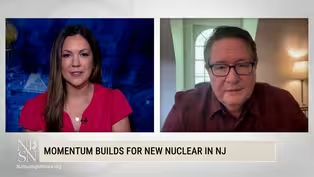
As NJ explores new nuclear, Holtec is poised to cash in
Video has Closed Captions
Clip: 7/3/2025 | 5m 43s | Interview: Jeff Pillets, The Jersey Vindicator (5m 43s)

Democrats react to House passage of Trump spending bill
Video has Closed Captions
Clip: 7/3/2025 | 5m 50s | Trump's "Big Beautiful Bill" approved by four votes (5m 50s)
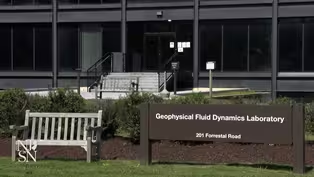
Weather forecasting, storm preparedness at risk
Video has Closed Captions
Clip: 7/3/2025 | 5m 5s | NOAA: Trump administration would fire 2,000 employees from agency (5m 5s)
Providing Support for PBS.org
Learn Moreabout PBS online sponsorship
- News and Public Affairs

Top journalists deliver compelling original analysis of the hour's headlines.

- News and Public Affairs

FRONTLINE is investigative journalism that questions, explains and changes our world.












Support for PBS provided by:
NJ Spotlight News is a local public television program presented by THIRTEEN PBS