NJ Spotlight News
NJ Spotlight News: July 8, 2025
7/8/2025 | 26m 46sVideo has Closed Captions
Watch as the NJ Spotlight News team breaks down today’s top stories.
We bring you what’s relevant and important in New Jersey news and our insight. Watch as the NJ Spotlight News team breaks down today’s top stories.
Problems playing video? | Closed Captioning Feedback
Problems playing video? | Closed Captioning Feedback
NJ Spotlight News is a local public television program presented by THIRTEEN PBS
NJ Spotlight News
NJ Spotlight News: July 8, 2025
7/8/2025 | 26m 46sVideo has Closed Captions
We bring you what’s relevant and important in New Jersey news and our insight. Watch as the NJ Spotlight News team breaks down today’s top stories.
Problems playing video? | Closed Captioning Feedback
How to Watch NJ Spotlight News
NJ Spotlight News is available to stream on pbs.org and the free PBS App, available on iPhone, Apple TV, Android TV, Android smartphones, Amazon Fire TV, Amazon Fire Tablet, Roku, Samsung Smart TV, and Vizio.
Providing Support for PBS.org
Learn Moreabout PBS online sponsorshipFunding for NJ Spotlight News provided by the members of the New Jersey Education Association.
Making public schools great for every child.
RWJBarnabas Health.
Let's be healthy together.
New Jersey Realtors, the voice of real estate in New Jersey.
More information is online at njrealtor.com.
And Oriston, committed to delivering clean, reliable, American-made energy.
Tonight on NJ Spotlight News, down the shore, the season got off to a slow start, but did the July 4th weekend crowds turn tourism around?
Plus, the fight over school funding continues in Tom's River, with residents reeling from a major tax hike needed to keep the district afloat.
Also, an annual report once again finds a broken system of care for people with disabilities.
But will there ever be the political will to fix it?
It's not easy, but none of this is rocket science.
We know the way forward.
We know how to stop abuse and neglect through the workforce, through paying direct support professionals a living wage to train them, to hold them accountable.
And real rules, as intense storms and floodwaters wreak havoc nationwide.
What's being done to prepare and protect our coastline from flooding?
It's a terrible thing to think about the loss of life, particularly those children that were lost.
These rules are giving us a chance to plan before the disaster happens.
NJ Spotlight News begins right now.
♪ ♪ >> From NJ PBS Studios, this is NJ Spotlight News with Brianna Vanozzi.
>> Good evening and thanks for joining us on this Tuesday night.
I'm Brianna Vanozzi.
We begin with a few of today's top stories.
First, it was a banner 4th of July weekend for the Jersey Shore.
The near perfect weather conditions brought the crowds, packing the beaches, boardwalks, and businesses.
From Cape May to Wildwood, Atlantic City and Seabright, hotel owners in the towns report rooms being fully booked through the weekend, with reservations stacking up for the rest of July and August, too.
Now, exact numbers are still being tallied, but local mayors and police departments use a number of ways to measure tourism.
According to reports, the Cape May city water utility broke records on the holiday, a telltale sign of big crowds.
Restaurant owners also reported long lines, high volume, and full parking lots.
It's a big turnaround from the slow start to the season.
Throughout the spring, weekends were filled with either heavy rain or punishing heat and few visitors.
Some business owners in Atlantic City say 4th of July was their biggest money-making weekend of the season.
Also tonight, a summer curfew is now in effect for Newark teens.
It's the second year the city's enforced the initiative, and it means residents under the age of 18 need to be home by 11 p.m. or have an adult with them.
It's all in an effort to keep teens out of trouble and, more importantly, from committing crimes.
According to Mayor Raz Baraka, unlike other youth curfews, Newark's doesn't include arrests, fines, or penalties.
Instead, it makes teens and their parents accountable for their whereabouts late at night and offers families resources when warranted.
The city uses an outreach team from the Office of Violence Prevention to find violators and gives them a ride home if needed.
If an adult isn't there, the teens are then taken to that department's office until someone picks them up.
Newark officials say the program works.
Last year, there was a 7 percent drop in juvenile arrests during the curfew.
Outreach teams reported dozens of encounters just during the July 4th weekend alone.
The curfew is in effect until the first week of September when kids are back in school.
Tom's River homeowners are about to be hit with a nearly 13 percent property tax hike as a bitter battle plays out between the school district and the state.
The district, which is the sixth largest in New Jersey, tried to file for bankruptcy after taking a big cut in state aid, but the Department of Education intervened, saying Tom's River needed to raise taxes instead.
Senior correspondent Joanna Gagas has the latest on the feud and what it means for the schools.
This shows, right, claiming of bankruptcy, two voted down budgets.
It shows that there's a problem.
There's something happening here.
What's happened is the Tom's River Regional Board of Education voted down the latest budget that was developed after state aid allocations were announced.
The district has faced year-over-year cuts under the school funding formula, totaling $175 million.
Without raising taxes, Superintendent Michael Sitta says they were simply insolvents.
If there was no tax increase and we didn't seek protection under Chapter 9, it would have been the end of Tom's River Regional Schools.
We're talking over 300 more staff members that would have been laid off.
We're talking class sizes in 150 to one in the elementary schools.
Unsustainable things.
We would have been done.
The district has already cut 250 positions, slashed programs, sold a school building, among other things.
So when it came time to approve the budget, the Tom's River Board of Education told New Jersey's Department of Education that it was filing Chapter 9 bankruptcy rather than impose a nearly 13 percent property tax increase on residents.
What we are doing is telling you that you're not messing with our kids and you're not messing with our taxpayers, and this is your problem that you need to solve.
But the DOE stepped in and blocked Tom's River from filing for bankruptcy and instead approved their budget by imposing the 12.9 percent property tax increase.
They issued a statement saying they were compelled to adopt the final budget and that the board's failure to do so marked a violation of several statutory and regulatory requirements.
Adding, while the department acknowledges the difficulty inherent in school district budgeting decisions, this is not only an expectation but is required under state law.
And that this marks the second consecutive school district budget the department has been forced to adopt for the board.
This troubling pattern indicates deeper and systemic concerns about the ability of the board and district administrators to meet their most basic responsibilities.
Tom's River Board of Ed President Ashley Lamb shot back at that allegation, pointing to the 2 percent property tax cap that she says has hamstrung her district.
We are sitting on a fiscal cliff that you put us on.
You would not allow us to raise taxes when we needed to.
You continue to cut our aid.
You will not share the formula.
And then you're blaming it on us.
We did not create this issue.
They created this issue.
And now they want to point the finger at us because they don't want anybody to look at what they're doing.
Lamb makes no bones about claiming political favoritism in the funding formula allocation.
We're the lowest spending, most efficient district in the entire state of New Jersey.
So we spend roughly in the neighborhood of $13,000 per child for a regular education student to educate them.
There are districts that are spending twice that.
And why are they spending twice that?
I think that most of the state is paying monumental taxes and the secret funding formula is funneling that money to the areas that elect the governor.
In response, the DOE said the budget they approved was the tentative budget the district submitted to them in May.
But when they approved the budget last year, it also came with a tax increase, this one 9 percent, making the total property tax increase more than 22 percent in two years.
Beachwood resident and parent advocate Melissa Morrison has a hard time with that, even if she does understand the complicated nature of passing these budgets.
And even with this tax increase with our kids, they're not gaining anything more from it.
The school district isn't gaining anything.
It's to keep it right where it is.
There are many political factors that are in the property tax funding formula that make it convoluted and not work.
I don't think there is anybody who created it that has an intent for what it did.
I'm not saying there's a conspiracy.
I'm saying it doesn't work.
And if we break it down to basic fundamentals and we focus on the purpose, which are the children and what it costs to educate them based on the average cost of teacher salary, based on all these things, we can spend a lot less money in the state of New Jersey on a much better education.
Tom's River has filed a lawsuit against the state, claiming it can't provide a thorough and efficient education under the current funding model.
That lawsuit has yet to have its first hearing in court, but this district stands ready to fight.
For NJ Spotlight News, I'm Joanna Gagas.
Well, in his latest report, the state's Ombudsman for Individuals with Disabilities offers an urgent warning and a handbook of sorts for the next administration on both the progress and the abject failures of New Jersey's system of care for some of our most vulnerable residents, one that's still rife with abuse, neglect and unsafe conditions despite dire calls for change and a mountain of bureaucracy that families and caregivers need to tackle as they try to seek help.
Paul Aronson was appointed by Governor Murphy in 2018 to take on the newly created role.
And since then, his office has been in touch with hundreds of providers and advocacy organizations, while also receiving thousands of complaints from individuals and families.
Paul Aronson is with me now to share what may very well be his last report.
And I want to start with that, start with the end, because you noted that at the very beginning of this report, that you are acutely aware that this may be your last several months in the office.
Does that leave you with sort of an unbridled feeling of let me lay it all out there for these policymakers?
Yeah, absolutely.
In fact, this whole notion of sort of leaving it on the field is sort of my mindset right now.
I've had the opportunity, and it has been an opportunity to do this for seven years, a little over seven years.
And as I note in the report, this has probably been the most rewarding job I've ever had, but it's also been the most heartbreaking and infuriating job.
And so I just feel compelled to sort of leave a blueprint, if you will, leave some sort of thoughts for the next administration, the next governor and the next ombudsman.
You wrote in each of my reports, I've asserted that New Jersey's system of care is a tale of two systems.
After seven years in this position, I know that to be undeniably true.
Why is that and what are those two systems?
What have you found?
I found that, you know, on the one hand, we have a very good system, a strong system.
We have a lot of good people in and out of government.
We have a lot of resources that we devote to people with disabilities.
Billions.
Yeah, billions of dollars, children as well as adults.
We have a good provider community.
So we've got a lot of good in our system.
But what we deal with in our office are those folks that are essentially falling through the cracks in the system, folks that are experiencing abuse and neglect, folks that are not getting the support and services they need.
Maybe they have severe challenging behaviors or medical complications or some combination of the two.
And so that's what we deal with.
You've called for urgent action, not just in this report, but in each.
I have sat down and spoken since you took on this role.
And a lot of what is in this reflects what you found the very first year you took on the job to now.
Where are there areas that you feel the state has responded effectively and where is the progress really slow?
I think, you know, on a day-to-day basis, I think our state, our government, you know, is very responsive to the needs of folks, children as well as adults.
And a lot of children's supports and services come through their school system.
I think, you know, again, Governor Murphy and the legislature have devoted a lot of resources to sort of providing supports and services for people with disabilities.
So that's the good news.
And I think on a day-to-day basis, you know, we have a government that responds and tries to do the right thing.
Systemically, though, you know, what we've seen over the years is that there are shortcomings.
You know, the abuse and neglect, which we've been writing about and talking about and working on over the last several years, it continues.
And it's throughout.
I'm very careful not to try to quantify, let's say it's most group homes or most anything.
I couldn't tell you that.
In fact, I think most providers actually really try to do the right thing and try to do it in the right way.
And yet there's still, these years later of you taking on this role--and I'm sorry for interrupting-- there's still a lack of accountability.
There's still no onus on folks to do an investigation or to provide those findings to family members.
Families have had to push, prod, plead to get those findings when a loved one has been abused or even has died in the hands of these providers.
There's still this lack of transparency.
Absolutely, and you've hit on, I think, some of the core challenges and opportunities.
As I've said in the report and we've discussed before, a lot of this work is hard, whether you're on the front lines, you're a direct support professional or provider, working in government, trying to do the right thing.
It's not easy.
But none of this is rocket science.
We know the way forward.
We know how to stop abuse and neglect through the workforce, through paying direct support professionals, a living wage, to train them, to hold them accountable, to hold the provider agencies accountable.
We have a system right now that if a provider agency continues to do something wrong or doesn't follow through on a corrective plan of action, there's no financial penalty.
There's no repercussion, really.
So who is the system protecting, then?
The provider or the person that they're charged with caring for?
Yeah, and one of the concerns, and I sort of note this towards the end of the report, is I get this sinking feeling every once in a while that there's this too-big-to-fail sort of mentality, that there's a concern that we have to sort of be careful how we treat these provider agencies for fear that they'll sort of just pack up and leave.
And I don't think that's the case.
In fact, I have found some of the larger provider agencies, good ones, trying to raise the bar on the rest of sort of the industry, if you will.
But we need more accountability.
We need investigations that are not--right now, most of the investigations are conducted by the private agencies themselves.
That doesn't make any sense.
And even if we're an agency that tries to do it the right way and really devotes the resources to do it the right way, it's not going to have any credibility.
If they come back with an unsubstantiated finding, which they often do, it's not going to be able to leave for the family, and they have no closure on a situation.
We have up on our screen right now just a poll from the report of some of the urgent calls that your staff--and in you, your staff, I say it's only a couple of people--have received.
What's your biggest concern for this next administration?
What do you hear most from families?
I think, you know--I mean, we deal with abuse and neglect on a daily basis.
We deal with, again, folks with severe challenging behaviors and medical complexities.
I think what I would say to the next governor, the next administration, is just put people in this office and in other offices that have that lived disability experience.
They get it.
I don't expect anyone, particularly a governor who comes in and has to deal with a whole range of issues, to be expert on disability issues.
But what I want, what I would urge them to do, is to put in place people who have lived disability experience, people with disabilities, family members.
Put them throughout government, on your policy staff, as your commissioners, your assistant commissioners, and certainly in the ombudsman role, because, you know, we see things differently sometimes.
We understand it as family members or as people with disabilities, and we have that sense of urgency, and that sense of urgency, I think, is what's missing most.
Take the last eight years' worth of everything that you have learned and lived in this position.
Can you tick off for us just a couple of top recommendations?
I mean, that I think is maybe your number one priority, because families and caregivers want to see these things put into action.
I mean, they're the ones coming to you.
Are there just a couple of recommendations that you are leaving?
Absolutely.
I appreciate the question.
Staffing is the first thing.
I mean, having the right people in the right place is absolutely important for any organization, but particularly when you're running a state.
You know, making sure that you have folks with lived disability experience, not just running disability offices, but also, you know, again, throughout government, because we want that sort of diversity of perspectives at the table.
We want folks that understand it from a real-life perspective sort of helping not just to be part of the conversation, but actually driving that conversation.
So staffing is number one.
Number two, you know, the next governor really needs to sort of take a holistic approach to autism.
I always say, you know, we can't say one disability is more important than the other by no means, but one in 29 children in the state of New Jersey have autism.
We have one of the highest prevalence rates in the world, and what we need to do is bring all the experts together, the folks in government, the folks in the academic community, the advocacy community, families, bring them together, and we need to sort of take, again, a holistic approach, looking at providing the right level of services and supports for children as well as adults.
Paul Aronson, thanks for your work in this role, and thank you for being available to us throughout it.
Thanks for coming in.
Thank you.
In our Spotlight on Business report tonight, the Department of Commerce to cut pollution and promote clean trucking at Port Newark is taking a major step forward.
The Port Authority this week announced the opening of new charging stations for electric heavy trucks, specifically for electric dryage truck operations.
Those are the trucks that make short trips to bring containers from the port to nearby warehouses and distribution centers.
They represent nearly half of greenhouse gas emissions at the port.
Electric heavy and medium duty vehicles that serve Port Newark are a major source of diesel pollution, threatening the air quality of neighboring communities and contributing to climate change.
The Port Authority and state regulators have ramped up efforts to electrify the port in recent years to cut back on that pollution.
Beyond the port, New Jersey has enacted state rules aimed at putting more electric heavy vehicles on our roads, and the Newark-based company is currently in legal limbo after being blocked by the Trump administration and congressional Republicans.
Support for the Business Report is provided by the Newark Alliance Presents the 2025 Halsey Fest, featuring the vibrancy of Newark's Arts and Education District and Halsey Street.
Halsey, a neighborhood built on hustle and heart.
The Halsey Fest schedule is available at halseynwk.com.
Meanwhile, efforts to get rid of lead-tainted soil in East Trenton also got a boost this week.
The U.S. Environmental Protection Agency announced the remediation of the city's historic pottery sites will be put on the federal Superfund list.
Now, the EPA has been investigating historic lead pollution in the neighborhood since 2018 and started an emergency cleanup of Trenton's Ulysses Grant Intermediate School grounds after finding lead in the soil there last year.
That emergency response work was already being handled by the Superfund program, but listing the site on the Superfund list ensures federal resources will be available for the long-term cleanup.
The Murphy administration recommended the listing last year.
The lead problem traces back to the 1800s when the area was home to large pottery manufacturers that used lead to glaze their products.
The addition of the Trenton pottery site means New Jersey now has, get this, 115 sites on the federal Superfund list.
That's more than any other state.
Well, as we continue to see the tragic impact of the devastating flooding in Texas, it got many people here thinking about our own state's preparedness for future natural disasters.
New Jersey environmental regulators are still in the process of adopting sweeping new development rules for flood-prone coastal areas known as REAL RULES.
That's the DEP's Resilient Environments and Landscapes proposal.
It's focused on boosting flood resilience for vulnerable and valuable low-lying areas as climate change fuels the problem.
But the proposal has its critics.
Opponents worry the rules could harm future development, and the rhetoric is heating up as the Murphy administration weighs a final version of the regulations.
Senior correspondent Brenda Flanagan reports.
This is a life and death moment for Governor Murphy to fulfill his promise to ensure our children and grandchildren are safe.
Advocates gathered in Trenton to launch a PR campaign aimed at convincing Governor Murphy to adopt a controversial flood management plan proposed by New Jersey's DEP.
The so-called REAL RULES would update flood risk zones and toughen building standards across the state.
Activists pointed to the deadly flood tragedy in Texas.
It's a terrible thing to think about the loss of life, particularly those children that were lost.
These rules are giving us a chance to plan before the disaster happens.
The DEP based these new rules on a Rutgers study that predicted Jersey Shore sea levels will rise by more than five feet by the end of the century.
But climate science says New Jersey's also experiencing flash floods from periods of increasingly intense rainfall.
Climate change is here and it's going to continue to plague us and to affect us in ways that we can never imagine.
Lambertville's mayor says his town council passed a resolution in favor of the REAL RULES.
He described rescuing apartment residents during Ida's floods.
All 44 families that night were rescued by boat by the fire department which had to break into the rescue squad to get a boat.
We had all kinds of problems that night in terms of logistics.
But some other towns, over 130 at last count according to the New Jersey Conference of Mayors with many down the shore, have opposed the REAL RULES.
Their concern is over changes to current flood and stormwater regulations that could cause economic hardships for builders and businesses.
And the Builders Association's Deb Tantliff fears it could impede current projects.
We think the rules as proposed are not acceptable and not viable and really have detrimental impact and have a lot of unintended consequences.
It really doesn't allow for incremental adjustments.
Deb Tantliff's actually pushing some of her own projects through the permitting process to beat the looming August 4th deadline to adopt REAL RULES.
Because if these regulations got put forward and adopted as proposed, the projects would be unviable and we would not be able to move forward.
Part of the problem, advocates say, is that this is an extreme climate issue being debated at a moment of extreme politics.
The New Jersey Conference of Mayors sent Governor Murphy and legislative leaders a letter opposing the rule changes and cc'd the top two candidates for governor last month.
It escalated a campaign to derail the rules adoption by challenging the climate science accuracy and demanding more input.
The DEP hasn't dismissed inquiries, says New Jersey League of Municipalities Executive Director Michael Cera.
They have been attentive.
They've been engaged.
I think they certainly recognize that they're going to have to make some changes and we'll see where they go from here.
Tantliff says the DEP is expected to outline at least some potential changes to the REAL RULES next week.
But supporters who helped shape the new regulations vehemently oppose any meddling.
For those who would lie about these regulations and would issue disinformation about them, they are wrong.
They are purposeful in their pushback to these regulations.
We are asking Governor Murphy to adopt these NJPAC REAL regulations immediately.
The DEP deferred any remarks to the governor's office, which previously stated it's, quote, planning the adoption of supportive regulatory changes.
But it had no new comment on making any changes to the rules.
In Trenton, I'm Brenda Flanagan, NJ Spotlight News.
That's going to do it for us tonight.
But a reminder, you can download our podcast wherever you listen and watch us anytime by subscribing to the NJ Spotlight News YouTube channel.
Plus, you can always follow us on Instagram and Blue Sky to stay up to date on all the state's big headlines.
I'm Brianna Van Osie.
For the entire team at NJ Spotlight News, thanks for being with us.
Have a great night.
We'll see you right back here tomorrow.
NJM Insurance Group, serving the insurance needs of residents and businesses for more than 100 years.
Horizon Blue Cross Blue Shield of New Jersey, an independent licensee of the Blue Cross and Blue Shield Association and by the PSCG Foundation.
Have some water.
Look at these kids.
What do you see?
I see myself.
I became an ESL teacher to give my students what I wanted when I came to this country.
The opportunity to learn, to dream, to achieve, a chance to belong and to be an American.
My name is Julia Torriani-Crompton and I'm proud to be an NJEA member.
[Music]

NJ ombudsman on fixing care system for disabled residents
Video has Closed Captions
Clip: 7/9/2025 | 9m 10s | Interview: Paul Aronsohn, ombudsman (9m 10s)

Curfew for Newark youth begins this week
Video has Closed Captions
Clip: 7/8/2025 | 1m 13s | Residents 18-years-old or younger must be home between 11 p.m. and 5:30 a.m. (1m 13s)

Is DEP eyeing changes to controversial flood rules?
Video has Closed Captions
Clip: 7/8/2025 | 4m 48s | REAL Rules would update flood risk zones, toughen building standards (4m 48s)
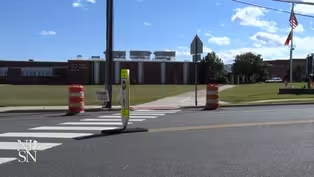
Toms River schools to raise taxes nearly 13%
Video has Closed Captions
Clip: 7/8/2025 | 5m 10s | The school district tried to file for bankruptcy, state said no (5m 10s)
Providing Support for PBS.org
Learn Moreabout PBS online sponsorship
- News and Public Affairs

Top journalists deliver compelling original analysis of the hour's headlines.

- News and Public Affairs

FRONTLINE is investigative journalism that questions, explains and changes our world.












Support for PBS provided by:
NJ Spotlight News is a local public television program presented by THIRTEEN PBS