NJ Spotlight News
NJ Spotlight News: July 9, 2024
7/9/2024 | 26m 46sVideo has Closed Captions
Watch as the NJ Spotlight News team breaks down today’s top stories.
We bring you what’s relevant and important in New Jersey news, along with our insight. Watch as the NJ Spotlight News team breaks down today’s top stories.
Problems playing video? | Closed Captioning Feedback
Problems playing video? | Closed Captioning Feedback
NJ Spotlight News is a local public television program presented by THIRTEEN PBS
NJ Spotlight News
NJ Spotlight News: July 9, 2024
7/9/2024 | 26m 46sVideo has Closed Captions
We bring you what’s relevant and important in New Jersey news, along with our insight. Watch as the NJ Spotlight News team breaks down today’s top stories.
Problems playing video? | Closed Captioning Feedback
How to Watch NJ Spotlight News
NJ Spotlight News is available to stream on pbs.org and the free PBS App, available on iPhone, Apple TV, Android TV, Android smartphones, Amazon Fire TV, Amazon Fire Tablet, Roku, Samsung Smart TV, and Vizio.
Providing Support for PBS.org
Learn Moreabout PBS online sponsorshipAnnouncer: Funding for NJ Spotlight News, provided by the members of the New Jersey Education Association, making public schools great for every child.
And RWJBarnabas Health, let's be healthy together.
Joanna: Tonight on "NJ Spotlight News" -- The defense team for U.S.
Senator Bob Menendez begins closing arguments today, saying there is no proof of a quid pro quo.
Also, Democratic powerbroker George Norcross makes his first appearance in court, charged with racketeering and running a criminal enterprise in camden.
-- in Camden.
>> The excitement has a lot of words.
A lot of pages.
A lot of delegations.
But one thing it does not have, it does not have elements of a crime.
Joanna: Plus, regulating hemp -- >> They are selling cannabis to children in higher levels of THC than you can find any dispensary, that stuff has to get off the shelves quickly.
Joanna: Lawmakers urge Governor Murphy to close loopholes and regulate potentially dangerous hemp products.
But critics say the bill goes too far.
And high heat.
Code reds activated around the state, as temperatures near 100 degrees with another heatwave bearing down on us next week.
>> We are in a really tough stretch now.
We just went through the second warmest June on record in New Jersey with records dating back to 1895.
Joanna: "NJ Spotlight News" begins right now.
♪ Announcer: From NJ PBS Studios, this is "NJ Spotlight news" with Briana Vannozzi.
Joanna: Hello, and thanks for joining us tonight.
I'm Joanna Gagis.
Briana Vannozzi is off.
The prosecution and the trial against U.S.
Senator Bob Menendez wrapped up its closing argument today, bringing a close to the nearly two-month presentation of evidence against New Jersey's senior senator.
The U.S. Justice Department, trying to prove Menendez engaged in a quid pro quo.
Providing political favors for friends in exchange for gold bars and cash.
The defense for Menendez and his two codefendants took much less time to present their case, insisting all along that the prosecution has failed to prove its case.
And that is the case the Menendez team made today, as defense lawyers began their summation, pointing the finger at Menendez's wife, Nadine.
Senior correspondent Brenda Flanagan has more on how they have expended away all that the Justice Department has presented.
Brenda, good to see you.
What did you hear from the defense attorneys today?
Brenda: Menendez's defense attorney told jurors "the government has not proven a single count beyond a reasonable doubt."
He called the prosecution's case a cherry picked story and said you are being asked to imagine criminal stuff to fill in the gaps in their evidence.
The defense argued even the government's evidence is not always credible and they had to backtrack on even the simplest facts, like whether there was a blue blazer hanging in a closet.
He said you need to question the credibility and the accuracy of what you are being asked to conclude.
Joanna.
Joanna: That might be one of the simplest facts.
Right?
How do they explain or address all the gold bars, the cash found in the Senate's home?
-- the senator's home?
Brenda: He actually joked and said the prosecution presented Menendez as a "Scrooge McDuck," swimming in gold coins.
That got a big laugh in the courtroom.
He then added the prosecution is trying to overwhelm jurors or ask them, who has that kind of cash and gold hanging around their house?
He said, they want you to conclude that every dollar, every piece of gold was a bribe.
Then he mentioned the senator's wife, and he said Nadine was supporting herself by selling personal family gold and jewelry.
But, he said there is no evidence that the senator actually took a bribe for doing something.
Joanna: Brenda, we know that the prosecution had their shot to finish up their summation this morning.
Were there any key takeaways from those closing arguments?
Brenda: There was a dramatic presentation the prosecution made, essentially telling jurors why they must convict on all 18 counts, telling them how they could fill in the blanks to end up with the evidence to support a quid pro quo.
Now, prosecutor Paul M. warned, "Menendez is smart and careful and he does not say the quiet part out loud and he is not a puppet, having his strings pulled by someone he simmers -- he summons with a bell," referring again to wife Nadine.
Regarding the gold bars, he said "nobody gives $60,000 bars out of friendship."
He then said in closing "it all boils down to a classic case of corruption on a massive scale about a politician who was -- who is putting his power up for sale, and people who are willing to buy it."
Joanna: What comes next in this case?
Brenda: After he wraps up summations for Senator Menendez, we are going to get closing arguments for the other two defendants.
Will H.'s attorneys are expected to take a couple of hours.
Then comes Fred Davies.
After that, the prosecution because it carries the burden of having to prove beyond a reasonable doubt, gets to do a rebuttal.
Joanna: OK.
So not the last time we will hear from the prosecution.
Senior correspondent Brenda Flanagan, we know you are out there in the heat today.
Thank you.
Great reporting as always.
While the Menendez trial wrapped up, another high-profile court case is just beginning in Trenton.
Powerbroker George Norcross made his first appearance in state court today.
His arraignment in the state's case against him charging that he and five codefendants participated in a racketeering scheme in connection with properties along the waterfront in Camden.
Norcross pleaded not guilty this morning, as did four of the five codefendants who appeared in court alongside him.
Senior political correspondent David Cruz has more on the charges they are facing, as this case kicks off.
David: George Norcross took a seat in the front row at this morning's arraignment, solidifying his position as the lead defendant in this potentially explosive case.
Five of the six defendants were in court this morning represented by some of the highest paid attorneys on the -- attorneys in the state to enter there please.
-- their pleas.
>> Not guilty.
David: Michael Presley for George Norcross began the chorus of not guilty please.
-- pleas.
With that out of the way, the judge tried to bring the sides together on evidence to be presented at trial.
>> It is comprised of 13,700 documents followed by an additional terabyte or so of data, that's comprised of approximately 150 media files, and 2.5 million other documents.
Those documents range from a single page document all the way to thousands.
So it is a little hard to estimate what the subpoena comprises.
That is set to go out immediately following the state's concern.
David: That's a lot of stuff the defense has yet to see.
And the prosecution says it should be kept out of the public view, since it could contain testimony or other evidence they say is sensitive.
But the defense says they can't agree to any protective order on evidence have not yet seen.
-- on evidence they have not yet seen.
>> What I want to know is, they didn't investigate the case for five years.
Where are the documents?
Why are we being told there is an initial production?
There should be a complete production.
That's what the rules and title as -- and title -- entitle us to.
David: The defense says the state should have had its evidentiary ducks in a row by today.
They also say they are waiting for evidence from the feds which the defense blasted in court and outside of court later.
>> The media is here to get to the bottom of it.
Are you wondering why you are not getting those materials that were presented to the grand jury?
Why you don't have those title III materials?
Where are the materials?
They go back years.
They have them.
When did they ask the government and Washington, D.C. -- in Washington, D.C. for permission to give it to us and to you?
Last week.
Does that not strike you?
What's going on here?
David: The defendants are charged with being part of a criminal enterprise run by Norcross which used corruption, -- coercion, intimidation, and manipulation of local resources including public officials to illegally take advantage of tax credits and other incentives provided by the state's economic development Authority to help the city of Camden.
>> The indictment has a lot of words, a lot of pages, a lot of delegations.
-- a lot of allegations.
One thing it does not have is elements of a crime.
This is a speaking indictment.
It's more a press release.
It doesn't have the respect of an indictment.
Today was the first step in our journey to get where we know we are going to get to.
And that's justice.
David: The often loquacious Norcross did not speak to reporters today, nor did prosecutors.
The judge will see the sides again September 10th, by which time prosecutors will need the -- will have to give all the evidence they have to the defense and the defense has to show why the evidence should not be subject to a protective order.
A slow start to what promises to be a slog and a slug fest.
I'm David Cruz, NJ Spotlight News.
Joanna: as Hurricane Beryl slammed into Houston this week, a team of Red Cross volunteers from New Jersey headed down to Texas today to lend a helping hand.
Others from New Jersey were already down before the storm.
The volunteers come from Burlington and Camden Counties.
They will be assisting Texans at shelter sites.
Beryl is the first hurricane of the season and it's already broken records as the fastest growing storm, reaching a Category 5.
It did reduce to a Category 1 by the time it hit land in Houston knocking out power for more than two million people.
Climatologists are warning it could just be a warm up for was likely -- what's likely to be an extremely active hurricane season, with hurricanes that could be Category 3 or higher.
They point to the warming climate as a contributing factor.
While Texans battle the aftermath of the storm, here in New Jersey, the big weather story is the high heat cooking the garden state over the last week.
We have already seen temperatures into the high 90's, with the real feel temperatures hovering around triple digits.
According to a new state of the climate report just released by Rutgers University, last summer was the third hottest on record, and temperatures will continue to rise in the coming years.
The high heat has caused cities like Newark to issue a code red.
Encouraging residents to stay out of the heat and stay hydrated.
And the latest forecasts show temperatures will be dropping anytime soon.
I'm joined now by David Robinson, New Jersey's state climatologist, to discuss the latest weather pattern and state -- and then new state of the climate report.
Great to have you on the show.
What are the dangers both for humans and the environment?
David: We are in a tough stretch now.
We just went through the second warmest June in record.
With records dating back to 1985.
With that, it has persisted into July.
As they say, it's not just the heat.
It's the humidity.
That's a real health hazard.
Our bodies have a difficult time ridding themselves of heat.
Particularly when the humidity levels are high.
We perspire, but that perspiration does not evaporate.
People may not realize that evaporation removes heat.
So people can get into stress pretty quickly.
You often hear about the Young, the infirmed, and the elderly being susceptible to heat.
But there are people out there working in the heat all day.
Construction, agriculture, Police officers, and so on.
All of us have to be careful.
For goodness sake, don't go out and exercise in the middle of the afternoon.
Do it in the morning, if you can.
Joanna: Good advice.
Not everyone listens.
We can attest to it, we see people out there running in the peak of the heat.
When it comes to the environment, we have been reporting on this forest fire.
What is the risk of wildfire when we reach the temperatures close to triple digits?
David: It doesn't help because we got back to that evaporation again, and we need rainfall, at this time of the year, we need timely rainfall as much as we need abundant rainfall.
Because things can dry out very quickly.
Now, generally, in New Jersey, the greatest fire threat is in the spring when you have litter on the floor from the previous fall, the leaves are not on the trees yet, and so on.
When you get into the summer, you also get more humidity.
So humidity actually helps a little bit in that regard, in keeping conditions a little more moist.
But when you get those high temperatures, and if you get the wind blowing and you don't get your weekly storms coming through the area, with a shower or thunderstorm, they are in a -- you are in a heap of big trouble really quickly.
Joanna: You co-authored this report released by Rutgers University, "The state of the climate 2023" points to some really alarming statistics.
It might not seem alarming to the average person.
New Jersey has increased in temperature by four degrees since 1900.
That is one key point I saw.
The report makes a connection between these rising temperatures and broader health concerns for the population.
Make that connection for us.
David: Yeah.
With those rising temperatures, and we are rising at a pace almost twice that is other parts -- as other parts of the country, for a variety of reasons that are known and still being worked on, you are dealing with that added heat, which is directly affecting your body but you also have to start thinking about invasive species that can come in and bring disease with them, that in the past may be could not make it through a cold jersey winter.
Now they are able to survive a winter and also persist longer from earlier spring warmth to later fall warmth.
So a longer season to be exposed and potentially new diseases that you can be exposed to.
Joanna: Just a few seconds left, is there a greater connection to things like asthma and heart attack?
David: Yeah.
You are talking air quality.
When you get under these heat rages with subsiding air and not much wind blowing, you can get into very stagnant air situations.
The sun promotes chemical reactions of these releases from power stations, from automobiles and trucks and so on.
Joanna: Great information.
Dave Robinson, state climatologist.
You always make it simple to understand.
Thank you.
David: My pleasure.
Joanna: In our spotlight on business report, it's not hard to find hemp-based products front and center at your local convenience store, some of them have low levels of THC and others include potentially dangerous amounts of substances like Delta 8.
Lawmakers are concerned they can too easily make their way into the hands of kids.
But there is a bill sitting on the governor's desk that would restrict those themselves and -- those hemp sales and regulate them under the cannabis regulatory commission.
But some opponents warned the luck would have unintended consequences for New Jersey business owners.
Raven Santana has more.
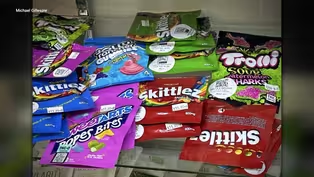
>> So I see the wrapper and I happened to notice it said 600 milligrams of THC.
Raven: It was a moment Michael Gillespie described what caused his then 14-year-old son to pass out in the woods for hours prompting a police search where he was found near lifeless.
Gillespie says it was a result of his son ingesting an entire bag of candy like this that contained Delta eight THC.
>> so, 8:00 in the morning, they withdrew his blood.
It tested positive for THC, from the amount.
The package he took, he took the full 600 mg.
When I told adults with experiences with that stuff, they said that is like five plus joints.
Reporter: Gillespie has become an advocate and strong supporter of the proposed bill awaiting Governor Murphy's signature that would close a loophole that has allowed intoxicating hemp products to be sold at convenience stores and other places.
Under the bill, intoxicating hemp products, which include Delta 8 THC, that have at least .3% THC, would be regulated by the cannabis regulatory commission and face similar regulations as cannabis products.
Settlers of those products would need to get a license just like with cannabis and would require someone to be age 21 or over to purchase one of the products.
The bill was sponsored by a number of lawmakers, including Senator Teresa Ruiz, who in a statement said the primary motivation for regulating intoxicating hemp products is to protect public health and safety, particularly that of our children.
There have been instances of children falling out due to exposure of these products which are currently illegal to sell to minors.
>> Those convenience stores and gas stations selling cannabis to children in higher levels of THC than you can find in a dispensary, that stuff has to get off the shelves quickly.
Reporter: The bill has also gained the support of Scott Roeder, president and founder of the NJ cannabis Association, who says transparency and regulation are key.
>> Everything that we sell has gone through a testing process and labeled exactly what is in there, and it has to be, it has to be generated and cultivated by a licensed cultivator, manufactured and processed by a licensed manufacturer, all the way to a licensed dispensary operator.
You can't set foot into the door of a dispensary unless you have already proven you are over 21, 21 and over.
Reporter: Industry groups and represented like Orlando oppose the bill and say their industry needs to be left out of the law.
>> Seemingly, everybody else in this legislation is -- when the legislation started out, what the intent of the bill was was to get regulatory structure in this great area in the cannabis space.
Now it's turned into a business opportunity.
We believe that local manufacturers who have experience in making different types of products and being under a regulatory scheme similar to that of cabinet -- that of cannabis should be given the opportunity to make beverages in the spaces will.
-- the space as well.
Reporter: He says the focus of the bill should be eliminating products containing Delta 8 THC off the shelves of unlicensed store shelves.
For NJ Spotlight News, I'm Raven Santana.
Joanna: On Wall Street, the S&P hit any record, as investors reacted to testimony from Fed Chairman Jerome Powell about interest rates.
Here's a look at the final board.
♪ Finally tonight, a look at how the state's trying to help one of its most vulnerable populations.
Those struggling with addiction.
Earlier this year, the Murphy administration committed to invest in harm reduction services.
Some state funding went to Black Lives Matter in Paterson, which the organizing used to run a harm reduction center.
A space for those struggling with substance use to access services and support or just have a safe place to be.
Our social justice reporter Taylor jung -- Taylor Jung had a chance to visit the center.
Examining challenges along with the actions that make positive change.
Taylor joins me now to discuss this sixth installment of the series.
Taylor, great to talk to you.
As part of this ongoing change project series, multimedia series, you have visited a harm reduction center in Patterson.
Tell me what you saw when you walked in there in terms of how people are greeted at the door.
Taylor: it's definitely got more of a family community-oriented by, which is why I wanted to report under in the first place.
It feels different.
You feel really welcomed.
There is no judgment.
I feel like I had known all these people for over 10 years at least.
Anyone who walks through those doors can really get the services they need.
Whether that is receiving a state ID and filling out those applications, getting to a doctor's appointment, or as I witnessed, printing out photos of someone's kids, really community oriented place.
Joanna: Of course we know harm reduction centers are places where folks can go and get Narcan, if they need it, testing strips.
You point out in your reporting that treatment is never forced to anyone who comes through the doors.
But is that the goal?
>> Yes.
That is actually the core tenant of harm reduction work.
You never force someone into any sort of treatment plan or you never assume what needs are because the idea is that the person has autonomy and make the choices for themselves and that's when you see the most success for people.
To honestly survive into the drive.
-- and to thrive.
A lot of their core tenants are to make sure that they to meet people where they are at and that is what separates harm reduction work from traditional drug treatment programs.
If someone wants to engage in social services at the federal or state level, often they are forced to be in detox or to practice abstinence, as well.
This is completely different.
You don't have to remain sober for any of those services the center provides.
Joanna: It is interesting to see some of the history you pointed out in your reporting that harm reduction centers -- the idea came from the way that folks started to care for each other during the HIV epidemic.
Explain that a little bit.
Taylor: The idea was that the LGBTQ community really practiced disease prevention strategies and also tried to help their fellow committee members thrive, when they often felt ignored by the government, or treated with a lot of different stigmatizing ideas.
That was also really rooted in the practice of the Black Panthers and the mutual aid work during the 1960's and civil rights era.
The idea of the community helping itself trying to thrive in the face of systemic racism.
Joanna: What did the Black Panthers bring to this kind of community minded way of caring for each other as well that plays into this history?
Taylor: It's like the community aspect.
The idea of the community helping itself, when they are feeling ignored or not helped by larger power structures, whether that be the government or health care and hospital systems.
Joanna: Take that concept and fast forward to where we are today, we've seen the war on drugs as many point out has been a failed effort.
Do you see the future of drug treatment being this more community-minded approach?
More harm reduction centers and a move away from criminalization?
Do you see the state moving in that direction?
Taylor: Definitely the state and actually the country as a whole whether it be state, local or federal governments, everyone is investing more and more into harm reduction work.
At a base level, often that looks like just providing more Naloxone or Narcan doses to different community organizations and law enforcement agencies.
But at most, it is really providing actual dollars and funding to harm reduction centers, like in Paterson.
I think as the opiate epidemic grows and the toxic drug supply still exists, more and more people are looking for a different approach rather than punitive measures which advocates have set are proven to -- have said are proven to not work in the past.
Joanna: Thank you.
Great reporting.
David: Thanks so much.
Joanna: That does it for us tonight.
Before you go, a reminder to download the NJ Spotlight News podcast, so you can listen to us anytime.
I'm Joanna Gagis.
From the entire team here at NJ Spotlight News, thanks for being with us.
Have a great night.
We will see you back here tomorrow.
Announcer: NJM Insurance Group.
Serving the insurance needs of for 100 years.
-- of residents and businesses for 100 years.
Horizon Blue Cross Blue Shield of New Jersey, an independent licensee of the Blue Cross and Blue Shield Association.
And by the PSEG foundation.
>> Have some water.
>> Look at these kids.
What do you see?
I see myself.
I became a teacher to be able to give my students what I wanted when I came to this country.
The opportunity to learn, to dream, to achieve.
A chance to belong and be an American.
My name is Julia.
I am proud to be an NJEA member.
♪ [CAPTIONING PERFORMED BY THE NATIONAL CAPTIONING INSTITUTE, WHICH IS RESPONSIBLE FOR ITS CAPTION CONTENT AND ACCURACY.
VISIT NCICAP.ORG]
Effort to curb sale of intoxicating hemp products
Video has Closed Captions
Sen. Teresa Ruiz says the primary motive is to protect health and safety of children (4m 8s)

Closing arguments continue in Menendez trial
Video has Closed Captions
Defense lawyers point the finger at Sen. Bob Menendez’s wife, Nadine (4m 31s)

High heat in NJ, climate warming faster than other regions
Video has Closed Captions
Interview: David Robinson, New Jersey State Climatologist (5m 7s)

Norcross and co-defendants make first court appearance
Video has Closed Captions
Five of the six defendants in court for arraignment (4m 11s)
Rutgers to raise tuition by 4% for 2024-25 school year
Video has Closed Captions
School officials cite inflation, salary increases, increasing cost of health care benefits (4m 12s)
Providing Support for PBS.org
Learn Moreabout PBS online sponsorship
- News and Public Affairs

Top journalists deliver compelling original analysis of the hour's headlines.

- News and Public Affairs

FRONTLINE is investigative journalism that questions, explains and changes our world.












Support for PBS provided by:
NJ Spotlight News is a local public television program presented by THIRTEEN PBS