NJ Spotlight News
NJ Spotlight News: June 17, 2025
6/17/2025 | 26m 46sVideo has Closed Captions
Watch as the NJ Spotlight News team breaks down today’s top stories.
We bring you what’s relevant and important in New Jersey news and our insight. Watch as the NJ Spotlight News team breaks down today’s top stories.
Problems playing video? | Closed Captioning Feedback
Problems playing video? | Closed Captioning Feedback
NJ Spotlight News is a local public television program presented by THIRTEEN PBS
NJ Spotlight News
NJ Spotlight News: June 17, 2025
6/17/2025 | 26m 46sVideo has Closed Captions
We bring you what’s relevant and important in New Jersey news and our insight. Watch as the NJ Spotlight News team breaks down today’s top stories.
Problems playing video? | Closed Captioning Feedback
How to Watch NJ Spotlight News
NJ Spotlight News is available to stream on pbs.org and the free PBS App, available on iPhone, Apple TV, Android TV, Android smartphones, Amazon Fire TV, Amazon Fire Tablet, Roku, Samsung Smart TV, and Vizio.
Providing Support for PBS.org
Learn Moreabout PBS online sponsorship>> Major funding for "NJ Spotlight news" by Horizon Blue Cross Blue Shield of New Jersey an independent licensee of the , Blue Cross Blue Shield Association.
And by the PSEG foundation.
Briana: Tonight on "NJ Spotlight News."
On the run.
One Delaney Hall escapee is still at large.
New York Mayor -- Newark Mayor Ras Baraka sing the facility was never equipped to help house thousands of detainees.
Plus, returning to prison.
Bob Menendez will spend the next 11 years behind bars in Pennsylvania after being convicted of federal corruption and bribery charges.
>> Why would he risk so much for money when he had such a huge top position in American politics today?
Briana: Also harm reduction.
Breaking down how New Jersey will spend more than $1 billion from opioid settlement funds.
>>>> The hope is among advocates involved in this is that the money will go directly as possible to the people who were doing the work on the front lines.
Briana: And seeking a safety net.
Hundreds of low income Newark residents were given a guaranteed income for two years.
Did it bring them financial security?
"NJ Spotlight News" begins right now.
♪ >> From NJPBS Studios, this is "NJ Spotlight News" with Briana Vannozzi.
Briana: Good evening and thank you for joining us on this Tuesday night.
I am Briana Vannozzi.
We begin with today's top headlines.
First, the FBI says three out of the four detainees who escaped from a Newark immigration detention center are now back in custody.
According to police officials, the third detainee was arrested earlier today with one man still on the run.
The FBI is offering a $25,000 reward for information leading to his arrest.
U.S.
Senator Andy Kim said at a news conference Friday the four men escaped from Delaney Hall, a privately held I's facility, during an uprising by breaking through a wall.
The Department of Homeland Security has since contradicted his statement saying there's been no widespread unrest.
The detention center has become a flashpoint over conditions there.
Local officials accused ice of opening it without having permits.
Newark Mayor Ras Baraka was previously arrested in a confrontation there and Congresswoman LaMonica McIver is facing charges of assaulting law enforcement related to that scuffle.
Ras Baraka today maintains the building was never properly inspected and should not have opened in the first place.
>> We think that they should move everybody out of there.
We've told them in the beginning if you don't have a certificate of occupancy, nobody belongs in the building.
Briana: Also tonight a nationwide week of action kicks off to protect workers from extreme heat.
Dozens of labor organizations rally this morning outside the Statehouse and what has been dubbed the fired up for heat justice movement, calling on the legislature to pass state-level heat protection standards for workers, arguing that existing rules at the federal level are not enough.
Advocates today pointed out that as summer temperatures have gotten hotter over time, the number of workers dying from heat related causes in the U.S. has doubled since the 1980's.
Thousands of workers they say missed at least a day on the job each year due to heat related illnesses from work, while deaths and injuries are preventable.
Advocates are trying to amplify worker voices, many of whom are immigrants, calling for rules that guarantee access to water, rest, shade and protection from employer retaliation.
At the rally today in Trenton and in cities across the country coincides with the start of the occupational health and safety administration's proposal put under President Biden with an eye on pulling it back.
The New Jersey State Supreme Court today rejected a challenge to Daniel's law which allows judges and law enforcement to have their private home addresses and phone numbers removed from public records.
A journalist petitioned the court saying it violated freedom of the press after uncovering a story using public records that New Brunswick's former police Director was living more than two hours away in Cape May and was a no-show for most city Council and other government meetings he was required to attend.
Officials try to block the journalist from publishing his address saying it violated the law.
He appealed, kicking off a years long court case.
In delivering the opinion today, the justice agreed with lower court rulings that he was free to print where the police director lived without disclosing his exact address.
Daniel's law was passed after a man invaded the home of New Jersey federal judge Esther Salas in 2020 and fatally shot her son, Daniel.
This comes on the heels of an attack on state lawmakers in Minnesota over the weekend that has heightened security concerns of public officials.
He was once among the most powerful members of Congress, but starting today, former U.S.
Senator Bob Menendez will be known by his prisoner number.
Menendez this morning arrived in miners's will, Pennsylvania to start serving his 11 year federal prison sentence for taking part in a sweeping bribery and corruption scheme that earned him the nickname gold bar ball.
The 71-year-old Democrat maintains his innocence.
Last week a federal appeals court rejected his effort to me and free on bail while he tries to get a conviction overturned.
That's unless President Trump Barack offers him a pardon, Menendez will call this federal prison home.
Nancy Sullivan just launched a podcast series on the disgraced Senator's rise and fall and she was there when Menendez reported to prison.
First of all, thank you for doing this, you are quite literally at the prison.
Can you give us a sense of where you are and did you see Bob Menendez this morning when he reported?
>> Yes, so I'm right at the edge of the prison property.
It is school cool federal correctional Institute in minors will, Pennsylvania.
There were a few reporters earlier today and it was part of a group of us waiting for him to drive in.
Sure enough a car with Jersey plates came around the corner and sped up as soon a the driver saw the press.
He was in the backseat and that was just before 9:00 this morning.
I'm told that he had all day like business hours today to report, but I guess he chose to leave at the crack of dawn from New Jersey, it's about a two and a half hours drive and get here right before 9:00.
Briana: Do we know anything about what life will be like for him inside?
Certainly it will be different than being a high-ranking senior U.S.
Senator, but about the conditions there and how much access he will have to the outside world?
>> He will have access in terms of emails, phone calls, visits, people can send him magazines and newspapers.
This is a medium security prison.
There is a work camp adjacent to it.
But my understanding is anyone sentenced to more than 10 years in federal prison, and he was sentenced to 11, are not eligible for the minimal security camps.
He will be in this medium security prison and he is not going to have much access to the outside world except for what I mentioned.
Talk about a difference in circumstance.
I happened to be at the capital a few days ago.
To look at the dome and the reflecting pool and be in the rotunda and see how grand it is, and the respect that Senators are shown.
To think about going from that to prison, it was kind of mind-boggling actually.
Briana: It is such a contrast, the opulence of the White House, Capitol Hill, the rooms that he sort of held court in for so many years on the respect and power he wielded here.
We have spoken before about what a stunning fall from grace it has been for him.
I know you have done a little more digging into that for your podcast dropping this week.
Can you tell us what to expect from it and what you decided to dissect and this really long political career that he's had?
>> Happy to talk about that.
I begin with the first episode called the fighter and it's really about Bob Menendez and how he came up.
A lot of the good things he did, he really was a historic political character.
He did a lot and he was very well respected.
And so I sort of followed him through his rise and spoke to people close to him, and tried to grapple with not just what happened, but why.
Why would he risk so much for money when he had such a huge top position in American politics today?
So I grappled with that throughout.
In the second episode we explore his romance with Nadine Arslanian and their marriage and how the two of them quickly hatched a plot to work with the Egyptian government to get military aid and using his position in the Senate, and in exchange Egypt gave a halal meat certification monopoly to an Egyptian American man who is a friend of Nadine's, and he in turn made payments to them.
That's kind of the heart of the three-way deal at the heart of the bribery scheme.
Briana: Really quick before we let you go, and he as to whether a pardon might be in the cards for Bob Menendez?
>> I think it's quite possible.
We've seen President Trump pardon all sorts of people already so early in this term.
He is antagonistic towards prosecution of corruption to begin with.
He's also antagonistic sort -- toward the Southern District of New York, the federal prosecutors who brought this against Menendez.
I don't think it's out of the realm of possibility that even a progressive Democrat that Menendez was and voted to impeach the president, I don't think it's out of the realm of possibility that he could be pardoned.
Briana: Anything is possible these days.
Nancy Sullivan with WNYC, her podcast is "dead end: The rise and fall of Gold Bar Bob Menendez."
Thank you so much.
The rising cost of electricity is starting to show up in resident utility bills and at least some lawmakers are putting to research that finds data centers are a big driver in the increased demand on the grid.
They are considering a number of bills to study their impact and special rules the centers would need to follow.
As Senior correspondent Joanna Gagis reports, they will have to balance that concern over energy use with the state's larger goal of becoming a national AI hub.
>> We just want them to say we will take ownership and responsibility for the potential impact upon the local rate.
>> Assemblyman creating a rate structure for any data centers becoming into New Jersey.
Data centers power the programs that give us a I search results and all the technology we hold in our hands, on our smart phones and computers.
>> We have to strategize.
We have to think, what are the positive impacts of this type of technology and potential negative impacts, especially on the ratepayer and the increased use of energy that will come about because of these data centers.
>> Data centers have come into focus as a possible culprit in the spiking energy costs we are about to experience following the last PJM auction that created a 180 percent increase in electricity cost for the state.
One example is in Vineland where a Dutch company plans to build a data center that could use up to 300 megawatts of power, roughly a quarter of what PSEG can -- produces.
>> The future supply and demand costs on forecasting how much energy will be necessary.
>> Nobody knows right now how much electricity these data centers are going to use.
What we need to do, as a good regulator should do, is make sure consumers are protected regardless of how much electricity the data centers and abusing.
We can do that and I think this is where the package of bills comes in.
By requiring data centers to post deposits, make sure they have long-term contracts and that they're taking the service that they say they're going to take.
>> Mr. Silverman is a professor at Johns Hopkins who says that the bills essentially create contrast with data centers who create an interest in developing of the state to allow for better planning.
But Republican lawmaker assemblyman Kristian bronco says this bill looks good on paper but does not have much practical impact because data centers are already dependent on their own power sources, a term called co-locating.
>> AI data centers are not able to be connected to the public grid because they are buying their own power sources.
He believes >> The spike in energy costs comes from the state not producing enough of its own power.
>> New Jersey needs generation now.
Six or seven years ago New Jersey generated 110% of the electrical energy it consumed.
It was a 10% reseller of energy to Delaware, Maryland and Pennsylvania, whoever needed it.
Today we generate just over 50% of the energy we consume which means we are buying 47, 45% to 47% of energy from out-of-state sources.
>> Greg counter with the NJ business and industry Association also says the focus should be on expanding sources rather than what he believes is scapegoating data centers.
>> Granted data centers are large energy users, but so are large manufacturers and hospitals.
What we need to do as a society, if we have economic growth, we need to make sure we build the energy supply we need.
We believe natural gas is a very efficient and clean source of energy.
It also could be put online relatively quickly if we do it right.
>> Democratic Senator John versatility thinks we need to keep thinking about data centers and energy needs with a regional approach because even data centers built in other states will impact New Jersey's costs given our participation in the regional power grid.
>> All we know is these will be extraordinary demands on power.
Not something we don't welcome but it has to be planned for.
If the states were better organized, may a strategy could be developed between the 13 plus District of Columbia to tackle this.
>> Assemblyman Daly says this is fully invested in data centers coming here but this allows for better planning.
His bill has moved out of committee in the assembly but has a long way to go before becoming law.
I'm Joanna Gagis.
>> Under the dome is made possible in part for the Corporation for Public Broadcasting.
Briana: As we reported Monday, New Jersey is gearing up to receive about 120 $5 million as part of an opioid settlement deal with Purdue Pharma and its owners.
If you add it all up, the state has been awarded more than $1 billion total and settlement funds related to the deadly public health crisis.
A panel of experts part of what's called New Jersey's opioid recovery and remediation advisory Council just recently released a plan on how to spend that money.
It's a 108 page report that details which programs and parts of the state would benefit most.
I were health care writer joins us with more.
Coming off of another settlement agreement, this time with Purdue, the states pot of money is growing.
What are experts recommending for how the state use this money?
>> Experts are largely on the same page whether you're talking to people advocating for how the local money is spent for the state money, and a lot of that is about primarily housing, it's expanding access to harm reduction strategies which are distributing Narcan, clean needles, things like that, which bring down deaths.
Getting people and providers trained in best practices.
There are lots of new rate programs and methods out there but they don't always filter down to the people doing the work.
And then sort of supporting these wraparound services so that people who need basic things like food or transportation can also get help .
So a lot of it is about meeting needs but it's about really doing the clinical best practice for treating these diseases and that includes outpatient use of medications that have methadone that have site -- high success rates.
Briana: How was the money being distributed?
We are talking about $1.3 billion over 15 years including the latest amount announced yesterday.
Is it going to nonprofits?
Is it going to the local level?
How does it work?
>> There are two pots of money, the state overseas have and the other half is being distributed by the 21 county governments and about 200 50 local municipalities or towns that opted into the settlement and they were given access to the settlement either because of their size or location or because they wanted in.
They are essentially communities that have been particularly hard-hit by the epidemic.
The hope is among advocates involved is that the money will go as directly as possible to the people who were doing the work on the front lines.
It's interesting in the advocacy community, there's a lot of talk about making sure that their colleagues get access to this information and know this money is out there and know that it is for them.
So there are grants going out all the time in the state.
This money is going out the door already but as we know, it's a huge pot and there's many years to come still.
Briana: It is when you look at it as a whole, but when you think of it as the number of deaths, if it's not getting into the right hands, you have to wonder if justice is served at all no matter how much money there is.
Is there a way, very quickly, that this can be tracked to make sure the money is getting to those who have been harmed?
>> That's a great question.
The state did not opt to give it directly to people who lost loved ones.
However, oversight of the programs that they are funding is somewhat limited.
Shout out to the state comptroller who is looking into at least one community that has arisen to their attention, Irvington.
And that is caught up in court.
So there is limited oversight, but advocates are really hoping that they can sort of keep their eyes out and encourage people to do the right thing and invest in the practices that they know will make a difference and save lives.
Briana: Lilo Stanton for us, you can read all of her reporting on our website.
Thank you.
What would you do if you had a guaranteed basic income with no strings attached?
In Newark, needy families say they used the cash to pay debts, buy food for their kids and start savings accounts.
Mayor Ras Baraka's administration revealed the results of the two year guarantee income pilot program which they say improved some of the city's most vulnerable residents financial, emotional and mental health.
Ted Goldberg has the story.
>> It creates a safety net for your life outside of bills.
Your career, your future passions.
>> For a few years, Jenny Maria was one of the lucky few at Newark earning biweekly payments of $250 and she did not squander it.
>> It wasn't like I went to Atlantic City and dropped it all on a spin.
All of my money was invested into myself and my future, my family.
>> Newark's pilot program guaranteeing income for 400 low-income people help replace the boiler in her home, pay down student loan debt and was a safety net between jobs.
>> When I started with my job, it's just the extra money I could put towards things that initially I couldn't.
I could put it to my student loans more and to the interest and fulfill those things that initially I could not do.
>> Tuesday the city released findings and data for the program which gave others lump-sum payments of $3000 twice a year for a few years.
>> As that income volatility was smooth, parents reported less chaos in the home.
Kids who were in homes of the parents in treatment groups for recurring cash were more likely to earn a grades.
>> People who receive guaranteed income were less likely to experience food insecurity, less likely to be evicted, and more likely to increase their savings.
Mayor Ras Baraka says Newark and other cities trying out guaranteed income are bucking the national trend of government reducing services.
>> I think it's timely we talk about this now and try to expand it especially in an environment where the richest people in the world are trying to take food out of the mouths of the most struggling in this country and the world, taking food and medicine from people.
>> Science is kind of under attack.
We have institutions that are crumbling.
The cornerstone of guaranteed income and what Mayor Baraka has been doing is saying we are going to lead in one hand with science and on the other hand with human rights.
>> People who spoke about the program today hope it can be replicated elsewhere in New Jersey.
>> People found out they had gotten this, they could not believe it.
They hung up on us.
They did not trust us.
And people cried picking up those cards repeatedly saying thank you Mayor Baraka.
>> I think I would not have put more money into my student loans.
I think I would have had more time to really think about my future and invest in my careers.
>> The big question is the price tag.
Newark's program got help from federal COVID relief and private investment.
>> That's a big ask and long term.
Even a relatively modest guaranteed income program at the state level with a relatively strict income cap, we are talking $10 million and a state budget that's not even $60 billion.
>> Patterson is running a similar program next year hoping -- helping those who could use a lifeline.
I'm Ted Goldberg, "NJ Spotlight News."
Briana: That will do it for us tonight.
A reminder, you can download our podcast whenever you listen and watch any time by subscribing to the YouTube channel.
Plus, follow us on Instagram and blue sky to stay up-to-date on all the states big headlines.
I'm Briana Vannozzi.
For the entire team at NJ Spotlight News, thanks for being with us.
Have a great night and we will see you back here tomorrow.
Announcer: New Jersey Education Association, making public schools great for every child.
Arch -- New Jersey realtors, the voice of real estate in New Jersey.
More information is online at NJrealtor.com.
And Orsted, committed to creating clean, reliable, American-made energy.
♪

How to spend NJ's share of opioid settlement funds?
Video has Closed Captions
Clip: 6/20/2025 | 4m 51s | Interview: Lilo H. Stainton, health care writer, NJ Spotlight News (4m 51s)

NJ lawmakers target energy-hungry AI data centers
Video has Closed Captions
Clip: 6/20/2025 | 5m 5s | As energy costs rise, data centers singled out for using huge amounts of electricity (5m 5s)
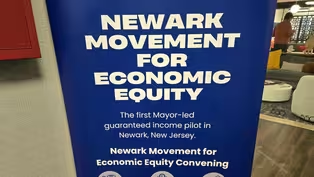
Leaders, advocates praise Newark’s Guaranteed Income program
Video has Closed Captions
Clip: 6/17/2025 | 3m 44s | Program beneficiaries save more and were less likely to be evicted (3m 44s)
Providing Support for PBS.org
Learn Moreabout PBS online sponsorship
- News and Public Affairs

Top journalists deliver compelling original analysis of the hour's headlines.

- News and Public Affairs

FRONTLINE is investigative journalism that questions, explains and changes our world.












Support for PBS provided by:
NJ Spotlight News is a local public television program presented by THIRTEEN PBS