NJ Spotlight News
NJ Spotlight News: June 21, 2024
6/21/2024 | 26m 46sVideo has Closed Captions
Watch as the NJ Spotlight News team breaks down today’s top stories.
We bring you what’s relevant and important in New Jersey news, along with our insight. Watch as the NJ Spotlight News team breaks down today’s top stories.
Problems playing video? | Closed Captioning Feedback
Problems playing video? | Closed Captioning Feedback
NJ Spotlight News is a local public television program presented by THIRTEEN PBS
NJ Spotlight News
NJ Spotlight News: June 21, 2024
6/21/2024 | 26m 46sVideo has Closed Captions
We bring you what’s relevant and important in New Jersey news, along with our insight. Watch as the NJ Spotlight News team breaks down today’s top stories.
Problems playing video? | Closed Captioning Feedback
How to Watch NJ Spotlight News
NJ Spotlight News is available to stream on pbs.org and the free PBS App, available on iPhone, Apple TV, Android TV, Android smartphones, Amazon Fire TV, Amazon Fire Tablet, Roku, Samsung Smart TV, and Vizio.
Providing Support for PBS.org
Learn Moreabout PBS online sponsorship>> Major funding for NJ Spotlight News is provided in part for NJM insurance group.
Serving the insurance needs of residents and businesses for more than 100 years.
Horizon Blue Cross Blue Shield of New Jersey, an independent licensee of the Blue Cross and blue shield Association.
New Jersey realtors, the voice of real estate in New Jersey.
More information online.
And by the PSEG foundation.
Anchor: Tonight on J Spotlight news, a nightmare week for NJ transit riders.
Service suspensions leaving meters stranded and fuming.
>> It leaves them in a world of confusion because they have to get to work.
When they are coming home they have to get home.
Anchor: Plus, defining anti-Semitism.
Legislators advance a controversial measure to adopt a state definition of anti-Semitism after more emotional testimony.
Also, budget countdown.
With about a week to go before government shut down, still no budget bill to vote on.
>> A lot of states not only have their budget through the legislature but signed into law.
In New Jersey the tradition has always been to wait into -- until the last minute.
Anchor: And a gaming crackdown, a task force created by the governor as fears of a gambling addiction epidemic is on the rise.
>> We've seen a 277% increase in our helpline calls since sports betting was legalized in 2018.
If that statistic doesn't raise a red flag, I don't know what would.
Anchor: NJ Spotlight News begins right now.
♪ >> From NJPBS Studios, this is "NJ Spotlight News" with Briana Vannozzi.
Anchor: Thank you for joining us tonight, I am Raven Santana in for Briana Vannozzi.
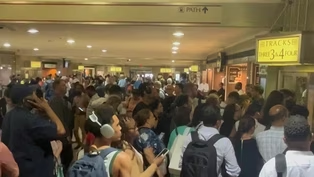
NJ transit and Amtrak writers on themselves stranded again after the Northeast corridor was disrupted during the Friday rush, and Amtrak lamed the disruptions on the disabled commuter trait at New York Penn Station.
NJ transit pointing fingers at Amtrak for the delays.
That marks two major schedule suspensions in 72 hours, and at last count five rush-hour disruptions in this week alone, causing a hellish commute for thousands of riders that are fed up.
This comes as riders are set to pay more to ride in July.
Amid the finger-pointing and confusion, I'm joined by Larry Hicks.
Thank you for joining me.
Larry: Happy to be here.
Anchor: And not on a train, we will start with that.
This morning again, commuters stranded, trains suspended for two hours due to a disabled train at New York Penn Station.
This is becoming an everyday occurrence.
People are fed up, what can be done about this?
Larry: There are two issues at hand, one is Amtrak's aging structure which is responsible for problems with overhead wires.
The wires between New Brunswick and New York basically date back to the 1940's and need to be replaced with something Amtrak already has between New Brunswick and Trenton, it's called constant tension, and what that means is the wires automatically adjust to pull the slack out of them if it is too hot or to let a little slack into them if it is too cold, which will prevent some of the problems we are seeing.
Anchor: With warmer weather this week and summer here, should commuters brace for a summer of transit meltdowns?
Larry: This is one of the questions we are asking, we are asking officials and Amtrak's as well, it is this a repeat of the summer of health from 2017 but that was a different situation.
That was caused by several Amtrak track issues at Penn Station, New York that caused low-level derailments.
Public officials wanted answers and Amtrak it came back with a program to basically do emergency track work over the summer.
NJ transit cooperated moving a certain number of trains to Hoboken for the duration.
It proved not to be as hellish as people thought it was.
This is a different situation because this deals with infrastructure on the nation's busiest railroad.
It is different than saying we will take track 14 out of service in an Station, New York, to say we are going to take track one on the Northeast corridor between New York and Trenton for however many weeks it needs to be out of service.
NJ train is trying to help out by offering increased windows of opportunity.
They've talked about possibly curtailing service at the extreme early morning, 1:00 in the morning period until 4:00 period, to give Amtrak more time to work.
Anchor: Here's the thing, it feels like there is a lot of finger-pointing going on, is it NJ transit's fault, or Amtrak's fault?
Who is to blame?
Larry: We are dealing with at this morning because NJ transit put out an alert saying service was suspended because of the wire problem, and Amtrak it said service had a 60 minute delay due to a disabled commuter train, NJ transit's train, at Penn Station.
I'm going back to say what was the real cause.
Everybody is saying we are investigating the cause.
This leaves commuters in a world of confusion because they have to get to work.
When they are coming home, they have to get home.
Commuters are dealing with the childcare issue and if they are not there to pick up their kid at a certain time, they have to pay a cash penalty.
These are the real world consequences.
Anchor: Right, and its confusion and frustration because we know in two weeks, transit fare hikes will be here.
How can they justify the 50% hike -- the 15% hike with such inconsistent service?
Larry: I was in Penn Station interviewing commuters saying basically is the service worth 15% more and if not, how much more would you be willing to pay?
People I interviewed said they were willing, none of them felt it was worth paying anything more.
One of the major complaints is when a problem happens, it is how it is communicated to them.
While I was there, we watched one of the trains disappear from the video monitors.
After that there was no information.
It was leaving those commuters with what do I do?
Do I go to the bus terminal, get a ferry, get five people today -- get five people together for an Uber?
How I get home?
Anchor: That's the question.
Thank you for joining me.
And Trenton, lawmakers advancing a controversial bill that would adopt a new definition of anti-Semitism.
Critics say it would effectively label critiques of Israel as anti-Semitic at a time when many young people are raising their voices against Israel's offensive in Gaza.
Legislators say they are motivated to pass the bill as Jewish citizens share stories of rising anti-Semitism in the state.
Ted Goldberg shares the story.
>> I think this is something that is long overdue.
Reporter: This is some lemon happy to see New Jersey get -- assemblyman happy to see New Jersey get closer to addressing anti-Semitism.
A committee heard nine hours of testimony between Monday and Thursday.
600 people signed up to speak and many said new protections were needed for Jewish people statewide.
>> I can speak to the Hanukkah parade that has been performed in Robbinsville for many years, and this year someone shouted out of their car, f you Zionists.
>> I regularly here, you don't look Jewish, the Nazis wouldn't kill you, you have blue eyes, or you are one of the good Jews.
>> I'm angry hearing Jewish high school students speaking about being harassed and afraid.
Reporter: The new definition of anti-Semitism comes from the international Holocaust remembrance alliance and includes certain criticisms of Israel.
The definition says it is anti-Semitic to hold Israel to different standards than other democracies.
Some think this will have a chilling effect on free speech despite assurances from lawmakers it won't.
>> Members of our community have lost hundreds of their family members and some New Jersey residents would be punished for voicing their suffering and our pain and outrage over these injustices.
>> While Israel claims to bring safety for the Jews, its actions are the greatest exacerbation of anti-Semitism.
Silencing criticism of Israel by falsely using the activation of anti-Semitism is not helpful, it just adds more fuel to the fire.
>> If you want tomorrow to talk about is really genocide in Palestine and criticize the United States for it, there's nothing in this legislation that I hope will ultimately be signed by the governor, that will do that and infringe on those rights.
>> Criticizing Israel is not the definition of anti-Semitism.
Criticizing the current government in Israel is not the definition of anti-Semitism.
No one is curtailing anyone's freedom of speech or expression.
Reporter: The head of the New Jersey chapter of American Muslims for Palestine.
>> Our message is simple that this is a slippery slope.
Reporter: He has several issues with the new definition, which says it is anti-Semitic to say that Israel existing is a racist endeavor.
>> It cost Palestine's a forcible removal and literal mass murder, whether it is 1948, today or in between.
If I say that today, its actions are unique in its flagrant genocidal conduct toward Palestinians, those things would be considered anti-Semitic.
Reporter: 36 other states have adopted the definition and so has Camden County.
In April, Eastern regional high school nearly had a student walkout to support Gaza but county commissioners stepped in to help stop it, telling the potential walkout dangerous and anti-Semitic.
>> Folks understand how government works, it adopts a definition and builds beyond the future, it will set possible ramifications for what the state deems to be anti-Semitic.
Reporter: His problems with the definition also include something not in the definition.
>> It is mind blowing that the primary source of Jewish hate is right wing, white nationalist Jewish hate and it's not even being acknowledged.
This definition is wholly inadequate.
It is irresponsible.
And it is misguided.
We are ready to keep going.
Reporter: The bill still faces a vote in front of the full assembly and Senate.
No doubt there will be more passionate debate on both sides of the issue.
For NJ Spotlight News, I am Ted Goldberg.
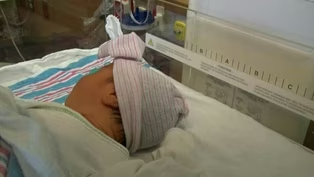
Anchor: Shortly after birth, newborns are purged in the heels.
It's widely known that the process is meant to test their blood to identify life-threatening conditions, what isn't known is the amount of time the sample is kept.
In New Jersey, the sample has additionally -- traditionally been stored for decades, a policy now fought by pallet -- I parents who say it violates the fourth amendment, which protects against illegal searches and seizures.
We have more.
>> The state doesn't belong in that moment and they are there without anyone knowing they are there.
Reporter: This is one of the plaintiffs in a class-action lawsuit against the state of New Jersey over a practice called blood spot retention, where the state takes a sample of blood from every baby born and keep that data for a period of 23 years.
>> Realizing how upsetting it was as a mother who has had both of her children in New Jersey, to think that in that most vulnerable and sacred moment, something happened without my knowledge over which I have no control now.
Reporter: Erica is the other plaintiff in the case.
>> My son's blood, that is his person, his personal property.
As his parent and guardian, it is my job to keep him safe and secure.
Reporter: The state test each newborns blood for six to one disorders that could lead to serious health problems and those tests are conducted within 48 hours of birth.
They collect the data across the entire population.
But parents are never told about it or given the chance to opt out.
The lawsuit argues this is a violation of their fourth commitment rights.
>> The fourth amendment prohibits unreasonable searches or seizures.
When they take the original blood, that is a seizure.
They have a justification for the seizure and we are not challenging that seizure, but the justification is to test for 60 some diseases.
Like we mentioned, that purpose for seizing the blood is over in a couple of weeks.
Reporter: That's how long it takes for the results to come back and, says the attorney for the plaintiffs.
>> Once that reason is over, they have to give it back, or they could destroy it.
They don't get to keep it forever just because the original reason for having it was justified.
Reporter: The case was first brought in November 2023 and strengthened when a request revealed a baby blood sample was used to identify a family member, the baby's father, whose biological data was connected to a sexual assault cold case.
The blood was accessed by law enforcement through a subpoena to the department of health.
>> At least in New Jersey our Constitution would not allow for a minor child's blood to be obtained and tested by law enforcement without a warrant and without probable cause, to be clear.
Not only if the minor child committed a crime because the baby did not commit the crime, but a specific person committed the crime.
They didn't know who it was and so they were using this babies genetic material to figure out who the suspect was.
Reporter: The Institute for justice that has filed the case on behalf of plaintiffs has been in settlement negotiations with the state.
The state argues that law-enforcement has all most never sought to use this material as part of an investigation, citing justified grand jury subpoenas over the preceding five years as of 2022.
Just yesterday, the Attorney General issued an executive order outlining several major changes to the blood spot program.
First, records will only be held for two years rather than 23.
Any request for blood data from law enforcement will go through a strict approval process and must exhibit genuinely exceptional circumstances that make the request necessary.
But one piece is missing says Morris.
>> The number one thing they need to do is get parental consent before the keep it.
Our lawsuit will continue until parents, when the blood is taken, are given a choice.
Reporter: Attorneys have a week to respond to the executive order.
They believe given the success of similar lawsuits and other states, parents will win in the end.
Joanna Gagis, NJ Spotlight News.
Anchor: In a business report tonight much New Jersey has just over a week to pass a new budget or could face a government shutdown.
Negotiations remain on going for everything from property tax relief programs to state aid for public schools.
To discuss more on what we can expect from legislators as the deadline nears, I'm joined by our budget and finance writer.
Thank you for joining me.
John: Happy to be here.
Anchor: Let's talk about money, we don't know how much is in the budget, we know back in May, the governor submitted, the total was about $56 billion and that could change, tell me about that.
John: We are in the phase of the process where the legislature has the power under the state constitution to draft the spending bill and so we are walking -- are waiting for the spending bill to be introduced in Trenton.
We know where the governor last left things they got the final revenue update in mid-May and we've been waiting since in for the legislature to put out its budget.
Is likely to change, he usually does, there are usually priorities the legislature has.
They could add funding for things like higher education that lawmakers are prioritizing, property tax relief.
We will wait to see where the number goes but the baseline the governor left it at was $56 billion, which would be the most expensive state budget in state history at that level.
We will see what lawmakers do with it.
Anchor: We are currently in a transit meltdown, nightmare.
Passengers, commuters have been left stranded.
We know some of that money from the budget can be allocated to NJ transit's future.
Does that remain, what could we see, does that change?
John: It's an open question.
Lawmakers could've acted earlier this year but unfortunately for transit riders there is a 15% fare hike going active on July 1 even after they've faced to the service meltdown the last few days.
That's for the operation budget, so for a lot of the infra-structure problems, NJ transit for three years has had to take money from capital resources to fund the operating budget.
We are seeing these decisions long-standing come home to roost.
Lawmakers could have taken action earlier in the budget season and averted this fare hike by throwing more money at NJ transit.
NJ transit is getting more money from the Turnpike Authority outside of the budget, but where lawmakers land on funding for NJ transit, including a dedicated source of funding for NJ transit, something the governor has called for, they have yet to take action.
Anchor: What are some other items we can see when we think about the budget, especially when you thicken about tax relief programs like anchor?
John: The state budget itself, it's always subject to year-to-year appropriation.
A lot of people are receiving anchor tax relief benefits and we know what has been set aside in the governor's budget, he would keep it at the current levels, but is not finalized until lawmakers come through and draft a budget bill and send it to the governor for adoption.
We are waiting right now, there hasn't been any change we know about.
Same for school aid.
Funding for K-12 public schools in New Jersey, we know what the governor has proposed and now we get to find out at what level the legislature would find it.
John: -- Anchor: Why are these late negotiations standard practice in New Jersey?
Does this happen in other states?
John: A lot of states already have their budgets not only through the legislature but signed into law.
In New Jersey for whatever reason, the tradition has been to wait until the last minute.
Just a few years ago, lawmakers made a mistake in the drafting of the child tax credit where they put the wrong year in the legislation that was going with the budget but funding was in the budget for the tax credit, so when they rush and do things like this, it takes away the public opportunity to see the final budget.
It also leads to this type of haphazard lawmaking where then they have to do what they call cleanup bills constantly because they are always rushing and making mistakes.
Anchor: Hopefully they will figure it out so we don't have a government shutdown.
John, thank you for joining me.
Turning to Wall Street, stocks were flat today, here is how markets closed for the week.
♪ >> Support for the business report provided by Newark's arts and education district, and Halsey Street, and neighborhood built on heart and hustle.
Visit their website for the 2024 Halseyfest schedule.
♪ Anchor: Whether you are on your phone watching TV in your car or on the train, you've likely seen ads for online sports betting apps and casino games.
New Jersey has always been on the forefront of the gaming industry as the rest of the country now legalizes betting.
As camping has gone digital and more people laydown bets, problem gambling and addiction has seen a drastic rise in our state.
Brenda Flanagan Slane's how a new task force graded by the governor will address gambling and recovery.
>> All the bells and ringing of the machines was exciting and it was almost kind of sexy to me.
I went in thinking it was just fun.
Reporter:: George wants his identity hidden because he hasn't attic -- addict in recovery.
It cost him his marriage and so much more.
>> A los time and heartache and I was so alone.
So terribly alone.
Reporter: George gambled at Atlantic city casinos and laced sports bets with the bookie.
He fortunately quit before smartphones put wagers a finger swipe away, especially in sports betting.
Gaming addictions hit epidemic proportions, putting more than half a million New Jersey residents at high risk of problem gaming, a records study shows.
George attends Gabler's and knowledges -- gamblers a nonymous and he says the government needs to address this.
>> I know two people who took their lives, they hated themselves and could not handle the debt.
>> We seen a 270 7% in our helpline calls since sports betting was legalized in 2018.
If that statistic doesn't raise a red flag I don't know what would.
Reporter: This advocate welcomed Governor Murphy's new executive order 360, which created a task force to study the impact of naming and gambling offerings on underage individuals and vulnerable populations, and review the obligations and requirements related to responsible gaming and problem gambling.
While this senator appreciates the gesture -- >> I'm happy he did that but that doesn't mean we will put our hands up and do nothing for a couple of years.
Reporter: He knows the report is not due until March 2025 and a lame-duck governor has limited leverage.
He has sponsored a raft of bills to remove casino legal liability exceptions, make the industry better police it's a bad gamblers list and stop luring kids with gambling games that award points instead of money.
>> What does that do?
It's like a candy cigarettes, it introduces young people into that thought process and either they get a burner phone or grab the parents phone, they are ready to rock 'n' roll when they turn 21.
>> We received a phone call from a woman whose 19-year-old son has been betting online on sports, got access to an online account using her identity, and has gambled tens of thousands away.
Reporter: The New Jersey King -- casino Association welcomes the task force and pledges "we ensure that our advertising and marketing efforts aligned with our commitment to responsible gambling."
George knows people don't like to talk about addiction.
>> It's very sobering when you are mature enough to finally stare the beast in the eye and say I don't want to be a slave anymore.
I want to be free, I want to be happy.
Reporter: Advocates say the constant barrage of online and casino gaming ads and the venues themselves need to add warning labels.
Brenda Flanagan, NJ Spotlight News.
Anchor: That does it for us tonight.
Remember to download the "NJ Spotlight News" podcast so you can listen anytime.
For the entire team here, thank you for being with us, have a great weekend and we will see you back here on Monday.
>> New Jersey Education Association, making public schools great for every child.
RWJBarnabas Health, let's be healthy together.
And New Jersey realtors, the voice of real estate in New Jersey.
More information online.
♪

NJ moves to redefine antisemitism
Video has Closed Captions
Supporters say Jewish people need protections, opponents say it will curtail free speech (4m 41s)

NJ's budget deadline is looming
Video has Closed Captions
Interview: John Reitmeyer, budget and finance writer (4m 56s)
NJ's collection of baby bloodspots draws lawsuit
Video has Closed Captions
Murphy administration announces changes to controversial practice (4m 30s)
NJ Transit, Amtrak meltdown continues
Video has Closed Captions
Interview: Larry Higgs, transit reporter for NJ.com (5m 45s)

Problem gambling in NJ to be examined by new task force
Video has Closed Captions
The task force will review requirements for responsible gambling (4m 8s)
Providing Support for PBS.org
Learn Moreabout PBS online sponsorship
- News and Public Affairs

Top journalists deliver compelling original analysis of the hour's headlines.

- News and Public Affairs

FRONTLINE is investigative journalism that questions, explains and changes our world.












Support for PBS provided by:
NJ Spotlight News is a local public television program presented by THIRTEEN PBS