NJ Spotlight News
NJ Spotlight News: June 27, 2025
6/27/2025 | 26m 46sVideo has Closed Captions
Watch as the NJ Spotlight News team breaks down today’s top stories.
We bring you what’s relevant and important in New Jersey news and our insight. Watch as the NJ Spotlight News team breaks down today’s top stories.
Problems playing video? | Closed Captioning Feedback
Problems playing video? | Closed Captioning Feedback
NJ Spotlight News is a local public television program presented by THIRTEEN PBS
NJ Spotlight News
NJ Spotlight News: June 27, 2025
6/27/2025 | 26m 46sVideo has Closed Captions
We bring you what’s relevant and important in New Jersey news and our insight. Watch as the NJ Spotlight News team breaks down today’s top stories.
Problems playing video? | Closed Captioning Feedback
How to Watch NJ Spotlight News
NJ Spotlight News is available to stream on pbs.org and the free PBS App, available on iPhone, Apple TV, Android TV, Android smartphones, Amazon Fire TV, Amazon Fire Tablet, Roku, Samsung Smart TV, and Vizio.
Providing Support for PBS.org
Learn Moreabout PBS online sponsorshipFunding for NJ Spotlight News provided by the members of the New Jersey Education Association.
Making public schools great for every child.
RWJBarnabas Health.
Let's be healthy together.
New Jersey Realtors, the voice of real estate in New Jersey.
More information is online at njrealtor.com.
And Oriston, committed to delivering clean, reliable, American-made energy.
Tonight on NJ Spotlight News, a giant win says President Trump.
The Supreme Court rules lower courts can no longer issue nationwide injunctions on his executive orders.
Thanks for this decision and thanks to this decision.
We can now promptly file to proceed with numerous policies that have been wrongly enjoined on a nationwide basis.
Plus, down to the wire, legislators will vote tonight on the multi-billion dollar state budget.
What will it mean for your wallet?
As people are concerned about taxes, the governor and the legislature appear to be ready to implement a number of new tax hikes in New Jersey.
Also, internet access for all.
The BPU pushes to expand connectivity to areas of the state struggling to connect.
The ability to acquire the information, whether it's through telemedicine or anything else, I mean it's just become a vital part of life.
And only in Jersey, it's the final weekend for the North to Shore, the statewide festival bringing music and the arts to your community.
NJ Spotlight News begins right now.
♪ ♪ >> From NJ PBS Studios, this is NJ Spotlight News with Brianna Vanozzi.
>> Good evening and thanks for joining us on this Friday night.
I'm Brianna Vanozzi.
We begin with a few of today's top stories.
First, the U.S. Supreme Court issued blockbuster rulings on its final day of the term, handing President Trump a decisive win on his executive powers.
Ruling 6-3 to limit lower court judges' ability to issue nationwide injunctions that have temporarily blocked some of the president's policies, including his controversial plan to put an end to birthright citizenship.
Now, the court didn't rule on the merits of that case or whether the executive order violates the 14th Amendment of the Constitution.
Justices instead handed that off for lower courts to decide.
But legal experts say even if the birthright citizenship order is never enforced, this decision will change presidential powers moving forward.
The administration has railed against federal judges for what they saw as an overstep of authority because they've essentially been able to pause his agenda while they consider legal challenges to the president's powers.
Both conservative and liberals have complained about those nationwide orders, and it means opponents will need to jump through more hoops to shut down executive orders.
Attorney General Matt Plotkin today immediately held a joint virtual press conference with other state AGs who have sued the administration for the order and had this to say.
Make no mistake.
Birthright citizenship is in our United States Constitution for a reason.
We fought a civil war to address whether babies born on United States soil are in fact citizens of this country.
For a century and a half, this has not been in dispute.
Also tonight, New Jersey is on the wrong track according to nearly half of residents who responded to a Rutgers-Eagleton survey.
The new poll out today gives a split assessment on the direction of the state, with 48 percent of residents having a more negative outlook compared with 39 percent who say it's headed in the right direction.
Now, that gap is the widest it's been in several years, according to the Eagleton poll director Ashley Koning, and people's views appear to be influenced by partisanship.
So, for example, more Republicans said the state is headed off the wrong track, while Democrats had a more positive opinion.
The biggest concern for people who live here should come as no surprise.
It's affordability.
When asked to name the most important problem in New Jersey, 36 percent of residents said something to do with taxes, and 22 percent cited cost of living and affordability.
And that makes pocketbook issues front and center for both gubernatorial candidates and the assembly heading into this November's election.
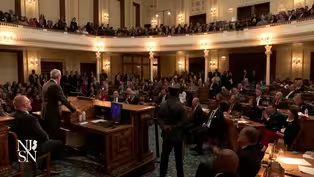
While lawmakers are spending their Friday night at the statehouse, despite working out a budget agreement earlier this week, last-minute negotiations stalled the process, and the Office of Legislative Services is preparing a draft spending plan for committees to vote on tonight, then hold floor votes on Monday.
The outcome of that vote isn't a question.
It's roughly a $58 billion budget that's expected to pass, but both the governor's office and legislature are running up against the clock.
Senior correspondent Brenda Flanagan has the latest as part of our Under the Dome series.
If you notice, sometimes if you wait to the end, you force people to start talking, and things get done, amendments get done.
And Chairman Paul Sarlo's Senate Budget Committee will wait until 8 o'clock this Friday night to get things done by voting on New Jersey's budget bill.
Sarlo said the package won't differ much from Governor Murphy's record $58.1 billion spending plan unveiled months ago.
The governor's budget message has not changed much.
The overall budget hasn't changed.
The full dollar amount, the $6 billion surplus hasn't changed.
So what's different?
Taxes.
The committee voted along party lines Thursday to release several revenue raisers, but at lower amounts than the governor originally wanted, to plug a $1.2 billion budget hole.
Instead of raising online gambling and sports betting tax rates to 25%, a bill would boost them to 19.75%.
Business leaders still aren't thrilled.
Atlantic City is kind of the powerhouse of South Jersey, and we don't want to do anything to impact their competitiveness with other states.
I know, Chairman, you've worked really hard to get to this compromise, and we do appreciate that it is less than what the governor proposed.
The committee approved measures to raise cigarette and nicotine vape cartridge taxes, and it also reworked a so-called "mansion tax," which currently charges the buyer 1% of property sales worth over $1 million.
The new levy would charge the seller instead, and wouldn't trigger a transfer tax until the sale price hits $2 million.
Fees would start at 2% and range up to 3.5% for property transfers worth $3.5 million or more.
Realtors objected.
Obviously, we do have great concerns about what this could do to the higher-end market.
However, transferring over the buyer's 1% over to the seller with the current market that we see, I think this is going to help a vast majority of New Jerseyans.
And the way we're looking at the numbers, it's only 2% of properties that are affected at the end of the day.
The bulk of property owners, real property owners, are not going to be affected by this change.
Progressive advocates called it a "common-sense solution."
This is a model for other progressive revenue raising in the state that we are going to need more of.
Certainly, you all are looking at the same budget projections and numbers that we are, looking at the state health benefits plan projections.
We are seeing that costs are going to increase and that there's a risk of real revenue cuts coming down the line.
In fact, state workers wearing red T-shirts turned out to protest a reported budget proposal that would save money by cutting $100 million in their health care benefits.
To add even more uncertainty, Trenton lawmakers are bracing for deep cuts in federal aid.
Who knows what's going to happen on the federal government level, right?
They're going to pass it on July 4th.
And I'll complain about that, too.
The public should be part of this and should know exactly what's happening.
Frustrated Republicans railed about having to wait until late Friday to even get a copy of the budget proposal.
They worried the plan contains unaffordable items, including the stay-and-jay property tax relief program that could ultimately cost over a billion dollars a year and unbalance future budgets.
It's about a three to four billion dollar structural deficit.
It's falling like a ticking time bomb into the lap of the next governor, whoever he or she may be.
So they are getting off to a good start with a $6 billion surplus.
Sarlo says Democrats and the governor's office agree on this budget.
The legislature meets Monday to make it official and send the governor a balanced budget before the midnight deadline.
In Trenton, I'm Brenda Flanagan, NJ Spotlight News.
Yeah, as you heard in Brenda's story, most of the governor's proposals will remain intact with some tweaks, including about a billion dollars in new fees and taxes.
Our budget and finance writer John Reitmeyer joins us to help explain the numbers and how much those taxes are going up.
All right, John, here we are in the midst, the thick of this budget cycle.
It's interesting to me because you have this poll on one hand that says most residents feel like the state is completely out of touch with affordability and the needs of folks here.
And yet what did go through so far, the legislature, are these bills to increase taxes.
What are they?
A couple of different.
And, yeah, that's a really good point to bring up.
So as people are concerned about taxes, the governor and the legislature appear to be ready to implement a number of new tax hikes in New Jersey.
Coming off last year when about a billion dollars in tax hikes were also enacted by the governor and majority Democrats.
So these new ones will be the rates that we pay those who smoke cigarettes or use vaping devices.
So the cost of a pack of cigarettes, the tax on that is going up, as is the tax on the liquid nicotine that is used in vaping devices.
The big one, though, however, is there will be new revenue raised from high dollar real estate sales that occur in New Jersey.
So a tax rate now that's levied on sales of properties valued at more than a million, that's going to stay the same, even though Murphy had been seeking to increase that one.
But there's new rates starting with sales over two million and going up to three and a half million that are now going to be charged.
And they're shifting who pays these taxes from the buyer of the property to the seller of the property.
And then another big one generating hundreds of million in revenue, although we don't have the final figures, will be increased tax rates for online gambling and online sports betting.
Two activities that have grown in popularity, particularly among young people in New Jersey in recent years.
And those rates, they're different rates now, whether you're gambling or sports betting, but they're going up to nearly 20 percent from in the mid-teens under the proposals that are going to be going before the legislature on Monday.
What about those so-called fund taxes, John, that the governor had proposed in his spending plan?
I mean, I thought these were on things like your bowling shoes, laser tag.
I mean, this drew the ire of lawmakers on both sides, actually.
It did, and that's probably why we didn't see it make it to the finish line here at the end of June.
So the expansion or broadening of the sales tax base that Murphy was proposing back in February, including what they call participatory sports venues, that looks like it's been cast aside as one of the increases.
And really, the needle that they're trying to thread is the budget is growing.
And unlike what's probably happening in Washington, revenue is not being really raised down there, and it's running a deficit.
Well, the state really can't do that to the same degree.
And so what's happening in Trenton is they're trying to pass things that bring revenue in to match the increased spending that doesn't hit everybody.
So who gets hit is smokers and gamblers and people who have the means to buy really or to sell really expensive homes or commercial properties.
So that's sort of the tug of war that's happening.
When you talk about that poll, people are concerned about taxes.
And the idea here is that you're bringing in the revenue needed to support the increased spending, but trying to do it in a way that doesn't hit everybody and is more targeted to maybe smaller groups that maybe have the means to do it or there are less blowback for raising the types of taxes that are making it to the finish line right now.
All right.
You can check out John Reitmeyer's reporting today and, of course, all of his budget coverage, which will continue into next week on our website, NJSpotlightNews.org.
John, thank you.
You're welcome.
Under the Dome is made possible in part by the Corporation for Public Broadcasting, a private corporation funded by the American people.
Another step toward bridging the digital divide in New Jersey, the State Board of Public Utilities this week launched a $40 million project to extend high speed Internet service to remote and underserved parts of the state, especially in South Jersey, where Internet providers have been reluctant to invest in rural, low population towns where the return on investment might be lower.
Ted Goldberg reports.
New grants for expanding Internet access have people in underserved areas feeling optimistic.
The sky's the limit when you think of what connectivity brings in today's world.
It's really going to allow us to envision a true smart city.
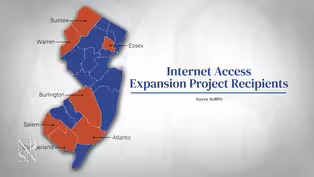
A $40 million grant from the state's Board of Public Utilities will help bring broadband Internet access to nearly 10,000 homes and businesses across these seven counties.
Tony Quigley is the Municipal Director of Information Systems for the City of Vineland, and he says Internet access is crucial.
The ability to acquire the information, whether it's through telemedicine or anything else, I mean, it's just become a vital part of life.
During the COVID time, it really came to light that a lot of people, you know, have, don't have the resources available to actually, you know, survive in a digital environment.
Among other things, Quigley helps people pay their utility bills in a city more well known for its agriculture than its Internet access.
Meanwhile, one county over.
We are hopeful that this will open all sorts of opportunities.
Salem County will receive almost $10 million.
Mickey Ostrom is the Deputy Director of the county's Board of Commissioners and says it's common to hear people quoted $30,000 to hook up their homes for cable and Internet.
It's been really hard to get penetration of Wi-Fi compatibility or Internet compatibility.
The population density does not justify, at least in their minds, the economic output to expand the services they have.
You have providers, as you're saying, you know, the ROI is not worth it.
Well, here's that opportunity to sit here and say, well, we're going to help you.
We're going to meet you halfway.
Let's get this work done.
So now there's no longer that excuse.
Valerie Ballard runs the Office of Broadband Connectivity in the BPU and agrees that Internet access has pretty much become a necessity.
Knowing that we are working with communities that are in need in other arenas when it comes to having quality water and, you know, being able to afford electricity, knowing that we have another role in just helping them, we're pretty excited.
The BPU kicked off its grant at a church in Penns Grove Wednesday where speakers celebrated the news and poked fun at their current situation.
Most of you have experienced how bad our Wi-Fi is.
Case in point, Joe sent me the run of the show and names and everything.
And guess what?
My phone's in SOS.
It matters for agricultural communities.
Farmers use the technology in order to compete.
It matters for our students.
The $40 million is split between Vineland, Salem, Penns Grove, Verizon and Brightspeed, who was awarded almost $10 million to create the infrastructure for broadband in Warren and Sussex counties.
We're excited about what we're going to be working in up there.
We're ready to get to work and partner with them and with the counties and municipalities and really bring our customers with some real high-speed Internet.
Brightspeed says the next three to six months will be spent on contracting and engineering.
These projects need to be done by the end of next year, so faster Internet could be coming to rural areas sooner than you think.
For NJ Spotlight News, I'm Ted Goldberg.
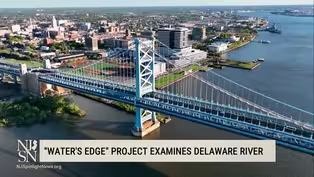
Tonight, we're revisiting a multimedia project we started producing and reporting two years ago called Water's Edge, which is a series of trials and tributaries of the Delaware River watershed.
It looked at the transformation of what was once a highly polluted body of water to one that's now frequented by both boaters and bald eagles.
It's arguably our region's most important watershed.
NJ Spotlight News explored the threats to the Delaware, but also steps that have been taken to protect it.
I spoke with founding editor John Mooney earlier today about what our reporters found.
You're on the set today in the studio, so this has been a long time coming.
What were the areas that you all decided to revisit to sort of check up on how things have progressed?
Yeah, I mean, two years ago when we did the main project, Water's Edge, we focused in on sort of several of the hot spots in terms of the pressures on the water, on the watershed, on the New Jersey side.
Obviously, the watershed spans four states, New York, Delaware, and Pennsylvania as well.
But on the New Jersey side, the key areas we determined were the highlands in western New Jersey, the pinelands in southern New Jersey, massive, the bay shore along the Delaware Bay, and then the urban estuary from Camden up to Trenton.
So the reporters who did that reporting two years ago, we said, "Go back, see if things change."
I mean, these are problems that took years to happen and to surface, and obviously there's not going to be a ton of things.
But it turned out to be a pretty eventful last two years, literally all of them.
Yeah, because part of it was not just to point out all of the history and the challenges, but also some of the ways that these challenges were being solved.
And so we rarely get an opportunity to go back and check things like that.
As a journalist, that's fun.
I've done a lot of projects in my time, and rarely do I go back a couple years later.
And so this was a real opportunity to do that.
And the big change that we've seen in virtually all of them has been the federal administration, the Trump administration, and the potential threats in terms of environmental protection, in terms of all kinds of ways.
And they're evolving now.
So to be honest with you, we could do this, we could go back in two years further.
So it's really been an interesting project for us.
Is there a sense that any of that progress will be rolled back because of the changes coming at the federal level?
Oh, sure.
Yeah.
I mean, there's a real worry on a few of them.
The Highlands is a really interesting story in terms of what's happening in terms of some of the state pressures, but we also have in Highlands is beautiful, pristine areas out there, but also have some affordable housing issues.
So the state has these requirements for these towns to build housing, yet at the same time, they also have requirements through the Highlands Council to not build housing.
So you see these conflicting things.
And Colleen O'Dea, our reporter, just did that piece.
And it's really interesting.
Another one is we're seeing PFAS, the forever chemicals, and fixing that is going to require some plumbing and some pipes, which under the Highlands Council you can't do.
So those kinds of conflicts are really emerging.
And how are they navigating around that?
I mean, because this is a really important body of water, as you've talked about.
Yeah.
I mean, that is the challenge.
I think they are being allowed to do it, but there's some things that are going to be coming down the pike.
I think next week even the EPA is putting out some new standards for oxygen in the urban estuary around Camden and Trenton.
And it would be very interesting how strict those are going to be, especially under this administration.
So what's next?
What's ahead for this project?
And also just generally for some really important work that needs to be done?
Well, for the project, we have a couple more stories to still come out.
And then on Monday we're bringing the gang back together, and we're going to do a virtual roundtable at noon.
And you can come to our site and you can register for it or just sign into it.
And that will be an hour-long conversation among reporters.
It will be interesting.
It's sort of like the reporters' roundtable, talking a little bit about what we found over the course of time.
And then, you know, not that we'll stop covering the watershed by any means.
We do a lot of environmental reporting, and these reporters are dedicated to all kinds of watershed issues.
But we probably won't give it the same treatment that we've been giving it over the last couple years.
I mean, it's been a real pleasure to do it.
Big thanks to the William Penn Foundation, which largely funded it and made it possible.
But there's other projects to do, and we have done.
But who knows?
We certainly--the pressures aren't dissipating at all.
There's always more stories to tell.
There are always more stories.
All right, well, you can sign up for that virtual event on Monday or check out any of the articles in this series, Water's Edge, on our website, njspotlightnews.org.
John Mooney, thanks for coming in.
Brianna, a pleasure.
And finally, if you are looking for something to do this weekend, you can catch the final performances in this year's North to Shore Festival.
It's back for the third time.
It's a statewide music, arts, and culture fest that runs until Sunday, June 29th at venues in Atlantic City, Asbury Park, and right here in Newark.
It's been called a showcase of everything that makes this state unique because it offers a stage for big names like Stone Temple Pilots, but also under-recognized artists and, importantly, art organizations.
Tonight, you could catch Streetlight Manifesto at the Stone Pony Summer Stage in Asbury or grab some last-minute tickets to comedians Jon Stewart, John Mulaney, and Pete Davidson in Newark.
The headline act, though, that's this weekend on Saturday at the Prudential Center for the Rock the Bells concert.
That's got a lineup of artists like Busta Rhymes, Redman, and Big Daddy Kane.
Rapper Roxanne Shante is emceeing the event and spoke to our David Cruz for Chat Box, reminding the public this is also a celebration of Black Music Month.
We wanted to give it that educational spin because there's always something that you can learn from Rock the Bells, whether you're listening to the station or if you're coming out to the festivals or if you're going to the website.
There's always something to learn.
So we believe in having that educational component with it.
But we also want you to know that it's cool to learn.
So it's cool to come on out and have a good time and learn something.
You can see the full interview with Roxanne Shante on Chat Box this weekend.
That's Saturday at 6.30 p.m. and Sunday at 10.30 a.m. And on Reporters Roundtable, David talks with Peter Chen, senior policy analyst with New Jersey Policy Perspective, about the latest on the state budget as the June 30th deadline for passage looms.
Plus, a panel of local journalists talking about all the week's big political headlines.
That's Saturday at 6 p.m. and Sunday at 10 a.m. right here on NJPBS.
That's going to do it for us this week.
I'm Brianna Van Osie.
For the entire team here at NJ Spotlight News, thanks for being with us.
Have a great weekend.
We'll see you right back here on Monday.
NJM Insurance Group, serving the insurance needs of residents and businesses for more than 100 years.
Horizon Blue Cross Blue Shield of New Jersey, an independent licensee of the Blue Cross and Blue Shield Association and by the PSCG Foundation.
Public service is what we do.
At the PSCG Foundation, through volunteer hours, partnerships and our other contributions, we're committed to empowering communities.
We work hand in hand with you, our neighbors, to educate young people, support research, environmental sustainability and equitable opportunities, provide training and other services all over New Jersey and Long Island, uplifting communities.
That's what drives us, the PSCG Foundation.
Look at these kids.
What do you see?
I see myself.
I became an ESL teacher to give my students what I wanted when I came to this country.
The opportunity to learn, to dream, to achieve, a chance to belong and to be an American.
My name is Julia Torriani-Crompton and I'm proud to be an NJEA member.
[Music] (upbeat music)
$40M internet expansion for underserved parts of NJ
Video has Closed Captions
Clip: 6/27/2025 | 3m 50s | Thousands of households, businesses could get broadband internet access by December 2026 (3m 50s)
Interview: Delaware watershed's trials and tributaries
Video has Closed Captions
Clip: 6/27/2025 | 5m 30s | NJ Spotlight News returns to ‘Water’s Edge’ special project (5m 30s)
NJ lawmakers scramble to vote on tax hikes, spending plan
Video has Closed Captions
Clip: 6/27/2025 | 4m 48s | Democrats push in final stretch before July 1 deadline (4m 48s)
Providing Support for PBS.org
Learn Moreabout PBS online sponsorship
- News and Public Affairs

Top journalists deliver compelling original analysis of the hour's headlines.

- News and Public Affairs

FRONTLINE is investigative journalism that questions, explains and changes our world.












Support for PBS provided by:
NJ Spotlight News is a local public television program presented by THIRTEEN PBS