NJ Spotlight News
NJ Spotlight News: March 10, 2025
3/10/2025 | 26m 46sVideo has Closed Captions
Watch as the NJ Spotlight News team breaks down today’s top stories.
We bring you what’s relevant and important in New Jersey news and our insight. Watch as the NJ Spotlight News team breaks down today’s top stories.
Problems playing video? | Closed Captioning Feedback
Problems playing video? | Closed Captioning Feedback
NJ Spotlight News is a local public television program presented by THIRTEEN PBS
NJ Spotlight News
NJ Spotlight News: March 10, 2025
3/10/2025 | 26m 46sVideo has Closed Captions
We bring you what’s relevant and important in New Jersey news and our insight. Watch as the NJ Spotlight News team breaks down today’s top stories.
Problems playing video? | Closed Captioning Feedback
How to Watch NJ Spotlight News
NJ Spotlight News is available to stream on pbs.org and the free PBS App, available on iPhone, Apple TV, Android TV, Android smartphones, Amazon Fire TV, Amazon Fire Tablet, Roku, Samsung Smart TV, and Vizio.
Providing Support for PBS.org
Learn Moreabout PBS online sponsorshipAnnouncer: Funding for "NJ Spotlight news" is presented in part by NJM Insurance group.
Briana: Tonight, strike averted.
New Jersey transit make the deal with engineers to keep the trains rolling.
Plus, the Camden Catholic diocese fight to keep clergy abuse under wraps has now been exposed.
And victims may finally get their day in court.
>> They want accountability, they want validation, they want somebody to acknowledge what was done.
And they want to know the facts.
Briana: Also, federal cuts to teacher training programs here will not help a statewide teacher shortage.
>> The recent cancellations of the grants across our country are yet another way that young people may feel they are being told that teachers do not matter.
Briana: And after a series of fatal crashes, Middlesex County tries to curb dangerous driving along a stretch of Route one.
>> Cars have gotten safer, roadways have gotten safer, yet we see fatal crashes increasing over the last couple of years.
And here in Middlesex County, we think it is time we do something about it.
Briana: NJ Spotlight News begins right now.
♪ >> From NJPBS, this is NJ Spotlight News with Briana Vannozzi.
Briana: Good evening and thanks for joining us on this Monday night.
I'm Briana Vannozzi.
We begin with a few of tonight's top headlines.
First, strike averted.
With roughly two weeks left to strike a deal, New Jersey transit and the union representing the agency's locomotive engineers have reached a tentative deal on a contract dispute.
According to a joint statement released this morning, the agreement includes wage increase minutes, which has been the main sticking point for union workers since they contract expired in 2019.
It is unclear how much of the hike they settled on, but during negotiations, they ask for increases closer to what workers make on commuter railroads in Long Island and New York City.
And JT sought to raise pay at the same percentage of its other 14 rail unions.
Union members still need to vote to ratify the contract.
The contract comes as New Jersey transit proposes a $3.2 billion budget for the next fiscal year.
That includes an automatic annual 3% fare hike to take place this year.
That means the cost for a one-way ticket will be just shy of $20.
Tonight, fossil fuel companies that operate within New Jersey could soon face fines.
Environmental advocates rallied outside the state house earlier today, urging lawmakers to pass the New Jersey climate Superfund act.
A bill requiring oil and gas producers that contributed to greenhouse gas emissions to pay for the economic damages of climate change.
It will apply to companies find for more than one billion extra tons of emissions.
Opponents say the measure would create a pot of money similar to the way the federal government cleans up toxic waste by charging chemical and petroleum companies and extra tax to fund resiliency and infrastructure projects.
Demonstrators today said the move is necessary given the increasing number of severe weather events being driven by climate change, and the costs that come with it.
But business and industry groups are strongly against the bill.
The NJ BIA says the fees will end up hurting residents because the cost will inevitably be passed down to them through either their energy bills or filling up their cars at the pump.
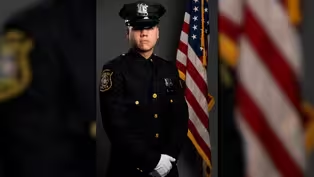
And the investigation is ongoing into Friday's fatal shooting of a Newark police officer.
27-year-old Detective Joseph Azcona, a five year veteran of the force, was investigating illegal gun activity in the city when he was shot to death before he could get out of his car.
Authorities say a second officer was also shot and remains in the hospital.
Prosecutors have charged a 14-year-old with murder, attempted murder, and other weapons offenses.
Five other people were also taken into custody.
Authorities say the teenager, whose name hasn't been released, was hospitalized with injuries from the exchange of gunfire and is expected to survive.
According to prosecutors, the officer was part of a special intelligence unit within the Newark Police Department, investigating a group they believe had illegal weapons when the shooting occurred.
His body was escorted by a police procession Saturday afternoon from University Medical Center to a funeral home in Newark.
Newark's mayor this week and -- this weekend pointed to the dangers officers face every day on the job, adding Azcona knew that there was danger where he was headed but went anyway.
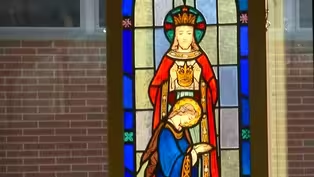
State prosecutors just landed a big win in their long fought battle to investigate allegations of clergy sexual abuse.
New Jersey's Supreme Court recently ordered records in the case to be unsealed and agreed to hear arguments next month.
The documents revealed secret efforts by the Catholic Church to quash the case and keep it from going to a grand jury.
New Jersey's Attorney General's office initially launched the investigation after a 2018 Pennsylvania grand jury report found hundreds of Catholic priests had sexually abused at least 1000 children.
New Jersey's victims, survivors, and their families have been waiting for answers ever since.
For more, I am joined by Mark Crawford, state director of the survivors network of those abused by priests.
Mark Crawford, thanks for coming on the show.
Simply, what does the Supreme court's decision mean both for the case, but most importantly for the survivors of clergy abuse?
>> It is really huge.
Survivors have been waiting for years for a full accounting of what has happened.
They were asked to come forward, give testimony, which they have done, and for years we have heard nothing.
It was silent, very little from the AG's office.
And they were really wondering, what is going on here?
So, now that we know that it has been the Camden diocese actually taking legal action to oppose the grand jury presentment and the investigation, it is deeply disturbing, right?
The ability to be heard, the ability to have their story told, and I think it gives them a sense of validation.
It is not just in a kind of renumeration for the harm that has been done.
They want accountability.
They want people to know what could have been done to stop it or what was not done to stop it.
Briana: What do you make though, Mark, of this argument from the Camden diocese that victims can get relief through civil lawsuits?
So there is, in their purview, no need for a grand jury, no need for this to be made public because of the privacy of being a religious organization?
>> It is terrible that they think, OK, go to the court, maybe you will win some money, I don't know.
But does that give them closure?
That is not what they really want.
They want accountability, they want validation, they want somebody to acknowledge what was done.
And they want to know the facts.
A lot of times, as we can see now, our bishops have taken every step to conceal the truth of these matters.
How is it, why is it that for seven years now, almost seven years, none of the bishops have said, hey, wait a minute, we are taking this legal action.
They have even asked that that be sealed and prevented from the public from knowing their actions.
If they were right, then why did they need it sealed?
Why should we hide the fact they are wrong?
And they don't want the faithful or the people or the public to know what they are up to.
They publicly promised openness, transparency, and cooperation with the AG's investigation.
Well, behind the scenes, Camden was fighting to keep this from ever happening.
Briana: If the grand jury comes to pass and their recommendations come to pass, how in your mind might that help some of the systemic issues or any future abuse from happening?
>> Well, number one, many of the offenders that might be acknowledged or exposed are still living and working among us unknown.
And that is a problem.
So, it is critically necessary and the public as a right to know.
It is in the public's interest and a matter of safety for the public.
And I would like to say that, look, this is not just victims from Camden.
Their actions have suppressed victims across the whole state from any diocese or any other institution.
So, just because you're a private institution doesn't mean you shouldn't be held accountable for the actions or inactions which led to criminal behavior for the sexual abuse of children.
Briana: Mark, thanks so much.
>> Thank you.
Briana: Tuition aid for thousands of college students in New Jersey is in jeopardy.
That was the message to lawmakers today during an assembly higher education committee hearing.
They heard from leaders and experts within the field about the proposed $330 billion in cuts from the Trump Administration, as it also tries to dismantle the federal education department.
John Walsh from the American Association of State colleges and universities told the committee federal Pell grants are on the chopping block, facing a nearly $3 billion shortfall by the end of this year.
That would put about 144,000 students here who get their tuition help from the program in limbo.
The state is also tightening its belt in light of federal cuts.
Governor Murphy proposed slashing upwards of $180 million to colleges and universities in his latest budget.
And while some programs are in peril, others have been downright decimated, like an initiative that helps train students to teach in urban schools.
Senior correspondent Joanna Gagis reports on recent cuts to the program and what it means for its future.
>> The recent cancellations of the teacher quality partnership grants across our country is yet another way young people may feel they are being told that teachers do not matter.
Joanna: As President Trump continues to reshape and resize our federal government through cuts to a wide variety of programs and jobs, one cut hit home for educators and future teachers here in New Jersey.
The program is called the Teacher Quality Partnership grant, or TQP Grant, and funding was just cut off to the two higher ed schools in New Jersey that receive it.
>> It is a grant that supports getting quality teachers in hard to staff positions in schools across the country.
Joanna: The college of New Jersey and Montclair State University both lost their funding.
But New Jersey was not the only state.
Seven other states saw their TQP grants slashed.
The $3.7 million grant funds a partnership between MSU and urban school districts in Newark and Orange.
>> We are preparing future teachers, and we are not just preparing teachers.
We are preparing teachers who really understand the needs of students living in urban communities, students with disabilities, students in various different subject areas.
And so, the impact of this grant is really on the children.
And also on this current teachers in the school district.
Joanna: But the U.S. Department of Education said they cut funding to schools that were teaching divisive ideologies, including topics like building cultural competence, dismantling racial bias, and centering equity in the classroom, among others.
And many of these grants included teacher and staff recruiting strategies implicitly and explicitly based on race.
But Montclair State program leaders say the grant didn't just get teachers into the pipeline by covering their tuition.
It kept them in urban districts where many drop out through a mentorship program that supports them in the first three years on the job.
>> We have placed over 140 teachers in Newark and Orange public schools through this program.
Many of them are typically special ed certified as well or STEM certified, and they stay in the profession in numbers that are really staggeringly over what typically prepared teachers stay.
95% of them stay for over three years and many of them go on to become administrators or serve other roles in education.
Joanna: Why do you think that is?
>> It is the support and preparation they receive.
We prepare them to understand the communities they are going into and really understand the job that they are undertaking so that when they become first-year teachers, it isn't a shock.
They know the job they are doing and they know how to do it.
Joanna: Mia Touw has been in the program long enough to become a certified teacher, but losing the grant funding means she likely can't finish her master's degree and she won't have the mentorship support she was counting on when she starts teaching in Newark.
>> I want to stay and so does anybody else, but I think without that support, that is what is causing teachers to leave the classroom.
And so, the thought of me not having that anymore is definitely scary to me because I think having that community is vital to actually keep going in this profession.
Joanna: A profession that's lost countless teachers since the pandemic without attracting nearly enough new ones, leading to a teacher shortage across New Jersey and the nation.
And that is the basis of a lawsuit brought by New Jersey attorney General Matt Platkin and seven other attorneys general whose states lost funding, saying the cuts interrupts pipelines and destabilizes local school systems.
>> They are threatening teachers who go to work in rural schools and urban schools.
They are threatening to end the pipeline for teachers who are trained in math and science.
We are talking about winning the economic fight for the next century.
Those are pretty important skills.
Joanna: For now, all the teachers enrolled in the grant program are waiting to see what comes next.
In Newark, I am Joanna Gagis.
Briana: It is the end of an era for one of New Jersey's most renowned national polling centers.
The Monmouth University polling Institute announced it will shut down and its leader, Patrick Murray, who you have seen plenty of times on this broadcast, will leave the university.
Polling has come under fire since the 2020 election as both pundits and politicians question their accuracy and the ability to truly capture the pulse of a nation.
At the same time, federal funding to universities could be at risk, making it harder to support polling programs.
Senior political correspondent David Cruz looks at the legacy of the Monmouth polling Institute and what its closure means for the political world.
>> It is a sad day for all of us.
This is a huge loss for the state.
David: Don't let anybody tell you that you are a chicken little warning that the sky is falling, because it kind of is.
Newspapers, radio stations, and online news outlets shuttering their doors.
And now, the Monmouth University poll, one of the leading polling institutes in the country, about to shut down, too.
Ashley Coning runs the Eagleton Center for public interest polling, now one of just two polling institutes left in the state.
>> Polls are an integral part of that small d democratic process.
We are able to represent ively represent the voices of the public back to policymakers and the press.
That is an integral part of this society that we live in.
David: But in this day of instant Internet polls and rent a partisan pollster, they have lost interest and faith in polls.
And it says Dan Cassino, who runs a poll that just published three polls last week, that kind of erosion is bad for business.
And a business with a margin for error that is minuscule.
>> It is never made a ton of sense.
We take our best products, the public polls, and we give them away for free for people.
As a business model, it is not great.
And it works as a loss leader.
Most polls are bringing in outside clients that pay for polls.
Or you are doing this for advertising.
So, for decades polling has been been funded by newspapers.
Briana: And -- David: And the cracks have been evident for some time.
So more people who don't answer their phones means fewer polls.
Now just two in New Jersey.
>> When I started doing polling, 20 years ago, we had six or seven polls.
Nowadays, it is really too.
It is us at FDU and it is Eagleton that are all that is left.
And that is a problem.
That is a problem because this is the primary way in which elected officials get information about policies.
David: Republican consultant Chris Russell is a polling skeptic, has been since 2021 when a Monmouth University poll showed his gubernatorial candidate trailing Phil Murphy, by double digits, which ended up being off by eight points in the final count.
Russell says that cost his campaign in dollars, momentum, and probably votes.
>> I am a fan of no public polls.
That is fine by me because any campaign at that level is doing their own internal polling.
They know what they know about the race, and hopefully they're -- and hopefully their polling is right.
That is always a big test inside campaigns.
It is a difficult thing to pull -- a difficult thing to poll correctly these days because of the way the voter landscape is changing, the way we are in some kind of political realignment here.
I think some of the old rules don't apply, and that makes it challenging to get a sample that is representative, which often then leads to bad numbers.
>> It means it is one more way that we are flying blind.
As the media is contracting, as the people whose eyes are on politics every day is shrinking, we have one less set of data points now, and it is happening fast.
David: Just another way that it is getting harder to find out the things you need to know about the issues and people that directly affect your life, resulting in fewer educated voters in a time when the opposite is more critical than ever.
I am David Cruz, NJ Spotlight News.
Briana: In our spotlight on business report tonight, Governor Murphy on Saturday declared a state of emergency for the sinkhole that has left I-80 closed in Morris County for the past month.
The declaration came with a request to the federal government for emergency relief funds to help with the ongoing repair work.
Murphy toured the work site, along with Congressman Tom Kane Jr. and state and local officials over the weekend.
Route 80's eastbound lanes have been closed since February 10 in response to a sinkhole that opened up just weeks after an earlier sinkhole forced the road closed in December.
Centuries old abandoned mines underneath the highway have been blamed for the sinkholes.
Meanwhile, officials are targeting another stretch of New Jersey highway notorious for horrendous traffic and fatal crashes.
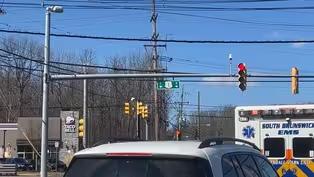
Route 1, which has seen a spike in deadly car accidents in recent years.
The Middlesex County prosecutor's office is launching a program to get drivers to slow down and ditch their aggressive behaviors.
Raven Santana reports.
>> Cars have gotten safer, roadways have gotten safer, and yet we see fatal crashes increasing over the last couple of years.
And here in Middlesex County, we think it is time that we do something about it and find a way to stem the tide.
Raven: Sergeant Jonathan Berman of the Middlesex County prosecutor's office is spearheading a new traffic safety initiative in response to a recent surge in fatal crashes in the county, specifically on Route 1.
The action plan includes identifying crash locations, mapping high injury corridors, and then proposing a series of actions designed to promote crash prevention.
>> It is really just a way to bring together all the different parties that are responsible for the roadways in Middlesex County through engineering, enforcement, and education efforts.
Raven: The initiative is part of the county's vision zero program, focused on addressing the rise in deadly car crashes with an emphasis on U.S. Route 1, a vital and high-volume roadway in the county.
>> The speed limit on Route 1 is 50 or 55 miles an hour, depending on the section you are in.
We are routinely seeing vehicles in excess of 75 or 80 miles per hour.
The data we are getting shows it is not an insignificant percentage of the travelers that are driving 50%, 60% greater than the posted speed limit.
It is just unacceptable and it has to come to an end.
Raven: The safety efforts come after the state initialed -- after the state announced an initiative to limit traffic deaths by 2040.
Since 2020, the county has reported more than 300 deaths on the roadways.
Out of these, 45 fatalities have occurred on U.S. Route 1.
>> The most problematic area is on Route 1 between Parsonage Road right in front of Menlo Park Mall to Grandview Avenue.
That is where we see most of our serious accidents.
Raven: Why is that?
>> With respect to Parsonage, I think it is because it is right after people are coming off the parkway, they are coming flying off that offramp, and they're coming to a chokepoint where traffic is at a dead stop, it is always backed up, it is a very heavy merge, and they are not expecting it.
In addition, Route 1 has a lot of businesses along the highway, a lot of driveways.
There are people pulling off the highway, pulling onto the highway.
and when You factor in the high speeds with which people travel down Route 1, it leads to a lot of serious accidents.
Raven: Erin Campbell is section chief of the crash investigation unit for the Middlesex County prosecutor's office.
She says the office has partnered with the New Jersey division of traffic safety and the State Department of transportation, as well as officers from Woodbridge, Edison, New Brunswick, North Brunswick, South Brunswick, and Plainsboro police departments to collect data.
>> The Department of Highway and traffic safety has generously given us a $230,000 grant that we will be using to fund the project.
>> Distracted driving is very quickly rising to challenge it.
And we see it all the time.
Most of the time, people are lucky and it winds up with minor crashes.
But unfortunately sometimes it does wind up with a very significant or fatal crash.
Raven: Lieutenant Gary Holsten of the South Brunswick Police Department's vice president of the New Jersey police traffic officers Association.
Holsten has responded to many unfortunate crashes on Route 1, including the latest one occurring on Tuesday.
>> Ultimately, it involved four vehicles, including a pickup truck which wound up overturning.
And I believe at least eight people went to the hospital.
Raven: Holsten says education is key to preventing fatalities on Route 1.
>> Some people may get an educational pamphlet and they get a summons.
They may get both.
But the goal of this isn't the summons.
The goal is to get the speed down, to get driver behaviors under control.
Raven: Sergeant Berman says the enforcement period will start in the next couple weeks.
For NJ Spotlight News, I'm Raven Santana.
Briana: That's going to do it for us tonight.
A reminder, you can download our podcast wherever you listen and watch us any time by subscribing to the NJ Spotlight News YouTube channel.
Plus, you can follow us on Instagram and Bluesky to stay up-to-date on all the state's big headlines.
I am Briana Vannozzi.
For the entire team at NJ Spotlight News, thanks for being with us.
Have a great night and we will see you right back here tomorrow.
>> New Jersey education Association, making public schools great for every child.
RWJBarnabas Health, let's be healthy together.
New Jersey realtors, the voice of real estate in New Jersey.
More information is online at njrealtor.com.
And Orsted, committed to the delivery of clean, reliable, American-made energy.
>> NJM Insurance group has been part New Jersey for over a century.
We support our communities through NJM's corporate giving program, supporting arts and culture-related and nonprofit organizations that serve to improve the lives of children, rebuild communities, and help to create a new generation of safe drivers.
We are proud to be a part of New Jersey.
NJM, we've got New Jersey covered.
>> No one plans on heart disease, but everyone should have a plan for it.
We help patients of all lifestyles and medical histories plan for healthy hearts.
We offer convenient screenings without judgment.
Hundreds of preventive programs and women's heart specialists, and we are the largest cardiac surgery program in New Jersey.
Make plans for a healthy heart with RWJBarnabas health.
Let's be healthy together.
♪
14-year-old suspect charged with Newark police killing
Video has Closed Captions
Clip: 3/10/2025 | 1m 18s | Detective Joseph Azcona was investigating illegal gun activity when he was killed (1m 18s)
Catholic bishops 'took every step to conceal the truth'
Video has Closed Captions
Clip: 3/10/2025 | 5m 7s | Survivors group speaks on efforts by the church to quash abuse cases (5m 7s)
Crackdown on Route 1 drivers in effort to curb fatalities
Video has Closed Captions
Clip: 3/10/2025 | 4m 31s | The crackdown is part of a broader road safety initiative in Middlesex County (4m 31s)
NJ to lose prominent political poll
Video has Closed Captions
Clip: 3/10/2025 | 4m 44s | Monmouth University Poll to stop counting soon, leaving just two (4m 44s)
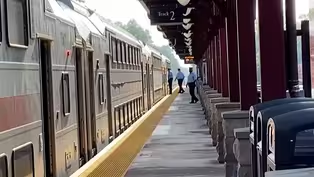
NJ Transit and engineers reach tentative contract agreement
Video has Closed Captions
Clip: 3/10/2025 | 1m 11s | Union members must vote to ratify the contract, which includes pay increases (1m 11s)
Providing Support for PBS.org
Learn Moreabout PBS online sponsorship
- News and Public Affairs

Top journalists deliver compelling original analysis of the hour's headlines.

- News and Public Affairs

FRONTLINE is investigative journalism that questions, explains and changes our world.












Support for PBS provided by:
NJ Spotlight News is a local public television program presented by THIRTEEN PBS