NJ Spotlight News
NJ Spotlight News: March 13, 2024
3/13/2024 | 26m 46sVideo has Closed Captions
Watch as the NJ Spotlight News team breaks down today’s top stories.
We bring you what’s relevant and important in New Jersey news, along with our insight. Watch as the NJ Spotlight News team breaks down today’s top stories.
Problems playing video? | Closed Captioning Feedback
Problems playing video? | Closed Captioning Feedback
NJ Spotlight News is a local public television program presented by THIRTEEN PBS
NJ Spotlight News
NJ Spotlight News: March 13, 2024
3/13/2024 | 26m 46sVideo has Closed Captions
We bring you what’s relevant and important in New Jersey news, along with our insight. Watch as the NJ Spotlight News team breaks down today’s top stories.
Problems playing video? | Closed Captioning Feedback
How to Watch NJ Spotlight News
NJ Spotlight News is available to stream on pbs.org and the free PBS App, available on iPhone, Apple TV, Android TV, Android smartphones, Amazon Fire TV, Amazon Fire Tablet, Roku, Samsung Smart TV, and Vizio.
Providing Support for PBS.org
Learn Moreabout PBS online sponsorship>> Major funding for NJ Spotlight News -- Serving the needs of New Jersey residents and businesses for more than 100 years.
Briana: The clock ticking for TikTok forcing its parent company to divest in the social media or risk being banned.
>> This attempt to ban TikTok is a functional ban would I can whack a mole because we don't know what is next.
Briana: Plus sounding the alarm on government transparency is a new bill looks to reform the public records act.
>> Young people are trusting you to be good stewards of our democracy, and let us not be on the wrong side of history.
Briana: As the war rages on and the Palestinian death toll mounts in Gaza how are Muslims in New Jersey celebrating the holy month of Ramadan?
>> This year is sad.
This year, actually, we feel guilty for our families in Gaza not having water to drink.
Briana: Mental health access, new legislation to expand health services for the hundreds of thousands who are deaf or hard of hearing.
>> It is a step in the right direction to recruit more mental health professionals who know sign language in different sign systems.
Briana: NJ Spotlight News begins now.
♪ >> From NJPBS studios, this is NJ Spotlight News with Briana Vannozzi.
Briana: Good evening and thanks for joining us this Tuesday night.
I am Briana Vannozzi.
Congress is giving one of the most popular social media platforms an ultimatum to divest or TikTok will be banned in the U.S. as the house voted overwhelmingly in favor of ByteDance, the parent company of TikTok, to sell it within six months or face a national ban.
352-65 vote with many lawmakers arguing it poses a threat to national security because the Chinese government could force ByteDance to hand over data on its roughly 170 million American users, which is alleged to be useful to China for disinformation campaigns, even identifying U.S. intelligence targets.
TikTok's owner has denied those accusations in China today responded by equating the band to a "active bullying."
Every member of the House delegation voted yes except Andy Kim who did not vote and was not in D.C., but sent a statement it would've been a no and wants Congress to take up a comprehensive bill protecting user data across all social media platforms.
The bill faces an uphill battle in the Senate but plenty of groups agree and say this is a free speech issue.
For more on that, I am joined by Nadeem Johnson, policy director at Columbia University.
Thank you for giving us your insight today.
The Institute has said there are potential implications here when it comes to the First Amendment.
What are your concerns?
Nadeem: That this is an affront to the First Amendment because American should have access to the information via the platform of their choosing.
Briana: There is historical precedent though.
I'm thinking in 2020 went the U.S. successfully got China to divest from the dating app grinder and citing national security issues.
Does that not rise to the same level here when we are talking about a for adversary potentially having access to info on more than 100 million users in America?
Nadeem: Again, the key is if this were to pass the Senate, again we believe there are significant First Amendment concerns, but ultimately this bill does not solve the base issue, which is there are platforms with access to Americans data and with this legislation, other governments could gain access via a data brokerage or other means of collecting that kind of information.
Briana: There have been suggestions, as I am sure you have seen, that perhaps by banning TikTok, which lawmakers say this gives six months for that divestment to happen, not a straight out ban is what they are saying, their words, that it would embolden other social media platforms to collect even more data with having an app like TikTok out of the extra.
Is that not an issue that you see or something that could happen to data and security in the U.S.?
Nadeem: Absolutely which is why it is important that there be a comprehensive effort to secure American state of the comprehensive data privacy legislation.
Briana: But is there a fear this could potentially open the door for similar actions like this in Congress against other platforms where folks express themselves?
Nadeem: Well that is exactly right.
The bill that passed the House today provides the president with wide power to be able to take similar action against other foreign acts.
The other thing this does that is of concern is that its citizens a signal to their countries that they can in turn -- citizens access to information because if you look at this from a fundamental level the issue is America ends right to access information and cutting out that access flies in the face of First Amendment principles and sending messages to authoritarian saying hey, we are doing it here.
You can do it there.
Briana: When you're talking about an adversary like China or the Communist Party could there not be uh greater good perhaps, which is what some are in support of this bill to take away a platform like that in order to provide uh more national security?
Nadeem: So, we have heard the national security argument and of course there are concerns about TikTok and other platforms having access to Americans data but what Congress has to do when it puts forward a law is to show that this is the path that is most narrowly tailored to achieve the government's interest in protecting Americans in this particular sense.
Right now we do not think they have done so and because there are other paths that are clear including the passage of legislation limiting data brokerage access to information, those steps could and should be taken with urgency in order to protect Americans privacy without infringing on their First Amendment rights.
Briana: Nadeem Johnson is the policy director at the night First Amendment Institute at Columbia University.
Thank you so much.
Nadeem: Thank you.
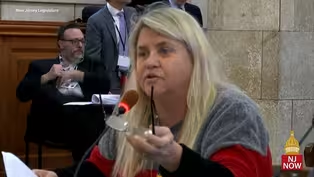
Briana: A controversial bill that critics say would gut government transparency is making its way through Trenton that reforms New Jersey's open Public records act, enacted more than two decades ago, creating a statewide set of rules for public access to public documents.
Supporters say reforms have long been needed to protect the privacy of citizens, but watchdog groups, lawyers and the public defenders and journalist and a bunch of other say it will make it harder to uncover corruption, fraud and abuse that runs rampant in New Jersey.
David Cruz reports.
David: The irony is on was to rich, on national sunshine we are reminded of how important access to public records is for a healthy democracy.
The law in New Jersey to ensure that very bright is about to get gutted.
>> Relax.
Relax.
Lowered the temperature, everybody.
David: Paul Sarlo was cool as the guy with all the votes at his committee hearing this week.
His OPRA reform bill is long overdue, he said, painting a dark picture of a good law gone bad.
>> We want to make sure we protect our citizens and children, so folks, quite frankly, for lack of better words, have made some really creepy, creepy request.
David: There has been pushed back from good government groups and others including journalists who say the proposed law takes a machete to a bill that needs a scalpel.
>> What else does this bill do to limit access, restrict access?
-- material would no longer be available, including notes generated and used to prepare final reports, documents, records, blogs of telephone calls, emails or texts would no longer be available.
David: It is the end the weeds and nooks and crannies of government information the journalists used to expose things like corruption in government.
The nursing home scandals.
And remember, time for some traffic problems?
Those came to light via OPRA requests.
Reporting for NJ.com expose the abuses of public run facilities that cost people their lives.
Reporter: we use the open Public records act to request emails, particularly from the veterans homes as well as nursing homes in New Jersey to find out you know, what is the conversation going on, but we were primarily focused on veterans homes because they are public and what we found is people were not seeing doctors.
People were not getting medical care.
They were not eating because nobody was there helping them.
David: Journalists and advocacy groups were not the only ones sounding the alarm about the bill which goes before another committee tomorrow, where some amendments are expected.
>> If boards of education in municipalities do not want to answer questions that the only way you can get your answers is through an OPRA, that is what we have to do.
>> Young people are trusting you to be good stewards of our democracy about us not be on the wrong side of history and also, I do want to mention, that you know, we, we drove about an hour to get here and I find it completely disrespectful that half if you have not been looking at me when I have been speaking.
[APPLAUSE] David: It is true, lawmakers, those who stuck around, seemed more interested in their funds than the testimony.
After the session, Paul Sarlo ignored reporters waiting to talk to him.
Joe Danielson meanwhile lashed out at media coverage calling it "fake news."
By the way, he and his colleagues in the legislature are exempt from OPRA altogether.
David Cruz, NJ Spotlight News.
Briana: And David continues the conversation about changes to the open Public records act on Chat Box tomorrow talking to more experts about the political public and journalistic implications of the bill Thursday at 6:00 p.m., NJ Spotlight News YouTube channel.
A number of groups and individuals are signing onto a federal lawsuit to end the so-called party line used in most counties in New Jersey.
The lawsuit was filed by Congressman Andy Kim running for the Democratic nomination for Senate who says the way candidates are grouped on ballots in a column or rope based on party endorsements rather than the office they are running for is "unjust and undemocratic."
Organizations that have filed briefs in support of the lawsuit include the ACLU, the law clinic at Harvard Law school, and the League of Women Voters which calls the line a sophisticated form of voter suppression.
The closely watched a Senate race has put the party line and center and made New Jersey's unique pallet design national news.
The lawsuit is trying to stop the use of the county line ahead of the June primary County clerks defendants in the case that warned it is too late to make those changes to ballot layouts without disrupting elections.
A hearing on the lawsuit is scheduled for federal court on Monday.
Sunday marks the start of the holy month of Ramadan, a time when Muslims take part in prayer, fasting and celebrations.
This year though New Jersey's roughly 300,000 Muslim-Americans are preparing for a more somber observance under the shadow of the war in Gaza, where more than 30,000 Palestinians have been reported killed in the conflict with Israel, along with rising incidence of Islamophobia here at home.
Melissa Rose Cooper spoke with Muslim community members in the state about how that has shifted the tone of Ramadan this year.
>> Ramadan for me is the most special time of year when we break away from everything in our lives and focus on God.
You know, we fast throughout the day and at nighttime we break read with our community members and family members.
Melissa: Celebrating Ramadan for him was a lot different this year, since the war in Gaza began.
He lost 19 members of his family.
>> My mom, for instance, who is constantly tuned into the news and what is going on is you know, she, she cries more often than I have seen her cry.
I mean, it is that really really tough situation.
You know, family members here you can see it all over their faces there is so much stress, you know, just worry, contemplation about what will happen with our family over there.
Melissa: Muslims across New Jersey sharing a similar sentiment as they -- on the holy calendar.
>> As you can see, no decoration.
We decorate.
We get ready to get toys and gifts for our kids.
As we fasting the whole entire day from sunset to sundown, we break fasting here together where we celebrate the food and we eat together as a family.
This year, no.
It is sad.
This year actually we feel guilty with our families in Gaza not having water to drink or inviting others to meals when we know our people, our family, friends, and community in Gaza cannot have a sip of water to drink daily.
Melissa: And as the war rages on , Rashida and other leaders are expressing disappointment over the refusal of some elected officials to call for a cease-fire.
The Council on American-Islamic relation releasing those at the start of Ramadan highlighting the right to exclude anyone who does not support their sentiment stating mollusks need to consider whether the representatives actions and positions along with the values and interests of the community.
>> I think if a person wants to support not supporting the cease-fire, how he is going to put his eyes in the community eyes and said, I am not supporting it knowing 30,000 plus from this community died.
>> We are not here for picture opportunity.
When you support just people do not call for a cease-fire, when there is a genocide happening in Gaza, what we need is to sit down with them.
How can we share?
You know, what do we celebrate with them?
Is there anything to celebrate?
We are in grief and there is no reason to come.
They are not welcome.
>> It is not OK to starve, displace an entire population.
That is not OK.
The world has spoken out.
Our country needs to listen, to hear loud and clear that this is not -- and I believe most of the country is not coming to that understanding, as well.
Melissa: And even though many hearts remain heavy this Ramadan, members of the Muslim community say they will continue to lean on their faith as they pray for a better future.
For NJ Spotlight News, I am Melissa Rose Cooper.
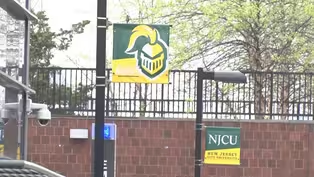
Briana: In our spotlight on business report tonight a path forward for cash-strap New Jersey city University, after six months of reviewing finances at the nearly 100-year-old higher education Institute.
I state monitor appointed said the college was survived but it will take more budget cuts, more state investment, and partnering with another University to secure their future.
The report comes a nearly two years after the school's Board of Trustees declared a financial emergency, replacing top leadership in slashing a number of academic courses to begin writing the ship.
Ted Goldberg has the story.
Ted: A state appointed monitor for NJCU says the university should state open despite a to mulch was financial situation.
>> It is essential that Institute of higher education such as NJCU needs to be in place to serve the myriad of students, particular those of first generation have long come to NJCU further educational opportunity.
Ted: Henry Amoroso released a fiscal accountability plan yesterday stating NJCU has made strides from the financial black hole it was in a few years ago and says windowing enrollment, bad real estate investments and financial mismanagement put the school more than $230 million in debt.
He credits the interim President from making hard choices and trying to boost enrollment.
>> He has reached out to high schools.
His team has gone out to try to recruit more students.
He has entered into agreements with the community college.
This has all serve the purpose beginning to stem the tide.
Ted: In response to the story, he sent a statement reading apart "we look forward to fully reviewing the state monitors fiscal accountability plan and its recommendations.
Our work will continue to be emboldened by our students faculty staff and community and local and state leaders who have unwaveringly poured so much into the unrelenting renewal of our indispensable mission."
The union representing NJCU faculty agreed sank the school did overextend and should try to sell or rent out some things you'd -- some buildings.
>> We had no reserves to hang onto unwise investments.
It is not a useful thing to do.
Ted: Other parts of the plan were more controversial, like when Amoroso said NJCU should consider sharing or merging programs with other schools.
>> -- students past, present, and still to come, to explore the opportunities that may combine a sufficient synergy to create something better, something that can achieve more as it relates to its mission and to the outcomes that we all want.
>> Thinking about a merger I think would be the kiss of death in terms of the identity of this institution.
Ted: A union negotiator says NJCU has a distinct identity in Jersey City which could be threatened by mergers.
>> The average family salary, income for students that attend NJCU is like $42,000 a year, impoverished, so the school has been a beacon of hope.
Ted: NJCU phased out on much of the third of its academic programs as part of budget cuts.
In February, Moody's upgraded their bond rating from negative to stable, showing the austerity measures could save the school, even if they're not out of the woods just yet.
For NJ Spotlight News, I am Ted Goldberg.
Briana: Wall Street stocks next after a winning session.
Here is where the markets closed.
♪ >> Support for the business report is provided by, Junior achievement of New Jersey, providing students with skills and knowledge to explore, choose, and advance their career paths for a bright future online at -- And by the New Jersey Chamber of Commerce, announcing its New Jersey business Summit and Expo March 26 on March 27 at Harrods in Atlantic City.
Event details online -- Briana: People who are deaf and hard of hearing in New Jersey could soon have more access to mental health services.
Including more professionals who are fluent in American sign language.
A bill that will go before lawmakers this week will require the state to not only recruit more of those providers but also ensure that they can communicate appropriately with patients.
Research shows that people who are deaf and hard of hearing are subject to more risks to their mental health and according to Tate health records there are roughly 850,000 residents across New Jersey living with varying degrees of hearing loss.
Our mental health writer Bobby Brier has been digging into the legislation and is with me for the latest.
Bobby, thanks so much.
This is an interesting topic.
Where did the need come from?
Are there not enough folks who are trained in this?
Bobby: Yeah, unfortunately that is really the case right now and it is kind of mirroring the mental health shortage were seen across the state and across the nation.
This is particularly a severe shortage, unfortunately, for folks deaf and hard of hearing.
Some experts I had spoken to mentioned that there are 10 Masters level mental health clinicians across the state who are fluent in American sign language to that point that folks who are well over 800,000 of whom are deaf and hard of hearing.
We are seeing those numbers don't add up when somebody needs the services, and a lot of times because there is that lack of services, that can really influence and aggravate anxiety, depression and many people.
Briana: Wow.
I don't want to understand a one million in need in less than 10 providers, so why is this population at a greater risk?
What is it about it that is really exacerbating mental health issues?
Bobby: There are different factors.
One that is most important is the communication barrier in a lot of different aspects.
A lot of times if somebody needs to reach out for help, if they do not have an interpreter or somebody who is able to help them through that process, that cut often times lead to heightened anxiety and depression.
There is also living in a world when there are many people part of the hearing population.
That can often exacerbate those challenges as well, so there are a number of different layers to this with the communication barrier being the most prominent.
Briana: And so isolating especially coming out of these past few years, and not necessarily having the right avenues to go down.
Bobby: Yes, folks have spoken about the exacerbation of these mental health issues under the pandemic and it only made things worse.
You know, this bill, advocates have said it would be a step in the right direction to retain more mental health professionals fluent in American sign language in different sign systems, and they would also be requiring the state to have a deaf services coordinator that would be a state official who essentially would oversee the implementation and hiring and retaining of these mental health professionals to ensure more people receive more services.
Briana: So where does the bill stand as it goes before a Senate committee this week?
What is the plan there?
Bobby: It is up in front of the committee tomorrow.
You know, there has been widespread support leading to the hearing tomorrow.
After that, it will make its way through the Senate, simply, but there is a question of funding and where that will go from here.
We know we have an upcoming budget and what that may mean.
Briana: Is it limited to mental health care?
Because we know statewide there is a lack of specialized care, especially when you are talking about these populations?
Bobby: Right.
It would be in certain cases primary health care, but particularly focusing on mental health care for this bill in particular.
Briana: Is there any estimate at this point about how much state funding would be needed, because were not just talking about hiring these folks but they have to be trained in what you and I were talking about different dialects of American sign language?
Bobby: Right.
Right now the staple makers I spoke to were not specific on the amount of funding that would be needed to go towards it but it would have to be substantial, to your point, to hire and retain pokes.
One person I spoke with who hires folks in Pattison spoke about how difficult it is to find people to fill the slots.
Often times taking up to a year to find somebody, so there is the time issue and money issue as well.
Briana: That is significant for sure.
Bobby Brier will be following this hearing.
Thank you so much.
Bobby: Thank you.
Briana: that would do it for us tonight but don't forget to download the NJ Spotlight News podcast to listen anytime.
I am Briana Vannozzi Briana Vannozzi for the entire NJ Spotlight News team.
Ask for being with us.
Have a great evening.
We will see right back here tomorrow.
♪ >> New Jersey education Association, making public school grade for every child, and RWJBarnabas Health-- let's be healthy together.
♪

House passes bill that could ban TikTok
Video has Closed Captions
Interview: Nadine Farid Johnson of Knight First Amendment Institute at Columbia University (7m 11s)

Muslims in NJ celebrate Ramadan amid difficult times
Video has Closed Captions
Islamophobia and the Israel-Hamas war has shifted the tone of the holy month (4m 11s)
New Jersey City University should stay open, monitor says
Video has Closed Captions
But recommends cash-strapped NJCU consider merging programs with other school (4m 20s)

NJ law looks to expand services for deaf community
Video has Closed Captions
Legislation to expand mental health services for people who are deaf or hard of hearing (4m 46s)
Proposed changes to NJ's public records law draw pushback
Video has Closed Captions
Government transparency advocates, media organizations, residents object (4m 14s)
Providing Support for PBS.org
Learn Moreabout PBS online sponsorship
- News and Public Affairs

Top journalists deliver compelling original analysis of the hour's headlines.

- News and Public Affairs

FRONTLINE is investigative journalism that questions, explains and changes our world.












Support for PBS provided by:
NJ Spotlight News is a local public television program presented by THIRTEEN PBS