NJ Spotlight News
NJ Spotlight News: March 14, 2024
3/14/2024 | 26m 46sVideo has Closed Captions
Watch as the NJ Spotlight News team breaks down today’s top stories.
We bring you what’s relevant and important in New Jersey news, along with our insight. Watch as the NJ Spotlight News team breaks down today’s top stories.
Problems playing video? | Closed Captioning Feedback
Problems playing video? | Closed Captioning Feedback
NJ Spotlight News is a local public television program presented by THIRTEEN PBS
NJ Spotlight News
NJ Spotlight News: March 14, 2024
3/14/2024 | 26m 46sVideo has Closed Captions
We bring you what’s relevant and important in New Jersey news, along with our insight. Watch as the NJ Spotlight News team breaks down today’s top stories.
Problems playing video? | Closed Captioning Feedback
How to Watch NJ Spotlight News
NJ Spotlight News is available to stream on pbs.org and the free PBS App, available on iPhone, Apple TV, Android TV, Android smartphones, Amazon Fire TV, Amazon Fire Tablet, Roku, Samsung Smart TV, and Vizio.
Providing Support for PBS.org
Learn Moreabout PBS online sponsorshipAnnouncer: Major funding for NJ Spotlight News is provided in part by, NJM Insurance Group, serving the insurance needs of residents and businesses for more than 100 years.
And - And by the PSEG foundation.
♪ BRIANA: Tonight on "NJ Spotlight News," a new report from Rutgers University finds that the CDC is overestimating the maternal mortality rate in the United States.
>> We were actually stunned The maternal mortality rates.
Eddie: is not as bad as has been previously thought.
BRIANA: Plus, the controversial bill targeting government transparency is of the table.
>> It was 95% in opposition to this bill, and while the road to reflect that in the committees, I think the pressure has continued to be on for days.
BRIANA: Also, it arrived together has arrived in Morris County.
The program Paris police officers with mental health specialist with the goal of bettering safety outcomes for residents in crisis.
And, no more double Frappuccinos or Venti Lattes in Trenton.
The only Starbucks entire is closing its doors, after promises to help revitalize the state's capital.
>> There has been a lot of businesses that have closed in downtown Trenton.
BRIANA: NJ Spotlight News begins right now.
♪ Announcer: From NJBS studios, this is "NJ Spotlight news" with Briana Vannozzi.
♪ BRIANA: Good evening and thanks for joining us this Thursday night.
I'm Briana vannozzi.
Rising maternal death rates across the U.S. may be sharply overestimated.
A new study co-authored by a researcher at Rutgers University is challenging the CDC's data on maternal health statistics, citing flood record-keeping for including the scale of the crisis, all due to the ways that data is reported and analyzed.
According to the CDC's analysis, the U.S. maternal mortality rates more than tripled over the last 20 years to just over 32 deaths per 100,000 live births.
Far higher than any other developed nation.
But the records report shows that rate is actually much less, closer to 10 deaths per 100,000 births.
Still, as Senior correspondent Brenda Flanagan reports, troubling racial disparities persist even with an overall lower number.
Reporter: for years, U.S. news outlets duly reported alarming CDC data on maternal mortality -- the latest showed almost 33% deaths for every 100,000 live births, double or even triple the rate in similar wealthy nations.
But why?
Researchers who recently reviewed the CDC statistics found mistakes.
Data collection so flawed that it artificially inflated U.S. debt for its.
>> We were actually stand when we saw that, partly because the rates were so low when we did the corrections.
Maternal mortality rates in the United States are not as bad as has been previously thought.
Reporter: The records researcher and fellow scientists took a deep dive into how the CDC compiles the U.S. maternal mortality rate.
Their report in this week's American Journal of Obstetrics and Gynecology highlighted some egregious errors.
For example, the deaths of 147 very elderly women.
>> We found data where pregnant females aged 85 years who died, being attributable to a maternal death.
Reporter: Another problem they discovered, fatal accidents with pregnant victims should not have been logged as maternal deaths, but a so-called pregnancy checkbox added to U.S. death certificates in 2003 caused confusion.
After researchers weeded out the mistakes, the results cut CDC maternal death rates in half from 23.5, down to just over 10 per 100,000 live births from 2018 2021.
>> The revised rates are now very comfortable and well within range of most of the data that comes from industrialized countries.
Reporter: In response, the CDC admitted its pregnancy box is sometimes mistakenly checked, but disagrees with the findings, indicated the report of a substantial undercount.
That's because there are maternal deaths occurring that wouldn't otherwise be identified if the death certificate didn't include a pregnancy checkbox.
But the researcher also found that even corrected data still shows deep racial inequities in maternal health care, death rates three times higher for Blacks than whites.
Sadly, he was not surprised.
>> Structural racism is another issue we are dealing with in this country.
>> We rely on quantitative data -- qualitative data, which is the storytelling from women in the community, and the story I am hearing from them is that there is still a major problem.
Reporter: Jersey advocates say the report does restructure data so it can help focus more resources on continuing health problems.
>> There was a section in the article that talked about preeclampsia and hypertensive disorders in Black Women, and that has been our major push as an organization, is calling attention to that.
>> And so where maternal mortality is one measure, we do prefer to look at measures that provide a broader view of those birthing experiences and the overall quality and safety of their care.
Reporter: In New Jersey, in maternal committee examines medical records in every single case.
The latest figures found 35% of maternal deaths within a year of pregnancy showed direct complications.
Doctor Kemi Alli served on the committee.
>> And I know in the meetings I was in that there was really in-depth discussion around that and making sure we checked the box of well, is pregnancy-associated, versus real maternal mortality.
So I think New Jersey has created a real roadmap that other states could follow.
Reporter: The state has also recently launched several programs designed to offer wraparound maternal health care.
I am Brenda Flanagan, NJ Spotlight News.
BRIANA: The highly controversial bill to reform New Jersey's Open Public Records Act got derailed in Trenton today, just one hour before lawmakers in the assembly Appropriations Committee were scheduled to vote on changes to the OPRA bill, top legislators folded and said they needed more time to work through amendments.
It comes after intense backlash from the public, watchdog groups, and journalists who argue the bill would gut government transparency and make it harder for the public to access important documents.
Senior writer Colleen O'Dea is with me now for the latest.
A bit of an upheaval in Trenton today.
Why was this bill pulled?
Guest: So on Monday, there were hearings in two committees and there were many, many dozens, I didn't even try to count, people, including just regular folks not just people representing organizations, who came out in opposition to this bill.
Senator Sarlo, who is the sponsor in the Senate, recently put out a statement that people testified on both sides -- and that is technically true, but it was 95% in opposition to this bill.
And while the vote did not reflect that in the committees, I think the pressure has continued to be on for days and the leaders of the house thought, maybe we should take a step back, as everyone is saying to do, and try to work on some amendments that will work for people.
BRIANA: For critics of the bill, is this considered a victory?
What happens next?
Guest: They are uploading that we are taking a breather here and taking a step back but it remains to be seen whether stakeholders are going to be brought to the table as a speaker Coughlin said in his statement announcing that the bill was not going to be heard today.
I think one of the complaints -- there were a bunch of people on a call yesterday, activists complaining about the legislation.
Many said that there were some discussions over the summer about this, but that anything that was brought up was not included in the bill.
So, based off of that -- they really were not questioned about this before it came forward.
They want to have a say in what this bill is going to do.
BRIANA: Is there any indication that those stakeholders will get an opportunity to be part of the reform process?
There was an op-ed from Mark Pfeiffer at the Blaustein school, who essentially helped to craft what is the OPRA bill, saying this process was always meant to have these stakeholders at the table in order to serve those who use it.
Is there any indication from legislative leaders that that is going to happen?
Guest: Not yet, except that the speaker said they should be brought to the table.
So it seems as if he is giving a commitment that that will happen.
If they don't, you know people will not know about it because people will continue -- you know that we will know about it because everyone will continue to speak out about it.
But, yes, Mark Pfeiffer's Op-ed dropped today.
He also sent letters to all of the legislators.
So perhaps that had a little bit of an influence in terms of saying this really needs to take some time.
The current OPRA law that we currently have was worked on for the more than a year.
It wasn't something that was tried to be rammed through within a couple of weeks.
BRIANA: In this instance that is a lot of what was brought up in terms of people not even having a four-week today just what is a pretty extensive piece of legislation.
Guest: Right, and what we had expected today was that there would be some amendments that would not be available online before the bill was heard.
Maybe they would be available to people in the room on paper.
No one will have had time, including members, to look at that before they are asked to vote on it.
Is that the right way to craft legislation?
I think the answer is pretty obvious.
BRIANA: Colleen O'Dea for us.
We will stay on this, thank you so much.
Guest: Thank you.
Another hotly debated issue that did get a hearing today in Trento revolved around the state's school funding formula which has been contested for years, because the method of dividing the state aid means some district have gained funding for each of the past several years, while others continue to see cards.
As Melissa Rose Cooper reports, that is still the case even after New Jersey's governor proposed a record investment in the education system in his most recent budget.
>> One of the few constants I have seen is the chaos that comes every March as numbers are released and we are unsure as to what our budget will look like.
Reporter: Educational leaders gathered in Trenton to discuss New Jersey's school funding formula.
The calculation has been raising concern for years over there way the money is dispersed.
>> With eight essentially, to an end with the reconfigurations of the numbers this year and more than a decade's worth of data on how the formula has impacted districts, I think we should start taking the steps to modernize the formula.
Reporter: Leaders say the unpredictability of the formula results in a negative impact.
>> The share created a perpetual cycle of funding laws for these districts.
This, combined with the manner in which the funding formula assesses valuations, has put districts and populations where property taxes may decrease, but so do support for their students, their overall staff, and course offerings.
In conjunction with increased crisis, these printer compromise the future success of the students.
>> Four years ago in fiscal year 21, there were 21 school districts in the state that saw an increase in their equalized valuation of 10% or more.
21 school districts statewide.
Last year at Fiscal Year '24, that number skyrocketed to 322 school districts that saw an increase in their equalized valuation of 10% or more.
So that significant impact of increasing property value is driving up the local share, in turn driving down aid and we are seeing it widespread and more significant around the state.
Reporter: The school funding formula aims to create equity, but leaders say it doesn't always get things right.
>> In my hometown of Long Branch, they gained about $600,000 last year, and lost $10 million this year.
That is a $10.6 million swing in one year.
To get that information in early March and to be told you have to do our budget to cut $10 million, 20% of your budget, in a couple of weeks, I think, is not practical at all.
So I think there is a lot we need to do.
>> We need to take a holistic look at the formula and make the adjustments as a package.
I agree already with what I have heard today, and I suspect I will agree with all the recommendations.
We do not believe they should be done piecemeal, however, because there's imports, outputs, and expectations placed upon the formula of what it should provide for education.
Each time you change one piece, you change the impacts of the other.
So our strongest recommendation is not to do individual bills, fixing a little bit here and a little bit there, but take the time to do a holistic evaluation, come forth with comprehensive recommendations, understanding that we one piece impacts the other and put forth solutions that will set us up for success for the next decade or 15 years.
Reporter: Governor Murphy recently proposed an increase of 908 million dollars in school funding for Fiscal Year 25, for a record total of $11.7 billion.
It is pending review by the legislature.
.
Educational leaders are hopeful the formula can be adjusted to all districts will truly get their fair share.
For NJSpotlightNews, I am Melissa Rose Cooper.
BRIANA: Morris County is the latest area to launch the Attorney General's arrived together program, partnering police with mental health professionals when responding to press his pulse.
The program began as a pilot in 2021 in Cumberland County and is now active in all 21 counties throughout the state, part of an effort to help de-escalate durations involving law enforcement and members of the public in distress.
As senior correspondent Joanna Gagis reports, Morris County is taking a different approach and how they will rollout the model.
>> It is shocking with the violence that occurs with law enforcement, almost two of those incidents involve persons suspected of having a mental health challenge.
Reporter: Situations officers are not adequately trained to respond to, says this Prosecutor.
>> Coupled with domestic abuse, domestic abuse, domestic violence situations, and situations in officer particularly is facing when he is dispatched to a call, we have recognized that professional screeners, mental health screeners can be of extremely valuable use in responding to these situations.
Reporter:.
Reporter: Morris County is participating in the Attorney General's Arrive Together program, where officers and mental health care providers respond to 911 calls together, although in this case they don't use a co-response model.
This case, mental health professional arrives on the scene within 30 minutes of an officer's arrival.
Morris County recently partnered with the mental health Association of Essex and Morris counties on the program.
>> We have people who are basically embedded in a number of different terms, one day a week, and -- different towns one day a week and they rotate.
They respond to calls with law enforcement and when the art there in, what they will do is the officers will provide the information to our clinicians, so they can do follow-up work afterwards.
Reporter: Right now funding for the program only covers two clinicians who work from 7:00 a.m. to 3:00 p.m. Monday to Friday.
But that follow-up work is a critical piece, ensuring somewhat in crisis get connected to resources and, in turn, freeze up officers to handle more pressing matters.
>> Auto theft is huge throughout the state of New Jersey, so we want to focus on a proactive presence in communities and neighborhoods deterring those activities.
But towns everywhere are dealing with manpower shortages.
If we can just take a component of what we do every day and have the appropriately trained and certified individuals to deal with those issues, officers can focus on our communities a little bit more.
>>.
>> By working together, it really benefits the person who called, at least to begin with.
As a result of that, people are arrested less, people are incarcerated less, the officers have to use less force, the people are more likely to be engaged in treatment.
Reporter: Today officers and other emergency responders underwent crisis intervention training alongside those mental health professionals where they were taught techniques to identify and deal with a range of mental illness and special needs.
>> What schizophrenia looks like.
What you would expect to see with somebody who is bipolar when they are in a manic stage.
Somebody who is suffering from anxiety or depression.
We talk about perinatal depression and anxiety.
We talk about autism.
>> Officers are taught that the two biggest skills that they have, the two tools that they have when they arrive on the scene is time and space.
There is no reason to rush to intervention, and there is no reason to get to close.
Reporter: Are lives saved in this process?
>> Without question.
Without question.
The Reporter: Mental health Association is in the process right now of hiring two more clinicians.
They are hoping more money comes their way in the next budget to staff overnights and even a weekend shift.
In Morristown, Joanna Gagis, NJ Spotlight News.
BRIANA: In our Spotlight on Business Report, to Sam, it is just coffee, but for some people in Trenton, having a Starbucks in the capital city was a sign of economic progress.
So it came as a blueprint the country largest coffeehouse chain announced it would close Trenton's only store by the end of the month, which served more than drinks with fancy names, but hope that fertility for many of the city's youth.
Erin go Bragh reports.
>> It will certainly leave a gapping hole in the city if they leave.
TED: Trenton could become one of the few state capitals without a Starbucks.
>> It will be sad to see them go.
I like going to Starbucks, they make good coffee.
There has been a lot of businesses that have closed in downtown Trenton.
So it is hard.
>> It brings a lot of foot traffic.
It is going to hurt the downtown economy.
Reporter: Earlier this week Starbucks said it would close the only store after only several years in business.
Folks working at a nearby coffee shop were sad to hear that, even with a bump in customers needing coffee.
>> I can't describe it any other way besides shock and disappointment.
It was more than just about coffee.
It was about a place for the community.
>> they gave out jobs for the Black and Brown communities.
So it is heartbreaking to know that there are kids there who depend on the benefits like tuition for school.
They're able to go on to other business opportunities.
So this has been a wonder to a lot of disadvantaged youth in the capital city.
Reporter: Mayor Reed Gusciora hopes Starbucks will change its mind, ready and open letter to the CEO.
Part of it says, quote, "this particular location has been a beacon of hope and opportunity for many young workers, particularly those from disadvantaged backgrounds in our Black and Brown neighborhoods.
The closing represents a setback in our collective efforts to uplift and empower our residents.
Are employed you to reconsider this decision."
Congresswoman Bonnie Watson Coleman also sent him a letter asking, given the clear and obvious alignment of the Trenton location's performance with the growth of the community store program, is this a signal from Starbucks that "you are moving away from your stated commitment to supporting and uplifting underserved communities?"
>> It has had that Starbucks effect where a lot more businesses have opened since 2017 and they feed off of each other.
>> This Starbucks has really been a beacon for the community in terms of supporting local artists, also supporting local businesses, as well.
Reporter: This location was branded as a community store, operating in distressed cities to help give young people their first jobs.
If this store closes at the end of the month, people have ideas for what should replace it.
>> If we can get an organization, a retailer that will track costs -- attract customers, that is what we need.
>> Some kind of food option, another café or another local lunch spot will be great.
>> As long as it is beneficial for the community, especially the kids and teenagers around this area, they need something they can rely on to get them off the streets and doing things they don't need to be doing.
>> This has a lot of possibilities, it's a highly trafficked intersection.
We hope will be able to fill it.
Reporter: In response to the story Starbucks sent a statement reading, in part, "we want to thank our Trenton neighbors for the last six years.
We are continually evaluating our portfolio to make sure it is meeting the needs of our customers and our communities."
They also say that 10 or so employees will be up for jobs at nearby locations, after the store closes on March 30.
In Trenton, I am Ted Goldberg, NJ Spotlight News.
BRIANA: The Royals and the knight fought a good battle, but the union campaign is over at the Medieval Times.
The American Guild of Variety Artists says it will no longer represent workers at two of the company locations, one in Lyndhurst, New Jersey, the other in Southern California.
Two years after voting to unionize, neither group was able to secure a collective bargaining agreement.
We covered their efforts in 2022 to lock in higher wages and improve safety culture for the actors, crowds and horses used in those epic tournaments.
The medieval termites pushed back against organizing efforts and allegedly engaged in a number of unionbusting practices, like giving raises to castles that didn't pursue a union.
It comes at a time when employees at other former nonunion companies like Amazon and Starbucks have had major union election victories, but they are in better contract battles with their employers.
On Wall Street, stocks tumbled today after a new inflation data showed wholesale prices are still stubbornly high, jumping 0.6% in February.
The market closed.
♪ ANNOUNCER: Support for the "Business Report" provided by the New Jersey Chamber of Commerce announcing its real New Jersey business Summit and Expo from March 26-27 at Harrah's in Atlantic City.
Event details, online at njchambers.com.
♪ BRIANA: And make sure to tune into "NJ Business Beat" with Raven Santana this weekend.
She marks women's History Month by assessing the health of women -owned businesses in New Jersey, and how this generation of women are paving the way for new entrepreneurs.
Watch it Saturday morning at 10:00 a.m. on the NJ Spotlight News Youtube channel.
♪ BRIANA: And finally tonight, spring is knocking on our door.
Today topped off what has been a welcome string of unseasonably warm weather.
For North Jersey, it was the warmest day of the year since October.
Forecasters say that sunshine put us about 20 degrees above normal temperatures time of year, peaking at just over 70 degrees.
But changes are ahead, with a slow-moving cold front headed our way to start the weekend and possibly even some rain showers and a cool down to end our final week of winter which overall, was pretty mild with much more rain than snow.
All on par with records from NOAA, which showed 2023 was the earth's hottest year on record, by far.
That will do it for us tonight.
But make sure you catch "Reporters' Roundtable" tomorrow.
David Cruz talks with gubernatorial candidate and Jersey City Mayor Steven Fulop, about the push to abolish the party line, where he is against the OPRA reforms, and the status of his campaign.
And then, local reporters break down this week's political headlines.
Tomorrow at noon on the NJ Spotlight News Youtube channel.
I'm Briana Vannozzi.
For the entire NJ Spotlight News team, Thanks for being with us.
Have a great night.
We will see you tomorrow.
♪ Announcer: New Jersey Education Association, Making public schools great for every child.
And, RWJ Barnabas health.
Let's be healthy together.
♪
Arrive Together initiative launches in Morris County
Video has Closed Captions
The program is now active in all 21 New Jersey counties (4m 13s)
NJ’s school funding formula takes a beating from advocates
Video has Closed Captions
Committee hears how some schools gained funding and others continue to see cuts (4m 10s)
OPRA reforms bill pulled after fierce backlash
Video has Closed Captions
NJ lawmakers pull controversial reforms to OPRA bill (4m 40s)
Researchers question CDC data on maternal deaths
Video has Closed Captions
CDC disputes the findings (4m 57s)
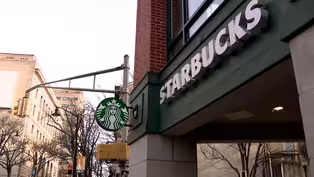
Trenton leaders decry Starbucks’ plan to close downtown shop
Video has Closed Captions
The coffee shop on South Warren St. was seen as an anchor in city’s revitalization (4m 17s)

Union campaign at Medieval Times ends
Video has Closed Captions
Workers at Lyndhurst location were among those who sought collective bargaining agreement (1m 24s)
Providing Support for PBS.org
Learn Moreabout PBS online sponsorship
- News and Public Affairs

Top journalists deliver compelling original analysis of the hour's headlines.

- News and Public Affairs

FRONTLINE is investigative journalism that questions, explains and changes our world.












Support for PBS provided by:
NJ Spotlight News is a local public television program presented by THIRTEEN PBS