NJ Spotlight News
NJ Spotlight News: March 20, 2024
3/20/2024 | 26m 46sVideo has Closed Captions
Watch as the NJ Spotlight News team breaks down today’s top stories.
We bring you what’s relevant and important in New Jersey news, along with our insight. Watch as the NJ Spotlight News team breaks down today’s top stories.
Problems playing video? | Closed Captioning Feedback
Problems playing video? | Closed Captioning Feedback
NJ Spotlight News is a local public television program presented by THIRTEEN PBS
NJ Spotlight News
NJ Spotlight News: March 20, 2024
3/20/2024 | 26m 46sVideo has Closed Captions
We bring you what’s relevant and important in New Jersey news, along with our insight. Watch as the NJ Spotlight News team breaks down today’s top stories.
Problems playing video? | Closed Captioning Feedback
How to Watch NJ Spotlight News
NJ Spotlight News is available to stream on pbs.org and the free PBS App, available on iPhone, Apple TV, Android TV, Android smartphones, Amazon Fire TV, Amazon Fire Tablet, Roku, Samsung Smart TV, and Vizio.
Providing Support for PBS.org
Learn Moreabout PBS online sponsorship>> funding for NJ Spotlight News provided by the members of the New Jersey education Association, making public schools great for every child, and by And RWJBarnabas Health, let's be healthy together.
Briana: Tonight on NJ Spotlight News -- Jumping on the bandwagon.
>> they can count on us for being good partners.
Briana: Plus the Democratic candidates running to replace embattled U.S.
Senator Bob Menendez have been sucking up all the oxygen in the race, but the race between GOP contenders is also heating up.
>> You are well-positioned as the front Rayner -- front runner where you have infrastructure to complete statewide.
Briana: Governor Murphy's sides landmark legislation developing a new system to address the affordable housing crisis.
>> For the next decade in the decades after, we will be ensuring that more New Jerseyans can move into safe communities that they love.
Briana: And preventing wildfires.
>> When people think of wildfires, particularly in the Beltway, they think of Wyoming and California.
New Jersey has over 1000 wildfires, sometimes 1500 year.
Briana: New Jersey Forest Service looking to fight fire with fire.
NJ Spotlight News begins right now.
♪ >> From NJPBS Studios, this is NJ Spotlight News, with Briana Vannozzi.
Briana: Good evening and thanks for joining us this Wednesday night.
I am Briana Vannozzi.
This could spell the end for New Jersey's century-old party line.
In a rear joint statement Tuesday night, leading members from both political parties of the state legislature thou to address New Jersey's controversial ballot design, which critics say favor parties office and the candidates they back.
In a letter, the Senate President, simply speaker Craig Koplin, Senate Minority Leader, and others acknowledge they " listen to the public debate about the ballot structure," and added any changes would best be handled by the legislature, which they are prepared to.
The statement comes after a lengthy federal court hearing brought by Andy Kim to abolish the line, as he runs in a heated U.S. Senate primary against first lady Tim Murphy.
Kim claims the line gives the first lady an unfair advantage.
Governor Murphy staunchly backed the line.
Gov.
Murphy: I get the reason why it has come into place, but have I been open-minded from the get go to tweaks that could make this system better than it is?
Absolutely.
If the legislature wants to proceed in that process, they can count on us for being good partners.
Briana: Clinical analysts say a change to the partyline on the ballot could have a significant impact on the primary.
Senator Bob Menendez is staring at a Monday deadline to file for reelection and told NJ Spotlight News he will make an announcement on his plans this week.
In majority of Senate Democrats had urged him to resign.
So have Republicans, including GOP contenders in New Jersey's primary, who may see an opening of the dysfunction on the Democratic side.
Senior correspondent Brenda Flanagan has an update on the GOP race.
Mr. Bashaw: we are well-positioned as a front runner to compete statewide.
Brenda: Republican Curtis Bashaw 's confidence is high as he campaigned for a seat now held by Senator Bob Menendez.
Seeking the coveted County line on jerseys June 4 primary ballot even as Democrats battle in court over whether that system unfairly favors candidates picked by lyrical bosses.
Mr. Bashaw: well, it is a huge irony.
Brenda: Indeed, he has no qualms playing by those rules because the County convention process a participation in democracy.
Mr. Bashaw: Different counties have different bylaws.
I thought it was very democratic.
These committee people are elected to their job to help the Republican Party that they are competitors.
So I found it invigorating, exhausting, challenging, a very exciting process.
And what happens now remains to be seen.
Brenda: The Republican contest pits Bashaw, a self-described moderate, against two candidates, one who won the line in Bergen County last night, and former order Alex sedan.
As it stands, 12 have picked Bashaw, five Cerrado Glassner.
Analyst Chris Russell set that up.
Chris: I think with South Jersey and a big fish like Ocean County, I think Bashaw is your leader in the clubhouse, as they say, but Glassner is a contender.
Brenda: Meanwhile, Jersey legislative leaders including Republican say they intend to control ballot reform efforts but if the court strikes down the County line, candidates will have to compete for name recognition.
That is expensive and time consuming.
>> It does become a completely different race overnight.
Throws it into the same kind of turmoil and chaos, but on the Democratic side at least, Andy Kim and Tammy Murphy both have the kind of money to compete statewide.
I think on the Republican side, there are going to be scrambles.
Brenda: Bashaw says he could sell finance, while some call him a defective Democrat who did not vote for Trump and he now supports Trump at the top of the ticket.
Why?
Mr. Bashaw: I think President Trump has been vindicated on many issues, and as people try to make a label out of something that is simply not true or exaggerated is a distraction from the fact that they don't have the infrastructure to run a statewide campaign.
Brenda: Zdan did not respond to requests for interview, and Serrano Glassner was not available.
A Trump endorsement could be a game changer in this primary race.
I'm Brenda Flanagan, NJ Spotlight News.
Briana: In what is considered a milestone for New Jersey's affordable housing program -- problem, Governor Murphy today signed a bill overhauling how towns up and down the state will determine the number of affordable units they need to fulfill a cost usual obligation.
The framework is considered one of the strongest in the country and sets up a formula to help municipalities figure out their share of homes for low and moderate income families in the state.
Senior political correspondent David Cruise reports even those on board with the legislation say it is not a cure-all.
David: Joe Biden when he was vice president said something, this is big, today is a big landmark, you can fill in the blank.
This is a landmark day by any measure.
David: Governor Murphy respect to Joe Biden's exuberance about Obamacare some years ago to fully express his exuberance at today's bill signing, for a problem that has plagued New Jersey for a generation now, legislative fix came with lightning quickness for a bill in Trenton.
Findlay sponsored Yvonne Lopez has been working on one version or another of his bills and she got into the assembly in 2018.
Asw.
Lopez: Thank you for being here today.
I appreciate all of your support.
It is emotional right now.
Thank you so much.
David: Lopez fought back some tears, especially being in her hometown today, where she says bringing stability to the community depends on maintaining its economic diversity.
Asw.
Lopez: It has been a long journey for everyone involved, however, for the next decade and a negative after, we will be ensuring that more New Jerseyans can move into safe, thriving, communities that they love.
>> Today inciting this bill, New Jersey makes a choice to embrace diversity, dynamism, and dignity of families like the people who live and work in the city, and we choose those values as more important than the walls that divide us.
David: The bills abolish the Council on affordable housing.
It also more directly involves the Department of community affairs in the process and makes the courts and arbiter of last resort, which they hope cuts down on Lawson's.
With estimates that New Jersey needs to build more than 200,000 as of affordable housing to meet the growing need, the speaker says the new set of bills will have a profound impact on that number, though he could not quite quantify it.
Speaker Coughlin: literally decades of litigation, fighting, people trying to avoid providing housing for people.
All of that stuff is really helped bring everybody together.
David: Even some Democrats have had a bone to pick with the bills.
Jersey City Mayor Steve Phillips says big cities like his should not be exempt under so-called urban eight extension.
MayorFulop: urban eight exemption is built on the assumption that we have enough affordable housing.
It is wrong and the fact is we are thriving and we should list every climb.
David: Beyond the affordable housing crisis, cities like Newark, Pattison, and others face the often forgotten crisis of low income and subsidized housing, housing for the most challenged, the poorest, and the unhoused.
Speaker Coughlin: I think something like homelessness is a scourge on the state of New Jersey.
We are our brothers and sisters keeper.
As I said at the end, we are all better when everybody is in a good place, when they are well fed, have a place to live, they have health care.
All those things.
So this is not the end.
David: True, but a bill as monumental as this one only serves to show how far the state still needs to go to make sure that everyone has a place to call home.
I'm David Cruz, NJ Spotlight News.
Briana: The pandemic put into sharp focus how deep health disparities run in the state.
Low income, Black and brown residents, a recent response to the Covid crisis highlighted help critical it is for public leaders to address that feud at a health symposium today, experts in research, public policy, and community health came to get into it and if I existing problems and work to solve them.
Melissa Rose Cooper reports.
>> There were a couple of very large grants that we were going to apply with you will, too, but we couldn't because they are self recipients.
Melissa: A day of conversation and exchange of ideas as members of the medical community attended this symposium at Rutgers New Brunswick.
>> We commemorate a decade of growth and progress but also to affect on the -- reflect on the challenges as we address the critical issue of health inequities.
Melissa: They have existed for quite some time but were highlighted even more during the pandemic.
Mary: We continue to see challenges with health inequities in the state of New Jersey, which is a phenomenon not just in our state but as a country and our world.
But what I think we tend to see is we do make progress in improving health for people in different populations, but the gap between different subsets of our population persist.
>> Statistics like Black people living in the United States, their life expectancy is four times lower than that of white United States residents.
That people of color in our state in New Jersey were two times to three times more likely to die or be hospitalized during the pandemic than white New Jersey residents.
Like many people talk about today, pregnancy mortality is three times higher for Black and Brown women than for white women.
Melissa: Her decision to enter a career in medicine has always been driven by the need for equity, having been raised in rural America.
>> Growing up in Southeast Ohio, I witnessed inequities and had troubles limiting the inequities I saw around me.
And that range found just poverty to seeing as a kid I when I was young get on the school bus without shoes on one day, to hearing, you know, racial statements or racial slurs when I walking through the town.
And all of those, from a very young age, just sat uncomfortably with me, and I decided, from being imprinted at that young age, I do that we are people in that out had so much more to do with where they started and what we throw at them in the world than anything else.
Melissa: Health advocates believe instead of just documenting disparities, tackling the root of the problem means healing and solutions to me the communities since a one-size-fits-all approach does not work.
>> Some>> of the researchers here at Rutgers University are learning how different communities use technology different, through different cultural groups, differently with this, so we have to think about how we use those tools to meet the needs of that population and understand how they are using those tools differently.
I think that is a great example of how both understanding through research is really important to than executing public health initiatives and in diversity of different ways.
Melissa: Staff at Rutgers are hoping the supposing will lead to significant change, so all residents can have access to the high-quality care they deserve.
For NJ Spotlight News, I'm Mel Melissa Rose Cooper.
Briana: President Biden makes his biggest move yet on the climate.
The White House today set the nation's strictest rules yet on vehicle emissions, requiring gasoline-powered models to slash pollutants and carbon dioxide to slope the planet's warming.
They will accelerate the transition to electric vehicles but unlike last year's proposal, that won't need to happen until after 2030.
The new environmental protection agency rules come after a year of intense lobbying between the Biden administration and labor union and will likely face legal challenges.
For more details, I'm joined by Doug O'Malley, the president of ChargEVC, an electric vehicles coalition.
Doug O'Malley, good to have you on the show.
Correct me if I'm wrong.
This is a less aggressive plan than the president originally put out, but does it still achieve the same goals when it comes to cutting emissions?
Doug: Yes.
This plan that President Biden and his administration announced today in Washington will be the single most significant regulation in history to reduce climate pollutants.
It will take a little bit longer to ramp up, but it will get to the right place at the end of the day, and that is really critical, because we are at a moment right now of an inflection point where across the country, we need to be getting more drivers behind the wheel of electric vehicles.
Briana: What does it apply to, though, because there are some stipulations around not all electric vehicles but also some carveouts for hybrids and plug-ins.
Can you explain that?
Doug: Yeah.
It is important to know that the transition to electric vehicles, it could be multifaceted.
Your pure battery electric vehicle, those are ones that have the best bang for your buck for consumers, that save the most amount of money, and get just a pure driving experience of an electric vehicle.
That being said, some people will prefer the plug-in hybrid.
Those plug-in hybrids will be part of this regulation.
They are part of New Jersey's clean car standards.
For those drivers that are really worried about guidance, that is a good middle ground.
This regulation that the EPA is moving forward on really is doing the right thing for the climate, for air pollution, and it is providing the path forward to accelerate electric vehicles all across the country, not just in New Jersey.
Briana: But it is not, as some states are doing, including a mandate on auto manufacturers stop the production on gas-powered vehicles.
Yes, it is working around that a bit more.
Doug: That's right.
It is important to know that New Jersey for two decades has been stronger than what the federal government has required, and 40% of the auto market is now in states just like New Jersey that have strong clean car standards.
We need to make sure we are raising the floor.
If you are in Texas, Pennsylvania, Alabama, you, too, should have the option to have an electric vehicle.
This regulation as it stands will actually save drivers $6,000 a year of which decreased maintenance costs.
This is a reminder that electric vehicles are not for their future anymore.
They are here.
But we want to make sure that they are more accessible and available for consumers across the country.
Briana: How many more electric vehicles do we expect to have on the road by 2030 because of this rule, and how much emissions do we expect to be cut?
Doug: This is why this rule is so significant.
The rule does ramp up a little more slowly this decade and has a steep ramp up after 2030, but by 2032, more than half of the new cars sold in the United states won't most likely be zero emission vehicles -- United States will most likely be zero in mission vehicles, in order of the emission standards.
That will have a huge climate benefit.
More than 7 billion tons of carbon dioxide over the next 30 years.
That is the equivalent of removing a year of greenhouse gases in this country.
When we talk about the climate crisis, these are the kind of actions we need to take.
Briana: Doug O'Malley is the director of Environment New Jersey.
Thanks so much.
On Wall Street, stocks popped today after the Federal Reserve held interest rates steady and stoked to its projection of three rate cuts this year.
Here is how the markets closed.
♪ >> Support for the business report provided by the New Jersey Chamber of Commerce, announcing its New Jersey business Summit and Expo, March 26th and 27th at Harrah's in Atlantic City.
Event details online at NJchamber.com.
♪ Briana: Spring is officially here, and that puts us at the peak of New Jersey's wildfire season.
New Jersey Forest Fire Service today began controlled burns around the state, part of a strategy to prevent wildfires by eliminating their sources of their fuel.
That is especially critical for the communities in and around Joint Base McGuire-Dix-Lakehurst, which are at higher risk because of the combustible landscape.
To reduce the threat, the Department of Defense is working with the state to build and maintain what they call fuel breaks.
Raven Santana has the story.
John: When people think of wildfires, particularly in the Beltway, they think of Wyoming and California, Colorado, Texas.
Well, you know, New Jersey has over 1000 wildfires, sometimes 1500 year.
Raven: Wildfire season in New Jersey has historically been from mid-March to mid-May but has gotten longer during the past decade, with major wildfires occurring in February and extending into the summer, which is why the New Jersey Department of environmental protection forest fire services is partnering with the Department of Defense to conduct more prescribed burns like this, in an effort to reduce wildfires that made 2023 the busiest fire season in more than a decade.
John: The last significant wildfire to impact the Roosevelt city community occurred in May of 2020 and affected 99 acres of forests not far from where we stand today.
Raven: This demonstration in Roosevelt city in Manchester Township is one of three wildfire resiliency projects in the pinelands funded through the U.S. Department of Defense of readiness and environmental protection challenge program also known as REPI.
It maintains 30 miles of field -- fuel breaks in the vicinity, two military bases, including Joint Base McGuire-Dix-Lakehurst.
Vegetation is reduced or modified to prevent fires from spreading.
>> Our work with the local county, state is essential to protect places like this.
Thanks to the fuel break, prescribed burning can be done safely around the Roosevelt city communities.
Raven: New Jersey's Environmental Commissioner Shawn LaTourette says fuel breaks are key to ensuring safety of life and property.
Shawn: What we see are periods of more dry conditions interspersed with intense rainfall that our burn system gives a bit interrupted, right?
We try to get started earlier , keep it going as long as we can, but in the last few years, we have not been able to reach our tens of thousands of acres treatment area in part because of these really rapidly changing conditions.
Raven: Prescribed burning is also used as a way to maintain the effectiveness of fuel breaks, which LaTourette says is now critical as he is concerned this wildfire season could turn into a wildfire year.
Shawn: Because the reality is that New Jersey is ground zero for some of the worst impacts of climate change.
Those impacts include a lengthening wildfire season, sometimes I think we should start thinking of it as wildfire year.
We had nearly 1200 wildfires last year, as referred to the full 1400, 14 of them major, burning 18,000 acres, right?
That is considerable risk to people, to property, to public health and safety, and to the environment that we share.
Raven: Officials say project s like this are just one part of preparation.
It is also important for property owners to reduce fire threats around their home.
Tim: our biggest message to folks around New Jersey and nationwide is the key to success, to saving your home, to be prepared and take advantage of all the resources that are offered out, to keep the home and hear property safe from wildfire, because the time to plan for it is not when you see the smoke.
Raven: for NJ Spotlight News, I am Raven Santana.
Briana: That will do it for us tonight, but be sure to tune into Chat Box with David Cruz.
Tomorrow night, David continues the conversation over the controversial party line ballot system with Democratic Party Chair LeRoy Jones, tomorrow at 6:30 p.m. on our NJ Spotlight News YouTube channel.
I am Briana Vannozzi.
For the entire NJ Spotlight News Tian, thanks for being with us.
Have a great night.
We will see you back here tomorrow.
>> NJM Insurance group, serving the insurance needs of residents and businesses for more than 100 years, and by the PSEG foundation.
Julia: Look at these kids.
What do you see?
I see myself.
I became an ESL teacher to give my students what I wanted when I came to this country, the opportunity to learn, to dream, to achieve, a chance to belong and to be an American.
My name is Julia Toriani Crompton, and I'm proud to be an NJEA member.
>> Our future relies on more than clean energy.
Our future relies on empowered community, the health and safety of our families and neighbors, of our schools and streets.
The PSEG Foundation is committed to sustainability, equity, and economic empowerment, investing in part, helping towns go green, supporting civic centers, scholarships, and workforce development that strengthen our community.
♪ ♪
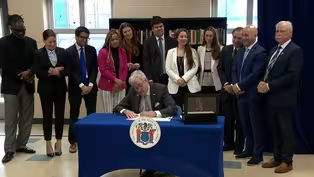
Gov. Murphy signs ‘landmark’ affordable housing legislation
Video has Closed Captions
Measures include abolishing the defunct Council on Affordable Housing (4m 19s)
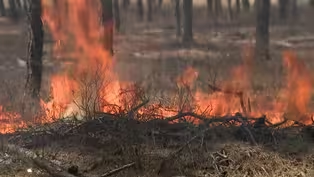
Military program funds wildfire protections in the Pinelands
Video has Closed Captions
Joint Base McGuire-Dix-Lakehurst and adjacent communities face high wildfire risks (4m 16s)
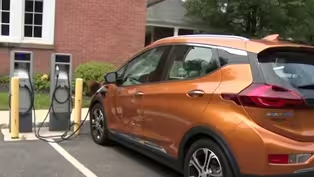
New EPA rule to cut vehicle emissions, boost EVs and hybrids
Video has Closed Captions
Interview: Doug O’Malley, president of ChargEVC (4m 59s)

NJ health inequities are focus of Rutgers symposium
Video has Closed Captions
Research, policy and health experts also address possible solutions (3m 52s)
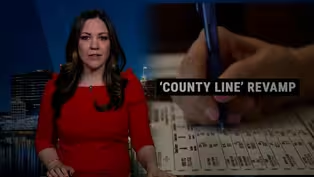
NJ legislative leaders vow to address the ballot system
Video has Closed Captions
Critics of the 'party line' said it favors party leaders and the candidates they back (1m 36s)
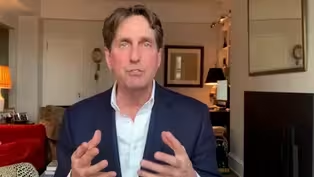
Republican front-runner in Senate primary race backs Trump
Video has Closed Captions
Curtis Bashaw, a Cape May developer, is a self-described moderate (4m 13s)
Providing Support for PBS.org
Learn Moreabout PBS online sponsorship
- News and Public Affairs

Top journalists deliver compelling original analysis of the hour's headlines.

- News and Public Affairs

FRONTLINE is investigative journalism that questions, explains and changes our world.












Support for PBS provided by:
NJ Spotlight News is a local public television program presented by THIRTEEN PBS