NJ Spotlight News
NJ Spotlight News: March 20, 2025
3/20/2025 | 26m 46sVideo has Closed Captions
Watch as the NJ Spotlight News team breaks down today’s top stories.
We bring you what’s relevant and important in New Jersey news and our insight. Watch as the NJ Spotlight News team breaks down today’s top stories.
Problems playing video? | Closed Captioning Feedback
Problems playing video? | Closed Captioning Feedback
NJ Spotlight News is a local public television program presented by THIRTEEN PBS
NJ Spotlight News
NJ Spotlight News: March 20, 2025
3/20/2025 | 26m 46sVideo has Closed Captions
We bring you what’s relevant and important in New Jersey news and our insight. Watch as the NJ Spotlight News team breaks down today’s top stories.
Problems playing video? | Closed Captioning Feedback
How to Watch NJ Spotlight News
NJ Spotlight News is available to stream on pbs.org and the free PBS App, available on iPhone, Apple TV, Android TV, Android smartphones, Amazon Fire TV, Amazon Fire Tablet, Roku, Samsung Smart TV, and Vizio.
Providing Support for PBS.org
Learn Moreabout PBS online sponsorship♪ ANNOUNCER: Funding for "NJ Spotlight News" is provided by, the members of the New Jersey Education Association, making public schools great for every child.
♪ RWJ Barnabas Health.
"Let's be healthy together."
♪ New Jersey Realtors.
The voice of real estate in New Jersey.
More information is online at njrealtor.com.
♪ and Orsted, committed to delivering clean, reliable, American-made energy.
♪ Briana: Tonight on "NJ Spotlight News," A second sinkhole opens up on I-80, forcing the closure of both sides of the interstate, causing more delays, more detours, and fears the road is unsafe.
>> This is a problem that we didn't create, but it feels like we are opening it.
BRIANA: Plus, a constitutional crisis is brewing as the Trump administration continues to defy federal judge after judge.
>> We really need to make sure that there are checks and balances being followed as part of the constitutional framework that the framers of the Constitution created.
Bianna: also spoke Congress passed a spending bill to avert a shutdown.
What cuts will hit the garden state.
And, making menopause matter -- New Jersey lawmakers are working to fast-track a bill focused on improving treatment options for women.
>> Menopause, although it affects more than half the population, is misdiagnosed, undertreated, and often ignored.
BRIANA: "NJ Spotlight News" begins right now.
♪ ANNOUNCER: from NJPBS Studios, this is NJ Spotlight News with Briana Vannozzi.
BRIANA: good evening and thanks for joining us this Thursday night, I'm Briana Vannozzi.
We begin with a few of today's top headlines.
First, President Trump is expected to sign an executive order laying the groundwork to dismantle the Federal Education Department, making good on a campaign promise to eliminate an agency that's been in the crosshairs of conservatives for years.
The order instructs Education Secretary Linda McMahon to take all necessary steps to close the DOD, and to the states.
According to the White House press secretary today, the department will shrink significantly but still continue managing federal student loans and Pell grants, along with civil rights enforcement, but didn't say exactly how it will do that.
The Trump Administration had said the department is wasteful and plagued by liberal ideology.
Dismantling the department entirely, though, would take an act of Congress, which created the agency in 1979.
But even without formally shutting it down, the administration could make it nearly impossible for employees to do their work, which some say has already happened after the White House recently slashed the department's workforce by more than half.
Also tonight suck at Princeton University is the latest in higher education to announce a hiring freeze -- the Ivy League will pose most hiring and take other steps to save money, citing uncertainty around federal funding.
In a memo sent to faculty and staff Wednesday morning, the university acknowledged recent cuts to research dollars, the possibility that endowment taxes will go up, and that other schools have seen federal money revoked.
Princeton plans to tighten its purse strings by reevaluating requests to fill vacancies, plans for capital projects, and returning the annual employee merit pay increase to the level it was at pre-pandemic.
These actions are some of the most significant taken by the university in response to changes coming from the White House.
Princeton, of course, is one of 60 colleges and universities, including Rutgers, under federal investigation for potential civil rights violations of Title VI stemming from campus protests held last spring against the war in Gaza and allegations of anti-Semitism.
And as summer approaches, travelers may want to add one important item to their checklist -- a relay D. You'll need one by May 7 if you want to board a flight and don't have a passport -- a REAL I.D.
.
Starting today, the Motor Vehicle Commission is launching Real I.D.
Thursdays, making 4,500 appointments available statewide every Thursday through March and April to meet the demand.
Travelers over the age of 18 will need to present a Real ID to board domestic flights or use a passport.
To get one, applicants need to have a Social Security number, two forms of proof that you live in the state, and other identity documents adding up to six Real ID points.
The licenses come nearly two decades after Congress made it a requirement as part of beefed-up security post-9/11.
Starting April 5th, the Motor Vehicle Commission will also hold a series of mobile events on Saturdays to help people make the switch.
For more information, residents are being encouraged to check the MVC's website.
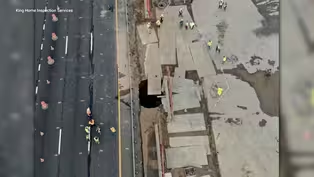
one of those I.D.s will not help with this problem for Jersey drivers -- another sinkhole has opened up on Route 80 near Exit 15 in Morris County, but this time on the westbound side.
According to the state DOT, the massive void opened yesterday evening while work crews were repairing a separate sinkhole on the east side of the highway, sparking even more delays and detours.
Now that both sides of the interstate are closed down in the same section, that's left state officials scrambling to figure out their next steps and drivers worried whether the area is safe.
Ted Goldberg has the latest.
Reporter: Earlier this week, this public owner, Jim Hill, was skeptical when the Department of Transportation said work on I-80 eastbound would take two more months.
>> I'm hearing what they say, at least two months.
That means at least six months to me.
Reporter: the discovery of another sinkhole has complicated the reconstruction of I-80 and almost certainly means that nearby communities will endure heavy traffic for more than two months.
>> I would say it's going to be another -- not until the fall before it gets done again.
You know, it opens up.
They are going to find one after another.
Reporter: the traffic has gotten a lot worse around the last month and is particularly terrible in the morning and afternoons, so breakfast places like Pop's Bagel Shop take a huge hit from customers who don't feel like dealing with all this extra traffic.
>> It's been horrible.
We are down 25% to 30%, some days as much as 40%.
That this is while the eastbound lanes were closed.
Reporter: now, the westbound lanes are closed too, and Yazid says regulars might stay away longer.
>> We definitely miss them.
we haven't seen them in a long time.
They all live on the other side of town, and with all this traffic, it really has been a pain to get through here.
So, we're seeing a lot of new faces, but it's not enough to sustain or even come near where we were prior to all this.
>> It is just sad to see.
There is so much traffic on 46, because we can see it from the house and we see the 18 wheelers.
>>.
>> I feel sorry for the businesses, like this business.
You know, these truck drivers go by, and they're not going to stop.
They are in a big traffic jam.
Reporter: the state Department of transportation says it is evaluating the situation, after , quote, a 15-foot hole opened up in the median Wednesday.
>> It's just kind of scary that this is going on, and like, we're not really sure how long it's gonna go on for.
Reporter: Julia and a few miles from the restaurant, and wasn't shocked to hear about the news of another sinkhole.
>> There is actually a sinkhole in my apartment complex too, so it's kind of like there's this new threat of sinkholes that I never knew existed.
People in the apartment are speculating that after the earthquake last year, it's kind of like exacerbated all of these sinkholes.
Like, there was loose ground under there already, and now after that, it's starting to open up.
>> Much of this traffic comes from commuters.
Muhaisen's commute is normally 20 minutes.
>> Today it took me about an hour and a half.
I mean, to think that we were driving underneath all this is definitely scary.
Definitely is concerning.
>> It is scary.
I'm not going to lie.
My mom is scared too for me living out here.
I've heard that you're supposed to now look for dips in the road.
>> I try to do what I can.
Reporter: what can you do, besides speeding?
[LAUGHTER] >> I try to leave earlier from my house.
>> This is a problem we did not create, but it feels like we're owning it.
Reporter: the mayor says he hopes federal funds can help local businesses that have suffered.
>> We test whether this would end up in FEMA so the locals can get some money, you know, doing COVID, they had COVID money that came down.
Reporter: meantime, the mayor says Wharton is organizing a small business walk to try and bring in revenue.
>> We're going to do it a couple of weekends.
So, where you walk to all the different restaurants, and you go in, and what you'll do is sit down or we're going to have something that is a box lunch also.
We are talking about that.
Where your company can order a box lunch from some of our businesses to help them out.
Reporter: governor Murphy has already declared a state of emergency, the first step in getting federal funds to help rebuild I-80 and possibly help businesses that have taken heavy losses in Wharton.
I'm Ted Goldberg, NJ Spotlight News.
Briana: In New Jersey federal judge has weighed in on the case of Mahmoud Khalil, the Columbia University graduate and pro-Palestinian activist who was detained by I.C.E., ordering his case to be transferred from New York to New Jersey where his lawyers will continue fighting for his release.
The Trump Administration has accused him of being a terrorist sympathizer for participating in untagged Gaza war protests, and is relying on obscure sections of U.S. law to give more broad authority in revoking a person's immigration status.
That authority is drawing increased attention, though, after the White House today failed to meet a deadline responding to a federal judge's questions about deportation flights ordered by the president.
The court temporarily blocked the flights carrying Venezuelan migrants last weekend, ordering them to return to the U.S., but the flights landed anyway.
Trump and his allies have since called for the federal judge to be impeached.
The defiance against the judicial branch has top legal experts warning we're not just heading toward a constitutional crisis, we are in one.
For more on that, I'm joined by Rutgers Law Professor Rose Cuison Villazor.
Professor, thanks for coming on the show.
A lot of legal scholars and folks like yourself have said lately, they are not just cracks in the system of our checks and balances, we are in a constitutional crisis.
Is that true, in your mind?
>> Absolutely.
In my mind, what is going on right now is that the United States government and, in particular President Trump's administration, is expanding the use of executive powers in ways that have led to the lack of checks and balances, to the point where the judiciary orders have been issued by federal judges, seem to be being ignored by the Trump Administration.
Briana: Is there, though, an argument to be made that there is a thin line between may be procedural missteps and clear acts of defiance?
Guest: By the clear act of defiance that I am seeing, just based on what is being reported out there, suggests to me that the Trump Administration is not complying with federal judges in their specific orders.
That is a problem, in my mind, because we need to make sure there are checks and balances that are being followed, as part of the constitutional framework that the framers of the Constitution created.
Briana: So the administration claimed urgency, when talking about these recent deportations, these members of who they claimed were part of El Salvador and going -- Venezuelan gang, the court ordered some of those planes to turn around, others to come back.
The administration did not adhere to that and in fact there were posts on social media.
But they said there was a sense of urgency, that these were people who posed a threat.
How does the law work in that case when these are folks who are being detained, as far as we know, and certainly went out in the public?
Guest: It's not clear to me that these noncitizens, these Venezuelans who were removed from the United States, had due process hearings before a judge.
Instead, what seems to have taken place is that the administration decided to bring several of them, hundreds of them together, put them on the plane, and deported them to El Salvador.
Briana: Are we at a tipping point then, if the executive branch can't be held accountable.
Guest: that is why we are in a serious constitutional crisis.
The executive branch, obviously, has the power to implement and enforce the laws, but those laws must comply with the U.S. Constitution.
And under the Supreme Court's precedent, Marbury v. Madison, one of our earliest cases in the United States under the U.S. Supreme Court, it is these courts that have the power to determine whether there is a violation of the Constitution, even if the actor in this case is the federal government.
Briana: Before I let you go, I just want to get your take on the case of Mahmoud Khalil, the Columbia University student.
It judge on Wednesday said he wouldn't hear the merits of the case, but the case would be transferred to New Jersey and Mahmoud Khalil will not be deported.
What do you make of that, and what it means for his chance at due process?
Guest: The judge's order in transferring the case from New York to the District of New Jersey is a strong indication that in this case, there will be an opportunity for Mr. Khalil's constitutional rights to be heard by a federal judge who would be sitting in New Jersey.
His case, it's a challenge to his removal from the grounds that he is being removed or being deported by the United States government because of his participation in the Columbia protests.
He is saying that his deportation will violate his First Amendment right to free speech as well as his Fifth Amendment right to due process.
Briana: mm, it's a slippery slope.
Professor of Law at Rutgers, thank you so much.
from a veteran's outreach program in Mercer County to a new pumper truck for Wildwood's fire department, New Jersey is losing out on more than $200 million that was slated for community projects by the federal government.
The earmarks were requested by Congress members for spending projects in their districts during the budget process.
But they were slashed along with thousands of others across the country in the GOP stopgap spending bill President Trump signed into law last week.
Our Washington, D.C. correspondent looked into the bill to see just how many products New Jersey lost, and joins me now.
Great reporting, first of all.
Talk to me about the types of projects -- we named a couple -- but it seems that going through your data, a lot of floodwater and fled resiliency projects communities were planning on, now they are not going to get.
Guest: Right, I would say flooding and really anything to with water, treatment of PFAS chemicals, those 'forever chemicals'-that was another common theme.
Replacement of lead pipes that have been underground for ages was another common motif in these chunks of money.
But I would also underscore that this is money that state governments, city governments, tribal governments nationwide along with nonprofits had requested and expected for a whole year, the earmark process kicks off in the spring, so this is many people had applied for through their member of Congress back in the spring and might have been banking on Coming Home right about now, and now they are out of luck.
Briana: I'm end we're talking a couple hundred projects in New Jersey alone.
Were there districts that lost more than others that were banking on this?
Guest: The state lost over all -- it's a bit tricky to break down particularly where a project, will be felt most.
Some of them to your point, are , very specific -- a well for a town, or money for a fire department or police department in a given county.
But a lot of these projects, especially in South Jersey, are more regional.
FEMA money, for example, would have really come in handy for Jeff Van Drew and Chris Smith's districts.
They both got big earmarks from FEMA to deal with flooding in their districts.
But, of course, that's all a moot point now because it's all gone.
Briana: You bring up an interesting point, these are earmarks lost not just for -- we have a majority democratic representation in Congress, but also our three Republican members and the money they were promising to bring home to their constituents.
How is that playing?
Guest: It's interesting, there isn't really an ideological divide on earmarks.
People who dislike earmarks typically dislike them because they view them as some form of government corruption.
you could get an earmark for corporations.
That has now changed.
There are more disclosure rules around earmarks.
But this affects everyone, and the members who did not get earmarks are the newer members like Mikie Sherrill, Andy Kim, Jeff Van Drew, and Chris Smith, who all came to Congress recently.
Briana: You mentioned this earmarks process change was sort of revived in a new form.
A lot of folks thought of that as more private project previously.
But looking through the list of items you noted for Jersey, a lot of these seemed like items that may be these communities can't really do without.
Guest: Or at least they are not frivolous, that is probably a better way to think about it.
It is fairly basic stuff -- food bank money, money for hospitals, money for health clinics, policing.
Fire.
Sort of the core civic items that keep government running.
And now, of course, with other federal cuts coming out of Washington and maybe some cuts at the state level, this is money that really could have come in handy and now has vanished.
Briana: Is there anything we should take from this in terms of how we prepare for the Trump Administration to unveil their own budget plan and the type of paths that might be included -- the types of cuts that might be included?
Guest:?
Guest: I think the best in a log of what is happening now happened in 2017, when the first Trump Administration came in and proposed deep cuts across the board to health programs, environmental programs, transportation.
That is roughly where we are now time-wise.
The federal budget process.
Played out really seriously this summer.
I don't know how much earmarks tell us.
But this was more of a casualty of the budget process and time.
Congress simply ran out of time last week to keep the government open, and cutting earmarks was the choice they made.
And I will also point out that the three Republican members in New Jersey all had earmarks in this underlying bill and underlying legislation, I should say.
They all voted to pass the CR, the continuing resolution, to keep the government running.
They voted against projects that they had worked to get folded into law, which is interesting.
Briana: Yeah,, as you say, they had to make a choice, and they did.
You can find his full reporting on our website, NJSpotlightNews.org.
Thanks for coming on.
More and more research shows, menopause has a significant effect on women's health, their careers, and their wallets.
Yet, little attention or money is being spent to help address this natural part of life.
But a bill package moving through Trenton is trying to tackle one big piece of it by expanding insurance coverage to cover more services and treatments.
It's a start.
Senior correspondent Joanna Gagis reports.
>> The problem is that women are left often to navigate treatments and physician appointments without proper guidance because menopause, although it affects more than half the population, is misdiagnosed, undertreated, and often ignored.
Reporter: Assemblywoman Heather Simmons gave testimony before the Assembly Health Committee today on a topic that's growing in public awareness lately: menopause-the time in a woman's life when she stops getting menstrual periods and can no longer get pregnant -- and perimenopause, a period of several years leading up to it when her hormones begin changing.
>> This bill package came from lying in my bed in the middle of the night with insomnia, unable to sleep, anxiety, and night sweats, watching commercials for $0.87 Viagra.
And thinking to myself that as a country, as a state, we can do better.
Reporter: Symptoms of perimenopause and menopause can also include mood swings, joint and muscle pain, like frozen shoulder, for example low , libido, weight gain, headaches, and more.
>> What we're looking at today is a two-bill package that, one, mandates insurance coverage for perimenopause and menopause services and approved treatments.
Reporter: Simmons acknowledged that many of the menopause and perimenopause symptoms a woman experiences-anxiety, for example-are already covered by insurance companies.
She's focused on areas like hormone replacement therapy, which replaces diminishing estrogen and progesterone in the body and often isn't covered.
It's a topic that's been before !
new moon [shouting] At Reporter: with Halle Berry advocating for $275 million to go toward menopause research and education and toward clinical trials on hormone therapy.
That education piece came into focus today in Trenton.
>> The second piece of it, I think, is equally as important or more important, and that is physician education.
The way that we've structured this is to make available to practicing physicians education on menopause and menopause-related services as part of their continuing medical education.
>> Are there currently validated courses or credits that they can take?
And why do we, as a legislature, have to write a law to permit this to be done if they are already there to be done?
>> I'm not an expert on licensure, but my understanding of that, I don't know that this makes any difference, that this will change anything.
>> I wanted a bill that said all the medical schools in New Jersey had to include menopause education in the curriculum for medical students.
So that was taking it a little bit too far, too fast.
But what we decided was that, for practicing physicians, because we know that 30% of them haven't been trained, that we should make aware that training is available in this area.
>> They do teach menopause in medical school?
That is why we questioned where they got that 30% number.
Reporter: But Assemblywoman Nancy Munoz and most of her Republican colleagues did vote in support of moving the bill forward, but with one critical change.
>> It's not just physicians who treat female patients.
It is also advanced practice nurses and others.
And I think that those providers should also be included if you're going to do this because, in so many cases now, our females are going to advanced practice nurses, particularly that phase of care.
>> Thank you for mentioning that, and I should have in my testimony.
We are absolutely correct.
Reporter: this was only the first reading of the menopause bill, which will now be amended to include many of the points raised today before it goes on through the voting process.
Joanna Gagis, NJ Spotlight News.
Briana: That's going to do it for us tonight.
But before we go, a reminder, you can download our podcast wherever you listen and watch at any time by subscribing to the NJ Spotlight News Youtube channel.
Plus, you can follow us on social media to stay up-to-date on all the big headlines.
I'm Brianna Vannozzi, for the entire team at "NJ Spotlight News."
Thanks for being with us.
Have a great night, and we'll see you right back here tomorrow.
♪ ANNOUNCER: NJM Insurance Group, serving the insurance needs of residents and businesses for more than 100 euros.
And by that PSEG foundation.
>> Orsted believes that clean energy is more than just a power source.
It's an opportunity to create stronger economies and communities.
Together, the South Fork wind and sun rays wind projects from Orsted will provide American women-powered energy for New Yorkers, and support jobs, education, and are committed to a clean energy future for New York.
♪

As REAL ID deadline approaches, MVC has special appointments
Video has Closed Captions
Clip: 3/20/2025 | 1m 8s | Starting on May 7, adults on domestic flights will need REAL ID or passport to board (1m 8s)

How federal spending cuts will impact NJ
Video has Closed Captions
Clip: 3/20/2025 | 5m 36s | Interview: Ben Hulac, Washington, D.C. correspondent, NJ Spotlight News (5m 36s)
New I-80 sinkhole worsens traffic jams, fuels frustrations
Video has Closed Captions
Clip: 3/20/2025 | 4m 32s | Sinkholes have closed I-80 in both directions near Exit 34 (4m 32s)
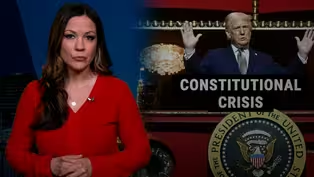
Trump deportation stance causing ‘constitutional crisis’
Video has Closed Captions
Clip: 3/20/2025 | 6m 1s | Interview: Rose Cuison-Villazor, Rutgers University professor of law (6m 1s)
Providing Support for PBS.org
Learn Moreabout PBS online sponsorship
- News and Public Affairs

Top journalists deliver compelling original analysis of the hour's headlines.

- News and Public Affairs

FRONTLINE is investigative journalism that questions, explains and changes our world.












Support for PBS provided by:
NJ Spotlight News is a local public television program presented by THIRTEEN PBS