NJ Spotlight News
NJ Spotlight News: May 14, 2024
5/14/2024 | 26m 46sVideo has Closed Captions
Watch as the NJ Spotlight News team breaks down today’s top stories.
We bring you what’s relevant and important in New Jersey news, along with our insight. Watch as the NJ Spotlight News team breaks down today’s top stories.
Problems playing video? | Closed Captioning Feedback
Problems playing video? | Closed Captioning Feedback
NJ Spotlight News is a local public television program presented by THIRTEEN PBS
NJ Spotlight News
NJ Spotlight News: May 14, 2024
5/14/2024 | 26m 46sVideo has Closed Captions
We bring you what’s relevant and important in New Jersey news, along with our insight. Watch as the NJ Spotlight News team breaks down today’s top stories.
Problems playing video? | Closed Captioning Feedback
How to Watch NJ Spotlight News
NJ Spotlight News is available to stream on pbs.org and the free PBS App, available on iPhone, Apple TV, Android TV, Android smartphones, Amazon Fire TV, Amazon Fire Tablet, Roku, Samsung Smart TV, and Vizio.
Providing Support for PBS.org
Learn Moreabout PBS online sponsorship>> Funding for NJ Spotlight News provided by the members of the New Jersey Education Association, making public schools great for every child.
RWJBarnabas Health, let's be healthy together.
And New Jersey realtors, the voice for real estate in New Jersey.
More information is online at NJrealtor.com.
Briana: Tonight, jury selection continues in the corruption trial against Senator Bob Menendez.
If you are a news junkie or have Springsteen tickets, you are excused.
>> it is a fairly complex process.
It is a mix of art and science in picking a jury.
Briana: Plus a second wave of pro-Palestinian students continue their hunger strike as Princeton University orders its and cap meant to be taken down.
>> A place for the expression of controversial ideas, for debate, discussion.
At historically universities have been a place for student protests.
Briana: Also, a radically revised New Jersey public records bill is on its way for Governor McKee's -- Governor Murphy's signature.
Much say it will be much harder to get back records.
-- to get public records.
And in the running.
Ed Durr tosses his hat in the ring for the gubernatorial race.
NJ Spotlight News begins right now.
♪ >> From NJ PBS Studios, this is NJ Spotlight News with Briana Vannozzi.
Briana: Good evening at thank you for joining us this Tuesday night.
I am Briana Vannozzi.
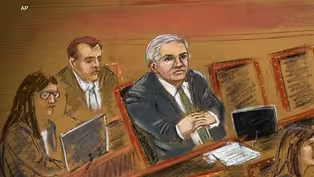
Day two of the corruption trial against Senator Bob Menendez and a jury selection is still underway.
The seven-year-old Democrat and his wife are accused of accepting cash, gold bars, and a Mercedes-Benz from three New Jersey businessmen in exchange for official political acts that would benefit the governments of Egypt and Qatar.
Menendez, his wife, and two of the businessmen have cleared -- plead not guilty.
The third is expected to be a star witness after accepting a plea deal and agreeing to cooperate with the government.
Menendez sat alone today, while the judge continued interviewing prospective jurors in a back room, sifting through 150 total, vetting each person who said they could not sit for the trial.
Their reasons ranging from those who felt they could not be impartial, to travel plans, and curious medical conditions.
Cameras are not allowed inside the federal courthouse in lower Manhattan, but our senior correspondent Brenda Flanagan was and she joins me now with the latest.
Good to see you.
Day one, no jury sat.
What can you tell us about the process today?
Brenda: No actual jurors seated yet, but we did get a pool of 89 jurors.
The judge had them all seated together in the courtroom.
And what he was looking to try and do was instruct them that they needed to assure him they could be fair and impartial.
He wanted to see if there were any conflict of interest.
So, do you know any of the defendants?
Have you had any relationships with these attorneys?
Do you have family who is in law enforcement?
He started to ask the jurors would raise their hands, what is your problem, can you still serve and be fair and impartial?
And then he listed some possible witnesses, people who might be mentioned in the trial.
And it was a total Who's Who.
First of all, Nadine Menendez, the defendant's wife.
Then he listed U.S. senators.
Just a partial list includes Cory Booker, Marco Rubio, Lindsey Graham, Tim Scott, Kyrsten Sinema.
He talked about possibly including former Treasury Secretary Steven Mnuchin.
He talked about the port authorities Kevin O'Toole.
Brian Stack, the mayor of Union City.
A couple of Qatari sheiks.
The list of potential witnesses was so long that he had to stop halfway through and take a drink of water.
But then he continued and he got to the David while Stephen who was involved in Bridgegate.
He worked at the port authority, pleaded guilty and now he is head of the New Jersey globe.
So this is going to be quite a prorated.
Briana: That is a power list for sure.
Can you give us any color on what some of the reasons were that jurors gave for why they cannot either be impartial or just show up in Manhattan for the next seven weeks?
Brenda: This is going to be a big commitment.
We are talking about a seven week trial that apparently will be Monday through Friday, 9:00 to 5:00.
That is a lot to ask.
The judge was very considerate.
People who thought that they might not be able to do this, he called them all into a side room, individually, privately, and he met with them and asked them what their issue was.
We have juror 92 who was a single parent, the judge said you are excused.
Juror 94 at a nonrefundable trip to Rome, and the judge figured OK, go ahead.
But he did say he was tempted to ask for proof that the tickets were nonrefundable.
Jurors 97 and 110, completely different situation.
One said that they thought that these people are completely guilty and could not change their mind.
On their the one said their mind was made up.
The judge told them, goodbye.
Juror 106, extreme fear of heights.
This court is on the 23rd floor, and he was excused.
Juror 105, who has tickets to a Springsteen concert in Spain.
She was also dismissed.
Briana: That is as good a reason as any.
Let me ask you quickly, did you see Menendez today, and did you get a chance to exchange any words?
Brenda: Actually, when he was in the front of the court, we were all sitting waiting for the judge to finish some business.
He came to the back of the room and he talked to reporters.
I was there.
We did not discuss the trial.
And he was very pleasant, very chatty, very calm.
If we had not been in the courtroom in Manhattan under these circumstances, it would have been any other day with Bob Menendez.
He sat back down in his seat and throughout much of the day he appeared very calm, cool, and collected, as he waited for this whole drama to unfold.
Briana: Brenda Flanagan for us in Manhattan.
Thank you.
Brenda: You are welcome.
Briana: To the jury selected for this corruption trial will have to wait some of the strongest charges ever leveled against a sitting federal lawmaker.
The judge, defense attorneys, and prosecutors know the importance of sitting the right jurors and asking tough questions to ensure that they will view the case through an impartial and clear lens.
For more of an inside look at what the process entails, I am joined by someone who has been through a number of jury selections, attorney and former federal prosecutor, Brian Whistler.
Thank you for coming back on a shell.
What we know from Brenda Flanagan is that 65 prospective jurors were initially excused from sitting trial.
What is the judge looking for?
What is the selection process about here?
Brian: The key ingredient is there has to be determination rendered as to whether any potential juror can be fair and impartial to both sides.
And that is a challenging standard.
But there is a significant amount of questioning that goes into that, as you know, to reach that judgment.
And folks who may not think that they are capable of being impartial sometimes are second-guessed by the court for their rationale.
So it is a fairly complex process.
It is a mix of art and science in picking a jury, and I have picked quite a few in my tenure, it is a fascinating component of the trial.
Briana: What do you makes of the folks who today claimed they are, quote, news junkies, they have already heard too much about this case to be impartial.
And does that play into what the defense was arguing, which is that the prosecutors were tainting the jury pool with some of the court filings?
Brian: Fairly commonplace particularly for a high-profile case.
Most folks who are watching the news locally are probably catching at least glimpses of this case in advance.
But what you read in the media and the fact that you read a case is not a per se bar to serving on a jury.
The question comes back to, is your read of certain information, does it creditors -- prejudice you to the part where you cannot beat impartial?
If a news junkie says I just know too much -- I have been in courts where the judge has said, well, are you able to set aside what may have been said in the press and just focus on the facts as presented by both parties?
So, it is a multilayered process.
Briana: It seems from the court transcripts that the judge is in fact pressing some of those folks, or at least setting them aside to still be prospective candidates.
What do you make of some of the questionnaires that were given out initially about potential juror's feelings on whether people from New Jersey are more likely to commit a corrupt act, or how they feel about someone who keeps large amounts of cash in their home?
Are these common questions?
Brian: Yeah, generally speaking they are.
What you want to get at is get a complete a picture as you can of a profile of a juror.
That is not only for the judge to review but also the parties.
As you probably know, in federal court, by law the parties are given preemptory strikes.
They are also permitted to attempt to strike a juror for cause.
That kind of information in terms of what biases a potential juror might carry into the courtroom is really important for the judge and the Council to know up front.
Briana: Just to clarify, there is no timeline on this, right?
The judge can take as long as he needs to find the right members for this jury.
Brian: That is quite right.
I have been in courts where it has been over a week to pick a jury.
And I have been in court where it has taken a day.
Some of that is determined -- actually, a lot of that is determined by the discretion of the judge.
A lot of judges feel very confident in their judgments about potential jurors.
Other judges will defer more to counsel in that process.
So, a lot of it does depend on the particular judge.
But there's no legal prescription for how long is required to pick a jury, that is correct.
Briana: Brian Whisler, thanks for the perspective.
Brian: Great to see you.
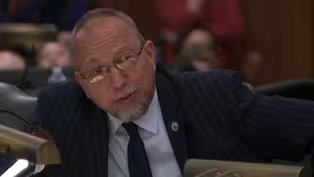
Briana: Ed Durr once to be New Jersey's Governor.
The blue-collar conservative officially launched his gubernatorial campaign Monday night, giving a speech at a church in big Harbor.
The 60-year-old Republican shock to the political world in 2021 by ousting longtime Democratic Senate President Steve Sweeney for his seat.
Now he is looking to make a comeback, even though Durr was ousted himself in the last legislative election.
In his speech last night, Durr slammed Governor Murphy and Democrats in the state, saying New Jersey is quote, in a crisis, criticizing the administration's policies on taxes, guns, and education.
Durr is now the third GOP candidate to enter the race, joining Senate Minority Leader Jon Bramnick and former state assemblyman Jack Ciattarelli.
With the election still more than a year away, other Republicans are expected to join.
Democrats are also taking hits for pushing through a bill on Monday that rewrites the state's open public records law, agreeing to more than a dozen changes that will make it tougher for people to get access to government documents.
The vote was cast after zero debate on the floor, and no comment from lawmakers who refused to vote.
When always said and done, critics in Trenton said this is not a bill that modernizes it, but decimates it.
Senior writer Colleen O'Dea was covering the vote and joins me now with the details.
Good to have you on a lot to get through.
Let me start with first, what are the changes that they lawmakers agreed to in what is now a bill heading to Governor Murphy's desk?
Colleen: There are of changes.
The bill is better than it was when it was first introduced back in March and it is better than the initial amendments that were discussed early last week.
But we came up with about a dozen ways it would still make it harder for people to get records.
Among those, I call it the Goldilocks provision.
If you have too much detail in there and the clerk has to do some searching, it could be a denial.
If you are too vague, could be a denial.
Kind of like you need that just right amount of information.
Briana: Lawmakers when they set out to do this said there were too many loopholes that allowed for commercial enterprises to take advantage of this, and essentially get clerks and mayors and the like to do their work for them.
Does it actually address that, or does it simply make it more difficult to access these records?
Colleen: You got it, it's the latter.
Any mention and any specifics regarding dater brokers -- data brokers were taken out of the bill.
I am not a lawyer, but I am assuming if you provide access to documents, you cannot stop one group of people or organizations from getting them.
But the benefit that they get -- and they get a better benefit than any miles -- than anyone else -- is that they can pay to get their request filled faster.
Briana: What are opponents saying?
I got a text earlier from a former assemblyman and Senator worked with Loretta Weinberg in drafting the original legislation 20 years ago.
He said this is not what we intended for this bill when we wrote it.
So what has the feedback been?
Colleen: I saw Loretta also put out a statement, saying just how disappointed she was in particular that it was her party, the Democratic Party, that was driving this.
The Democratic Party which has been for things like transparency in the past.
Advocates are saying that, in one word, it's decimating, this law.
They are not large, but there are a lot of tweaks that are going to make it harder to get information.
It is going to give agencies, greater agency, I guess, to deny requests.
And without the mandatory fee shifting that is in the law, which essentially states that if you win your case, the agency that denied you have to pay your lawyer fees.
Now there's a reasonable fee that would have to be paid, but only if you prove that it was a willful denial by an agency.
That may be a hard bar.
So without those things, it's going to be difficult for people to get records.
Briana: The ball is in the governor's court now.
Colleen O'Dea, thank you so much.
Princeton University has issued an edict to pro-Palestinian demonstrators, telling them in a letter to the campus community Monday night, that they need to clear out their encampment.
Also, the University can prepare for annual class day celebrations.
The message comes as more than a dozen students who have been on a hunger strike since May 3 ended their fast and traded off with new participants to keep the strike going.
As Ted Goldberg reports, little is known about the deadline or consequences for ending the encampment.
Ted: As Princeton prepares for commencement on May 28, the school's message to anyone in the encampment is to get out, forcing protesters to figure out the next steps.
>> We are communicating with the Princeton administration thus far.
The administration has not met our demand so we are still deliberating on what to do.
Ted: The president set out a message last night saying protesters needed to leave Kenyon Green, but did not set a hard deadline.
He said having protesters there makes it impossible to ready the green for class day and other events.
Under these circumstances, to continue the sit-in would involve a significant and impermissible disruption.
This comes as a second wave of a hunger strike begins, until Princeton grants amnesty for the 15 people arrested during protests.
>> They have dispelled the notion that this movement is violent in any form.
Because hunger striking is a peaceful act of self deprivation.
Their act of compassion by doing this hunger strike has enabled us to better facilitate conversations with the administration.
That being said, for us, our top priority is their health and safety, period.
Ted: Be first wave of hunger strikers had to stop after 1.5 for health concerns.
>> One of them was sent to the hospital.
Unfortunately had poor vitals on one day.
And so yeah, she had to go to the hospital.
Then the other ones are recovering.
Ted: U.S. Democratic --has joined the hunger strike for 24 hours.
>> I think it diminished the stature of the University.
A University is supposed to be a place for the expression of controversial ideas, for debate, discussion.
And historically, universities has been a place for student protests.
Ted: He says he will only drink water out of solidarity.
>> Which was something we did not do in 1978, when 210 of us took over Nassau Hall.
We didn't have a hunger strike.
And I was very impressed, extremely impressed by the number of days.
Ted: Princeton's president also said the University would work to minimize the impact of the rest on the participating students.
The restorative justice option would require students to accept responsibility for violating university policy and promised to avoid future violations, and reconciled with people significantly affected by their actions.
Protesters have said that is not good enough to end the hunger strike, but they are satisfied there is at least some communication.
>> Our satisfaction with how the administration has responded to us has been less than what we had hoped for.
But we still think that the negotiations that we are partaking in are still a success for us.
Ted: There was also a meeting today held by the Council of Princeton University community resources committee to give an assessment for the protester's request to divest.
So while protesters have started packing their belongings, they may not be finished making their voices heard.
In Princeton, I'm Ted Goldberg, NJ Spotlight News.
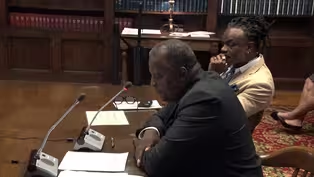
Briana: In our spotlight on business report, lawmakers are overhauling state contracting rules after a report pointed out major disparities.
Legislators on Monday heard from business owners who say they have been left out of contracts, and state money awarded for big projects.
Largely, they allege, because of being minority or female owned.
Data released in January found most state contracts are given to businesses owned by white men.
As Raymond Santana reports, Monday's hearing offered data so the legislature can now take action.
>> At the end of the day this is a defining moment, a day of reconciliation for New Jersey because Black people are tired of being at the bottom.
Raymond: The president and CEO of the African-American Chamber of Commerce of New Jersey John Harmon did not hold back when discussing the results of the new steward -- of the New Jersey disparity study that found disparities in the state's contracting procedures.
The study, which was conducted, reviewed statewide debt relating to goods and services, professional services, and construction over a five-year period.
They reviewed more than 1.2 million records including 240,000 contracts from over 60 contracting agencies, authorities, commissions, state colleges, and universities.
The report found significant gaps between the number of contracts awarded to white men compared to minority and women owned businesses.
>> It is an all boys club.
All the engineering firms play golf with each other and it is generations of a closed-door policy.
Raymond: The president and CEO of the statewide Hispanic Chamber of Commerce of New Jersey joined more than 10 others who testified and shared their own experiences.
>> Hispanics and African-American and Asians and women are getting contracts so much lower than their population.
We're 22% Hispanic, I expect 22% of contracts, 22% of boards of directors.
Raymond: The contracts were awarded between July 1, 2015 and 2020.
Women owned businesses got less than 10% of the prime contracts for professional services, but represented about 40% of the businesses available for the work.
>> We want to be able to have the opportunity to have work just like everybody else.
There is enough pie for everybody and we should not have to fight among ourselves as women and minority firms.
It is a bigger pie that we should get bigger pieces of.
>> AI is starting to kick in now.
So, we've got to get our smaller and minority businesses up on AI because AI will do the algorithm to push you out.
Raymond: The Newark Mayor shared ways to help minority and women owned businesses improve on receiving prime and subprime contracting opportunities.
>> We must implement, set-aside procurement and price preference programs that prioritize participation, unlocking the untapped potential of diverse businesses, and driving economic growth and social equity.
>> Some other important actions can be create and maintain a database of certified small and diverse businesses in New Jersey .
This database would serve as a resource for government agencies and contractors seeking diverse suppliers.
The current state database is antiquated and not user-friendly.
Raymond: In addition to creating these databases, John Harmon stressed that legislation will be key when it comes to equity, and says more bills need to be put forward to improve participation rate on public contracts for minorities.
For NJ Spotlight News, I'm Raven Santana.
Briana: On Wall Street, Sox had steady ahead of the April inflation report that is due out tomorrow.
Here is how the markets closed.
>> Support for the business report is sponsored by -- Even details are online at jerseycityjazzfestival.com.
Briana: That does it for us tonight.
But don't forget to download the NJ Spotlight News podcast, so you can listen anytime.
I'm Briana Vannozzi.
For the entire NJ Spotlight News team, thank you for being with us.
Have a great evening.
We will see you back here tomorrow.
>> NJM insurance group, serving the insurance needs of residents and businesses for more than 100 years.
Horizon Blue Cross Blue Shield of New Jersey, an independent licensee of the Blue Cross and Blue Shield Association.
New Jersey realtors, the voice for real estate in New Jersey.
More information is online at NJrealtor.com.
And by the PSEG foundation.
>> Have some water.
Look at these kids.
What do you see?
I see myself.
I became an ESL teacher to give my students what I wanted when I came to this country.
The opportunity to learn, to dream, to achieve, a chance to be known, and to be an American.
My name is Julia, and I am proud to be an NJEA member.
♪
Former state Sen. Ed Durr to run for governor
Video has Closed Captions
Durr is the third Republican candidate to enter the race (1m 4s)
Highlighting disparities in state contracting
Video has Closed Captions
Lawmakers hear testimony on ‘New Jersey Disparity Study’ (4m 3s)
Jury selection continues in Menendez corruption trial
Video has Closed Captions
Judge Sidney Stein interviewed prospective jurors away from the courtroom (5m 24s)
NJ lawmakers pass restrictions on access to public records
Video has Closed Captions
Lawmakers agreed to changes that will make it tougher to access to government documents. (6m 3s)
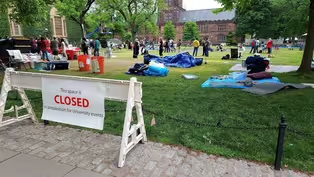
Princeton president orders pro-Palestine protesters to leave
Video has Closed Captions
President says protests 'would involve a significant and impermissible disruption...' (4m 3s)

Selecting jury in Menendez trial is an 'art and a science'
Video has Closed Captions
Interview: Brian Whisler, an attorney and former federal prosecutor (5m 12s)
Providing Support for PBS.org
Learn Moreabout PBS online sponsorship
- News and Public Affairs

Top journalists deliver compelling original analysis of the hour's headlines.

- News and Public Affairs

FRONTLINE is investigative journalism that questions, explains and changes our world.












Support for PBS provided by:
NJ Spotlight News is a local public television program presented by THIRTEEN PBS