NJ Spotlight News
NJ Spotlight News: May 22, 2024
5/22/2024 | 26m 46sVideo has Closed Captions
Watch as the NJ Spotlight News team breaks down today’s top stories.
We bring you what’s relevant and important in New Jersey news, along with our insight. Watch as the NJ Spotlight News team breaks down today’s top stories.
Problems playing video? | Closed Captioning Feedback
Problems playing video? | Closed Captioning Feedback
NJ Spotlight News is a local public television program presented by THIRTEEN PBS
NJ Spotlight News
NJ Spotlight News: May 22, 2024
5/22/2024 | 26m 46sVideo has Closed Captions
We bring you what’s relevant and important in New Jersey news, along with our insight. Watch as the NJ Spotlight News team breaks down today’s top stories.
Problems playing video? | Closed Captioning Feedback
How to Watch NJ Spotlight News
NJ Spotlight News is available to stream on pbs.org and the free PBS App, available on iPhone, Apple TV, Android TV, Android smartphones, Amazon Fire TV, Amazon Fire Tablet, Roku, Samsung Smart TV, and Vizio.
Providing Support for PBS.org
Learn Moreabout PBS online sponsorshipAnnouncer: Major Funding for "NJ Spotlight News" is provided in part by NJM insurance group, serving the insurance needs of residents and businesses for more than 100 years.
Horizon Blue Cross Blue Shield of New Jersey, an independent licensee of the Blue Cross Blue Shield Association.
New Jersey realtors, the voice for real estate in New Jersey.
More information is online at NJrealtor.com.
And by the PSEG foundation.
Briana: Tonight on NJ Spotlight News, a New Jersey pharmacist who had been trapped in Gaza is safely home.
She shares her heartbreaking journey as the Israel-Hamas conflict approaches its eight month.
>> Being in this kind of war zone, being able to be humanitarian relief for others is something I believe is a must.
Briana: Self-administered birth control is no available over-the-counter without a prescription.
>>>> Few pharmacist are certified.
This is groundbreaking for women.
The more we can eliminate these barriers to contraception, the better our lives will be.
Briana: A state looks to crackdown on E bikes looking to license and ensure them.
Advocates want to pump the brakes on the legislation.
>> Let's call this bill what it is it is an attack on Viking and immigrants and an attack on street safety for all of us.
>> It is a huge one across the country.
Briana: NJ Spotlight News begins right now.
♪ >> From NJPBS Studios, this is NJ Spotlight News.
Briana: Good evening.
Thank you for joining us.
I am Briana Vannozzi.
A New Jersey pharmacist and mother of six who was stranded at a hospital in Gaza is back home with her family tonight.
She was part of a group of 19 medical workers volunteering at the European hospital just outside of Rafah.
Since May 1.
One week into their mission, escalation is caused the borders to be sealed, trapping her and the other volunteers, which included Americans and a New Jersey doctor NJ Spotlight News spoke with before the team was evacuated with the help of the White House the group said they left the region with the reservations, heartbroken to abandon their Gazan patients and others who were not being guaranteed safe passage.
She is with me now to talk about her experience.
You just returned home on Monday.
How are you?
Where is your mind out right now?
>> I feel that I still live in Gaza with real people and the real life over there.
I told my family and my kids, I'm not sure how long it will take me to have the balance and to go back to real life.
It was the best of three weeks I had in my life in Gaza.
Briana: The best ever.
Why are you qualifying it like that?
Ghada: When you are helping people and you are living with people where they have nothing in life, they have no food, no water, they have no shelter or they have nothing.
There is bombing all the time.
And they are still happy, and they still want to live.
The injuries we saw, even the doctors who were in a different kind of war zone in different countries before Gaza, they mentioned they never saw what they did in Gaza.
It is totally -- there is destruction in the infrastructure.
The injuries that are coming to the hospital, most of them are coming.
And when you see the hands and the legs, the head by itself coming to the hospital, we heard about that.
But when you see it with your eyes, it is totally different.
Briana: And yet, somehow, you managed to provide a sense of safety to the people you rate -- you were treating.
What was it like inside the hospital?
Ghada: The health system is collapsing.
The capacity of the people working in the hospital is down to 24% the international medical team, they are available in the hospital.
They provide the hope.
They provide the medications in the surgical supplies and the knowledge that they have with them when they come in.
The safety we have, people just to see the risk in the international medical doctors, they feel that they are safe.
That this is a Green Zone, they will not be killed in the hospital.
Which they have the same experience before in other hospitals.
That is number one.
Number two, the medical missions usually get so many supplies and medications and equipment.
Those kind of things, we use it while we are there for the two weeks.
We have all of these kinds of things we are able to help doctors.
The doctors over there, as I mentioned, 20% of the capacity of the hospital, either they are skilled or they are relocating their families.
Being around them, someone who comes for two or three weeks, so we have all the energy to help them out, doctors over there are exhausted.
They are working full-time.
Of course they are all volunteers, they are not being paid.
For how many hours, not able to see their families, for eight months.
Just imagine how they feel and how we are able to help them with that.
Briana: I can't.
Many of us can't.
It begs me to ask, would you go back again if the opportunity were to present itself, given what you have seen and what you know now?
Ghada: I tell them, I will be the first to go.
I promised people over there that I will not leave them, and I will come once they open the borders.
We know the story about what happened with us.
We should be there for only two weeks, but what happened when the Israeli blocked the Rafa borders, we were not able to come back.
The other mission in Cairo, also not able to go to Gaza.
Being in this kind of war zone, being able to be a humanitarian relief for others is something I believe is a must.
And I urge all doctors, surgeons, pharmacists, nurses, to write their name and to go where the medical missions are to Gaza.
Briana: I can't imagine those conversations with your family, with your young ones especially.
I'm sure that had to be very painful for you as a mom, and scary for them knowing that you may not return.
Ghada: My family, my brothers and sisters, they did not talk to me.
They told me, you cannot go there.
You have no mind to go over there.
You are a woman.
You have kids.
They need you more than people over there.
You are a pharmacist for what are you going to do?
Were against me being there.
My husband and my kids, they didn't want me to go.
My little one is six years old, did not talk to me, a word, while I was in Gaza because he was worried about me.
His colleagues in school, they told him that your mom is going to die.
No one goes there and will come back alive.
But my kids, they work with me in COVID time.
Mine was the number two pharmacy in the United States.
We did the most vaccinations and testing in New Jersey.
So we arrived as the number two pharmacy.
So they knew what it needs to help people.
My kids, they have shelter, they have a house, they have food, they have everything.
Over there, they have nothing.
You cannot imagine, it is a city of ghosts.
We see how the horrors, over there, it is more than that.
And still, people say, we want to live.
We are sure that one time -- one day, it will come very soon, and we will be back to our homes.
We will build up.
And things will be different.
Briana: A city of ghosts.
The example you are setting for your family is remarkable.
And as are you.
Thank you so much.
Ghada: Thank you.
Appreciate that thank you.
Briana: The student led protests against the Israel-Hamas war have mostly come to a halt.
Without an agreement from New Jersey University officials to divest and boycott Israel as demonstrators demanded.
The administration told organizers of a pro-Palestinian encampment it is time to leave.
After three weeks of sleeping intents to make their stash intends to make their stance known, and as they are set to testify before Congress about reports of anti-Semitism on campus.
As Melissa Rose Cooper reports, student protesters say they are not going anywhere.
>> What is hard, at least personally for me, and I want to make sure I'm very clear, this is a personal statement from me.
Is that, genocide is happening.
People are like, you are ruining my graduation, you are you -- you are ruining my picnic.
Kids are dying.
What is your line in the sand?
I'm always point to do whatever in my power to make sure I am fighting for social justice issues.
Melissa: Anthony Deas reacting to a recent request from Rutgers Newark to clear this encampment in support of Palestine just days before students are set to graduate.
>> I get it.
You work three years, this is a culmination of the peak highlight of your life or career or professionalism, and then you come and you see this Palestinian encampment.
But I think what we have to realize as Americans as we don't live in a bubble.
All of these interconnecting points, the intersectionality of the struggle, the land back for the Palestinians, it is all tied up in one another.
People need to constantly be reinforced and that.
Melissa: On its 22nd day, participants of the encampment have been culling on the University to divest from Israel and reinvest resources into Newark's communities and their needs, like more affordable housing.
>> I have always felt personally connected to the Palestinian issue.
Even as someone who lives in Newark at the moment, all of these struggles are interconnected.
It felt important to speak out.
>>>> It is a genocide, ongoing, across the ocean that is an extension of the genocides that have been committed here and all over the world by imperialist and colonial powers.
That have been doing this for hundreds of years now.
And it needs to stop here the cycles of violence need to stop.
Melissa: Despite two meetings with the school administration, students say their demands are still not being met.
>> They are putting a lot of the research and the finding of the resources on us, which they are an institution in the city with billions of dollars and academics.
And people, it is their profession to research this kind of stuff and figure out how it works.
Instead of them asking people to do that, they are telling us we need to come with them with these fully formed plans on how exactly to do this.
That just does not seem like you are acting in good faith.
If you have all of these resources and you are available to do this type of resource, and you want to work with us to accomplish these things we are asking, then you would put people on it.
Melissa: Spokesperson from Rutgers Newark maintains they reached out to students in good faith to address their concerns.
The spoke person also says they reached out to person -- two people yesterday and are waiting for them to respond.
I am Melissa Rose Cooper.
Briana: As of this week, pharmacies in New Jersey are now allowed to sell hormonal birth control without a prescription, making the state one of roughly 30 in the country where you can get the contraception over-the-counter.
The new rules are based on a log Governor Murphy signed in 2023, allow pharmacists to dispense birth control pills, patches, and diaphragms among others.
Senior correspondent reports, don't expect to find a participating pharmacy right away.
Those who opt in will have a few hoops to jump through first.
Reporter: gave birth control?
You have more options in New Jersey where drugstores can offer you contraceptive pills, rings, patches, and injectables, no prescription needed and no visit required to see a doctor first.
But there is a safety check.
>> We need to make sure that people are not just blindly taking these medications.
Because there are risk factors.
Reporter: he says first time clients will get questioned by specially trained arm assists -- pharmacists who will do screening.
>> If they have any risk of cancer, if they are taking any medications that may interfere with these medications.
For example, if they are taking an antibiotic.
Antibiotics can decrease the effectiveness of birth control pills.
We will tell them to use a secondary form of contraception.
>> I'm excited that people will not have to wait for appointments, potentially delaying their ability to access care by being able to go to their local pharmacy, get screened, and be able to get the medication then and there.
Reporter: Dr. Kristin Brandy says patients have been able to buy the FDA pill over-the-counter since March.
.
But that control method uses progesterone only.
New Jersey is joining other states that offers pills that uses estrogen and other self-administered options.
The CDC says almost half of U.S. pregnancies are unintended.
That motivated Senator Shirley Turner to sponsor this bill.
>> By the time you get an appointment with a doctor, they could do pregnant or pregnant again with another child.
This is groundbreaking for women.
The more we can eliminate these barriers to contraception, the better our lives will be.
Reporter: the state division of consumer affairs is working on a website that will list pharmacies that offer self-administered birth control without a prescription, but it is when to take some time to get the pharmacist trained and ready.
CBS reports the law, Walgreens says it is looking into it.
Birth control suddenly headlined presidential campaign news when Former President Donald Trump told CBS affiliate K.D.
KA in Pennsylvania but, like abortion it should be up to the states.
>> Things really do have a lot to do with the states.
Some states are going to have different policies than others.
I'm coming out within a week or so with a very comprehensive policy.
Reporter: Trump reversed himself after the comment provoked a furious backlash, saying he had that she would never restrict birth control and blamed "a Democratic lie."
It reverberated in New Jersey.
Is so called sanctuary state for reproductive rights in a post Dobbs landscape.
>> It is a great threat to women.
I think that has been demonstrated in many states when they have put the issue on the ballot.
>> Right now, we have great laws.
There is always a chance of something like a federal band that could prevent our care and our state.
Reporter: New Jersey snow prescription birth control law does not have an age risk -- age restriction.
Products will become more available as more pharmacists take the four hour online training course.
For now, advocates advise Jersey residents to call ahead before going to their local pharmacy.
I am Brenda Flanagan, NJ Spotlight News.
>> Support for the medical report is provided by Horizon Blue Cross Blue Shield of New Jersey, an independent licensee of the Blue Cross Blue Shield Association.
Briana: In our spotlight on business report, a potential roadblock for eBay co-owners.
A proposed bill moving through Trenton would require electric bikes and scooters to be registered with the state and insured, just like cars.
While Pettus trans and traditional bicycles are covered by no-fault insurance, low speed e-bikes are not.
Our correspondent Joanna Gagis reports that the legislation is getting major pushback from those who say it would create barriers for low income residents and others who argue the insurance does not exist.
>> Let's call this bill what it is.
It is an attack on Viking, an attack on immigrants, an attack on street safety for all of us.
Joanna: A group of more than 40 organizations came together to protest a bill that creates strict regulations for e-bikes in the state.
>> Each year, motor vehicle crashes kill over 1000 New Yorkers.
A growing proportion of those casualties are e-bike and scooter riders themselves.
Why are our legislators seeking to punish the likely victims of fatal crashes?
Joanna: The bill, sponsored by Nick's to Cardi and another senator would require low-speed electric bikes and scooters to be registered with the motor vehicle commission.
It would ban the use of any unregistered e-bikes and scooters, and it would require owners to have insurance coverage.
>> Adding on an extra layer of cost just to ensure this Level 1 e-bike will really be a burden.
It would cut out not just people who do e-bike delivery, but anybody who, for whatever reason, cannot afford a car.
Joanna: The coalition, made up of bike and pedestrian advocates, clean energy groups, and members of the insurance industry, sent a letter of opposition to the Senators highlighting what they say is the plan's ineffectiveness and inconsistencies in the state's net zero goals.
The office offered no comment on the bill at this time.
Senator echo pal told us he expects the bill to be amended, based on these concerns.
In the insurance industry says the bill right now mandates something they cannot deliver.
>> Enacting a mandate on the tens of thousands of these devices that are already in place, we don't have the insurance capacity to meet that.
It is going to take time.
That is one of our major concerns with this legislation.
The time is not built in to the legislation as proposed for us to do this right.
Joanna: And they warn it could have unintended consequences.
>> This proposed legislation by requiring insurance and registration could potentially lead to more unwanted police stops, disproportionately targeting BIPOC writers.
-- riders.
Many visitors bring their e-bikes on vacation.
This could deter tourism and negatively impact local economies.
Joanna: A better solution these groups say, create a vision zero policy across the state.
The vision zero alliance has drafted an alternative bill that would create what they call the vision zero commission.
>> Let's go where the danger is.
Look at statewide, where are crashes happening, why are they happening there every year, and what is the state doing to improve safety there?
The city has a great vision zero policy.
.
They eliminated fatal crashes on local streets recently.
Neighboring neighbor has gone seven years without a fatal crash.
Because of that success, Pete Buttigieg called out them at a national level and said it is an example.
Every Kathy in New Jersey is working on a zero vision policy.
I don't have jurisdiction over state roads.
Joanna: They say fix the roads and you will need less insurance, but added more insurance will do nothing to improve safety.
In the city, I am Joanna Gagis, NJ Spotlight News.
Briana: Turning to Wall Street, stocks lift from record highs today.
Here is where the markets closed here is where the markets closed.
♪ Briana: Finally tonight, four years after the global COVID-19 outbreak was declared a pandemic, millions of people are still suffering from one of the virus's worst side effects.
Long COVID.
And for some, the debilitating brain fog it causes.
Researchers at Rutgers University recently published one of the most detailed investigations into the symptom, looking at how and why Long COVID causes some people to experience difficulty thinking or concentrating.
Dr. William who is the senior author of the study, and he joins me now to share what his team discovered.
It is so good to have you on the show.
I think there are a lot of people who are interested in this topic.
What did the findings from your study show?
Thank you for having me.
I think the issue of long COVID is really a huge one.
Not only in New Jersey, but across the country.
One of the biggest questions that the people asked me a number of years ago is a, what happened to people with long COVID?
We really did not have a good understanding because the disease was so new.
We recruited a group of people who were coming here to Rutgers for care.
We followed them over time to see what happened to their memory issues or what many people call brain fog over time.
Over the course of two years, about half of the people experienced improvement in their cognition, while the other half did not.
We are able to at least answer the question that there is some recovery, but recovery is slow.
We also tried to understand what the basis for this recovery was, so we recruited a subgroup of people to undergo analysis.
We did something that was fairly extraordinary, we were able to collect other immune cells in the spinal fluid that were in contact with the brain.
And we were able to study the genes in these cells.
What we learned was that long COVID was really very similar to acute infection, acute SARS-CoV-2 infection.
In the field, there is a lot of debate about whether this is due to a post-infectious autoimmune process, whether this is a chronic infection, or sadly, whether this is all in the patient's heads.
Briana: Correct me if I'm wrong, because they were thoughts early on in the pandemic that perhaps the long COVID, the brain fog you are speaking about, may be shared similarities with what we would find in dementia or Alzheimer's.
.
But you are saying what you found contradicted that?
Dr. Hu: Yeah, absolutely.
We routinely see people suffering from Alzheimer's disease, living with Alzheimer's disease.
So we have precise markers.
We did not have all -- we did not find Alzheimer's signatures in any way in the group of people with long COVID.
We are fairly convincingly excluded Alzheimer's as a potential mechanism for the brain fog.
Briana: That is the good news.
Did you find anything about what might be helpful in terms of speeding up the recovery for folks who have long COVID?
Dr. Hu: From a biological biochemical perspective, what we found is people who were able to mount a strong in you and reaction to fight infection, they were better at clearing the brain fog over time.
Whereas if people failed to achieve this, and this is a biological pathway, directed downstream from another molecule, if people were unable to mount this response, then their brain fog never quite improved.
Briana: Dr. William Hu, the senior author at Rutgers University, looking into brain fog specifically from long COVID.
Thank you for sharing your findings with us.
Dr. Hu: Thank you for having me.
Briana: That does it for us tonight.
Don't forget to download the NJ Spotlight News podcast so you can listen any time I am Briana Vannozzi.
For the entire.
NJ Spotlight News to steam, thank you for being with us.
.
Have a great evening.
We will see you back here tomorrow night.
>> New Jersey education Association, making public schools great for every child.
Our WJ Barnabas health.
Let's be healthy together.
And New Jersey realtors, the voice of real estate in New Jersey.
More information is online at NJrealtor.com.
♪
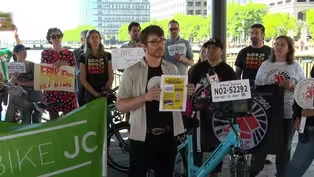
Coalition protests against proposed e-bike regulations
Video has Closed Captions
Bill would require registration and insurance for low-speed electric bikes (4m 27s)
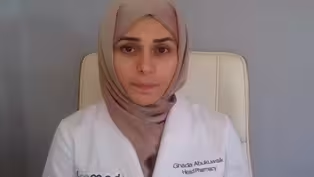
NJ pharmacist among medical volunteers evacuated from Gaza
Video has Closed Captions
Interview: Pharmacist Ghada Abukuwaik (10m 9s)
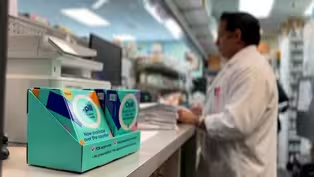
No-prescription birth control now available in NJ
Video has Closed Captions
Residents should call ahead to make sure of availability at their pharmacy (4m 19s)
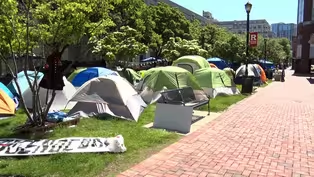
Rutgers-Newark students stand firm with protest encampment
Video has Closed Captions
Protestors are calling on Rutgers to divest from Israel, reinvest resources into Newark (3m 41s)
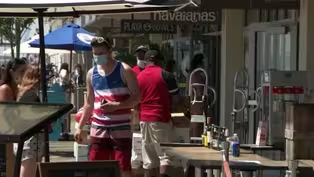
Rutgers researchers zero in on long COVID’s ‘brain fog’
Video has Closed Captions
Interview: Dr. William Hu, Center for Healthy Aging Research, Rutgers University (4m 12s)
Providing Support for PBS.org
Learn Moreabout PBS online sponsorship
- News and Public Affairs

Top journalists deliver compelling original analysis of the hour's headlines.

- News and Public Affairs

FRONTLINE is investigative journalism that questions, explains and changes our world.












Support for PBS provided by:
NJ Spotlight News is a local public television program presented by THIRTEEN PBS