NJ Spotlight News
NJ Spotlight News special edition: May 27, 2024
5/27/2024 | 26m 46sVideo has Closed Captions
In this special, NJ Spotlight News examines New Jersey's shrinking shoreline
As the summer season kicks off this Memorial Day, NJ Spotlight News examines New Jersey's shrinking shoreline and the significance this has on tourism and its impact on the state’s economy -- as well as the billions of federal and state dollars being spent to maintain New Jersey’s beaches each year.
Problems playing video? | Closed Captioning Feedback
Problems playing video? | Closed Captioning Feedback
NJ Spotlight News is a local public television program presented by THIRTEEN PBS
NJ Spotlight News
NJ Spotlight News special edition: May 27, 2024
5/27/2024 | 26m 46sVideo has Closed Captions
As the summer season kicks off this Memorial Day, NJ Spotlight News examines New Jersey's shrinking shoreline and the significance this has on tourism and its impact on the state’s economy -- as well as the billions of federal and state dollars being spent to maintain New Jersey’s beaches each year.
Problems playing video? | Closed Captioning Feedback
How to Watch NJ Spotlight News
NJ Spotlight News is available to stream on pbs.org and the free PBS App, available on iPhone, Apple TV, Android TV, Android smartphones, Amazon Fire TV, Amazon Fire Tablet, Roku, Samsung Smart TV, and Vizio.
Providing Support for PBS.org
Learn Moreabout PBS online sponsorship- [Announcer] Funding for NJ Spotlight News provided by: the members of the New Jersey Education Association, making public schools great for every child; RWJ Barnabas Health, let's be healthy together; and New Jersey Realtors, the voice of real estate in New Jersey, more information is online at njrealtor.com.
[dramatic music] [dramatic music continues] From NJ PBS studios, this is "NJ Spotlight News" with Briana Vannozzi.
- Good evening and welcome to a special edition of "NJ Spotlight News."
As we kick off the summer season this Memorial day, we're using the broadcast to examine New Jersey's shrinking shoreline.
We look at the significance this has on tourism, and its impact on the state's economy, as well as the billions of federal and state dollars being spent to maintain New Jersey's beaches each year.
To put it in context, New Jersey ranks number one in the country for spending on beach replenishment.
You can see it best from the air, how climate change and sea level rise is impacting the coastline.
In some sections, beaches are now less than a football field wide, and places like North Wildwood and Atlantic City are desperate for emergency repairs before the summer tourism season kicks into high gear.
We begin with senior correspondent Brenda Flanagan in North Wildwood.
[dramatic music] - [Brenda] Beach season's a real cliffhanger here in North Wildwood.
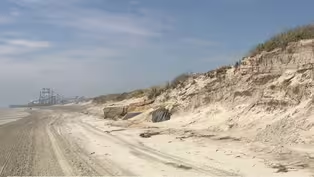
Ravaged dunes look like they've been bulldozed.
Its skinny beach, brutally stripped of sand by erosion, can almost disappear under a high tide in some sections.
Joe checks tide charts before walking his dog, Finn.
- Come on.
I play the tide, so basically low tide.
I'll come out here so I have a little bit more beach.
- A high tide, there's no beach.
- None?
- No.
So where are you gonna put your towel?
[Steve and Brenda laughing] - [Brenda] Steve's a hotel handyman.
Like other locals, he's concerned because if North Wildwood loses beachfront, it loses business.
The town markets itself with the motto, "Sun and sand."
Summer resident Lucille Stanziale says cancellations have already started rolling in.
- And I think it's taken a financial hit on the whole area here because a lot of people have canceled and relocated to a different part of the shore, or they're just going on cruises, or going somewhere else.
- [Brenda] Because there's?
- Because of the beach being so limited in space.
- It's devastating to see all this sand gone.
- Yeah?
- Yeah, it's horrible.
- We've been coming down for years with our grandkids, for over 30 years, and there was always room on the beach.
I mean, it would get crowded, but there was plenty of room.
And the last couple of years, I don't know what happened.
- North Wildwood has been fighting to hold onto its sand for years.
This dune is 16 feet high.
It used to run for about 25 yards, and then after that was the beach.
The beach went for 100 yards.
I mean, that's as long as a football field.
Almost none of it's left.
- So really in the last two years is when we saw this really dramatic erosion because we had no means of replenishing it.
- North Wildwood Mayor Patrick Rosenello explains they had built back this shoreline using emergency truckloads of sand, driven along the waterline from neighboring Wildwood.
But erosions erased so much beach, dump trucks couldn't squeeze around amusement piers to make the trip anymore.
The city tried to build a steel bulkhead barrier to protect streets like 13th Avenue.
With no dunes, it's wide open to the waves, vulnerable to ocean storms, like the one back in January 2016.
- Just from a nor'easter that just happened to coincide with a full moon and a high tide and an intense nor'easter, and it caused significant damage.
- [Brenda] However, North Wildwood's bulkhead plan hit a different kind of barrier.
The DEP denied them a permit, claiming bulkheads here would only make the problem worse.
Facing a virtually beach-less summer, the hapless city sued the state.
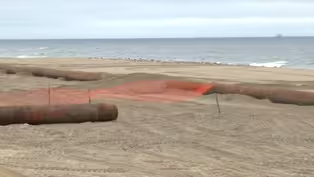
[machine rumbling] Just a half hour drive north, the federal government came to Sea Isle City's rescue with a scheduled sand dredging project to repair its eroded shoreline.
[machine beeping and rumbling] The Army Corps of Engineers started replenishing three beaches along Sea Isle City's oceanfront in May.
The Corps works on a rotating multi-year cycle with Jersey Shore towns that started in the early 1990s.
In Sea Isle, it's pumping and spreading enough sand to fill 140 football fields four feet deep by Memorial Day.
- The economic engine is tourism here for us.
It's very important that our beaches are vibrant, our beaches are open, and our beaches are able to be used by people that come here.
The beaches are our lifeline.
- [Brenda] But at what cost?
One eye-opening study shows that, per foot of shoreline, New Jersey leads the nation in beach replenishment.
More than $3 billion from all sources, adjusted for inflation, since 1936, 245 million cubic yards of sand.
And that sand keeps getting washed away, sometimes catastrophically.
Superstorm Sandy obliterated much of Ortley Beach, part of Toms River.
[waves crashing] The Corps repaired Ortley's dunes in 2019, and it's in the pipeline for more federal beach nourishment.
But with relentless erosion chewing at Ortley's slender ribbon of sand, Toms Rivers had to spend more than 1.3 million out of pocket since 2021, dollars it can ill afford, just to maintain its beaches until the Corps arrives.
For the feds, it's a mission.
- In general in New Jersey, with a very highly developed shoreline with homes, businesses, roads, boardwalks, utility lines, all of that, generally speaking, beach fill emerged as the most cost effective way to manage the risk.
- [Brenda] Stockton University has identified lots of erosion hotspots all along the Jersey Shore.
Some places even flood on sunny days simply from high tides.
With New Jersey sea levels projected to rise another two feet by 2050, Stockton's Kim McKenna warns the Army Corps may have to rethink its approach.
- It means we all have to figure out how to adapt to that.
If we're not willing to move off of the barrier islands, we have to figure out what's the best way to adapt to these rising waters.
We can certainly place more sand on the beaches.
It's gonna be extremely expensive.
- The fear is everyone's gonna have a different breaking point, and every municipality has different challenges.
- [Brenda] Christina Renna heads South Jersey's Chamber of Commerce.
She says shore tourism generates $20 to $30 billion a year, mostly from Atlantic and Cape May counties.
But with erosion now outpacing the Army Corps's efforts to repair beaches in some places, it's a changing economic reality.
- The beach replenishment projects are necessary and expensive.
Creating infrastructure, new infrastructure, that is raised higher, expensive.
There is no easy solution to this problem.
- [Brenda] It's a risky business.
Casinos along Atlantic City's erosion-prone north end have privately paid hundreds of thousands of dollars to replenish sand that winter storms gouged out of their beaches, but it's gone now, and the city's not due for Army Corps beach replenishment until next year.
The mayor sees an imminent threat to both tax revenues and public safety.
- The beach is dangerous right now.
You can see the condition that it's in.
We have a tremendous beach patrol and everything, but safety is first and foremost, and that's what are gonna stress here.
- So when you think about all of the businesses that are impacted by beach tourism, anywhere from, of course, the casino hotels, but non-casino hotels, so many vendors depend on the beach tourism.
- [Brenda] Atlantic City is working with state officials.
Meanwhile, North Wildwood scored a last-minute emergency rescue.
The $17 million dredging project in nearby Hereford Inlet will soon funnel more than 330,000 cubic yards of sand via pipeline to help bolster the town's damaged beachfront, until the Army Corps can do a full-scale beach restoration next year.
New Jersey pays 10 million, the city, 7 million, the bigger sandy beach by July 4th, priceless.
- So Hereford Inlet hasn't been dredged in over 10 years.
There's a restriction on using any federal money to dredge Hereford Inlet, but because this project will be 100% state and local, we're able to dredge outta Hereford Inlet.
- [Brenda] How you feel.
- I feel very good right now.
I'm very appreciative of Governor Murphy.
This has been a long road.
- It is kind of scary.
Mother Nature is getting a little vicious out there.
But I have faith in our mayor and our governor to come to a reasonable solution to all of this.
- [Brenda] Until its beach gets rebuilt, the town will ban big cabanas and outsized tents so more folks like Lucille and her family can fit in to enjoy the sun and sand.
In North Wildwood, I'm Brenda Flanagan, "NJ Spotlight News."
- The Jersey Shore's erosion problem is getting worse.
Climate change is making storms more intense, and sea level rise is eating away at beaches, from Cape May to Sandy Hook.
Municipalities are spending millions to keep up, but is it all really worth the cost and investment, year after year?
Melissa Rose Cooper reports from Monmouth Beach.
[dramatic music] [waves crashing] - [Melissa] For years, the sounds of waves along the Jersey Shore have offered both residents and visitors a sense of serenity.
But as sea levels rise and storms intensify due to climate change, there's concern that peace could lead to Jersey's beaches being washed away.
- Over time, you know, that sand would disappear.
It would, you know, beaches would get narrower and narrower.
And we get back to a point where we were in the late '80s, early 1990s, where a beach like this one here, you would stand on this seawall, and the water would be lapping right at the base of the seawall.
- [Melissa] That's why Tom Herrington, associate director of the Urban Institute Coast in Monmouth University says beach replenishment is so important.
The process aims to fight erosion by widening the beach with added sand.
- You know, we've had beach erosion throughout the history of our shoreline.
That erosion doesn't go away, so they need to replace the sand as it disappears.
So they're, they don't do it, it's like not paving your roads, right, they just become potholes and decay.
- [Melissa] This spring, the Army Corps of Engineers wrapped up a beach replenishment project stretching 21 miles in Monmouth County from Sea Bright to Manasquan.
Monmouth Beach, at the north end of that area, is considered a hotspot for erosion.
- The seawall will protect the houses behind the beach, the ones that, if you look right behind you, you can see all the houses.
But the seawall itself makes erosion more intense.
It exacerbates erosion.
And so when you put a seawall up, you have a problem maintaining the beach.
- [Melissa] Kenneth Miller studies how sea level rise is affecting New Jersey.
This drone, which takes hundreds of thousands of overlapping photos from about 100 meters in the air, will help analyze how the elevation of Monmouth Beach is changing.
- So sea level's rising around here in about, more than an inch per decade.
And it is, that makes the erosion worse in a sense because sea level is rising, and the sea and the ocean comes up further.
The most hazardous part though, is when we have intense storms, as we saw in Sandy.
And Sandy really trashed this area, particularly Sea Bright, just to the north here.
This wall continues up into Sea Bright.
And then there's a break in the wall, and then it continues from Sea Bright into the southern part of the national park.
And it was in where that wall had a break between the two places that the town of Sea Bright was flooded.
And so again, the storm surge is getting worse, in general, as storm intensities are increasing.
- Now there are some places, like on the mainland, where yes, you have beaches, the sand would move laterally right down the shore, but the shoreline would not necessarily retreat at the same place.
But barrier islands want to move.
That's sort of inherent in the nature of their structure.
- [Melissa] Bob Kopp is an expert in sea level rise and coastal adaptation.
He says a 2019 assessment shows a two in three chance of sea level rising by one to two feet along New Jersey's coast by the year 2050, and even more by the end of the century.
- By our assessment in 2019, under the emissions trajectory the world seemed to be headed for then, which was a bit more than three degrees of warming, we thought there was less than a 17% chance of sea level rise in New Jersey exceeding 5.1 feet.
And again, that's where that number came from.
Since then, you know, we've sort of continued to bend the emissions curve downward.
So I think that the likelihood of exceeding 5.1 feet has gone down further.
But that's a number that's still, you know, pretty closely tied to a pretty conservative attempt to protect the coast.
- [Melissa] But while beach replenishment is used as a means to protect the shoreline, the process can be quite expensive.
New Jersey has already spent billions of dollars on it.
- I think people think of it, you're just protecting the homes, or maybe you know, the recreational aspect for people that come in the summer.
But actually the cost-benefit analysis that's used before we can do a project doesn't take, you know, the beach goers or the homes into consideration.
It's just the infrastructure, the roads and the utilities.
- [Melissa] Congressman Frank Pallone has spent much of his career working to secure funding to protect the shore, which he admits can be difficult.
- Again, I wanna stress that it's always a cost-benefit analysis that shows that if you do this prevention, then you don't have to come back and pay for all the damage later.
And so it's harder, but it's more important than ever because of the problems with climate change.
- [Melissa] The congressman also says cheaper methods of beach replenishment are sometimes possible, like what was recently done at Monmouth Beach.
- The sand here was not actually from off shore, but was as a result of a dredging project that I have in the Shrewsbury-Navesink River.
And they used the extra mud, if you will, to pump this beach.
- [Melissa] The Army Corps is currently spending $3 million to study how beach erosion is acting in the area and how it might change plans for future beach management.
That study is not expected to be released until next year.
- So what the Corps is looking at is some kind of an offshore mechanical or infrastructure device that would deflect the wave action.
And there's another one like that in Long Branch, my hometown, there's others up and down the shore, to look at possible infrastructure offshore that would deflect the waves so you wouldn't have to do the beach replenishment as often.
- I think the way we manage the shoreline will change.
I think we know more and more about how shorelines naturally evolve, and we can start to consider different methods of managing our sand resources, maybe not letting them go right back to the inlets, or maybe not letting them kind of end up at the tip of Sandy Hook and the New York Harbor.
We have ways to take those materials and bring them back.
- [Melissa] For now, even as sea levels rise, pumping sand on our beaches remains the plan to protect the Jersey Shore.
For "NJ Spotlight News," I'm Melissa Rose Cooper.
- Andy Coburn is a Jersey native, but now studies beach replenishment trends for the Program for the Study of Developed Shorelines at Western Carolina University.
His research focuses on the scope and cost of beach replenishment around the nation, and is raising questions about if the work to replenish makes sense from a cost-benefit perspective.
He joins me now.
[dramatic music] Andy Coburn, great to have you here and to talk about this, which is obviously your expertise.
When we think about these beach replenishment projects, obviously the sand is meant to be washed away, but the extent that the state and the federal government have put money behind it has likely ballooned beyond what folks thought decades ago when a lot of these projects began.
Why is the work so very expensive now?
We're talking like $3 billion since it's been tracked over the last century.
- Right, well, thank you Brianna.
It's a pleasure to be back and chatting with you about beach nourishment once again.
It's expensive because it's expensive.
The process of beach nourishment entails a lot of very costly technical analyses.
Using a dredge to pump sand from the ocean onto a beach is very expensive.
There are not a lot of companies that can do that kind of work at that scale, so there's a supply-demand issue.
A lot of fuel, as you can imagine, is required to run these barges, and these pumps, and heavy equipment.
So it's just a very costly thing to do.
And it costs, we used to say about 10 or 15 years ago, we used to have, we had a general rule of thumb that said it would cost about a million dollars a mile to nourish a beach.
And that was anywhere, rule of thumb.
Now we'd say it'll cost $5 million before a grain of sand is even pumped on the beach.
- Give us an idea, quickly, I'm just curious, about the cost per cubic foot now, compared to even, let's just say 10 years ago.
What's the contrast?
- The cost per cubic yard of sand is increasing, and has been increasing over the past 20 to 30 years.
I think what we're gonna end up seeing is, when we go back and do trend analysis of the data, we're gonna see a significant increase in the cost of beach nourishment nationally.
In about 2004, 2005, when Florida was hit by so many hurricanes, I believe they had to start, they ran through the alphabet and had to start using the Greek letters, which is kind of rare but not unheard of.
And the demand for beach nourishment after that season was so great that we saw a significant increase in prices.
And prices don't ever come down, as we all know.
Prices go up, and maybe they slow down, in terms of how they increase, but they do not ever go down.
And for beach nourishment, we have never seen prices go down, or costs, I should say.
- When we chat with folks from the Army Corps, for example, you know, obviously their priority is to protect infrastructure at large.
Whereas when you talk to, especially local, you know, municipality leaders, there's a lot of concern about protecting tourism dollars.
But it seems as though this is becoming untenable.
There's so much working against it.
Are we at that point yet?
And do we have enough other options, or blueprints for other options, that we can even begin to think about pivoting?
- Beach nourishment is not undertaken because of the beach.
Beach nourishment is undertaken to protect what's behind the beach.
And you alluded to that when you talked about storm damage reduction and so forth.
The Army Corps of Engineers, that's their main charge, and they do shore protection projects, storm damage reduction projects, terminology changes over the years.
And that's their goal, is to keep that beach in place, keep a wide beach with an artificial dune there to protect what's behind that beach should a storm happen.
And that's the intent of nourishment.
Does it do that?
How well does it do that?
To what extent?
What are the benefits?
What are the costs?
Who pays?
Questions that we're continuously asking, or we have been asking for the last 50 years, probably, and have yet to get a great answer, a justifiable answer, to us at least, that allows us to say, "Hey, you know what, the cost, the public expenditure on nourishment is worth it."
We don't see that.
The Army Corps does cost-benefit analysis, that's true.
We have some issues with the methodology.
I don't really wanna get into the details of that.
But what we think is, instead of looking at the benefits, and the Army Corps of Engineers quantifies benefits as the, they quantify benefits in terms of property value.
We think the Army Corps of Engineers should identify benefits of nourishment in terms of the tax revenue generated by that property value.
Now that might be somewhat confusing, but it's a really, really important distinction to make when we're looking at costs and benefits, because the benefit of nourishment is almost exclusively to that front row, first row of structures and properties.
And so I think we need to reevaluate costs and benefits, equitability, fairness, those kinds of things before we spend public money on nourishing beaches.
- I wanna move on and ask you how New Jersey compares, nationally, in terms of federal and local money spent.
Because we are right now looking at a state record, some $50 million that's being planned to be spent on nourishment projects.
And I wonder how we stack up nationally.
- Well, New Jersey's number one.
I'm born and raised in New Jersey, so I'm proud to say that.
Put that in context, that by number one means the most money spent in any coastal state in the United States has been spent in New Jersey to put sand on the beach.
So you know, you can look at that as a great thing, or you can look at that as maybe that's $3 billion of, inflated to 2022 costs of, that's $3 billion that is no longer available to be spent on something else.
- We need more and more of this sand every year.
It never seems to be that we need less.
And so how long can we keep this up?
And are we going to run out of options?
- Well, that's a, you know, that's the, I used to say the $64,000 question, which that doesn't seem like a lot these days.
I can't answer that.
I really don't know what it is going to take for the powers that be to say to themselves, or say to the general public, or say to whoever, "Hey, you know what, we don't think it's worth spending money to protect that front row of housing anymore.
What else can we do?"
There are alternatives that we know are feasible.
We know they could work.
It's very difficult, politically, economically, socially, to get people to change their minds.
Nourishment's been going on for 100 years.
It's real difficult to say, "Hey, how about doing something different?"
We're trying, you know.
We work with decision makers all the time.
We're a research center at a university, so we have no authority to make decisions.
We don't make policies or enforce things.
The best thing we can do is talk to decision makers and get them to understand there are alternatives.
There are other ways that we can look at eroding shoreline, especially during a time of change in climate and rising sea levels and say, "We can do this."
It'll be different, it'll look different.
You have to get used to it, but it's in the best interest of the beach, the community, the state, the economy, the environment, everybody.
- Andy Coburn is the associate director of Western Carolina University's Program for the Study of Developed Shorelines.
Thank you so much, Andy.
- Thank you, Briana.
It was a pleasure seeing you again.
- That does it for us tonight.
But don't forget to download the podcast of this special edition of "NJ Spotlight News," so you can listen anytime, like when you're driving to the shore this summer.
I'm Briana Vannozzi.
For the entire "NJ Spotlight News" team, thanks for being with us.
Have a great rest of your Memorial Day.
We'll see you back here tomorrow night.
[dramatic music] - [Announcer] NJM Insurance Group, serving the insurance needs of residents and businesses for more than 100 years.
Horizon Blue Cross Blue Shield of New Jersey, an independent licensee of the Blue Cross and Blue Shield Association.
New Jersey Realtors, the voice of real estate in New Jersey, more information is online at njrealtor.com.
And by the PSEG Foundation.
- [Announcer] NJM Insurance Group has been serving New Jersey businesses for over a century.
As part of the Garden State, we help companies keep their vehicles on the road, employees on the job, and projects on track, working to protect employees from illness and injury, to keep goods and services moving across the state.
We are proud to be part of New Jersey.
NJM, we've got New Jersey covered.
- [Announcer] If you need to see a doctor, RWJ Barnabas Health has two easy ways to do it from anywhere.
You can see an urgent care provider 24/7 on any device with our TeleMed app, or use our website to book a virtual visit with an RWJ Barnabas Health Medical Group provider or specialist, even as a new patient.
You've taken every precaution and so have we.
So don't delay your care any longer.
RWJ Barnabas Health, let's be healthy together.
[dramatic music] [dramatic music continues] [dramatic music continues]
Time to reevaluate the money spent replenishing beaches?
Video has Closed Captions
Interview: Andy Coburn, Western Carolina University (8m 20s)
How climate change complicates NJ beach replenishment
Video has Closed Captions
More rapid erosion is forcing officials to consider alternatives (6m 50s)

NJ's beaches wash away faster than feds can fix them
Video has Closed Captions
Shore beach towns look for immediate fixes while nature strips away the sand (8m 58s)
Providing Support for PBS.org
Learn Moreabout PBS online sponsorship
- News and Public Affairs

Top journalists deliver compelling original analysis of the hour's headlines.

- News and Public Affairs

FRONTLINE is investigative journalism that questions, explains and changes our world.












Support for PBS provided by:
NJ Spotlight News is a local public television program presented by THIRTEEN PBS