NJ Spotlight News
NJ Spotlight News: November 28, 2023
11/28/2023 | 26m 47sVideo has Closed Captions
Watch as the NJ Spotlight News team breaks down today's top stories.
We bring you what's relevant and important in New Jersey news, along with our insight. Watch as the NJ Spotlight News team breaks down today's top stories.
Problems playing video? | Closed Captioning Feedback
Problems playing video? | Closed Captioning Feedback
NJ Spotlight News is a local public television program presented by THIRTEEN PBS
NJ Spotlight News
NJ Spotlight News: November 28, 2023
11/28/2023 | 26m 47sVideo has Closed Captions
We bring you what's relevant and important in New Jersey news, along with our insight. Watch as the NJ Spotlight News team breaks down today's top stories.
Problems playing video? | Closed Captioning Feedback
How to Watch NJ Spotlight News
NJ Spotlight News is available to stream on pbs.org and the free PBS App, available on iPhone, Apple TV, Android TV, Android smartphones, Amazon Fire TV, Amazon Fire Tablet, Roku, Samsung Smart TV, and Vizio.
Providing Support for PBS.org
Learn Moreabout PBS online sponsorshipANNOUNCER: funding for NJ Spotlight News, provided by the members of the New Jersey Education Association.
Making public schools great for every child.
And -- RWJ Barnabas Health, let's be healthy together.
BRIANA: Tonight on NJSpotlightNews," truce extended.
Israel and him agree to a considered cause infighting as more hostages are fighting.
Expert weighs in with it will allow Hamas to rearm and get fuel and to get we organize.
You have to assume it has a strategic consequence.
BRIANA: Also, partyline pushback -- >> It's a sophisticated form of voter suppression.
BRIANA: New Jersey's unique memory ballots under scrutiny again.
A new reform: Found on the dues being brokered.
Plus, looking for shortages limited to just shortages in the state, with eliminating requirements makes a great?
>> Sometimes they do not recruit the best and retain the best, but repeat people out who would be great educators.
BRIANA: And is a $34 million beach replenishment project in Monmouth County, enough to save the shoreline?
>> We have been working on these projects for years and will continue to do so.
BRIANA: "NJSpotlightNews" begins right now.
♪ >> From NJPBS videos, this is NJSpotlightNews Breonna Vannozzi.
BRIANA: Hello and thanks for joining us tonight, I am Joanna Gagis in for Breonna Vannozzi.
JOANNA: Today marks the fifth day fighting has been caused, allowing for 12 more hostages held by Hamas to be released to their families in exchange, 30 more Palestinian prisoners were released.
Fighting was to resume today, but tarp officials announced Israel agreed to pause fighting for an additional two days to allow more hostages to be released.
The latest round of releases includes mothers and children, but they have broken the rules agreed upon between Hamas and Israel, by separating families who were being held together.
Somewhere around 150 hostages remain in, as captivity including then Americans, one of them from New Jersey.
Both Israel and Hamas have accused the other of violating the truce agreement, Israeli forces the explosives were detonated near their forces.
And Hamas cleaning the IDF caused friction.
Despite this, the extent of business Move Forward.
Most of the Philistine is really so far, the IDF has simultaneously arrested more than 130 destiny is in the West Bank.
Meanwhile in Gaza, the number of Palestinians killed during IDF attacks count were near 14,000, according to the United Nations, which says that most are women and children.
So what does this continued cause infighting and these ongoing exchanges mean for the war overall?
I am joined by Michael Boyle, associate Professor of political science at Rutgers University Camden for some perspective.
Great to have you with us today, the fifth day of Israeli hostages and Palestinian prisoners being released.
What do we know about who was released by Hamas today and the process by which they continue to be elected?
Professor Boyle: the releases have been happening in batches of 10, they have been prioritizing largely women and children and not counting those who are military aged males for active military service.
So is drawing a distinction between those who are combatants and potential combatants.
They have been doing this in batches of 10 of the agreement is that this will happen alongside Philistine in Fresno releases done by Israel.
Every day, they will get a couple extra days of Cease Fire.
Yesterday it was a master there will be two extra days of the ceasefire while this kind of trade of about roughly 10 to 11 to 12 hostages per day are released, and roughly 100 to 150 Palestinian prisoners are released as well.
JOANNA: Let's talk about the American hostages being held.
President Biden confirmed there are nine.
One of them is from Tenafly, New Jersey.
What we know about Americans possibly being released?
Alexander himself was an IDF soldier, it doesn't look like they are anywhere on the list of being released, though the U.S. government is already for their release.
What do we know?
GUEST: the president made that the top priority to get American citizen out of,'s custody.
Hmmm asked is holding the hostages, but they have different valves of Hamas and there are also stories coming off of Palestinian Islamic jihad and other organizations holding hostages.
From what I understand, the CIA director is currently meeting with Qatar and other representatives in an attempt to get all hostages released before a resumption of the war, although it is unclear whether that will happen.
The sticking point is likely to be military aged males, which Hamas said they are not willing to consider releasing in this batch of hostage releases in support of the cease-fire.
JOANNA: You mentioned the pause infighting has been extended an additional two days, what do we know about the impact on Hamas and their ability to reorganize or regroup militarily?
Guest: The U.S. government has been clear, Jake Sullivan, national security advisor pointed out the other day that the break infighting will allow Hamas to rearm, to get fuel, to reorganize and to defend itself.
So you have to assume a strategic consequence.
The other point is that although this may give a pause that helps Hamas, if it gets more hostages out of harm's way, it is probably a net benefit.
We have to assume Hamas will probably be refreshed and possibly refuel, ammunition and so on.
Is that going to massively change to a strategic balance?
I don't think so.
JOANNA: Israel has made it clear that when the exchange ends, they will continue to fight and I talk guys out and Hamas.
The U.S. government is our duty take a more strategic approach to that attack.
What impact does that warning have on Israel, does it change their military strategy?
Guest: The U.S. has been trying to quietly lobby Israel and say, after you come back from the cease-fire -- and Israel has been clear that the war will continue once the cease-fire stops -- that the war will continue and it will go to the south.
The U.S. is trying to explore what leverage it has two persuade Israel to take a specific, targeted and much more limited approach, because the political cost of this is growing.
JOANNA: Absolutely.
Michael Boyle, associate Professor of political science at Rutgers come dead, thank you for your insight.
New Jersey native Evan Gershkovich and reporter, will remain in a Russian prison until January 30.
A private hearing was held in Russia this morning where the court determined his detention would be extended once again.
He is being held on charges of espionage, the Russian government saying he obtained a state secret about activities related to its military-industrial complex and acting on instructions from the American side.
Russia has provided no evidence to support that claim, and U.S. officials along with his employer, the Wall Street Journal, vehemently denied the accusation.
Russia continues to ignore calls from government officials to release him, adhering to their policy that no trade can be made until Gershkovich is convicted.
It has been a nearly 250 days since he was first detained in March.
The game of politics can be a dirty sport, but there is growing pushback against a process that plays out here in Jersey called the Party line.
It is a closed-door backroom endorsement of a candidate by county leaders in the state that ends up giving the candidate priority placement on election ballots.
Senior political correspondent David Cruz takes a look at a new report that shows just how undemocratic those county lines can be.
David: like the traffic jughandle and not being able to pump your own grass, the Party line is a uniquely Jersey thing awarded to primary candidates favored by the ruling political organization and it gives them favored ballot position and usually comes with that organization's money and human resources.
No other state doesn't let Jersey because no other state does it.
>> It's not just that you have good ballot position, which you do on the County line, it's that everyone else has pretty much bad ballot position and there may be multiple blank spaces away from you and they aren't running with the whole slate of candidates.
So all of these things contribute to the power of the County line and there is no other state who does those things.
David: Records Professor Julia Rubin is something of an authority on this, she has a new study due out soon for the Seton Hall law review looked at the power of the line in Congressional and U.S. Senate races in Jersey over the past two decades.
>> So there were 45 instances where either a U.S. House or U.S. Senate primary candidate net the endorsements, and in every one of those 45, the person on the County line won, and decisively.
The average difference between being on the County line and having your opponent on the County line was 38 percentage points.
David: Progressives are challenging the line in court, claiming that the sometimes Byzantine Jersey ballot represents blatant voter suppression and keeps many good candidates from even running because they know the deal.
But the issue has gotten hot again because of this.
>> I am running for the U.S. Senate.
David: Within days of her announcement, Tammy Murphy married to Governor Phil Murphy head of the state's Democratic party, got the endorsement of the five most powerful counties in the state Bergen, Essex, Middlesex Hudson and Camden, which collectively accounted for more than 50% of primary vote in the last election.
Putting her main opponent, Congressman Andy Kim, at a big disadvantage.
Mr. Patel co-authored this op-ed, saying this is no way to elect a U.S.
Senator.
>> These are the facts here, the first lady has announced she wants to be a U.S.
Senator, and the governor who happens to be the head of the party between that power, they have now locked up the support of the five biggest counties.
That means they are going -- that she is going to get the line.
That's absurd in terms of what a real democracy should look like.
It simply is and everyone should be willing to say that.
And everyone should acknowledge that we deserve better.
David: But Micah Rasmussen, who teaches politics and government at Rider University says the Murphy-kim race featuring two well-funded candidates will be a big test for the County line.
That said, he says we shouldn't be so quick to dump the lines which, in the end, he says it represents the will of the party's elected leaders.
>> Ultimately, these are elected officials of the party.
And it is up to them what they go along with and what they don't go along with.
That is entirely your choice.
If they didn't want to go along with the recommendations of the county chair or the endorsement of the County chair, then they don't have to do that.
David: Tell that to Hector who ran unsuccessfully in the congressional primary in Hudson County in 2020.
He notes that Party Chair's can override committee votes, essentially leaving it to five guys in big counties to pick winners and losers.
>> What it really does is make a candidate running for one office have to recruit candidates for every other office that you are going to appear on that ballot, or else you will be put in column g where nobody is going to see you.
And this is not theory.
You can see that in the way the elected officials themselves tightly guard the line.
David: Having the cash and the bodies is always going to be a leg up, but those we talked to said a good first step towards leveling the playing field would be simplifying the ballot, so that everybody running for, say, the U.S. and it is listed together, and forcing them to be to articulate a rationale for their candidacy, beyond the "bosses say it's OK." I am David Chris, NJ Spotlight News.
JOANNA: The teacher shortage in New Jersey has increasingly worsened in the last two years, exacerbated by the pandemic and culture wars that have infiltrated classrooms.
But education experts say it is actually New Jersey's teaching requirements that prevent aspiring teachers from ever making it into the classroom.
Yesterday Governor Murphy signed a bill that would eliminate one of the tests, that critics say it arbitrary and unnecessary.
I am joined by the nhbbia, and a committee board member to explain why.
Glad to have you with us tonight.
New Jersey is known for its high-quality standards in education and it begins with the quality of our teachers.
So why is the state's largest Teachers' Union in support of getting rid of this basic skills test that aspiring teachers have to pass in order to become a teacher?
GUEST: we are excited.
As educators and many others who are part of that system.
But we have to eliminate barriers for people coming into the profession whether it is, professional or otherwise, we see barriers that keep people out who would be great educators.
This is an example of that.
Every educator still has to pass a subject-specific test but go through what they need to know for the course they will teach.
The basic skills, I use that in air quotes, definitely measure the things somewhat things are basic skills that everyone needs to know.
It is abstract and obscure and doesn't have any measure of how successful an educator will be.
JOANNA: I want to draw down on the history of the test.
We have set through many hearings were advocates called for the removal of this test.
Give me an example of why this test doesn't accurately indicate the success a teacher might have in the classroom.
Guest: Say you're asking about obscure, high-level math for someone who will be teaching a kindergarten class.
Something as basic skills, you have basic math or basic writing or reading skills.
Those are the things I would think of or most people think of as a sick when it is asking about very high-level, very secure things where I have to pass a specific math practice to teach that course.
JOANNA: How does this change potentially bring in more teachers of color?
New Jersey classrooms very often don't represent the diversity that our classrooms do, how do we see more teachers of color, especially in urban areas, with this change?
Guest: It's a combination of things, not any one thing that will make a massive change.
We are one of the most diverse states, also one of the most segregated states.
As we try to recruit and retain, we have been working with the Department of Education and other partners to say, how can we get a more diverse workforce that is reflective of the student population that they teach?
That means talk about eliminating barriers.
Barriers that might mean tests that keep people out because of the obscure things they ask.
It also could mean the dollars.
Some of the times high cost tests that people have to take multiple times, while at the same time, they are trying to go to student teaching, which thankfully Governor Murphy is giving a little money for, but they didn't get any money for.
All of these compounding to say, I have to put out all of these dollars to try to get into a profession where for somebody as the same degree as me, they are making a lot more money and they don't have these obstacles that I have to get through.
JOANNA: What else would your organization like to see change when it comes to either the standards required or incentives for more teachers to get into the classrooms?
Guest: I think two things, but I want to highlight another one.
A lot of those things focus on recruitment.
And that is important from we have to focus on recruiting people into the profession.
But we need to focus on retention.
What we're seeing is that educators are not staying until retirement which they traditionally did in the past um .
Let's start giving a stipend for student teaching.
Let's eliminate the fees to process your paperwork, let's eliminate practice tests, let's get rid of edtpa.
But these individuals will not stay in their salaries are lagging behind their peers, when they are facing a new dynamic where in some other job areas, you can work from home.
When you see the burdensome paperwork that you don't think has any impact on student success but you have to do, and combine that with the loss of autonomy that educators are seeing as professionals.
And the erosion of benefits.
Thankfully, we have seen some success of the health care side, but pensions has still been eroded over the years.
We have to do more on the Rotation side chanson.
JOANNA: Enter, thank you for being with us tonight.
Guest: Thank you for having me.
JOANNA: In our Spotlight on Business Report, tonight Governor Murphy addressed the business community today to double down on the promise he made not to renew a corporate orchard tax that New Jersey businesses had said was stifling them.
That was just one of the matters discussed at the New Jersey business and industry association's 2023 public policy Forum where business and government leaders took on the tough topics that surround the estate's economic growth.
Senior correspondent under Flanagan was there and has more on the state hospital business Outlook.
>> I am still supporting the sunsetting of the corporate business tax on December 31.
BRENDAN: in a glass-half-full's reach Governor Murphy promised , this crowd of business folks that he will not succumb to political pressure and renew the business tax surcharge many view as onerous that he also emphasized the state is looking at a budget cliff.
>> the deal is a deal.
He said this was a bridge.
On the other hand, it does exacerbate what is the structural deficit we are running at the moment and we have to be clear about that.
>> The sunset of the corporate business tax makes a difference for New Jersey corporations.
That is hundreds of thousands of jobs important here in the state of New Jersey.
Brenda: She has New Jersey's Disney is an industry association which sponsored this policy forum.
The group's latest annual survey showed 69% of employers rated the state economy as fair or poor.
But that is a slight improvement over last year, when 78% gave it a thumbs down.
Also, 68% of employers found the state had not done enough to address business affordability in 2023, compared to 75% last year, again, a small 9% improvement.
>> This is a slow climb out of what some feel was a tough after COVID four to be climbing out of.
Brenda:.
Brenda: As for structural deficit, a panel of lawmakers talked about the $30 billion fiscal cliff confronting NJ transit in 2026.
>> We need to find some type of dedicated revenue short in the budget.
I am trying not to be vague here at all.
What that looks like, I am not certain, quite frankly, and we should avoid any type of surcharge for tax on the business community.
>> Did they ever tried to explain to commuters what the value of taking on that New Jersey transit is?
I don't think they explained that very well.
Brenda: The governor who said he would fix New Jersey transit if it kills him, remains upbeat about the future.
>> We will see that reality slips that it will be a positive reality, it will not be tomorrow.
My gut tells me we are in a 6-1 8 month softness or sideways period of time.
Brenda: The governor said New Jersey talent and locations so well anywhere.
The key is keeping both engines fed.
He promised an announcement soon on artificial intelligence and financial technology.
>> We are trying to keep the state as competitive as we can.
Brenda: He heads New Jersey's African-American Chamber of Commerce.
When engaging the economic future of the state, he says he sees the same candidate, the same old playbook.
He wants change.
>> We see the same old stuff you're in and you're a.
That I tell you -- year in and year of, and I tell you from my organization, we will put a stake in the ground coming up in 2020 or because we are tired of it.
It is inequitable.
The demonization of business in New Jersey.
Brenda: The business community says it wants a say in what happens after eight years of the Murphy administration.
In is learned, I am Brenda Flanagan, NJ Spotlight News.
JOANNA: Turning to Wall Street, here is how the markets closed today.
♪ >> Support for the business report is provided by new work Alliance, which curates the new work holiday festival.
A collaborative colander of holiday events in the arts and education district.
More details available at Newark holidayfestival.com.
♪ JOANNA: Every year, New Jersey's sure account get slammed by the seas and storms from that leading to beach erosion.
Tens of millions of pour into dollars the state each year to fund beach replenishment efforts.
Meanwhile, dredging of rivers like the never sink River and the Shrewsberry are also ongoing to ensure passage by marrying vessels.
But is this leaving the state swimming upstream when it comes to combating the effects of climate change?
Ted Goldberg takes a look.
TED: this life's making its way through the beach is taking sand from the Shrewsberry and putting it on the beach.
>> The pipe goes from the river into this hole and then to the other side.
Ted: Congressman Frank followed stopped by Monmouth Beach today, bringing attention to the project dredging parts of the Shrewsberry and never sink Rivers.
>> If you don't dredge the rivers, people can't vote for fish with the last few years, we have had a lot of complaints about people not being able to get their boats in or out.
Ted: The project aims to make it safer for boats to move around the rivers and build up the beach in front of the wall, in one mouth beach and Sea Bright.
>> When you dredge, you get both mucky and sad.
To the extent there is and, that is what you get here.
>> This project is unbelievably important to Monmouth each.
It helps with our resiliency.
Ted: Every bit of residency helps, as Monmouth Beach can get pretty narrow.
>> When you are standing here, you can see the river.
On the other side of the The Wall is the ocean.
It is of vital importance to us that this project happens.
>> The benefit of his to not have the damage that comes in a major storm, which costs literally billions of dollars to fix.
The utilities, the roads, everything, costs a lot more to fix than it does if you put the beach replenishment in.
>> We are doing it with the intent of preserving the economic usefulness of oceanfront properties that are being vulnerable, being threatened by erosion, shoreline migration, he will rise, storm waves and so forth.
Ted: He is the associate director for the study of developed shorelines at Western Carolina University.
>> I still don't believe that beach replenishment works in a lot of places.
Ted: Where he couldn't speak specifically on this project, he disagrees with how the U.S. Army Corps of Engineers determines if beach replenishment for beach nourishment is worth the price.
>> The methodology is flawed because it uses property value to determine the benefits of nourishment.
Our belief is that property values are not the correct way to assess the utilization for return on public funds.
A better way to do that is looking at what are the public benefits of nourishment, instead of the value of property and the tax value that property generates.
Ted: The Congressman also announced a separate project in Lebron in Monmouth Beach which is edges to start next week.
Offshore sand.
Will produce the sand needed in both places.
>> We have been working on beach replacement and dredging project for years and will continue to do so.
Ted: Federal fives will pay for 65% of that, even while some question if that's the best use of resources for protecting the shore.
In Monmouth Beach, Ted Goldberg, NJ Spotlight News.
JOANNA: That's it for us.
Don't forget to download the NJ Spotlight News podcast so you can listen anytime.
I am Joanna Gagis, and for the rest of the NJ Spotlight News team, thanks for being with us.
We'll see you back here tomorrow.
>> NJM Insurance Group, serving the insurance needs of residents and businesses for more than 100 years.
And by the PSEG foundation.
♪

Dredging, beach replenishment continues in Monmouth County
Video has Closed Captions
Work has been needed with increasing frequency with the effects of climate change (3m 41s)
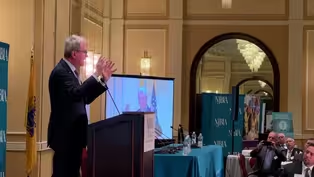
Gov. Murphy says CBT surcharge will sunset
Video has Closed Captions
Latest NJBIA survey showed 69% of employers rated the state economy as fair or poor (4m 16s)
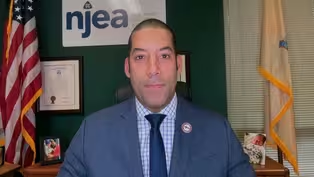
NJEA head: Eliminating skills test can help recruit teachers
Video has Closed Captions
Interview: Sean Spiller, president of the New Jersey Education Association (6m 16s)
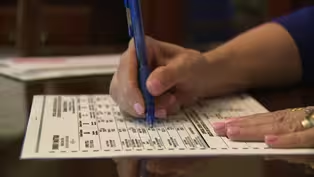
'Party lines' an unfair advantage on ballots, new report
Video has Closed Captions
Rutgers report examines how primary ballots with “county lines” affect election outcomes (5m 18s)

Rutgers professor: Ceasefire holds as hostages are released
Video has Closed Captions
Interview: Michael Boyle, associate professor of political science (4m 7s)
Providing Support for PBS.org
Learn Moreabout PBS online sponsorship
- News and Public Affairs

Top journalists deliver compelling original analysis of the hour's headlines.

- News and Public Affairs

FRONTLINE is investigative journalism that questions, explains and changes our world.












Support for PBS provided by:
NJ Spotlight News is a local public television program presented by THIRTEEN PBS