NJ Spotlight News
NJ Spotlight News: October 10, 2024
10/10/2024 | 26m 46sVideo has Closed Captions
Watch as the NJ Spotlight News team breaks down today’s top stories.
We bring you what’s relevant and important in New Jersey news and our insight. Watch as the NJ Spotlight News team breaks down today’s top stories.
Problems playing video? | Closed Captioning Feedback
Problems playing video? | Closed Captioning Feedback
NJ Spotlight News is a local public television program presented by THIRTEEN PBS
NJ Spotlight News
NJ Spotlight News: October 10, 2024
10/10/2024 | 26m 46sVideo has Closed Captions
We bring you what’s relevant and important in New Jersey news and our insight. Watch as the NJ Spotlight News team breaks down today’s top stories.
Problems playing video? | Closed Captioning Feedback
How to Watch NJ Spotlight News
NJ Spotlight News is available to stream on pbs.org and the free PBS App, available on iPhone, Apple TV, Android TV, Android smartphones, Amazon Fire TV, Amazon Fire Tablet, Roku, Samsung Smart TV, and Vizio.
Providing Support for PBS.org
Learn Moreabout PBS online sponsorshipAnnouncer: Major Funding for "NJ Spotlight News" is provided in part by NJM insurance group, serving the insurance needs of residents and businesses for more than 100 years.
Horizon Blue Cross Blue Shield of New Jersey, an independent licensee of the Blue Cross Blue Shield Association.
And by the PSEG foundation.
Briana: Tonight on NJ Spotlight News, attention TD bank customers, your bank is facing billions of dollars in penalties for alleged drug cartel money laundering.
>> TD Bank created an environment that allowed financial crime to flourish, by making its services convenient for criminals, it became one.
Briana: 12 more towns join a lawsuit fighting back against a new affordable housing law, as we look for housing solutions in our digital series "the change project."
>> There are a lot of ideas that New Jersey code adopt.
It is -- code adopt.
It is just taking them a while to get through the legislature.
Briana: Searching for solutions.
Rutgers looking at the challenges people with disabilities face because of onerous laws and regulations.
>> Really hoping that the state, as they have programs like this, they are really working hard to make sure our complaints are registered.
Briana: And expanding the plastic ban.
A built in Trenton looking to decrease plastic packaging by another 50%.
Businesses are pushing back.
>> List of those facilities do not have facilities on-site or the ability to put out silverware and collect it and wash it.
You have to hire and create that space.
Briana: NJ Spotlight News Spotlight news begins right now.
♪ Announcer: from NJPBS Studios, this is NJ Spotlight News, with Briana Vannozzi.
Briana: Good evening and thank you for joining us this Thursday night.
I am Briana Vannozzi.
We begin with a few key stories we are following.
First, TD bank has been hit with $3 billion worth of penalties by federal prosecutors after pleading guilty to allowing three separate criminal networks to launder $670 million through the bank in recent years.
TD is the first bank in U.S. history to plead guilty to conspiracy to commit money laundering.
The U.S. Justice Department said TD knew it had weak internal controls to guard against money laundering and criminals knew it was an easy target which enabled a drug cartel to administer hundreds of millions through its branches in New York and here.
Prosecutors argued TD bank executives knew there was a problem, but chose to do nothing about it.
Over two dozens into -- dozen individuals have also been charged for participating in the scheme.
The federal investigation is ongoing and Attorney General Merrick Garland said he expects more prosecutions to come.
>> There is nothing wrong with a bank that tries to make its services convenient for its honest customers.
But there is something terribly wrong with a bank that knowingly makes its services convenient for criminals.
Briana: Girl leaders are taking stock of hurricane Milton's distraction which made landfall Wednesday night as a category three storm, slamming into Florida's barrier island of Siesta Key near Sarasota, then plowing across the state.
Bringing sustained winds of 120 miles per hour and torrential rainfall.
Talking out power to more than 3 million customers, ripping the roof off of Tropicana Field in St. Petersburg.
Multiple fatalities are being reported in the aftermath.
Four deaths were confirmed in St. Lucie County, far from where the storm made landfall after two tornadoes touched down.
Part of multiple tornadoes that tore through the state leaving widespread damage.
Florida's emergency management leaders say some 11 million people are at risk of flash and River flooding, and rescue teams are still actively pulling people from homes and buildings where they took cover.
New Jersey's National Guard deployed to the area to help with rescue and response operations as well.
The fate of roughly half a million immigrants who were brought to the U.S. illegally as children is being considered by a federal appeals court.
A panel of judges in Louisiana today is deciding whether the Obama era program called deferred action for childhood arrivals is unlawful.
DACA allows those individuals referred to as dreamers to live and work in the U.S. with protections, and the program has been the subject of a years long court battle.
After Texas and six other states filed a lawsuit in 2018, arguing DACA was a presidential overreach putting burden on states.
New Jersey joined the suit as a defendant, arguing the state would suffer if dreamers were deported, because they would become part of their communities -- they had become part of their communities.
While a Texas judge ruled the program illegal last year, stopped short of shutting it down, and today judges gave no indication when or how they will rule.
Gretel Rodrigues was born in Honduras and came to New Jersey at the age of four.
She traveled to New Orleans for today's arguments.
>> Anytime DACA is back in the court, anytime it is making news headlines, it's that reality check for DACA recipients like myself.
In that this program provides no permanent protections or a pathway to citizenship.
It is merely a Band-Aid over a larger wound.
And a product of an outdated immigration system.
Being in the courtroom, this is my first time in federal court.
It was surreal and this is a case that should not even be in court to begin with, because we provide so many benefits back to our communities, back to the state of New Jersey and the country overall.
Briana: With less than four weeks to go before election day, predictions are shifting for New Jersey's competitive seventh district congressional race.
The Cook political report is changing the odds from a tossup between incumbent Republican Tom Kane and Democratic challenger Sue Altman to favor in Republicans.
Proving the state's only true swing district to be one of the tougher ones for Democrats to flip.
That is despite President Biden carrying voters thereby almost four points in the 2020 election, a major swing from 2016 when the district backed Trump.
For more on what went into the change, I am joined by the U.S. House editor at the Cook political report.
It is good to talk to you.
The Cook political report has shifted the arts in the Tom Keene's favor.
Can you share what factors went into that decision?
Erin: Yeah.
To start, I want to say New Jersey's seventh district is still quite a competitive race.
This is a competitive district.
Biden carried up by four points in 2020.
At the end of the day, we expect Harris should probably win the district.
But we do believe it looks like Kane is on track to over perform Trump's margin, and is in a decent position to win his race.
Part of the reason for that is that despite the fact that Sue Altman, his Democratic opponent, has outspent him on the airwaves recently, he still has maintained a persistent edge in polling.
That age varies from a couple points to a larger margin.
But he still managed to retain the edge.
Altman also is not getting that much help from outside Democratic groups that are playing and other competitive districts.
Briana: Are these internal poles you refer to because we just don't see head-to-head poles when it comes to congressional races, which I would imagine makes it tough to forecast.
Erin: It is tough.
This is -- this cycle in particular, we have seen fewer public house poles which is unfortunate.
Luckily, at the Cook political report, we are relying on seeing internal data from both parties we use to make our judgments about these race rating changes.
We look at the internal data, we look at the spending decisions, we talk to the campaigns, and that is how we come to these decisions.
Unfortunately, a lot of the data we are looking at is not available for the public to see.
Briana: Let's talk about that spending.
As you mentioned, outside groups, at least Democratic outside groups, are not pouring in the type of cash we expected.
Sue Altman had a pretty groundbreaking spending, rather fundraising quarter this past go around, a little over $2 million.
If we are not seeing spending from PAC'S like the House majority, Democratic Congressional campaign committee, does that mean the Democrats don't think it is worth putting money into the race?
Erin: First of all, I will say there is still time for these outside groups to make money changes.
These shift around their money at the last minute, based on where they see the races headed at the last minute.
I will also say a major factor for this raise is that it is in the really expensive New York City media market.
It costs a lot more for outside groups and campaigns to go up on broadcast TV here.
That contributes in part to some of the spending decisions.
At the same time, there are other competitive races in the New York City media market across the Hudson River that are getting outside attention.
Some of those races it seems like both groups view as more competitive than this one.
Briana: You mentioned internal poles.
Sue Altman's campaign had a poll putting her at 2% behind Tom Kane.
They are saying this is within reach for us, don't give up, make sure you come to the polls.
How much stock should we put in that?
You have to take into account the margin of error there.
Erin: Right.
I think this is absolutely still a competitive race.
And Altman has a real fighting chance at flipping the seat.
I don't want to discount that.
At the same time, there is a reason that campaigns put out polls.
It's because they are trying to boost their fundraising and attract outside donors.
From what we have seen from the other data, Kane has had a larger of a lead, from both the Democratic and Republican sources.
When you're looking at polls released by campaigns, I think a lot of times, the pollsters they use are very good, it doesn't mean the results are inaccurate by campaigns have a motive, so you have to take it in the context of that.
You have to remember we don't have a lot of other outside polling from this race that we can compare it to.
Don't know whether it is a true outlier or indicative of the race as a whole.
Briana: It's a big factor there.
Aaron Covey is the U.S. House reporter at the Cook reporter.
Thank you so much.
Affordable housing rules are back in the crosshairs.
12 more towns have signed on to a lawsuit against the state over a new affordable housing law, claiming it goes far beyond what is constitutionally required.
The law created a standard obligation for every town and makes it harder to bring lawsuits that block the housing from being built.
The new plaintiffs include towns that range from Mendham and Oradell, to Wes Tam Dell and Westwood.
They joined the original nine municipalities that brought the suit, led by the mayor, arguing towns should have a say in how they grow.
Affordable housing advocates including the Attorney General have called the lawsuit baseless and a way for wealthy towns to avoid wielding housing for low income residents.
New Jersey's housing has been a problem for decades.
It has been decades in the making and has only gotten worse as the seat comes a more expensive lease to live.
Colleen O'Day dug into the issues as part of our change project and joins me with her reporting.
This is a very complex topic we are talking about.
There were Supreme Court rulings some 50 years ago that is collectively known as the Mount Laurel doctrine.
This is what decides what is a town's fair share of affordable housing.
How much is the state in need of affordable housing, at this moment in time?
Colleen: The estimates are more than 200,000, depending on who you ask.
Could be as high as 220,000, perhaps more.
The problem is there have been municipalities that really have pushed back and have not wanted to build their fair share as the Supreme Court ruling called it.
It is a fair share obligation.
That is why this thing has dragged on for so long.
Briana: Is it a not in my back yard situation, is that as these towns say, we don't have the capacity in our schools, we don't have the services, we can't afford to have an influx of people living here?
Colleen: It is certainly a not in my back yard.
They have been allegations that perhaps there are some racial biases there because people think lower income folks might be black or Hispanic.
There is this feeling that people want to keep their town with its own characters away they put it.
But you can take that in a number of ways.
Briana: You look at some strategies that are being used elsewhere in the country.
Where exactly did you look?
Were any of them viable for a place like New Jersey?
Colleen: We looked at California.
I have to say, California has a huge housing problem of its own.
Some of the advocates when I talked to them said, you know we have a problem here.
And I said, yes, but at least you are trying to resolve it.
One of the things they are doing is these accessory dwelling units, which is being able to build a little house on your property, turn your garage into a housing unit.
They are called mother-in-law suites.
California has embrace that.
They are getting a lot of new housing, including affordable housing, from that.
New Jersey now just this year is coming up with a project that is about $10 million.
We still don't have all of the details.
It is going to involve 10 municipalities.
But largely, New Jersey municipalities do not allow for accessory dwelling units at this point.
The state has done other things, there are some existing legislation but have not moved through the state legislature.
For instance, if you have a dead mall, rather than having to wait for a town to rezone that, if a developer comes in and says I will build mixed housing unit, including affordable housing, they would be allowed to do that and override local zoning.
That is another thing that is helping out in California.
There are a lot of ideas that New Jersey could adopt.
It is just taking a while to get them to move through the legislature.
Briana: Now what will happen since the state abolished COA, they moved this under the Department of community affairs, and government shoveling their.
What is going to happen now with that shuffle?
Colleen: October 20 is the official deadline based on the legislation that was signed earlier this year.
For the Department of community affairs now to essentially calculate these new obligations, and do it for all towns.
What has happened in the past was that, if you are a town that fair share housing in particular, this is this organization in South Jersey that has been an advocate, has targeted and said, you should build some housing and you were sued, or otherwise somebody brought a suit, then you had to have an obligation.
Not everybody will have an obligation.
Even places out in Sussex County, where maybe there is not a lot of jobs.
Briana:Briana: One of the arguments we should say is a lot of urban cities were left out of having these obligations.
Colleen: And that is because these communities it was deemed that they have a lot of affordable housing.
We will see how the rollout of those obligations goes.
Briana: The problem is real, you can't argue that.
Colleen, you can see her full reporting on our website,.
Thank you for coming in.
New Jersey seniors and disabled residents will have more options for getting around soon.
A new law signed by Governor Murphy last week is expanding New Jersey transit's riders choice pilot program, so people who use access link can instead opt for a taxi, Uber, or lift.
It is one way the state is trying to lift barriers for vulnerable residents.
That was a focus of a wreckers event educating the public about the rights of people with disabilities and the challenges they face.
Raven Santana reports.
>> Generally speaking, we need to do a better job as a society in educating people that people with disabilities have rights in this country.
Raven: Javier, who relies on his wheelchair to get around, did not hold back when I asked him what else can be done to better empower people with disabilities.
Where are we in terms of your perspective when it comes to disability rights?
>> In terms of my perspective, we have come a long way, in terms of legal rights, like the American disability -- Americans With Disabilities Act.
What we saw during the pandemic, which you guys have covered extensively, maybe we have not come as far as we should.
We saw that we as a state and nation were not prepared, the people with disabilities were left behind more often than not.
Briana: The Rutgers professor and director of the Center for disabilities to sports, health and wellness at the University moderated a panel to mark disability awareness month.
The panel which was also available virtually focused on the critical issues impacting those with disabilities.
It included diverse voices from disability advocates, as well as representatives from the state, who gave examples of how they are trying to advance disability rights through laws and protections.
>> I will give a quick example of that.
There was some legislation earlier this year related to guardianship, to move the age that parents could petition for guardianship from 18 down to 17.5.
We really stepped in there and helped educate the legislature why that was really detrimental to people with disabilities.
That before they had even reached the age of majority, before they could retain an attorney for themselves to defend the right to self-determination, you were already subjecting them to guardianship proceedings.
Raven: Throughout the discussion, access to services and housing discrimination proved to be a constant issue impacting individuals with disabilities.
>> New Jersey has a great law against discrimination.
We need to see it and forced much more stringently.
We are really hoping the state as they begin to have programs like this, they are barely working hard to make sure our complaints are registered.
They are taken care -- taken seriously.
>> That's where our division comes in and we have been focused and in a concerted way of trying to expand our enforcement in the last couple years.
Raven: The director of the New Jersey division on civil rights says the agency has seen an increasing number of complaints alleging discrimination by housing providers.
>> Whether it's because they are denying rental opportunities to people based on disability, whether it's because there is tenant on tenant harassment of a tenant with disabilities and a housing provider does not take meaningful action to address it.
Whether it is the housing provider has failed to provide a reasonable accommodation for someone's disability.
Whether it is by providing appropriate access to their partner.
>> There definitely a lot of room for improvement.
Let's take transportation as an example.
If you are not near a New Jersey transit, transportation line, you probably don't have access to transportation through access link or some other ways, which means you can't get to work, you can't get to appointments, you can't even just go out and have a fun time.
Transportation is one huge issue for people with disabilities.
We need to do a better job of just preparing.
We are not prepared.
If an emergency happened, we don't know how we could get people from point a to point B. Raven: He stressed her in the conversation that the goal of the workshop was to raise awareness and educate everyone on the barriers that individuals with disabilities have.
He says it will ultimately take advocacy from everyone, able-bodied individuals included, to ensure an equitable feature for people with disabilities.
I'm Raven Santana.
Briana: In our spotlight on business report, it started with pop -- with plastic straws and bags.
Now there is a move to cut down on plastic packaging in the state.
A Senate committee is considering a bill that will require business owners and manufacturers to do a better job of managing the plastic they sell and use more items made from recycled material instead.
Ted Goldberg has the details.
>> Skip the stuff.
Ted: The Senate is hoping New Jerseyans skip the stuff any news less plastic.
The committee voted 3-2 to advance a bill that would require most restaurants to provide reusable utensils for customers eating on-site.
>> If you have a 200 seat restaurant, you should not be doing plastic where.
On the other hand, if you are a roadside stand.
Ted: The regulations would affect restaurants that can seat at least 50 people.
Customers eating elsewhere would have to request plastic utensils for delivery or orders to go.
Debate around the bill grew between environmentalists who say less plastic should be used, in the business community who call this overregulation.
>> NA estimated 33 billion pounds of plastic enters the marine environment every year.
That is not plastic production, that is how much enters the marine environment.
>> Restaurants with Dine incapacity are typically -- they typically already have dishwashing capacity for their prep dishes.
They should not be permitted to generate unnecessary plastic waste.
>> In many instances, it's not practical.
List of those facilities do not have facilities on site or the ability to put out silverware and collect it and wash it.
You have to hire, create a space.
Ted: Another issue is schools, which would have a five-year grace period to introduce reusable utensils to their cafeterias.
>> The parents may not want their children using them.
They could have themselves, others if they don't know how to properly use them, could pose a to others students, but them in the hands of someone with disciplinary issues.
>> Every school building is different.
We have some school buildings that don't have kitchens.
They are not going to save money by reducing single-use plastics because food is delivered to them and they don't have a way of cleaning that food.
>> The widespread use of plastic is not just an environment a problem.
Chemicals and plastics don't break down easily.
Advocates say more should be done to use less plastic overall.
>> A tidal wave of plastic that is absolutely overwhelming us.
The problem with these chemicals is many of them lead to infertility.
I'm a little old for that right now, but just think of your children, your grandchildren, all of them being affected by plastic.
>> They do not stay out or within the set of exposure.
They do not stay within the G.I.
system.
To date, plastic particles have been identified in the human lung, liver, kidney, urine, heart, placenta, breastmilk, and recently in the old factory bold.
>> Just like we have normalized having a water bottle, there is no reason why we should not have education in normalized bring your own cutlery with you.
To say it is so hard to do in a stadium, I bring my stuff with me.
Not a knife if I'm going to a stadium, but I have a sport.
>> Every day we are getting more and more scientific data about how badly plastics are impacting human health.
>> Business community mentioned studies of their own, which might have contributed to a similar bill not getting passed into law in New York.
>> Online hearing about is people are hurting, they can't afford to put groceries in their house, to add an additional $700 a year to their cost of living is a lot.
>> That is your guest.
>> No, there is a study done in New York by New York University.
Ted: The committee heard testimony on a bill that would create new DEP office dedicated to managing plastics and packaging.
Funded by companies grossing more than $5 million a year.
Bill was not voted on.
But committee chair Bob Smith says it will likely pass the committee by the end of the session.
At the Statehouse, I am Ted Goldberg, "NJ Spotlight News."
Briana: That is going to do it for us tonight.
Before we go, a reminder, "NJ Spotlight News" for host an event with the two candidates running for U.S. Senate.
It's not a debate but a conversation, talking about the issues affecting you.
We are partnering with Rome University for the event as we look to boost stability during this divisive political election.
David Cruz and I will be leading the discussion and you can watch it live on Tuesday, October 15 at 8:00 p.m. right here on NJPBS and streaming on our NJ Spotlight News YouTube channel.
For the entire team at NJ Spotlight News, thank you for being with a spirit have a great night.
We will see you back here tonight -- tomorrow.
>> New Jersey education Association, making public schools great for every child.
Our WJ Barnabas health, let's be healthy together.
And New Jersey realtors, the voice of real date in New Jersey.
More information is online at an dayrealtor.com.
♪

7th District race shifting in Kean’s favor, analyst says
Video has Closed Captions
Interview: Erin Covey, Cook Political Report analyst (5m 10s)

Federal appeals court weighs challenges to DACA
Video has Closed Captions
NJ argues the state would suffer if Dreamers were deported (1m 54s)
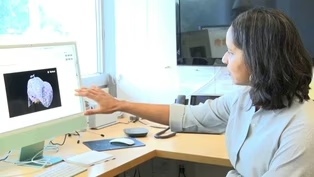
Major advance as Princeton researchers map fruit fly's brain
Video has Closed Captions
The research could lead to long-term developments in science and human health (3m 55s)

Push to ditch plastic utensils in restaurants, schools
Video has Closed Captions
A bill advances that would require most restaurants to provide reusable utensils on-site (4m 29s)
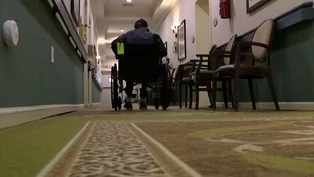
Rutgers workshop: Empower those with disabilities
Video has Closed Captions
University highlights Disability Awareness Month (4m 48s)
Providing Support for PBS.org
Learn Moreabout PBS online sponsorship
- News and Public Affairs

Top journalists deliver compelling original analysis of the hour's headlines.

- News and Public Affairs

FRONTLINE is investigative journalism that questions, explains and changes our world.












Support for PBS provided by:
NJ Spotlight News is a local public television program presented by THIRTEEN PBS