NJ Spotlight News
NJ Spotlight News: October 11, 2024
10/11/2024 | 26m 46sVideo has Closed Captions
Watch as the NJ Spotlight News team breaks down today’s top stories.
We bring you what’s relevant and important in New Jersey news and our insight. Watch as the NJ Spotlight News team breaks down today’s top stories.
Problems playing video? | Closed Captioning Feedback
Problems playing video? | Closed Captioning Feedback
NJ Spotlight News is a local public television program presented by THIRTEEN PBS
NJ Spotlight News
NJ Spotlight News: October 11, 2024
10/11/2024 | 26m 46sVideo has Closed Captions
We bring you what’s relevant and important in New Jersey news and our insight. Watch as the NJ Spotlight News team breaks down today’s top stories.
Problems playing video? | Closed Captioning Feedback
How to Watch NJ Spotlight News
NJ Spotlight News is available to stream on pbs.org and the free PBS App, available on iPhone, Apple TV, Android TV, Android smartphones, Amazon Fire TV, Amazon Fire Tablet, Roku, Samsung Smart TV, and Vizio.
Providing Support for PBS.org
Learn Moreabout PBS online sponsorship>> Major funding for New Jersey Spotlight News is brought NJM Insurance group.
Verizon -- Horizon Blue Cross Blue Shield of New Jersey.
An independent licensee of the Blue Cross Blue Shield Association.
And by the PSEG foundation.
Briana: Tonight, a TikTok Confession.
Secret documents reveal the social media giant was aware but completely ignored safety concerns for teenagers.
Plus, are your transit troubles over?
NJ transit finally names a customer service advocate to help improve your commute.
>> It should be mandatory as part of your job that you need to ride the train yourself, either once a month, once a quarter, something like that, but there needs to be a regimen, and kind of audit it.
Eat what you are cooking.
Briana: The end Jersey NAACP is demanded the resignation of State police Superintendent Pat Callahan after a scathing report revealed misconduct among his ranks.
>> Lawsuit after lawsuit has not stopped state police from making a mockery of the laws that we the people and the New Jersey State legislature have enacted.
Briana: And the move entrance into phase out student aid to for-profit colleges and universities.
>> Need oversight, accountability, and transparency.
Briana: NJ Spotlight News begins now.
♪ >> From NJPBS Studios, this is NJ Spotlight News with Briana Vannozzi.
Briana: Good evening and thanks for joining us this Friday night.
I met Briana Vannozzi.
We begin with a few key stories.
Dozens of an pages of uncovered documents on Tonto a lawsuit against -- in a lawsuit against TikTok reveal the tech giant ignored safety concerns while encouraging young kids to use the app.
That is occurring -- according to internal company communications which remain public.
New Jersey and more than a dozen other states sued TikTok this week, alleging the company knowingly threatened the health of kids and teens by creating a potentially addictive platform and not enough guardrails on the content kids see.
The new information comes from one of the lawsuits filed by the Kentucky Attorney General's office.
A journalist at Kentucky Public radio discovered pages of the court filings were not correctly redacted.
TikTok is also facing a January deadline to divest from its Chinese parent company or face a ban in the U.S. Also tonight, it looks like the legislature is going to tackle the state's ballot design after all through a new bipartisan assembly select committee that is pledging to hold public hearings on the issue and find legislative solutions after talking to experts around the country.
Speaker Craig Coughlin and assembly minority leader John DeMeo today unveiled a 12 member committee with six lawmakers from each party and two cochairs.
This all stems from a years long lawsuit challenging the legality of a party line which allows candidates to group together in a shared row or column.
Research shows it gives those candidates an unfair advantage.
It came to a head after Congressman Andy Kim joined the fight and a U.S. District Judge ordered office block voting during the June Democratic primary.
Lawmakers quickly chimed in, saying the decision should be left to the legislature, not the courts.
Several counties have already settled and agreed not to use County lines moving forward.
And at long last, New Jersey transit has filled the customer advocate role which sat vacant for four years.
The Board of Directors on Thursday night officially named Frank Newman.
He came to the U.S. to work with Rhode Island and Boston's transition agencies -- transportation agencies, and he's got a tall tax ahead.
NJ transit has faced scrutiny in recent months after the summer was filled with widespread delays and can solutions -- and cancellations, leaving riders frustrated.
All of this as ticket prices went up.
Brenda Flanagan has more details on the new customer advocate and which problems passengers want him to attack first.
Brenda: Commuters waiting for their train today welcomed news that the agency finally hired Franck Beaumin.
Riders are tired of excuses.
Their message?
>> It seems like you can't get to work half the time.
More on-time service.
>> I work in New York.
I live here.
Sometimes it takes two hours to get home from work.
>> I go one stop from Secaucus and most of the time it is late, and then I've got to catch a bus when I get there and I miss that bus, and then I've got to take an uber.
Brenda: Customer excitations are high.
Beaumin's French born with experience in Bangladesh and Boston.
His salary, $175,000 a year.
Riders hope he is more responsive to customer complaints than the NJ transit app.
>> Has anyone filled out the app?
That is 20 minutes of my life I'm never going to get back.
It is so clunky.
I get an email six weeks later from the thing that says, I am so sorry.
>> She demanded action, not apologies.
Beaumin was not available for an interview last night.
>> Franck gives perspective with his transit background.
We look forward to see how he will apply that experience in New Jersey.
>> It took him long enough to get here, but on paper we found somebody who looks like he's got an appropriate background.
Brenda: Former Senator Loretta Weinberg in 2018 wrote much of the legislation creating the customer advocate position.
She notes Beaumin will report to the board for an agency that pays his salary, a potential conflict.
>> He's got a tough job, but hopefully he will do it as an independent voice reporting directly to the board and that he chooses to spend the better part of his week riding public transit.
>> There is an ivory tallow mentality from the agency.
Brenda: Adam was part of the group of advocates that helped to interface between NJ transit and its customers.
He was to discuss a long list of problems with the new advocate and advises Beaumin to monitor social media and talk to customers.
>> Go to the stations.
See what I have seen in recent months, benches that are broken, platform sections that are crumbling, things like that, and we see on Twitter people talking about dirty bus seats, closed train cars.
Understand why it is such a problem by writing it -- riding it.
Brenda: He says NJ transit needs to improve its app so riders get warnings of late rides.
Almost everyone advised Beaumin, ride the system.
As one tweet said, I 100% require he not own a car and traverse our fine state that the rest of us commuters.
>> It should be mandatory as part of your job that you need to ride the train yourself, either once a month, once a quarter, something like that, but there needs to be some regimen where you ride the train and kind of audit it.
Eat what you are cooking.
I think that will go a long way.
Brenda: Beaumin's first J on -- first day on the job, Monday morning.
Briana: The New Jersey chapter of the NAACP is ramping up demands for new leadership at the state police after a pair of investigations found systemic discrimination and abuses within the agency.
It propped at the Attorney General to take over certain functions at the state police, specifically anything dealing with personnel.
But the NAACP wants officials to go further, calling for the immediate removal of state police superintendent Pat Callahan, more transparency from the system, at a meeting with the governor.
Ted Goldberg reports.
>> All of these reports with all of the lawsuits that are going on against the state police, nothing's happened -- has happened.
-- nothing has happened.
Reporter: Leaders are calling for more sweeping changes to the state police.
A couple weeks after Attorney General Matt Platkin took over personnel functions and reforms after two investigative reports showed what platkin called troubling conduct and systemic problems.
>> Report MMO released by Attorney General Platkin is not news to us -- the report and memo released by Attorney General Platkin is not news to us.
We applaud the Attorney General for his courage and transparency.
We are also encouraged by his attempts to clean up this mess.
Ted: State conference President Richard Smith is asking for, among other things, the ouster of Colonel Patrick Callahan, who has let the state police for seven years.
>> The Colonel has been living in a dirty house for a long time.
It should not take some living in the street -- if you know your house is dirty, you know it needs to be cleaned.
I should not have to go to your house and give you recommendations on how to clean up the filth you've gotten your house.
Ted: In response, the governor's office said he is committed to working with Attorney General Platkin and Colonel Callahan to ensure all the recommendations contained in the reports are enacted without delay.
The New Jersey State police must make meaningful reforms to ensure all of its troopers are treated fairly and professionally.
The agency is facing lawsuits from state troopers who alleged discrimination based on race and gender, and from civilians, including one who is suing 18 troopers over discrimination and malicious prosecution.
>> He has been involved in miscarriage of justice as a relates to frivolous stops and frivolous arrests.
>> Continuing to litigate these cases since a really troubling message.
One that directly contradicts the stated goals of reform and zero-tolerance of discrimination and retaliation as expressed by the Attorney General.
>> Our political leaders say the state opposes racism, that this state once to end police brutality.
If this is so, we call on the state to come to the table and to settle the scores of lawsuits that are the evidence of the racism, the sexism, the misogyny.
Ted: These leaders are also calling for the state to settle these lawsuits.
Curtis's has dragged on for five years.
Activists accused the state police of a legacy of racism, including what happened to the first black trooper in the 1960's.
>> Signs were hung in state police have quarters that said "porch monkey," "coon."
Lawsuit after lawsuit has not stopped the state police of making a mockery of the laws that we the people and the New Jersey State Legislature has enacted.
Ted: The reforms include a more diverse hiring process and protection for people who report misconduct.
Smith would like to see Platkin go a bit further than that.
>> Kate is clear that the Attorney General needs to oversee the state police employment practices, but why?
It is because the state police leadership cannot follow New Jersey law.
Ted: State police did not respond to our request for comment before deadline.
Activists are also hoping for a meeting with Governor Murphy about other changes to the department.
In Plainsboro, I'm Ted Goldberg, NJ Spotlight News.
Briana: The election countdown is on and there is no shortage of political polls indicating what candidates have the edge or are trailing behind among voters.
But not all polls are equal, and some information can be confusing, especially for the uninitiated.
No single survey can fully capture a race.
It is more about getting a snapshot from a group of selected voters responding to a set of questions during a moment in time.
What purpose do political polls serve for the public, and how should you read them?
We turn to the experts, the director of the Monmouth University polling Institute, and the director for the Rutgers Eagleton Center for public-interest polling.
Good to talk to you both.
We have this sort of murky information ecosystem, especially when it comes time for elections.
What I am hoping to get to is to help our viewers, our audience understand how to read polls.
Pat, let me go to you first.
There are margins of error and waiting, all of these terms they get put into a pole for its legitimacy.
What is your number one tip for folks when they are looking at a poll to make sure it is credible?
Pat: There are two things to think about.
One is the credibility.
I would go to a place like real clear politics, which averages polls, but what they do is they sort out some of them.
They curate some of the bad ones out of there.
What I hear all the time is, your pole said candidate X is up by two, but your other pole said candidate XY is up by one, why are they different?
The media is telling me that is a different poll, but it is not.
They are telling a story of a very close race.
That is something we need to do with folks, particularly with the polling I am seeing out of this election.
Briana: That also comes into play when we are talking about head-to-head polling versus issue polling.
What issue does it play in an election cycle like this, and what is your tip for folks who are reading them?
>> Polling is very important because polling sometimes gives us what the public thinks on issues that may never get their day at the ballot box.
What polling is not is it is not a crystal ball.
This is a snapshot in time of what people are thinking, and we are trying to predict an unknown electorate of likely voters, so we have to be careful of how we are interpreting pre-election results.
It will tell us what issues are important.
It will not necessarily tell us who was going to win on election day.
Briana: Pat, if you are doing a presidential election pole and you have a candidate like Donald Trump, where conventional wisdom has gone out the window in terms of the ways we poll, what is it you are looking for when you conduct a poll like that?
You and I discussed over the years have confidence was shaken back in 2016, even 2020 a little bit.
How should folks be reading these when Kamala is up two points in one poll, trailing in another?
Pat: Donald Trump has changed the way we think about pulling.
We look back at the 2020 election and there was a small but systematic underrepresentation of Donald Trump in the polls, his support.
We are still not sure exactly why.
It has shaken things up.
What you are doing, and you should look for polls that point to the uncertainty, that try to point out not just where the candidates stand in terms of their support, but we are there floors and ceilings are, where the possibility of movement is.
Briana: Ashley, in a polarized climate like this, what role do polls bang serve, and how useful can they be?
Pat: This is the only assessment we have on what the public is thinking and the political process, whether election or not.
That is why they are so important.
They do not take much time for their voice to be heard, and we are representing all voices in highly well-done: -- well done credible polling.
All the samples can be traced back to the population.
There is still great value in giving these.
We need to have more of an educational effort and for the average citizen to be more of a good pole consumer and a bit more of a detective, making sure the polls bang they see -- making sure the polls they see are high-quality.
Briana: When we take a a week like that, these historic hurricanes, and if you are looking at a presidential race, how much does the timing matter?
These are snapshots of time when you are talking to folks.
Pat: You can find out something happens that is a major event where someone who was a likely voter last week is not anymore because they have other things on their mind.
In elections like we have been having recently, and certainly this one, which will be decided by 20,000 people in a particular state, that could matter.
What you want to look at is what Ashley said.
You want to look for the "why."
We do a lot of questions about the "why," the issues, the underlying dynamic, the value systems of voters, that doesn't get reported as much as that horse race, but that is where polling has its strength.
That is what voters should look at to explain what is going on and what could potentially happen when the election finally rolls around next month.
Briana: Pat, Ashley, thank you so much.
Speaking of political races to watch, NJ Spotlight News will host an event with the two candidates running for U.S. Senate.
It is not a debate, but a conversation talking about the issues affecting you.
We are partnering with Rowan University for the event as we look to boost stability during this very divisive political election.
David Cruz and I will be leading the discussion.
You can see it live on Tuesday, October 15, at eight :00 p.m., right here on NJPBS and streaming on our NJ Spotlight News YouTube channel.
In our spotlight on business report, the for-profit college industry is facing increasing scrutiny after student complaints from around the country and here in New Jersey revealed predatory practices that frequently left them with mountains of debt and sometimes worthless degrees.
A bill in Trenton would change how much state financial aid those receive, but as Raven Santana reports, for-profit college leaders say cutting funding would only hurt the students who need it most.
>> Do you have a sense as to how many of those folks actually finish, the folks that are in debt from day one, which my quick math is 1440.
How any of those folks finish versus those folks who do not take out loans?
Raven: I would have to provide the committee with that information.
Raven: Senator Joe Cryan, who chairs the Senate higher education committee, met more than an hour with other committee members, grilling representatives of for-profit colleges about their graduation rates.
>> The research I took a look at was that DeVry was next to Eastern College of Jersey City, the lowest among the for-profits.
-the hearing -- Raven: The hearing focused on the profits of for-profit institutions and their role in the higher education system.
Some have been accused of allegedly making false promises to borrowers with the goal of profiting off student aid and loan dollars impacting borrowers like Vanessa Harrison.
>> I applied to the Art Institute of Philadelphia and enrolled in 2002.
And I got there, everything quickly went sideways.
They maxed out my course schedule, and when I asked to scale it back, they strongly discouraged it.
When I wanted to try to go somewhere else, they refused to give me my transcripts, and I learned my credits would not transfer, which they had lied about.
Raven: That is why the committee considered four bills, including one that would phase out tuition aid grants for students enrolled in our profit schools, something representatives for for-profit schools spoke out against, testifying that their institutions have nothing to hide.
>> You have a complaints apartment that everything is reviewed by them in terms of advertising, what goes on to the website, and we are trying to be as thorough as we can.
Every once in a while, something may get interpreted differently.
>> Among those students who are receiving tag dollars today, there's only about 49 of them in the last session.
Graduation rates we would put up against just about anybody, 68% to close to 69%.
I don't think you will find a tighter ship than the one that is before you today.
>> Legislation basically unjustly treats all students differently than the other 360,000 students we have in the state of New Jersey.
>> My co-authors and I have showed that when over 1000 poor performing for-profit institutions were threatened with the loss of federal student aid in 19 -- in the 1980's due to high default rates, the declines of for-profit enrollment were almost completely offset by increased enrollment in local institutions.
>> There are a disproportionate amount of black borrowers, women borrowers who are attending New Jersey for profits.
They are not brick-and-mortar ones, they are taught online.
This is something where we need some oversight, accountability, and transparency.
Raven: Ashley Harrington is with a group that represents more than one million student borrowers across the country, including tens of thousands here in New Jersey who words are prodded -- who were defrauded by predatory institutions.
>> I learned about borrowers defense and the class-action lawsuit brought on by the PPSL.
They and Teresa sweet have been amazing.
I had my federal loans discharged, but I am still waiting for a refund of the money.
>> There were a lot of quotes today about eight year graduation rates and things like that, where I don't think anybody says hey, when I start school, I'm going to finish in 2032.
Raven: If passed, the bill would phase out tag eligibility at for-profit colleges in the 2026-27 academic year.
The goal is to get the bills enacted in the next three months.
Briana: That's going to do it for us tonight, but before we go, we are rolling out our final episode of our NJ decides 2024 election exchange podcast.
Remember, all 12 U.S. House seats are up for grabs and 1 senate seat is on the line.
This is a chance for you to meet the candidates and hear why they think they deserve your vote.
Today we are dropping our conversation with District 2's Joseph Salerno, the Democratic candidate looking to unseat incumbent Congressman Jeff Van Drew, who declined to be interviewed.
>> Archimedes said give me a place to stand and a lever long enough and I can move the earth.
This is the biggest lever I could find.
Jefferson Andrew ought not remain in Congress, because he lacks the devotion to principle that we should expect from elected representatives.
When I saw we did not do so well two years ago in this race, I figured I was either going to support somebody who can or do it myself.
Briana: Check out the entire series by downloading the NJDecides election podcast.
Thanks for being with us.
Have a great weekend.
We will see you right back here on Monday.
>> New Jersey education Association.
Making public schools greater for every child.
RWJ Barnabas health.
Let's be healthy together.
And New Jersey realtors.
The voice of real estate in New Jersey.
More information is online at NJrealtor.com.
>> Our future relies on more than clean energy.
Our future relies on empowered communities, the health and safety of our families and neighbors, of our schools and streets.
The PSEG foundation is committed to sustainability, equity, and economic empowerment, investing in parks, helping towns go green , supporting civic centers, scholarships, and workforce development that strengthen our community.
♪
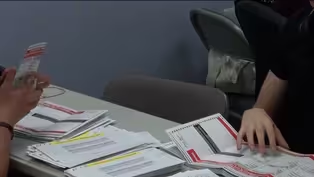
Assembly leaders announce new review of NJ ballot design
Video has Closed Captions
Special committee will have six Democratic members and six Republicans (1m 6s)
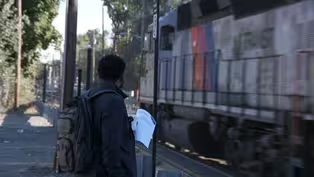
High hopes for NJ Transit’s new customer advocate
Video has Closed Captions
‘He's got a tough job, but hopefully he will do it as an independent voice’ (4m 50s)
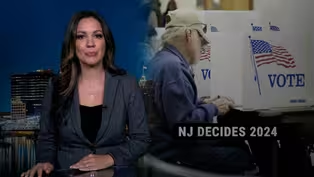
How to read political polls, NJ experts give pointers
Video has Closed Captions
Interview: Patrick Murray and Ashley Koning, polling experts (5m 57s)
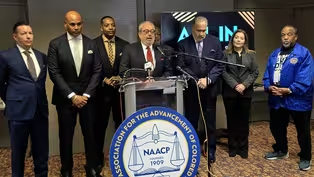
NJ NAACP, activists call for changes to State Police
Video has Closed Captions
Leaders are asking Murphy to remove Col. Patrick Callahan (4m 31s)
Providing Support for PBS.org
Learn Moreabout PBS online sponsorship
- News and Public Affairs

Top journalists deliver compelling original analysis of the hour's headlines.

- News and Public Affairs

FRONTLINE is investigative journalism that questions, explains and changes our world.












Support for PBS provided by:
NJ Spotlight News is a local public television program presented by THIRTEEN PBS