NJ Spotlight News
NJ Spotlight News: October 14, 2024
10/14/2024 | 26m 46sVideo has Closed Captions
Watch as the NJ Spotlight News team breaks down today’s top stories.
We bring you what’s relevant and important in New Jersey news and our insight. Watch as the NJ Spotlight News team breaks down today’s top stories.
Problems playing video? | Closed Captioning Feedback
Problems playing video? | Closed Captioning Feedback
NJ Spotlight News is a local public television program presented by THIRTEEN PBS
NJ Spotlight News
NJ Spotlight News: October 14, 2024
10/14/2024 | 26m 46sVideo has Closed Captions
We bring you what’s relevant and important in New Jersey news and our insight. Watch as the NJ Spotlight News team breaks down today’s top stories.
Problems playing video? | Closed Captioning Feedback
How to Watch NJ Spotlight News
NJ Spotlight News is available to stream on pbs.org and the free PBS App, available on iPhone, Apple TV, Android TV, Android smartphones, Amazon Fire TV, Amazon Fire Tablet, Roku, Samsung Smart TV, and Vizio.
Providing Support for PBS.org
Learn Moreabout PBS online sponsorship>> Funding for NJ Spotlight news brought to you by vendors of the New Jersey education Association.
Making public schools greater for every child.
RWJ Barnabas Health.
Let's be healthy together.
And New Jersey realtors.
The voice of real estate in New Jersey.
More information is online at NJrealtor.com.
Joanna: At least one killed and more than a dozen injured after a fallen tree causes a deadly morning crash.
In the wake of hurricane Milton's discretion, the New Jersey Red Cross deploys volunteers for a helping hand.
>> It is going to be a long road to recovery for a lot of folks here.
Joanna: The battle heats up for the seventh congressional district.
Tom Kean Junior takes on Sue Altman in their one and only debate.
>> I think they both accomplish their goals for the evening for the debate.
I am not sure if it is going to make much of a difference.
Joanna: A new CDC study sheds light on the challenges faced by transgender students in New Jersey and across the country.
>> I think surrounding a lot of stigma with trans students and a lot more coming out, there are people trying to take away protections to us, a lot more people find themselves increasingly isolated.
Joanna: NJ Spotlight News begins right now.
♪ >> From NJPBS Studios, this is NJ Spotlight News with Rihanna Vannozzi.
Joanna: Good evening.
I'm Joanna Gagis in for Briana Vannozzi.
We begin with a few stories we are following.
First, a nurse's strike was narrowly avoided at the only level one trauma center in northern New Jersey.
On agreement was reached on Friday between the nurses and University Hospital over staffing ratios, the key sticking point in the negotiations.
The nurses have been asking for a numeral 5:1 nurse to patient ratio, saying it is critical in their success for caring for patients.
It has played out at other hospitals around the state, namely Robert Wood Johnson hospital last year, where nurses went on strike for five months.
No strike in Newark.
Medical and surgical units will CA 6:1 ratio until July 2026, when the hospital will move to the requested 5:1 ratio.
Intensive care units will immediately seek to: One ratios and pediatric units 5:1.
170 nurses have been hired in the past year.
The nurses' union has struck similar deals with other systems across the state.
Debbie White, who heads the union, is urging New Jersey legislators to pass a statewide mandate for lower ratios.
>> We have wins in our union that affect so far five separate hospitals, more to come, but not every hospital in New Jersey is unionized.
This needs to be a law.
Every hospital must be held to this standard.
Every hospital must provide safe staffing so that their patients' quality of care improves and said they can retain the nurses at the bedside.
Joanna: Also, a deadly train crash early this morning.
Just before 6:00 a.m., a light rail train struck a tree that had fallen on the tracks, killing the train engineer and injuring 23 others.
The crash happened in Florence.
Passengers could be seen taken out on stretchers, some taken away by ambulance.
The remaining 19 passengers on the train were transported away by bus.
The River line service remains suspended in both directions while NJ transit is investigating.
NJ transit bus service is being provided in the meantime.
New Jerseyans lend a helping hand.
Volunteers are in Florida offering aid for those displaced from their homes after hurricane Milton ripped through communities Wednesday after a passage -- a path of death and destruction were left in its wake.
Around 400,000 are reportedly still without power as of this morning.
President Biden visited the state, promising 100 million dollars to restore Florida's power system and 600 million dollars in relief funds for the citizens impacted by Milton Anhelina.
Volunteers with the American Red Cross New Jersey reason went down to the Tampa area to set up shelter for those fleeing their homes for safety.
A New Jersey native, Riksum, was among them, sheltering with them as the storm passed by.
He joins us now to talk about the work that he and other volunteers have been doing since last week.
Thank you for taking time to talk with us today.
I know you are busy where you are.
To set the stage, you left your home in Essex County just before Milton hit in Florida.
You headed down to set up a shelter.
Help us understand what it was like weathering the storm as it came through and you were in that shelter with others there.
Riksum: of course, thanks for having me on.
We set up an emergency evac shelter in Hillsborough County with the support of other volunteers and government agencies.
We were there before landfall and did what we could to support the evacuees.
Joanna: I can imagine you were not directly in the impact, kind of, zone but felt the storm come through.
Who was there in that shelter?
How many folks had to flee their homes?
What was the feeling like in that space?
Riksum: We were supporting upwards of 450 residents from the community and the county.
A lot of them were coming from mandatory evacuation areas.
A lot of them were concerned about what they were going to be returning to or if there was anything left of what they were going to be hopefully surviving of their homes.
Joanna: How many of those folks have returned to homes that were badly damaged or even worse?
>> I don't have an answer for you, but I can tell you that the Red Cross along with other agencies are going to be here long term, so they will have support.
It is going to be a long road to recovery for a lot of folks.
Joanna: It looks like you are in an emergency vehicle right now.
We can see you distributing food behind you.
We can see that going on.
What is the need right now?
What are the key needs that folks are experiencing?
Riksum: We were obviously a shelter team.
Leadership from the Red Cross side of the house identified that the immediate need was feeding, so my team was reassigned to a feeding mission, and we are feeding all throughout Florida.
Right now we are Tampa, and we have in my unit 500 meals, and there are other units like me and my team that are distributing breakfast, lunch, and dinner as long as we need to be here.
Joanna: Do you have enough supplies to meet the need of the community?
Riksum: We are working with partners.
I am on the ground here, so I really do not have an answer on that, but we are working with tremendous partners here and obviously, like me, there are Red Cross volunteers coming from all over the country to support this mission.
Joanna: As you do your work every day, how often are you able to sit down and talk to the folks you are serving right now?
How are they feeling?
What are they experiencing?
Riksum: The Red Cross continues to operate shelters.
That is our team.
We have teams that specialize in disaster mental health, disaster health services, and other things, all staff typically with volunteers.
My mission is to feed and we are trying to reach as many people as needed.
For us, we are all boots on the ground, doing what we can to get food out there.
There are others specializing in mental health and longer-term recovery needs.
Joanna: For folks in New Jersey who want to help and do not know how, what should they do?
Riksum: You can join us down here, but if you have other things to do, I would consider donating to the American Red Cross.
Redcross.org.
Joanna: You are doing tremendous work in Florida.
We wish you safe return every you can.
Our thoughts and prayers to all those affected.
Riksum: Thank you so much, ma'am.
Joanna: Voters in New Jersey's seventh district finally got to see a head-to-head matchup at the two candidates vying for Congress in November.
Tom Kean Junior and his challenger, Democrat Sue Altman, former head of the New Jersey working families party.
This debate was the first and only time the two candidates will spar, and viewers got to see a fiery exchange on topics like abortion, affordable housing, U.S. support of foreign wars, and much more.
Senior correspondent Brenda Flanagan has more on the key moments from the night.
Brenda: Candidates in New Jersey's tightest congressional race clashed in the campaign's only face-to-face debate.
Sue Altman tangled with one term Republican Tom Kean Junior, each labeling the other too extreme for their district's constituents over issues like abortion and immigration.
Kean attacked Altman as the head of the left leaning progressive working families alliance.
Rep. Kean: She is for defunding the police.
She has supported the legalization of narcotics.
Those are extreme positions.
They are out of step with people in the district.
Ms. Altman: Tom Kean Jr. has an unsolvable problem.
The values of his voters and the values of his donors are not the same.
His donors, the national Republican Party and extremist billionaires, represent an insane point of view.
Brenda: Altman explained she has broken with the left over defunding police and now supports a comprehensive approach to public safety.
She said she never supported legalizing narcotics and attacked Kean for supporting Donald Trump.
>> I am disappointed in you.
You don't have to repeat the lies your overlords tell you.
We need someone who will stand up to Trump.
We need someone who will stand for women's rights.
Brenda: On that topic, the two candidates slammed each other's positions on abortion.
Kean said he is pro-choice.
And he opposes a national abortion ban.
Rep. Kean: She supports a plan that would allow abortions for any reason up until birth.
That is extreme.
Ms. Altman: At what point is the federal cash at what point is it -- at what point is it the federal government's job to make sure women's rights are protected?
I find it ironic that you think that is an extremist point of view.
Brenda: The district leans red and both candidates struck more moderate towns on several issues, but when asked about Trump's controversial plan to deport illegal immigrants, Kean called for more protections and to build a border wall without addressing Trump's policy.
Altman pounced.
Ms. Altman: You just dodged the question.
You were asked a very specific question -- would you support the porting migrants, yes or no?
-- deporting migrants, yes or no?
Brenda: Kean stared silently for several seconds, not the best look according to Republican strategist Chris Russell.
>> I thought he could have filled in the space better.
If he supports it, OK, if he does not, say it.
Part of that was strategy.
She wants her race to be a Trump-Harris referendum.
Brenda: but Russell said Kean kept his cool.
>> I thought every time she tried to rattle Kean and get him off his game, I thought he stated pretty disciplined in terms of his approach and did not let her get under his skin.
>> You have to be aggressive and intergenic -- energetic and go for it.
Brenda: A Democratic strategist said Altman had to establish herself.
>> You are seeing two different energies from the two different candidates.
One is being aggressive, being energetic, going for the throat when she has to, and then see a candidate where -- again, I will go back to the moment where he stared blankly at the camera.
Brenda: What will this debate actually move the needle?
>> The first rule of political debates is do no harm, like the Hippocratic oath.
Just make sure you do not do something really bad that hurts your campaign.
So I think they really both accomplished their goals for the evening.
I am not sure whether it is going to make much of a difference.
Brenda: Political analyst been Dworkin says he things neither side committed a fatal error.
He called the debate a draw.
I'm Brenda Flanagan, NJ Spotlight News.
Joanna: Speaking of political races to watch, here tomorrow night, NJ Spotlight News will host an event with the two candidates running for U.S. Senate, Democrat Andy Kim and Republican Curtis Bashaw.
It is not a debate, it is a conversation on the issues that affect you.
We look to boost stability during this very divisive political election.
David Cruz and Briana Vannozzi will be leading the discussion.
You can see it tomorrow night at eight :00 p.m. right here on NJPBS and streaming on our YouTube channel.
For people with intellectual or develop metal disabilities, navigating the challenges of life can be a struggle.
Some turn to family for help, others are placed in support of housing, but some find themselves placed in guardianship, which gives themselves and other power over their life choices -- how they spend their money, where they live, and what jobs they can take.
I recently spoke with disability advocates who say these situations can lead to abuses of power, and they are raising concerns over proposed legislation that could make already in SCHIP easier to attain.
>> If you have a guardian, that person -- could make guardianship easier to attain.
>> If you have a guardian, that person has the right to decide everything for you.
There are very few rights you actually retain.
>> Guardianship is often placed on individuals with intellectual or developmental disabilities.
>> People come to me and say they do not want to be subjected to guardianship anymore or want to have a less restrictive guardianship because these tend to be abusive relationships.
Not all guardians are abusive, but it is an easily abused system.
Reporter: Disability rights New jersey represents many individuals with disabilities by fighting these cases in court.
People like Peter, who has autism and spent close to three years trying to get out from under his mother's petition from guardianship.
The appellate court recently filed in Peter's behalf, but it is the petition process has him concerned for others like him.
What should be criteria to prove that guardianship is needed?
>> You have done literally everything you can to make that kid competent if you are a parent, and this person, there is literally nothing else that could work, so literally you would have to prove you tried assisted decision-making and you have powers of attorney, and you have tried everything within your financial means.
I believe that if that were the case, my mother would have flat-out not been allowed to file guardianship.
Brenda: But given how easy it is to apply and how hard it is to get out from under a request, let alone an actual guardianship appointment, advocates for individuals with disabilities are very concerned about a bill that has been introduced in New Jersey legislature that would allow someone to request guardianship of a minor six months before that person turns 18.
It was introduced by assemblyman Howe worth and is now carried forward by assemblywoman Carol Murphy.
>> Often times, once they turn 18, it is not on nomadic that their parents will automatically become their guardian -- not automatic that their parents were automatically become their guardian.
In order to avoid that break out into the guardianship, it allows the parent to continue being that child's guardian if they file early before 18.
Brenda: To keep the most vulnerable from falling into a care gap where people cannot advocate for them.
But Murphy has also hurt concerns raised about this bill from people worried about their loss of autonomy and even risks of abuse.
>> It is important that we allow those people who do not need guardians to be able to live independently and seek the help they need when they need it.
Brenda: This bill puts the onus on those who would have a guardianship placed over them to prove they have capacity to care for themselves.
Paul is New Jersey's ombudsman for individuals with intellectual or develop metal disabilities and their families.
He urges caution.
>> You should not start from the position where people are guilty until proven innocent.
If someone is seeking guardianship over another individual, I think it is incumbent upon them to make the case in a thoughtful way.
Brenda: There was another option, one that 22 other states have adopted, called supportive decision-making, but New Jersey has no clear model for it.
Peter Bramnick's father explains what it looks like.
>> You sign a power of attorney to a caregiver to help them so others, banks, doctors, are willing to talk to them.
At a higher level like Peter has, you have several people you turn to for important life decisions.
Brenda: A County circuit Judge approves guardianship requests, and she too is in support of a more centralized system that puts supportive decision-making before guardianship.
>> We should try to look at the least restrictive means, because ultimately -- and that is my personal opinion -- we should move forward as a state in considering how to support individuals and meet them where they are and work on their strengths with the right support, rather than automatically taking away a person's right and their autonomy.
Brenda: She would also like to see a shift away from court-appointed attorneys, instead using a guardian ad litem as an advocate, someone appointed by the court to protect the rights and interests of a person who cannot do it themselves.
>> In other states where a guardian ad litem is appointed, who is there to really advocate for that individual, that is how we actually should address this, maybe adding that to that bill would be a happier medium.
Brenda: Murphy said she is holding the bill while she is continuing to have conversations with all stakeholders involved.
In our spotlight on business report, those of you who have already filed for your 2021 acre property tax relief benefits, check your mailboxes.
The first round of rebates were mailed out on Friday and should be arriving at your home sometime this week.
If you applied for a direct deposit rebate, those benefits were distributed last Thursday.
The state was able to speed up its delivery of these initial payments, surly applicants are receiving the funds earlier than expected.
This round applies for anyone who owned a home in 2021 and earned up to 250,000 dollars that year, or who rented and earned up to $150,000.
If you have not yet applied, it is not too late.
The deadline to file for the 2021 benefits is a, November 30.
The Centers for Disease Control and Prevention released a new report that is the first of its kind to support transgender identity and the social outcomes of those who identify as trans or are questioning their gender.
The report revealed that only a very small percentage of young people are either trans or questioning, but those that are facing significantly higher rates of violence in schools, poor mental health, and suicidal thoughts.
I'm joined now by Sam, a former Sparta high school student who is transgender and here to offer his perspective on the study and the concerns among the transgender community.
Sam, it is so great to have you with us.
Thanks for joining us.
This CDC report, the youth risk behavior survey, really highlights some of the concerns we have heard from folks in the transgender community, particularly in schools.
We see there are highly rates of bullying -- higher rates of bullying, and that correlates with higher mental health concerns and absenteeism.
Does any of that ring true for you in your life?
Sam: I would say yes.
Surrounding a lot of stigma with transit students, and especially with a lot more coming out, where people are trying to take away protections from us, a lot more people find themselves increasingly isolated, and it is time when we are so connected to one another.
There is so that will sense of privacy and protection already, so to take away something else from kids and create even more stigma further isolates us from our community.
Joanna: When you talk about taking away from transgender students, what do you mean?
>> In terms of taking away autonomy, schools are often a place where kids will find out more about themselves and create a separate life from their home life or their parents or some things that they just want to keep private or with their friends.
To take away transit students' abilities or in general students' abilities to keep that privacy is something that will affect any student, but especially those who are at risk, like transit students.
Joanna: -- trans students.
Joanna: You are touching a proposed policy guidelines that some school district have considered.
5756 is what it is known as.
That would essentially inform parents if and when a student came out to someone in the school district as transgender.
I am curious about your thoughts on that policy, and then you will get into what you think schools should be doing.
Sam: For sure.
That policy I think is important to have protections for kids, for students, and to take away those protections, to take away things like that, it puts more students at risk and it relieves kids of that autonomy, takes away a lot of their rights to grow as a human being and to find themselves on the run terms.
Joanna: The report highlighted that about 3.3% of their students are trans, 2.2% are questioning.
This is really a small percentage of students we are talking about, but do you believe that school districts need to develop policies specifically for this population of students to help them feel safer in school?
Sam: Absolutely, because it is not just about the transit students themselves feeling safer.
It is about all students being able to learn about the different types of people that exist in the world.
The more you are exposed to the diversity of humanity, the more easy it is to talk to people, to relate to people, to have empathy towards people.
That is one of the things I feel schools is lacking in, the teaching of empathy.
To be able to -- to be able to protect more trans students will teach kids in general more empathy towards each other.
Joanna: This is a small population of students, and yet it is an issue that was so hotly debated in our last election cycle.
It has been kind of driving the new cycle around this issue for quite a while.
I wonder your thoughts on whether or not there is just maybe an inherent fear that people feel, because the transgender community is often misunderstood or there is not a whole lot that they know about folks in that community.
What are your thoughts there?
Sam: I feel there is a lot of fear, because fear is born of ignorance and born of not being educated on certain topics.
Of course, it becomes this vicious cycle of constantly not wanting to know things because you fear things, fury things because you don't know things.
Joanna: it is a vicious cycle, as you say.
Sam, thank you for sharing your perspective.
>> Support is provided by Blue Cross Blue Shield of New Jersey, an independent licensee of the Blue Cross Blue Shield Association.
Joanna: That is it for tonight.
Before you go, a reminder to download the NJ Spotlight News podcast so you can listen anytime.
Thanks for being with us.
Have a great night.
We will see you right back here tomorrow.
>> NJM Insurance Group.
Serving the insurance needs of residents and businesses for more than 150 years.
Blue Cross Blue Shield of New Jersey.
An licensee of the Blue Cross Blue Shield Association.
>> NJM Insurance Group has been serving New Jersey businesses for over a century as part of the Garden State -- for over a century.
As part of the Garden State, we help companies keep their vehicles on the road, employees on the job, and projects on track.
Working to protect employees from illness and injury.
To keep goods and services moving across the state.
We are proud to be part of New Jersey.
NJM.
We've got New Jersey covered.
♪

'Extremism' charges in 7th Congressional District debate
Video has Closed Captions
Sue Altman and Tom Kean Jr. label each other out of touch with constituents on key issues (4m 42s)
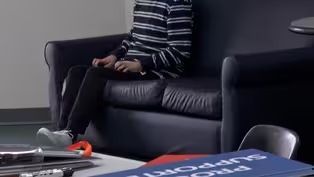
Guardianships for those with disabilities draws debate
Video has Closed Captions
Advocates for those with disabilities want less restrictive guardianships or none at all (5m 33s)

Most Anchor property-tax relief payments already sent out
Video has Closed Captions
Direct deposits started on Oct. 10 (54s)

NJ Red Cross volunteers help Hurricane Milton survivors
Video has Closed Captions
Interview: Volunteer Riksum Kazi (5m 4s)
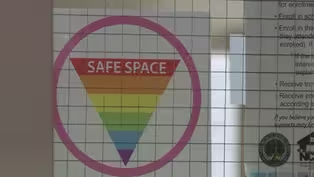
Study: Transgender students at greater risk of violence
Video has Closed Captions
Interview: Sam Holovacs, former Sparta High School student (5m)

Train operator killed in NJ Transit crash
Video has Closed Captions
More than 20 people were injured (44s)
Providing Support for PBS.org
Learn Moreabout PBS online sponsorship
- News and Public Affairs

Top journalists deliver compelling original analysis of the hour's headlines.

- News and Public Affairs

FRONTLINE is investigative journalism that questions, explains and changes our world.












Support for PBS provided by:
NJ Spotlight News is a local public television program presented by THIRTEEN PBS