NJ Spotlight News
NJ Spotlight News: October 18, 2024
10/18/2024 | 26m 46sVideo has Closed Captions
Watch as the NJ Spotlight News team breaks down today’s top stories.
We bring you what’s relevant and important in New Jersey news and our insight. Watch as the NJ Spotlight News team breaks down today’s top stories.
Problems playing video? | Closed Captioning Feedback
Problems playing video? | Closed Captioning Feedback
NJ Spotlight News is a local public television program presented by THIRTEEN PBS
NJ Spotlight News
NJ Spotlight News: October 18, 2024
10/18/2024 | 26m 46sVideo has Closed Captions
We bring you what’s relevant and important in New Jersey news and our insight. Watch as the NJ Spotlight News team breaks down today’s top stories.
Problems playing video? | Closed Captioning Feedback
How to Watch NJ Spotlight News
NJ Spotlight News is available to stream on pbs.org and the free PBS App, available on iPhone, Apple TV, Android TV, Android smartphones, Amazon Fire TV, Amazon Fire Tablet, Roku, Samsung Smart TV, and Vizio.
Providing Support for PBS.org
Learn Moreabout PBS online sponsorshipAnnouncer: Funding for NJ Spotlight news is provided in part by the members of the New Jersey education Association.
Making public schools great for every child.
Our Jubilee Day -- RWJ Barnabas health.
Let's be healthy together.
And New Jersey realtors.
The voice of real estate in New Jersey.
More information is online at NJrealtor.com.
Briana: Tonight on "NJ Spotlight News" -- Cracking down on new laws, setting harsher punishments for home invasions and bulgur rays after a string of high-profile crimes.
>> We need to ensure that our state's laws hold perpetrators of these crimes accountable and help prevent them from being committed again in the first place.
Briana: Plus, as school layoff plans rock East Orange, the district grapples with a major budget crunch.
>> We've got $200,000.
Briana: Also terminally ill people from out of state are fighting to access New Jersey's "medical aid in dying" law.
>> I would like soft pillows, a blanket I am particularly fond of, some really lovely music, some poetry, a few very close friends, a glass of wine, and to say "goodbye" and "I love you."
Briana: And a developer in Irvington starts a new effort, pairing affordable housing with another critical need, social services.
>> We, the residents, really needed this.
We have been fighting for this for a long time.
Just to see it actually come to a head is really important.
Briana: "NJ Spotlight News" begins right now.
♪ ♪ Announcer: From NJ PBS Studios, this is "NJ Spotlight news" with Briana Vannozzi.
Briana: Good evening and thanks for joining us this Friday night.
I'm Briana Vannozzi.
We begin with a few key stories we're following.
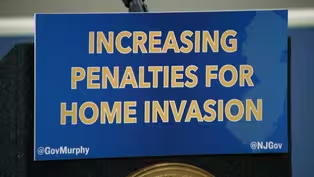
First, New Jersey is cracking down on home invasion crimes.
Governor Murphy was in Edison today signing a new law that puts stiffer penalties on people who commit crimes of burglary on home invasion.
To start, it classifies the crimes separately.
A home invasion burglary is now a first-degree crime, carrying a 10-20 year prison sentence and a fine of up to $200,000.
That refers to when a person breaks into a home and injures someone while also carrying a deadly weapon, even if that weapon is not used.
A residential burglary is now a second degree crime, that is when a person breaks into a home but no one is hurt.
That person can face 5-10 years in prison now and a $150,000 fine.
Governor Murphy said today the law also extends to juveniles carrying out a home invasion with a firearm, meaning they can be tried as adults.
The bill signing comes after the governor was pressed by lawmakers in both parties to act on the legislation after assemblyman Paul K.'s home was burglarized and a detective was shot and killed in her home following an invasion.
>> This is tough, tough medicine.
All of these reforms will help make our criminal justice system more responsive to meaningful threats, support our continued efforts to restore the public's trust in that system, and at the same time will make your streets and communities safer.
Briana: Also tonight, there's an ongoing wildfire warning for the state, the National Weather Service has issued a special weather statement asking people to be aware of an increased risk for the spread of wildfire over the next several days, largely because humidity is low and expected to drop further, on top of below normal levels of rain in the last 90 days.
About two to seven inches lower than usual.
The state Department of environmental protection issued a drought watch on Thursday asking residents to voluntarily conserve water.
State climatologist Dave Robinson says the past month was the third driest September on record.
According to officials, the lack of rain, mild winds, and moderate temperature create the environment perfect environment for wildfires to quickly become out of control.
Earlier this week, the New Jersey Forest fire service also issued Camp Fire researchers across the state.
So if you are tempted to start a bonfire in the backyard on these chilly nights, just make sure you are following all the precautions.
And it is another shortened school day for students in East Orange amid unrest from the teachers after the district announced 75 positions are being cut.
The East Orange Board of Education announced the layoffs Wednesday night, as they try to figure out how to make up a roughly $10 million budget gap.
The layoffs include four district employees and 71 in-school staff.
Teachers started calling out sick on Thursday in protest despite warnings from their union that any job action, like calling out en masse, could require courts to get involved.
Meanwhile, parents have been left scrabbling to find childcare and wrap their heads around what this means for the rest of the school year.
The layoffs take effect in December.
Many showed up to voice their frustration at a town hall last night.
As Senior correspondent Joanna Gagis reports, things quickly got heated.
>> I'm here tonight to answer questions to the best of my ability.
Reporter: The East Orange school superintendent Christopher Irving face scrutiny and an emotional crowd right last night during a Town Hall meeting that came on the heels of the district announcing it is laying off 75 personnel, including teachers, counselors, and other support staff in their schools.
>> We are having to consult our nine and 11-year-old daughters who are distraught because of what you guys did last night.
These people are a part of our families.
>> What are you going to do to address the social/emotional needs of the students of East Orange?
You are getting rid of all the social workers.
And it is very important that these children have somebody that they feel safe to talk to.
Reporter: When teachers learned of the layoffs, so many called out, that the district called a half day yesterday and again today.
>> Calling a half-day at 7:12 a.m. in the morning as we are already on our way?
Reporter: The district told us that it's facing an $8 million shortfall saying costs have gone up while state funding from the school funding formula, known as S2, has remained flat.
Irving's critical of that funding model, given that East Orange was once an Abbott district controlled by the state.
>> North received $100 million.
Our colleagues in Irvington and Orange received almost $15 million to $30 million.
It is really unfair and forcing us to make difficult decisions.
Reporter: The layoffs of 71 and school staff and four district employees will save between $7 million to $9 million but won't interfere with education.
>> Class sizes are not going to increase as a result of this action.
Again we are taking our coaches, folks who have not been in a classroom for some time, they are now moving back in the classes.
Those coaches will then indirectly shift the folks who are newer to the district out of the district and we will be helping those individuals transition.
But I want to be very clear, these movements will not impact the day-to-day classroom instruction.
Reporter: Irving is new to the district and got a pass from some parents, acknowledging his -- acknowledging he has only been there since July, but teachers who will be let go in December gave him no such grace.
>> How do you explain me and all the other teachers that are now being laid off?
Are we not directly affected?
Are we not directly deep in the classroom?
>> We found out mid August.
I am sorry.
Reporter: Alice is a pre-k teacher who was just hired in August.
He says during his transition into the district, positions were listed in the budget that were actually not budgeted for.
Now, he has to make those hard cuts.
As for those class sizes -- >> The schools in East Orange have not been fully staffed for a while.
I went to a back-to-school night at STEM, and one class had 103 students in it.
That is unacceptable.
>> We are taking a step back, it is a dramatic step back.
So we can file the budget and offer every job we have been his district -- in this district to ensure every single class has a teacher.
Reporter: He said it's also an effort to ensure the state does not once again have to take over the district.
>> What will be so wrong with the state taking over?
If you are not going to be truthful with us at this point.
>> If we let the state come into the school district and take over, will they do the development?
It's not our community that's going to make the decision about how this community moves forward.
>> We are not making that now.
Reporter: The governor's office told us in a statement he is aware of the situation and the Department of Education is closely monitoring the impact of East Orange school district's decision.
For NJ Spotlight News, I'm Joanna Gagis.
Briana: A controversial practice known as "medical aid in dying" has been legal in New Jersey for the last five years, helping people to end their lives after receiving a terminal diagnosis.
But only if they are a resident here.
Now there is a fight to lose that requirement, following in the footsteps of states like Vermont and Oregon, which would make medical aid in dying available to millions of more people, both the promise and the problem, depending on who you ask.
Senior correspondent Brenda Flanagan has the story.
>> Dying, everybody is going to die, it would be nice to have some guide rails along the line.
Reporter: Cancer survivor Judy Govatos wants to plan a peaceful death using New Jersey's medical aid in dying law, which allows Germany ill patients end their life with prescription drugs under a doctor supervision.
A peaceful end if her cancer returns for a third time, no more ravagingchemo.
-- no more ravaging chemo.
>> I would like soft pillows, a blanket I am particularly fond of, some really lovely music, some poetry, a few very close friends, a glass of wine, and to say "goodbye" and "I love you."
To say "goodbye" and "I love you."
Reporter: But the 80-year-old grandmother lives in Delaware, where medical aid in dying is considered assisted suicide, a felony, and New Jersey's law applies only to state residents.
So Govatos joined a group that sued, calling New Jersey's residency requirement unconstitutional.
But the judge disagreed and dismissed their case, continuing the ban on out-of-state patients, who often request help from Dr. Paul Bryman.
>> They would like nothing better than not to be terminally ill and dying but they feel that their suffering is insurmountable and ending their suffering is their goal and their choice.
Under New Jersey law, we need to tell them that they are not eligible, unless they change their residency to the state of New Jersey.
Reporter: The Camden physician treats hospice patients.
He joined Govatos in her lawsuit to abolish Jersey's residency requirement and does not expect it would trigger a rush of patients to New Jersey.
>> The number of people is small.
In other states where this is legal, in Vermont and Oregon, it is a handful of people.
There are not people rushing in droves.
It is their choice.
Reporter: But the federal court judge wrote, at its core, the issue is whether the Constitution requires a state to extend to nonresidents of nonfundamental privilege that it affords to its own residents.
Notwithstanding a terminally ill person's genuine desire to access medical aid in dying, this court concludes that the answer is no, the Constitution does not so require.
Advocates are appealing.
>> We wish that the judge had seen things our way.
We feel confident the appellate court will take a look with fresh eyes and we are hopeful that they will recognize that medical aid in dying in New Jersey is an established medical practice that fits within the standard of care.
Reporter: Attorney Amitai Heller feels the state is taking a hypocritical stance.
>> Would New Jersey deny access to abortion care for an out-of-state resident?
And if not, why should medical aid in dying be any different?
>> The reason I'm doing this is, I want to be a part of changing the culture around death, because people really are suffering needlessly.
>> Reporter: About 100 New Jersey residents opted for medical aid in dying last year.
Govatos says, if New Jersey will not let her opt in, she will travel to Vermont when the time comes.
I'm Brenda Flanagan, NJ Spotlight News.
Briana: In our spotlight on business report tonight, it is no secret demand is outpacing the supply of affordable housing in New Jersey.
Estimates show the state needs roughly 200,000 units to close the gap.
In Irvington, one developer is combining building affordable homes alongside needed social services, including supportive housing units dedicated specifically for young women aging out of foster care.
Raven Santana was at the groundbreaking to find out why residents and leaders in Irvington believe this could change the community.
>> We, the residents, really needed this.
We have been fighting for this for a long time.
Just to see it actually come to a head is really important.
Reporter: Jonelle Giles has been a resident in the Township of Irvington for 14 years.
Giles lives right down the block from this vacant piece of land and could not be more excited to attend a groundbreaking ceremony for the Sankofa enclave at 21st Street, which will fill the area with two family homes, affordable housing, and outdoor green space.
>> I've seen developers come and go, I've seen projects start and not finish, you know what I mean?
That's why to actually have this ground breaking, and to actually see the hope, it's like, OK, we are finally getting somewhere, we are finally going to have something.
They are probably going to give us what they promised, you know what I mean?
That's kind of where I'm at.
Reporter: The $100 million project is being funded through a mix of sponsors, equity and debt that will bring 215 houses, 240 units of affordable housing, five supporting housing units for young women aging out of foster care, and a 30,000 square-foot community development center.
>> This whole area is an establishment desert.
-- established food desert.
That's why we consciously did that.
Everywhere you see that is overgrown, you know, any parcel of land that has nothing on it, we will put something there that has value.
Reporter: Nana Duncan is the owner and founder of Thatcher Duncan group.
Which is a partner of 21st Street development, the developer for this project.
The development, led by a team of black women, will offer homeownership, green space, and affordable housing in the area.
Duncan says part of the project is designed to help low income families become homeowners by offering housing that is affordable and accessible.
The affordable units are the result of a previous investment, funding from the U.S. Department of Housing and Urban Development, which was allocated through the nonprofit organization "Brand New Day."
The developer is also pursuing tax credits through the state's housing and mortgage finance agency and economic development authority.
>> We are providing mixed-income, homeownership.
-- mixed-income homeownership.
Some of it is market rate.
Some of it is affordable.
What is affordable is affordable to anyone at 80% or lower, the remaining income -- the idea is that we do not expect anyone that is buying any of the homes who is lower income to spend more than 28% of their income on those houses.
>> One of the things that is appealing to Irvington is we are centrally located.
You can get anywhere in the state and New York from Irvington, New Jersey.
Reporter: Tony Vauss is the mayor of the Township of Irvington.
He says Irvington is a prime location for people who want to do redevelopment projects.
>> We want to let residents know, the ones who have been here, who have been patient, that they have an opportunity to be a part of projects like this and be a part of the community and be a part of the transformation and have a first selection for some of these projects we have.
Reporter: She says the entire project will take between three and five years.
She says the thought is to begin to remove any vacancies in blight immediately.
For NJ Spotlight News, I'm Raven Santana Briana: Finally tonight, some know her as the feisty grandma who served in the New Jersey legislature.
Loretta Weinberg spent her life as a no-nonsense advocate who was not afraid to take on the political establishment or stand up to bullies in the process.
From marriage equality, to reproductive rights, and her work uncovering the Bridgegate scandal, Weinberg's career is captured through the lens of a new documentary, "politics is a mother: raising hell as part of -- is part of the job."
It's premiering this week and at the Montclair film Festival and directed by Weinberg's daughter, Francine, who wanted to show that at 80 years old, a time when most women feel invisible, her mother was at her most powerful.
Take a look.
>> When people ask me about that longevity, I say it is a combination of vitamin C and a little hostility.
>> It was not always easy, having her as a mother, but somewhere along the way, her career became bigger than the both of us.
>> New Jersey politics is tough, it's rough.
>> Can you guys, please?
>> She's this adorable 78-year-old lady, state senator from New Jersey.
Turns out Chris Christie once said to the press, you guys out -- ought to take a bat to her.
Briana: Loretta and Francine Weinberg join me now.
Thank you both for sitting down with me.
Francine, let me ask you first, why did you start capturing footage of your mother's career of her at work?
What was your intended goal?
Francine: Well, I'll say that this really started when I was about five years old.
And I am an observer of life.
Even at that young age, I would look at my mother and I would say, "she is not like all the other mothers."
She was not a Girl Scout leader.
She did not join the PTA.
She did not take us to the park after school.
[Laughter] We did not have smartphones.
I just knew, someday, this story needed to be told.
Briana: She didn't take you to the park, because she was busy taking on the world and the New Jersey political establishment.
But did you envision it coming together in this format?
You take us through some of those early years.
Senator, what was it like for you to see your work captured and encapsulated like this?
Loretta: First of all, I have to make one editorial correction -- I did join the PTA.
I once even ran a PTA program.
So there were little moments -- >> Oh, yeah?
How long were you in it?
>> That she might not have captured -- [Laughter] Loretta: This kind of evolved.
Somebody asked me just the other day, how did you give permission to your daughter to do this film?
And I said, "well, I never really did."
[Laughter] She just -- Before I knew it, we were in the middle of a film.
I'm very proud of her.
I'm very proud of the work she did here, really, on her own, the writing, the producing.
Everything but carrying the camera herself.
It captures a snapshot of my career.
The issues around Bridgegate, which I guess is a snapshot maybe of the years I was in the legislature, and a very interesting part of dealing with New Jersey politics as a woman, and at that point in my career, as an older woman.
Briana: The two big areas -- I don't want to give away the entire documentary -- but the two big areas you focus on are the work with marriage equality and then of course investigating and uncovering the Bridgegate scandal.
As a journalist, it never really occurred to me, but Francine, you point out in the film that when most are may be considering retiring, your mom was really at the pinnacle of her career.
Why was important for you to show that?
Francine: Well, I tell people, this is not a legacy project, this is not a love letter to my mother.
There are a lot easier ways to do that.
This is a love letter to people, women, but especially women, as we get older, we are sort of -- our voices are sort of invisible, and we are made to feel invisible.
My mother was almost 70 when she became a state senator.
She was almost 75 when she ran for lieutenant governor.
She was almost 80 when she, as I like to say, "kneecapped" Chris Christie and his presidential aspirations.
And this is a love letter to all of those people who, if you want to take care of your grandchildren, I have no judgment, go ahead and do that, but if you are called to do something, get in the game, because the world needs you, and you are not invisible.
Briana: Senator, you have also been extremely vocal on situations with New Jersey transit.
There was the smart gun bills, Planned Parenthood, reproductive rights, a whole feast, if you will, of issues and topics.
What do you think New Jersey is left with now that you have left the political scene in that way?
There's no Loretta Weinberg sitting in New Jersey transit and Port Authority hearings anymore.
Loretta: Well, I think there are people there to carry out this so-called legacy.
It is having not only the passion for the issue you are trying to move forward, but the discipline to stick with it.
Nothing in New Jersey worthwhile happens overnight.
Nothing worthwhile happens overnight.
Lots of things happen.
But not necessarily things we want.
So it takes discipline.
I use marriage equality -- It was over the course of almost 20 years, before we got from the beginning to, yes, marriage equality is the law of the land here in New Jersey.
So it is the ability to step over the roadblocks and keep pushing.
And there aren't, I guess, a lot of people who have that kind of discipline.
But there are some in the legislature, some I have worked with, that I keep on encouraging.
And I know it is not fun to go Newark to speak before the transit board particularly when you don't get warm welcomes at the other end.
It is not always fun to keep taking on the smoking lobby, like people are doing in the legislature right now with the casinos.
It's not always fun taking on the medical insurance companies to guarantee 48 hours for new moms.
But nothing in these areas ever came easily.
Briana: Senator Loretta Weinberg, Francine Weinberg, thank you so much for coming on.
>> Thank you.
>> Thanks, Briana.
Briana: That will do it for us tonight.
Before you go, a reminder to download the NJ Spotlight News podcast so you can listen to us anytime.
I'm Briana Vannozzi.
For the entire NJ Spotlight News team, thank you for being with us.
Have a great weekend.
We will see you right back here on Monday.
>> NJM Insurance group, serving the insurance needs of residents and businesses for more than 100 years.
Horizon Blue Cross Blue Shield of New Jersey.
An independent licensee of the Blue Cross and Blue Shield Association.
And by the PSEG foundation.
>> Our future relies on more than clean energy.
Our future relies on empowered communities.
The health and safety of our families and neighbors, of our schools and streets.
The PSEG foundation is committed to sustainability, equity, and economic empowerment.
Investing in parks, helping towns go green.
Supporting civic centers, scholarships, and workforce development that strengthen our community.
♪

A $100M development plan to eliminate blight in Irvington
Video has Closed Captions
The development will also include housing for young women aging out of foster care (3m 58s)

Challenge continues to NJ's right-to-die law
Video has Closed Captions
Group calls state's residency requirement unconstitutional (4m 3s)

East Orange families outraged over teacher and staff layoffs
Video has Closed Captions
District is facing an $8M shortfall, saying costs have gone up while funding remained flat (5m 3s)

Loretta Weinberg documentary: 'Love letter to women'
Video has Closed Captions
Interview: Loretta Weinberg and director Francine Weinberg Graff (7m 58s)

NJ issues drought watch as wildfire risk spreads
Video has Closed Captions
State DEP asks residents to voluntarily conserve water (1m 8s)
NJ law gets tougher with home invasions
Video has Closed Captions
Lawmakers pressed Gov. Phil Murphy to sign after string of high-profile crimes (1m 39s)
Providing Support for PBS.org
Learn Moreabout PBS online sponsorship
- News and Public Affairs

Top journalists deliver compelling original analysis of the hour's headlines.

- News and Public Affairs

FRONTLINE is investigative journalism that questions, explains and changes our world.












Support for PBS provided by:
NJ Spotlight News is a local public television program presented by THIRTEEN PBS