NJ Spotlight News
NJ Spotlight News: October 22, 2025
10/22/2025 | 26m 46sVideo has Closed Captions
Watch as the NJ Spotlight News team breaks down today’s top stories.
We bring you what’s relevant and important in New Jersey news and our insight. Watch as the NJ Spotlight News team breaks down today’s top stories.
Problems playing video? | Closed Captioning Feedback
Problems playing video? | Closed Captioning Feedback
NJ Spotlight News is a local public television program presented by THIRTEEN PBS
NJ Spotlight News
NJ Spotlight News: October 22, 2025
10/22/2025 | 26m 46sVideo has Closed Captions
We bring you what’s relevant and important in New Jersey news and our insight. Watch as the NJ Spotlight News team breaks down today’s top stories.
Problems playing video? | Closed Captioning Feedback
How to Watch NJ Spotlight News
NJ Spotlight News is available to stream on pbs.org and the free PBS App, available on iPhone, Apple TV, Android TV, Android smartphones, Amazon Fire TV, Amazon Fire Tablet, Roku, Samsung Smart TV, and Vizio.
Providing Support for PBS.org
Learn Moreabout PBS online sponsorship(upbeat music) - From NJ PBS Studios, this is NJ Spotlight News with Brianna Vannozzi.
- Good evening and thanks for joining us on this Wednesday.
I'm Brianna Vannozzi.
Tonight, a few stories we'll get into later in the broadcast.
The latest poll in the race for governor shows Democrat Mikey Sherrill's lead is shrinking.
We look at one of the defining issues for the campaigns, how the candidates would overhaul New Jersey's school funding.
Then, can the state really eliminate all traffic deaths in the next 15 years?
We hear from a mother fighting for safer streets after losing her son.
And later, direct cash, no strings attached.
A new program for expecting moms is coming to New Jersey.
We'll tell you how it works.
But first, a few of today's top headlines.
Amazon is facing more legal trouble in New Jersey.
Attorney General Matt Plotkin is accusing the retail giant of discriminating against pregnant and disabled workers at its warehouses here in the state.
In a lawsuit announced today, Plotkin accused Amazon of repeatedly denying those workers reasonable accommodations and then allegedly either placing the workers on unpaid leave or firing them for not meeting quotas.
The complaint comes just a day after the Attorney General targeted Amazon, the state's largest employer, for worker misclassification of its flex drivers, allegations Amazon denies.
A spokesperson for the company didn't respond to our request for comment on this lawsuit, but the company has denied wrongdoing in other similar cases.
Also, a Jersey City hospital facing a major funding crisis says it's ending some services in an urgent bid to stay open.
Heights University, formerly known as Christ Hospital, announced today it'll begin winding down some non-essential services in the next few days, but will continue operating as an acute care hospital, including keeping the emergency department critical care, operating rooms and medical-surgical services open.
The move still needs state approval and comes just days after Heights received $2 million in emergency funding from the state.
It also comes as another $25 million is being considered by lawmakers to keep the hospital from shutting its doors entirely.
Hudson Regional Health, which took over Heights and two other hospitals from CarePoint Health last year, says it poured $300 million into stabilizing the facilities, most of it at Heights, which is considered a safety net hospital that takes a high rate of uninsured patients.
The operator, HRH, cites cuts to charity care and low reimbursement rates as the main driver of their financial pressures.
The nurses union, HPAE, has repeatedly raised concerns, accusing the operator of failing to live up to its promises to keep the hospital fully running, and today called on state regulators to do a public review of its finances before any changes are made.
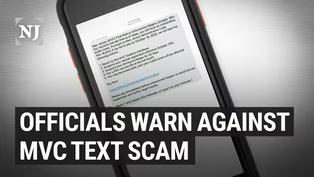
And it may look official, but that text from the New Jersey DMV is a scam.
Authorities are warning residents not to click links in unsolicited messages claiming to be from the Motor Vehicle Commission or other state agencies.
The fake text will often threaten license suspension, unpaid tolls or legal action, urging you to pay up fast.
But here's the red flag.
New Jersey hasn't had a DMV in more than two decades, and the Motor Vehicle Commission says it's never sent payment demands via text.
The latest warnings come from the Middlesex County Prosecutor's Office, which says it's all part of a growing SMS phishing scam that cost consumers $470 million last year alone, according to federal data.
New Jersey ranks among the top five states for internet scam losses, and they're getting really sophisticated, using URLs that have NJMVC or EasyPass NJ in them, but they're usually from overseas and have suspicious domain names like .ICU instead of .gov.
If you get one of those texts, authorities say, "Don't click, don't reply, and don't pay.
Block the number and report it as spam.
Coming up, how would a Governor Chittarelli or Sherrill reform the state's school funding formula and are they planning to raise your property taxes to fix it?
We'll have that story next.
Major funding for NJ Spotlight News is provided in part by NJM Insurance Group, serving the insurance needs of residents and businesses for more than 100 years.
>> The latest poll on New Jersey's governor's race finds the competition is still Democrat Mikey Sherrill's to lose.
The Rutgers-Eagleton survey out today puts Sherrill ahead with a narrow five-point lead over Republican Jack Cittarelli.
That's down from the double-digit advantage she had in the same poll just after the June primary.
The tight race is one reason National Democrats are pumping another six figures into New Jersey to hire more field staff and boost voter turnout.
It brings the Democratic National Committee's total spending in the state to $3.5 million, as they try to hold on to one of just two gubernatorial seats on the ballot this year.
And while both parties pour money and attention into the race, we're taking a closer look at some of the defining issues for the campaigns.
Among them, school funding, which impacts not just students and their education, but also your property tax bill.
Senior correspondent Joanna Gagis breaks down the candidates' starkly different views and how they could reshape affordability in New Jersey.
In the final stretch of the gubernatorial campaign, the candidates are seizing on issues traction with voters.
The impact runs deep, not on pay in property taxes, a and modernize it, making the formula in many year school funding formula wa eight years ago pre pand updated since Democratic Mikey Sherrill hasn't off how she'd modernize it, b changes to help support s students.
Republican Jack very critical of the form It's arbitrary.
I think it violating the equal benef constitution that says th supposed to suffer at the other.
No one's ever justified to me why the districts that get the greatest amount of state aid have a cost per pupil that could range anywhere from 35 to 40,000.
When those communities that hardly get any aid have a cost per pupil is between 15 and 20,000 and better educational outcomes.
The formula puts a value on each student based on a set of needs.
If they're an English language learner, if they rely on free or reduced lunch because of economic challenges, those students are considered at risk.
And when they're not, they're considered at risk.
The state will determine whether they require special services.
These are the key factors.
Those valuations are then calculated for each student across the district, creating the amount the district needs to provide a thorough and efficient education.
Under Chittarelli's plan, the state will take over the cost of special ed.
is causing a crowding out what we will do is give e for every english language that student is more educ then every school distric has to be between 15 and And if they're not, they' state aid because they're change would mean a dist spends 24 to $33,000 per 40% per pupil.
Education Ferry says that change co impact on educational out that he's proposing that funding for at risk stude in the field suggests tha a very poor choice that s come to school from low additional resources thr career.
And so removing t to shift it over to speci would be a really unwise create enormous inequities funding formula and reall disservice to students.
B more support in districts over year losses as the f adjusted aid based on dec Superintendents like Micha want to see Chiarelli's c really does understand th and the problems that it agree with some of the so proposed and I hope that and and and vetted throug what it costs to educate or E. L. L. We know what with a certain degree of plenty of dollars in the the state of New Jersey t these issues equally.
So funded fairly and propert at the same time to addre tax issue in the state.
require districts to merge more county based schools more municipalities than have more school district and it's raising costs on some school districts who cost all of the buildings not even running a K thro school system.
So we do n of these school districts some county based school that we have are some of in our state.
And this is we can ensure we're getti to people while driving d especially in those areas running a full K through districts has long been t it as a way to drive dow hasn't gained much tracti mergers but says he would a proponent of school cho wants to see more charter especially in urban distr not believe vouchers shou private institutions with are these the kinds of is voters to the polls?
Maybe depend on where you live.
- Our senior correspondent Joanna Gagas joins us now in the studio.
Hey, Jo.
So, clearly they are taking very different tracks for how they would overhaul the funding formula, but do we have specifics on how they would do it?
- When we hear from Jack, he is very specific.
He really has laid out a very detailed plan for how he would restructure this formula, which by the way is pretty complicated.
There are all these valuations that are attributed to a student based on a number of criteria.
He wants to simplify that majorly.
Now, there's a lot of conflicting responses to that.
Some folks say, "Yes, that's really helpful and beneficial."
Other folks say, "That's going to really put students who are at risk "kind of out of the calculation there, and that could create some harm."
So, mixed reactions there.
But when it comes to Cheryl's plan, she's much lighter on specifics.
I would say she's really said she wants to stop some of the fluctuations that happen.
The way we've seen districts see these major wins or major losses in terms of equalization aid, that's how much they get from the state.
And we've seen multi-million dollar losses versus wins or increases.
So she wants to level that out.
But I'll just tell you that I don't think either of these, whoever comes in this next administration isn't going to have that same type of fluctuation because we are much more quote level set, I'd say, from the formula rolling out over the last seven years.
But it's, I mean, I think as someone told you for your piece, Chidarelli's plan is simple for a very complex issue.
Is it more layered than that?
I mean, because it's not just the school funding formula when you look at it all.
Well, if you take the broader budget, he's going to.. He says that he's going to make a lot of priorities.
He says he will fully fund the pension.
He says he will fund the school formula according to this new plan.
But he also wants to tackle health care.
And so, that's going to be a major, I think, cost driver for him.
So, how he cuts the budget and does that, that's yet to be seen, of course, - Right, which of course is a big piece when they negotiate with the schools.
Joanna, great reporting.
Thanks so much for coming in.
- Thanks, Brie.
- Well, for the first time, the public is getting a chance to weigh in on a new statewide plan aimed at eliminating traffic deaths.
The state's Target Zero Commission held its first hearing today on ways to improve road safety in order to reach a goal of ending serious injuries and road fatalities by 2040.
It comes on the heels of a devastating year for pedestrian fatalities in New Jersey.
According to state police statistics, as of today, 126 pedestrians have been killed.
Sangeeta Bedlani was among the advocates at the hearing.
She lost her 11-year-old son Nikhil in a 2011 crash caused by a distracted driver and now works to ensure no other family endures the same loss.
Sangeeta, thank you for being with us.
You and I have spoken over the years, but it's nice to talk with you in person.
This meeting marks a major step for the commission.
Let me just ask you what that means for you personally.
- Oh, you know, I mean, when we started working on this bill, we didn't know whether we will end up having this passed into a law.
It took us almost over two and a half years to get to pass the law.
And then since then we've been working very closely with the commission on the next steps and what the action items will be for the commission to implement, you know, to eliminate traffic deaths by 2040.
So it's very heartening to me to see this come through and the engagement that we are seeing from the commission members, the way they're engaging the advocates, you know, in the conversation.
It has been just wonderful.
And of course we have to wait and see how it goes.
Right.
So the commission is as you mentioned it's 13 agencies involved a representative from each.
What specific policy reforms or or changes do you think need to be prioritized in order to get.
It's an ambitious goal.
But in order to reach it.
Yes we know it's an ambitious goal but we know it's achievable.
We have seen cities and other states achieve it.
Like a Hoboken has had zero traffic deaths in the last eight years.
So we know it can be done.
And 50 percent of you know all the roadway fatalities in New Jersey are on state controlled roadways.
So we know that we knew that we needed the state to be involved in this conversation.
And so it's really nice that we have these agencies.
But that's some of the items that action items that we're really focused on as advocates is the road design and infrastructure improvements.
So you know the focus has always been on educating the public.
And I think that's really important.
I think law enforcement is important and that's why we have the New York Police, not the New York, I'm sorry, the police, the state police department involved and as a commission member here.
But really, roadway designing, infrastructure.
What would that look like?
Right.
I mean, as you said, education has been a key component changing driver behavior.
But if the roads aren't set up to also help the cause, you're kind of stuck there.
So what would that look like?
What type of specific suggestions are you making?
So for example like you know you're driving on a road and people the speed limit is set at say 40 miles per hour.
Right.
People are speeding at 50 miles per hour.
Well the reason is because we have the roads that are designed to for people to speed.
So you could have like traffic calming measures over there to slow down the people you know from speeding.
So that's why when I talk about infrastructure improvements and road designs you know we have all these tools that can calm people from speeding.
So you know speeding is one of the contributing factors to high number of traffic crashes, right?
But then we're also looking at some legislations.
For example, automated enforcement, especially in you know to reduce speed in school zone areas.
We have on neighboring towns and states that are doing it like New York, Pennsylvania, Wycampe, New Jersey.
There's another legislation that we are looking at right now is the school bus safety camera.
And it's already been introduced in the assembly.
These are for people who instead of stopping when the school buses are parked and letting students off, they zip around, which I've seen probably just this week.
Exactly.
So we're talking about illegally passing a school bus, right?
And we see so many instances of that.
And we need to protect our kids.
So these are some of the legislative and some of the other reforms that we are looking at.
One big concern I know that you and other advocates have is accountability and ensuring that the transition between state leadership, we have a new governor who will be taking office, that they follow through, that they actually continue with this plan.
How are you and others looking to make sure they do that?
So that is a big question and a concern for us.
You know, embedded in this law is the adoption of this action plan, and that's why it's on an accelerated path, and it's going to be adopted by the end of this year, and hopefully, you know, it's signed in.
We just need to make sure that the next administration is also committed to saving lives and prioritizes safety.
And as advocates, we will continue to fight for that, you know, and hopefully they pay attention.
Because I know it's deeply personal for you.
You started a foundation in your son's name.
- Mm-hmm.
- Parents don't necessarily think that they'll be in that position.
And here you've dedicated your life now to it.
That's right.
And our hope is that with this action plan, we're able to prevent further tragedies and parents don't have to worry about their children not coming home.
You know, that's what we can do, but it's very important for the public to also understand that, you know, traffic deaths are not inevitable, right?
And we have to have this systemic change to ensure that we can prevent further tragedies.
And it's so important for others to understand that.
So for example, we hear about distracted driving, people speeding, impaired driving.
These are all contributing factors.
But unless we take that action and we say that we're not going to do that, our children's life is at risk.
We need to make that change by ourselves.
But again, that's not enough on itself.
We need the transportation system also.
So we need everything to come hand in hand.
- Sangita Badlani, thank you so much for coming in.
Really appreciate your time.
- Thank you.
- A groundbreaking program aimed at fighting childhood poverty is coming to New Jersey, offering eligible pregnant moms direct cash assistance, no strings attached.
The project is already active in nine other states and early data shows those participants had healthier babies, improved mental health and better job opportunities.
Raven Santana has more on how it works and who qualifies.
Moms, especially parents generally know what their kids need best and have the sense of when a dollar needs to go to making sure that rent is on time, when it needs to go to making sure that there's food on the table, when it needs to go towards a camp scholarship for a kid.
Susanna Fritzberg is the Executive Director of The Bridge Project, a cash assistance program that gives expecting mothers unconditional direct cash payments during a child's critical first thousand days of life.
Born in New York City five years ago, the initiative has now expanded to nine states and this fall to New Jersey.
The goal is simple but profound, to break the cycle of childhood poverty by trusting mothers to decide what their families need most.
Our premise is that when you trust moms with resources and no strings attached, children grow up healthier with parents who can thrive economically.
And we've seen that in our own research and we've seen that in the field again and again.
The program will support 250 pregnant individuals in Newark, Trenton, Patterson, and the southern counties of Gloucester, Salem, and Cumberland.
Applicants must be at least 18, earn under $44,000 a year, and be 23 weeks pregnant or less.
No social security number or ITIN is required.
New Jersey has one of the highest wealth gaps in the country, right?
There are a quarter of a million children living in poverty, one in eight are experiencing food insecurity.
The Bridge Project's New Jersey expansion is backed by $6 million in local funding and the Monarch Foundation.
Under the program, each participant receives three years of support, starting with a one-time prenatal stipend of just over $1,100, followed by $750 a month for the first 15 months, then $375 a month for the next 21 months.
It starts with a prenatal stipend that's a little over $1,100.
That happens at the beginning of the third trimester because we know it's important to be able to buy your car seat, get your stroller, get ready for baby to come.
Throughout that time, we're working with moms to catalyze connections to local resources, services that may be available in their area.
You know, I was in a situation where, you know, I was making, you know, reasonable money to maintain a household.
But the program has definitely, like I said, helped with the gaps in between, especially when you have little to no support, you know, from the other half or, you know, your own family.
Newark resident Essence Vines just graduated from Kean University.
She's the mother of two daughters ages 11 and 14 with another baby on the way.
250 applicants.
You were chosen.
What did that feel like?
It felt like, honestly, it took me back to graduation, you know, like when I graduated in May, um, just having my name called.
And it's like, wow, like, you know, um, I am deserving of this.
Vines says the extra support offers stability and peace of mind, especially as critical food assistance programs will run out of money at the end of this month due to the ongoing government shutdown.
Vines receives monthly food benefits through SNAP, also known as food stamps.
It feels like a relief, especially knowing that food stamps will be jeopardized across the nation.
I would definitely be more strategic with wipes and diapers.
We really care about supporting and defending our moms' dignity and endowing them with our trust.
Applications opened October 1st and will remain open until all 250 spots are filled with payments beginning in November.
For NJ Spotlight News, I'm Raven Santana.
That's going to do it for us tonight, but a reminder, you can download our podcast wherever you listen and watch us anytime by subscribing to the NJ Spotlight News YouTube channel.
Plus, you can always follow us on Instagram and Blue Sky to stay up to date on all the state's big headlines.
And with Election Day just around the corner, check out our voter guide to get up to speed on the candidates and races on the ballot this year.
Head to the NJ Decides 2025 tab on our homepage.
I'm Brianna Vannozzi.
For the entire team at NJ Spotlight News, thanks for being with us.
We'll see you right back here tomorrow.
(upbeat music) - New Jersey Education Association, making public schools great for every child.
RWJBarnabas Health, let's be healthy together.
And Orsted, committed to delivering clean, reliable, American-made energy.
- Public service, it's what we do.
At the PSEG Foundation, through volunteer hours, partnerships, and our other contributions, we're committed to empowering communities.
We work hand in hand with you, our neighbors, to educate young people, support research, environmental sustainability, and equitable opportunities, provide training and other services all over New Jersey and Long Island, uplifting communities.
That's what drives us, the PSEG Foundation.
- Whatever your cancer journey, there's one place in New Jersey where our discoveries become your care.
You'll have access to advanced treatments, including clinical trials, thanks to our renowned scientists and multidisciplinary teams at New Jersey's only NCI-designated comprehensive cancer center, the one world-class cancer program that's close to home.
RWJBarnabas Health and Rutgers Cancer Institute, let's beat cancer together.
[MUSIC]
Beware of state MVC text scams
Video has Closed Captions
Clip: 10/22/2025 | 1m 27s | The texts threaten licenses suspension, unpaid tolls or legal action (1m 27s)
Jersey City hospital to end some services
Video has Closed Captions
Clip: 10/22/2025 | 1m 36s | Heights University Hospital continues to face major funding crisis (1m 36s)
Providing Support for PBS.org
Learn Moreabout PBS online sponsorship
- News and Public Affairs

Top journalists deliver compelling original analysis of the hour's headlines.

- News and Public Affairs

FRONTLINE is investigative journalism that questions, explains and changes our world.












Support for PBS provided by:
NJ Spotlight News is a local public television program presented by THIRTEEN PBS