NJ Spotlight News
NJ Spotlight News: October 3, 2024
10/3/2024 | 26m 46sVideo has Closed Captions
Watch as the NJ Spotlight News team breaks down today’s top stories.
We bring you what’s relevant and important in New Jersey news and our insight. Watch as the NJ Spotlight News team breaks down today’s top stories.
Problems playing video? | Closed Captioning Feedback
Problems playing video? | Closed Captioning Feedback
NJ Spotlight News is a local public television program presented by THIRTEEN PBS
NJ Spotlight News
NJ Spotlight News: October 3, 2024
10/3/2024 | 26m 46sVideo has Closed Captions
We bring you what’s relevant and important in New Jersey news and our insight. Watch as the NJ Spotlight News team breaks down today’s top stories.
Problems playing video? | Closed Captioning Feedback
How to Watch NJ Spotlight News
NJ Spotlight News is available to stream on pbs.org and the free PBS App, available on iPhone, Apple TV, Android TV, Android smartphones, Amazon Fire TV, Amazon Fire Tablet, Roku, Samsung Smart TV, and Vizio.
Providing Support for PBS.org
Learn Moreabout PBS online sponsorshipAnnouncer: Funding for "NJ Spotlight News" funded by the members of the New Jersey Education Association, making public schools great for every child.
RWJBarnabas Health, let's be healthy together.
And New Jersey realtors, the voice of real estate in New Jersey.
More information online at NJrealtor.com.
Briana: Tonight on NJ Spotlight News, nearly a month after Johnny Gaudreau and his brother, their family is pushing to block the public release of records and footage of that fatal crash.
Day three of the porch strike, a big sticking point in negotiations is workers being replaced by automation.
>> We are never, ever going to support automation that displaces our workforce.
Robotics over people, hell no, we will never accept that.
Briana: We are digging deeper into the newly released solitary confinement report.
Advocates urge for more oversight due to inhumane conditions.
>> A lot of the problems that have been identified in those reports are from the larger prisons, particularly New Jersey state prison.
Briana: After a summer of scorching heat, lawmakers explore new solutions to combat wildly expensive electric bills.
>> We need to strike a balance between affordable and renewable, because in the world of engineering, those two are diametrically opposed.
Briana: NJ Spotlight News begins right now.
♪ ♪ >> From NJPBS Studios, this is " NJ pop -- Spotlight news" with the Briana Vannozzi.
Briana: Thanks for joining us.
We begin with a few key stories we are following.
First, the family of NHL hockey star Johnny Gaudreau and his brother Matthew are asking the courts to prevent videos and police records of their deaths from being made public.
According to NJ advanced media, attorneys representing the estates of the brothers filed a court motion to block all public release of that information, including 911 calls, records related to the crash, video footage from police cams when they responded to the fatal incident, along with autopsy reports, photos, or pretty much any details regarding the investigation.
The brothers died on August 29 on a rural road near their family home in Salem County, when they were struck by an alleged drunk driver.
That driver has been charged with two counts of second-degree vehicular homicide in the crash.
Johnny Gaudreau had two children, both brothers wives are currently pregnant.
Law enforcement are barred from releasing any records before a hearing scheduled October 8.
Also tonight, a judge has denied deals for six of the 13 Princeton University students arrested during protests last spring against the Israel-Hamas war.
The seven other protesters opted not to take the deal and go to trial instead.
According to reports, the agreement would have required a guilty plea to a municipal noise ordinance to avoid charges of defiant trespassing.
Students set up a barricade during a sit in at Cleo Hall last April, demanding a meeting with Princeton's administration to talk about divesting from businesses with ties to Israel.
Princeton police alongside the University's Public Safety Department cleared the hall and arrested the students.
Somewhere even temporarily banned from campus.
The judge decision to stay centered around an unanswered question, whether protesters threatened University staff with a 62nd countdown to leave their offices during this sit in.
One student testified confirming a time limit was given, scaring the staff, while other said it was not true.
The next court date is scheduled for November 5.
The state is gearing up for its next phase in fighting the opioid crisis by spending 25 million dollars in opioid settlement money on new programs to tackle the epidemic.
Governor Murphy announced the funding will be used to expand legal services for recovering patients, also to include treatment and prevention options, and help first responders by buying more emergency supplies like the kids that test for Fentanyl.
New Jersey's drug overdose rates have dropped by 14%, including data from the state Department of Health and the CDC, but that still amounts to more than 2500 lives lost.
The governor's announcement comes after the administration designated nearly $100 million in other settlement funds to support programs over the next three years.
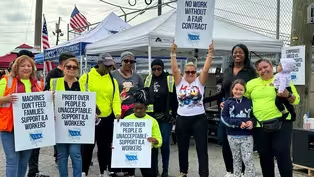
It is day three of the biggest pork strike in nearly half a century.
Tens of thousands of members of the international Longshoremen's Association are on the picket lines from Maine to Texas in -- including Elizabeth.
At least 45 container vessels that have been unable to unload their cargo are anchoring and deciding to wait it out in the hopes that both sides will come to an agreement soon.
No negotiations are scheduled between the union and their employer, the U.S. maritime alliance, but according to reports the port owners are under pressure from the White House to boost the pay or to strike a deal.
Workers are demanding higher wages and importantly a ban on the use of automation on the docks out of fear that it will eventually put an end to their jobs.
It is a common concern in labor fights that has led to other recent work stoppages in industries.
Brenda Flanagan takes a deeper look at what is driving this strike.
♪ [cheering] Brenda: Longshoreman walked and ran the picket lines around Port Newark, spirits high this morning.
>> no work!
Brenda: The strike sent panic shoppers to clear shelves of toilet paper.
They are spooked after the union threatened to cripple the supply chain unless port operators raise wages and promised job protection against wholesale automation.
>> We are going to accept technologies that allow the job to be safer and more efficient.
But we are never, ever going to support automation that displaces our workforce.
Robotics over people, hell no, we are never going to accept that.
Brenda: The union boss blamed foreign corporations from pushing fully automated terminals for profit at American expense.
The ILA is backed by its West Coast cousin which is not on strike.
but vowed not to process trips -- ships diverted to its ports.
>> Automation will not put food on your baby's table.
Automation is your enemy.
>> The fight is to save the jobs we have in the other approach is if jobs to need to be eliminated, how can we make sure the workers who are displaced are made whole?
Brenda: A records labor expert says port liberty also uses partially automated cranes to handle shipping containers.
The ILA's current contract allows some semi-automation with union permission.
But it stopped negotiating a new contract in June after Maersk and port Mobile installed Automatic Data Processing for trucks.
It has been dead set against fully operating cranes operating worldwide.
>> If you have a very big terminal and a lot of activity, ships are there all the time, you want to operate 24/7, automation is a more reliable, I would say strategy to them lament.
Brenda: One shipping expert explains the New York-New Jersey import market is booming, but it is constrained by a tight footprint that limits expansion by adding terminals.
So, how to stay competitive in a global marketplace where automation is common and ships keep getting bigger?
>> Something has to give.
You have to find ways to squeeze more productivity of what you have.
I have to improve the productivity of it.
Therefore, I start to consider and implement automation plans.
>> It creates pressure on the employers to say, if we wanted this technology, do we have to actually pay the workers more to use it?
And the ILA is essentially doing that, protect our jobs and pay us what we are worth.
Brenda: A Rutgers historian notes the move toward automation started with shipping containers.
An idea launched by Sealand in Newark.
Moving standardized containers instead of individual packages increased efficiency, but cost longshoreman thousands of jobs.
The union struck in 1977 and settled only after shippers agreed to compensate workers for jobs lost to automation.
>> Even in the mid-1960's, the ILA had begun winning language around job protection container funds that could go to the membership if they were facing cuts and layoffs.
Brenda: He says high-tech innovations lead to job actions across the nation including the writers strike in Hollywood over using AI.
>> If those changes are happening, all the benefits should go to the employer.
It should be shared with the workers.
That is always an underlying thing in these negotiations.
Brenda: The U.S. maritime alliance yesterday stated it want to ratify a new master contract that addresses all the critical issues.
We cannot agree to preconditions to return to bargaining, but we remain committed to bargaining in good faith.
The ILA hasn't budged.
[chanting] Brenda: I'm Brenda Flanagan.
NJ Spotlight News.
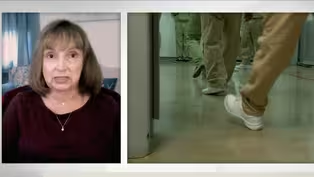
Briana: Donte Hatcher says during his 14 years behind bars, he was routinely locked in his cell for 23 hours a day, some days he was only allowed out for 30 minutes to get a shower.
He was released from prison almost a year ago and spoke with NJ Spotlight News on behalf of a new, scathing report issued by the watchdog group the NJ prison justice watch, which accuses the state Department of Corrections of violating laws around solitary confinement.
The group surveyed 65 incarcerated people and found the vast majority are getting far less than the legally required 4 hours a day outside their cells.
In fact, many said half an hour was the norm.
Research shows people in isolation deal with negative long-term consequences like PTSD, self-harm, and increased risk of suicide, even after they are released.
Inmates like Dante said conditions worsen rather than improved since Governor Murphy signed the updated law in 2019, describing solitary as inhumane and gruesome.
>> They are not prisoners.
They are not slaves.
They are people, they are human beings who have made a mistake in their life and they are suffering the consequences, understandably.
Nobody is perfect.
We have all done something wrong.
That don't give anybody else in this world the power to step on my neck because I made a mistake, the power to beat me just because you had a bad day.
That don't give you that right.
So in this report, we are not only asking them to end torture and solitary confinement, but we are asking them to take accountability.
The journey begins with one step.
This fight we are fighting is bigger than isolation.
This is only the beginning.
Briana: With us now is our senior writer who spoke with Donte for her reporting on the piece.
Good to see you.
Some very powerful thoughts from Donte.
What did he share with you personally about what it was like being confined to his cell?
Colleen: You know, he said that it made him feel less than human to not be able to go out, breathe fresh air.
To go out and take a shower every day.
And make a phone call to a loved one.
It felt totally isolating.
It felt like you were totally alone.
He makes a very strong case for why this should not continue to happen in prisons.
Briana: We know the report accuses the state of violating these policies, but what is the policy?
New Jersey has not put a ban on solitary confinement all out.
Colleen: So, and there is some dispute over this.
The isolated confinement restriction law, which was passed in 2019, says that a person must have at least four hours a day outside of a cell or if a person is being capped in a restrictive environment that that is for no more than 20 days in a row or 30 days in a two month period.
Now, the question comes over the language in the law and whether that applies to every person incarcerated or people in specific circumstances.
One of those is disciplinary circumstances.
The Department of Corrections used to have, in the old days, it was called solitary confinement.
Used to be called administrative segregation.
Now, they have things called restorative housing units, which are clearly used for disciplinary purposes, but the department is saying that the law does not apply to folks in those circumstances.
Briana: So I'm wondering, can two things be true at once?
That they had a different interpretation of the law and also that these inmates were being held in their cells for too long?
Can those things be held true at once?
Colleen: That is a great question.
If you want to look to an arbiter, the ombudsman's office, the corrections in Bud's men's office put out a report last year that said essentially the same thing, that it was only 4% of people that they surveyed were getting four hours out of cell.
And the ombudsman's office says that it believes that restorative housing units are used for disciplinary purposes, but they haven't gone so far as to say, the state is breaking the law.
It may wind up being something that has to be adjudicated in a court.
Briana: So what if any action might we see from the legislature at least?
Colleen: So, we are trying to get in touch with lawmakers who sponsor the law and ask them what they think about this.
You would think that a legislator who wrote a law would be unhappy if it is not being followed.
We are endeavoring to do that.
You know, the group is calling for legislative hearings on this.
There is a question as to the appetite in the Leq is -- legislature given just recently that both houses have passed a bill that would increase sanctions if you were to assault a police officer, particularly using bodily fluids, which is something that happens more and more often in prisons.
Briana: You mentioned the ombudsperson's report from last year.
There has been increasing scrutiny around the Department of Corrections.
Is there talk of more overhaul in general?
Colleen: That is something we are constantly hearing discussed at least from corrections officials from the ombudsman's office.
It seems like these things happen in baby steps.
There haven't been any whites -- widescale changes.
There have been a lot of changes at the women's prison.
A lot of the problems that have been identified in those reports are from the larger prisons, particularly New Jersey state prison, which as I understand it has an awful lot of people in the segregated, special units due to disciplinary issues.
Briana: All right, you can check out Colleen's full reporting at our website, njspotlightnews.org .
Thank you so much.
Colleen: Thanks very much.
Briana: The DOJ has arrested and charged two people working for a company hired by Newark to replace lead pipes, alleging they intentionally left lead service lines in the ground, conceal the fact from Newark, and defrauded the city by collecting payment for work they didn't perform.
In March of 2019, Newark announced plans to replace tens of thousands of lead service lines through the city after high levels of lead were found in drinking water.
Hiring contractors to do that work.
The complaint accuses Michael Sawyer and Latronia Sanders of defrauding the city by submitting false documents and pictures, making it appear they replaced the water lines when in fact they never did.
Both are charged by complaint with conspiracy to commit wire fraud and appeared in court today before a federal judge in Newark.
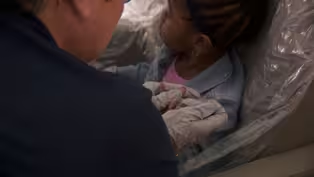
Meanwhile, in Camden, where lead has also been a problem, Virtua health is holding free screenings for kids to have their blood tested to see if lead levels are elevated in their systems.
It is an important program there since Camden's kids have alarmingly high levels of lead poisoning.
♪ >> Virtua's pediatric mobile services is using bubbles as a helpful strategy to test more than a dozen kids under the age of 64 six for lead lead levels.
>> Camden city, we test about 14% of the children have elevated lead levels.
That is considered to 2.5 children nationally.
>> the clinic is one of eight being held by Virtua health this month in an effort to help detect lead poisoning in children.
>> most doctors offices do not provide the lead screening.
They are given a script to go to a lab to get a blood draw.
A lot of families don't have the time to do that, may not have the financial means to do that, may not have the transportation.
But I think one of the main things is they don't understand why they need to do it.
They don't understand how devastating lead and elevated lead levels in the blood can be.
It is neurological, it can be irreversible neurological damage.
So, develop mental delays, speech and hearing issues, vision issues.
A lot of behavioral issues you see in children.
And then that leads to aggression, mental health status later in life.
>> We are going to play a bubble game.
>> This registered nurse has the important task of testing children for lead.
She says the process is as quick and easy as the results.
>> Do a tiny little prick in their finger, most of the time the kids do not feel it.
I run the specimen on the analyzer on the van and it takes three kids -- seconds for me to get that result.
All of our results are reported to the state daily.
There are lead levels made by the CDC and the state of New Jersey.
They want them to be under 3.3.
Our machine will detect anything over 3.3.
But over 5 is the level where we recommend they get the Venus draw.
We do this on kids six and under because that is when the brain is still growing and vulnerable for lead to interfere with that growth.
>> in addition to the free lead testing, Virtua pediatric mobile services offered health screenings and resources to raise awareness about lead exposure.
>> We are also offering dental screenings and that is because lead can affect the enamel growth on the teeth and a lot of children who have elevated lead levels have a lot of oral health issues, cavities, things like that.
We also have Saint Joseph's carpenters society, they do lead abatement in homes because it is very important for us to screen homes for lead, not just kids.
>> We have a majority of our homes built before 1978, where lead was outlawed.
A majority of our homes have lead in them.
Not only of the kids eating the paint, it is the lead dust.
That is the biggest issue.
You have all doors and windows opening and closing, the dust emits and then you are breathing it in.
>> According to new research published over the summer despite successful efforts to reduce lead exposure from praise -- places like lead paint and water pipes, the toxic metal can still be found in some consumer products.
Kate Porterfield, lead author of the study, found those consumer products may be the main source of lead exposure in some cases, especially those imported from other countries with more lax or even nonexistent laws around limiting lead levels.
>> We suspected a lot of these products are being handcarried through travel or the mail.
They might be purchased through online retailers like eBay and etsy.
For this reason, the U.S. regulations can't get to those products the way they could traditionally imported ones.
They are slipping through the cracks.
Raven: Emerson says the mobile lead testing will extend through the year to combat what she believes is a lead poisoning crisis in Camden.
For NJ Spotlight News, I'm Raven Santana.
Briana: In our spotlight on business report, as temperatures soared during the scorching summer, so did utility rates.
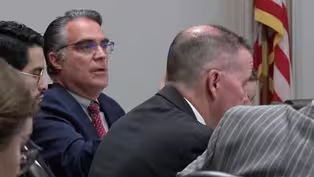
At a hearing in Trenton Wednesday, lawmakers tried to find out why, bringing in representatives from the major utility companies in the state to explain the rising costs and find solutions for burdened homeowners.
The big take away, the supply just can't meet the demand for electricity.
Ted reports on the big divide on how to meet these new power demands.
♪ >> It is safe to say that if we do nothing, we are going to pay the price.
>> If the state does nothing, that would be fair to say.
Ted: Millions of New Jerseyans have been paying the price this summer, mainly higher electric bills, which was the subject of an assembly hearing Wednesday.
>> Far too often, our office hears of examples where a senior will have to choose between putting food on the table, purchasing the medicine they need, or keeping their home at a comfortable temperature.
Ted: Experts from New Jersey's four main electric companies testified what drove prices this summer up.
They said there were multiple barriers including higher cost to produce.
>> We are in the midst of a transition and we are seeing a tightening of supply and an increase in demand and they are going in opposite directions and they are going in opposite directions fairly quickly.
>> We experience the hottest June on record.
>> There is a supply and demand Delta that is smaller.
The cost of energy has gone up and that had an impact on bills.
>> Everyone agreed not enough electricity is being produced.
Disagreement came from how that is being addressed.
Whether that is expanding renewable energy or the fossil fuels the state has begun to gradually phase out.
>> The governor and the BP you are striving to see that generation come from clean resources, not just renewable.
As the chairman mentioned, we have a nuclear generation fleet.
>> My constituents and yours cannot afford to continue down the Murphy administration's yellow brick road.
>> Do you believe that there is a right time to mandate that we have reached a certain threshold.
>> This is the time to act.
>> My fear is that we are not investing in the actual sources powering us right now, that are standing right now.
>> We need to strike the balance between affordable and renewable because those two are opposed.
>> Despite the sticker shock, it could always be worse and New Jerseyans are not alone in facing higher utility bills.
>> New Jersey's rate increase of 2.8% is lower than the national average over the same timeframe.
Especially when you compare it to those states in the Midwest and along the East Coast.
>> We did experience -- we didn't experience what Texas did during the winter a few years ago, where they had a complete blackout.
We did not experience rolling brownouts.
Ted: Congressman Jeff Van Drew is hosting a hearing of his own next week to investigate higher power bills across South Jersey.
He will gather experts in the field and elected officials next Tuesday.
In Trenton, Ted Goldberg, NJ Spotlight News.
Briana: That will do it for us tonight, but make sure you check out the latest episode of our off exit podcast.
Everson Milken introduces us to LeVar Scott, a 20-year-old rising skull in the NASCAR circuit.
Coming up through NASCAR's drive for diversity program.
Harrison got to spend a day with him at the monster mile racetrack.
You can download the latest episode wherever you listen.
I'm Briana Vannozzi.
For the entire team, thanks for being with us.
Have a great night.
We will see you right back here tomorrow.
♪ >> NJM insurance group, serving insurance needs of residents and businesses for more than 100 years.
Horizon Blue Cross Blue Shield of New Jersey.
Independent licensee of the Blue Cross Blue Shield.
And by the PSEG Foundation foundation.
♪

DOJ alleges fraud in Newark’s lead pipe replacement
Video has Closed Captions
Construction CEO and vendor arrested and charged with defrauding city (58s)
Free lead testing for children in Camden
Video has Closed Captions
Virtua Health plans free screenings throughout October (4m 36s)

Gaudreau family seeks to block release of accident records
Video has Closed Captions
Records include 911 calls, camera footage, autopsy reports and more (1m 10s)
NJ violates solitary confinement law, report says
Video has Closed Captions
Inmates say they aren’t allowed out of cells for mandatory four hours a day. (6m 32s)
Striking dockworkers: Automation will cost jobs
Video has Closed Captions
The strike has been suspended until Jan. 15 (5m 31s)
Why are NJ electric bills so high?
Video has Closed Captions
Lawmakers press energy experts for answers (3m 45s)
Providing Support for PBS.org
Learn Moreabout PBS online sponsorship
- News and Public Affairs

Top journalists deliver compelling original analysis of the hour's headlines.

- News and Public Affairs

FRONTLINE is investigative journalism that questions, explains and changes our world.












Support for PBS provided by:
NJ Spotlight News is a local public television program presented by THIRTEEN PBS