NJ Spotlight News
NJ Spotlight News: October 4, 2024
10/4/2024 | 26m 46sVideo has Closed Captions
Watch as the NJ Spotlight News team breaks down today’s top stories.
We bring you what’s relevant and important in New Jersey news and our insight. Watch as the NJ Spotlight News team breaks down today’s top stories.
Problems playing video? | Closed Captioning Feedback
Problems playing video? | Closed Captioning Feedback
NJ Spotlight News is a local public television program presented by THIRTEEN PBS
NJ Spotlight News
NJ Spotlight News: October 4, 2024
10/4/2024 | 26m 46sVideo has Closed Captions
We bring you what’s relevant and important in New Jersey news and our insight. Watch as the NJ Spotlight News team breaks down today’s top stories.
Problems playing video? | Closed Captioning Feedback
How to Watch NJ Spotlight News
NJ Spotlight News is available to stream on pbs.org and the free PBS App, available on iPhone, Apple TV, Android TV, Android smartphones, Amazon Fire TV, Amazon Fire Tablet, Roku, Samsung Smart TV, and Vizio.
Providing Support for PBS.org
Learn Moreabout PBS online sponsorship>> Funding for NJ spotlight news provided by members of the New Jersey education Association, making public schools great for every child.
RWJ Barnabas health.
Let's be healthy together.
And New Jersey realtors.
The voice of real estate for New Jersey.
More information is online at njrealtor.com.
>> Tonight on NJ spotlight news, the strike is suspended.
Longshoremen in Newark are back to work and ports up and down the coast are open after a tentative deal is struck.
>> Since the agreement was reached last night, it has been all hands on deck to reopen the port and restart the flow of cargo.
>> Plus, fire fighters in LBI are trying to bring relief to flood ravaged towns in North Carolina.
>> We experienced Sandy and afterwards people from all over the place brought us supplies for relief.
Now with this devastation in the Carolinas and Florida it was our time to do the same.
>> And a deeper dive into the consent decree to better protect residents in veterans homes.
>> There are a lot of things that need to happen and we hope they don't just put Band-Aids on those and go back to the judge a year from now and say can we come off the consent decree.
Anchor: And fighting for marriage equality.
A new documentary features a new Jersey couple with disabilities who desperately want to get married, but can't.
>> If I were to get legally married my benefits would be cut and I'm already struggling, having to live on a fixed income.
Even though I work two jobs.
Anchor: "NJ Spotlight News" begins right now.
♪ >> From NJPBS Studios, this is "NJ Spotlight News" with Briana Vannozzi.
Briana: Good evening and thanks for joining us this Friday night.
I am Briana Vannozzi.
We begin with a few key stories we are following.
First, the historic port strike that threatened to upend the economy has been suspended and dockworkers are back on the job.
The International Longshoremen's Association reached a tentative agreement late Thursday night with port owners on higher wages, extending their existing contract through January 15, giving both sides more time to negotiate the contract.
According to reports, the tentative deal includes pay hikes by 62% over the next six years, or about four dollars per hour more for each year of the deal.
It's unclear if both sides resolved differences between automation at the ports.
A real sticking point in the work stoppage.
Our senior correspondent will have more on that later in the show.
Also tonight, Millville is the latest town to punish the homeless for sleeping outside.
The city's board of commissioners approved an ordinance this week banning anyone from sleeping in public spaces like on streets or sidewalks, but also outside businesses or government buildings.
Members of the board say the decision was driven by an increase in homelessness through the city.
Those caught will be slapped with a $500 fine for the first offense.
After that, they could be hit with tickets up to $2000 and even jail time.
This comes after a recent Supreme Court decision cleared the way for a town in Oregon to find people sleeping outside as a way to manage homeless encampments that sprang up.
At least three other towns in South Jersey have followed suit , but critics say it is an inhumane way to address the issue, adding yet another barrier for people already struggling to get back on their feet.
Down the shore, volunteer firefighters in Surf City have launched a donation drive to collect and deliver relief supplies to Western North Carolina, where communities remain devastated in the wake of Hurricane Helene.
Power and cell service in the area has slowly been restored in recent days, allowing the full scope of destruction to become clear.
Many communities remain without running water and are cut off after scores of mountain roads were washed away.
The Surf City firefighters are collecting items like first aid supplies, toiletries and pet food through Sunday or until their container is full.
Then private planes from the Jersey aero club will fly the supplies to North Carolina.
The volunteers say it is their chance to give back after so many people helped that community following Superstorm Sandy.
>> 12 years ago at the end of this month we experienced Sandy and in the days afterwards, people from all over the place brought us supplies for relief and now with the devastation in the Carolinas and Florida, it was our turn to do the same.
We organized a collection and put the word out on social media and invited people to make donations.
Briana: As we reported at the top of the show, tens of thousands of union dockworkers are back at work today, getting terminals up and down the coast, including those in Newark and Elizabeth, at operational status.
The strike was short-lived, three days, but the threat it carried to the economy and supply chain loomed large.
Thursday afternoon, more than 45 container ships were backed up at major U.S. ports, but as experts point out, the tentative agreement still needs to be ratified by union membership, otherwise we could be right back in this position come next year.
Senior correspondent Joanna Gagis has the latest.
>> Three days of picketing and nearly four days of ships sitting idle at the docks, so ends the biggest longshoreman straight in nearly 50 years.
>> The two sides came to a tentative agreement that is essentially halfway between what the employers had been offering previously and with the union had been demanding previously.
>> The International Longshoremen's Association was demanding a 77% raise over a six-year term.
Their employer had come up to 50% just before the strike.
Their Middle Point, 61.5% over six years.
The two released a joint statement saying they reached a tentative agreement on wages and have agreed to extend the master contract until January 2025 to negotiate other outstanding issues.
>> The big one being the automation which the union fears will threaten a lot of jobs of members.
Employers agreed to keep talking about that issue, so that is still open to negotiation.
Reporter: As this played out, economists worried this would up end global supply chains.
Yesterday, Senior Biden officials intervened, calling a meeting with shipping lines, urging the ports needed to reopen especially with Hurricane Helene recovery efforts.
The acting Labor Secretary came to New Jersey to meet with union leaders.
President Biden saying he believes in collective bargaining, releasing a statement saying it works and is critical to building a stronger economy from the middle out and bottom up.
>> Certainly I have to praise the administration for getting them to talk to each other again.
That was a big win, I have to give them that.
But they still ended up, if they been talking, it would have been happening anyway.
Reporter: He says you can't ignore the timing of the intervention with an election just five weeks away.
>> I question how they did this where they basically took sides.
That was potentially political too.
You want union votes.
That particular tactic isn't something I would have done, but at the end of the day if the result justified the means, they did a good job.
Reporter: Because the strike result in a week, it is not likely it will have an impact on inflation but it will take about two weeks to dig out of the backlog of shipments along the east end Gulf Coasts.
>> Since the agreement was agreed to last night, it's been all hands on deck to restart the flow of cargo.
Reporter: The Port Authority of New York and New Jersey had a virtual press briefing today talking about how they will reduce the backlog and likely beat analyst projections for how long it takes to get through them.
>> The cargo operations, and in the case of container traffic, reloading export containers on to the ships, it will begin tonight at 7:00 p.m. and work around the clock as is usual on the vessel side of the terminals.
Following the discharge of the cargo, two of our terminals will open over the weekend for truck activity, meaning the ability to deliver the cargo out of the gates to warehouses and distribution centers.
The remaining terminals will open Monday morning at 6:00 a.m. Reporter: While systems begin moving again, union delegates will now have to go back to members to present the wage offer for a vote and they now have 90 days to negotiate the automation piece.
>> Given the way these negotiations have played out, do you think it will be another struggle in terms of how they negotiate the remainder of the automation piece?
>> I do believe it will still be a long and bumpy road over this issue.
Reporter: He says they should look to West Coast port agreements that have struck a middle ground on automation.
>> The West Coast agreed to a level of automation.
By the way, some of the East Coast ports have automation.
The truth is, in the port of L.A. and Port of Long Beach where they've done that, there are now more ILA workers than there have been at the time.
There has been retraining, re-functioning, and I think that's the model the East and Gulf Coast ILA should look at because it works well.
Reporter: Given what we've seen on the picket lines this week, that idea is not popular with these union workers.
Whether they end up reaching some middle ground remains to be seen but it is possible we could see another strike at the ports a few months from now.
I am Joanna Gagis.
Briana: In what was a highly anticipated move, the federal government this week filed a civil lawsuit against New Jersey over the poor conditions at state run veterans homes.
That is where hundreds of residents died during the COVID-19 pandemic.
At the same time, state officials agreed to enter a federal consent decree, calling for a third party to monitor conditions at the veterans homes.
Senior correspondent Brenda Flanagan reports on what is in the consent decree and what if anything will change.
>> My father was very proud of his service in the Army and our veterans did not get the care they deserved at Menlo Park.
Reporter: It's personal for Regina.
Both her dad and mother died at the Menlo Park veterans home during the pandemic.
Here in Paramus, more than 200 residents died, and in scathing reports federal investigators cited ongoing mismanagement and lack of proper medical care, leading to this week's legal agreement to correct multiple failures.
>> Such deficiencies expose residents to uncontrolled, serious and deadly infections and resulted in the veterans homes suffering among the highest number of resident deaths of all similarly sized facilities in the region.
Reporter: The Department of Justice sued the state over institutions that claim claimed violated veterans rights, and New Jersey agreed to a consent decree to avoid litigation.
It is a bittersweet moment for families and veterans advocates, who have demanded improvements.
>> I'm very glad the Department of Justice confirmed what the families already knew.
There's no question their constitutional rights to safety were violated.
My parents didn't deserve to die alone either and that was a major factor.
Reporter: Under the consent decree, New Jersey must address major problems at the veterans homes, including poor infection control, defective clinical care and lack of competent management and oversight.
The state also agreed to an independent monitor.
>> The consent decree, which still must be approved by the court, details the steps the state will take to ensure the veterans homes meet the accepted standards of clinical care, and provide competent leadership and accountability for the veterans homes.
>> There's no vindication at all because we still lost over 200 brothers and sisters that were living in homes.
We are not looking for any type of vindication.
Reporter: This veterans advocate welcomes the consent decree but says the veterans homes need more funding, more staff, better training and their own state advocate.
>> A lot of things need to happen.
We hope they will not just put Band-Aids on those and then go to the judge a year from now and say can we come off the consent decree.
There needs to be changes that are sticking that are policy and culture.
Reporter: Governor Murphy commented, with this consent decree, we can resolve past differences with the Department of Justice and focus on our efforts providing the best possible care to veterans home residents.
While state military officials overseeing these facilities have resigned, Republicans want a housecleaning.
>> If the governor was a real leader, he would put people in these organizations that would challenge him and be truthful about what they need in order to provide the best services for veterans.
That's not what he has right now.
He has a bunch of yes people that says whatever they want to give him as a budget is OK and it's obviously not.
Reporter: This State Senator says the veterans homes have improved but he welcomed an independent monitor, noting the culture of caring for people is extraordinary but the challenges is the administrative side.
The monitor should be in place for two to three years to make sure it does happen.
We need to fix it to make sure we get this right.
He says a bill to create a New Jersey veterans advocate is slated for committee hearings within a month.
He is still working on a bill to create a new Department of Veterans Affairs.
Some are still skeptical.
>> It has already been four years and I don't think there's been enough improvement but maybe with someone else in charge or directly overseeing the care, things might change.
Reporter: She says it's what veterans deserve.
I'm Brenda Flanagan.
NJ spotlight news.
>> Support for the medical report is provided by horizon Blue Cross Blue Shield of New Jersey, an independent licensee of the Blue Cross Blue Shield Association.
Anchor: Finally, two New Jersey residents are stars of a new Hulu documentary raising awareness about the next frontier in marriage equality.
Patrice the movie tells the story about a loving couple that also happened to be disabled.
They desperately want to get married, but doing so or even just living together would mean losing disability benefits.
The very lifeline that enables them to survive.
It's a beautifully told story that gets at the heart of one of the many injustices people with disabilities face in our society.
Now they are speaking out.
I spoke with the director and star herself, Patrice.
Patrice and Ted, it is an honor to get to talk to you both.
This film is so beautifully told.
Patrice, you meet the love of your life, Gary, really chronicle what it takes it for you to get your home, your job, find this love, and you are not able to get legally married.
Why?
Patrice: Because the way the laws are written and I get on Social Security and Medicaid and Medicare, if I were to get legally married, my benefits would be cut.
I am already struggling, having to live on a fixed income even though I work two jobs.
I am restricted from the amount of money I am allowed to make and now I meet the love of my life and we want to spend the rest of our lives together and you get hit with another burden if you lose your benefits.
I would not be able to afford my medicines or anything.
Briana: It's a very fragile way to live.
Not only can you not get married, you can't live together or make it appear you live together?
Patrice: Right, because they can still consider it holding out and they can still cut your benefits.
Briana: What I love, Ted, about the way the documentary shines through, and this is a testament to you, Patrice, that you tell this story with a positive spirit.
Ted, you went to great lengths to make sure you shed light on the fact that we are living in a system and infrastructure that has barriers and is not created with disabled folks in mind.
Why was it so important for you to film this documentary in that way and to tell Patrice's story?
Ted: That's 100% true.
The system we live in was not set up for disabled people and telling the story was crucial.
25% of our country is disabled.
There are a lot of people left out of our system the way it is set up.
We told the story the way we did with the tone that we did primarily because of Patrice and just following her lead.
Patrice has a tendency, she can tell you a story about something that could be really dark or difficult and she will always find a way to interject humor and joy no matter how serious the topic.
We wanted to make sure the film had her voice and style as much as possible.
We were just following her example.
Briana: Patrice, was it nerve-racking to share this much of your life now with the world and your personal life?
There is some really poignant moments, like when you and your friend are sifting through to find aluminum cans to try to get some money together so you can pay for repairs on your wheelchair accessible van.
We see so much of your life in this.
Why was it important for you to allow the cameras to see all of it?
Patrice: Because I wanted people to see how real people with disabilities have to struggle.
Because a lot of folks still don't understand what disabled people go through on a daily basis.
Or they think there is something you could be doing but you're not putting the effort into it.
Briana: It's clear that you and Gary, your boyfriend, are putting a ton of effort into it.
Was there an outcome or goal in mind?
We've seen some responses from the Social Security administration already that it is up to Congress to change these rules.
What was your intent going into this?
Ted: At the least we wanted to shine a light on the systemic failings that disabled people have to battle with every day in just about every aspect of their lives.
We also are really hopeful that if we can bring attention to these issues, that change can happen.
A lot of the advocates working on these issues many years and trying to change the laws keep telling us the biggest barrier they run into is it simply not a priority.
Marriage equality for the disabled is not a priority, raising asset limits for disabled people is not a priority.
But legislation has been written and it is sitting around waiting for a vote.
If we can use this story and platform to get the conversation out there and bring attention to the issue, we are really hopeful change can actually happen and happen soon.
Briana: Patrice, it is not even just that your benefits would be cut if you get married, you also have limits on how much you can keep in your bank account to just a couple thousand dollars.
You cannot have your wedding and so you go to have a commitment ceremony.
As I mentioned, your van breaks down and now you cannot even have that, it's like insult to injury, so maddening to watch as a viewer.
Take me through what that felt like in that moment.
Because you didn't give up despite all that.
Patrice: I know at that time for me, it was very overwhelming and depressing and even to get a new er used accessible van, they go for as much as $50,000, $65,000.
I've seen a brand-new one for as much as $82,000.
People with disabilities don't have that kind of money to pay for things like this.
It is medical equipment.
But that is not the point.
I don't know what they expect people like me to do when we are restricted from what we are allowed to have.
Briana: I will clarify, people with disabilities, the government doesn't allow them to have that type of money.
Patrice, is there a message you want folks to know as they watch this documentary?
And I know they will.
Patrice: I want folks to watch the movie and find out who your legislators are and write a letter to get them to repeal the marriage limit and raise the asset limit to help people like myself gain the level of independence we need so that also with the asset limits being the way they are, you still have to rely on fundraising and family members to help you.
A lot of us, we don't want a handout, just want a helping hand.
Briana: Patrice and Ted, thank you so much.
Your star is shining, your friendship of 20 years seems only stronger now, so thank you for sharing this beautiful work with us.
Patrice: You're welcome.
Ted: Thank you for having us.
Anchor: Before we leave you, we continue dropping episodes of NJ Decides 23 for election exchange podcast.
All House seats are up for grabs and 1 senate seat is on the line.
This is a chance to meet the candidates and hear why they think they deserve your vote.
Today's episode features a conversation with the Republican candidate for Congress in District one, facing a long time incumbent Democratic congressman.
Here is a preview.
>> I think people are looking for something different.
Norcross has been in office 10 years, five two-year terms, and I believe people are looking for a public servant who cares about people, number one, number two, who wants to make a difference in their lives, and number three, who will demonstrate service in a selfless way.
That's what I bring to the table.
I'm someone who has served my country, I went to West Point, as you said, after that, graduated in 1990 and served as an officer in the Army for six years.
Briana: You can check it out by downloading the NJ decides election exchange podcast.
That will do it for us this week.
For the entire team at NJ spotlight news, thank you for being with us.
Have a great weekend and we will see you back here on Monday.
>> NJM insurance group, Serving the insurance needs of residents and businesses for more than 100 years.
Horizon Blue Cross Blue Shield of New Jersey, an independent licensee of the Blue Cross and Blue Shield Association.
And by the PSEG foundation.
>> Life is unpredictable.
Health insurance shouldn't be.
For over 90 years, horizon Blue Cross and Blue Shield of New Jersey has provided quality health care to New Jersey residents.
We've served generations of New Jersey families and businesses and are committed to innovations that put you at the heart of everything we do.
Our members are our neighbors, friends and families.
We are here when you need us most.
Horizon, proud to be New Jersey.
>> Our future relies on more than clean energy.
Our future relies on empowered communities, the health and safety of families and neighbors, of our schools and streets.
The PSEG foundation is committed to sustainability, equity, and economic empowerment.
Investing in parks, helping towns go green, supporting civic centers, scholarships, and workforce development that strengthens our community.
♪
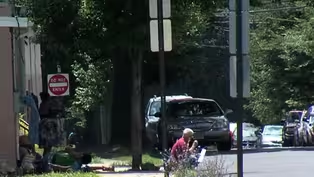
Another NJ town targets homeless with sleeping ban
Video has Closed Captions
Millville makes it illegal to sleep in public places. First offense is a $500 fine (1m 2s)

Hulu film shows NJ couple in new fight for marriage equality
Video has Closed Captions
Disabled couples cannot get married, or live together without loosing benefits (8m 37s)

Longshoreman suspend strike, reach tentative agreement
Video has Closed Captions
ILA and the USMX have 90 days to find a middle ground on automation (5m 31s)

NJ veterans' families wary of new oversight
Video has Closed Captions
To avoid federal lawsuit, state agrees to correct problems at troubled nursing homes (4m 57s)
Providing Support for PBS.org
Learn Moreabout PBS online sponsorship
- News and Public Affairs

Top journalists deliver compelling original analysis of the hour's headlines.

- News and Public Affairs

FRONTLINE is investigative journalism that questions, explains and changes our world.












Support for PBS provided by:
NJ Spotlight News is a local public television program presented by THIRTEEN PBS