NJ Spotlight News
NJ Spotlight News: September 27, 2024
9/27/2024 | 26m 46sVideo has Closed Captions
Watch as the NJ Spotlight News team breaks down today’s top stories.
We bring you what’s relevant and important in New Jersey news and our insight. Watch as the NJ Spotlight News team breaks down today’s top stories.
Problems playing video? | Closed Captioning Feedback
Problems playing video? | Closed Captioning Feedback
NJ Spotlight News is a local public television program presented by THIRTEEN PBS
NJ Spotlight News
NJ Spotlight News: September 27, 2024
9/27/2024 | 26m 46sVideo has Closed Captions
We bring you what’s relevant and important in New Jersey news and our insight. Watch as the NJ Spotlight News team breaks down today’s top stories.
Problems playing video? | Closed Captioning Feedback
How to Watch NJ Spotlight News
NJ Spotlight News is available to stream on pbs.org and the free PBS App, available on iPhone, Apple TV, Android TV, Android smartphones, Amazon Fire TV, Amazon Fire Tablet, Roku, Samsung Smart TV, and Vizio.
Providing Support for PBS.org
Learn Moreabout PBS online sponsorshipANNOUNCER: Major funding for NJ Spotlight News is permitted in part by NJM Insurance Group.
serving the insurance needs of residents and businesses for more than 100 years.
Horizon Blue Cross Blue shield of New Jersey.
An independent licensee of the Blue Cross and Blue Shield Association.
And, by the PSEG foundation.
Briana: Tonight on NJ Spotlight News, the state is accusing a major hospital system in South Jersey of discriminating against pregnant patients.
Plus, Mayor Eric Adams is the first sitting New York mayor to be indicted for corruption.
Unfortunately, that is not the case here in New Jersey.
>> usually starts out small with a lot of corruption.
Starts with small donations are small bribes, and it just seems that there is this lack of vigilance.
Briana: Also, free Naloxone.
The opioid overdose saving measure, can now be found in your child's school.
>> We believe we have a duty of care.
And this opioid antidote is nothing different in our eyes than a student who has an allergic reaction and needs an epipen.
Briana: And, as inflation strains people's pocketbooks, making sure families in need have a basic necessity -- diapers for their kids.
>> these items are a basic need to keep babies healthy and clean , but they are also very expensive.
BRIANA: "NJ Spotlight News" begins right now.
♪ ANNOUNCER: From NJPBS Studios, this is "NJ Spotlight News" with Briana Vannozzi.
Briana: Good evening and thanks for joining us this Friday.
I am Briana Vannozzi.
We begin with a few key stories we are following.
First, the state is suing one of South Jersey's major hospital systems.
Attorney General Matt Plotkin is accusing the system of discriminating against pregnant patients by routinely drug testing them without their consent from that to the complaint, virtua has-been sickly drug testing of all patients admitted to the liver and delivery units is 2018.
But they didn't subject and the other patients admitted to hospitals in East Camden, and Mount Holly to those same screenings.
Two women cited in the lawsuit reported eating poppy seed bagels the morning of their hospital visits, prompting false-positives on their drug tests, causing them to be reported to the division of child protection with-month long investigations into them for child abuse.
The lawsuit alleges Virtua violated the New Jersey Law against discrimination, also known as LAD.
A spokesperson told NJ Spotlight News in a statement, we hold the safety and well-being of each patient per.
For more on this, check out Lilo Stanton's reporting on NJSpotlightNews.org.
Also tonight, free COVID tests are back just in time for a cold, flu and now Coronavirus season.
From now till the end of the year, each household conforto four free COVID tests for the government by online to CovidTests.Gov, or by calling a toll-free number on the website.
According to the CDC, hospitalizations from the virus are on a down swing across the U.S. after spiking early in September, but public health experts are still anticipating an uptick this winter.
The Department of Health and Human Services says the tests work against the newest variants , and detect infection roughly 80% of the time.
Scientists say it is rare to get a false positive.
If you get a test that says you have Covid, you can be pretty confident.
You do the FDA has extended expiration dates for many at-home tests so check the number before you toss the old kit.
Indented New York City Mayor Eric Adams appeared in court today for the first time since being hit with federal bribery and fraud charges, pleading not guilty to allegations he took more than $100,000 in illegal gifts in exchange for using his political influence to help Turkish nationals.
The arraignment lasted less than 20 minutes, but the charges could land him in prison for a long time if convicted.
He is accused of bribery, conspiracy, fraud and soliciting illegal foreign campaign donations, then taking public-matching funds he got a hotel states and deeply discounted airline tickets to places like China, France, India and Turkey.
His defense attorney filed a motion to dismiss next week and maintain his client's innocence.
Adams in the first sitting mayor of New York to set foot in the courtroom as a criminal defendant.
That's not the case on the side of the river.
For more on that, I am joined by Bergen record political columnist Charlie Stein.
Good to talk to you.
We have a litany that we could go through of elected officials who have been charged, convicted with public corruption schemes.
Props to your power at the record, David Zimmer, who actually put together a list.
But who comes to mind when you talk about sitting public officials who have been indicted, charged, and convicted?
Guest: Oh, I think the most obvious example is the Menendez case, receiving bribes from Egyptian officials to influence a whole litany of needs they had in Washington.
I think that tracks along for a similar path from the Adams case where he was receiving money and all kinds of lavish gifts from the Turkish government.
New Jersey's long, tortured history of corruption is usually more localized.
It's all about kickbacks from contractors, and, you know, politicians stuffing money into their own bank accounts for their own self-aggrandizement.
But the one that really makes this case stand out is the foreign influence.
Briana: But if you look at it, there almost a formula.
Look at Jersey City, or Paterson, the Joey Torres's, pick almost any major city in New Jersey and there's almost this formula of kickbacks, charges, prison.
What's at the root of this?
These folks have a tremendous amount of power.
Why risk it for something like this?
Guest: I think it is because they feel that they are in a culture that, they see it there's a lot of their colleagues over the years have gotten away with it and they don't feel the scrutiny is really -- it usually starts out small and a lot of corruption.
Starts out with small donations or small bribes.
And it just seems that there is this lack of vigilance, particularly in urban areas, where the whole systems are broken down.
The media is in there in the good way that it used to be.
And the local community vigilance is not really there as well.
And even though those cities are broken down and their infrastructure is collapsing and the economy is falling apart, Et cetera, there is still a large public needs to be done.
Briana: But why, Charlie, why does New Jersey have such a rich history of these troubled mayors and elected officials?
It's not unique to here.
but we have a real rich history of it.
Guest: I think that good thing is that we have so many municipalities and so much money to be made in these municipalities.
And I think the laws are structured in such a way that there is a lot of -- how should we call it, sort of "institutionalized bribery" to get a lot of those contracts.
But there's so much money and so much competition for all of those municipalities, that it is just going to breed more opportunity.
Briana: Charlie Stile to us.
Good to talk to you.
Guest: You're more than welcome.
Briana: Tonight, we are taking a deeper dive into public health efforts to address the opioid crisis.
Starting this month, every New Jersey School District will have access to the overdose reversal drug Naloxone, for free, from the Department of Human Services' Naloxone direct program.
Certified nurses will be responsible for storing, and if need be, administering the drug.
It's all part of a larger plan to get the life-saving antidote into more hands.
And it comes after a 12-year-old student in South Jersey died in 2022 after unintentionally being exposed to Fentanyl.
Raven Santana reports on how the program works and which districts are already looking to take advantage.
>> we have had to use the Naloxone boxes three times here at this high school.
Reporter: the superintendent for the Black horse Pike regional district, he has remained transparent about how the opioid crisis is impacting students in and around the district.
>> Our neighboring school district had an unfortunate occurrence on the school bus of a 12-year-old who accidentally ingested Fentanyl through opioid use.
Reporter: That student died from an accidental overdose in 2022, and the tragic event prompted the district to start equipping schools with the overdose -reversal medication, Narcan, also known as Naloxone.
He proudly showed off one of the boxes at the Highland regional high schools.
This little red box can be opened with a key or a small hammer to break the plastic protective cover.
He became the Superintendent to first endorse the naloxone box program in all schools and buses.
In addition to the high school that this verse says has been life-saving.
>> we have a large population.
I think every high school does now, of kids who use vapes, edibles are really big right now also.
These students don't know sometimes where they are getting things from, and we don't know if these things are laced with something that could potentially cause them to overdose and need a dose of Narcan.
>> we believe we have a duty of care.
In this opioid antidote -- and this opioid antidote is nothing different in our eyes than a student who has an allergic reaction and needs an EpiPen.
Four who has an asthmatic attack and needs an inhaler.
Reporter: he is optimistic that the life-saving drug will become even more widely available now that all districts can be provided with the nasal spray free of charge through the Department of Human Services at Pacific Naloxone direct program.
>> we are making available 4-milligrams sprays, two doses, in the package.
It is in for medication.
So it is easy to use, and administer.
And it literally saves individuals' lives.
Reporter: she is the deputy commissioner for health services for the New Jersey Department of Human Services.
She says school districts just need to submit a simple form to their county office with the request for the drug, and can do so by accessing the agency's naloxone direct portal.
>>'s 2018 -- since 2000 Governor Murphy signed a law that requires schools to make Naloxone available, including in charter schools, and now we are providing a streamlined way for them to access it without any cost to them.
>> I have been working in the field for just shy of 15 years.
I am the person in long-term recovery from an opioid use disorder which started when I was in high school.
Reporter: she is the chief executive Professor of "prevention links," a nonprofit organization that works with communities to prevent addiction and support recovery.
Thompson says even though naloxone is a safe and effective way to save someone's life, she says folks are still not on board.
>> People still don't really want to be associated with it.
Like, ok, that sounds like a good idea for those who need it.
I am not against it but at I don't necessarily feel like I need to be the one to carry it.
I have had that experience at community events handing out Naloxone for free.
People will kind of say, oh, no, that is not for me.
And we have a conversation about well, we are at a baseball game, what if you walk into the bathroom and find that someone's overdosed?
Wouldn't you want to be able to administer this nasal spray and save their life if that were an option?
And still, folks sometimes are very uncomfortable.
>> we want to continue to drive those numbers down.
And in order to do so, one of the many strategies being enlisted here in New Jersey is making sure Naloxone is in the hands of everyone.
Reporter: school district has a she says the FAA school district has a -- she says it's a school district has a question about ordering naloxone kits or would like to place an order, they should contact their county office of education.
Raven Santana, NJ Spotlight News.
Briana: Thanks to new research from Rutgers scientists have , pinpointed the most likely sources for children who are exposed to opioids.
The most common substances contributing to fatal poisonings among kids under the age of 5.
It turns out a grandparent's pill organizer, the family dogs pain medication, even discarded tissues, are among the way young ones get their hands on the potentially lethal drug.
Dr. Howard is a medical toxicologist at the New Jersey Poison Control Center who led the study at Rutgers New Jersey medical school, studying exposure in babies as young as one month after six years old.
He drives me to share what they found.
Doctor, good to talk to you.
When we are talking about the youngest among us, how do these accidental exposures typically occur in the household setting?
Guest: I think the safety is the key concern here, and people are often not thinking about medications that they take as being a risk to others, particularly children and small adults.
Soak in our study, one of the things that we found was that while parents were often the source of the medication that child was exposed to, grandparents also contributed significantly, and that is often because they are in an environment where they live by themselves.
They don't typically think that anyone could be exposed to their medications.
And they often may leave them out.
Briana: Right, they may not be as vigilant as say, a parent would be when there's a toddler running around.
But it was interesting in the report, that even just residue on a tissue could become dangerous.
What is the difference between the toxicity of opioids in small children versus an adult?
Guest: So, a child being much smaller and also typically, a child that is not a patient that would be exposed to an opioid.
Smaller person, a dose meant for an adult, they have the risk of greater impact and effect.
More toxicity.
And they are also generally naïve to the medication and so they often will have a more significant clinical impact.
Briana: How effective our current public health campaigns in sort of raising awareness about just how dangerous this can be, and what are some solutions that you and your team might recommend?
Guest: I think the public education is good.
I think that we always have room for growth and to do better, and to more broadly disseminate the information.
Medication safety is a very important thing not only for children, but for adults, as well, so making sure that they remain in the bottles they were originally prescribed in, putting them away so there are places children cannot access them.
And particularly for the opioids , the importance of having no available as a reversal agent or a child to be exposed, or an adult.
BRIANA: I wonder then, it may be in your purview, would it make sense that if someone is prescribed as opioid, they also have easier access to Naloxone to keep in their home?
Guest: Absolutely.
One of the things that people have been recommending for years now is co-prescription of Naloxone within a.
Prescription.
There are many efforts to make Naloxone availability more broad .
In New Jersey, you can go into almost any pharmacy and request Naloxone without a prescription.
And often for a low or no fee.
Briana: Yeah, we are seeing it being distributed in schools, given the prevalence of this, what is your take on that?
And its availability for school districts.
Guest: This is a public health issue.
It is not meant to stigmatize any group.
Naloxone saves lives.
And it should be available as broadly as something like an automated external defibrillator is available.
So this is something that is an intervention that can help someone survive an overdose, and really should just be carried by everybody, if possible.
Briana: Yeah, that is a comparison I have seen be made more frequently.
Dr. Howard Greller, thank you so much for your time.
Guest: my pleasure.
Thank you.
ANNOUNCER: Support for the medical report is provided by Horizon Blue Cross Blue Shield of New Jersey.
An independent licensee of the Blue Cross Blue Shield association.
♪ Briana: In our spotlight on business report tonight, some 25,000 dock workers from Maine to Texas are preparing to strike , in a shut that could disrupt supply chains and raise prices on certain goods.
Longshoremen at ports along the East and Gulf Coast, including right here in Newark for the off the job on Tuesday morning.
Negotiations for a new contract between the international Longshoremen's Association, the ILA, and their employer, the U.S. maritime alliance, has stalled.
Both sides have an October 1st deadline to reach a new contract.
Specifics of the contract negotiations aren't public, but the ILA is reportedly asking for significant wage increases over 60 years, and more regulations around automation in the industry.
On Thursday the group representing the ports filed an unfair labor practice charge to make the longshoremen's union come back to the bargaining table.
This records expert on labor says it means that employers' backs are up against the wall.
Guest: what that signals really is the employers are fearful that a strike will actually happen on October 1, so they are looking at creative ways to bring the unions back to the table.
But for the units to come back to the table, they will need to see the employers making some movement in their counter proposals.
Which is why they haven't come to the table in sometime.
BRIANA: finally tonight, here is a statistic that will make you pause.
Nearly half of families with young children in the U.S. can't afford diapers to keep their babies clean, dry and healthy.
What is worse, food stamp programs like NJ S.N.A.P.
can be used by low-income families to pay for them.
Places like the Salvation Army in Trenton are stepping up efforts with a year-long diaper pantry distribution for local families to fill the gaps where parents can't.
Correspondent Joanna Gagis has a look at how advocates are trying to come back this public health crisis.
>> diapers are very expensive and it would be very hard for me to adjust my economic situation to be able to invite her diapers for my child.
Reporter: Iris Bautista is a mom of four young kids whose family lives on her spouses income.
By the end of the month, after paying rent and other bills, she is left with little to no money for groceries or diapers for her five month old.
>> it helps me a lot could have diapers available for my baby.
The Salvation Army has been helping me on a monthly basis with a supply of diapers to keep my baby healthy and happy, and also it helps me economically, as well.
Reporter: that is because while the cost of just about everything has gone out, diapers are no exception, and babies can use anywhere from 5:00 to 12:00 -- 5-12 diapers a day on average, depending on their age.
>> These items are a basic need to keep babies healthy and clean .
But they are also very expensive.
Buying diapers, wipes, formula, it adds up.
And families will need to choose whether they keep their babies clean, or whether they need to buy food, or whether they pay next month's rent.
It is not critical.
Reporter: diapers are one of those things that, I think people don't think about it when they think about food insecurity, but they often go hand-in-hand, right, so a person who needs It's that critical.
To drop off Diapers are one of their children in child care without those Diapers are one of clean diapers, they can't drop off their child and go to work.
It's a cyclical thing.
Without those items, we see that cycle of food insecurity just keep repeating itself.
Reporter: During this national diaper need awareness week, organizations like the community Food Bank of New Jersey, and the Salvation Army, ask those who want to help to remember the need for these basic care items because they are not covered by federally funded public assistance programs like S.N.A.P.
or W.I.C., which is alarming when you consider the need.
>> nearly one in two families can't afford clean diapers.
Reporter: and Captain Isabella says the Salvation Army struggles sometimes to keep them stocked on their shelves.
>> We do run very quickly, especially for the bigger diaper sizes.
When we do, we just make a call and say, hey, who need help.
Sometimes our advisory board steps in and says we want to supply this.
Otherwise, we're just waiting for donations to come in, whether it's a check in the mail or someone to drop them off at our office.
>> [Speaking Spanish] Translator: I am grateful with all my heart to the Salvation Army and other people involved in the operation and making sure that people like me have their needs satisfied, and even though I can't repay them back at the moment, I know that God will do that for them.
Reporter: so, with all eyes on this issue during national diaper need Awareness Week, The reality is, for so many families in New Jersey, this need exists day in and day out all year round.
So this outreach is critical.
In Trenton, I am Joanna Gagis, NJ Spotlight News.
Briana: That will do it for us, but before we leave you, a reminder, we are consuming to drop episodes of our NJ decides 2024 Election Exchange podcast.
All 12 U.S. House seats are up for grabs, and one Senate seat is on the line.
This is a chance for you to meet the candidates and hear why they think they deserve your vote.
Today's episode features District Six, where Democratic incumbent Frank Pallone, Jr. served in Congress since 1987, is being challenged by Republican Scott Feagler.
Representative Pallone declined to participate, but here a preview of my conversation with Scott.
>> like -- the guy running against me is the member of -- in New Jersey and hold him responsible for this rush to decarbonize haphazardly and create this climate crisis process.
I am not supportive of offshore wind.
I want to save the whales, right?
I want to deliver utility bills that don't have 40% to 50% increases once this is implemented, and I want to protect jobs along our coastline and fishing industries, and the boardwalks and the whole whatnot there.
So Yeah, I am against offshore wind.
We have better ways to do this.
Briana: You can check out the full chat by downloading the NJ decides Election Exchange podcast wherever you listen.
♪ I am Briana Vannozzi.
For the entire NJ Spotlight News team, thanks for being with us.
Enjoy the weekend and We will see you back here on Monday.
ANNOUNCER: New Jersey education Association.
Making public schools great for every child.
And, RWJ Barnabas health.
Let's be healthy together.
And New Jersey realtors.
The voice of real estate in New Jersey.
More information online at NJrealtor.com.
♪
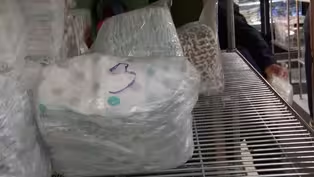
Half of US families can’t afford diapers
Video has Closed Captions
NJ charities highlight the need during National Diaper Need Awareness Week (4m 9s)

Longshoremen prepare to strike next week
Video has Closed Captions
A port shutdown could disrupt supply chains and cause prices to rise (1m 31s)
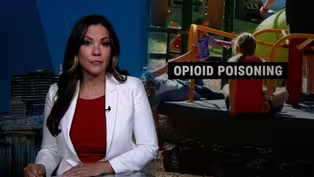
Rutgers study: Accidental cases of child opioid poisoning
Video has Closed Captions
Interview: Dr. Howard Greller, Rutgers New Jersey Medical School (5m 3s)
Providing Support for PBS.org
Learn Moreabout PBS online sponsorship
- News and Public Affairs

Top journalists deliver compelling original analysis of the hour's headlines.

- News and Public Affairs

FRONTLINE is investigative journalism that questions, explains and changes our world.












Support for PBS provided by:
NJ Spotlight News is a local public television program presented by THIRTEEN PBS