NJ Spotlight News
NJ Spotlight News: September 5, 2023
9/5/2023 | 26m 46sVideo has Closed Captions
Watch as the NJ Spotlight News team breaks down today's top stories.
We bring you what's relevant and important in New Jersey news, along with our insight. Watch as the NJ Spotlight News team breaks down today's top stories.
Problems playing video? | Closed Captioning Feedback
Problems playing video? | Closed Captioning Feedback
NJ Spotlight News is a local public television program presented by THIRTEEN PBS
NJ Spotlight News
NJ Spotlight News: September 5, 2023
9/5/2023 | 26m 46sVideo has Closed Captions
We bring you what's relevant and important in New Jersey news, along with our insight. Watch as the NJ Spotlight News team breaks down today's top stories.
Problems playing video? | Closed Captioning Feedback
How to Watch NJ Spotlight News
NJ Spotlight News is available to stream on pbs.org and the free PBS App, available on iPhone, Apple TV, Android TV, Android smartphones, Amazon Fire TV, Amazon Fire Tablet, Roku, Samsung Smart TV, and Vizio.
Providing Support for PBS.org
Learn Moreabout PBS online sponsorship>> tonight, sleeping in.
High schoolers and bargains can -- Bergen County's length of just -- largest school district get more time before the first bell.
>> I think students will be more alert and productive.
>> COVID-19 uptick.
Cases rise across the country and some universities in New Jersey are still mandating vaccines.
>> they are requiring kids who are living on campus to be vaccinated against COVID.
>> a month in, still no deal.
The RWJ nurses strike heads into five.
Is the hospital playing hardball?
>> They are willing to spend millions on replacement workers rather than clearing staffing standards that would benefit patients and nurses.
>> It's payback time.
Millions of borrowers prepare for edible student loan payments to resume next month.
Check your statement because interest starts now.
>> If you haven't reached out to your loan servicer, do so now.
Go to student aid.gov.
>> NJ Spotlight News begins now.
>> Funding is provided by the members of the New Jersey education Association, making public school great for every child.
RWJ Barnabas health, let's be healthy together.
And orsted, creating a clean -- Committed to the creation of a new, long-term, sustainable clean energy future for New Jersey.
♪ >> From NJPBS, this is NJ Spotlight News.
>> Thanks for joining us this Tuesday night.
I'm Briana Vannozzi.
There are probably fewer people who dreaded the sound of their alarm clock more than teenagers heading back for the first day of school.
At Bergen County's largest district, it is one of several that have taken the plunge to adopt a later start time.
The majority of residents support pushing back high school daily schedules over concerns that teenagers don't get enough sleep, with piles of medical research to back it.
There is pushback from parents and educators concerned about how a later start will impact sports and other activities.
Raven Santana checked in at Ridgewood high.
>> I think the students will be more alert and they will be more productive in class.
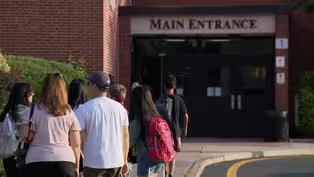
>> That is because nearly 18 hundred students in Bergen County's largest district will get extra time to sleep after the district changed the time from 7:45 to 8:20 a.m. >> I have been working on this for 10 years.
A lot of these problems have been worked through, but we have to remember the reason we are doing this is for the kids.
Raven: Lawmakers introduced legislation mandating school districts to make changes by 2024, 20 25, pushing high school start times to no earlier than 8:30 a.m. but it never passed.
Ridgewood's principal says giving students more sleep in the morning to be productive is not just an opinion, it is based on research and science.
This doctor breaks it down.
>> For adolescents, as kids get older there is a shift in their normal sleep times.
They call it the circadian rhythms.
Adolescents have a 2-3 hour phase shift from where they are younger to where it is hard for them to fall asleep much earlier than 10:30 or 11:00 and hard for them to wake up earlier than 7:00 a.m.
Combined with that, we know they need at least eight hours of sleep, if not closer to nine hours, to function.
Raven: Administrators at the school say they are confident the extra time will support mental health and academic achievements.
>> We will make adjustments.
A few years ago we turned everything upside down for COVID and made that work.
This is relatively minor, but significant as far as helping kids be healthier and do better in school.
Raven: Ridgewood is one of a handful of districts that had made similar changes, including Maplewood and Chatham.
Chatham's superintendent shared the impact in his district.
>> The students are reporting sleeping more to start with, and beyond that, they report being more alert during the school day, being in a better mood, being more likely to eat breakfast before the date begins.
There has been a reduction in the number of students who are chronically late to school and a reduction in the number of students who are failing courses.
We have seen a reduction in the percentage of students reporting suicidal ideation or concerning depressive periods.
We haven't seen an impact, a negative impact on athletics or extracurricular activities.
Raven: Eden -- even with pediatricians recommending later start times, there has been pushback of those concerned that the time change will negatively impact afterschool activities like sports.
He disagrees.
>> Our sports will be fine.
Practices will be pushed back at most 10 minutes.
Raven: They will conduct surveys to evaluate and reassess how the timeshift went and what else they can improve.
The superintendent hopes the change will be made in more districts or even statewide.
I'm Raven Santana.
Briana: The school year is off and running but summer is holding on with a white knuckled grip, hitting the state with sweltering temperatures and a heat wave that is forecast to last through Thursday.
The National Weather Service says the heat index will peak above 100 all week, making for dangerously hot conditions.
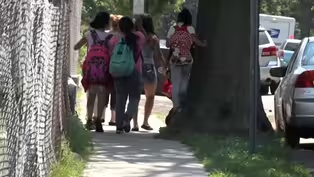
A heat advisory has been issued for all or parts of 15 counties, and it is forcing some New Jersey schools to dismiss students early.
From Winslow Township to as far north as Belleville, districts are opting for early dismissal or half days with no afterschool activities.
In North Jersey, other schools may avoid the worst due to late week openings.
For anyone who has been asking where the summer weather was during July and August, it is finally arriving.
After a quiet summer, cases and hospitalizations from COVID-19 are on the rise.
First Lady Jill Biden tested positive for the virus on Monday.
She is experiencing mild symptoms and is recovering at the family home in Delaware.
President Biden has tested negative and White House officials say he will be monitored and tested regularly.
It is a reminder that COVID infections are still among us.
New Jersey is seeing an uptick.
Hospitalizations increased more than 50% since July according to data from the State Department of health.
326 people are hospitalized with the virus as of today.
Public health experts say there is no reason to panic.
Total case counts remain low here and nationwide.
The U.S. is not expected to have a dangerous wave of illness like we saw during the height of the pandemic, which is one reason Rutgers University is getting a lot of criticism for keeping a mandate requiring all students to be vaccinated against COVID-19.
Our health writer found out the vaccine rule is one of the strictest in the country, but not rare.
She joins me now.
Good to see you.
Let me start with, what exactly is Rutgers requiring?
There is confusion about what constitutes being fully vaccinated.
>> My understanding is, they require a primary series for students on campus and some groups would require a booster as well.
Those are the clinical programs, people in nursing and physician programs and things like that.
Rutgers is not alone.
Montclair University is worth wiring kids who are living -- requiring kids who are living on campus to be vaccinated against COVID.
This is one of many vaccines or several I should say that kids get for colleges in New Jersey.
Briana: Rutgers being the flagship university in the state, the largest, Montclair is not far behind.
Is that one of the factors that went into this decision-making, the sheer amount of the student body and people on campus?
>> You know, it makes sense from an epidemiological point of view.
Rutgers said in its policy that the goal is to -- it is congregate housing.
I talked to a doctor at Montclair and she said their requirement only applies to a fairly small group, less than one third because residential students are less than one third of the total student population on campus.
That is the most at risk group.
You are living close together, sharing water fountains or bathrooms, all kinds of things.
We know COVID doesn't spread that way but it is close contact, you are breathing on each other in a closer proximity.
So there is some science to it.
Regardless of the fact that obviously, people who opposed mandates are frustrated because they don't see it as making sense at this point during the pandemic.
Briana: With the pandemic archly behind us, sure.
But vaccine requirements are not new to the state.
What does state law say and how does that apply to other folks who have students that aren't yet in the college world?
>> This is, if you are a child growing up, you will get a lot of shots.
You are vaccinated against nearly a dozen things at some point in your childhood.
For college the state requires three vaccines that protects against five diseases.
Measles, mumps and rubella is one.
Hepatitis B, then a shock -- shot to protect against meningitis and other diseases.
Three shots, and it is when you get them, that depends on how old you are and what you have had before area but those are required.
Even the two schools we found that are requiring COVID shots aren't alone.
They are within 100 nationwide.
Briana: Our health care writer, thank you so much.
To read more of her reporting on school vaccine requirements, head to NJ Spotlight news.com.
>> Support is provided by Horizon Blue Cross Blue Shield, an independent licensee of the blue Ross Blue Shield Association.
Briana: Pandemic era government funding is set to expire this month for the childcare industry.
Presenting a new crisis for hundreds of thousands of families across the country.
Experts are warning some 70,000 childcare programs, including many in New Jersey, could close their doors, leaving parents with even fewer and less affordable options.
Our Senior correspondent Joanna Gagis reports.
>> We have seen in this Congress proposals to massive cuts to Headstart.
I have to say that would be a huge mistake.
>> Mikey Cheryl says New Jersey and the nation are going to follow for Cliff if opposed cuts to early education programs are enacted.
>> On top of this, the pandemic relief funding we put in place is facing what many of you may have heard as the childcare Cliff.
It runs out at the end of September.
Joanna: American rescue plan dollars help families of 3 million children afford childcare.
As of September 30 the funds will run out, meaning more than 1000 childcare facilities in New Jersey alone could close their doors.
>> The American rescue plan, which supported childcare, they were really a lifeline for programs for working families, because it didn't just look at what is traditionally funded by the federal government, low income working families.
It looked at the totality of the system.
The problem is, without those dollars, we are looking at a system that was fragile before COVID becoming even more of a problem.
Joanna: It could impact 305 families whose kids attend Headstart in Dover, forcing parents to stop working when they lose childcare.
>> If those funds are threatened, those families won't receive services from Headstart.
We provide whole day childcare that they wouldn't be able to receive, the youngest children from birth all the way up to age three would have no services whatsoever.
Research says for brain development, that period is the most important, from 0-3 and subsequently from 4-5.
Joanna: She has joined with other members of Congress to urge President Biden to work with Congress to provide $16 billion per year to avoid a childcare crisis.
>> Without federal action we will see ripple effects across every corner of the economy.
Joanna: She has been on the road telling her district about a bill she has drafted called the childcare for every family act, which would dedicate federal funding to help families afford childcare and help providers pay staff.
>> No one would pay more than 7% of their income on childcare.
I anticipate there will be a combination of private and government funding, and there will be that 7%.
Depending on a person's income, that could be quite a contribution.
But I think this is something that I do envision will be widely supported by the government because this is how we bolster our workforce.
Joanna: With the economy and inflation being what they are, Megan says in action from Congress will land us back where we came from.
>> In 2020 we saw what happened when we took childcare away, and the ripple effect on every industry in society.
It had an impact on the economy, a great impact on our K-12 system.
>> Congress talks about the investment they need to make.
They need to understand that everything is linked to childcare.
Working parents need it to go to work.
Joanna: The congresswoman says she will be working to secure funding when she returns to Washington next week.
I'm Joanna Gagis, NJ Spotlight News.
Briana: A labor crisis is already happening among health-care workers.
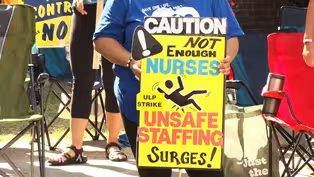
More than 1700 nurses at Robert Johnson University Hospital are still on the picket line.
This is five weeks after initiating a strike.
The battle between the union and Hospital is only getting uglier.
Nurses who walked off the job lost their health insurance at the start of the month.
They are seeking better pay and staffing, two items they have been trying to lock in since the pandemic took a toll on the work.
They say they are prepared to strike as long as it takes.
>> We get spit on, punched and we still come to work.
Our benefit is sick time and they want to penalize us.
How do you treat your family like that?
Ted: Nurses at RWJ are still on strike after a month and a day.
It has been three weeks since nurses in the hospital met at the negotiating table.
The nurses continue to insist on higher staffing levels that are enforceable.
>> I had to go to the bathroom so I pushed the call bell.
Two hours later somebody came to help me to the bathroom.
The nurse who cared for me greeted me with an apology, I'm sorry, I have so many patients.
Ted: RWJ Barnabas, an underwriter for NJ Spotlight, took away health insurance from striking workers last week.
That forced them to pay for COBRA if they want insurance and it has angered nurses and union leadership.
>> They think they will squeeze us because they got our health care.
They may think they will squeeze us because they brought scabs in for 30 days.
They will learn a lesson in New Brunswick that they will never forget.
We are going to last longer and they will never, ever do that again.
>> It is getting ugly.
The hospital is resisting.
They are demonstrating they are willing to spend millions on basement workers rather than agreeing to their staffing standards that would benefit patients as well as nurses.
Ted: Rebecca is associate professor for the Rutgers school of management and labor relations.
She says stripping WellCare from striking workers isn't an extraordinary move, but she thinks it is petty.
>> If they said we understand as a health-care care organization that health insurance is significant to our nurses, and as a show of good faith we will allow them to have continuity, it is taking the lowest road they could take.
Ted: The union got a boost as some of RWJ's newest hires joined them.
They were previously going through paid training but now they are on the picket lines.
>> The strategy is to send us out here so when the union goes to the second group, we will vote against the strike.
We are not going to do that.
>> It was hard seeing coworkers out here fighting and there was nothing we could do.
Until we needed out of our probation period.
Ted: A long dormant bill and trim for -- in Trenton would require these staffing levels.
State Senator Linda Greenstein is a sponsor for the bill, which could shorten the strike if signed into law.
>> Making sure hospitals and health care facilities are adequately and properly staffed means the staff will be well-equipped to provide essential care and save lives.
>> We have bills, I have student loans.
I can't speak for everybody but I paid up until September.
What happens if this goes on longer?
I worry about financial situations along with 1700 other nurses.
Ted: The union president says RWJ told them a strike would mean nurses are out of work or 60 days.
We are nearly a month away from that and mark with little hope for a deal insight.
I'm Ted Goldberg, NJ Spotlight News.
Briana: In spotlight on business, the paws on federal student loans that began in March 2020 will officially end next month but interest on those loans resumed September 1.
That means a lot of borrowers are likely to experience payment shock as they budget for the extra expense.
Life is more expensive than it was three years ago, when bills and interest rates were largely frozen as a pandemic relief measure.
To ease the transition, the Biden administration is allowing for flexibility during the first year repayments begin.
For everything you need to know, I'm joined by Paul, founder and CEO of the credit management and repair firm better qualified.
Great to talk with you.
The Biden administration has created what they are calling a year-long on-ramp for these borrowers.
What does that mean?
>> They are trying to ease the blow going into, we have had a layoff for three years now so they are trying to make sure as many borrowers as possible can repay their loans.
A lot of repayment programs have been in place since the Reagan administration, but Biden, the Biden administration updated them to include more people, to make it more affordable for these people to actually start paying back their student loans.
Briana: What will that look like if, for the last three years, I have not had a payment?
What should I expect and will there be options for payment plans?
Because now I will have to budget this in when I didn't have to think about it for a few years.
>> Borrowers need to know, fortunately one thing only.
Go to studentaid.gov.
You can go to studentaid.gov/ idr.
These are income driven repayment plans now available to most of the student loan borrowers.
Don't take phone calls from anybody, don't reply to text messages, don't click on links on social media or emails.
The bad actors are already starting to pour in so student aid.gov will have all the information you will need to know, whether you will be eligible for these repayment plans and don't forget, the creditors, the people who loaned you the money or the servicing company, unfortunately a lot of borrowers servicing companies have changed.
When was the last time you log into your account, and spoke to your servicer?
Be proactive here.
Every day we get closer to October 1, these companies are getting flooded and inundated with inquiries.
Be proactive.
Do it soon.
If you haven't reached out to your loan servicer, do it now.
Briana: There are folks who are counting on, hoping for President Biden's plan to wipe clear significant amounts of student loans to get through Congress.
Where do we stand on that and how much should folks be hanging on that proposal?
>> Unfortunately, it became a politicized football.
It was being kicked back and forth.
It caused confusion among borrowers.
I say hope for the best but prepare for the worst.
I don't think that grandiose loan forgiveness plan is ever going to get past.
I think this is a compromise in what he has done, modifying the income driven repayment plans.
If you have been paying back your loans for 10 years or more, you really need to take a look at it because you might be eligible for complete the loan forgiveness.
If you work for a 501(c)(3), any government agency at all, whether it is teaching, you might be eligible for the forgiveness.
They will not reach out to you and let you know that.
You have to take the matter into your own hands and find out what your eligibility really is.
Briana: You are your own best advocate.
Paul is CEO of better qualified.
Thank you so much.
>> Thanks for having me on.
Briana: On Wall Street markets started slow on the first trading day of the holiday week.
Here is how stocks closed today.
♪ >> Support for the business report provided by new arc alliance, presenting the future as new arc Halsey Street Festival in Newark.
Details online.
Briana: That will do it for us tonight but don't forget to download the NJ Spotlight News podcast so you can listen anytime.
I'm Briana Vannozzi.
For our entire team, have a great evening and we will see you back here tomorrow.
>> NJM Insurance Group has been serving insurance needs for businesses for years.
Horizon Blue Cross Blue Shield, an independent licensee of the Blue Cross Blue Shield Association area and by the PSEG foundation.
>> Have some water.
>> Look at these kids.
What do you see?
I see myself.
I became an ESL teacher to give my students what I wanted when I came to this country.
The opportunity to learn, to dream, to achieve, a chance to be known and to be an American.
My name is Julia and I am proud to be an NJEA member.
>> NJM Insurance Group has been serving New Jersey businesses for over a century.
As part of the Garden state, we help companies keep their vehicles on the road, employees on the job, and projects on track, working to protect employees from illness and injury, to keep goods and services moving across the state.
We are proud to be part of New Jersey.
NJM, we have got New Jersey covered.
♪
Heatwave shortens school days for some
Video has Closed Captions
Some school districts opt for half days or early dismissal with no after-school activities (1m 2s)

Video has Closed Captions
Rutgers retains COVID-19 vaccine rule, sparking debate — and criticism (4m 59s)
Nurses' strike at RWJ University Hospital — no deal in sight
Video has Closed Captions
'It's getting really ugly. The hospital is absolutely resisting' (4m 9s)
Ridgewood High School switches to a later start time
Video has Closed Captions
Several other school districts have pushed back the start time of classes (4m 25s)

Student loan repayments resume Oct. 1: What to do
Video has Closed Captions
Interview: Paul Oster, a credit-repair specialist (4m 42s)

Warning of ‘child care cliff’ as federal funds run out
Video has Closed Captions
Sherrill: 'We'll see ripple effects across every corner of the economy' (4m 15s)
Providing Support for PBS.org
Learn Moreabout PBS online sponsorship
- News and Public Affairs

Top journalists deliver compelling original analysis of the hour's headlines.

- News and Public Affairs

FRONTLINE is investigative journalism that questions, explains and changes our world.












Support for PBS provided by:
NJ Spotlight News is a local public television program presented by THIRTEEN PBS