Washington Grown
Northwest Berry Goodness
Season 13 Episode 1304 | 26m 46sVideo has Closed Captions
Whatcom County, where fertile soil and family traditions make it a powerhouse for raspberries.
In Whatcom County fertile soil and family traditions make it a powerhouse for Washington’s famous raspberries. At Enfield Farms, generations of innovation keep the berry industry thriving, while the Whatcom Conservation District helps growers protect soil and water for the future. We explore the charm of Lynden, enjoy raspberry treats from Coyle’s Bake Shop and A la Mode Pie Shop.
Problems playing video? | Closed Captioning Feedback
Problems playing video? | Closed Captioning Feedback
Washington Grown is a local public television program presented by KSPS PBS
Washington Grown
Northwest Berry Goodness
Season 13 Episode 1304 | 26m 46sVideo has Closed Captions
In Whatcom County fertile soil and family traditions make it a powerhouse for Washington’s famous raspberries. At Enfield Farms, generations of innovation keep the berry industry thriving, while the Whatcom Conservation District helps growers protect soil and water for the future. We explore the charm of Lynden, enjoy raspberry treats from Coyle’s Bake Shop and A la Mode Pie Shop.
Problems playing video? | Closed Captioning Feedback
How to Watch Washington Grown
Washington Grown is available to stream on pbs.org and the free PBS App, available on iPhone, Apple TV, Android TV, Android smartphones, Amazon Fire TV, Amazon Fire Tablet, Roku, Samsung Smart TV, and Vizio.
Providing Support for PBS.org
Learn Moreabout PBS online sponsorship- "Washington Grown" is made possible by funding from the Washington State Department of Agriculture and the USDA Specialty Crop Block Grant program, and by the Potato Farmers of Washington.
Learn why Washington is home to the world's most productive potato fields and farmers by visiting potatoes.com.
- Hi everyone.
I'm Kristi Gorenson and welcome to "Washington Grown" Northwest Washington is known for its maritime climate and breathtaking vistas.
It's also home to some of the best berries in the world.
In this episode, we're gonna explore this region, learn about the amazing fruit that's grown here, and we'll find out what farmers are doing to protect their natural resources.
Tomás is learning all about raspberry breeding at Enfield farms.
- If you come up with a raspberry that's big, juicy and fruitful, I think you should call it Tasty Tomás.
- Tasty Tomás.
[both laugh] - And I'm making a special sponge cake with raspberries at Coyle's Bakeshop in Seattle.
I worked really hard.
- You did.
You worked very hard.
You had the torch, you know?
[Kristi laughing] You dumped the berries.
- Then I'm learning how one farm is working on a new irrigation system with the help of a local conservation district.
So there's blueberry- Oh, that was a good one.
[Kristi laughing] All this and more today on "Washington Grown" [bright music] Cooking with Kristi.
Sweet Pete!
- Jiminy G. Willikers.
- Watch my bangs!
Go big or go home.
- Ah!
Right in my eye.
- You made me a believer.
[both chuckle] Oh, I am making a mess!
- Oh, Val, I love you.
- Heaven on a plate!
That's yummy!
- We're gonna need a to-go cup for this.
- Yeah.
[laughs] - You keep talking, I'll keep eating.
Looking for a neighborhood bakery that feels warm and cozy?
Than look no further, because Coyle's Bakeshop in Seattle has fresh treats and a homey feel waiting for you.
- It's a nice little stop in the morning before I have to start work.
- All the food is really good and then the coffee is really good.
- It's what I always wanted, but couldn't find.
- Rachael Coyle opened Coyle's Bakeshop 10 years ago, bringing her vision of the perfect bakery to life.
- We have this abundance of natural resources and of beautiful produce and you know, money can't buy that kind of access to really fresh, beautiful ingredients.
So being really particular about the ingredients and the produce that we use, and really trying to bring a higher level of technique into baking.
- She's got the best croissants in town.
I mean, I had other croissants and they don't light a candle to these.
- Don't miss later in the show when Rachael and I make the customer favorite Victoria Sponge Cake with Washington-grown raspberries.
- This is really the hard part.
The upper body strength.
- Yeah.
- Yeah.
I always think about- - Show me your muscles.
- They're, I mean- - There they are.
[Kristi laughing] - I can't believe you got me to do that.
[bright music] - In Whatcom County, we're returning to a place that may look familiar.
Enfield farms.
Over 1,000 acres of raspberries and blueberries are being grown here every year.
The raspberries have just been harvested, and I've come to see how Andy Enfield and his crews prep these rows for seasons to come.
- In the raspberry harvest, we harvest them 15 to 17 times over the season.
- Really?
They grew that fast!
- Every two and a half days.
Yeah, they ripen that fast.
- So what happens now in the process?
- Now, we're gonna go through and take out the compaction.
- After about six weeks of harvesting raspberries, the machinery used compacts the soil between the rows, making it difficult for future plants to take root and for water to penetrate the soil.
Crews will drive through these rows with a cultivator, which churns that soil up, making it nice and loose for future use on the farm.
But what about the plants?
What do you do for these plants to ensure that they are ready for next year?
- And we're gonna take out this old cane.
- This right here?
- These old canes.
All that's coming out.
- Okay.
- All the way to the ground.
- So the ones that are green- - These are green.
- These stay.
And will those green ones produce next year?
Is that the idea?
- These green ones, they're gonna send laterals.
These are all laterals that come off and the fruit comes off the lateral.
- Hand-pruning hedgerows is an intense and time-consuming process that requires capable people to do it properly.
Finding good laborers can be difficult, causing farmers like Andy to seek help from hundreds of miles away.
- We're seeing a lack of qualified workers.
- Okay.
- Locally, we started using the H-2A program.
We're getting H-2A workers from Mexico, highly qualified individuals that are capable of doing lots of different tasks.
- So of all the workers that come here and work for you, do you get people that come back specifically just to work with you guys?
- Yeah, we have.
This is our third year in the H-2A program and we, we have 90% returns.
They're making a good living.
- Yeah.
- To take back home.
- Growing some of our favorite berries is only part of the work being done at Enfield Farms.
Together with Northwest Plant Company, research is being done to develop new varieties of raspberries that we get to enjoy in the future.
- So we're taking pollen from one and crossing it with the seed parent from the other, and then we can grow those out and we can look for the characteristics that each of those parents might bring.
We're looking for higher yield, we're looking for better flavor.
Planting longevity, disease resistance.
- Julian Enfield oversees plant breeding at Northwest Plant Company.
And it takes years of research and testing before we can even see the results of her team's labor.
- This one here, Wake Haven, is one that we crossed here, selected here.
- Right.
- And we've seen it through the whole way.
- What's that process look like?
I mean, are we talking like a boardroom full of people?
That little cups of raspberries?
- You know, that's part of it.
That's part of it, definitely.
But it's like years of data.
And it's like, well, how did it yield that year?
How did it yield that year?
And when it was really hot, how did it do?
And when it rained, how did it do?
We've got a couple advanced selections that are in grower trials right now and we're seeing some good data come out.
So it may not replace something, but it may be a good alternative.
- If you come up with a raspberry that's big, juicy, and fruitful, I think you should call it Tasty Tomás.
- Tasty Tomás.
[both laugh] I'll add it to the list.
- Add it to the list!
- Yeah.
- I think it'd be a big seller, really.
- Right.
[Both laughing] - Seattle is a massive place.
Which means claiming that you have the best apple pie in the whole city.
Well, you better be able to prove that.
Here in A La Mode Pies, owner Chris Porter has been told that his apple pie wins the award.
So in the interest of public service, I'd better try myself.
- The big idea was to open a pie shop in Seattle.
- Just a pie shop?
- Not just a pie shop.
I really wanted it to be like the best pie shop.
- Okay.
See?
You gotta have aspirations.
- Exactly.
Obviously you have to have an apple pie.
That's on the menu.
- Here in Washington, yes.
[chuckles] - Here in Washington.
- That is gorgeous!
This is the best apple pie in Seattle, my friend.
- Wow.
It is so chewy.
- Yeah.
- And delicious.
- Good!
- And I bet just full of butter.
- With a scoop of ice cream, this is electric.
- Alright, time to put it to the test.
[bright music] - This is delicious.
- That is good apple pie.
Alright.
- That's delicious.
Oh my God.
- Beautiful apples.
Nice and tart, not too sweet.
- The apples are kind of like, "Mm!"
[Tomás laughs] Melt-Mm!
- That bottom pastry is so tender.
- It's like the perfect apple pie.
- Whoever came with with this recipe, in my- Yeah, they're in my good book.
This is fantastic.
- What more do you need?
- Ah, nothing.
That's great!
Absolutely amazing!
- If you ever find yourself in need of a pie fix, A La Mode Pies here with Chris.
This is the place to go right here.
[chuckles] [bright music] - A raspberry is made up of tiny bead-like fruits called drupelets.
Each drupelet contains one seed.
How many drupelets are in one raspberry?
We'll have the answer for you after the break.
- Coming up, I'm making Raspberry Victoria Sponge Cake at Coyle's Bakeshop.
- This is really the hard part.
The upper body strength.
- Yeah.
- Yeah.
I always think about- - Show me your muscles.
- They're, I mean- - There they are.
[Kristi laughing] - I can't believe you got me to do that.
- Then, we're taking a tour of Bellwood Farms in Whatcom County.
And trying some of their homemade apple alcohol.
[Tomás exclaiming] [Kristi laughing] - That warms you up.
Quick, man.
[bright music] - A single raspberry contains anywhere between sixty to a hundred drupelets which contain the seeds.
- We're back at Coyle's Bakeshop in the Greenwood neighborhood of Seattle.
Here, fresh coffee and handmade pastries make this spot the perfect place to add to your morning commute.
- I just like the smell when I come in here.
- It's very chill.
I think everyone there is about as cheerful as you could possibly imagine.
- I considered a different career.
And then realized that all I wanted to do was bake.
So I went straight from college to pastry school.
And there, that's where I've been ever since.
- Rachael Coyle opened the bakeshop to create her ideal bakery where fresh ingredients make treats that bring smiles to her customer's faces.
- I'm always really, really excited when strawberries come on the scene, especially June-bearing strawberries and Washington State are absolutely delicious.
But it's really whatever is in that moment.
Freshest so- - Because that's when it tastes the best.
- It's true.
- She's very careful about the ingredients, which makes a difference.
- If she grows extra rhubarb in her yard, she can bring it here.
It's just fun knowing that little things like that are happening.
- They're tuned into what is available and it tunes me into what I should be looking for when I do some of my own grocery shopping.
- So you and I get to bake together.
- Yes.
- What are we gonna make?
- We are gonna make our Victoria Sponge Cake.
And we are gonna make it with local raspberries and raspberry jam.
Victoria Sponge is a really classic English cake that we have kind of made more complicated.
[Kristi laughs] So, often it has- - Why not?
- Yeah, exactly.
Often it has just jam in the middle.
Sometimes it'll have jam and cream.
Our version has jam, fresh fruit, and cream.
- Okay.
- So that we get those two versions of the fruit.
- Oh yeah.
- And lots of cream.
- Okay.
Well let's get started!
We begin making our cake batter by creaming butter and sugar in a stand mixer.
While that mixes, Rachael adds a little heat to help the ingredients blend together.
- We want this to be at a nice temperature.
- Yeah.
- For creaming.
'Cause what we're doing when we cream the butter and sugar is we are adding air to the butter.
And this allows us to add just a minimal amount of leavener, so it has less baking powder than a lot of cakes.
- We slowly add in eggs to our mixture.
Once that's complete, we'll move our creamy batter to a bowl and fold in a mixture of flour, baking powder, milk, and fresh vanilla.
Once folded together, we transfer our cream to a tin and bake at 350 degrees for 45 minutes to an hour.
- Okay.
So this is our cake.
- Wow.
- It's been baked and cooled.
- It looks so good!
- We're gonna fill it with our raspberry jam, our fresh raspberries, and our mascarpone cream.
- Okay.
We cut our cake in half and add a homemade raspberry jam as a base.
We place the prettiest berries along the edge and fill the center with the rest.
Now it's time to hand whip our cream filling.
We add a cup of cream, some vanilla, and two tablespoons of sugar to a bowl, and whisk it until it starts to hold shape.
- This is really the hard part.
- The upper body strength.
- Yeah.
- Yeah.
- I always think about- - Show me your muscles.
- They're, I mean- - There they are.
[Kristi laughing] - I can't believe you got me to do that.
You can pass it off to me if you're ready.
Or you could try to do the non-dominant hand whip, which is always... - Oh.
- Chaotic.
- Yeah, yeah.
I should try.
Maybe I'm better at this one.
- I think you're just not tired.
[both laughing] - Here you go.
In a separate bowl, we fold cold milk into marscapone until it has a similar consistency as our cream.
Then we whisk them together until evenly blended.
Next, we place the cream on top of our raspberries, top it off with our cake, and finish with powdered sugar.
That's beautiful.
- Thank you.
- I can't wait to try it.
- I am very excited to have a slice myself.
So, - Okay.
- That's delicious.
Hmm.
Super light.
- It's lighter than you think it's gonna be based on the sort of texture of the outside.
But, I'm so glad.
- I can see why this is one of your, one of the favorites.
Beautiful.
But it wasn't- - Thank you.
- I mean, I worked really hard, but- - You did.
You worked very hard.
You had the torch, you know?
[Kristi laughing] You dumped the berries.
- I did.
- And the finishing touch.
- I know.
- Of course with the powdered sugar.
- Thank you so much.
- I think it has the perfect- - For letting me into your kitchen.
[laughs] - Of course.
- For this and more chef-inspired recipes, visit us at wagrown.com.
Up in the northwest corner of the state, Whatcom County is the ideal picture of Washington beauty.
Right near the ocean and surrounded by picturesque farm landscapes.
It's tough to find a more amazing place to be in the northwest.
- So many people think of this area as one of their favorite places.
- Becky Mandelbaum is the communications manager for Visit Bellingham.
From downtown to back roads, there's something for everyone out here.
- You can stay in Bellingham, have the like small, almost city vibes, and then come out here to the county and get a little bit of peace and quiet.
Meanwhile, there's hiking and mountain biking and kayaking.
- We're trying to get folks on the road to see what's happening in local farming in Whatcom and Skagit counties.
- Jessica Gillis works for the non-profit sustainable connections.
Each year, they put out a map listing the many experiences people can have visiting local farms and farm stands.
- You'll see these loops are color-coded around the counties and down into Skagit?
They're meant for you to make a day of it.
Right now we're talking about the Eat Local Lynden Loop.
And we're here just at the beginning of apple season, so it's the time to be coming for some you-pick.
The fields are gorgeous.
We've got Mount Baker in the background everywhere.
So you're getting sort of this farm experience and a local experience, but also getting to see the amazing landscapes we have to offer here.
- And there's nothing wrong with little fresh air.
- That's right!
That's right!
Especially around here.
- We decided to visit one of the spots on the map ourselves.
Now we're at Bellwood Farms near Lynden.
Talking with vice president of farm operations, Blake Abel.
With apple trees and amazing farm stand and so much more, they're staying busy and keeping guests happy.
- We have Friday Night Farm Tunes.
We have local bands that come and people bring their families, cornhole.
We basically are just a building for everybody to hang out in.
- But aside from all the family fun, they also offer fun for adults as well.
All using the apples grown right here.
- We are the first apple distillery in Washington state.
We have a vodka that's made from just honey crisp apples.
You think about a spirit made from apples, you kind of think it would have an apple taste, right?
- Yeah.
- Yeah.
- But it's pretty much a neutral spirit.
It tastes just like a potato vodka or rice vodka.
- No self-service.
[Kristi and Blake laughing] - Okay.
Our vodka's pretty hot.
Meaning like a high ABV.
- Sure.
- We like it when it burns on the way down.
- It's gonna- [Tomás and Blake laugh] - So that's our honeycrisp vodka, Moonshine.
[Tomás exclaiming] [Kristi exhaling] [Kristi laughing] - Ooh, that warms you up.
- What do you think, Kristi?
- Thanks for coming.
- Oh I like it.
Thank you for having us.
- Thanks Blake, man, this is great.
- We'll get you guys a ride home.
No, I'm just kidding.
[all laughing] - But there's a whole lot more to explore.
So when you get the chance, head on out to Whatcom County and see all the magic that this area has to offer.
Coming up, I'm learning how one conservation district is helping a farm get a new irrigation system.
- So there's blueberry- Oh, that was good one.
[Kristi laughing] [bright music] [bright music continues] - Hey everyone, Tomás and Anna Lucia here.
And we are at a very, very special place.
You know where we're at?
- Camp Dudley.
- That's right.
We are at YMCA Camp Dudley, located on Clear Lake.
This is where I got my start in video.
Right here.
Making all sorts of fun programs and games for the kids, and doing just a lot of wacky and crazy stuff.
And one of the things we would make are banana boats.
Have you ever had a banana boat before?
- I have not.
- Okay.
For these banana boats, you're gonna need bananas, Nutella, strawberries, hazelnuts, marshmallows, and some raspberry truffles.
- We begin by slicing the banana right down the middle.
And then spreading the banana open to create a valley.
- We then add our Nutella spread, strawberries, marshmallows, top it with some hazelnuts, and then we add some truffles from our friends at Chuckar Cherries.
Those are delicious.
Uh, you're supposed to put 'em in your banana boat.
- We then wrap our bananas in heavy duty foil and place them on the grill for about 10 minutes.
- Ooh, wow.
Look at that!
Might be hot.
Be careful.
Look at this.
Cheers.
- That was really good.
I like how it reminds me of like... Nutella and banana, like pancakes or waffles.
- So if you're looking for your next campfire dessert, give banana boats a try.
You can try all sorts of different kinds and different flavors.
Anything that floats your boat.
It's a banana boat.
[both laughing] Alright.
We'll see you guys next time.
To learn how to make this recipe and many others, head on over to wagrown.com.
- It's funny how life works.
When I was a kid, I worked as a picker at a blueberry farm.
And today, I'm back in a blueberry field at Williams Blueberry Farm in Deming.
But despite their long history, when the farmstead was established, they weren't growing any berries.
- They had cows and beef.
All their own vegetables.
I think the first bushes went in in like 1952 and some of the original plantings are still here and still producing.
- Alexandra Williams works alongside her extended family on the farm.
Successfully growing and selling berries means it's all hands on deck.
- My husband manages the fields.
My sister-in-law manages the packing house.
Pretty much anything that involves typing or computers or paper, that's my job.
It's just really cool to see three generations all working together with the same end goal.
- As a smaller farm, Williams uses every resource they can find to make sure they're taking good care of the land and the natural resources around them.
That's where the Whatcom Conservation District steps in.
- The first time we got help from the Conservation District was after the 2021 floods here.
They definitely came in and did some helpful stuff.
Like with the cleanup, aftermath of the flood for us.
- Now, Alexandra and her family are working to get help with the next item on their list.
Their irrigation system.
Which I got up close and personal with.
- So there's blueberry- Oh, that was a good one.
[Kristi laughing] - Welcome to the working farm, right?
- We want to use water more efficiently.
We're running low on water in a lot of parts of the county, and we understand that farmers have a tight budget.
- Trevor Gearhart is the farm planner for the Whatcom Conservation District.
His help and expertise is making sure that Williams Farm gets the new irrigation they need at a fraction of the cost, all while working to keep the environment clean and healthy.
- Right now, you can see the hand lines there.
Somewhere in the like 60 to 70% efficient, so 60 to 70% of the water that comes out of that sprinkler actually gets into the ground.
What we're hoping to do is put in a drip system here, which puts the drip line right along the ground of the blueberries.
And we're in the 90 to 95% efficient water use at that point.
You're not getting water on the plants and on the fruit, so you reduce like the mold that is possible and the pest pressure.
- I just feel like everybody at the Whatcom Conservation District has been so helpful.
Trevor's helped me with maps for our inspections, and just goes above and beyond.
- A productive farmer is a farmer who has the time to take care of the land around them.
And so as long as we're farming this land and not letting it just sit there, it's gonna be healthier.
- And we get to eat all the good food.
- And we get to eat all of our local food.
- Drip line's expensive.
It's just always been such a large expense.
We've never really been able to find money in the budget for that.
- What I would want farmers to know is that we're here to help.
We're not regulatory.
Our goal is to keep a farm functioning and efficient.
And to improve it as much as we can.
- Everybody should be doing it.
- Everyone.
Yeah.
- Everyone.
[chuckles] - If they're willing to help you, and it could save your farm for another generation, why not?
[bright music] - Washington is one of the country's top producers of raspberries.
And they have long been woven into the fabric of Washington agriculture.
The state's amazing berry harvests of Whatcom County is a testament to its rich history.
Let's take a look back and see where it all began.
Long before Europeans discovered Washington, it was home to indigenous tribes such as the Lummi, Nooksack, and Skagit.
The native people foraged for wild berries.
Like huckleberries, salmonberries, and blackberries.
And used them for food, medicine, teas, and trading goods.
When European settlers made their way to the Pacific Northwest, they preferred the berries from their homeland, including raspberries.
The first historical evidence we have for raspberry growing in Washington comes from 1833 at Fort Nisqually near Olympia.
Chief Trader William Tolmie wrote about transplanting raspberry bushes into a new garden in his journal.
As westward expansion continued, raspberry growing became more popular.
Many settlers who made the journey to Washington headed north to present day Whatcom County.
Where most of the state's raspberries are grown today.
The area was home to places like Bellingham Bay, which had plenty of Douglas fir trees that settlers needed for lumber.
With the arrival of the Northern Pacific Railroad in the 1870s, Bellingham Bay boomed with miners, lumber mills, and berry farmers.
For the rest of the 19th century, European settlers grew most raspberries on small farms.
And sold the berries straight from the source.
Blueberries and strawberries were also popular.
With people experimenting to create more delicious and sought after varieties throughout the 1900s.
By the 1950s, commercial market farms replaced a small-scale farms and garden plots, establishing Whatcom County and the Puget Sound as a berry-grower's paradise.
Washington's raspberries took a backseat to strawberries and blueberries over the next few decades.
But they finally came into their own in the 1980s.
Since then, berry tourism has continued to grow in popularity in the Pacific Northwest.
One popular event is the Northwest Raspberry Festival in Lynden.
The festival began as a humble Sidewalk Sale in 1997 before growing into the large event it is today.
The community celebration takes place over the third weekend in July and attracts tens of thousands of people each year.
Guests can enjoy food, live music, and more.
Many local business owners have also joined the festivities and shown their love for Washington-grown raspberries over the years.
Including Macrina Bakery in Seattle.
- So a lot of our products use raspberries and specifically raspberries from this area, and we just like to be able to participate and support the community.
And show just like how fabulous the raspberries are.
- Most of the state's red raspberry production, around 99%, comes from Whatcom County.
Punjabi, Sikh immigrants from British Columbia farm side by side with families of Dutch and other European descendants, each bringing their own history and expertise to the land.
It hasn't been easy for Washington raspberry farmers.
A devastating heat wave in 2021 destroyed much of that year's harvest.
And ongoing struggles over water and labor have made it harder than ever to keep their farms running smoothly.
But despite these challenges, Washington farmers remain positive and continue to grow some of the best raspberries in the world every year.
- My family's been farming berries since the mid 90s.
My husband and my dad and my brothers, they're all out in the field right now working.
It's super exciting to have the whole community come together and support the product that we grow.
- In 2024, Washington harvested over 50 million pounds of red raspberries.
Most are shipped out for jams, juices, and frozen products.
But you can still find plenty at local farms, markets, and grocery stores.
Oh man, these are so good.
Oh!
- If you're a person who enjoys hometown fun and beautiful maritime scenery, then Whatcom County is a place to explore.
That's it for this episode of "Washington Grown" We'll see you next time.
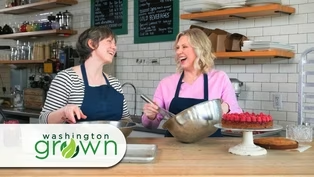
Northwest Berry Goodness | Preview
Video has Closed Captions
Preview: S13 Ep1304 | 30s | Whatcom County, where fertile soil and family traditions make it a powerhouse for raspberries. (30s)
Providing Support for PBS.org
Learn Moreabout PBS online sponsorship
- Food
Christopher Kimball’s Milk Street Television
Transform home cooking with the editors of Christopher Kimball’s Milk Street Magazine.




Support for PBS provided by:
Washington Grown is a local public television program presented by KSPS PBS