VPM News Focal Point
Notorious Virginia | September 21, 2023
Season 2 Episode 13 | 26m 46sVideo has Closed Captions
What about Virginia's notorious associations with Project Exile, moonshine and tobacco?
While Virginia is respected for its contributions to American history, what about unflattering associations for which our state is notorious, like moonshine and tobacco? And we reexamine a 90’s-era effort aimed at reducing gun-related homicides.
Problems playing video? | Closed Captioning Feedback
Problems playing video? | Closed Captioning Feedback
VPM News Focal Point is a local public television program presented by VPM
The Estate of Mrs. Ann Lee Saunders Brown
VPM News Focal Point
Notorious Virginia | September 21, 2023
Season 2 Episode 13 | 26m 46sVideo has Closed Captions
While Virginia is respected for its contributions to American history, what about unflattering associations for which our state is notorious, like moonshine and tobacco? And we reexamine a 90’s-era effort aimed at reducing gun-related homicides.
Problems playing video? | Closed Captioning Feedback
How to Watch VPM News Focal Point
VPM News Focal Point is available to stream on pbs.org and the free PBS App, available on iPhone, Apple TV, Android TV, Android smartphones, Amazon Fire TV, Amazon Fire Tablet, Roku, Samsung Smart TV, and Vizio.
Providing Support for PBS.org
Learn Moreabout PBS online sponsorshipBILLY SHIELDS: Over centuries Virginia has earned a reputation for many laudable contributions, but also for a number of unflattering distinctions.
Coming up, moonshine was once illegal, but one county is dispelling myths about distilling.
Revisit a controversial crime fighting tactic that some want to revive and meet a father and son committed to changing the reputation of their county.
You're watching VPM News Focal Point.
Production funding for VPM News Focal Point is provided by The estate of Mrs. Ann Lee Saunders Brown.
And by... ♪ ♪ BILLY SHIELDS: Welcome to VPM News Focal Point.
I'm Billy Shields in for Angie Miles.
We're taking a second look at some of Virginia's vices to consider their influence and lingering legacy in this state.
One of the more notorious chapters in Virginia history involves lawsuits against tobacco companies, one of the state's largest industries.
In 1998, Big Tobacco settled a landmark lawsuit with the U.S. government.
The companies paid billions of dollars related to the marketing of products to children and concealing information about the addictiveness of cigarettes.
But as special correspondent A.J.
Nwoko reports, the complex history of the tobacco industry goes back much further and a new generation of consumers is being drawn in by messaging around new products.
FRANKIE G: I believe so.
Yep.
A.J.
NWOKO: Frankie G. picked up vaping.
FRANKIE G: And good to go.
A.J.
NWOKO: To drop a decades-long addiction.
FRANKIE G: 20 years.
It was like 2014 when I quit.
When my mother passed away of cancer, like I did it for her because she always wanted me to quit.
A.J.
NWOKO: Frankie says, infamous iconography influenced his desire to light up.
FRANKIE G: Like I grew up as a child of the eighties so like Joe Camel was a thing and my father smoked Camel.
So like brand recognition was like obviously there.
A.J.
NWOKO: But the legacy of tobacco goes back much further than the mascots of the eighties.
NICOLE SACKLEY: Oh yeah.
A.J.
NWOKO: Historians like Nicole Sackley with the University of Richmond says the notorious rise of tobacco begins right here in Virginia.
NICOLE SACKLEY: If we want to talk about that layered history we have to start back in the 1600s.
A.J.
NWOKO: That relationship immortalized in Richmond's Shockoe Bottom where the slave trade helped fuel the spread of tobacco throughout the country for centuries.
NICOLE SACKLEY: Tobacco is important in all of the history of Virginia but it's only when tobacco becomes tied to the cigarette after World War I that Virginia becomes a center of the cigarette industry.
A.J.
NWOKO: Sackley says advertising became paramount to the industry's success, from print to television.
But the industry would wind up suffering its first huge blow with a landmark lawsuit in 1998.
But if the monolith that is the Philip Morris plant, visible from I-95 is any indication, the industry, like an old habit, dies hard.
And when the smoke of those lawsuits cleared it paved the way for the e-cig industry and companies like JUUL to target that same young audience.
21 year old Colby C. knows from experience.
COLBY C.: Instagram, Twitter, name it.
You saw JUUL advertisements online.
I was 15 the when I regularly started.
I have not quit vaping since I was about 15.
A.J.
NWOKO: For VPM News, I'm A.J.
Nwoko.
BILLY SHIELDS: E-cigarette maker JUUL was sued in 2019 for misleading consumers about its product.
The result was a multimillion dollar settlement.
Richmond based Altria Group, owner of Philip Morris USA was a stakeholder in JUUL until March of 2023.
In June, Altria acquired e-cigarette competitor NJOY.
BILLY SHIELDS: Virginia has a complex history marked by good moments and bad.
When we asked locals for their point of view on what constitutes notorious history in Virginia, here's what they told us.
MATILDA McCARD: I think like most southern states, Virginia does have an unfortunate history with racism, segregation, slavery, et cetera.
Obviously, Richmond, which is where I'm from, has the Confederate monuments which were thankfully taken down.
But I think balancing the sort of southern culture with our past, like how do we reconcile those two things?
But also sort of like, looking towards the future.
MAILI STEWARD: There's a lot of good and bad.
Virginia, capital of the confederation during the Civil War, so you get a lot of bad history but then you also get like, really close to the Union.
So a lot of people trying to help people get out.
Segregation was very clear and prominent.
You know, if you were relatively wealthy, you were able to go to the private Catholic school, otherwise you went to public schools.
And while I don't think we felt it day to day, I certainly believe it made a difference in how the city made decisions, and also where we find ourselves today in the city.
NIY WHITE: Petersburg also has a pretty bad name when it comes to the crime that goes on but there's a lot of good things as well.
There's a lot of businesses trying to put out a good image to keep the community kind of together.
But it's kind of hard when there is crime still ongoing.
BILLY SHIELDS: Franklin County, Virginia was once known as the “Moonshine Capital of the World.
” A haven for bootleggers selling their hooch across the country.
We caught up with stillhands there who are still making their wares, but selling them legally now.
I traveled there to hear their story.
BILLY SHIELDS: This crystal clear stream of liquid is part of what's called a bead, the central component of the country whiskey known as moonshine.
Now, a simmering hot product, legally produced by at least three distilleries in Franklin County in the foothills of the Blue Ridge Mountains.
This particular variety comes from what is known as a copper submarine made at the Twin Creeks Distillery, owned and operated by the Prillaman family.
CHRIS PRILLAMAN: I mean, it ain't been that many years ago that people just wouldn't talk about stuff like that at all.
It was a hush, hush thing, you know.
BILLY SHIELDS: For years, Franklin County has been known as the “Moonshine Capital of the World.
” A reputation that locals say was more infamous than famous.
RONALD HODGES: What you don't understand Franklin County is, basically, everyone was in whiskey someway somehow.
BILLY SHILEDS: Ronald "Rooster" Hodges is a former bootlegger.
In a previous life, he hauled gallons of the stuff on these country roads for years.
RONALD HODGES: I love the whiskey business.
It like gets in your blood, you can't stop it, you know.
I've hauled enough to fill up the Mississippi River, I guess.
BILLY SHIELDS: Hodges also sells his own brand of legal moonshine out of a tasting room near Smith Mountain Lake.
Another legitimate business born from the county's notorious past.
BETHANY WORLEY: It's a scene I thought I would never see in my life.
It is unbelievable that it is now legal to make moonshine.
But right here, this is just part of our large... BILLY SHIELDS: The Blue Ridge Institute and Museum proudly displays the tools of the trade.
What's known as a turnip-style still, the copper coil known as a worm, and glass jugs traditionally used to bottle the liquor.
Time was when these were components of a back woods smuggling enterprise that was worth millions operating during prohibition.
BETHANY WORLEY: Oh, huge industry.
Yeah, it didn't slow down.
BILLY SHIELDS: A big factor that made this region prime shine country is simple.
(train hooting) It was always close to the railroad, meaning raw materials like sugar, corn and mason jars could get in and the clear liquor could roll out.
Shortly after prohibition ended in 1933, the Federal Government prosecuted what became known as the Moonshine Conspiracy of 1935, which ensnared Anna Prillaman's great-great-grandfather James Walker "Peg" Hatcher.
ANNA PRILLAMAN: That Great Moonshine Conspiracy trial of '35 was a huge deal here and it caught national attention.
BILLY SHIELDS: For many people, the ingenuity and do-it-yourself nature of moonshining is a point of pride.
BETHANY WORLEY: You can imagine when he first started, how, I mean, it is hard work and you're in the mountains and you're on hillsides.
How hard it is hauling in all this stuff.
BILLY SHIELDS: The stills of Franklin County kept churning out this stuff illegally well into the 20th century until a sting operation about 25 years ago.
RONALD HODGES: And it got to the point that the ATF and the ABC officers they couldn't control it.
BILLY SHIELDS: Worley points out it was a business that required creativity and intelligence.
BETHANY WORLEY: The stereotype of the hillbilly is just ridiculous, because these people were very smart in what they did.
They were very creative.
And again, the ingenuity behind some of this is amazing.
BILLY SHIELDS: Now, shine comes in all kinds of flavors like you'd see at Roosters, but the old still hands will tell you it could be a hard business to break into.
RONALD HODGES: People see what I'm doing, or Chris is doing.
All they see is money, okay, which is not, it's not all money.
We have to-- bust our butts for this.
(upbeat fiddle music) BILLY SHIELDS: And the Prillamans have more than money.
They have music and the Twin Creeks tasting room in Rocky Mount.
CHRIS PRILLAMAN: I like to think that we're making a really craft product you know, and I don't want it to get out of our, I mean, growing is a good thing, but it's hard to find help.
You know, we got a very limited crew to what we can do.
If you ain't careful, you'll try to sell what you ain't got.
BILLY SHIELDS: These days, it may be a craft that is for many, more notable than notorious.
(upbeat fiddle music) For some in Franklin County, it can provide the perfect backdrop for a dry nip and a bit of old time music.
(upbeat fiddle music) BILLY SHIELDS: And before you get the impression that all they do in Franklin County is distill spirits, stay tuned for another story we worked on there exploring historic schoolhouses.
ANGIE MILES: VPM News Focal Point is interested in the points of view of Virginians.
To hear more from your Virginia neighbors, and to share your own thoughts and story ideas, find us online at vpm.org/focalpoint.
BILLY SHIELDS: Over the past several years, Virginia's capital has appeared near the top of various tourism lists because of the city's cultural offerings.
Richmond is known nationally for its craft breweries and its public art.
But in the 1990s, it distinguished itself with an incredible amount of violence.
Notoriously, Richmond had one of the highest per capita murder rates in America.
What that time was like and what law enforcement did about it, is also notorious in some people's minds.
Anchor Angie Miles takes us to the 1990s for a discussion of Project Exile.
POLICE DISPATCH: In progress fight.
OFFICER 1: Let's go, let's clear the street.
OFFICER 2: Let's go.
ANGIE MILES: In the mid 1990s, the city of Richmond, Virginia became notorious for a record number of murders propelled by the crack cocaine epidemic that swept the nation.
Richmond became home to open air drug dealing and where there were drugs, there were guns.
JOE FULTZ: People called me Joe.
My last name is Fultz.
I was a homicide detective in the city of Richmond.
I was working in a unit called Strikeforce at the time which was a drug and gun seizure team.
During that time, there were open air drug markets all around the city, specifically, crack cocaine was a big deal.
Now, there was also heroin and marijuana but the main drug of choice back then was crack cocaine.
You saw a high level of violence during that time, homicides, shootings and other vice crimes.
A lot of money was flowing with the drug trade back then and one of the things we were tasked to do was stem the flow of the violence, getting the guns and drugs off of the street and taking the people responsible for doing the crimes.
ANGIE MILES: Richmond had seen its first triple digit homicide year in 1988 when 100 people had been murdered.
In 1994, the city hit a new high 160.
Many of the killings were related to drug wars and turf battles.
Some of those lost were bystanders who happened to be in the wrong place when the bullets flew.
DAVID M. HICKS: My name is David M. Hicks.
I was the commonwealth attorney for the city of Richmond, Virginia.
During the 90s, the number one issue in the city of Richmond was its homicide rate.
We were, I believe, number two per capita in the United States.
And then when we still talk about the 160 homicides in 1994, one of the things that also has to be remembered is that still didn't capture the entire picture of the level of violence.
MCV, as it was known then, just had such a off the charts trauma center.
They literally kept a statistic in those days of individuals who were clinically dead when they came in and they brought them back.
So our 160, which is just mind boggling, could have easily been 300 or 400 because the level of violence that was happening in the city.
ANGIE MILES: Then came Jim Comey, an assistant U.S. attorney for the Eastern District with his boss, Helen Fahey and a range of government agencies and private funders, Comey launched a program called Project Exile in 1997.
JOE FULTZ: Project Exile allowed us to make arrests take it to federal court, if you will.
Some of those laws are still on the books right now.
When a person has illegal gun, you're looking at extra time especially if it goes to the federal court, it's five years or more, and that helped back then to stem the flow of violence and take illegal guns off the street.
ANGIE MILES: The word went everywhere.
Get caught with an illegal gun do five years, in exile essentially, sentenced by a federal court to a mandatory minimum of five years usually served far away from home.
DAVID M. HICKS: The primary parents of Exile were Jim Comey and myself.
I was commonwealths attorney, and Jerry Oliver he was the chief of police, and he was hired by Robert Bobb the city manager for the City of Richmond.
We were the three primary creators for lack of a better term.
ANGIE MILES: Jim Comey has also been quoted giving credit to then mayor Tim Kaine.
Within a year, the murder rate in the city that had become known as the murder capital dropped significantly.
DAVID M. HICKS: So just the whole theory was, I can't stop you from getting mad over some of the scuffing your sneakers, but maybe if you don't have your gun with you immediately by the time you act on getting mad, it might be with something other than a gun that you're shooting someone with five times.
I distinctly remember probably a year or two into the program, we literally saw a slight uptick in malicious wounding charges from knives.
So all of a sudden someone's using a knife instead of a gun.
Now it sounds like a small thing, but it's like, "Oh, it's making a difference."
MAN: I was just walking down with my boy, my boy to the hotel.
ANGIE MILES: The results were not convincing for everyone.
Project Exile had a number of critics.
One of the more outspoken opponents then and now is U.S. Representative Bobby Scott.
REP. BOBBY SCOTT: And the studies are inconclusive.
At the time, Project Exile was going on in Richmond the crime rate was going down all over the state.
More in other cities where they didn't have Project Exile.
It may not have had any effect at all.
Curiously enough, one thing that is not discussed in all of this is how much did it cost?
There are initiatives we know that work prevention, early intervention, rehabilitation that we know reduce crime.
And rather than invest in those, we're discussing a thing that could be very expensive.
ANGIE MILES: In addition to the cost and questions about effectiveness, Scott objects to the mandatory minimum sentencing requirements in federal court, which he says.
REP. BOBBY SCOTT: If you look at crack where the penalties were significantly more draconian disproportionate number of people caught up in that are African American.
Similar crimes with powder are not prosecuted with the same vigor or with the same punishment.
You can have a policy that is targeted to the African American community and it tends to get passed as a good criminal justice policy.
I just think it's unfair.
ANGIE MILES: Exile defenders say that crack, unlike powder and street crime versus less public crime tend to be associated with violence, and that the effort to stop that violence is not racially targeted.
REP. BOBBY SCOTT: We ought to be looking at the cost-effectiveness of crime prevention programs.
And you know if you put the money in a lot of programs starting very early, early childhood education, after school programs, summer jobs, getting young people on the right track and keeping them on the right track those are the things known to reduce crime.
Most of them saved more money than they cost.
ANGIE MILES: After other cities saw what appeared to be success with Project Exile, it was emulated all over the country and even garnered praise at the federal level, including from several presidents.
Fultz says he believes Exile worked and can work again.
He says it's not meant to solve the entire problem of crime but it is designed to give citizens an immediate degree of protection, immediate relief from murder and street crime.
Fultz says the fight against crime should not be up to law enforcement alone.
He says, families, schools, politicians, everyone in a society, he says has a role to play in helping people make better choices and avoid crime and its consequences.
JOE FULTZ: The police are just one cog in the wheel.
Now, do we have other things to work on, yes.
Can we start at the home?
Can we start at the school is a major place.
Everybody has to be involved.
Everybody has to get on the page and say, "Hey look, we got this piece.
Let's try to put this together and see what problems we can fix and solve this problem."
BILLY SHIELDS: Project Exile is no longer enforced in Virginia in the same manner as the original program, but it is still at work in Rochester, New York and the exile component remains in effect nationwide as part of Project Safe Neighborhoods.
As violent crime has inched higher in Richmond and elsewhere in recent years, some have called for a return to the original program, but the questions about cost, effectiveness and racial inequities remain.
You can explore more about those questionable aspects of Project Exile by visiting our website.
BILLY SHIELDS: Eugenics is the idea that humans can improve future generations genetically by controlling who gets to have children and who does not.
This forced sterilization targeted people of color and those with mental and physical disabilities.
Here to talk with us about Virginia's historical role in promoting this practice is legal scholar Paul Lombardo.
Thank you for joining us.
I was wondering if you could maybe go over what your area of specialty is and some of the the latest research that you've done.
PAUL LOMBARDO: Well, I'm a historian of eugenics who happens to teach in law school.
I have been studying since about 1980 in the field of eugenics.
But I spent about 22 years in Virginia, and that's when I really became interested in the history of Virginia's eugenical sterilization program and related topics.
I continue to write about those topics now as they relate to both to history and to current events.
BILLY SHIELDS: What's the rationale behind that, behind the whole Carrie Buck situation?
If you could explain that.
PAUL LOMBARDO: The Carrie Buck story, of course, is a story of a young woman who eventually was sterilized under a Virginia sterilization law that was passed in 1924.
She was alleged to be somehow "defective".
That's what they called her.
They said she was a moral delinquent because she'd had a baby but she wasn't married.
And so she was sent to the Virginia Colony for the Epileptics and the Feebleminded and subjected to that law.
And that really kind of captures the motive force behind that part of the eugenics movement, which was to eliminate people who were considered to be somehow inferior, mentally or physically disabled.
Or in Carrie's case, poor as well.
BILLY SHIELDS: What happened in Virginia, even though the Supreme Court listened to Carrie Bucks situation, the laws changed.
But the Supreme Court never struck anything down.
How could it play out in the future?
PAUL LOMBARDO: Depending on which argument youre following, the Supreme Court says, “were going to leave all this up to the states.
” Itll be up to states to decide these rules.
Well, I dont have any indication that any states are planning to do this although, they certainly, if that were the case, could decide to reenact sterilization laws or other kinds of laws that would simply reduce reproductive prerogatives in the citizens.
ANGIE MILES: You can watch the full interview on our website.
BILLY SHIELDS: Now we head back to Franklin County and a story about a dad and a son uncovering a piece of forgotten history.
It all started with a book about the county's one and only high school.
As news producer Adrienne McGibbon shows us, it turned into a project to prove that Franklin County was about more than just moonshine.
BENNY GIBSON: We're in the Sontag community of Franklin County and this is one of the schools in that area.
This is first grade through seventh grade High Point school.
This one ended in the late 1930s, so that was 80 years ago, 80 plus years.
ABE GIBSON: If anyone has heard of Franklin County, Virginia, they have probably heard that we are the “Moonshine Capital of the World.
” We're not challenging that narrative, but what we're doing, I think, and why we think it's important is that it's not the only story about Franklin County.
BENNY GIBSON: I wrote a book about Franklin County High School and during the research of that, I ran across a list, dated 1927, and that list showed 149 active schools in Franklin County at that time.
I thought it was a misprint, 149.
And my son who did the editing, of course, saw that also.
So after the book was printed and released, he brought up the idea, "Let's investigate this 149 and see what we can do with it."
ABE GIBSON: I immediately recognized that he had stumbled on or I guess uncovered this trove of data that I didn't even know existed.
All these hundreds of schools that existed prior to 1950.
Most of them are one-room schools, most of them without electricity, most of them without indoor plumbing, and that sort of thing.
I didn't know about it, and a lot of people in Franklin County have forgotten about it, and so it's been fascinating to recover that history.
BENNY GIBSON: And word has gotten out that we're doing that and people have called me or emailed me or seen me on the street or at the gas station and said, "Listen, I know where our school is," and that's how we've been finding many of these schools, just word of mouth.
ABE GIBSON: Franklin County had far more schools than most counties in Virginia.
They may not have had the most, which you wouldn't expect them to anyway, 'cause of the small population, but it's one of the counties with the highest number of schools in the early 20th century for sure.
What you've got in the time period we're looking at is hundreds of schools with thousands of students and teachers and parents, all of whom are promoting education and trying to make a better life for themselves, for their communities.
And so it's sort of an inspiring story to Franklin County, in my perspective, and I hope it provides a fuller picture of our history.
BENNY GIBSON: These schools came about at the initiation of the parents.
The parents, you know, "We've got kids, we deserve a school," and they were, they just, all over the county.
Now, most of the parents probably didn't receive any formal education and times were tough in Franklin County during the early 20th century.
Economically, roads were bad, and so on, so most of the kids were needed at home to help raise crops or take care of livestock, whatever.
So it was a sacrifice for the families to send their child to school.
That kind of showed me the value of the local population, that they put on education at that time.
We're not in competition to claim that we're the education capital of Virginia, but we're much, much more than the “Moonshine Capital of the World.
” It really is complimentary of our ancestors in Franklin County that they wanted education and the strong number of schools reflected that.
And I think it says a lot for the character and the heritage of Franklin County citizens.
BILLY SHIELDS: The Gibsons have mapped out the schools they've uncovered in Franklin County, nearly 200 of them.
They're unveiling their findings in an exhibit at Ferrum College next month.
Now we've taken a look at some of Virginia's ills and how our perceptions of them have changed.
For more coverage, including the full interview about eugenics with Paul Lombardo, visit us at vpm.org/focalpoint.
Thank you for joining us.
We'll see you next time.
Production funding for VPM News Focal Point is provided by The estate of Mrs. Ann Lee Saunders Brown.
And by... ♪ ♪

Aber says Project Exile is in exile
Clip: S2 Ep13 | 17m 2s | Crime-fighting office says it's not in their vocabulary (17m 2s)
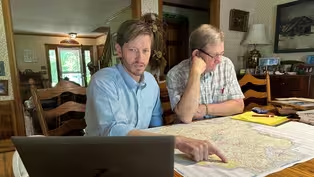
Video has Closed Captions
Clip: S2 Ep13 | 8m 8s | With Roe v. Wade gone could lawmakers limit reproductive decisions based on genetics? (8m 8s)
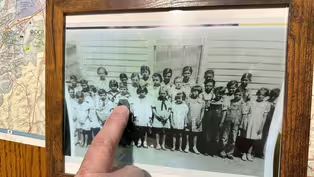
Family shows Franklin County is about more than moonshine
Video has Closed Captions
Clip: S2 Ep13 | 3m 46s | Father and son uncover a forgotten history about Franklin County. (3m 46s)
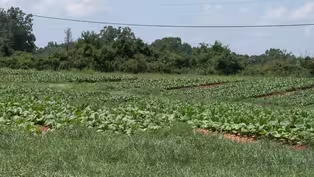
Video has Closed Captions
Clip: S2 Ep13 | 2m 59s | 95-year old Herman Harrison recalls growing up in Franklin County. (2m 59s)
How Virginia's tobacco legacy endures in repackaged form
Video has Closed Captions
Clip: S2 Ep13 | 4m 27s | Tobacco remains a prominent part of Virginia’s culture, despite its infamous roots. (4m 27s)

Moonshining in Franklin County: Bootlegging Goes Legit
Video has Closed Captions
Clip: S2 Ep13 | 4m 10s | Once the moonshine capital, Franklin County is home to a thriving white lightning business (4m 10s)

Video has Closed Captions
Clip: S2 Ep13 | 7m 25s | Project Exile aimed to combat the notorious record number of murders in the 1990's (7m 25s)
Providing Support for PBS.org
Learn Moreabout PBS online sponsorship
- News and Public Affairs

Top journalists deliver compelling original analysis of the hour's headlines.

- News and Public Affairs

FRONTLINE is investigative journalism that questions, explains and changes our world.












Support for PBS provided by:
VPM News Focal Point is a local public television program presented by VPM
The Estate of Mrs. Ann Lee Saunders Brown