
‘Noura,’ Black fraternities & sororities, ‘Wild Horses’
Season 7 Episode 23 | 26m 46sVideo has Closed Captions
Original storytelling at Detroit’s theaters, Detroit’s Black history, and a performance.
The Detroit Public Theatre presents “Noura,” a play about an Iraqi American family written by Heather Raffo. City historian Jamon Jordan gives an oral history of Detroit’s Black fraternities and sororities. Arts & Culture host Satori Shakoor talks with the director of a new play, “Wild Horses.” Plus, Detroit artist Eli Dyon sings acapella and raps on “Detroit Performs: Live from Marygrove.”
Problems playing video? | Closed Captioning Feedback
Problems playing video? | Closed Captioning Feedback
One Detroit is a local public television program presented by Detroit PBS
‘Noura,’ Black fraternities & sororities, ‘Wild Horses’
Season 7 Episode 23 | 26m 46sVideo has Closed Captions
The Detroit Public Theatre presents “Noura,” a play about an Iraqi American family written by Heather Raffo. City historian Jamon Jordan gives an oral history of Detroit’s Black fraternities and sororities. Arts & Culture host Satori Shakoor talks with the director of a new play, “Wild Horses.” Plus, Detroit artist Eli Dyon sings acapella and raps on “Detroit Performs: Live from Marygrove.”
Problems playing video? | Closed Captioning Feedback
How to Watch One Detroit
One Detroit is available to stream on pbs.org and the free PBS App, available on iPhone, Apple TV, Android TV, Android smartphones, Amazon Fire TV, Amazon Fire Tablet, Roku, Samsung Smart TV, and Vizio.
Providing Support for PBS.org
Learn Moreabout PBS online sponsorship- Hi, I'm John Sloan III and here's what's coming up on one Detroit Arts and Culture: The story of an Iraqi woman at Christmas time, what's behind some of Detroit's historic homes, and a play delves into the complexity and beauty of the human experience.
It's all ahead, on One Detroit Arts and Culture.
- [Announcer] Support for this program, provided in part by, the Kresge Foundation, the Cynthia and Edsel Ford Fund for Journalism at Detroit Public TV.
From Delta faucets to Behr paint, Masco Corporation is proud to deliver products that enhance the way consumers all over the world experience and enjoy their living spaces.
Masco, serving Michigan communities since 1929.
- [Announcer 2] The DTE Foundation is a proud sponsor of Detroit Public TV.
Among the state's largest foundations committed to Michigan-focused giving, we support organizations that are doing exceptional work in our state.
Visit DTEFoundation.com to learn more.
- [Announcer] Gregory Haynes and Richard Sonenklar, Nissan Foundation, and by contributions to your PBS station from viewers like you.
Thank you.
(upbeat music) - What up, though.
And welcome to One Detroit Arts and Culture.
I'm John Sloan III, a Detroit-based artist, activist, founder of GhostLight Productions, and producing artistic director of the Obsidian Theater Festival.
And while I managed to keep myself pretty busy, I'm thrilled to be guest hosting for Satori Shakoor as she reprises her role in the groundbreaking play, "The Kink in My Hair," at Toronto's Soulpepper Theater through December 23rd.
Now, because I'm a theater kid at heart, the only thing that could make this any better is the fact that I get to come to you from Detroit's iconic Fisher Theater, here in the new Ambassador Lounge.
Coming up on the show, the history behind Detroit's black fraternity and sorority houses, and the play, "Wild Horses" from the Obsidian Theater Festival.
But first, the play "Noura" by Heather Raffo runs at the Detroit Public Theater through December 18th.
This production focuses on an Iraqi woman who fled her country to the United States eight years ago.
As she's trying to celebrate the Christmas holiday, a visitor pops up and the family is forced to confront their past.
Let's take a look.
- I know you want to sponsor every Iraqi orphan, once we open that door, you know, it will never close.
- Not every orphan, one.
from Mosul, from my grandfather's church.
- You can't bring Mosul back.
- She's lucky to be alive.
The least we can do is help with school.
- Theater really is a tool to create empathy.
We're telling stories not to an audience, but with an audience.
- She's gonna stay a week.
At most two.
She's got school in California.
- You see these stories that maybe you don't know personally, but you can watch and say to yourself, "Oh, I know what that's like."
- I'm just saying, if you want to hold on to what Iraq was, maybe you need to remember who you were.
- Hey, who was I?
Who?
- "Noura" is about an Iraqi family that has immigrated to the United States and are really examining kind of what it means to be Americans, what it means to be Iraqi Americans, and they're celebrating Christmas.
And so just like any family, as they come together to celebrate their Christmas, a lot of things start, you know, feelings start coming out and a lot of things happen.
- Right, Alan?
It's the language.
This dinner in Arabic.
How different would it be?
Circling each other for hours.
Gossip underneath each word.
- Heather Raffo is an internationally-acclaimed playwright and performer who's work we have loved and admired for a long time.
And so this is a play that we wanted to produce for a long time.
And the moment was finally right.
- What inspired me to write "Noura" was the convergence of many things.
One being, when Isis overtook Mosul.
And just that sense of, I had Iraqi family in Iraq through multiple wars.
For thousands of years, my family had been rooted there, but that felt like the last straw in a way.
So, since that time and in the last 10 years, I've had family now scattered in diaspora across the world.
And "Noura" is hugely about family.
You know, it's a refugee family living in America, living in immigrant life, but very attached to back home and questioning if they're still Iraqi anymore.
That once you leave and if you leave in a particularly harrowing way, do you still have the roots system?
- I won't say anything.
- You're a doctor.
Why not just lecture me on smoking rather than my obsession with my dying identity?
And another inspiration was I had been working for four years with an Middle Eastern and Arab American community throughout New York City.
The stories they told were ones of strength and resilience, but all of them felt torn between culture, and the real pull between what America offers, which is a focus on rugged individualism, and what Middle Eastern culture offered, which was a focus on community.
And we all kept saying in this workshop like, "Why isn't there something a little bit more in between?"
And that's a line that Noura says in the play, is I need a country in between.
She wants something that can find the good of both and uplift that.
Do we live for each other or for ourselves?
I need a country in between.
- Heather Raffo is incredible.
She is such an inspiration.
What drew me to the play "Noura" was the fact that it was such a great representation of my culture.
I read her words when I was in Michigan and she was all the way in New York, and I couldn't believe how seen I felt by a person I had never met before.
So, I think she is just incredibly powerful, and she has an amazing ability to draw people in with her empathy and creativity and warmth.
And I think it does a great job, bringing awareness to the refugee crisis.
And it also does a wonderful job preserving our culture.
(indistinct radio voices) - Please turn it off.
I can't stand this propaganda.
Not on Christmas.
- No, they're the only ones praying for the refugees today.
- Noura, that channel's not even Iraqi.
It's evangelical out of Texas.
- What, you don't care?
How many in Erbil are trapped in malls, freezing on Christmas?
- Of course I case, but can't I have a day?
My whole year is saving other people's lives.
I would like a chance to live mine for once.
- Noura came here with her husband Tareq and their son Yazen eight years ago.
They live in New York City, and they've been sponsoring an Iraqi refugee named Maryam who lives in California currently.
And they're going to fly her out for Christmas dinner, and their friend Rafa also lives in New York.
I believe it sparks a lot of conversations about what it's like to live here now and be an American and what they left behind from their past.
- No, you can live amongst Arabs or Christians or Iraqis anywhere in the world.
It would never be the community it was.
Not again.
- But don't you feel a great loss?
- Yes.
- The play "Noura" honors that tremendous weight of leaving home in two ways.
It allows some of the characters in the play to want to leave home, to want a new life, to want to forget.
And it allows other characters in the play to struggle with feeling like they have to forget and they have to move on.
It allows for a feminist, female central character to be the one who doesn't wanna have to move on, and yet realizes that she is being forced to, in a way, just for her own survival.
And she gets to speak a monologue in the end that I would say the entire play was written in order to be able to speak this monologue in context.
No wonder so many of us are drowning.
The responsibility, it's just, it's impossible to bear.
it's just the way to be erased.
- I think all audiences can relate to what it feels like to search for a place to call home.
There are so many moments and Heather writes this beautifully, where we are fighting for the love and then we might have a moment where we lose the love, but then we recover and we try and find love again.
And I think everyone has experienced moments like that.
- Who do I love?
- Me.
- Who else do I love?
- Dad.
Nana.
All of our family, all over the world.
- Who the most?
- Me.
(audience laughing) - I mean, I think what is most touching about this piece is the way this family navigates love.
There is a really beautiful scene between Noura and her son, that is just speaks volumes of, you know how close this family is.
There's an also an incredible scene between Noura and her best friend from childhood.
He is Muslim and she's Christian.
And they are discussing both just what it was like growing up back home, how well they know each other, but also the divisions that feel like it, they're, it's shaping their older lives that didn't used to be when they were young.
And then there's of course this incredible relationship between this married couple, that has weathered so many things and finally begins to talk about some of their history.
And I think that in each of those respects, audiences will feel like they are both getting to eavesdrop on very intimate moments in people's lives, but also recognizing things very true to their own experiences.
- Of course, she doesn't know who the father is.
She should have saved everyone the trouble.
Most of all, the tortured kid.
- Why can't she want a child?
- When you're a 20-year old orphan running from medieval madmen, whisked off to an American university, the last thing you want is a burden.
- You know, I've never heard you so spiteful.
- She has a hold on you.
I hate seeing you attached to someone I don't trust.
She could hurt you.
- How?
- It's a huge honor to be bringing, telling this story in the largest Arab American community in the country.
It was also really important to us that this cast in this community be Arab American.
- There's a specificity to this cast, in that we have two Chaldeans in the cast playing Chaldeans.
We have an Assyrian playing Chaldean.
And so those are three Iraqi Christians playing Iraqi Christians.
We also have Cal Nega, who's an Egyptian movie star, a Muslim playing the role of the Muslim best friend.
It's just everybody is bringing their own cultural specificity, and mixing that with how they see the characters.
You know, we really got to experiment with this play in a really fresh and interesting way.
And for that, I feel really fortunate.
- I hope that the Iraqi American community can come and see this show and see themselves in it.
I want them to feel the way that I felt when I first read this play, that it felt like home.
It felt like being seen.
- As playwrights as, I'll just speak for myself.
I bear my soul, I bear my heart.
I say the bravest things I can possibly say.
When I'm performing, I try to do my bravest work by embodying that.
And all of that means that I would never tell anyone what to think of it.
But I think that, in this piece, if I did have a wish, it's just that they go forth with their family, with a stranger, with their neighbor into a deeper conversation.
I don't know how to let go and hold on at the same... - Detroit is filled with historical landmarks, and that includes some of the city's black fraternity and sorority houses.
City of Detroit historian Baba Jamon Jordan gave us a history lesson on the significance of the Black Greek letter organization's houses and the contributions here in Detroit.
He teamed up with American Black general producer and videographer Marcus Green to provide us with some historical insight.
- African American Greek fraternal organizations and sororities have been a major part of African American history for over a century in the United States.
But not only have they been important in United States history, in African American history in general, they've been a very vital part of Detroit's Black history.
We going to take a tour of this history in these historic places in the city of Detroit that are tied to these African American Greek letter fraternities and sororities.
We are now at the home for the Alpha Phi Alpha fraternal, fraternity house.
So, the chapter is the Gamma Lambda chapter in the city of Detroit.
Now Alpha Phi Alpha, of course, is the first African-American collegiate, Greek letter fraternity, founded in 1906 at Cornell University.
But Detroit's chapter would be founded a few years after that.
And not only would they be founded, they'll be led by some of the most prominent African-American Detroiters in history.
There's been two mayors in the city of Detroit who were part of Alpha Phi Alpha, Kwame Kilpatrick and Dennis Archer.
The Alpha Alpha Gama Lambda chapter moved into this house in 1939.
They are the first African American fraternity and Greek-lettered organization to own their own house in the city of the Detroit.
At 269 Erskine, we have the Kappa Alpha Psi fraternity house, another African American fraternity founded in 1911.
They're right around the corner from Alpha Phi Alpha's house at 239 Elliot.
Also in Brush Park, one of his most well-known members is a man named Dr. Ossian Sweet.
And so Kappa Alpha Psi has enjoyed an important history in the city of Detroit, and they've owned their fraternity house in the city of Detroit since 1945.
At 235 East Ferry Street, we have the fraternity house of the new Omega chapter of Omega Psi Phi.
Omega Psi Phi is the second Greek letter fraternity to own, African American Greek letter fraternity to own their own home in the city of Detroit.
And they own it in this cultural center neighborhood in the city of Detroit, a couple of blocks away from the Detroit Institute of Arts and the Charles H. Wright Museum of African American History, the Detroit Historical Museum, and the campus of Wayne State.
And they buy this home in 1942, and they would get their home, being the second fraternity, black fraternity in the city of Detroit to own their own home in 1942, just three years after Alpha Phi.
At 24760 West Seven Mile is the Detroit alumni chapter of Delta Sigma Theta's Center.
In 2010, they moved from a smaller building, a little few miles down the road to this 50,000-square foot building.
They moved into this car dealership, transformed it to a event center, headquarters, meeting place, office building, and really brain trust of the alumni chapter of the Detroit Delta Sigma Theta.
They've been a vital force in the city of Detroit and they've been in the city of Detroit for years, for decades, and they've owned their own house, but they've moved from a house to a center, a 50,000-square foot facility that is a major part in the city of Detroit, at 24760 Seven Mile Road at Seven Mile in Grand River.
Alpha Kappa Alpha Sorority Incorporated is the oldest black Greek letter sorority in this country.
So as we are at the 100th anniversary of the AKAs, the AKAs, of course are profoundly involved in Detroit's history, although they do not have a sorority house in the city of Detroit.
The Alpha Rho Omega chapter, the Detroit chapter of Alpha Kappa Alpha Sorority has a foundation, and that foundation has a headquarters in downtown Detroit at 1525 Howard Street.
It's been there since 1987.
So for 35 years, Alpha Kappa Alpha Sorority Incorporated, at least the Alpha Rho Omega chapter, has had a building that houses the headquarters for their foundation.
African American Greek letter fraternities and sororities are a major part of American history, a major part of African American history, and a major part of Detroit's black history.
One of the major reasons why is because in what these organizations represent is scholarship.
These are people who have gone to college, who are in college, and come out and become leaders.
They become leaders in medicine.
And so many of the African American doctors come out of these Greek letter fraternities and sororities.
They're leaders in law.
Many of them end up as as attorneys and politicians.
Of course, two mayors have been members of Greek letter fraternities of the city of Detroit, two mayors of the city of Detroit have been members of African American Greek letter fraternities.
And they are, they have been a major plank in black leadership, in black success.
And so as the African American community looks at these organizations, they're looking at people who have excelled in college, people who have excelled in business, people who have excelled in their careers and professions, and people who have excelled in political leadership.
The fact that these organizations still have houses speaks to their determination and their ability to to weather the storm.
And they're still around in the city of Detroit to this day.
- A couple of years ago, in the midst of a global pandemic and civil uprising, the company I founded, GhostLight Creative Productions, partnered with the Nicely Theater Group to create the Obsidian Theater Festival.
OTF exists as an exciting new project, a platform that highlights and celebrates the rich diversity of stories relevant to the people of the African diaspora in America.
We celebrate blackness, y'all, in all its presentations and understandings.
This year we were honored to feature the play "Wild Horses" by Brandy Victoria Durham.
The story follows a black couple who goes camping and is faced with a challenging experience brought on by a fellow camper.
Earlier, Satori Shakoor sat down with the play's director, Ny'ea Reynolds to discuss the meaning behind this production.
- Oh, we getting started already?
- We're celebrating.
- Celebrating?
- Yeah, your first voyage into nature.
(glass clinking) - I'm excited to be sitting here with Ny'ea Reynolds, director of "Wild Horses" for Obsidian Fest.
Welcome, Ny'ea.
- Thank you so much.
It's good to be here.
Thank you for having me.
- So, can you tell us a little bit about Obsidian Fest and your role as director of "Wild Horses?"
- Yep, so Obsidian Theater Fest is a festival that's taking place right here in Detroit.
We have several productions that consists of plays, cabarets, musicals.
So, I happen to be a director for one of the plays and these are short plays that are put on.
And so, we had a couple weeks to rehearse, and then we got into the theater space at the Y, and we put on our show.
We had an amazing, amazing time.
I'm absolutely honored to have been a part of that process.
- Okay, and you directed "Wild Horses?"
- [Ny'ea] "Wild Horses," yes.
- What is that about?
- So, "Wild Horses" is actually, it has a couple of different meanings if you really think about it, but what "Wild Horses" really hit on was the idea of the image of the black person in America.
So, you got this couple, this black couple in particular, and they decide to go camping.
And there's this running joke that black people don't camp, black people don't camp.
This is not something that black people do.
So, they're out, they're trying to enjoy their time in the wilderness, and as they're doing that, they're being looked at as a spectacle in the white eye frame.
So, a white woman comes in, and you know, she eventually presents herself as this friendly person, but there's this undercurrent that, you know, there's a lot of microaggression happening, there's a lot of prejudice and assumptions on both ends, and things get really, really outta control towards the end.
And it's just the idea that, you know, black people are looked at as this thing to be stared at or looked upon, but they're also something to be afraid of, like a wild horse.
They're beautiful to look at from a distance, but you might be scared to get too close to 'em, because you don't know what they're gonna do.
And it kind of plays on that idea that we are black people, we are humans, and you know, we have a range of emotions, and you can't just pick at us, you know, just because it seems like something interesting in the moment or because you're afraid.
So, it really plays on a lot of different things and it's just a really beautiful piece overall.
- You're here.
- The Rangers?
- No!
Horses.
(horses running) Look.
Wow.
(horses neighing) - They're free.
- What should we take away from the piece?
- I would say the biggest thing to take away from it is that we are not a monolith, as black people.
We are complex, we are beautiful, we are afraid, we are powerful, we are loving, we are sad, right?
But at the end of the day, we are people, and that's black, white, any race that you are, we're all people.
And we should look at each other as such with that eye of humanity and not come in by looking at somebody's color of skin, and judging them based off of that, and assuming X, Y, and Z about a person.
- We were just about to take a walk.
- Uh-huh.
- Do you think that's such a good idea?
Walking alone in the dark with him?
- Who?
The thug of Asertin?
- That's enough, Jenny.
Now please go.
- I had the honor of being able to meet our playwright and to talk with her.
We talk to each other on Zoom, because she lives out state, but-- - And who is the playwright?
- Brandy, so she was, she was our playwright, and I was able to really like get an understanding of who she is and just, you know, where she comes from, what inspired her to write this story.
I think those are important things to know, when I am about to go and direct something.
Not that I'm just taking a piece that's already done, and I can just do whatever I want with it, but I really like to take the time to understand why a playwright went in a direction that they did.
And then that helps me in the collaboration process, to begin to think like that as well.
And then put my own creative vision in it.
So, it all works together.
- [Satori] Yeah, yes.
- [Ny'ea] It all works together.
- [Satori] How long have you been directing?
- So, I've been directing for about four to five years, off and on.
I do some other things in the arts as well, but my heart started with acting and then it moved into directing.
And I really see myself in the long run just being behind the scenes and really taking on that directing role.
I just, I love to create stories.
I love to be given stories and to create from there too.
You know, it's like someone giving away their own baby and you just have to take it and build on it.
- What is your mission as a director of stories?
- I really, really value the idea of camaraderie and just empathy.
Even if there's a play where you have characters where it's like, I'm not not rooting for that character.
That character is the bad guy.
At least we have to have an understanding of where every character comes from.
There's a backstory.
Even if the backstory is not on the pages, we gotta create that, because these are still people.
Each one of these characters are still people.
And that's what I wanted to emphasize, even with our other character who most people probably may not root for, because it was that idea of, we don't know what this lady's about, what she's gonna do.
We made it a point to make a backstory for her and really understand who she is, what her influences in life were, because she didn't just wake up and do whatever she wanted to do, just because we needed an opposing character, right?
And to look at the other two characters and understand, what are their perspectives?
Are there things that maybe they've been sheltered from, that they might misunderstand about the other side?
It just, I'm very interested in playing on all of those different things, but still telling the same story.
- I love it.
It's like you're a synthesizer of humanity.
- Yes, I'm all about it.
Just working together.
I mean, we already know, the world is just so many things.
So, it's nice to have moments where we can really just come together and create our authentically, but also at the same time, make sure that we understand, even if we're all coming from different places, let's try to have understanding somewhere.
- Thank you so much, Ny'ea Reynolds.
It was pleasure talking with you.
- Thank you.
- For more information on all of our arts and culture stories, go to our website at onedetroitpbs.org.
Thank you for joining me and thank you to the Fisher Theater for having us.
That's gonna do it for tonight.
For everyone here at One Detroit, I'm John Sloan.
See you next time.
(soft music) - [Announcer] You can find more at onedetroitpbs.org or subscribe to our social media channels, and sign up for our One Detroit newsletter.
Support for this program provided in part by, the Kresge Foundation, the Cynthia and Edsel Ford Fund for Journalism at Detroit Public TV.
From Delta faucets to Behr paint, Masco Corporation is proud to deliver products that enhance the way consumers all over the world experience and enjoy their living spaces.
Masco, serving Michigan communities since 1929.
- [Announcer 2] The DTE Foundation is a proud sponsor of Detroit Public TV.
Among the state's largest foundations committed to Michigan focused giving, we support organizations that are doing exceptional work in our state.
Visit DTEFoundation.com to learn more.
- [Announcer] Gregory Haynes and Richard Sonenklar, Nissan Foundation, and by contributions to your PBS station from viewers like you.
Thank you.
(soft credit music)
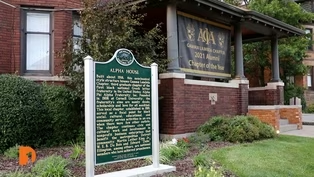
Detroit’s historical Black fraternities and sororities
Video has Closed Captions
Clip: S7 Ep23 | 5m 36s | Tour Detroit’s Black fraternities and sororities and learn about their contributions. (5m 36s)
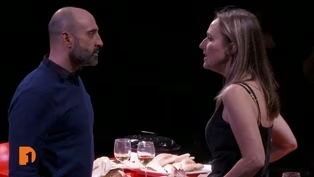
‘Noura,’ an Iraqi American story at Detroit Public Theatre
Video has Closed Captions
Clip: S7 Ep23 | 9m 46s | "Noura” tells the story of an Iraqi American woman family after fleeing their Iraqi home. (9m 46s)
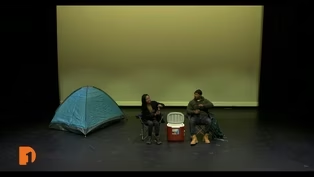
Obsidian Theatre Festival features ‘Wild Horses’ play
Video has Closed Captions
Clip: S7 Ep23 | 6m 19s | “Wild Horses” follows a Black couple who faces a challenge while they’re camping. (6m 19s)
Providing Support for PBS.org
Learn Moreabout PBS online sponsorship
- News and Public Affairs

Top journalists deliver compelling original analysis of the hour's headlines.

- News and Public Affairs

FRONTLINE is investigative journalism that questions, explains and changes our world.












Support for PBS provided by:
One Detroit is a local public television program presented by Detroit PBS