
Nov. 2, 2026 - Full Show
11/2/2026 | 26m 47sVideo has Closed Captions
Watch the Nov. 2, 2026, full episode of "Chicago Tonight."
Concerns over voter intimidation as Election Day approaches. And how cuts to pregnancy care are impacting communities.
Problems playing video? | Closed Captioning Feedback
Problems playing video? | Closed Captioning Feedback
Chicago Tonight is a local public television program presented by WTTW
WTTW video streaming support provided by members and sponsors.
Nov. 2, 2026 - Full Show
11/2/2026 | 26m 47sVideo has Closed Captions
Concerns over voter intimidation as Election Day approaches. And how cuts to pregnancy care are impacting communities.
Problems playing video? | Closed Captioning Feedback
Where to Watch Chicago Tonight
Chicago Tonight is available to stream on pbs.org and the PBS app.

WTTW News Explains
In this Emmy Award-winning series, WTTW News tackles your questions — big and small — about life in the Chicago area. Our video animations guide you through local government, city history, public utilities and everything in between.Providing Support for PBS.org
Learn Moreabout PBS online sponsorship>> Hello and thanks for joining us on Chicago tonight.
I'm Brandis Friedman.
Here's what we're looking at.
>> Chicago and Illinois voters will not be intimidated and we will not be silenced.
>> Voting rights advocates prepare for Election Day amid concerns of voter intimidation across the country.
Plus, what exactly happens to your ballot after you vote?
We explain.
And cuts to labor and delivery services at Chicago area.
Hospitals are becoming more common.
We look at the impact.
>> First off tonight, we are one day out from the midterm elections.
Many eyes will be on Congress and whether Republicans can hold onto control in the House and Senate as Democrats hope for a blue wave.
All 17 seats representing Illinois are up in the U.S.
House as well as one Senate Early voting is already underway in Chicago, including at this polling place on the North side where the line stretched out the door more than 180,000 Chicagoans have voted early as of Sunday, along with over 100,000 who have voted by mail.
For more on the candidates running and information on how to find your polling place.
Check out our website that's at W T Tw dot com Slash voter guide.
Another budget struggle at City Hall.
This time 44 City council members voting in favor of making a bigger pension payment in next year's budget.
But it might create another 75 million dollar budget hole.
>> It was clear that the 75 million dollars was clearly meant as a one-time.
Little shot in the arm to these to these pensions.
And it was it was a bit disingenuous to put it in the budget knowing that wasn't the intense.
I do appreciate the chair woman's words that this puts a 75 million dollar hole in the in the mayor's budget.
>> Alderman say the 75 million dollar payment the city received for the sale of park the parking meter deal should be made on top of the mayor's plan payment of 2.9 billion dollars.
But as the city's pension funds have been so woefully underfunded for years, council members want those 75 million dollars to go on top of the planned payment.
Not to help make it up.
Johnson's budget Chair Alderman Jason Ervin says the city may have no choice but to slash proposed spending for programs like libraries or to address homelessness for just how much the city is paying into its pension funds.
Visit our website.
Chicago's former FBI chief is suing the current U.S.
attorney saying he was scapegoated and forced into retirement this summer.
Douglas DePodesta, he is seen here is suing Andrew Boutros along with the FBI and the Department of Justice DePodesta claims that Boutros told officials top officials in DC but the protest was at fault for the unraveling of the so-called Broadview 6 case related to protests last year outside the ICE detention facility in Broadview.
The former agents sister is a defense attorney for one of the former defendants.
But deep Augustus says he would never discuss the case with her.
The case fell apart in May of this year amid allegations that one of the assistant U.S.
attorneys working under Boutros engaged in improper grand jury proceedings.
Meanwhile, Boutros and others have been ordered to testify under oath about the broad view 6 case on November.
16th.
For more on that visit our website.
3 former Cubs managers are on the ballot for baseball's Hall of Fame.
This list includes Joe Maddon who led the Cubs to their first World Series title in over 100 years and 2016 Skipper Loop Anello who led the team from 2007 to 2010 and was voted manager of the year in 2008 and Dusty Baker who manage the North Siders from 2003 to 2006, they joint 5 others on the contemporary era committees list of managers, executives and umpires being considered.
They'll need 75% of the vote to get inducted next July, along with the players who are selected separately, the vote happens in December.
The city is 113 official Christmas tree has a special story in its roots.
This 50 foot tall, Norway spruce comes from the Clarke family of Kane County.
Mandy Clark says it was a sapling in a pot back in 2004 when it was gifted it after the death of her husband's grandfather over the decades, though it's become so big that it needs to be relocated.
The Clark family says their donation to the city is a great way to celebrate the life and legacy of her.
Now late husband Michael and his grandfather, the city's tree lighting ceremony will be on November.
20th.
Up next, local efforts to push back against potential voter intimidation this election season.
That's right.
After this.
>> Chicago tonight is made possible in part by the Alexander and John Nichols family.
The Joyce Foundation.
The Pope Brothers Foundation.
And the support of these donuts.
>> Election Day is tomorrow.
And many voters are wondering what to expect at the polls last month the Department of Justice announced plans to send election monitors to polling places around the country, including Lake County in northwest Indiana.
Meanwhile, voting rights advocates in Chicago are hoping for smooth election, but are preparing for anything such as voter intimidation.
This all follows a redistricting battle court decisions on mail-in voting changes and more.
Joining us now with what you should know ahead of Election Day are Steven Schwinn a law professor at the University of Illinois, Chicago.
Kristina Beeler, senior counsel at the Chicago Lawyers Committee for Civil Rights and Emily Schrock.
Also senior counsel at the Chicago Lawyers Committee for Civil Rights with a focus on voting rights in Indiana.
Thanks to all of you for joining us.
I'm Christina starting with you.
What are you prepared for in Chicago on Election Day?
>> They for whatever our way.
So we hope that we are preparing for a very boring election day tomorrow.
elections boring But anything were to happen, they, for example, voter intimidation or federal agents at the polls.
we don't expect we are prepared to take action and it any boaters, see anything that they're concerned about.
should call 8, 6, 6 our votes.
We are nonpartisan Securus a free hotline for voters to call in with questions or concerns.
And we are standing by and ready all day tomorrow.
>> Kristina, what's the possibility that ICE or Border Patrol agents should show up at polling locations tomorrow?
>> So we do expect to see it Border Patrol agents at polling locations.
And if we did, it would be illegal for them to be there.
Federal law prohibits voter intimidation and prohibits federal agents from going to the polls.
So there are currently several lawsuits challenging preemptively the deployment of ice or federal agents at the polls or a type of our partners who are engaged in those lawsuits and ready to take action ourselves as well if needed.
We don't expect to see yet.
But if we do, we are ready to take action because it would violate federal law.
>> Emily focusing over in Indiana.
What do we know about DOJ?
Election monitors being sent to Indiana?
>> 2 of our counties, but Marion County and Lake County have both received notifications that DOJ as election monitors will be on site.
I've been in contact with the election boards for each of those counties and have they've gotten similar responses from DOJ in conversations with them.
We are expecting 12 monitors that each of those counties they're supposed to be paired up in plain clothes, but they're not allowed to interfere with the election so voters should feel safe to go vote even if they do encounter.
Election monitors.
And I will say that I have learned from our partners that the DOJ monitors to have the ability to do an exit survey.
And so voters may be asked questions leaving the polls, but you are not required to talk to anyone.
When you leave the polls.
>> Ok, and you mentioned Marion County, of course, that's where Indianapolis is you know, what does the law say about what these monitors can and cannot do?
>> Absolutely.
So these monitors were part of actually the original Voting Rights Act in 1965.
The start of them was to keep elections safe and secure when states were not doing that.
So now we have the DOJ miners coming in maybe to just make sure it's just safe and the election officials here in Indiana are cautiously optimistic that that is exactly what they're going to be here to do.
But we do know that they do not have a right to be in the polling location.
And here in Indiana, we have no electioneering within what we call the shoot, which is the 50 foot mark before voting occur.
So and anything physically within 50 feet of where voting occurs is not allowed by our DOJ election monitors or electioneering in general.
So there should be no encounters with them going into the polls as they're not supposed to talk to voters going into the polls.
They're not supposed to talk to them in the polling location themselves and only outside of that 50 foot Shuai they allowed when they're exiting the polls.
>> Steve, even before getting to Election Day, Howell says this administration sort of challenge the norms around voting rights around us where to even start.
Let's count the ways.
So this administration has issued a couple of executive orders that have been struck by the courts.
One, as we talked about last time with regard to the postal Service and dry land.
Allen exactly another one, creating a federal list of registered voters which the federal government just historically has not done.
And then more recently Brandis we've seen the Department of Justice move to intimidate local election officials by sending them a different letter saying that they're going to be prosecuted basically for doing their job.
And so we have a federal court in California that just over the weekend issued a landmark ruling telling the Justice Department that they can't threaten or intimidate voters or election officials in the upcoming election.
We also heard the administration in a couple of states, you know, asking those states are courts to withhold some ballots depending on on the outcome of the election and various efforts to sort of intervene.
>> But you know that plus, all of the other things that you've named to a kind of cumulative impact this.
What does all of that all of that have on elections?
Well, I think time will tell.
We'll see what happens with voter turnout tomorrow.
But so far the signs are good.
We've seen record breaking turnout in early voting.
>> We've seen lines in the year in the intro to the segment, we saw lines going around the block in Chicago.
So this is very exciting and hoping that voters are going to ignore the noise and nevertheless show up at the polls.
>> Kristina beyond providing legal support what other forms of voting rights advocacy are people preparing to engage and tomorrow?
>> Yeah.
So we're also just prepared to answer basic questions.
So if someone wants to know, hey, what ID do I need to take to the hall?
Hey, how do I do same day registration or, for example, a question we got today.
Hey, just been hospitalized and I'm not going to be able to get to the polls where my options we can either answer basic questions where we can help you solve a problem.
And we also can do advocacy with local election authorities.
>> Stephen, what are the possible scenarios for election challenge is extending beyond Election Day?
Well, so there are a lot of possibilities.
And and part of it is we just don't know.
Brandis.
We've seen this administration take extraordinary efforts in past elections and in this election makes it very, very difficult to know what to predict, but what we can expect, I think, is challenges at the state level.
So state challenges to state election results, possibly federal challenges as well.
We've already stunt seen the Department of Justice move in that direction in California and Washington and Alaska.
And they may move forward with those lawsuits challenging the outcome of the election.
>> Emily, how have Department of Justice election monitors historically been used in the past?
>> Yeah.
In the past they were used to prevent racial discrimination and it was making sure that states were not having poll taxes or anything else that made people of color feel any certain way about voting.
It is the right of every eligible voter and the United States to have the right to vote.
And it's the states that have the time place and manner ability to decide on how you vote.
So it was its beginnings.
It was to prevent any issues.
And I think that kinda to what we're hearing about with this administration, unfortunately, we are seeing a bit of a chilling effect just by them being president because current administration's decisions regarding the Department of Justice.
So here Indiana, we've been trying really hard to promote early voting if people feel chilled by decision by Department of Justice.
But also we're just asking voters if you see something that doesn't seem right.
Please call the hotline at 8, 6, 6, are both because that you should not feel intimidated at the polls.
We'll have a threat of intimidation itself.
So and you know that original impetus of monitors with was wholesome and like I mentioned, are board of elections.
Here is really cautiously optimistic that that remains the same.
>> All right.
Just to be clear, that is 8, 6, 6, O Ur vote Vo Ti and I'm I think journalists and attorneys alike are all in favor of Christina's idea to make elections boring again.
Me.
But maybe we should get some Thanks to the 3 of you for joining Kristina Baylor, conceived during things, everybody.
Thanks for Up next, the impact on maternal Health has another Chicago area maternity ward shutters.
>> Chicago >> area maternity services are becoming fewer and farther between over the weekend, the maternity ward at Roseland Community Hospital shut its doors.
It is the 4th labor and delivery department in the Chicago area to suspend services in just 30 days.
Rosen's administration says the closure was necessary due to declining birth rates and cuts to federally funded programs.
Now, hospital staff and expectant mothers are left to figure out what's next.
Joining us to talk more about this is Dr Joy West, the now former chair of the Department of OBGYN at Roseland Community Hospital.
We also reached out to Roseland Community Hospital and received a statement which we'll get to in just a bit.
Dr West, thank you for joining us.
Thank you for having So patients and staff at the hospital only given a few weeks initially it was thought to be December.
It got moved up to October 31st before the hospital would be suspending labor and delivery services.
Was this a shock to Was absolutely was a shock.
>> We had known for awhile that our volume was decreasing.
But we didn't think that it would happen.
So suddenly so we were devastated.
We're still devastated.
Any reason why the volume of deliveries might have been decreasing?
Were patients going elsewhere or people having fewer babies?
People are having fewer babies.
So birth volumes are down everywhere.
However, labor and delivery unit still have to be ready.
>> For anyone that comes into the hospital.
So even with the low volume, we were prepared for any patient that what com in the door.
But still, again, we did not expect the closure.
You've worked at Roseland for over 20 years.
What is it like knowing that this the hospital where you've spent, you know, this chunk of your career won't be offering these services anymore.
deeply personal to me.
24 years.
These are families that I know.
I know the community, the workforce than nurses.
We have really build a tight knit community there.
We all care about the patients that come through the doors there.
So not only is it professionally devastating for me, but also personally a big challenge right now.
We are looking now for ways to help the emergency room staff there prepare for what would they do have to take on that burden of taking care mom, right where and hopefully we can come back to that in a minute.
But I want to get to the statement from Roseland President CEO Timothy Egan.
It reads in part, quote, Roseland Hospital administration has fought a battle every day for 14 years to keep labor and delivery open in spite of tremendous odds, suspending labor and delivery is not a decision Roseland made by choice.
It is the result of decades of historical underfunding of safety net hospitals that made it impossible to sustain services that this community depends on and deserves.
Do you think that there's more that the hospital administration could have done to maintain the services?
I like to think so.
However, this is not an isolated incident.
Hospital labor and delivery units are closing across the country.
And so the financial burden of maintaining a Lindy unit really falls not just on the hospital.
It really is systems that create devaluation of moms.
And so the expense of a labor and delivery unit is usually burdened by Medicaid.
The majority of patients in our communities, our Medicaid reimbursement rates are low.
So we have a system in place where you're being reimbursed at a lower rate than the actual expenses.
So I wouldn't say that it was it's necessarily Roseland Hospital when I know it's happening all over the South side, 20 over 20 labor and delivery units have closed on the South side in the last 10, 15 years.
So, yeah, it's a pattern.
The closest hospitals to Rosen with labor delivery services are now more than 4 miles away.
What does this mean for patients in that area?
That means patients are going to have to travel longer distance.
They're going to have to bear the burden of getting from communities where they're already challenge with transportation issues in come issues.
And we know that maternal and fetal outcomes poor when patients have to travel far from home.
And so speaking maternal fetal outcomes, according to a 2025 report from the Illinois Department of Public Health, Black Women in Illinois are more than twice as likely to die from any pregnancy-related condition.
>> And 3 times as likely to die from a pregnancy-related medical condition white women.
It also found 91% of maternal deaths were potentially preventable.
Do you see this?
The closure just furthering the disproportionate impact on black without salute Lee, when you have communities that are already dealing with persistently high morbidity and mortality rates.
>> And you remove access to maternal health care outcomes are going to be poor.
It's like removing a fire station from a community that has lots of fires.
And so maternal outcomes are are going to be worse with the lack of access to labor and delivery services.
As you mentioned, you and other staff members Lindy are working to sort of support your emergency staff to figure out how to manage if a woman still comes in because of the fact is, I mean, patients might still come to Roseland because it's the closest hospital and they've got an emergency.
What does this mean for the staff there and outcomes for those patients who arrive?
Yeah.
A part of the sudden announcement of the closure was a frenzy to get the emergency room staff prepared.
We want our patients to be able to come into the emergency room and be assessed stabilized and transferred.
Now, that's not the optimum situation.
Of course, we'd love to take care of them right there at the hospital.
But we want to make sure that that ad staff is ready to take care of the patients.
So we have done the best we can to prepare them to take care of patients who may just walk through the doors of of the emergency room.
You and other staff members have called on local and state leaders to take action to invest in safety net hospitals because we have seen several others in the area and around the state close.
>> 30 seconds left.
Doctor Election Day is tomorrow.
What does meaningful action look like to you?
>> It means caring for and placing value on the most vulnerable women in the community.
It means taking time to look at the systems that are in place that are not working.
That lead to the sort of closure.
It means simply putting our money where our values are and that's in the lives of women and babies.
Dr.
Joy West, thanks for joining us.
Best of Luck.
Thank thank you for having me.
Up next, we take a look at how your vote gets counted.
>> Reflecting the people and perspectives that make up can This story is part of Chicago tonight.
Black Voice.
>> Tomorrow is still election day.
And there's a lot that goes into it from finding your polling places to researching the candidates who are running.
But what happens to your ballot after you cast it as part of our series W T Tw News explains, we explore the journey over Chicago ballot.
Here's Amanda been a key.
>> You've done your research.
Major choices.
Cast your ballot.
Then you cast a couple more on behalf of your dead relatives.
the Chicago way.
>> Just getting so you earned your I voted sticker.
What happens next?
In Chicago when you feed your on Election Day, if you're essentially putting it in a ballot box with 2 compartments ballots with write-in candidates, stay separate in one compartment election Jasper counties by hand.
At the end of the night, all other ballots are scanned and counted by machine from lucky for the judges of the place.
It would be a lot of counting.
>> Once the polls close machine spit out a tape of the totals like a receipt.
>> Election judges work in bipartisan teams at each precinct to keep an eye on everything they certify things went smoothly and that pellets were compromised when they signed the receipt and other legally binding documents, then they use cellular device to transmit the totals downtown to election central.
>> That's when we begin to see the results.
But it's not all The paper ballots that into the machine don't get tossed.
They go into a big new hard shell case on wheels packed up with a pretty bow or rather a security seal to ensure nobody messes with the precious cargo from then on anyone who touches the case has to sign a chain of custody him like evidence.
And one of those TV procedural dramas.
Thousands of suitcases from every Chicago precinct go to a warehouse where they stay signed, sealed, delivered for at least 22 months.
Just in case some will be open and review as an extra check by law.
A state audit recounts votes from 5% of all precincts procedures differ slightly for voting by mail early voting and those who vote from overseas.
But not by much.
All legitimate ballots are counted, kept secure at every turn and end up in the same warehouse for safekeeping.
So where that sticker with pride and peace of mind and building.
>> Kathy >> voting indeed.
You can watch more from our series W T Tw News explains on our website.
And that's our show for this Monday night.
Stay connected with our reporters and what they're working on by following us on Instagram at W T Tw Chicago and join us tomorrow evening at 5, 30 10 for special election night coverage.
We'll be live at campaign headquarters to bring you results and analysis.
Now for all of us here in Chicago Brandis Friedman, thank you for watching.
Stay healthy and safe and have a good night.
>> Closed captioning is made possible by Robert a cliff and Clifford law offices, Chicago, personal injury and wrongful death from that gives back to

Cuts to Chicago-Area Labor, Delivery Services Are Becoming More Common
Video has Closed Captions
The maternity ward at Roseland Community Hospital shut its doors over the weekend. (7m 9s)
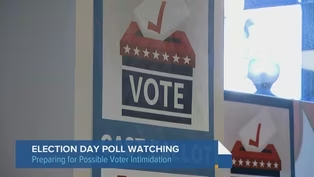
Voting Rights Advocates Prepare for Election Day Amid Intimidation Concerns
Video has Closed Captions
Many voters are wondering what to expect at the polls. (8m 58s)
Providing Support for PBS.org
Learn Moreabout PBS online sponsorship New Episode
- News and Public Affairs

Top journalists deliver compelling original analysis of the hour's headlines.

- News and Public Affairs

Today's top journalists discuss Washington's current political events and public affairs.




 New Episode



 New Episode



Support for PBS provided by:
Chicago Tonight is a local public television program presented by WTTW
WTTW video streaming support provided by members and sponsors.