
November 10, 2023 - PBS NewsHour full episode
11/10/2023 | 57m 46sVideo has Closed Captions
November 10, 2023 - PBS NewsHour full episode
November 10, 2023 - PBS NewsHour full episode
Problems playing video? | Closed Captioning Feedback
Problems playing video? | Closed Captioning Feedback
Major corporate funding for the PBS News Hour is provided by BDO, BNSF, Consumer Cellular, American Cruise Lines, and Raymond James. Funding for the PBS NewsHour Weekend is provided by...
November 10, 2023 - PBS NewsHour full episode
11/10/2023 | 57m 46sVideo has Closed Captions
November 10, 2023 - PBS NewsHour full episode
Problems playing video? | Closed Captioning Feedback
How to Watch PBS News Hour
PBS News Hour is available to stream on pbs.org and the free PBS App, available on iPhone, Apple TV, Android TV, Android smartphones, Amazon Fire TV, Amazon Fire Tablet, Roku, Samsung Smart TV, and Vizio.
Providing Support for PBS.org
Learn Moreabout PBS online sponsorshipGEOFF BENNETT: Good evening.
I'm Geoff Bennett.
Amna Nawaz is away.
On the "NewsHour" tonight: Bombings hit closer to hospitals in Gaza City, making conditions for civilians even more desperate, while the number of journalists killed also rises.
JODIE GINSBERG, President, Committee to Protect Journalists: What this increasing number of deaths means is that our ability to understand what's happening in Gaza and increasingly what's happening in the West Bank diminishes.
GEOFF BENNETT: Demand outpaces supply for a recently approved treatment to protect children from the respiratory virus RSV.
And David Brooks and Jonathan Capehart weigh in on the outcome of this week's elections and how Joe Manchin's decision not to run for reelection could shake up the U.S. Senate.
(BREAK) GEOFF BENNETT: Welcome to the "NewsHour."
More than 100,000 civilians have fled south from Northern Gaza over the last two days, as Israel's week-old ground campaign intensifies.
More than 11,000 Palestinians have been killed in the war, according to the Hamas-run Gaza Health Ministry.
And the Israeli death toll from those initial attacks was revised down today from 1,400 to 1,200.
Israeli officials gave no explanation for the change.
Nick Schifrin has our update on another bloody day.
And a caution: Some images in this story are disturbing.
NICK SCHIFRIN: Today, the hospitals treating Gaza City's wounds of war have become the war's battlegrounds.
This was the scene inside Gaza's Shifa Hospital compound.
Those left living scream: "Why, God, why?"
Inside, a doctor narrates the aftermath.
The injured line the hallway.
Family members act as nurses.
There is no dignity yet for the dead.
MAN (through translator): There's no treatment.
My dad is lying there.
Even the anesthetic has run out.
May God help the doctors.
There's nothing more they can do.
NICK SCHIFRIN: In this war, hospitals are also morgues.
Hamas blamed in Israeli airstrike.
Israel said tonight that these victims were killed by an errant Hamas rocket.
Shifa is Gaza's largest hospital located in Western Gaza City.
Israeli troops appear to be approaching from both the north and the south and say it hides Hamas' command-and-control underground.
Israeli Minister of Defense Yoav Gallant: YOAV GALLANT, Israeli Defense Minister (through translator): Those terrorists who are staying in the basements underneath Shifa tonight can hear the thundering sound of tank chains, the bulldozers that pound the ground.
They hear it and tremble with fear.
NICK SCHIFRIN: Last night, a projectile hit inside the compound.
Shifa is not just a hospital.
It's become a tent city, filled with thousands of families who considered it the safest place to shelter.
Not anymore.
Doctors said the projectile last night hit the hospital's courtyard and obstetrics department.
Israel's Defense Forces said it had no information about the explosion.
But, by this afternoon, multiple Gaza hospitals appeared to be surrounded or under attack.
Hundreds of Gazans who took shelter in al-Nasser Hospital left waving white flags.
They fled multiple hospitals in North Gaza by the thousands.
Those who could walked the six-mile journey to what Israel calls a safe zone.
Those who couldn't made the journey nonetheless.
The old tried to comfort the young.
Today's six-hour evacuation corridor was the longest one yet, after a U.S.-Israeli agreement to expand military pauses.
UMM AL-ADHAN, Displaced Gazan (through translator): What did all these people do, the sick person, the one unable to walk, the child, the old man whose son was martyred and whose house was destroyed?
What did they do?
ANTONY BLINKEN, U.S. Secretary of State: Much more needs to be done to protect civilians and to make sure that the humanitarian assistance reaches them.
NICK SCHIFRIN: Today, Secretary of State Antony Blinken, as part of a visit to New Delhi alongside Secretary of Defense Lloyd Austin, made one of the most direct American criticisms of Israel yet.
ANTONY BLINKEN: Far too many Palestinians have been killed.
Far too many have suffered these past weeks.
VOLKER TURK, United Nations High Commissioner for Human Rights: These are the gates to a living nightmare.
NICK SCHIFRIN: Those concerns are echoed by the international community.
Days after visiting the Rafah Border Crossing, today, U.N. Human Rights Chief Volker Turk called for Israel to be investigated.
VOLKER TURK: Considering the predictable high level of civilian casualty and the wider scale of destruction of civilian objects, we have very serious concerns that these amount to disproportionate attacks, in breach of international humanitarian law.
NICK SCHIFRIN: But the suffering goes on.
Today, the U.N. said the war has pushed 400,000 Gazans into poverty in an area that for years has already been one of the globe's most impoverished.
For the "PBS NewsHour," I'm Nick Schifrin.
GEOFF BENNETT: In the day's other headlines: President Biden and Chinese President Xi Jinping will meet next Wednesday for the first time in nearly a year.
The White House announced the high-stakes talks on trade, Taiwan and other disputes will come during an Asian-Pacific summit in San Francisco.
A statement said the leaders will discuss ways to -- quote -- "responsibly manage competition and work together where our interests align."
President Biden has formally entered the first primary on the Democratic presidential calendar for 2024.
Vice President Harris filed the paperwork today to get the ticket on the South Carolina ballot next February 3.
The vice president was in Columbia, joined by Congressman Jim Clyburn.
His endorsement in the state's 2020 primary set Mr. Biden on the path to victory after early primary losses.
KAMALA HARRIS, Vice President of the United States: So I'm here to first and foremost thank everybody.
Because of what you did in 2020, we have then come into office and, with your support, done a number of things that have been transformational for our country, because of the work of the folks here in South Carolina.
GEOFF BENNETT: The Biden team pushed for having South Carolina kick off the primary schedule to give Black voters and other voters of color a bigger say in picking the nominee.
New York Mayor Eric Adams has confirmed that the FBI seized phones and an iPad from him this past week.
It's part of an investigation into his campaign finances.
Agents had already searched the home of his top fund-raiser.
In a statement today, Adams said he has nothing to hide and is cooperating with the probe.
In Northern France, more than 100 towns faced severe flooding danger today after days of downpours.
Overflowing rivers have spilled into streets and inundated homes.
Some 200 schools have closed and miles of farmland are also underwater.
JEAN-LOUP MIONNET, Strawberry Farmer: The next season in April is compromised.
I risk having oxidized strawberries, diseases, fungi.
These are 1-year-old plants, so I surely risk having zero production or a really low one, at minimum.
GEOFF BENNETT: Forecasters say the region will stay on red alert for flooding through Saturday.
The U.N. now says catastrophic flooding across East Africa is a once-in-a-century event.
Unprecedented rain touched off deluges this week that killed at least 29 people in Somalia and forced more than 300,000 others from their homes.
Skies cleared today in Mogadishu, but roads and residential areas were still underwater along with more than three million acres of farmland.
Northern Kenya has also been hard-hit.
Back in this country, Las Vegas hotel workers reached a tentative contract deal today with Wynn Resorts just hours before a strike deadline.
The five-year deal follows similar agreements with Caesars and MGM, covering some 40,000 hotel and food service workers.
Negotiations are continuing with 24 smaller casinos.
The Big Ten Conference banned Michigan football coach Jim Harbaugh today from the final regular season games, starting with Penn State tomorrow.
It's punishment for allegedly using scouts to steal play-calling signs from rivals.
Michigan said it will ask a court to block the ban.
On Wall Street, stocks recouped Thursday's losses, and then some, as interest rate worries eased a bit.
The Dow Jones industrial average gained 391 points to close at 34283.
The Nasdaq rose 276 points.
The S&P 500 added 68.
And the National Toy Hall of Fame has a new class of inductees, led by the Fisher-Price Corn Popper.
Fans voted to add the push toy designed to help babies walk.
It had been a finalist more than once.
The other inductees are baseball cards, Cabbage Patch Kids, and Nerf foam toys.
But Barbie's friend Ken was passed over, despite the summer blockbuster movie.
Still to come on the "NewsHour": survivors of the Hamas attack on a music festival cope with the violence that has consumed the region; we hear a Brief But Spectacular take on rebuilding local news; and author Doug Melville tells the story of the country's first two Black generals.
The Israel-Hamas war has led to the deadliest four weeks for journalists in over three decades.
Yesterday, Amna spoke with the head of the Committee to Protect Journalists to understand what this means for those covering the war and for a world trying to get a clear picture of the ongoing conflict.
AMNA NAWAZ: The war has taken a heavy toll, including on those documenting it.
Almost daily, there are reports of journalists and their families killed in the conflict.
This was the moment Al-Jazeera's Gaza bureau chief, Wael Al Dahdouh, a veteran journalist covering decades of conflict there, stopped reporting to mourn his own family, his wife, his son, daughter and grandson, all killed in an Israeli airstrike on October 25.
According to the Committee to Protect Journalists, or CPJ, this has been the deadliest war for journalists ever documented amid countless conflicts in the past few decades.
Jodie Ginsberg is the president of CPJ.
Jodie, welcome.
So, I want to put to you and share with our audience your numbers as of November 7, the total number of journalists and media workers killed so far since October 7, 34 Palestinian, four Israeli, one Lebanese, eight journalists reported injured, three reported missing, nine reported arrested.
Jodie, put these numbers and this war into context for us.
What does this say about journalist access and safety in the war?
JODIE GINSBERG, President, Committee to Protect Journalists: So, as you said, this is the deadliest conflict for journalists that we have ever documented, and we have been documenting attacks on journalists at the Committee to Protect Journalists for over 30 years.
For some context, last year, we documented the killings of 68 journalists and media workers worldwide over the space of 12 months.
And we have seen, as you said, 39 deaths in Israel, Gaza alone.
It's incredibly dangerous.
There are very few safe spaces in which journalists in Gaza can operate, and they're trying to report while themselves -- while they themselves are in danger.
AMNA NAWAZ: Jodie, I have to ask you about a recent allegation made by a pro-Israel advocacy group, claiming that The New York Times and Associated Press were working with freelance journalists they say are aligned with Hamas.
The New York Times and AP both deny that.
But we now have Israeli outlets too labeling some journalists as Hamas propagandists.
And we have to be clear, Hamas does run Gaza.
So, how can viewers make sure that what they're seeing is the full picture and not just what Hamas wants to get out?
JODIE GINSBERG: Well, there are a variety of media outlets operating in Gaza, and that's been the case for many years, journalists reporting for, as you say, Reuters, AP, AFP, international news outlets, as well as for local news outlets.
And what's really important is that we have that plurality of voices who can help us build a comprehensive picture of what's happening in Gaza.
There are no international news crews who are able to get into Gaza, to operate in Gaza.
So, we're absolutely reliant on those local Palestinian journalists to be our eyes and ears on the ground to tell us what's happening.
AMNA NAWAZ: Well, those disturbing numbers we cited earlier look like this on the ground.
I want to share with folks the moment that a Palestine TV correspondent, a man named Salman Al-Bashir, was reporting live outside a hospital.
He saw his own colleague being carried into the morgue.
This is that moment.
SALMAN AL-BASHIR, Correspondent, Palestine TV (through translator): Helmets, they're just emblems that we wear.
They don't keep us safe at all.
They do not keep us safe.
We're victims live on air.
We're just waiting our turn, one after the other.
Our colleague Mohammed Abu Hatab was here just 30 minutes ago.
He's been killed, along with his wife, his son, and his brother.
AMNA NAWAZ: Jodie, Mohammed Abu Hatab was one of those 39 journalists killed.
And I want to just put up this graphic as I ask you this question to show the names and the faces of those 39 journalists and ask you, as this war rolls on, as the death toll among journalists in particular more broadly mounts, what does that mean for our visibility into what is happening on the ground?
JODIE GINSBERG: Well, first, I want to say thank you to you, PBS, for humanizing those individuals.
It's very easy, I think, for the statistics to somewhat become numbing, become meaningless.
Besides every one of those statistics is a person with a family, with colleagues, and with friends.
And as this rolls on, what this increasing number of deaths means is that our ability to understand what's happening in Gaza and increasingly what's happening in the West Bank diminishes day by day.
We need journalists to be able to understand what's happening in Gaza, to understand what's happening in the West Bank to be those reporting on the conflict.
AMNA NAWAZ: And, Jodie, some Palestinians we have spoken to look at these numbers.
They look at the previous killing of journalists like Shireen Abu Akleh in 2022 before the war, a killing that the IDF took a year to come out and apologize for.
And they feel like journalists are not just being caught up in collateral damage, but they're being targeted.
What would you say to that?
JODIE GINSBERG: Well, what we do know is that there is a clear pattern of impunity.
In fact, in May of this year, the Committee to Protect Journalists published a report called "Deadly Pattern," which is a report on the killings of journalists by the Israeli military since 2001.
And what we found was that, between 2001 and September 2023, there were at least 20 journalists killings by the IDF.
The vast majority were Palestinians, and no one has ever been charged or held accountable for these deaths.
It's really important that, when a journalist is killed, those killings are investigated and those responsible are held accountable.
AMNA NAWAZ: That is Jodie Ginsberg, president of the Committee to Protect Journalists.
Jodie, thank you for joining us.
We appreciate it.
JODIE GINSBERG: Thank you.
GEOFF BENNETT: Today, CPJ reported that a 35th Palestinian journalist has been killed, bringing the death toll of journalists killed in the war to 40.
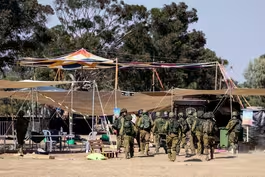
The day that started the war, October 7, was a day of horrific carnage and terror, and nowhere more so than at the Nova Music Festival in Southern Israel.
The rave in the desert was shattered at dawn by Hamas attackers.
Hundreds were killed and many hostages taken.
Leila Molana-Allen has been speaking with survivors of the massacre and those who rushed to help.
And, again, the images and accounts in this story are disturbing.
LEILA MOLANA-ALLEN: The final carefree moments of dancing until dawn.
As the sun rose on October 7, revelers at the Nova Music Festival heard a sound they never expected, gunfire.
Laura and her husband ran for shelter in the only place they could, their camper van.
For hours, they hid, unable to block out the sounds of terror and murder outside.
LAURA BLAJMAN KADAR, Nova Festival Survivor: The soldiers tried to open the door.
That moment, my husband looked at me and told me, "Well, this is it."
And my husband and I looked at each other and he told me he loved me.
I told him I loved him.
And I closed my eyes.
LEILA MOLANA-ALLEN: At that moment, the Israel Defense Forces finally arrived.
LAURA BLAJMAN KADAR: And then I opened the door to hell.
There were dead people in each car, people that were hiding inside a car, next to the car.
And my husband drive between dead bodies and between burned cars.
LEILA MOLANA-ALLEN: Laura came back today to find her van.
Seeing it has compounded her despair.
LAURA BLAJMAN KADAR: It's getting harder every day.
You understand better every day what happens, and you miss your dead friends every day a little bit more.
LEILA MOLANA-ALLEN: Hundreds of vehicles are still being brought to this graveyard of cars on Israel's southern border with Gaza.
Many bear the scars of bullet holes and explosives, where festivalgoers were attacked as they tried desperately to flee.
Twenty-three-year-old Amit Ganish and her friends were ambushed by terrorists as they tried to escape.
AMIT GANISH, Nova Festival Survivor: Everybody that were alive in the car just ran.
I ran through the forest, and I ran like this, because they were shooting after me.
LEILA MOLANA-ALLEN: And your friend's boyfriend was shot.
AMIT GANISH (through translator): They killed everyone and even set the car on fire.
Only after five days, we realized he was dead.
They found a very, very small piece of his brain and teeth, and there was no real grave to mourn for him.
LEILA MOLANA-ALLEN: For nine hours, Amit and her best friend, Zohar, hid inside a small bush, barely breathing.
AMIT GANISH (through translator): I heard everything, all the screams of everyone.
And I was in despair.
I believed I was going to die that day.
I knew I was going to die and said goodbye to everyone.
LEILA MOLANA-ALLEN: Like many survivors, Amit was saved not by the IDF, but by an Israeli citizen who ran straight toward the danger to help.
Eran Massas woke that morning to find his country under attack.
Barely thinking, he grabbed his gun and began to drive.
ERAN MASSAS, Municipal Worker: After a kilometer or something like this, one of the terrorists came in front, of me and I understand the situation, and I said to myself, OK, I'm in a war.
LEILA MOLANA-ALLEN: He shot the militant and drove on.
As word spread, Eran's phone began to fill with pleas for help from parents he'd never met.
ERAN MASSAS: "(INAUDIBLE) location.
Is hurt from a gunshot in his back."
Names.
"I don't know who are they."
LEILA MOLANA-ALLEN: For hours, Eran drove back and forth, seeking out young people hiding in terror across the plains.
Then, suddenly, a parent Eran did know, an old friend from his army days called.
ERAN MASSAS: "Eran, help me.
Omri (ph), my son inside.
You know him.
You know him when he was a baby."
And then when I walked around, I saw Omri dead.
And I told him: "I have not found him."
I told him: "I have not found him.
I cannot see him.
Maybe later.
I call you later."
And Omri dead.
He sent me a message after three days that they found Omri.
But I know.
I already knew.
LEILA MOLANA-ALLEN: As Eran approached the central site of the festival, the scale of the horror began to unfold before his eyes.
ERAN MASSAS: I start shouting: "Who is alive?
If there are any lives, if somebody heard me, just look at me."
And then I saw body after body and after body.
LEILA MOLANA-ALLEN: The further he walked, the darker the nightmare became.
ERAN MASSAS: There is a group of people who started run.
They fell.
They just take the gasoline from the generator of the lights to the party, and they burned them.
This is children.
LEILA MOLANA-ALLEN: So these kids were trying to escape.
ERAN MASSAS: That's right.
LEILA MOLANA-ALLEN: And they captured them and they burned them alive?
ERAN MASSAS: That's right.
LEILA MOLANA-ALLEN: Having saved as many of the living as he could, next, Eran stayed to help the dead.
ERAN MASSAS: This is the truck that I took from the party with that, and I just put inside dead bodies.
All my uniform was on blood.
LEILA MOLANA-ALLEN: You were covered in blood?
ERAN MASSAS: Of course.
There was 100 bodies that I took with my both hand.
LEILA MOLANA-ALLEN: Eran immediately rejoined the army after the attacks, but, that day, he was all alone.
Back home with his four young children, he's trying to process the burden of such loss.
ERAN MASSAS: When I think about my children, it breaks my heart, because it's not easy.
It's really not easy.
I guess every parent in the world, every human being, to see so many deaths, so many blood in one place, in one moment, it's not humanity.
It's not humanity.
LEILA MOLANA-ALLEN: Each survivor is trying to find their own way back to humanity.
At this pop-up healing center outside Tel Aviv, dozens of therapists have volunteered to help.
LEAH ORR, Natural Therapist: The few people that came on the first day were hollow.
It was like death was all around them.
LEILA MOLANA-ALLEN: Here, they're slowly learning to feel safe in their bodies and minds again, their souls, and to dance to the music they went to share in love, but ended in hell.
LEAH ORR: So much evil.
They saw so much evil and so much darkness.
And for a lot of them, it's hard for them to get back to life or to feel that they're allowed to be happy in other places.
But, here, it's healthy and it's healing and it's life.
LEILA MOLANA-ALLEN: But in a country where everyone has been touched by this tragedy, many are not yet ready to begin healing.
When Eran closes his eyes at night, the images play over and over.
ERAN MASSAS: What I see is not normal people.
I see it with one -- with not an eye, with not a mouth, with not -- and I wake up.
Every day for the last months, this is what I see.
LEILA MOLANA-ALLEN: Tomorrow, Eran is being deployed to fight in Gaza.
His battle is far from over.
For the PBS NewsHour, I'm Leila Molana-Allen in Haifa, Israel.
GEOFF BENNETT: Now a look at an illness that's dangerous for babies, made worse by a shortage of drugs to treat it.
Amna is back with this report recorded earlier.
AMNA NAWAZ: Among children under the age of 5, RSV leads to as many as 80,000 hospitalizations and up to 300 deaths a year.
It's the number one cause of hospitalization for infants under a year-old.
Dr. Celine Gounder is an epidemiologist and senior fellow at KFF.
She also hosts the podcast "Epidemic: Eradicating Smallpox."
Celine, it's good to see you.
And let's just start with what it is that makes RSV so dangerous for young children in particular.
What does it do to their systems?
DR. CELINE GOUNDER, Infectious Disease and Public Health Specialist: Well, RSV, or really any viral respiratory infection, leads to inflammation in the airways, which can lead to mucus, could lead to thickening of the lining of the airways.
And between the two of those, you can get blockages of the airways, especially in young infants who have smaller airways to begin with.
AMNA NAWAZ: So there are approved drugs to treat it.
They're available as shots.
There is this nationwide shortage.
Is high demand the sole reason for that shortage?
And, if so, can we boost supply?
DR. CELINE GOUNDER: There is a new monoclonal antibody that's delivered as a shot.
Its brand name is Beyfortus that is new this season to help protect the youngest of infants.
The challenge is really manufacturing.
And based on what I'm being told by the CDC and pharmaceutical companies, the supply that we have available right now is the supply that we're going to have available for the season.
It simply just takes too long to manufacture more to have more available this season.
AMNA NAWAZ: So that shortage has now led the CDC to issue guidelines saying who should be prioritized.
Who are they saying should get those shots first?
And who does that leave out?
DR. CELINE GOUNDER: So, the youngest of infants, so those under the age of 6 months, as well as other infants who might have underlying medical conditions that predispose them to severe RSV.
And pediatricians can help parents figure that out.
There are alternatives.
So there's an older monoclonal antibody against RSV called Synagis that is also effective in protecting infants.
And that is being recommended for those between the ages of 8 and 19 months as an alternative.
And then there's a third option, which is to vaccinate pregnant women.
Those pregnant women will then produce antibodies to the RSV vaccine and pass those on through the placenta and through breast milk to protect their infants in that way.
AMNA NAWAZ: Celine, what should we understand about the cost of all of these treatments too?
Does that impact who is able to get it?
Is it covered by insurance?
DR. CELINE GOUNDER: Well, under the Affordable Care Act, insurance companies do not have to cover this until a year after the initial recommendation.
However, the big insurance companies are covering the RSV vaccine for pregnant women.
So, even already now, many pregnant women will have coverage.
It's also been challenging, however, to educate obstetricians about the need to vaccinate pregnant women against RSV to help reduce some of the issues we're having with shortages with the other options for infants, and also educating pharmacists who work in pharmacies that it is perfectly safe to be vaccinating pregnant women and, in fact, should be the norm.
AMNA NAWAZ: So a lot of parents are seeing the headlines about these shortages.
You have been hearing about looming tripledemics, right, coming in this next fall and winter season.
What is your advice to them on how they should proceed, especially if their child isn't eligible under those CDC guidelines?
DR. CELINE GOUNDER: Well, if your child is not eligible, do talk to your pediatrician about Synagis.
It is an alternative for the older infants.
And then it's the commonsense measures that we take to reduce the risk of infection, not just with RSV, but also with influenza, COVID and other respiratory infections.
So, if you're sick, stay away from other people.
If other people are sick, keep them away from your child, to the best that you can.
I know that can be challenging if a child is in day care, for example.
Masks do work.
So, if someone is sick and absolutely has to be around your child -- maybe they're a caregiver -- they should be wearing a mask to reduce the risk of transmission to your child.
Handwashing is also an important piece of this.
And then a way to reduce risk in general in various indoor spaces is open your windows, open doors if you can, or put in a HEPA air filtration unit to reduce the risk of transmission in that space.
AMNA NAWAZ: More broadly, when you look at this, the issue of demand being so high for a drug seems to go against the trend of vaccine hesitancy and, frankly, skepticism in science that we saw, particularly in the pandemic.
How do you look at that?
DR. CELINE GOUNDER: I think there's a few things at play here.
I think some parents really have seen whether it's their child or other young children get very sick from RSV, end up in the hospital from RSV.
And so it's very real for them.
I think another issue, though, is that COVID was politically polarizing, politicized in a way that RSV has not been.
And I think, between those two different factors, we're seeing a difference in demand and uptake.
AMNA NAWAZ: That is Dr. Celine Gounder, epidemiologist and senior fellow at KFF.
Dr. Gounder, always good to see you.
Thank you.
DR. CELINE GOUNDER: My pleasure.
GEOFF BENNETT: As the war in Gaza continues, the Biden White House is facing fresh pressure over how to approach its relationship with Israel.
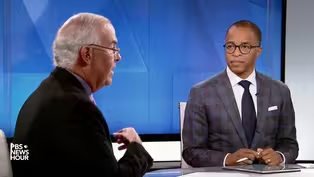
On that and more, we turn to the analysis of Brooks and Capehart.
That's New York Times columnist David Brooks and Jonathan Capehart, associate editor for The Washington Post.
It's good to see you both.
JONATHAN CAPEHART: You too, Geoff.
GEOFF BENNETT: So, David, I want to start with your reaction to Israel agreeing to put in place four-hour daily humanitarian pauses in its assault on Hamas in Northern Gaza.
DAVID BROOKS: Yes, I think it's a start.
I think that Israel has to do a few things here.
The first is obviously defeat Hamas.
There can be no peace in the Middle East as long as Hamas is there.
And so that's what you might call the near enemy.
But the real enemy and the far enemy is Iran.
And I was with a group of foreign policy experts last week, and one of them made a smart observation, which was, of all the nations of the world, who's had the most effective foreign policy in the last several years?
And it's been Iran.
They have surrounded Israel with a bunch of terror groups, Hezbollah, Islamic Jihad, Hamas.
And in order to defeat Iran, or at least stand up to Iran, you have got to have help in the neighborhood.
And so you have got to have help in Saudi Arabia, in Egypt.
And those regimes want to help you.
They don't like Iran at all.
But their populations are getting more and more furious about what's happening in Gaza.
And so in order to defeat Iran and keep your allies in with you, you have just got to be as humanitarian as possible.
And so I think, even aside from the moral reasons to spare the suffering of the people in Gaza, there are strategic reasons Israel should be as humanitarian as possible.
GEOFF BENNETT: Jonathan, when David talks about the moral and strategic reasons, the administration was pushing for a multiday pause.
And John Kirby, the National Security Council spokesperson, said that these four-hour-long pauses were a direct result of President Biden's contacts and conversations with Netanyahu.
JONATHAN CAPEHART: Right.
This is the -- this is public manifestation of hours, if not weeks, of private consultations, I was going to say lapel-shaking, but of the president, the secretary of state and his shuttle diplomacy, trying to impress upon Prime Minister Netanyahu that you must have - - if you're not going to do a cease-fire, which the administration is against, at least do a humanitarian pause.
Gaza is suffering.
There's no water, there's no food, there's no fuel, there's none of the basic necessities.
You must defend yourself against Hamas, but you also must do so in a manner befitting a small-D democratic nation.
And so it'd be great if it were over several days, but the fact that there is a -- there will be pauses over hours, it is the result of the president pushing Prime Minister Netanyahu to do the right thing, and, hopefully, that that will lead to more.
GEOFF BENNETT: What's your assessment of the way in which President Biden has navigated these competing interests and competing pressures?
DAVID BROOKS: Yes, I think he's done quite well.
I think the clarion call that Hamas has to be defeated, Hamas is a threat to the region, I think he -- frankly, he might be alone in his administration in feeling that so strongly, not quite alone, but he's certainly been a force.
And so I think he's put America and rallied the West into an idea that Israel, there was a -- there was relative stability.
And Hamas is not like Fatah.
Hamas is something different.
And I think one of the tragedies of what's happened over the last month is, in a lot of people's minds, that difference between Hamas and Fatah has been elided.
And Fatah, the Palestinian Authority, they recognize the state of Israel.
They have been trying to get to some sort of two-state solution.
They play rough.
And even in the Yasser Arafat days, there was terrorism.
But often it was terrorism with the purpose of building leverage to get to a better settlement.
Hamas is not like that.
Hamas is about homicide.
And it's about genocide.
It's about mass murder.
And I think the president's been very clear about that.
And it's because he's been doing this in the region for a long time.
So I think this is a case where his age has really paid off.
GEOFF BENNETT: Let's shift our focus to Tuesday night's election results.
One thing was certainly clear, that abortion rights, reproductive rights, abortion access is politically popular, no matter where it appears on the ballot, post the Supreme Court overturning Roe.
What were some of your other takeaways?
JONATHAN CAPEHART: That was the main thing, whether you are in a so-called blue state, but especially if you are in a red state.
I looked at sort of -- let's just take Governor Glenn Youngkin in Virginia, who made it a point of saying, I will go for a 15-week abortion ban.
Just give me both.
Give Republicans control in both bodies of the legislature, and I will get it done.
So, on Earth 2, that plays well,because that's what they want.
But the rest of us on Earth 1, and particular - - particularly suburban white women in the Northern Virginia suburbs, looked at what happened with Dobbs, and they're like, no, no, no, no, no.
We have seen what has happened in other states around the country, particularly Florida with a six-week ban.
We do not want that to happen here.
So, Glenn Youngkin didn't get what he wanted in Virginia.
Ohio Republicans didn't get what they wanted.
Ohio, that Trump won by double digits, now has in its state constitution, ruby-red Ohio, access to abortion.
Kentucky, Governor Beshear reelected with that unbelievably powerful ad at the very end of the young woman who looks directly at the camera and blames David (sic) Cameron for wanting to institute a policy that would force her to carry her stepfather's child after he raped her.
For Republicans who think that running on abortion is going to be the winning formula in 2024, Tuesday night should have been the wakeup call.
GEOFF BENNETT: And, David, you wrote a column this past week where the thesis was pretty evident, based on the headline.
It was: "Democrats, You Can Chill Out Now."
(LAUGHTER) DAVID BROOKS: Yes.
GEOFF BENNETT: Why?
DAVID BROOKS: We go for subtlety in our headlines at The New York Times.
JONATHAN CAPEHART: Yes.
(LAUGHTER) GEOFF BENNETT: Right.
Right.
DAVID BROOKS: Yes.
And I -- it was kind of, it was an emotional roller-coaster week.
So, in the beginning of the week, there's the Times/Siena poll, which shows Trump in a bunch of battleground states, and Democrats are like, ah, hair on fire, those who have hair.
And then the election results come in, and yet again, as consistently since Donald Trump has been elected president, Democrats have a good night.
And so my -- one of my points was that the polls have to be looked at with a grain of salt, and not just because all polls have to be looked at with a grain of salt, because we're in a different culture now.
Through most of our careers, presidential approvals go up and down.
But over the last -- since 2005, the country's been in such a sour mood, presidents have spent 77 percent of their time with their favorability ratings underwater.
People just blame the president.
So when a pollster calls them and people are upset with the country, they say, yes, I'm against the president.
They're venting.
They're not voting.
And so my point was, in this kind of climate, you have to -- we have to understand that what people tell pollsters could be about how they feel, but it's not necessarily the decision they're going to make in a year.
GEOFF BENNETT: Meantime, Democratic Senator from West Virginia Joe Manchin announced this past week that he's not going to seek reelection.
In some ways, it's not surprising, given that it would have been really difficult, if not impossible, for him to win reelection.
But what's the impact on the Senate and on the party?
JONATHAN CAPEHART: Well, the impact on the Senate is, the Democrats are going to lose a seat that they pretty much thought that they were going to lose.
And that was going to be a very tough, very tough reelection effort on Senator Manchin's part if he went for it, most likely was going to lose.
Immediately, it means that their chances of hanging on to the Senate just diminished, because it's basically 50/50.
And so that means that Senator Tester in Montana, Senator Sherrod Brown in Ohio, at least it gives the party, the Democrats, more time, more energy, more money to focus on those races, but I would also say focus in on Texas and Congressman Colin Allred, who's looking to unseat Senator Cruz.
Tough.
That's going to be an uphill battle.
Everyone thought that they were going to be the one.
GEOFF BENNETT: Yes.
JONATHAN CAPEHART: Beto O'Rourke thought he was going to be the one to be the next senator from Texas.
But I think Congressman Allred could be that person.
And Senator Manchin getting out maybe frees up some resources for the DNC to push his way.
GEOFF BENNETT: What's the legacy that Joe Manchin leaves behind?
DAVID BROOKS: He saved the Biden administration.
And so the Biden administration, and, if you remember a few years ago, wanted to spend $4 trillion to pump up the economy.
And he said, no way, no way.
It was more like $1 trillion.
And as a result, if we had spent $4 trillion, instead of $1 trillion, the inflation, which we really suffered from, would have been astronomical, and the Biden administration would be in much worse shape if our inflation had hit like double digits, which it could have overstimulating to that degree.
So Democrats don't like Joe Manchin, but he did save their bacon.
GEOFF BENNETT: Before we wrap up, I want to put a marker on these latest comments from former President Donald Trump, who in an interview with the Univision last night threatened to weaponize the DOJ against his opponents if he's reelected.
DONALD TRUMP, Former President of the United States (R) and Current U.S. Presidential Candidate: They have done indictments in order to win an election.
They call it weaponization.
And the people aren't going to stand for it.
But, yes, they have done something that allows the next party.
I mean, if somebody -- if I happen to be president and I see somebody who's doing well and beating me very badly, I say, go down and indict them.
Mostly, that would be -- they would be out of business.
They'd be out.
They'd be out of the election.
GEOFF BENNETT: I spoke with Devlin Barrett, a Washington Post reporter, this past week, who not only reported that former President Trump wanted to do it, but that there are lawyers, conservative lawyers, who are putting together a plan and writing executive orders for how he could do it if he wins reelection.
JONATHAN CAPEHART: It's called -- it's got a name.
It's called Project 2025.
Those plans, it's called the 180-day playbook.
They -- people who want to be a part of that administration, if it comes in, they can send in their resumes to that particular project.
And what the president -- what the former president said there, what he is saying is are things he tried when he was president.
Remember, at the very end of his administration, he was upset with Bill Barr because Bill Barr didn't move to arrest Joe Biden when Joe Biden was his political opponent.
GEOFF BENNETT: Yes.
DAVID BROOKS: The word for it is authoritarianism, indicting your political opponent.
(LAUGHTER) DAVID BROOKS: And I do think there's another Republican or a Trumpy plan which would -- right now, in the federal government, there are 4,000 political employees that the president appoints and thousands and thousands of civil servants.
And there's a plan afoot to gut as many as 50,000 of the civil servants and replace them with partisan political people.
JONATHAN CAPEHART: That's Schedule F. DAVID BROOKS: Yes, Schedule F. And that would decimate our civil service, but it would also lead to, apparently, the complete politicization of the Justice Department.
And so it's not just idle talk by Trump.
There's actually plans afoot, as Jonathan said, to put this into effect, and that is truly scary.
GEOFF BENNETT: David Brooks and Jonathan Capehart, thanks, as always.
JONATHAN CAPEHART: Thanks, Geoff.
DAVID BROOKS: Thank you.
GEOFF BENNETT: Steve Waldman is the founder and president of Rebuild Local News, a nonpartisan nonprofit working to counter the collapse of local news and strengthen democracy.
He's also the co-founder of Report for America.
That's a national service program that places journalists in newsrooms across the country.
Tonight, he shares his Brief But Spectacular take on how to Rebuild Local News.
STEVEN WALDMAN, Founder and President, Rebuild Local News Coalition: Local news is in collapse.
There's all sorts of evidence that, when you don't have local news, you have lower voter turnout, more alienation, more polarization, people at each other's throats, more misinformation.
I mean, it's really a terrible thing for communities to not have local news.
On the community level, local news organizations are often unifying figures.
They're the places where you have obituaries of interesting people who played an important role in the community or the review of the community theater.
The things in the community that tie them together are given voice through community news.
At least 1,800 communities right now don't have any source of local news.
What we're finding is that, when there's a vacuum, it gets filled by other types of information, often misinformation, or national news, which may be accurate, but tends to be more polarizing.
Part of what happens when you consume news that is very partisan or national in nature is that you tend to think of your opponents as your enemies, whereas, when you have local news, you still have disagreements, but you might actually see that person at the little league game or at the supermarket the next day, and you know they're a human being.
We created Report for America to put reporters into communities to cover on local affairs.
And the impact is amazing.
I remember one in Eastern Kentucky where the reporter got there and it turned out that the folks there were complaining for a long time about not having clean drinking water, and no one was paying any attention.
And he just started writing stories about the drinking water.
And before you know it, people in the state legislature were paying attention.
And things like that happen all the time in communities throughout America of problems that aren't getting addressed because no one is watching the story.
To solve this crisis, we need the commercial, local media sector to reform, get better at connecting with the communities and be more locally owned.
We're going to need philanthropy, large and small, to support community media.
And then, third, we're going to need some public policy help.
It has to be done really carefully, but it can be done.
At the end of the day, community journalism is not going to survive without the support of the community.
And that can mean subscribing to a local newspaper, even if you don't love it.
Subscribe to it, engage with it, tell them what they're doing wrong, but subscribe to it.
I'm Steve Waldman, and this is my Brief But Spectacular take on how to Rebuild Local News.
GEOFF BENNETT: You can watch more Brief But Spectacular videos online at PBS.org/NewsHour/Brief.
This Veterans Day weekend, Americans across the country will honor those who have served our nation in uniform.
A new book explores the legacy of two exceptional veterans whose contributions have gone largely unknown until now.
Author Doug Melville recounts his family history and tells the barrier-breaking stories of father and son Benjamin O. Davis Sr. and Jr., the country's first Black generals.
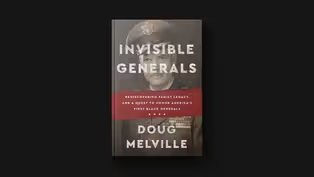
He recently told me how watching the movie "Red Tails," George Lucas' 2011 film about the Tuskegee Airmen, inspired him to write the book "Invisible Generals: Rediscovering Family Legacy, and a Quest to Honor America's First Black Generals."
DOUG MELVILLE, Author, "Invisible Generals: Rediscovering Family Legacy, and a Quest to Honor America's First Black Generals": So, I was invited to a screening, an advanced screening of the movie "Red Tails."
And when the commander of the "Red Tails" came out on screen, it was played by actor Terrence Howard.
But while I was thinking that they were going to say General Colonel Davis, who was commanding the Tuskegee Airmen, the name that they used was Colonel Bullard.
I was quite upset about it.
I went home, I tell my dad, I was furious, and he said: "If you think changing the names are bad, why don't I tell you the full family story?"
And he shared with me the story of the invisible generals.
I was so inspired, Geoff, that I immediately said, I have to be the one to bring this story to the world so the true heroes can get their stories out into the universe.
GEOFF BENNETT: And Benjamin O. Davis, Sr. and Jr., obviously, they were father and son.
And at the start of World War II, there were 335,000 Americans who were enlisted in the U.S. armed forces.
But there were only two Black officers, the Davises.
DOUG MELVILLE: Yes, so Ben Davis Sr. in 1901 was elevated to officer by President McKinley.
He then started his family.
His wife dies in childbirth.
He brings his son to go for a plane ride in a barnstorming traveling airplane exhibit.
And he comes down from that ride and goes: "Daddy, I want to be a pilot."
And Ben Sr. said: "I will help you live your dream."
And that was when he started training Ben Davis Jr. to go through what it would take to graduate from West Point.
Because of segregation, Ben Sr. knew that, unless it was through graduating at the top of West Point, his son would never get the opportunity to live his dream.
So he sells the family house in Washington, D.C., relocates to Illinois, so he can get the signature of the only Black congressman in the United States, Oscar De Priest.
And then they enter West Point Military Academy without them knowing he was Black.
And this was in 1932.
GEOFF BENNETT: And when Ben Davis Jr. was at West Point, he was obviously the only Black cadet.
He was ostracized.
He was ignored as a matter of policy.
How did he cope with that?
DOUG MELVILLE: Well, this is really the mental fortitude and leadership that makes me feel he was the greatest general and greatest West Point grad of all time.
When the cadets realized and the administration realized that they had let a Black cadet into West Point, immediately, they said, we will silence him until he drops out.
Ben Jr. called Ben Sr. and said: "Dad, I know they're going to silence me."
And he said: "Son, there's eight million Blacks on the outside world that are rooting for you.
Put a date on the wall of graduation in 1936 and no matter what anybody does to you, make sure you graduate at the top third of the class."
Four years went by, no human interaction outside the line of duty.
No one talked to him.
No one spoke to him.
He couldn't eat at the tables with other cadets because he wasn't getting the permission to sit.
Yet, he was able to still graduate in the top third of his class in the class of 1936.
GEOFF BENNETT: And fast-forward to the time when FDR was trying to get reelected.
He called up Benjamin Davis Sr. for advice.
And that is what gave rise to the Tuskegee Airmen?
Is that right?
DOUG MELVILLE: That's exactly right.
FDR assigned Ben Davis Sr. as the head of Negro policy in the military so he could work with him directly.
When asking Ben Davis Sr. how he could get the Black vote, as he was the highest-ranking Black in the military, he said: "You must ensure equal opportunity for black and white Americans in the United States.
And in the military, you must ensure equal opportunity by allowing Blacks to fly airplanes, which at that time was not something that was allowed to do."
And when FDR told Ben Sr., "Who would lead that if that was something that I decided to do?"
and Ben Sr. said, "My son."
His son would then go down to Tuskegee, and that would be the start of the Tuskegee Airmen that we all know and are familiar with.
GEOFF BENNETT: That's incredible.
Benjamin Davis Jr., when he retired from the military, he had just a consequential second act.
Tell me more about that.
DOUG MELVILLE: When Ben left the military in 1970, he couldn't get a job in the private sector as a pilot.
No one would hire him, because some of the evil segregation rules were still de facto in place in the private sector.
So the government created a special assignment role in the Department of Transportation Aviation.
And the first assignment the assignment was, how can we get commercial travel in aviation as safe as military travel in aviation?
There were a lot of hijackings and skyjackings at that time and people were starting to figure commercial travel.
So what he decided to do was implement national airport security for your baggage and for your person, which is exactly what we see today in every airport worldwide.
He also led the development of the air marshal program and trained 4,000 officers.
That then led to the Carter administration, and that was where he led the creation of the federally mandated 55-mile-an-hour speed limit.
And his name actually was called Mr. 55 at the Pentagon.
(LAUGHTER) GEOFF BENNETT: I will tell you, Doug, since this book landed on my desk, I keep coming back to a picture in here of Benjamin Davis Jr. and his wife of 60-plus years, Agatha, because what is so striking to me is that their grace, their strength, and their dignity comes through.
It was amazing that they were able to succeed and thrive and contribute so much to this country under conditions that were set up for their failure.
DOUG MELVILLE: Yes, Ben always lived by one thing that he would tell me over and over: "Doug, you have to use the system to defuse the system.
You cannot complain about something and fix something at the same time."
So if you want to evolve a policy, if you want to evolve a practice, the first thing is, you have to be part of the organization, then build a voice, then get a vote, and then, over time, the impossible may seem long, but, in time, you can accomplish the impossible.
GEOFF BENNETT: The book is "Invisible Generals."
It's about Benjamin Davis Sr. and Jr. Doug Melville, you did right by them both.
DOUG MELVILLE: Thank you so much.
GEOFF BENNETT: Be sure to watch "Washington Week with The Atlantic" tonight here on PBS.
Jeffrey Goldberg and his panel discuss Senator Joe Manchin's decision not to seek reelection and how the issue of abortion rights could help Democrats in 2024.
And watch "PBS News Weekend" tomorrow for a look at a program that uses horses to help military veterans with PTSD and depression.
That is the "NewsHour" for tonight.
I'm Geoff Bennett.
Have a good night and a great weekend.
A Brief But Spectacular take on how to rebuild local news
Video has Closed Captions
A Brief But Spectacular take on how to rebuild local news (3m 12s)
Brooks and Capehart on takeaways from the 2023 elections
Video has Closed Captions
Brooks and Capehart on 2023 election takeaways and Manchin’s Senate shakeup (11m 28s)

High demand for new RSV drug for infants outpaces supply
Video has Closed Captions
High demand for new RSV treatment for infants outpaces national supply (5m 49s)
‘Invisible Generals’ tells story of 1st Black U.S. generals
Video has Closed Captions
‘Invisible Generals’ chronicles little-known history of 1st Black U.S. generals (7m 45s)

Israel-Hamas war takes deadly toll on journalists
Video has Closed Captions
Israel-Hamas war takes deadly toll on journalists covering the conflict (6m 4s)
Survivors, rescuers recount horrors of Hamas festival attack
Video has Closed Captions
Survivors, rescuers in Hamas music festival attack recount the day’s horrors (8m 7s)
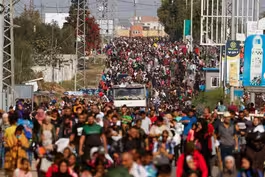
Thousands flee Gaza hospitals as Israeli troops close in
Video has Closed Captions
Thousands of civilians flee northern Gaza hospitals as Israeli troops close in (4m 27s)
Providing Support for PBS.org
Learn Moreabout PBS online sponsorship
- News and Public Affairs

FRONTLINE is investigative journalism that questions, explains and changes our world.

- News and Public Affairs

Today's top journalists discuss Washington's current political events and public affairs.












Support for PBS provided by:
Major corporate funding for the PBS News Hour is provided by BDO, BNSF, Consumer Cellular, American Cruise Lines, and Raymond James. Funding for the PBS NewsHour Weekend is provided by...