
November 10, 2025
Season 4 Episode 96 | 26m 29sVideo has Closed Captions
UPS, FedEx ground MD-11 fleets ‘out of an abundance of caution.'
Kentucky lawmakers react to a proposed deal that could end America’s longest government shutdown, UPS and FedEx ground their fleets of MD-11 planes following last week’s deadly UPS plane crash, and the U.S Supreme Court rejects former Rowan County Clerk request to revisit landmark decision on same-sex marriage.
Problems playing video? | Closed Captioning Feedback
Problems playing video? | Closed Captioning Feedback
Kentucky Edition is a local public television program presented by KET
November 10, 2025
Season 4 Episode 96 | 26m 29sVideo has Closed Captions
Kentucky lawmakers react to a proposed deal that could end America’s longest government shutdown, UPS and FedEx ground their fleets of MD-11 planes following last week’s deadly UPS plane crash, and the U.S Supreme Court rejects former Rowan County Clerk request to revisit landmark decision on same-sex marriage.
Problems playing video? | Closed Captioning Feedback
How to Watch Kentucky Edition
Kentucky Edition is available to stream on pbs.org and the free PBS App, available on iPhone, Apple TV, Android TV, Android smartphones, Amazon Fire TV, Amazon Fire Tablet, Roku, Samsung Smart TV, and Vizio.
Providing Support for PBS.org
Learn Moreabout PBS online sponsorship>> America's longest government shutdown could soon be over.
Details on the proposed deal and reaction from some Kentucky lawmakers.
>> We can use data to drive it, and we can use it to figure out what programs work really, really well and how can we scale those programs.
>> How a Kentucky based group is using data to make sure older adults are staying connected.
>> I go to work every day just doing what I love.
>> Educators are recognized for their passion teaching Kentucky kids.
>> Production of Kentucky Edition is made possible in part by the KET Millennium Fund.
>> Good evening and welcome to Kentucky Edition for this brand new week.
It is Monday, November the 10th.
I'm Renee Shaw, and we thank you for spending some of your Monday evening with us.
The longest federal government shutdown in U.S.
history could soon be coming to an end.
After weeks of gridlock, eight Senate Democrats sided with Republicans and agreed to consider a bill to reopen the government without a guaranteed extension of health care subsidies.
Instead, Senate Republicans are promising to vote on those subsidies next month.
The deal also reinstates federal workers and extends most government funding, as is through the end of January.
The end of the shutdown could still be days away.
One hurdle is an amendment filed by Republican Senator Rand Paul of Kentucky.
He wants to remove language from the proposed bill that would prevent the sale of some hemp based products, putting him at odds with his Kentucky colleague, Senator Mitch McConnell.
Posting on social media, Senator Paul said in part, quote, just to be clear, I am not delaying this bill, but there is extraneous language in this package that has nothing to do with reopening the government and would harm Kentucky's hemp farmers and small businesses, end quote should the funding bill pass the Senate, it would then go to the House, which has been out of session since mid-September.
Congressman Brett Guthrie of Kentucky's second district says he's looking forward to working to make health care affordable.
>> I'm absolutely happy with the version of the bill.
I think that there are things we need to negotiate, but we need to negotiate with people who are going to work, being honored for their work and being paid for their work.
And and there's some work we need to do on health care affordability.
That's my committee, actually.
So I'm looking forward to sitting down with people and and working.
>> Congressman Guthrie was in Bowling Green today for a presentation on We the People, a nationwide survey of Americans in every congressional district.
It's a partnership between the Neapolitan Institute and Google's Jigsaw division, and will collect insights through July of next year.
Guthrie said he's headed back to Washington soon, and hopes to be voting on the bill in the House by Thursday.
Meanwhile, the Trump administration is asking the U.S.
Supreme Court to keep SNAP payments on hold.
The federally funded food program helps about 42 million Americans, including nearly 600,000 Kentuckians, buy groceries.
Lower courts have ordered the government to keep all the money flowing.
The justices are expected to decide late Tuesday whether to halt these orders, amid signs the shutdown could soon come to an end.
Last week, Kentucky Governor Andy Beshear said Kentucky was already processing Snap benefits for the month of November in response to the lapse in Snap benefits, the Kentucky Democratic Party held a statewide food drive on Saturday.
Democratic leaders, local nonprofits and community leaders throughout the state participated in what was called the Day of Action, collecting food donations they say will go to help almost 600,000 Kentuckians who rely on Snap or food stamp benefits.
KET was at the kickoff in Lexington, where Lieutenant Governor Jacqueline Coleman was among the volunteers taking donations.
>> There are 600,000 Kentuckians that depend on Snap benefits, and they don't know when or how, or if or how much money is going to be made available to them to be able to feed their families as we enter the holiday season.
So it's never been more important to show up for our neighbors.
And so I've traveled this state, and I've worked with a lot of our food banks to help get the word out about supplies and donations and monetary donations and volunteering, because they need our help.
Now more than ever.
>> We have seen an increased need.
Our phone is ringing off the hook with families who are looking for ways to access food.
We do a hot meal distribution on Mondays and Wednesdays.
We are handing out 600 meals every night.
On Fridays we're doing grocery boxes, we build 125 and then continue building when those run out to ensure that nobody is going without food, we're doing a food drive to really supplement our Thanksgiving boxes that also to supplement the families who are missing out and weren't necessarily knowing that they were going to miss out on some food needs this holiday.
And so we are really working together to make sure that our neighbors are fed.
>> Working in recovery.
A lot of people we have come out of treatment or, you know, they have family or friends that don't have nothing.
Now, it's to the point now where it's strong and even food.
We're having people go to food pantries constantly.
There's not a day that went by this past week where I haven't had somebody contact me needing some kind of food.
>> You have nonprofits that are operating on a shoestring budget.
You have public schools who are collecting donations, and they're doing more than the most powerful government in the world to make sure that people don't go hungry.
And there's something seriously wrong with that.
>> We're concerned about the small markets.
We're concerned about our farmers who are relying on a lot of this income that does come from SNAP.
And so it it goes much further beyond just the recipients themselves.
It is our local food economy that is going to suffer.
>> This is a this is a hard time for a lot of people, a lot of families, a lot of households.
But as always, when we face disaster in Kentucky, we show up for each other.
And that's what you're seeing here today is neighbors coming in to help a neighbor to help neighbors, no questions asked.
The people who are preparing this food have no idea where it's going or what family it's going to, what their zip code is, what their religion is, what their race is, what their political party is.
Because that's not important.
What's important is that you do the right thing for the right reasons.
>> Now, food insecurity is our topic tonight on Kentucky Tonight, guests include state lawmakers on agriculture committees in Frankfort, a UK researcher, a leader in the state Department of Agriculture, and heads of food assistance programs.
So we hope you'll tune in tonight at 8 p.m.
eastern, seven central for Kentucky tonight on KET.
Now to our ongoing coverage of the UPS plane crash in Louisville.
Officials say the death toll has now risen to 14.
Everyone thought to be missing has now been accounted for over the weekend.
UPS and Fedex decided to ground their fleets of 11 planes out of an abundance of caution.
That's the type of plane that crashed last week, moments after taking off from the Louisville airport.
Investigators say the left wing caught fire and one of the engines fell off.
Seconds before the plane crashed and erupted into flames.
The National Transportation Safety Board is leading the investigation.
It's another setback for former Rowan County Clerk Kim Davis.
Today, the U.S.
Supreme Court rejected her request to consider overturning its landmark decision that legalized same sex marriage nationwide.
Davis hoped the Supreme Court would overturn a lower court ruling for her to pay $360,000 in damages and attorney's fees to a couple denied a marriage license.
Justice Clarence Thomas has repeatedly called for erasing the same sex marriage ruling.
The Supreme Court did not comment on today's decision.
Davis drew national attention when she turned away same sex couples in 2015, saying her faith prevented her from complying with the Supreme Court's ruling.
She defied court orders and was briefly jailed for contempt of court.
Davis was released after her staff issued the licenses on her behalf, but removed her name from the form.
The Kentucky legislature passed a bill removing the names of all county clerks from state marriage licenses.
Former Kentucky Governor Martha Layne Collins was laid to rest today.
She was buried at the Frankfort Cemetery.
Collins died earlier this month at the age of 88.
Her funeral followed a memorial at the Old State Capitol yesterday.
Here are some of the moments from the service that were captured on KET.
>> After shattering the glass ceiling with her win as governor in 1983, Governor Collins shepherded a massive education reform package that brought widespread improvements to our kids.
Maybe the biggest legacy of Governor's College tenure is perhaps landing the Toyota motor manufacturing plant in Georgetown.
Few partnerships can claim more widespread or impactful results for our Commonwealth and our people.
Governor Collins led a groundbreaking life and career.
She was dedicated to building a better Kentucky for our people.
>> You know, I had no idea.
I never really thought about the difficulties that a woman as governor would have.
Men had a difficult time dealing with, and in some women had a difficult time dealing with a woman sitting on the other side of the desk, making decisions and so forth.
And I watched how gracefully she handled that.
You know, she was a she was a team builder.
My wife said today, she said, you know, Governor Collins, there was no I in that.
You know, and that's rather unusual for many politicians.
There was no I that was in that.
It was we what she would want to say if she was here is, you know, we need to stay engaged.
She stayed engaged all the way to the end because she truly cared about making things better for people.
>> The emotional health of older adults is an often overlooked component to aging well.
Louisville based Humana Foundation hopes to change that, with $12 million in grants for programs that address loneliness, chronic illness and other factors affecting seniors emotional health.
Our Christie Dutton talks with the CEO of Humana Foundation to find out how these grants will help seniors right here in Kentucky.
This is part of our ongoing aging series, The Next Chapter, that explores the rewards and challenges of growing older.
>> Joining us is Tiffany Benjamin, the CEO of the Humana Foundation.
Okay, Miss Benjamin.
$12 million is a lot of money.
So how did the Humana Foundation zero in as seniors emotional health as the key initiative?
>> Yeah.
So we have been focused on seniors for a really long time.
What we know is 1 in 4 seniors are socially isolated, and being socially isolated leads to increased risk of self-harm and dementia.
And so we know that mental health is tied to physical health.
The more connected you are to other people, the physically healthier you are.
And so we decided that we want to be a leader in senior emotional health, really leaning into social isolation and creating spaces for social connection for seniors.
>> Because emotional health is often overlooked, especially when you're talking about the older population, where a lot of physical health problems start popping up.
Why is the emotional health often bypassed for the physical health in this population?
>> It's a great question.
We don't talk about it enough.
In Louisville alone, 40,000 seniors live alone.
We know that when you're alone, sometimes you can fall into depression.
Sometimes you get even less physically active.
Right?
Like, we've all felt that thing where you're like, oh, I'm by myself and I don't quite know what to do.
So if we want people to be more physically active, we want them to be more connected.
We have to get people up and find communities for them and give people positive opportunities to connect with other people.
>> Okay.
So how is how are these grants going to address that?
What programs, especially locally or in Kentucky, are going to receive some of these funds and what are they going to do with it?
>> Yeah, we're really excited.
We committed $1.45 million to programs here in Kentucky.
Examples include the Louisville Orchestra.
And what we're really funding there is the orchestra going across the state, across the Commonwealth, and really holding programs in senior centers and community centers to get people connected through music and art and really just energized.
There's something really powerful about the way that art connects us, and that is an example of that sort of powerful work.
We've also partnered with the Ali Center to support their Compassion Index, where they are getting people to talk more and more about how we can treat others with compassion, find commonality amongst differences, and and really look at the world in a positive way, and we're funding them, adding a senior counsel to that.
So we're talking about compassion for seniors with seniors towards seniors.
Super important work partnering with other organizations like Dare to Care to focus on nutrition.
Partnering with the University of Kentucky on really exciting work to look at senior food insecurity.
Really to be sort of best in class in the nation, in tracking food insecurity for seniors.
Be amazing for that to be here in Kentucky, where people go to find the source of data for how do we connect with seniors and understand what they're going through and how do we support them?
>> Yeah.
And dare to care.
And tracking county level data on senior food insecurity that has to do with just nutrition for seniors.
So how does that impact emotional health?
How might that improve?
>> Yeah it's a great question.
You think about it this way.
If you're hungry, if you're isolated, if you're alone, all of these things connect together, right?
Your well-being is really many different pieces, and you need to make sure that you are well nourished so that you can actually think about your mental health, and that you can get active and physical and be out in community and get the help you need and find the people who you can connect with.
And so we have to look at the whole person.
And so our work around senior emotional health is making sure people have the resources they need to be mentally healthy.
And then utilizing the connections and resources they get to be physically healthy, too.
>> How are you going to know if these grants to these programs are working?
>> Yeah, it's a great question.
And we are actually really unique in the fact that we track impact in our work.
So the Humana Foundation, unlike a lot of foundations, has a chief impact officer.
We make long term commitments to organizations.
Often our grants are 3 to 5 years long.
We give time for programs to grow.
And then we ask questions like, are you really connecting with seniors?
And can we track that with data?
So for example, when we think about social isolation, there's this thing called the UCLA Loneliness Index.
And a lot of our grants track.
Do people feel less lonely on that index after they have gone to a performance, after they have connected with Dare to Care and had somebody maybe deliver their food?
Do they feel more connected?
We can track that.
We can use data to drive it, and we can use it to figure out what programs work really, really well and how can we scale those programs?
>> Okay.
Tiffany Benjamin from the Humana Foundation, thank you so much for your time, and thank you for your work in this area.
>> Yeah.
Thanks for having me, Kristy.
It's a joy to talk about the work, and it's a joy to serve community in this way.
>> Three new educators are now members of the Kentucky Teacher Hall of Fame.
The induction ceremony was held Friday at Western Kentucky University.
Our Laura Rogers brings us the story from Bowling Green that in our Education Matters report.
>> It was a big surprise.
>> After 33 years in education, it's likely not easy to surprise Julie Cowan.
>> I've always believed that their kindergarten year is the most important ever.
It sets the foundation.
>> She's helped young learners in Adair County have a strong foundation with activities like her kindergarten bucket list, where they get to choose how they spend some of their classroom time.
>> They wanted to bring their fish to school day.
Just one example.
And I'm like boys and girls, you know, not everybody has a fish.
So we ended up being goldfish.
You could bring goldfish crackers.
You could bring your fish.
You could bring your stuffed fish.
>> It is that creativity and compassion that helped earn Cowan a spot in the governor.
Louie B Nunn, Kentucky Teacher Hall of Fame.
>> It brought tears to my eyes because once my kid, always my kid.
>> To get an award where I'm actually just being me and doing what I love.
It is very humbling.
>> Jennifer Miller Fritch is also a new inductee.
She teaches art at Glasgow Middle School.
>> Having them in art, they get to see themselves in a different way.
One of the first things I tell them is like, look, there are 30 of you all.
Every one of you came from a different background.
You have different experiences.
>> Yet, she says each of them has the potential for artistic talent and expression, which she aims to encourage inviting visiting artists to come speak and inspire.
>> I love that they feel like my room is safe.
I love that they know that they can come in there and be themselves, and I'm not comparing them to anybody.
>> Teachers, in my opinion, are the backbone of our great state.
>> Cowan and Fritch, along with the late Lois Chandler of Ballard County, were honored Friday, November 7th, at Western Kentucky University.
>> We know that teachers don't choose their profession for recognition, but instead to be a part of something larger than themselves, to mold young minds and to make the world a better place.
>> That is certainly the case for these three teachers.
Lois Chandler, who passed away in 2020 at the age of 92, spent 56 years in education.
>> I can't think of a more noble profession than being a teacher.
>> State Representative Kevin Jackson pointing out that teachers wear a lot of hats.
Over the past three decades, Julie Cowan has seen a lot of changes.
>> Now you have kids that are addicted to technology, coming to school at the age of five, and and their communication skills are really, really low.
Their hands on skills are really, really low.
>> While that is a challenge now, a reading interventionist at Adair County Primary Center, Cowan loves working with young children.
>> They're just so eager to learn when they're little.
I just think that we can learn a lot from them.
They've taught me much more than I've taught them.
>> For Fritch, it was teaching art at a summer camp that inspired her future career and eventual spot in the Hall of Fame.
>> The joy that they had while they were creating, I'm like, oh, this is it.
This is, you know, this is what I'm supposed to do.
>> For Kentucky edition.
I'm Laura Rogers.
>> Thank you, Laura, and our thanks to those fantastic teachers.
This is the Hall of Fame 17th class.
It was established in the year 2000 through a gift from Louie B Nunn, who served as Kentucky governor from 1967 to 1971.
It's forest fire season in Kentucky.
Some firefighters on the front lines are actually forestry students at the University of Kentucky.
Through a partnership with the Kentucky Department of Forestry, the UK Firecats are, as they are called, are paid emergency firefighters getting hands on experience while protecting our state's forests.
>> The Firecats program started back in 2014, and I think it started just because we wanted to get our students with more hands on experience with dealing with fire suppression here in Kentucky.
So students are paid through Kentucky Division of Forestry, and generally they work on the weekends.
>> Whenever the conditions are right for fire, like low humidity and low precipitation.
And things are dry enough for there to be a chance of fire.
We'll go down to the Division of Forestry office down in London, Kentucky, and we'll be on call in case there is a fire on the weekends.
And we also have other opportunities.
Like a couple weeks ago, we were on a prescribed fire out at Robinson Forest, which is owned by UK.
And that was a great experience.
I learned a lot about how fire works.
It's one thing to learn it in the classroom and another to see it in person.
How fire moves, how it reacts to wind, how it's it's like its own living thing, you know, it's like a it's like a creature.
And it it's just so mesmerizing to see how it works out in the woods.
We'll get sent out either with leaf blowers or rakes, or a combination of the two or various other tools that are needed.
And the name of the game is clearing away things that could burn to stop the fire from progressing any further.
And so oftentimes we'll go usually not directly up against the fire's edge.
Oftentimes we'll just call this indirect attack.
And so we'll just make a big box around it and head it off there.
Leather gloves are crucial.
Anything that's polyester or any kind of plastic will just melt right away.
Pretty much because we're dealing with a lot of hot logs, hot sticks, hot dirt, hot rocks.
Everything's hot.
The most important thing is situational awareness, knowing what's going on and where.
Because if you don't know that, then it's really easy to get yourself into a bad situation.
Even a low consequence situation can turn bad pretty quickly if you don't know what's going on.
I join the Firecats because I came into forestry wanting to go into a career in fire.
I was really drawn to the wildland firefighting thing, but I didn't want to go in kind of just as an entry level.
I wanted to really learn a lot about the way forests work and the way fire works within our forest, and how we can use it to better our forests.
It's the kind of work where everybody wants to do the really hard jobs.
And so it's a work environment like I've never seen before, where everybody is really engaged and really wants to be there.
And I just love that.
>> It's tremendously beneficial.
Fire suppression and using fire as a management tool to manage our forests is critically important, right?
And so having this type of hands on experience for our students not only helps them manage our forests and prevent fires here in Kentucky, but also gives them the experience in case they wanted to go out to the Western United States and fight fires, they'll have this, this, this coursework and this and this training that can really help them find find good employment.
>> The program continues to gain interest.
This year, 18 students are on the Firecats team.
>> Kentucky Pikeville.
>> Founded Florida 38 to 7 on Saturday.
Go, cats.
Tonight we're looking back at Kentucky's first ever game and it had a memorable final score.
Our Toby Gibbs tells us more about what happened this week in Kentucky history.
>> Happy birthday to Joshua Speed, a close friend of President Abraham Lincoln, born November 14th, 1814, in Louisville.
He became an advisor to President Lincoln.
Lincoln wanted to appoint him as Secretary of the Treasury, but speed declined.
On November 10th, 1899, the Carnegie Corporation of New York gave the City of Louisville $450,000 so the city could begin building nine libraries.
That's more than $17 million in $2,025.
After factoring in inflation.
The University of Kentucky played its first football game ever on November 12th, 1881.
UK was then known as A&M College or Kentucky State College.
The future UK played Kentucky University, later known as Transylvania UK one, seven and one fourths to one, obviously using a different scoring system than the one we know today.
UK.
S final football game at Stoll Field was November 11th, 1972.
The Wildcats beat Vanderbilt 14 to 13.
UK would move to the new Commonwealth Stadium the following season.
Both Roosevelts were in the news this week.
An editorial cartoon showing President Teddy Roosevelt refusing to shoot a bear cub inspired the teddy bear toy, and that cartoon from Clifford Berryman of Woodford County appeared in The Washington Post on November 16th, 1902.
Teddy's distant cousin, Franklin, was in Harrodsburg on November 16th, 1934, to dedicate a George Rogers Clark Memorial commemorating the first permanent settlement west of the Allegheny Mountains.
And that's what was happening this week in Kentucky history.
I'm Toby Gibbs.
>> We always learn from Toby Gibbs.
Thank you.
Toby.
That'll do it for us tonight, but we sure hope you'll join us again tomorrow night at 630 eastern, 530 Central on Kentucky Edition, where we inform, connect and inspire.
We do hope you'll connect with us all the ways you see on your screen.
Facebook, Instagram and X on the social media channels to keep you in the loop on all that's happening here at KET.
And we don't mind if you send us a story idea by email to Public Affairs at ket.org and look for us on the PBS app that you can download on your smart devices.
Thanks so very much for watching.
I'm Renee Shaw, and I hope to see you tonight at 8:00 eastern for Kentucky tonight when we talk about food
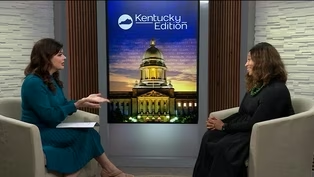
Grants Address Factors affecting Seniors' Emotional Health
Video has Closed Captions
Clip: S4 Ep96 | 5m 35s | A Kentucky-based group is using data to make sure older adults are staying connected. (5m 35s)
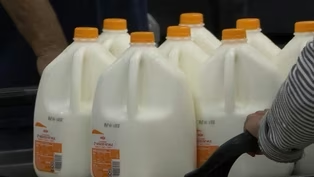
Kentucky Democratic Party Holds Statewide Food Drive
Video has Closed Captions
Clip: S4 Ep96 | 2m 59s | Democratic leaders, local nonprofits collected food donations during "Day of Action." (2m 59s)
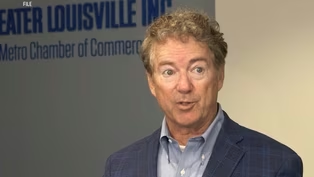
New Deal Could End Government Shutdown
Video has Closed Captions
Clip: S4 Ep96 | 2m 3s | A proposed deal could bring an end to the longest federal government shutdown in U.S. history. (2m 3s)
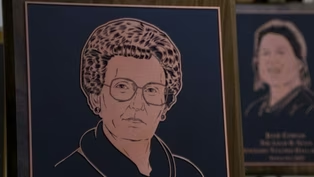
New Members Added to Kentucky Teacher Hall of Fame
Video has Closed Captions
Clip: S4 Ep96 | 3m 30s | Educators are recognized for their passion for teaching Kentucky kids. (3m 30s)
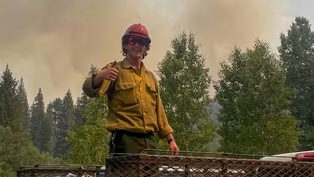
UK Program Gives Students Chance to Fight Fires
Video has Closed Captions
Clip: S4 Ep96 | 3m 32s | Partnership gives forestry students hands-on firefighting experience. (3m 32s)
Providing Support for PBS.org
Learn Moreabout PBS online sponsorship
- News and Public Affairs

Top journalists deliver compelling original analysis of the hour's headlines.

- News and Public Affairs

FRONTLINE is investigative journalism that questions, explains and changes our world.












Support for PBS provided by:
Kentucky Edition is a local public television program presented by KET