Living St. Louis
November 10, 2025
Season 2025 Episode 24 | 27m 51sVideo has Closed Captions
Across the Board, Washington Park Cemetery, Perennial, I Am St. Louis: The Joy of Cooking.
A maker of board games is an official supplier to several major league sports; preservation advocates are working to restore the once prestigious resting place for prominent Black St. Louisans; Perennial helps locals find creative ways to reuse objects and reduce waste; one of America’s most popular cookbooks, The Joy of Cooking, was self-published by local socialite Irma Rombauer in 1931.
Problems playing video? | Closed Captioning Feedback
Problems playing video? | Closed Captioning Feedback
Living St. Louis is a local public television program presented by Nine PBS
Support for Living St. Louis is provided by the Betsy & Thomas Patterson Foundation.
Living St. Louis
November 10, 2025
Season 2025 Episode 24 | 27m 51sVideo has Closed Captions
A maker of board games is an official supplier to several major league sports; preservation advocates are working to restore the once prestigious resting place for prominent Black St. Louisans; Perennial helps locals find creative ways to reuse objects and reduce waste; one of America’s most popular cookbooks, The Joy of Cooking, was self-published by local socialite Irma Rombauer in 1931.
Problems playing video? | Closed Captioning Feedback
How to Watch Living St. Louis
Living St. Louis is available to stream on pbs.org and the free PBS App, available on iPhone, Apple TV, Android TV, Android smartphones, Amazon Fire TV, Amazon Fire Tablet, Roku, Samsung Smart TV, and Vizio.
Providing Support for PBS.org
Learn Moreabout PBS online sponsorship(upbeat music) - Welcome to Living St.
Louis.
I'm Brooke Butler.
And today we're spending some time in Lafayette Park, one of the oldest urban parks west of the Mississippi.
And honestly, just looking around, you can feel that history.
From the commemorative statues to the old trees and Victorian homes, it's one of those places that remind us of our city's many layers, and the pride that goes into keeping those stories alive.
In this "Living St.
Louis," we have more stories exploring the legacy and care across our region.
From family game nights to friends craft nights, from honoring and restoring resting places of Black St.
Louisans, to the roots of one of America's most beloved cookbooks.
It's all next on "Living St.
Louis."
(upbeat music) Lafayette Park has long been a gathering place to unwind, connect, and even play.
Just miles from here, one form of play has become a serious and successful business.
Brooke Butler tells us how one family's love of games has earned them many fans across the U.S.
- It's one of those parts of life that we can all relate to, playing games.
Whether you're part of a yard game family, nerd out on board games, or like myself, are teaching the next generation some of the most valuable learned lessons right at the kitchen table, games are an essential part of the human experience.
And right here in St.
Louis, there's a place where craftsmanship is championing the art of quality time spent together.
Across the board started about 15 years ago.
My husband Ryan and I attended a after-dinner party and we played a horse racing game.
We had a whole lot of fun playing the game.
However, my husband thought he could improve the design of the game.
He could improve the odds, the way it was played.
So he started tinkering around in our garage the next day and he designed what is our current deluxe horse racing game.
What started as a fun hobby for Kim and Ryan just to gift to their family and friends soon turned into a way to supplement their income.
And when they took their games to a local festival, they completely sold out with new orders starting to pile in.
All simply from word of mouth.
Somebody would take our horse racing game to a party and they would play it and the next morning two people would order it.
So we we worked out of our home, out of our garage, making games for about four to five years and it was just the two of us.
He would make them in the garage, he'd bring them into the living room, I'd sit on the ground with our little kids and pound away and put the games together.
Then we just took a leap of faith.
We decided we kind of had something here.
In 2012, the McDaniels moved their operation to this warehouse in Crestwood, the same site that's still used today to carry out the full process of creating the board games.
From cutting and sanding, to printing their custom designs, to placing each intricate little detail, they evolved from a two-person operation to employing 30 dedicated workers that maintain the same sense of perfectionism that Ryan implemented from the beginning.
However, despite achieving tremendous success, across the board has lost a major player.
In 2013, Ryan, my husband, was diagnosed with stage 4 colon cancer at age 42.
And so with three small kids in a business that we both was our livelihood, it was it was scary.
It was really scary.
He was diagnosed in September of 2013, underwent treatment for 20 months, and he passed away in May of 2015.
So then it was a big decision.
Do we continue with Across the Board as a single mom of three small children, or do I work where financially it's a little bit more stable and a little bit easier for all of us?
But I decided I wanted to be able to pick the kids up from school, and I wanted to attend their different school activities, and I wanted to be more accessible for them.
And I wanted to see Ryan's dream come true, and the kids were on board with that.
With his creation of the signature horse racing game, one of Ryan's dreams was for it to become licensed as the official horse racing game of the Kentucky Derby.
So after he passed away in January of 2016, I went out to Las Vegas to the Sports Licensing and Tailgate Show and took the oval board that he had designed and walked the show and found the folks that did the licensing for Kentucky Derby and within a month we had the and we are now the official horse racing game of Kentucky Derby.
That's huge.
-It was big, it was so exciting, and so bittersweet like, you know, wanted him to see that but we do put his initials on every single game every single Kentucky Derby game as a tribute to him and his dream But why just stop at the horse racing game?
Across the Board then went on to become the official car racing game for NASCAR, the official golf game for PGA Tour, and just in time for Opening Day, their baseball game was recently licensed by MLB.
One of our most proud St.
Louis moments, we were selling our classic baseball game at Busch Stadium and Stan Musial's family saw it and they approached us and asked us if we would make a Stan Musial baseball game.
- In fact, Kim has many proud St.
Louis moments as she credits much of Across the Board's success to the support of the city.
- We built our business thanks to the St.
Louis community and all word of mouth.
We're national, I mean, we even ship worldwide now, but we started here in St.
Louis and St.
Louis is what got us to the point that we are now and they still support us tremendously.
- Yes, it definitely helps to have the support of the community for any local business owner, but it also doesn't hurt that there is an increasingly growing popularity of board games worldwide.
Reports show the global board game market is valued between 11 and $13 billion, with a prediction to grow at least 7% over the next five years.
As with a lot of things in our world, the pandemic had something to do with the growth as more people were staying home and playing games together.
But Kim agrees that there's a little more to it than that.
- We all know that we're all tied to screens, you know?
I mean, we're all guilty of it.
And it's just nice to put those away for a night, have a family game night, invite some friends over and just reconnect.
You know, I think that's what's kind of lost in the world today is just that human interaction and that reconnection.
And it's so, so fulfilling to be part of something that I know brings so much joy to other people.
I didn't bring my machete.
I don't have a machete, but you go first.
What is that?
[MUSIC] Established in 1920, Washington Park Cemetery was built during segregation, spanning 75 acres in what is now the city of Berkeley.
It was the largest Black cemetery in the metro area, and it's the final resting place of some of the most prominent African Americans in St.
Louis.
But that didn't stop the plans of urban renewal, which would end up erasing around 33 acres of its historic land.
What exists today is overgrown and neglected, and only preserved by volunteers and descendants.
But it just isn't enough to keep up the burial site.
We took a tour to get a good look at the current state of the land with Aja Corrigan, founder of Save Washington Park and the St.
Louis Preservation Crew.
She's a long-time volunteer who facilitates cleanups and educates anyone who's interested in the history of the cemetery.
- The cemetery is packed to the brim, 42,000 burials.
So as we walk along, I just sort of want to point a few things out.
All the headstones are facing east, so that's why you can't see any of the, you know, when we go around that way, you'll-- - Some of the graves we're looking for belong to my ancestors who were buried here, along with some other prominent Black St.
Louisans.
- And a few other details I'll tell you once we get a little bit farther along when we're looking for your family.
- This cemetery holds a lot of the heritage and culture of Black St.
Louis, individuals who called this city home and those who made a tremendous impact on the region.
People like William Mitchell, the founder of the first Black-owned news outlet in Missouri, the Argus, Supreme Court Attorney George Vaughn, and Professor William Ancell, Grandkeeper of Records and Seal.
This for-profit cemetery was the go-to for the who's who in the region.
Located right next to the airport and the city of Kinloch, a formerly thriving black town in St.
Louis County.
However, all of that changed as the city continued to progress.
In the 1950s, Interstate 70 was built, cutting right through the heart of the cemetery.
In 1972, Lambert Airport acquired nine more acres of the cemetery's land to build their longest runway.
And finally, in 1992, the city of St.
Louis condemned what was left of the north half of the cemetery and built the MetroLink light rail system.
This caused between 11,000 to 13,000 graves to be uprooted and the land to be paved over.
No matter the owner, there was nothing that could be done to stop the plans of urban renewal, especially in North St.
Louis.
It's a practice that's all too familiar to the region, and an expert from the African American Redress Network told me all about it.
They address U.S.
historical racial injustices through research, education, and advocacy.
St.
Louis is really well known for this because of the urban planner Harland Bartholomew.
Linda Mann focuses on policy and racial redress in the organization.
But Harland Bartholomew was a very well-known urban planner.
He actually did a lot of cities.
He designed Lexington, Kentucky, Atlanta, Georgia.
He was involved in Baltimore, Washington, DC.
And his urban planning design really purposefully segregated, was a tool that was used to segregate and zone communities segregated.
And they would confine basically black and brown communities to a certain area within cities.
If you trace that from that onset to today, you can literally watch the continual disinvestment in communities, to your point, the urban renewal, highways bifurcating communities, displacing individuals, taking land in some cases, and in your case, cemetery land even, with or without the removal of families.
- The cemetery declined continuously at the hands of private owners.
This article from the 1990s speaks of the issues and series of suits that eventually caused former owner Virginia L. Younger to take her own life.
Despite the residents' continuous fight for the land, it continued to be uncared for.
The owner of the cemetery today is Kevin Bailey, who bought the cemetery in 2006 for just $2.
We reached out to him for a statement about the plans for the site, but got no response.
But we did get a hold of State Senator Brian Williams, who represents the 14th District in North St.
Louis County, where Washington Park is located.
- I've been able to advocate for hundreds of millions of dollars to come back to the region, but in particular to support cleanup efforts in Kinloch, Missouri, which is right across the highway from the airport.
It's surrounded by so many communities, including Washington Park Cemetery.
So we believe that this is going to create a domino effect to start working towards revitalizing a part of the region that I think has been overlooked for far too long.
In terms of cleanup, this is private land.
So there has been a partnership with efforts of so many different organizations that I'm sure you've met with that have involved cleanups.
I've been proud to be a part of cleanups, which have been efforts to work with people that are mowing the lawn and the grass, I'm sorry, and being able to pick up trash and ensure that we preserve it the best that we can.
So every section has been geo tagged.
SIUE did this one, UMSL did this one, Spire did this giant one, and then they did the baby section.
And then we had just throughout the years volunteers doing seven and eight.
Entities like Washington University here in St.
Louis has done a tremendous job working with people like Aja Corrigan, who has been tremendous in terms of helping get access to records and helping descendants identify their loved ones.
Volunteers from the St.
Louis Genealogical Society preserved the cemetery's data after retrieving it from the previous owner and then donated it to the Missouri History Museum's Library and Research Center.
So it was easy to find the maps and plot cards for my ancestors' graves.
One in what was Section 12, three lost in the overgrown plots, and one in a section that we could walk through.
My second great aunt, Mary Thurman Brady.
Oh, so right.
She's like right here.
Oh, let's see.
What was the year again?
She died in 1980.
Did you?
I found 460.
Oh nice, where is that?
So this might be 470.
We unfortunately did not find her headstone, as it may have been destroyed or sunken into the ground, but we did find the exact spot where she's buried.
I don't see her either.
I think she would be right around here.
I experienced firsthand the disappointment that many Black St.
Louisans feel when visiting Washington Park to find their loved ones' graves.
This is honestly an epidemic in its own way and a sad statement to how we are caring for the deceased African Americans in this country.
There are so many generations of families here that will never be able to find their loved ones because their tombstones are missing, they may have been relocated to a new cemetery.
So it erased the history of so many families and we need to make sure that not only are we prioritizing some of the more underserved and impacted communities, but we're also bringing some of the wealthier communities to understand that we're all in this together.
And I think Washington Park Cemetery is just a symbol of how St.
Louis has come far, but it needs to go so much further.
- This park has been tended to and cared for by generations of neighbors who believe in restoration rather than replacement.
And this spirit is in our next story.
Perennial inspires and teaches St.
Louisans to turn their trash into sustainable treasure.
Perennial is a creative reuse hub in St.
Louis, Missouri.
And our mission is about building a creative culture of reuse where discarded items are transformed into cherished resources.
Creative reuse for all.
We offer almost 300 classes a year.
We really look for things that have a double objective.
So it has to have a creative objective and a sustainability objective.
After someone has taken a few classes at Perennial or come to workshops at a library or seen us out at a festival, that they're sort of building up this little magic trick, which is you look at materials differently after you see what they can be repurposed into.
So some really great examples of that that we use every day in the workshop are old t-shirts.
We turn those into yarn.
We use them for rags.
They're great for ties.
We turn them into kind of stretchy rope material.
And that's just a new way of looking at something that might otherwise, once you're done wearing it, you might think, "Oh, there's no more use for this."
And they can start to apply that to anything that's about to go in their trash can and just think, "Wait, could I use this for something else?"
We're always finding new ways to use scrap paper and old books that might be thrown away.
We use metal baking pans for different molds.
Basically, anything that we can think of a new creative use for, we're excited to show it to other people.
The demand for what we're doing has really increased in the last decade as well.
While you might get something faster and maybe even cheaper from a box store, it doesn't have the character in it.
You don't have a relationship with it, which is kind of how we came to this throwaway culture where it's easy to toss something out or donate it because you don't really have an investment in it.
So I think I'm really encouraged by the people that come in the door every day who are like, no, I want to learn.
I know it's a little bit harder.
I know it's going to take me a little bit more time, but I am excited about the end result and the journey along the way too, because chances are if you don't know how to do something, you're going to meet somebody that does, and that makes it really great.
I'm Veronica Mohesky.
Today I'm here with Jody Sowell, president of the Missouri Historical Society, and today we're going to introduce you to a St.
Louis that maybe you haven't met before.
If St.
Louis could introduce itself, it would say, "I am the place that taught America to cook."
That story is about Irma Rombauer.
Irma Rombauer's husband died in 1930.
This is during the Great Depression.
She has to figure out how is she going to support herself, how is she going to support her child.
And she surprises friends and family when she says, "The way I'm going to do it is I'm going to write a cookbook."
That book is, of course, The Joy of Cooking.
The Joy of Cooking is now in its ninth edition, has sold more than 20 million copies, and the New York Public Library listed it as one of the 150 most influential books of the century.
Not most influential cookbooks, most influential books.
That's amazing.
I know I had one of those in my house growing up.
That's anytime I ask audiences, "How many people have a copy of The Joy of Cooking?"
Almost every hand goes up.
But not many people know that that's a St.
Louis story.
Thanks so much, Jody.
I sat down with Andrew Wonko to learn more about her story.
Irma Raumbauer was born Irma Starkloff in St.
Louis in 1877.
She came from this wealthy, upper middle class family and grew up going to all sorts of civic parties.
social organizations around town.
That's Andrew Wonko, a public historian at the Missouri Historical Society.
But all of a sudden, in 1930, just after the start of the Great Depression, her husband, Edgar, died by suicide.
He had come into a lot of financial difficulty.
He struggled with a lot of mental health problems throughout his life.
Irma didn't work and was faced with having to raise two kids on her own.
She had just $6,000 left to her name.
It was in that very low moment when she didn't really seem to know what to do next that she made an announcement that surprised everyone.
She was going to write a cookbook.
She was in her early 50s.
She was recently widowed and she didn't have much in the way of marketable skills.
And she was always willing to take a chance.
Ethan Becker is Irma Rombauer's grandson and a co-author of later editions of The Joy of Cooking.
He's currently living in Montana.
She was not terribly well known as a cook.
She was extremely well known as a hostess.
And when she decided to write the cookbook, one of the relatives said, "But Irma, if you wrote a cookbook, who would read it?"
As it turns out, a lot of people would.
Her books contained everything from light lunches to elaborate dinners and even what to do with leftovers.
She wanted to create a cookbook that spoke to people who just needed to get a hot meal on the table, but also encouraged them to have a little fun while they tried.
On the front cover, it had a picture of St.
Martha, the patron saint of cooking, slaying a dragon.
And she encouraged people to just, you know, cinch up your apron and take a crack at it.
The first edition of the Joy of Cooking, she self-published 3,000 copies and she sold them for $2.75.
She mostly sold them to the wide circle of family and friends that she had here in town.
But this thing got around pretty quickly.
Irma's first edition provided easy, cost-effective recipes of all kinds to help families navigate the Great Depression.
Irma Rombauer knew the struggles people were facing, average people who were just trying to make meals for their family, and she approached them with a sense of respect and humor and joy.
And I think that's what made her cookbook so magical in the first place.
In 1936, Irma was able to find a national publisher.
All of a sudden, the joy of cooking exploded.
And her books also adapted over the years.
Her third edition was released in 1943 during World War II.
She added in wartime rationing recipes, so a whole bunch of recipes that had no meat at all.
Here's what to do with very limited amounts of sugar or salt or some of the other things that were rationed for daily consumption.
The book was practical, but many people also enjoyed Irma's humor.
Irma Rombauer's casual and fun style is definitely part of why this book became so popular.
But also her recipes are just plain good.
If you flip back through the book, even the earliest editions from the 1930s, there are recipes that have stood the test of time.
Now approaching a century old, they're still just as good as they ever were.
But as the book's popularity grew, Irma's health declined after a series of strokes.
Ethan's mother and Irma's daughter, Marion Rombauer, took over the joy of cooking in the '50s.
Marion added her own ideas to the book.
- She wanted to see the book as a reference book as well as a recipe book.
The book is worth the price strictly for the know-your-ingredients section.
- And she took up much of her mother's humor too in the 1975 edition.
She tells people in the opening that step number one is stand facing the stove.
So she has this wonderful kind of sense of humor that her mother has passed along down to her.
- Irma Rombauer passed away in 1962, but Marion led the Joy of Cooking through several more editions until it was time to pass the torch.
- When I was in my 20s, they came to me and said, "Are you interested in doing the book?"
Well, I like to eat, I like to cook.
I did a lot of recipe testing, and I did some of the writing.
And then when my mom died, then I took over the book.
- Now, Ethan's son and daughter-in-law, John Becker and Megan Scott continue the family legacy.
- I like to say that the cookbook has fed now four generations of our family.
And John and Megan are just doing a tremendous job.
I can't tell you how lucky I feel to have been given something which I kept alive and improved and found a way to make Irma's legacy increase greatly.
But one thing I realized early on is that no matter what I did to the book, no matter how great I made it, even if I made it 10 times as good, it was still Irma Rombauer's book.
Andrew Wonko says we can all learn from Irma's leap of faith.
She had no more knowledge than you or I do today about whether this was going to work, but she threw everything she had into it.
She threw herself into it.
She inhabited the pages of her book as much as any other serious author would.
You can find her sense of joy, her sense of humor in those pages.
Facing those sorts of really incredible circumstances, sometimes you just have to keep going and try your best.
- And that's Living St.
Louis.
You know, Lafayette Park may predate Forest Park, Tower Grove Park, but what do you think is the most St.
Louis park?
Let us know at ninepbs.org/lsl.
I'm Brooke Butler, thanks for joining us.
(upbeat music) Living St.
Louis is funded in part by the Betsy and Thomas Patterson Foundation and the members of Nine PBS.
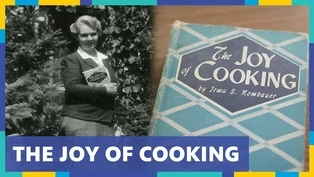
I Am St. Louis: The Joy of Cooking
Video has Closed Captions
Clip: S2025 Ep24 | 7m 13s | One of America’s most popular cookbooks, The Joy of Cooking, originated in St. Louis. (7m 13s)
Providing Support for PBS.org
Learn Moreabout PBS online sponsorship













Support for PBS provided by:
Living St. Louis is a local public television program presented by Nine PBS
Support for Living St. Louis is provided by the Betsy & Thomas Patterson Foundation.