
November 12, 2023 - PBS News Weekend full episode
11/12/2023 | 26m 44sVideo has Closed Captions
November 12, 2023 - PBS News Weekend full episode
November 12, 2023 - PBS News Weekend full episode
Problems playing video? | Closed Captioning Feedback
Problems playing video? | Closed Captioning Feedback
Major corporate funding for the PBS News Hour is provided by BDO, BNSF, Consumer Cellular, American Cruise Lines, and Raymond James. Funding for the PBS NewsHour Weekend is provided by...
November 12, 2023 - PBS News Weekend full episode
11/12/2023 | 26m 44sVideo has Closed Captions
November 12, 2023 - PBS News Weekend full episode
Problems playing video? | Closed Captioning Feedback
How to Watch PBS News Hour
PBS News Hour is available to stream on pbs.org and the free PBS App, available on iPhone, Apple TV, Android TV, Android smartphones, Amazon Fire TV, Amazon Fire Tablet, Roku, Samsung Smart TV, LG TV, and Vizio.
Providing Support for PBS.org
Learn Moreabout PBS online sponsorshipJOHN YANG: Tonight on PBS News Weekend, calls for a ceasefire in Gaza grow louder as the humanity crisis widens.
Then how a government program that's successfully helping fight HIV around the world is caught up in a political battle in Washington, putting its future at risk.
And the ripple effects of falling Mississippi river levels on farmers' bottomlines, consumers' wallets, and barge operators' schedules.
MAN: I've dealt with low water before, but not this low.
We're not loading the barges as heavy, so we have to make more trips.
So you have more boats down there.
Taking fewer barges, doing more lapsing.
(BREAK) JOHN YANG: Good evening.
I'm John Yang.
With conditions at Gaza hospitals getting worse, Israeli Prime Minister Benjamin Netanyahu today said that any ceasefire agreement must include the release of all the Israelis Hamas is holding in Gaza.
Netanyahu also said that pressure from Israeli ground operations pushed Hamas to negotiate about the hostages.
But there are reports tonight that Hamas has paused the talks because of the ongoing chaos around Gaza's hospitals, which is what special correspondent Leila Molana-Allen begins her report with tonight.
And we should warn you that some of the images may be disturbing.
LEILA MOLANA-ALLEN: Hospitals across Gaza are on the brink of collapse.
Doctors have been working by flashlight to treat patients, but staff at Al-Quds Hospital today were unable to continue under the conditions and were forced to stop accepting new patients.
WOMAN (through translator): Sorrow, pain, anger, discontent and disappointment, these are our feelings today.
LEILA MOLANA-ALLEN: Al-Shifa Hospital, the biggest in Gaza, was also forced to close to any more patients today.
Premature babies were lined up in ordinary beds because there was no more electricity to keep them in their life saving incubators.
DR. MOHAMMED OBEID, Surgeon, Doctors Without Borders: We merely sure that we are alone now.
No one hear us, but we want someone to give us the guarantee that we can evacuate the patient.
LEILA MOLANA-ALLEN: Today on NBC's Meet the Press, Israeli Prime Minister Benjamin Netanyahu claimed last night Israel offered to provide the hospital enough fuel to operate, but militants refused it.
BENJAMIN NETANYAHU, Israeli Prime Minister: We have obviously no battle with patients or with civilians at all.
And I think every civilian death, every dead baby is a tragedy.
But that tragedy should be placed squarely at the responsibility of Hamas, that is keeping its military installations inside hospitals.
So we obviously don't want to give them immunity, but at the same time, we're sensitive to this issue.
LEILA MOLANA-ALLEN: Hamas denies refusing any amount of fuel intended for medical use at Gaza's Al-Shafar Hospital.
In Khan Younis, in southern Gaza, the Israeli bombardment continued, a gaping crater where houses and buildings were obliterated, killing at least 13 Palestinians.
Residents combed through the rubble, searching for survivors.
In an interview on CNN's Fareed Zakaria GPS, UN Secretary General Antonio Guterres had this to say on ongoing bombings.
ANTONIO GUTERRES, U.N. Secretary-General: You cannot use the horrific things that Hamas did as a reason for a collective punishment of the Palestinian people.
LEILA MOLANA-ALLEN: And as more people try to leave Gaza, the wrath, a border crossing to Egypt, reopened after a two-day closure.
Many of those allowed to cross today were Russian.
And as the war threatens to trigger a wider conflict in the region.
On Israel's northern border with Lebanon, the sky was thick with smoke from rocket fire between the Lebanese militant group Hezbollah and Israeli forces.
For PBS News Weekend, I'm Leila Molana-Allen in Tel Aviv.
JOHN YANG: Newly minted House Speaker Mike Johnson is facing opposition from some members of his own party to his plan to avert a government shutdown at the end of the week.
Some hardline conservatives said they'd vote against it because it does not have any spending cuts.
The White House called the plan unserious.
Johnson's plan would fund parts of the government until January and other parts until February.
It does not include any money for Israel, Ukraine or the U.S. southern border.
The Pentagon says five army special operations forces were killed early Saturday morning when their helicopter crashed into the eastern Mediterranean Sea.
They were carrying out a routine air refueling mission as part of training.
At the beginning of the war in Israel, the Pentagon sent additional forces to the region.
Russian forces are wrapping up attacks in two eastern Ukrainian cities.
Russian battalions are trying to encircle Avdiivka, a Ukrainian stronghold considered the gateway to parts of the Ukrainian held eastern Donetsk region.
And in Bakhmut to the north, the site of the war's bloodiest battle.
Russia is trying to take back Ukraine's incremental gains from its summer counteroffensive.
And it wasn't quite the storybook ending to Megan Rapinoe's soccer career that many had hoped for.
Last night was her final game, and it was for the National Women's Soccer League championship.
She was in the starting lineup for OL Reign, but less than three minutes in, she limped off the field with a suspected torn Achilles tendon.
Her team lost the match two to one to Gotham Football Club, giving Gotham their first ever title, a remarkable turnaround for a team that finished in last place last season.
Still to come on PBS News Weekend, with the Mississippi river at historic lows how it's affecting farmers, consumers and international trade.
And for Native American Heritage Month, the story of a trailblazing astronaut John Harrington.
(BREAK) JOHN YANG: The federally funded President's Emergency Plan for AIDS Relief, or PEPFAR, provides HIV prevention, treatment and education around the world.
It's the biggest commitment of any nation to fight a single disease.
It's estimated to have saved 25 million lives since President George W. Bush launched it in 2003.
Throughout its existence, PEPFAR has enjoyed broad bipartisan support on Capitol Hill.
That is, until this year.
A small group of conservative House Republicans is blocking legislation to reauthorize PEPFAR.
They say the Biden administration is using it to promote abortion overseas.
PEPFAR's supporters say there is no evidence to back that up.
In September, President Bush wrote an op-ed in the Washington Post urging Congress to reauthorize the program.
He wrote, there is no program more pro-life than one that has saved more than 25 million lives.
Jennifer Kates is senior vice president and director of Global Health and HIV Policy at KFF.
Jennifer, let's start with the basics.
What does PEPFAR do and where does it do it?
JENNIFER KATES, Senior Vice President, KFF: So PEPFAR, the global AIDS response of the U.S. government, is a very large, it's the largest program in global health that the U.S. has and one of the largest in the world.
And it provides funding support to many countries around the world, about 50, to launch and deliver HIV services, whether that's antiretroviral treatment, prevention, social support, education, working with countries, working with partners on the ground.
And it's widely known as one of the most successful programs in the world.
As you said, it's saving 25 million lives.
And our analyses have also showed that it's had even broader impacts beyond HIV.
JOHN YANG: What are the things about it that has made it so successful and so effective?
JENNIFER KATES: When it was launched with incredible bipartisan support.
And having that bipartisan support has really lent the program the kind of support and ongoing stability that it's needed.
In addition, the program has been funded pretty well by Congress.
And also one of the unique things about it is it's been very focused on data and metrics.
So it has actually made changes over time, when new treatments have come on board, when it's seen that it needs to focus on a different area.
So it's very driven by the science, driven by the data, and a very large commitment that involves multiple agencies across the U.S. government.
JOHN YANG: You say it's gone beyond HIV and AIDS.
During the COVID pandemic, did it use some of its organization and infrastructure to work on that?
JENNIFER KATES: So during COVID when essentially the world shut down the operation in countries where PEPFAR is also had to shut down for a large part.
What PEPFAR was able to do, though, they were able to use that infrastructure to respond to COVID, because the infrastructure is there.
The U.S. has already developed it in many countries.
And it was an incredible example of taking something that, where the investment was HIV specific and being able to build on that.
JOHN YANG: Now the opposition to this, to PEPFAR, reauthorizing PEPFAR in Capitol Hill is being led by Representative Chris Smith of New Jersey, longtime ardent foe of abortion.
He's now chairman of the House Foreign Affairs subcommittee that has jurisdiction over PEPFAR and listen to how he defends or explains his opposition.
REP. CHRIS SMITH (R) New Jersey: I strongly supported PEPFAR when it was created in 2003, and I was the sponsor of the reauthorization of PEPFAR in 2018.
Regrettably, it has been reimagined, hijacked by the Biden administration to empower pro-abortion international NGOs deviating from its life affirming work.
JOHN YANG: What do you say to that?
JENNIFER KATES: Yes, Representative Smith mentioned that he was a supporter, has been a supporter of PEPFAR.
He really has been.
And the program has been reauthorized three times.
This would be its fourth.
I think what has happened is the larger politics in the United States around abortion and the partisan differences between Republicans and Democrats have sort of taken over what has been a very bipartisan discussion.
I think the important piece to know, though, is there's several U.S. laws that actually restrict the use of U.S. funding for abortion.
PEPFAR doesn't fund abortion.
It never has.
There's no evidence that it has.
This is really a broader issue around differences between the current administration's views on abortion and choice and that of those who are opposed to abortion.
JOHN YANG: And specifically, he's complaining about the Biden administration's repeal of what's called the Mexico City Protocol, not to use any funds to any group that provides abortion when it's in place.
JENNIFER KATES: And it's always been put in place by Republican presidents through an executive action, and then it's been rescinded or removed by Democratic presidents through executive action, is a policy that says when the U.S. is providing foreign aid to other organizations, to foreign NGOs, non-governmental organizations, it cannot provide any of that funding to organizations that use their own money or any other money, non-U.S. money for abortion related activities that are prohibited, that even are legal in their country, but may be prohibited under U.S. law.
So basically saying we're not going to give you money for abortion because we can't fund abortion, but we won't give you money if you do anything else related to abortion.
JOHN YANG: Now, PEPFAR is established in permanent law.
So what differences will it make if it doesn't get reauthorized?
JENNIFER KATES: Right.
There's essentially two kinds of laws, reauthorizing laws and appropriations.
And we always focus a lot on the money.
That's the appropriation side.
But there's these laws called authorizing laws or reauthorizing laws.
Those create programs or continue programs or structure them or have requirements on them.
PEPFAR was authorized as a permanent part of U.S. law.
It doesn't end as long as Congress continues to fund it.
So that's the good news.
However, there are some requirements and specifications within the authorization.
It's reauthorization that do end, and they did on September 30.
So those were essentially requirements on how the program should fund certain things, and those are no longer requirements.
This is a real symbolic departure from its past.
And I think that's the main aspect right now that most are focused on by getting to a point where there can't be a bipartisan agreement to reauthorize it and what message that might send on the ground and to other partner countries.
JOHN YANG: Jennifer Kates of KFF, thank you very much.
JENNIFER KATES: Thank you.
JOHN YANG: A warm fall and expanding extreme drought conditions have helped water levels along the.
Mississippi river drop to record lows.
Special correspondent Megan Thompson reports from Missouri on what conditions on this vital commercial route mean for farmers who rely on to get their crops to market.
MEGAN THOMPSON: October is one of the busiest times of year for Iowa farmer Robb Ewoldt.
His crops are ready for harvest and he needs to work fast to take advantage of good weather like today.
ROBB EWOLDT, Iowa Farmer: We are currently harvesting soybeans and we are hauling them directly down to the river terminals for export.
MEGAN THOMPSON: Ewolt sells his soybeans for export because that's where he gets the best price.
And lucky for him, his farm in eastern Iowa is just a few miles from the nation's most important grain shipping corridor, flowing 2,300 miles through the heart of the country.
The Mississippi is the nation's second longest river.
It's also a superhighway for American agricultural products.
Around 60 percent of the grain exported from the U.S. is sent down the river by barge to the Gulf Coast.
For some farmers in eastern Iowa, like Ewoldt and his friend Joe Dierickx access to the Mississippi is critical.
ROBB EWOLDT: It's a very important it.
I mean, it's a vital part of our operation.
JOE DIERICKX, Iowa Farmer: The Mississippi River is really our lifeline for exporting around the world.
MEGAN THOMPSON: Usually, Ewoldt and Derek spend these harvest weeks driving nearly non-stop back and forth from their fields to grain elevators on the river.
But this year, the routine was upended.
Ewoldt semi-truck got stuck in two hour lines and Dierickx was told not to show up at all.
JOE DIERICKX: The elevator told me that they were full.
They didn't have a barge that they could dump any more beans into and they were going to close at 02:00.
MEGAN THOMPSON: Closing unexpectedly because the giant barges that are the main mode of transportation are having a hard time getting up the river.
In October, water levels drop to the lowest ever recorded.
The low levels are exposing the riverbed and rocks, slowing down the thousands of barges that operate here.
BRANDON PHILLIPS, Towboat Captain: I've dealt with low water before, but not this low.
MEGAN THOMPSON: Brandon Phillips is a towboat captain for the American River Transportation Company, or ARTCo, a subsidiary of agriculture giant ADM. With 2,000 barges on the Mississippi, it's one of the largest operators in the US.
BRANDON PHILLIPS: Hey, I'll be crossing river beyond the one for you.
MEGAN THOMPSON: When we met Phillips in October, he'd just returned to St. Louis after 31 days straight on the river.
BRANDON PHILLIPS: These are just our typical hopper barges.
We'll tie them together with steel cables, and then we'll hook them up the boat and push them downriver.
MEGAN THOMPSON: The barges fill up at river terminals like this one in St. Louis, where grain is trucked in to be weighed, then dumped and stored.
A chute delivers the grain into the barges, which are then tied together into huge fleets.
Chad Hart is an agricultural economist at Iowa State University.
CHAD HART, Iowa State University: As we're thinking about the barge system, why do we rely on it so much?
It is because it is the most cost effective way for us to move our crops up and down a river.
MEGAN THOMPSON: According to a study by the Texas A&M Transportation Institute, one barge can carry the same amount of dry cargo as 16 train cars or 70 trucks.
Barges have a much smaller carbon footprint, too.
CHAD HART: So it's an incredibly large amount of grain that you're able to move quite easily and effectively down the river when we have full capacity along the Mississippi.
MEGAN THOMPSON: But this year, the barges are only carrying about two-thirds of what they normally would.
The lighter loads help them float higher in the water to avoid getting stuck on the river bottom.
The low water also means the river is narrower.
In a normal year, ARTCo could lash together 46 barges of grain for a trip south.
This year, the most they can fit is 25.
BRANDON PHILLIPS: We're not loading the barges as heavy, so we have to make more trips.
So you have more boats down there taking fewer barges, doing more laps.
MEGAN THOMPSON: And those laps are taking longer, in part because the shallow river is harder to navigate.
BRANDON PHILLIPS: You've got these two red triangles that tells me that it's gotten shallow on the backside there.
That tells you to take warning.
MEGAN THOMPSON: Even with the warnings, boats can run aground, which could mean jamming up river traffic and turning a trip from St. Louis to New Orleans that normally takes five days into a nine-day voyage.
BRANDON PHILLIPS: It's a lot of work.
It takes a lot of planning, takes a lot of communication with other vessels because you have a lot more traffic to deal with.
It's nerve racking.
Even being as experienced as I am, I don't have control over what other people do.
I don't necessarily have control over what Mother Nature does.
MEGAN THOMPSON: The barge problems caused prices for shipping on the Mississippi to spike this fall.
Right when farmers were trying to sell their grain.
To make up for the increased freight costs, grain buyers lowered the price they offered farmers.
JOE DIERICKX: They pay us less.
That cost is pushed back to the farmer.
MEGAN THOMPSON: You can't turn around and pass that cost on to somebody else.
JOE DIERICKX: I would love to pass that on to somebody, but I can't.
MEGAN THOMPSON: Joe Dierickx says he lost about $15,000 on his soybeans compared to last year.
Rob Ewolt is down around $25,000.
ROBB EWOLDT: I don't think anybody wants to take a $25,000 hit to their paycheck.
MEGAN THOMPSON: The issues on the Mississippi are adding to another problem.
Over the last few years, high transportation costs have begun to hamper international trade, contributing to higher prices for American goods, says economist Chad Hart.
CHAD HART: So it makes us less competitive in the international marketplace.
Over the past couple of years, Argentina and Brazil have been able to erode our market share in certain key markets, especially as we look into China.
MEGAN THOMPSON: That the barges are still able to reach these markets at all is thanks mostly to the U.S. Army Corps of Engineers.
Since mid-July, the Corps has been keeping the channel open by dredging, sucking out massive amounts of from the bottom of the river.
LOU DELL'ORCO, U.S. Army Corps of Engineers: What we see is our dust pan.
So our dust pan is our vacuum cleaner.
35 feet wide.
MEGAN THOMPSON: Lou Dell'Orco is the chief of operations for the Cores St. Louis District.
He oversees this massive boat called the Dredge Potter working near Scott City, Missouri.
The boat moves this machine a huge vacuum around the bottom of the river.
LOU DELL'ORCO: Once the dredge sucks it up through the vacuum cleaner, it runs through a pipe.
The pipe goes from the front of the dredge all the way out there and there it's deposited outside of the channel.
In an average day, we can move about 50,000 cubic yards or enough sediment to fill an Olympic sized swimming pool every hour.
MEGAN THOMPSON: A rotating crew of 35 people live on the boat for around three weeks at a time, running the dredge 24 hours a day.
MAN: This screen here, it shows you where we're dredging at, where we're digging.
MEGAN THOMPSON: It's one of eight Army Corps dredging boats working on the Mississippi right now.
It's hard work, made harder by the fact that this vessel was built in 1932 and requires a lot of maintenance.
LOU DELL'ORCO: They're maintaining a 91 year old vessel and there's challenges abound.
And the team keeps it together.
Everybody's dedicated to the mission, which is maintaining the channel which supports the nation's economy.
MEGAN THOMPSON: Dell'Orco's team could be out here until winter, when everyone hopes snow and rain will finally arrive and replenish the river, returning water levels and business back to normal.
For PBS News Weekend, I'm Megan Thompson in Scott City, Missouri.
JOHN YANG: And tonight for our Hidden History series during Native American Heritage Month, the story of a decorated naval officer and trailblazing astronaut.
MAN: Two, one, and lift off.
Space Shuttle Endeavor.
JOHN YANG: In 2002, when John Herrington became the first Native American in space, he carried with him pieces of his heritage, including the flag of the Chickasaw Nation.
MAN: Three new residents headed for the International Space Station.
JOHN HERRINGTON, First Native American In Space: I also flew a flute and a feather.
The flute was made by a Cherokee friend who was an engineer at the Kennedy Space Center.
And Eagle Feather was given to me.
That was beaded Mother Earth and father sky and all the people of the world.
The only two items that I was actually able to take out during my mission and photograph.
JOHN YANG: Herrington was born in 1958 in Watumka, Oklahoma.
He grew up during the height of America's space race with the Soviet Union.
Like many children then, his heroes didn't wear capes.
They wore spacesuits.
Herrington's father was a flight instructor.
He spurred his son's interest in aviation by taking him flying.
JOHN HERRINGTON: Early on my brother and I would sit in the back and we fly to Oklahoma.
And then later on my dad bought a little Cessna 150 and we used to fly and he'd say, here, fly.
And I'd fly and he'd lean over me and take pictures out the window.
JOHN YANG: He graduated from college in 1983 and went to the Navy's aviation Officer Candidate School.
In 1985, he was commissioned as a naval aviator.
Over the next ten years, he had a variety of assignments in the Navy, logging more than 3,800 hours, flying more than 30 types of aircraft.
In 1996, a childhood dream came true.
NASA selected him from 2,500 applicants for one of the 35 slots in the new class of astronaut candidates.
MAN: This view of John Herrington working in the vicinity of the UHF antenna.
JOHN YANG: He went to space as a mission specialist on the Space Shuttle Endeavor as it delivered a new crew to the International Space Station.
During the 13 day mission, Herrington completed three spacewalks.
His NASA career went from space to the depths of the ocean.
He spent 10 days in NASA's Underwater Aquarius lab to study survival techniques for space exploration.
For his achievements, Herrington is in the Chickasaw Nation hall of Fame and the Oklahoma Aviation and Space hall of Fame.
Now retired from NASA, he's an Indigenous scientific storyteller traveling the world, combining Chickasaw oral storytelling traditions with his love for science and space.
His new mission is not only to inspire more young Native Americans to study science, technology, and mathematics, but to burst preconceived notions about Native Americans.
JOHN HERRINGTON: A lot of people have a stereotypical view of what a Native American is, but reality.
We're engineers, we're scientists, we're doctors, we're lawyers.
We appreciate and we value our heritage.
Our ancestors provide us the opportunity to walk the Earth.
And so to be able to recognize that it's not just that we're proud of who we are, but proud of what we do.
JOHN YANG: Now online why the CDC recommends that infants be tested for Hepatitis C as part of the effort to stop the infection spread.
All that and more is on our website, PBS.org/NewsHour.
And that is PBS News Weekend for this Sunday.
I'm John Yang.
For all of my colleagues, thanks for joining us.
Have a good week.

Israel continues offensive in Gaza as hostage talks stall
Video has Closed Captions
Israel continues airstrikes, ground war in Gaza as hostage negotiations stall (3m 8s)

Mississippi River’s historic lows cause shipping woes
Video has Closed Captions
Historically low water levels on the Mississippi River cause shipping woes (8m 4s)

News Wrap: Speaker Johnson’s funding plan faces hurdles
Video has Closed Captions
News Wrap: White House calls Speaker Johnson’s funding plan ‘unserious’ (2m 5s)
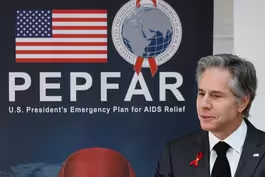
Political battle threatens federal program that fights HIV
Video has Closed Captions
How a political battle is threatening a federal program that fights HIV (6m 41s)

The story of John Herrington, 1st Native American in space
Video has Closed Captions
The story of John Herrington, the 1st Native American in space (3m 12s)
Providing Support for PBS.org
Learn Moreabout PBS online sponsorship
- News and Public Affairs

FRONTLINE is investigative journalism that questions, explains and changes our world.

- News and Public Affairs

Each week, explore science, health, and technology headlines with leading experts.












Support for PBS provided by:
Major corporate funding for the PBS News Hour is provided by BDO, BNSF, Consumer Cellular, American Cruise Lines, and Raymond James. Funding for the PBS NewsHour Weekend is provided by...