
November 12, 2025
Season 4 Episode 98 | 26m 29sVideo has Closed Captions
Congressman Massie's petition on the Epstein files gets the needed 218 signatures.
A discharge petition co-sponsored by Congressman Thomas Massie gets its 218th signature. Sen. Rand Paul explains why he opposes a bill designed to crack down on hemp products. Leaders at two military bases in Kentucky tell state lawmakers some of the problems they face. Officials identify all 14 victims of the deadly UPS plane crash in Louisville.
Problems playing video? | Closed Captioning Feedback
Problems playing video? | Closed Captioning Feedback
Kentucky Edition is a local public television program presented by KET
November 12, 2025
Season 4 Episode 98 | 26m 29sVideo has Closed Captions
A discharge petition co-sponsored by Congressman Thomas Massie gets its 218th signature. Sen. Rand Paul explains why he opposes a bill designed to crack down on hemp products. Leaders at two military bases in Kentucky tell state lawmakers some of the problems they face. Officials identify all 14 victims of the deadly UPS plane crash in Louisville.
Problems playing video? | Closed Captioning Feedback
How to Watch Kentucky Edition
Kentucky Edition is available to stream on pbs.org and the free PBS App, available on iPhone, Apple TV, Android TV, Android smartphones, Amazon Fire TV, Amazon Fire Tablet, Roku, Samsung Smart TV, and Vizio.
Providing Support for PBS.org
Learn Moreabout PBS online sponsorship>> The food banks are not to become the replacement for snap.
>> Food drives.
Can't do it all.
The big role food stamps play to keep some Kentuckians from going hungry.
>> I've been in Kentucky my entire life.
I know how to win.
>> A horse trainer hopes to end up in the political winner's circle.
>> Let's try to address this now, will we either may find something we can reverse, or at least treat this so that we can really maintain our quality of life.
>> And why this is a good time of year to check loved ones for signs of dementia.
>> All of us who come here to read, you know, we have such deep respect for Wendell Berry that we just want to be in his orbit.
>> No question about it.
Readers and writers converge in Newcastle, the center of the Wendell Berry universe.
>> Production of Kentucky Edition is made possible in part by the KET Millennium Fund.
>> Good evening and welcome to Kentucky Edition for this Wednesday, November the 12th.
Hope you had a great Veteran's Day yesterday.
I'm Renee Shaw, and we thank you for winding down your Wednesday with us.
A vote in the U.S.
House of Representatives could come later tonight on whether to reopen the federal government.
This is the 42nd day of the shutdown, the longest in U.S.
history.
We'll have results of that vote tomorrow on Kentucky edition.
The House vote is possible after the U.S.
Senate voted for the budget plan 60 to 40.
The yes vote came despite opposition from U.S.
Senator Rand Paul of Kentucky.
He opposes a provision that cracks down on intoxicating hemp products legalized in the 2018 farm Bill.
Supporters of that provision say it will preserve industrial hemp while preventing the unregulated sale of intoxicants.
Senator Paul says that provision will effectively put the hemp industry out of business.
>> The bill, as it now stands, overrides the regulatory frameworks of several states, cancels the collective decisions of hemp consumers and destroys the livelihoods of hemp farmers.
And it couldn't come at a worse time for America's farmers.
Times are tough for our farmers.
Farmers costs have increased as the price of fertilizer and machinery have jumped, while prices for their crops like soybean, corn and wheat have declined.
For many farmers, hemp has proved to be a lifeline.
A new cash crop.
Farmers turn to growing hemp to mitigate the losses they've endured during this season of hardship.
But that lifeline may soon be extinguished by this very legislation.
>> Senator Paul pushed for an amendment to remove the provision, but the Senate rejected Paul's Amendment 76 to 24.
Only two Republicans voted for it Paul and Senator Ted Cruz of Texas.
The other 22 votes were from Democrats.
Senator Paul's Kentucky colleague, Senator Mitch McConnell, is a backer of the hemp provision.
He put out his statement that says, quote, I am proud to have championed this language that keeps these products out of the hands of children, secures the future of regulated hemp businesses, and keeps our promise to American farmers and law enforcement by clarifying the intention of the 20 2018 farm Bill.
End of quote.
Today, the U.S.
House swore in a new member of the House from Arizona elected in a special election.
She's a Democrat, and she says she supports a discharge petition allowing the House to vote on whether to release the Jeffrey Epstein Files, files that supposedly show who was involved in or knew about Epstein's crimes involving underage girls.
She's the 218th vote if no one changes their mind, meaning supporters of the discharge petition have the support to force that vote.
Congressman Thomas Massie of Kentucky, a Republican, is one of the leaders of the movement to release the Epstein files.
This comes as House Democrats released Epstein emails that say President Donald Trump, quote, knew about the girls and spent hours at Epstein's house with a sex trafficking victim.
The white House accuses Democrats of selectively leaking emails to smear President Trump.
If the federal government reopens soon, it's not clear when the Snap or food stamps program will be back to normal.
Food drives are underway throughout the state to help people get by, and Kentucky Governor Andy Beshear declared a state of emergency and authorized $5 million in funding.
On Kentucky Tonight, Monday night, two of our panelists said that while food banks are helpful, they are not a long term solution.
>> The food banks are not to become the replacement for SNAP, so Snap benefits those dollars.
They're able to actually go further than what the food banks are.
So we always say that a food bank can provide that one meal versus Snap benefits can provide up to nine meals for so many different reasons.
One, a food bank is there to be able to come in to that crunch time when it's ultimately needed.
Whereas a Snap benefits you're able to shop at in Kentucky, close to 5000 retailers in the state of Kentucky accept snap.
Those retailers are open more often than a food bank or a pantry is.
So yet to be determined.
If 5 million will be enough.
>> Yeah.
Mr.
Halligan of God's Pantry, you've said and we've talked before in the last couple of weeks, that food insecurity in central and eastern Kentucky is at an all time high.
How is it been exacerbated because of the federal government shut down?
And did you have enough supply to meet the increasing demand?
>> So I would say that on the supply question, it's an important stopgap to provide immediate relief to the extent that we can.
One way to think about Snap and central and eastern Kentucky, the monthly benefit is $40 million a month.
The annual impact of God's Pantry Food bank in terms of our services and the food, is $80 million a year.
So Snap is six times what the food bank can do 40 million a month versus 80 million a year.
So an important stopgap.
>> You can see all of the program online on demand, where there are a lot of solutions talked about that's available at ket.org.
KY Tonight.
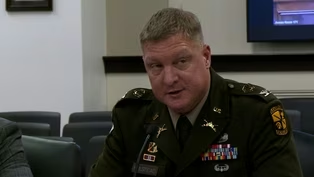
We know the shutdown has affected Kentucky's Fort Knox and Fort Campbell military bases.
And what other problems do those bases face?
A legislative committee wanted to find out.
Our Mackenzie Spink has more in tonight's legislative update.
>> Fort Campbell and Christian County is a major U.S.
Army installation, but it has not been immune to the workforce complications every federal workplace is experiencing due to the government shutdown.
>> The impacts to Fort Campbell and the life sustaining offices were pretty drastic.
You know, we have over 500 federal employees that work in the hospital or medical fields there at Fort Campbell that were impacted over 200 in the Department of Public Works.
>> Shannon Lane is the director of military affairs for the Christian County Chamber of Commerce.
He's hoping that the state could do more for these employees in the future, like helping them get unemployment benefits during shutdowns.
>> Many of them were considered, especially when you're talking to medical and the schools were considered critical.
So they had to continue going to work without pay for coming up on 45 days.
Of course, I think we all hope today is going to be the day that ends it.
Right?
But where did they get the money for the last 43 days?
They didn't get paid.
They put it on credit cards.
They cure debt without any, any kind of protection at all.
So that is one of the big impacts in the community.
>> An issue affecting both Fort Campbell and Fort Knox is the statewide housing shortage.
Representatives from both forts say that having affordable housing nearby is important to retain the military workforce required at these installations.
>> Affordable, quality housing is increasingly hard to find within a reasonable commute of the installation.
The challenge impacts readiness, retention and family well-being.
We we appreciate any support that the Commonwealth can provide and encouraging development that meets the needs of middle and middle income families, both military and civilian.
>> According to Colonel Holstead, Fort Knox has seen a reduction in its workforce, partly due to the Federal Army Transformation Initiative from Secretary of Defense Pete Hegseth, which intends to streamline and modernize the army.
>> We are currently under adapting under the Army Transformation Initiative, which is designed to modernize and align with national defense priorities.
As part of this effort, several Fort Knox organizations have been restructured and or slated for inactivation.
These changes, combined with some other personnel decrements within command, retirement, natural attrition, and the continuing continuing hiring freeze have contributed to what we now project to be.
An overall workforce reduction of about 1975 people.
>> Another concern was raised about the security of the land surrounding Fort Knox and Fort Campbell.
Co-Chair of the committee, Senator Matthew Dineen, plans to introduce a bill next session called the Military Installations Protection Act.
It would allow military representatives from the installations to sit on zoning committees as non-voting members to represent their interests regarding land use around the forts.
For Kentucky Edition, I'm Mackenzie Spink.
>> Thank you.
Mackenzie.
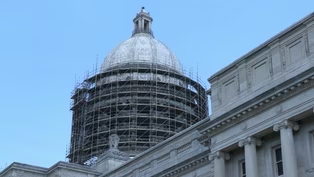
The upcoming state legislative session is less than two months away.
It will begin on January 6th.
So what are some of the top priorities for state lawmakers?
The Kentucky Chamber of Commerce hosted its annual legislative preview on Monday and heard all about all kinds of topics, from the state income tax to child care and more.
Our Emily Sisk was there and has more from Lexington.
>> We will face.
>> Some questions this budget cycle that we haven't in the past.
>> House Speaker David Osborne called Kentucky's current economy and budget an anomaly.
And with the upcoming budget session less than a couple months away, lawmakers will be faced with several decisions that could impact Kentuckians.
One of those is the state income tax.
>> We've reduced our state income tax from 6 to 3.5%, and we've enacted a plan that we're going to get to zero.
>> The 3.5% income tax rate will take effect on January 1st.
Kentucky tax revenues were just shy of the benchmark needed to reduce that rate to 3% in 2027, but legislators said the conversation is ongoing to see if any reduction at all can be made.
Senate Appropriations Chair Chris McDaniel wants to keep the purse strings tight.
However, after President Donald Trump's big, beautiful bill made cuts to some federal programs.
>> If you have a federal program currently that you think that the state is going to backfill, rethink your strategy.
The state is not going to backfill federal programs that get changed.
>> McDaniel did say the state government will likely have to pay tens of millions of dollars, if not more, for the administration of Snap benefits or food stamps.
The Senate leader also had a message about education after Kentucky's two largest school districts, Fayette and Jefferson County, announced they are both experiencing a multimillion dollar budget shortfall.
>> Here in Fayette County.
And you are demanding the resignation of your superintendent and your board chairman.
You are sorely mistaken.
State will not be coming in to bailout districts, period.
End of story.
>> And when it comes to child care, which is a topic the Kentucky Chamber has championed, lawmakers said they may need to look at lightning regulations or using resources to help open more facilities, especially in rural communities.
>> I love the adjective quality child care.
We actually just need child care.
And then maybe we can turn that into quality child care.
Our rural communities are really struggling with that.
>> A final priority of the legislators is building up eastern Kentucky, as the region has experienced steady population decline.
>> We.
>> Really have.
>> To look at the signs of what's going on over there and how we can help that region of our state.
>> We have to get our east on its feet, and if we do that, Kentucky will will be the North Carolina of of, you know, ten, 20 years from now.
>> McDaniel said he wants to find incentives to bring in more businesses and infrastructure to the region.
For Kentucky Edition, I'm Emily Sisk.
>> Thank you Emily.
State lawmakers also discussed priorities related to housing and the administration of Medicaid.
House Speaker David Osborne said the General Assembly will rely on recommendations from the Kentucky Housing Task Force and the Medicaid Oversight and Advisory Board.
Another Democrat has joined the 2026 race for the U.S.
Senate.
Dale Romans is a longtime Thoroughbred trainer.
Here's part of his kickoff announcement.
>> I've been in Kentucky my entire life, and I think I know what Kentucky needs in Washington.
An independent Democrat that can go to Washington, D.C.
and vote for what's right for the people of Kentucky.
>> Romans says he'll be able to cut through what he calls Partizan nonsense to deal with trade, health care and immigration.
He says people living in the U.S.
illegally who commit crimes should be sent back to their home countries.
But he says raids by immigration agents have created fear and resentment in targeted communities, while hurting people and businesses.
That's from him.
New tonight investigators have identified the victims in last week's UPS plane crash in Louisville.
14 people were killed when the cargo █plane crashed moments after takeoff.
Mayor Craig Greenberg says the city has set up a new hotline to help anyone impacted by the crash.
Beginning tomorrow, a community resource center will be open to connect victims to needed services.
Three of the 14 victims were on board the UPS plane.
The youngest victim was just three years old.
And our thoughts are with the victims and their families.
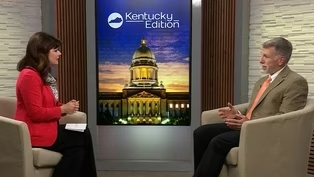
The holiday season is just around the corner, and while it's a special time to gather and celebrate with family, it also offers a chance to see how our aging loved ones are doing.
Our Kristi Dutton spoke with the neurologist to find out what the potential signs of cognitive decline are, and what you can do about it.
This is part of our ongoing aging series called The Next Chapter, that explores the rewards and challenges of growing older.
>> Doctor Gregory Cooper from Norton Neuroscience Institute is here.
So, Doctor Cooper, when we're with family over the holidays, what signs should we look for that might indicate cognitive decline?
>> Well, really, first of all, we want to look for some type of change.
And that can mean a lot of things.
Our loved ones may have trouble remembering recent events following the train of a conversation.
They may seem more disoriented.
They may struggle more coming up with their words.
All of those might be things that would worry us now in the commotion of the holidays.
We can all have lapses, so you don't want to overreact to that.
But any change would be a clue.
And something else, particularly if we're visiting them.
If they're having more difficulty maintaining their home, or maybe there are changes in their own appearance or their own hygiene, or we see that they're not paying their bills or managing their finances well.
Those might also be indications that would worry us.
>> Okay.
What about the relative that we see that tends to tell the same story over and over?
Is that a sign or anything to worry about?
>> It can be, it can be.
And again we're looking for a change there.
So I think we all will repeat ourselves.
We all may forget who we told the story to, and that by itself might not be a concern.
But if there's really an uptick in that, if we're repeating ourselves more and more often, and if there's a lack of awareness that we're repeating ourselves, then that could be a concern.
That could be a concern that we're having problems with memory.
>> Yeah.
In November is a big month for Alzheimer's awareness.
Why is it during the holidays that we might notice some of these changes with our loved ones?
>> I think a lot of it is because this is a time we come together again.
So we may not have seen a family member or spent significant time with them for some months, and now there's an opportunity to be with them, to observe them.
And so we see those changes that we might not have picked up just on a casual phone call.
So I think that's a lot of it.
The holidays, although a wonderful time, can be a stressful time.
And that increased stress stresses our system.
It tests us a little bit more.
So some of those changes may come out a bit more.
>> Okay.
So it brings it to the surface, perhaps a bit more.
So what sort of changes that we may see would be considered normal should we not worry about.
>> I think if we're just a little bit flustered, that could be normal.
If we're a little more short tempered, that could be normal.
If we're under stress, if we walk into another room and forgot why we walked into that room.
All of those things can be normal and just associated with all the commotion and all the excitement of the holidays, so those things can be normal.
>> Okay, that's good because all those apply to me.
>> Sometimes I think they apply to all of us.
>> Yeah.
Okay, so let's say you do notice something in a loved one, something that is of concern.
How do you bring it up?
>> So that can be very difficult.
And people are naturally going to be defensive.
I think all of us would be.
I think that you would want to try saying, well, we notice some changes.
Not sure that's significant, but it really would be a good idea to check that out with your primary doctor.
And if there is a change there, if there is a problem, let's see if there's a solution for that.
Very often I might have memory problems, and it turns out to be a medical condition that I can fix, or a medication problem that I can fix, or if it is part of a real neurological problem, let's say it's the beginning of Alzheimer's disease.
We now have treatments that can meaningfully slow that down.
So let's not wait for this to get too far along.
Let's try to address this now will we either may find something we can reverse, or at least treat this so that we can really maintain our quality of life.
>> Okay, so if you see something some changes, it is important to bring it up.
And the most compassionate understanding way.
Right.
>> Yeah.
And I think I'd really focus on there might be something we can do about this and let's not lose that opportunity.
>> Yeah.
And just real quick, let's say it's the holidays and you're with family members that have already been diagnosed with dementia.
Is there anything that can be done to help them during the holidays?
>> So I would say patience.
The holidays are a time when there's a lot going on.
It can be stressful, we can get overdone, we can get taken out of our routine.
When we get taken out of our routine, that's stressful.
So maintain that routine when we can.
And let's not overdo ourselves.
Give ourselves time for rest, and let's be patient.
If I have Alzheimer's disease and I'm repeating myself, give me a break.
Be patient with me and allow me to be me.
>> That's great advice, doctor Cooper, thank you so much for your time and for being here.
Thank you.
Okay, back to you.
>> Yeah.
Thank you so much, Christie, for bringing Doctor Cooper to us.
If you want to learn more about caring for someone with dementia, you can call the Alzheimer's Association 24 hour helpline at one 800 272 3900.
It was a battle in the bluegrass, with 12th ranked Louisville defeating ninth ranked Kentucky at the KFC yum!
Center last night.
The Cardinals were led by freshman Michael Brown, who scored 20 of his 29 points in the first half.
The cards stretched their lead to 20 before the Wildcats fought their way back within four points.
LED by Denzel Aberdeen.
But in the end, UK came up short and Louisville won 96 to 88, ending a three game skid against its in-state rival.
Go cards.
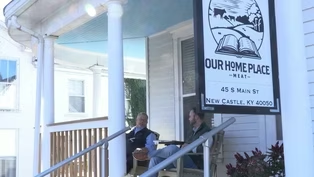
Kentucky's literary scene just celebrated book festivals in Louisville and Lexington, but last Saturday, a handful of Kentucky's top writers read to a sold out crowd in New Castle, Kentucky.
What's the cultural significance of this small town in Henry County?
Well, it happens to be the home of Kentucky's literary living legend, Wendell Berry.
Our June Leffler takes us there for this week's Arts and culture segment we call tapestry.
>> I founded the Berry Center in 2011 to continue my family's advocacy for small farmers in their communities.
I knew from my father when I started the Berry Center that we didn't just have an agricultural problem, we had a cultural problem.
So that brings me really to the Kentucky Arts and Letters Day, when we bring together the finest writers, maybe anywhere.
But a lot of fine writers live in Kentucky.
>> I'm reading two poems about real people.
So the first poem is about a woman who survived the 2022 floods in eastern Kentucky.
And another one is about the first federally prosecuted hate crime in the nation, which happened in Kentucky when a young gay man was almost killed.
And so they they used the new hate crime to prosecute the people who did it.
My poetry collection is a lot about grief and not only personal grief, but sort of witnessing collective grief.
Our effort as writers has always been or long been a way to honor the communities we're from.
Not to sugarcoat any of it at all, but to to realize that people we've known all of our lives have lived with dignity and purpose.
My father lived from pillar to post.
Well, he had his.
And I've had mine.
His life was not a trumpet vine.
There was something in him that never bloomed.
Most of his life he didn't have teeth and didn't know what to do with himself.
I don't know if ever he felt doomed or if he ever learned to feel.
>> Newcastle is the home of the Berry Center.
It is the county seat of Henry County, Kentucky, where my family has lived for.
I'm the eighth generation to live in farm in Henry County.
My daughter Virginia, who started Kentucky Arts and Letters Day, is the ninth generation to live in Henry County.
It's here because this is home.
>> Newcastle is not necessarily like a destination place in Kentucky, and it brings a lot of people to a small Kentucky town, a town that is, you know, mostly been built around agriculture and rural life.
And, of course, you know, sort of the center of the Wendell Berry world.
So a lot of people want to come here to see the place.
Wendell Berry is writing about all of us who come here to read.
You know, we have such deep respect for Wendell Berry that we just want to be in his orbit.
And it's a real honor to be asked to to read here with him.
>> And the day sold out this year in 12 minutes.
I mean, that just I can't think of anything more hopeful, really, than that, that there's so many people in this state that want to hear from these writers.
>> And big writers.
They are.
This was the ninth annual Kentucky Arts and Letters Day Festival.
Wendell Berry writes poetry, novels, and nonfiction.
In 2012, he received the National Humanities Medal, and a few years later, he was the first living author inducted into the Kentucky Writers Hall of Fame.
A Living legend, indeed.
A new report on lung cancer in the U.S.
shows Kentucky experiences some setbacks.
>> We have made a lot of progress and we should celebrate that progress, but know that we also have so much more work to do.
>> Where Kentucky is losing and gaining ground in the battle against lung cancer.
That story and more tomorrow night on Kentucky Edition, which we hope you'll join us again for at 630 eastern, 530 central, where we inform, connect and inspire.
Connect with us all the ways you see on your screen real quickly.
Facebook, Instagram and X to stay in the loop on the social media channels.
I'm Renee Shaw, thanks for being
Holidays Offer Opportunity to Check on Aging Loved Ones
Video has Closed Captions
Clip: S4 Ep98 | 6m 2s | Learn why this is a good time of year to check loved ones for signs of dementia. (6m 2s)
How Kentucky Bases Are Faring During Shutdown
Video has Closed Captions
Preview: S4 Ep98 | 3m 17s | Lawmakers hear how the shutdown is impacting Kentucky bases. (3m 17s)
Video has Closed Captions
Clip: S4 Ep98 | 4m 3s | Readers and writers converge in New Castle, the center of the Wendell Berry universe. (4m 3s)
Previewing Upcoming Legislative Session
Video has Closed Captions
Clip: S4 Ep98 | 3m 23s | The Kentucky Chamber of Commerce holds a legislative preview. (3m 23s)
Providing Support for PBS.org
Learn Moreabout PBS online sponsorship
- News and Public Affairs

Top journalists deliver compelling original analysis of the hour's headlines.

- News and Public Affairs

FRONTLINE is investigative journalism that questions, explains and changes our world.












Support for PBS provided by:
Kentucky Edition is a local public television program presented by KET