
November 13, 2025
Season 4 Episode 99 | 26m 30sVideo has Closed Captions
The reopening of the federal government sparks a fight over hemp in Kentucky.
How hemp advocates are reacting to the bill that reopened the federal government, a state legislator steps down from his leadership role, what's in a proposed omnibus bill that's already stirring up tension in Frankfort, and a preview of the upcoming session from lawmakers from Louisville.
Problems playing video? | Closed Captioning Feedback
Problems playing video? | Closed Captioning Feedback
Kentucky Edition is a local public television program presented by KET
November 13, 2025
Season 4 Episode 99 | 26m 30sVideo has Closed Captions
How hemp advocates are reacting to the bill that reopened the federal government, a state legislator steps down from his leadership role, what's in a proposed omnibus bill that's already stirring up tension in Frankfort, and a preview of the upcoming session from lawmakers from Louisville.
Problems playing video? | Closed Captioning Feedback
How to Watch Kentucky Edition
Kentucky Edition is available to stream on pbs.org and the free PBS App, available on iPhone, Apple TV, Android TV, Android smartphones, Amazon Fire TV, Amazon Fire Tablet, Roku, Samsung Smart TV, and Vizio.
Providing Support for PBS.org
Learn Moreabout PBS online sponsorship>> We're coming out of the shutdown.
What's most important is that the people in Kentucky get the help that they need.
>> As the federal government shutdown ends, how long before important programs are back up and running?
How Hemp's future is looking in Kentucky after action in Congress that supporters say protects kids and critics say hurts businesses.
>> We have made a lot of progress and we should celebrate that progress, but know that we also have so much more work to do.
>> Plus, what a new report is saying about the state of lung cancer in Kentucky.
>> Production of Kentucky Edition is made possible in part by the KET Millennium Fund.
>> Good evening and welcome to Kentucky Edition for this Thursday, November the 13th, I'm Renee Shaw, and we thank you for spending some of your Thursday night with us.
Last night, the U.S.
House passed and President Donald Trump signed a budget bill that reopened the federal government.
The shutdown lasted 43 days, the longest in U.S.
history.
The Senate had already passed the bill.
It was a mostly party line vote in the House.
Congressman Thomas Massie of Kentucky's fourth district was one of just two Republicans to vote no today.
Governor Andy Beshear talked about what to expect in Kentucky as the government reopens and funding resumes for Snap or food stamps and other programs.
>> I've learned that the federal government has now provided the guidance we need to start our state work on providing full benefits under the Snap program.
We're going to recognize a lot of great workers who helped make sure that people get those benefits.
But as an update, the federal government is moving on their side, and I know we'll move as quickly as we can.
When we have an update on timing, we'll make sure we provide that.
Let me just say that this didn't have to happen in this shutdown.
This is the first president that has ever refused to pay Snap benefits during a shutdown.
Two courts told him that he could pay full benefits during a shutdown, and he went to court to try to not pay those full benefits.
But we're coming out of the shutdown.
What's most important is that the people in Kentucky get the help that they need and that no one goes hungry, especially in a month where we celebrate Thanksgiving, there's going to be a number of programs that that should now be funded.
I don't know exactly how the timing will work.
TANF, which helps families in need.
We have provided state funding for the period of time of the shutdown.
We expect to get full reimbursement of that, but now we will have the federal portion coming in.
Head start was seeing challenges, but one of the most important parts is we have about 20 to 30,000 federal employees in Kentucky.
They've been going without a paycheck at all.
Life's already too hard right now.
The bills pile up.
It seems like there's nothing left over for most people at the end of the week and the end of the month, and then imagine not getting a paycheck at all for that period of time.
So certainly glad that our federal workers are going to be back on the job.
>> Michael Halligan, who is president and CEO of God's Pantry Food Bank, says the government shutdown increased public awareness about food insecurity.
He hopes that support continues.
In a statement, he said, quote, while the shutdown has officially ended, we know that its ripple effects will continue to be felt across Kentucky.
Many families who experienced disruptions to SNAP or other assistance will need time to recover, and our work remains as critical as ever.
End quote.
The budget bill that ended the shutdown includes a provision dealing with hemp related products.
Supporters of the provision, including U.S.
Senator Mitch McConnell of Kentucky, says it's needed to clarify the law and protect children from intoxicating substances.
>> Companies have exploited a loophole in the 2018 legislation by taking legal amounts of THC from hemp and turning it into intoxicating substances, and then marketing it to children and candy like packaging and selling it.
Easily accessible places like gas stations and convenience stores all across our country.
So children end up being the unknowing consuming of these poisonous products and being sent to the hospital at an alarming rate.
>> Kentucky's junior U.S.
Senator Rand Paul, is against this hemp provision.
He says it will effectively put the hemp industry out of business.
The U.S.
Hemp Roundtable says the bill threatens to eliminate a $28 billion industry and more than 300,000 jobs.
Former Kentucky Treasurer Jonathan Miller, a Democrat, is also general counsel for the U.S.
Hemp Roundtable.
I spoke to him just a couple of hours ago.
Jonathan Miller, thank you for a little bit of your time.
>> Thank you for having me.
>> So the provision in the legislation that reopened the government that President Trump signed last night affects rules for Americans who grow and sell hemp.
Now, Kentucky's U.S.
senators, as we have reported and as you know, are they differ on this issue.
U.S.
Senator Mitch McConnell has said these are dangerous products that should be out of the hands of children.
While Rand Paul says that this provision will actually gut the hemp industry.
Tell us where the U.S.
Hemp Roundtable falls on this and your opinion about this provision?
>> Well, you never you never would imagine this, but I would I'm sitting on your show saying, I stand with Rand and I always stand with Rand Paul.
But for members of the delegation, McGarvey, Barr, Comer and Massie also agree with our position, which is this ban would eliminate 95% of hemp products from the marketplace.
It would make it a federal crime to to buy them.
It would destroy the industry, cripple Kentucky hemp farmers and deny consumers products that they value for their health and safety, health and wellness.
>> But that's not the intent that Senator McConnell had with this.
Right?
So where are the wires being crossed here?
>> So Senator McConnell makes a good point.
Under the current, under the previous legislation, there are products that have been sold that are marketed to kids.
They are copycat products that look like Cheetos or candy bars, but really have high THC, and some of them are made synthetically or using bad manufacturing practices.
But the way to tackle that is through regulation, not a ban.
Because what you're doing is you're not only crippling the bad actors, but you're you're cutting the feet out from under the good actors who produce products that help our, our seniors and our veterans and which are enjoyed by average Kentuckians across the state.
>> Is this the final word on this?
Is there a way to cut a different deal that would affect an undo the harm that this could have for legitimate good actors and impact only the bad?
>> Yeah, there's a silver lining.
So the the, the the compromise was reached that this would not go into effect for a year.
And so we have 365 days to, to regulate, not to ban these products.
And there has been an outcry over the last 48 hours all over the internet.
And I know many politicians have been hearing from their constituents that they do not want these products to be taken away.
A lot of farmers are furious.
They were promised that they'd have this opportunity to sell these crops in the middle of a very tough agricultural economy.
It's being taken away from them.
So I really am confident that in the next 12 months we'll be able to fix this.
>> But why does it take another 12 months to get there?
I mean, was this sentiment not already out there before this vote?
>> You know, we've been fighting this issue for a couple of years.
Unfortunately, Senator McConnell is a master tactician.
He was able to take this in a back room without any hearing, without any any votes on it and attach it to a must pass bill to reopen the government.
So there was a vote later on the bill, but senators were deciding whether to protect hemp industry or or to let government open.
And, you know, the Snap benefits and the the airline delays.
And so he put them in a very difficult position.
It was brilliant.
But it is also devastating.
>> You've got a prop there.
Tell us about this.
And is this going to be something that folks can't get now.
>> Yeah.
This is something that's made in Louisville.
It's a cornbread hemp tea CBD.
It is something you put on your tongue.
People use it for sleep or for anxiety or for other wellness benefits.
It has a half a milligram of THC in it per serving per droplet.
It doesn't get you high.
But, you know, seniors and veterans really use this.
And average citizens as well use this for their benefits.
This bottle right here, if the law goes into effect a year from now, it would be a federal crime.
It's a schedule one drug narcotic equivalent to fentanyl or to to heroin.
And my mother who uses these products, I don't want to be considered a fentanyl or heroin addict.
This is something that average Americans really rely on.
And also there, the hemp beverages that are so popular all over liquor stores in the state, they might have 5mg or 10mg.
The average customer is not a teenage stoner.
It's a middle aged woman who is replacing a glass of wine with hemp beverage.
And this is these are the types of products that would be considered federal crimes.
And so we're very hopeful over the next 12 months that we'll be able to reverse that, regulate these problems so that the bad actors are eliminated, but allow farmers to survive, small businesses survive and consumers to have the products they need.
>> What kind of criminal penalties could be levied for possession of such?
>> It's it's the same as heroin, fentanyl.
So it is it would be a crime under the federal level.
And you know big question as to whether they would enforce it.
But you know, because of that, it would really crimp any commerce in it and would hurt a whole lot of people.
>> And in Kentucky, this is a viable market in our Kentucky agriculture ecosystem.
>> Kentucky is the ground zero for hemp.
We not only were doing this back in the days of Henry Clay, but it was in Kentucky where James Comer really took the lead and got legislation passed in the in the Kentucky legislature.
And then, ironically, Mitch McConnell took it to the federal level and got federal support for hemp and for CBD.
And so it's really troubling to see backing off like that in a way that really pulls the rug out from under farmers who have been relying on this crop.
>> Yeah.
Well, we'll keep our eye on it.
Jonathan Miller, thank you for stopping by to share with us.
>> Thanks for having me.
>> So more reaction on this issue.
Republican State Representative Savannah Maddox is also critical of the hemp provision.
She put out this statement, quote, by working to criminalize Kentucky grown and regulated hemp products.
Congress is not protecting children.
They are punishing farmers, entrepreneurs and consumers who have played by the rules.
This move represents the worst kind of Washington overreach a top down, one size fits all mandate that erases the work of state leaders who have already addressed their own issues.
End quote.
In other news, politically today, State Representative Al Gentry of Louisville has stepped down from the House Democratic leadership in Frankfort.
Gentry says it's so he can spend more time as a senior advisor to an adaptive golf initiative.
Representative Lindsey Burke of Lexington will move up to Gentry's position of Democratic Caucus chair, and Democrats will vote to replace Burk as Democratic whip tomorrow, weeks before the start of the Kentucky General Assembly 60 day session, some lawmakers are already talking up their ideas.
Representative Nancy Tate of Brandenburg, a Republican, wants a massive omnibus bill aiming to protect Kentuckians from conception through death.
During a legislative hearing this week, Tate and former state representative and now pro-life activist Addia Wuchner talked about it to lawmakers on the Joint Health Services Committee.
Our McKenzie Spink tells us what's in the bill and why it's already stirring up tension in Frankfort.
More in tonight's legislative update.
>> It would be called An Act to Protect Vulnerable People, a proposal seeking to increase criminal penalties or otherwise tighten up Kentucky laws regarding illegal abortion, pill trafficking, abortion, travel targeting minors, commercial surrogacy, medically assisted death, and organ procurement systems.
Addia Wuchner executive director of Kentucky Right to Life, says out of state companies are marketing abortion pills to minors in Kentucky, as well as practicing so-called death tourism to attract pregnant people out of state to seek an abortion.
>> Let's say that you want to get into selling socks, and you decide to order a case of socks, and then you want to repackage them and sell them, you know, three pairs for $1 out of your home and out of your basement.
That is also happening here with abortion pills by people who are not even medical providers, by individuals who are there to profit off the market, you know, buy a three pack.
And unfortunately, sometimes these come in a kit called Kill pills.
>> The Act to Protect Vulnerable People would also ban or restrict commercial surrogacy in the state.
Wisner says the industry commodifies women and children making the womb into a marketplace.
>> We are not talking about having carrying a child for your sister or helping someone very close to you.
We are talking about the large commercialization or carriers are hired for a price.
There are ads in Texas that say be a surrogate for 60 for $100,000.
They're contracted carriers for these for children.
Under these contracts, the carriers are required to terminate the pregnancy.
If the carrier if the purchasers change, changed their minds, or if there's a fetal anomaly.
>> Several Democrats on the committee spoke in opposition of the bill, saying that the measures in the bill haven't been proven effective by data and that the language was unnecessarily inflammatory.
>> I would really encourage you.
I plead with you as you craft this omnibus legislation, to really look at research, supported solutions, and not just.
Maybe popular political talking points.
>> When we talk about death tourism, but we fail to work on exceptions for fatal fetal anomalies.
We set people up.
We push them into a trap where we then call them death tourists.
What an ugly thing to say about someone who wants to be a mother.
>> There was also issue with the way that these policy ideas were being presented.
Representative Burke felt that putting so many measures in one massive bill would hamper a thorough vetting of each individual issue that she felt should be considered separately.
>> It's clear to me that it's not about doing the right thing, because doing the right thing is taking a slow and methodical approach, looking at things in great detail, filing each one of these as a single bill and workshopping them all.
I don't think that every member who is forced to vote yes or no is going to have alignment on every one of these issues, so I would welcome a conversation where we could find things that could move forward as bipartisan legislation, as opposed to an omnibus bill that I promise you I would fight.
>> Although the majority of comments on the bill came from the Democrats on the panel, Republican Senator Lindsey Titchener said she feels it will have a lot of support in the Republican dominated legislature this upcoming session.
>> I just want to say thank you.
I know you've gotten a barrage of negative comments about this legislation and the efforts that you're taking to preserve and protect human dignity and life in its most vulnerable form.
And I think the majority of the people that sit on this committee do support these measures.
>> Intended to be filed separately from the omnibus bill, is a measure that would require schools to show a video called Meet Baby Olivia, which is a computer generated video meant to represent fetal development.
But critics claim the animation isn't based on science.
This would be the third time the Baby Olivia measure has been in front of Kentucky lawmakers for Kentucky Edition.
I'm Mackenzie Spink.
>> Thank you, Mackenzie, for that report.
This was the last meeting of the 2025 Interim Joint Committee on Health Services.
Co-Chair, Senator Stephen Meredith says the Senate Health Services Committee will be hearing fewer bills per meeting during the regular session that begins in January to allow more time to discuss each measure.
Kentucky lawmakers from Louisville shared how they'll they'll proceed in the upcoming legislative session, which will determine the state's two year budget.
Our June Leffler has more in this report.
>> This Louisville Republican is ready to cut the state income tax again.
>> The message should be loud and clear to everyone who hears our voice.
We are getting to zero income tax in Kentucky.
>> That's despite a slump in state revenue failing to trigger an income tax reduction as set by law.
Of course, state lawmakers make the rules.
>> So I'm fully for a reduction in another, a full half of a percent from 3.5% to 3% of our income tax.
If I can't get that done, if I can't convince my colleagues to do that, which, by the way, we did not miss the trigger, we measured it at the wrong time.
But if I can't convince my colleagues to go down a full half of a percent, we need to go down a quarter of a percent.
>> Even Democrat's earlier opened a tax reduction.
Say now is not the time.
>> I'm actually pleased that there was some sort of responsible action to to talk about these reductions.
But I do think the Senator is correct.
I think we do not know what's happening in the federal policy day to day and for everyday people.
You can't plan a future around chaos.
>> A state senator leading budget negotiations recently said federal cuts just to SNAP would cost Kentucky $180 million.
The state does have a healthy, rainy day fund that some lawmakers on both sides say needs to be tapped into.
>> When we look at our overall fiscal policy, one of the things that's on my mind is money does us no good when we hoard it as a state and when we don't put it to work.
Working for the people of Kentucky.
There are a lot of needs in our community, and I hope we got a big bank account.
Right now is the time to start putting that bank account to use.
>> So what we've decided to do was we think 45 days is the right amount.
We're about 60 right now.
That's a couple billion dollars over, over.
So we'll have that money to spend.
And what do we do on that?
We spent it for water projects all over the Commonwealth.
We spent it for ports all over the Commonwealth.
We spent it for infrastructure.
That's what we did.
And then we gave a lot of money to Louisville for important things, for the least among us.
And we're looking hopefully, that we're going to be doing very similar thing this coming session.
>> While Democrats support more funding for public schools, Republicans are reluctant to give district officials more money.
>> We have an explosion in central office and no money going to the classroom, going to the teachers, going to the schools.
That's what the problem is.
And that's why I am so frustrated with JCPS.
>> What could gain bipartisan momentum are ways to increase housing supply.
>> If we don't get serious about housing, we won't have a Kentucky that our future generations will be proud of.
>> As far as housing goes, anything and everything is on the table, and I'd love to hear your all's ideas about your experiences.
Or, you know, because when we go into session in January, everything's on the table.
>> Session starts January 6th for Kentucky Edition.
I'm June Leffler.
>> Turning to health news, lung cancer remains the leading cause of cancer deaths among both women and men when it comes to new lung cancer cases.
Kentucky now ranks worst in the nation, according to a new State of Lung cancer report by the American Lung Association.
But there are some areas where the state is showing improvement, according to Shannon Baker, the director of advocacy for the American Lung Association.
In today's medical news, she says vaping is becoming the state's biggest challenge in the fight against lung cancer.
>> We are back to being the second highest smoking rate in the nation.
We had dipped down to four, but now we are back to the second highest, trailing only West Virginia.
And we all know that smoking is the number one cause of lung cancer.
And so we have so much more work to do as it relates to our our smoking rate in Kentucky.
While it's true that Kentucky ranks highest for lung cancer incidents or new cases diagnosed every year, and for mortality or deaths due to lung cancer, we have made a lot of progress and we should celebrate that progress.
But know that we also have so much more work to do.
And when I talk about progress, I'm really focusing on the fact that Kentucky is a national leader in screening for lung cancer.
We rank 12th in the nation with over 20% of high risk individuals being screened.
And that's above the national average, which is around 18%.
And the reason that's so important is because early detection is the key to successful treatment.
Our survival rate has increased by 32% over the past five years.
So we are again moving in the right direction.
But lots of ground to gain to make up for.
We know that nicotine addiction is very, very powerful.
Right.
And and one of the greater challenges is the fact that young people who would have otherwise probably never touched a traditional combustible cigarette have been targeted and lured with these newer vaping products.
People who begin with the use of these vape products often become addicted to high levels of nicotine and become dual users, with also the use of combustible cigarettes.
So we are calling for the jewel settlement funds that Kentucky receives as the result of a lawsuit against Jewel for targeting our children to be directed to tobacco prevention and control, as opposed to just absorbed in the general fund and used for anything.
These funds are coming into Kentucky for a limited amount of time, and should be appropriately directed to right the wrong perpetrated on Kentucky's kids.
And so we are calling for that roughly $1.2 million a year over the next few years to be directed toward youth prevention and cessation.
Let's keep kids from ever starting using these products through programs to educate them about the risks.
And then those who have already become addicted and are ready to quit and want to quit.
We need to support their quit journey.
So that's one thing that the Lung Association and our partner organizations are calling on the legislature to do.
But a second thing is also we need to increase the funding, the regular source of funding for the Tobacco Prevention and Cessation program.
And so currently, Kentucky directs $2 million toward that program.
But this is a budget session.
So we are calling on the legislature to double that amount.
Let's address this nation's highest lung cancer burden with appropriate programs to prevent initiation ever use.
Right.
And then also to help those who want to quit do that.
>> Earlier this year, the Kentucky General Assembly passed House Bill 11, mandating that only FDA authorized vape products can be sold in the state.
Also passed into law with Senate Bill 100 requiring all tobacco and vape retailers to get a state license with enforcement and inspection by the Department of Alcoholic Beverage Control.
Tomorrow is Friday.
Yay!
And we go inside politics with the Pantsuit Politics duo Sarah Stuart Holland and Beth Silvers as they discuss the end of the federal government shutdown and how things might reflect on Congress and President Donald Trump.
That and more tomorrow night on Kentucky edition, which we hope that you'll join us for again at 630 eastern, 530 central, where we inform, connect and inspire.
Do join us and connect with us on the social media channels Facebook, Instagram and X, formerly known as Twitter.
You also can send us a story idea.
We welcome that by email to Public Affairs at ket.org and look for Kentucky Edition and other public affairs programing on your PBS app that you can download on your smart devices.
And there's also a KET app that you can download as well, and you can stream video online on demand online at ket.org.
I'm Renee Shaw, thank you for being with us tonight.
And I'll see you right back here again tomorrow night.
Take good care.
"Act to Protect Vulnerable People" Gets Pushback
Video has Closed Captions
Clip: S4 Ep99 | 5m 2s | Lawmaker to introduce bill to protect Kentuckians from conception through death. (5m 2s)
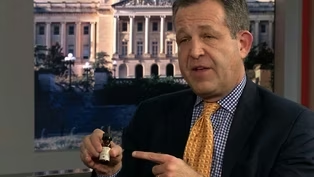
Hemp Advocates Say New Ban Will Cripple the Industry
Video has Closed Captions
Clip: S4 Ep99 | 6m 3s | Renee Shaw sits down with U.S. Hemp Roundtable General Counsel to discuss the new hemp ban. (6m 3s)

Kentucky Ranks First in Nation for New Lung Cancer Cases
Video has Closed Captions
Clip: S4 Ep99 | 5m 1s | State of Lung Cancer' report shows setbacks, progress for Kentucky. (5m 1s)
Providing Support for PBS.org
Learn Moreabout PBS online sponsorship
- News and Public Affairs

Top journalists deliver compelling original analysis of the hour's headlines.

- News and Public Affairs

FRONTLINE is investigative journalism that questions, explains and changes our world.












Support for PBS provided by:
Kentucky Edition is a local public television program presented by KET