Vermont This Week
November 13, 2026
11/13/2026 | 26m 46sVideo has Closed Captions
Lake Champlain cleanup efforts falling behind | Burlington Council president announces mayoral run
Lake Champlain cleanup efforts falling behind | Burlington City Council president announces mayoral run | USPS unveils 2027 Champ stamp | Moderator - Mitch Wertlieb; Mark Johnson - WCAX; John Dillon - Consulting Editor/Seven Days and ProPublica; Aaron Calvin - Seven Days.
Problems playing video? | Closed Captioning Feedback
Problems playing video? | Closed Captioning Feedback
Vermont This Week is a local public television program presented by Vermont Public
Sponsored in part by Lintilhac Foundation and Milne Travel.
Support provided by:


Vermont This Week
November 13, 2026
11/13/2026 | 26m 46sVideo has Closed Captions
Lake Champlain cleanup efforts falling behind | Burlington City Council president announces mayoral run | USPS unveils 2027 Champ stamp | Moderator - Mitch Wertlieb; Mark Johnson - WCAX; John Dillon - Consulting Editor/Seven Days and ProPublica; Aaron Calvin - Seven Days.
Problems playing video? | Closed Captioning Feedback
Where to Watch Vermont This Week
Vermont This Week is available to stream on pbs.org and the PBS app.
Support the crew
Help Mitch keep the conversations going as a member of Vermont Public. Join us today and support independent journalism.Providing Support for PBS.org
Learn Moreabout PBS online sponsorshipA new investigative series from seven days in ProPublica examines what nearly $1 billion in efforts to clean up Lake Champlain has accomplished.
Plus, Burlington City Council President Ben Traverse announces he's running to be the city's next mayor.
And Vermont's most famous cryptid enters the national spotlight in 2027.
All that and more ahead on Vermont this week.
From the Vermont public Studio in Winooski.
This is Vermont this week, made possible in part by the Lintilhac Foundation and Milne Travel.
Here's moderator Mitch Wertlieb.
Hi, I'm Mitch Wertlieb.
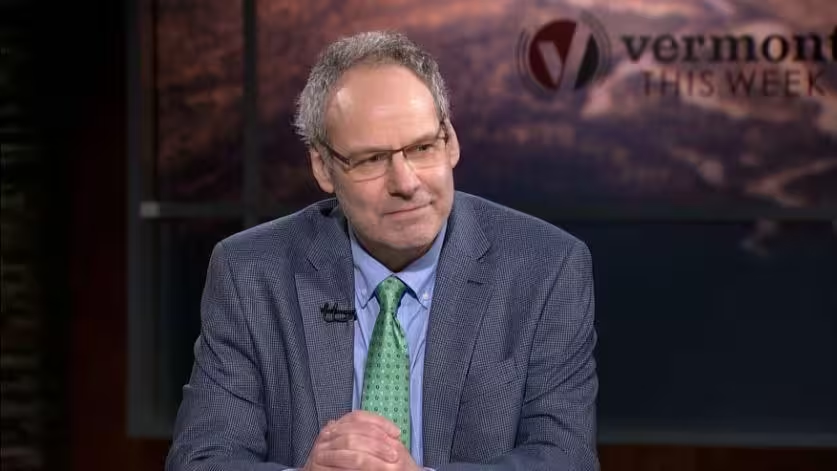
It's Friday, November 13th, and with us on the panel today we have Mark Johnson from WCAX.
Aaron Calvin from Seven Days and John Dillon, consulting editor for seven days and ProPublica.
Thank you all so much for being here today.
John Dillon, I want to start with you.
Just also just say hello and it's great to see you again.
You and I, long time colleagues from Public radio.
It's wonderful to have you on the show today.
Thank you.
It's great to be here.
And what a series that you and John Mingle wrote for seven days, checking up on the health of Lake Champlain.
This is something we have been talking about, obviously, for years.
This is a 20 year effort that has been told we've got to clean up this lake.
Phosphorus is a huge problem where ten years into this effort now, what is your article say about how much progress has been made and how much money has been spent on this project so far, too?
Well, I'll start with the money.
We've spent about $928 million, so close to $1 billion to clean up the lake.
Most of that state funds and the progress has been lagging, I would say.
The EPA said last year that we were about 26% of the way there toward the cleanup goals, the state said.
More recently, we are 35%.
But to look at the actual numbers we're supposed to, the goal is to have a reduction of 212, sorry, metric tons a year of phosphorus reduced.
And we're not we're not making that at all.
We've got ten years to go in this.
And what we were looking at was both the expense of the of the whole entire effort and the progress to date.
And I would say we're falling short of the main goals.
Well, this is a huge problem because the health of the lake, obviously it's important, you know, these algae blooms, people have seen them.
You see that sort of the green scum that floats on the water can be very dangerous for pets.
Drinking water, as you point out in the article, about 200,000 people in Vermont rely on drinking water from Lake Champlain, depending on where you live.
What has the money been spent on so far?
John?
A lot of efforts on farms, a lot of efforts to upgrade sewage treatment plants.
A lot of efforts administered through the Clean Water Board for things like reducing erosion from dirt roads, back roads.
So and then some mitigation is taking place on stormwater.
So what runs off of the your parking lots and and and roofs and whatnot.
And then gets dirty as it goes into streams and ditches and on the way to the lake.
Unfortunately for all of that effort and all that money spent, the the phosphorus in the lake is actually still increasing.
We looked at some of the raw data, and ProPublica has a data team.
So at a seven of the 15 monitoring stations that they track for decades, phosphorus levels have been increasing.
And, you know, that's not a pretty picture because it's increasing in the areas that are already hurting, like the South Lake and the Northeast Arm, Missisquoi Bay and Saint Albans.
Right?
Yeah.
Saint Albans Bay is is we had one of the editors from Pope Public came up from New York and wanted to see an algae bloom.
And so Saint Albans Bay is where you go if you want to see an algae bloom, there's a town beach there that is pretty much closed all season, all summer.
And all those property owners up there have been affected.
So it's not just a problem for, you know, you can't.
It's unsightly.
There are some health issues that cyanobacteria are linked to and there's real economic consequences.
The lake is a huge driver of tourism, you know, and if you can't swim in the water, if you can't use your camp, then then you feel it.
Yeah.
Go ahead.
John.
Mark.
I'm sorry.
You know, and let me echo what makes a great great to see you, JD.
You know what's so maddening about this story is that this is the same story you could have written in 2002, 2016, 2020, and here we are today.
And it just feels I mean, you just want to pull your hair out.
It's just maddening.
And, you know, you point out that most of this pollution is coming from the Vermont side of the lake and not the New York side.
So what is New York doing that we're not?
Well, a lot of it is geography and geology.
So if you look at the size of the watershed, it's huge compared to the Great Lakes acre for, you know, the watershed is just immense.
And most of it is in Vermont.
In New York, a lot of the watershed is forested.
The Adirondack National Park, and there's fewer dairy farms over there and then fewer cities.
You know, you got Plattsburgh, basically, and a lot of it is undeveloped.
So there's less stormwater.
So they're contributing from their land area less to the lake because of development patterns and land use over there.
And Quebec has a big piece of the watershed compared, well, the smallest of the three.
But that is also a lot of agriculture up there too.
But it also seems as though New York is doing a better job controlling the runoff from farms.
They have.
Yes, they have a large farm program which has very rigorous standards.
And we talked to the agency of AG about that, and they said, well, New York's a lot bigger state.
You know, they can spend a lot more money and they give the farms a lot more money to implement these things.
But they do.
They one of the issues that we brought up in the story was the divide between the agency of agriculture and the agency of natural resources over how to regulate farms.
And there's this thing called that they call CAFOs, which are concentrated animal feeding operations.
And if you look at medium sized CAFOs and large CAFOs, there's probably 100 or so in the state, and the state has a Cafo program.
They've never written a permit for an individual farm.
So the EPA has pointed that out and said that's a big problem.
You're not meeting the requirements of the Clean Water Act and how you're regulating agriculture.
So that's going to be an issue that will track, John, as the EPA said, anything as far as recommendations you mentioned capable.
But, you know, are they saying, look, here's what you need to do to fix this problem?
And why isn't the efforts that have been made in Vermont so far seem to have done much?
The EPA has told Vermont as well as recently as last year, that they need to double their efforts.
They need to double the pace of cleanup to get back on track.
In terms of specific programs.
They've they've called the state out for its failure, I would say, to regulate agriculture the way in, in compliance with the Clean Water Act.
And they've said you were supposed to stand up a program to control stormwater from three acres of impervious surface or more, the so-called three acre rule, the state in response to pressure from condo associations and real estate developers and even individual landowners who have three acres of impervious surface who didn't want to pay the cost of those systems, has kicked that down the road most recently until 2028 would be when they would have to begin to develop, you know, some of those rules and standards.
So that is something else.
The EPA said in 2020 that that was a problem.
So it to your point, Mark, you know, we could have written this story.
It's a little Groundhog Day ish I've been going through.
You know, one of the advantages or disadvantages of being around for a while is that you collect a lot of paper and files and stuff from that things you worked on.
And I found a story from 1999 about this ag agency and are divide related to a particular farm that was polluting.
So, you know, it's been around for decades.
And unfortunately, the less the more time that elapses and, you know, it doesn't get better.
It sounds like oversight is going to be an issue too, right?
I mean, look, so there have been calls for for audits to happen here.
Audits have not happened.
From what I can tell.
Well, so this a little bit of history.
Governor Shumlin in 2015 signed a bill called the Vermont Clean Water Act.
And the language in that bill called for an audit of the spending, because we were going to dedicate tax revenues, you know, dedicated funding, and we're spending about $40 million a year on this.
And so lawmakers put in the bill language to require an audit.
They then push that back another couple of years.
And then when it came time to actually, you know, after they delayed it to actually do the audit, they put out a request for a proposal.
They didn't get enough adequate response.
They redid the RFP and then they and they still didn't.
And it was during the pandemic and they still didn't get enough response.
And then they basically shelved it.
And then this week, the head of the Clean Water Board was before a legislative committee and basically said, it's not going to be worth it to do this audit.
It would cost about $150,000.
You have to take that away from programs and you know that actually clean up the lake.
And what we would learn wouldn't be, they say the way we track things internally is doing the job.
But the question I think remains very it's a very good question.
It's like, well, what did you get for that 928 million?
And what pieces of that pot that you spent actually was effective.
And if you learn that, then can you spend the money more wisely in the future?
And that's what the audit was supposed to answer.
Are we getting to the point, John, where the EPA may have to step in at some point and say, you're not taking care of this state of Vermont?
We are going to take care of this now.
And what would that mean if it happened?
They they have said they have a threat to take back clean water programs related to agriculture.
That or that threat stems from a petition at environmental groups filed over the way we administer ag enforcement.
And so that's sort of hanging over the state.
They could the EPA, the federal government could take back control over all of these clean water programs, including administration and funding.
So it's a big club.
They've never actually done that around the country, but it's a threat that the EPA has hanging over the state.
This is an ongoing series, as I understand it.
When is the next installment coming out?
Probably will probably do some quick follow ups to what we reported, like the response to this audit, but or lack of audit, but some bigger stories.
Probably not until after the first of the year.
Yeah, we're going to be following this up.
It's going to be interesting to see two with the new incoming state auditor, Tim Ash has to say about doing an audit on this, because this is such a consequential issue.
And thank you for writing about it.
Check it out in seven days.
As you mentioned, state Auditor Doug Hoffer did do an audit, and it seems as though he came to pretty much the same conclusions that you did in your reporting.
Yeah, and that was 4 or 5 years ago now.
And what he said is that we're spending the money on things that like upgrades, the really expensive things on sewage treatment, plant upgrades that are very minimal in terms of actual reductions in phosphorus.
So he he was looking at the efficiency and effectiveness of the spending as well.
All right.
Well, thank you again for starting the series off.
And we'll keep following that as well.
I want to turn our attention now to Vermont's largest city, Burlington, and the Burlington City Council.
The president of that council has announced a mayoral run to challenge mayor.
And here's what Ben Travers had to say about making the run.
I think this administration has failed to deliver.
Feels like we're stuck.
And yes, it has been a growing level of frustration, but I don't think I'm alone in that frustration.
Okay.
By the way, I should mention that Emma mulvaney Seneca has not yet said she is running for reelection, but we are awaiting that announcement.
Aaron, Calvin, let me start with you on this one.
Why is Ben Travers challenging potentially.
And I don't think that Democrats, Burlington Democrats, have gotten used to being out of power after holding the mayoral office for over a decade prior to Mulvaney statics election in 2024.
And Ben Traverse has essentially been positioning himself to make this run her entire tenure, almost.
And, you know, he didn't wait too long after the general election to let us all know that it was officially on.
And what are his complaints about her, let's say, mayoral style?
She's a progressive, we should say.
Right.
And the Democrats have complained a lot about not being kept in the loop, not being a appropriately collaborated with or informed, but it can often feel like and the city Council that that they would have something to say about almost anything that she does.
You know, the most recent police chief selection that was ultimately approved Monday night is a great example of that.
Democrats were faced with kind of a choice here, whether or not they were going to decide to make a big enough deal out of how they felt closed off.
The selection of this police chief was to make a big enough deal of it to oppose it entirely, or to just let their concerns be known and ultimately approve it anyway, for the good of the stability of the police department.
Ultimately, that's the choice that Travers made.
He voted to be voted to approve the new police chief.
But he you know, a couple Democrats definitely made some very loud votes against the chief.
And it was mostly in protest of how they felt the mayor went about making this choice.
Mark Johnson, you have spoken with Ben Travers.
I understand that length.
What is his angle here?
What is his main?
Well, you know, it's interesting.
It almost goes back to the discussion that we were having with John.
I think there are a lot of people in Burlington that don't feel like there's been a lot of progress made in the past three years.
Ben Travers is really, in large part adopting the same stance that the Democrat who Emma mulvaney Stanek defeated three years ago.
Little tougher on enforcement, a little more law and order kind of approach to this.
Not wanting to have an opioid overdose prevention center right downtown.
I think he's reflecting a lot of the concerns of the business community.
There are an awful lot of businesses that have shut down as a result of this, and probably other economic factors as well.
But, you know, the city is really kind of at a tipping point where the more businesses that close create less incentive for people to come downtown, and you can kind of get into a negative feedback loop.
You know, I spend Travers, they said, is Burlington Downtown unsafe?
And he said, well, you know, I feel safe when I'm walking around there.
But the problem is that there's a perception.
And, you know, perception unfortunately, can sometimes be reality.
And I think, you know, there's a lot of people that are going to the suburbs to go shopping.
They just don't really want to deal with going downtown, being approached by people who are panhandling.
And there's just sort of a there's like an aura downtown at this point.
And I think that's what Ben Travis is tapping into.
You know, the reality is that the issues that Mulvaney Stanek and Ben Travers are talking about are huge.
I mean, the fentanyl crisis is not going to be solved by somebody as the mayor.
And, you know, the homeless problem is not going to be solved by the mayor.
So he's just really talking about, in a sense, like changing the channel and just like the lake, where's the progress?
He may be able to be successful.
I think we're all assuming that Mulvaney runs again just on the basis of.
It's almost like a sports team that is isn't doing well.
And let's change and have a new coach come in.
But it may not really fundamentally make a difference.
I know you're a sports guy.
I'm so glad.
Yes, you totally have to do that.
And not to not to minimize the not at all issues downtown.
But I think that that may be Ben Travers greatest strength is that he is not a progressive and not doing it the way that they.
Well, I mean, just look at, you know, he made his official announcement at Battery Park, but before that, he went on the talk radio show of the of current right, the last Republican to serve on Burlington City Council.
And that really says something about the audience that he's trying to reach with this campaign.
He's trying to tap into a broad coalition of people who, for whatever reason, are upset about maybe not just the administration that's in power right now, but just the perceived lack of progress with these huge issues that Burlington is dealing with.
I would disagree with you.
I don't think going on Curt.
Right.
Show I mean, his show is one of the few popular radio programs these days.
I mean, we could talk about the shrinkage of the media.
You know, I talked to him that same afternoon.
I think he'll talk to anybody right now in the media to get his message out.
And, you know, as far as the shade that he got to for announcing a couple of days after the midterm elections, the caucus is December 6th.
You know, you either do it this week or next week.
The following week is Thanksgiving.
So.
But I wouldn't I wouldn't read a lot into that.
What I find interesting though, I was talking to Aaron about this before we came on air.
Mark, I'd love to get your take on this, because when I hear someone like Ben Trevor saying, well, you know, we've got an issue with homelessness, we've got an issue with drug use in Burlington.
All that's true, I think Emma mulvaney would agree these are issues.
But what are his actual solutions?
It's one thing to say, well, we want to move people from encampments.
Where does he want to move them to?
What is his idea that he's expressed, perhaps to you about dealing with these things?
I don't think he's got hard and fast answers to that.
You know, you asked earlier about approach, one of the comments he made to me that I thought was interesting was, you know, this is going to require help from the state of Vermont.
I think you can argue that Governor Phil Scott's administration has not been as helpful as many would like them to have been.
And I think when Ben Travers talks about it, he says his approach would be to reach a handout as opposed to pointing a finger at this is going to require state help.
It's going to require help from the outlying communities.
South Burlington, Shelburne.
This is not just a Burlington problem.
Where to figure out how to get people help and to get them homes.
You know, the other big hole is treatment programs.
You know, there are limited treatment programs.
You get put into a treatment program.
It's generally for two weeks.
You're not going to get off an addiction in two weeks, particularly if you have nowhere to live.
So I mean, these problems are so much larger, as I said, than I think what any mayor can do.
And, you know, Ben Travers may, if he wins three years from now, be in the same position that Emma mulvaney is right now, which is it's a referendum on what you've done in three years.
And just like the lake, you know, these are problems that are going to take a it took a long time to get into this.
It's going to take a long time to get out.
It's going to require housing treatment.
The the lack of police in the city of Burlington is outrageous.
I mean, there are 55 sworn officers.
Not to sound like one of those people, but back when I was at the Free Press, there were 95.
There are just too few police.
And again, there's a bit of a perception problem.
If you're a police officer looking for a job and you Google Burlington, it doesn't look like an attractive place to go.
So, you know, God bless this new chief and good luck in getting recruits.
That's going to be got to be priority number one for everybody.
That's the genie Anthony.
Yeah.
And you know the Burlington Democrats have put forward this Burlington Forward resolution as sort of you know, progressive councilors have certainly accused them of basically using it as a campaign tactic to try to draw attention to what they propose as solutions to this public safety problem.
But that is still being they're still trying to find a compromise solution to that.
The mayor is still hoping not to have to use her veto power to block it entirely.
They're trying to reach this sort of compromise solution, but the deeper we get towards the mayoral election, the more it becomes sort of a referendum on this.
And it's really kind of tapped into a huge divide.
And at Ben's announcement campaign, he tried to pitch himself as this unity candidate that would represent both the renter and the landlord, the business owner and the worker.
And that's a great thing to say.
But what we've seen play out in the City Council time and time again is that this, this very deep divide between the progressives and the Democrats doesn't seem to be an easy one to bridge.
Amen.
I mean, I asked Ben Traverse the same question.
I said, you know, I think people in Burlington are hearing the progressives and the Democrats arguing, talking at one another, and there needs to be more collaboration.
This is a huge problem.
Everybody's got to be rowing in the same direction.
I asked Phil Scott the same question why can't you just get in your car and drive to Burlington and meet with the mayor?
I mean, you know, there's too much political posturing going on in about eight different directions on this.
And in the meantime, nothing is really being done.
There's, you know, there's too much of the fighting.
You know, I'm hopeful that they're able to come to some sort of middle ground on this.
But the Burlington's, you know, develop this program without any progressive input.
And, you know, that's just not a, not a not a good way to get everybody on board.
I'm curious to about this perception problem that you were talking about, Mark, because you can get into this self-fulfilling prophecy where if you say if you give the impression that that Burlington is this very dangerous place, you're trying to get people to come downtown or they're not going to come down town to spend the money and you get into this, this loop thing.
So I think your point about progressives and Democrats working together towards the same goal is probably something that they should be figuring out.
We, of course, are going to be following as soon as we learn whether Emma mulvaney will make another run for mayor of Burlington, we will let you know about that.
I do want to finish up here with some some good news that I'm very excited about, because one of my favorite Vermonters and that would be champ.
You know him.
You love him, will now be as part of a USPS part of their Mythological Creatures Collection series.
We have the video up here.
For those of you listening at home, this is a stamp of champ.
It's kind of a tattoo artist style.
It's really cool.
Champ looks awesome.
He is going to be a commemorative stamp now, along with Mothman, the jackalope, the squad and the Sasquatch.
And no blue green algae in that.
In that?
Not at all.
That's the thing.
You bring it back to the lake, John.
Champs, champs.
Got to have a good leg to swim in, right?
He does.
I'm just so glad he's on his stamp.
That's where we're going to have to leave it for this week.
Look for your champ stamp wherever you get your postage stamps.
And thanks to our panel this week, Mark Johnson from WCAX, Aaron Calvin from Seven dDays.
And such a pleasure to welcome John Dillon back, consulting editor for seven days and ProPublica.
I'm Mitch Wertlieb, thank you so much for watching and listening.
And we'll see you right here next Friday for Vermont this week.
 New Episode
- News and Public Affairs

Top journalists deliver compelling original analysis of the hour's headlines.
 New Episode
- News and Public Affairs

Today's top journalists discuss Washington's current political events and public affairs.

 New Episode
 New Episode
 New Episode
 New Episode
 New Episode


 New Episode



Support for PBS provided by:
Vermont This Week is a local public television program presented by Vermont Public
Sponsored in part by Lintilhac Foundation and Milne Travel.