
November 14, 2025
Season 4 Episode 100 | 26m 30sVideo has Closed Captions
The state A.I. Task Force announces its policy recommendations.
The state A.I. Task Force lays out its policy recommendations ahead of the upcoming General Assembly session. A new report says lawmakers in Frankfort use tactics that discourage voter participation in the legislative process. The possible political fallout of the longest government shutdown in U.S. history.
Problems playing video? | Closed Captioning Feedback
Problems playing video? | Closed Captioning Feedback
Kentucky Edition is a local public television program presented by KET
November 14, 2025
Season 4 Episode 100 | 26m 30sVideo has Closed Captions
The state A.I. Task Force lays out its policy recommendations ahead of the upcoming General Assembly session. A new report says lawmakers in Frankfort use tactics that discourage voter participation in the legislative process. The possible political fallout of the longest government shutdown in U.S. history.
Problems playing video? | Closed Captioning Feedback
How to Watch Kentucky Edition
Kentucky Edition is available to stream on pbs.org and the free PBS App, available on iPhone, Apple TV, Android TV, Android smartphones, Amazon Fire TV, Amazon Fire Tablet, Roku, Samsung Smart TV, and Vizio.
Providing Support for PBS.org
Learn Moreabout PBS online sponsorship>> And accountability in transparency.
It's not Partizan.
I mean, this is vital to our healthy democracy.
>> A new report asks if some state laws were rushed with little public input.
>> But even this president, who takes a lot of liberty with his power, cannot do everything without the Congress.
>> We'll go inside Washington politics and talk about possible lessons learned from the federal government shutdown.
>> I've come a very long way.
I mean, I could not do a lot of this before.
>> And how a University of Louisville study is helping children take a big step forward.
>> Production of Kentucky Edition is made possible in part by the KET Millennium Fund.
>> Good evening and welcome to Kentucky edition for this Friday, November the 14th.
We've made it to the weekend.
I'm Renee Shaw, and we thank you for kicking off your weekend with us.
Everyone is talking about A.I.
Artificial Intelligence these days.
The good things it can do and the bad.
What will Kentucky lawmakers do about A.I.
when the General Assembly convenes in January?
The state's artificial intelligence task force just sent its policy recommendations to the Senate leadership, or to the leadership in general.
With children safety among the top priorities, our Mackenzie Spink tells us more about potential artificial intelligence legislation in this legislative update.
>> The ten recommendations from the Artificial Intelligence Task Force touch on subjects like protecting consumers from data collection, using AI to improve the Medicaid system, and assigning the overview of AI in the state to permanent committees.
Democratic caucus chair Senator Reggie Thomas says the recommendation to pass laws protecting children on social media is by far his favorite.
>> We see every day here in America discussions of sexual exploitation of minors, sexual trafficking of minors.
AI is out there every day causing harm and danger to to our children.
I think this is an excellent recommendation because it promotes online safety for minors, for child welfare and for parents.
>> However, he expressed cautious support for the recommendations regarding data centers.
Those recommendations ask the General Assembly to consider policies to determine future locations for data centers, and to keep in mind the center's large needs for water and energy.
>> I'm for data centers.
However, I think there are two points that need to be made regarding the increased use and proliferation of data centers here in Kentucky.
One is that no data center should be built in Kentucky without there being some kind of environmental impact survey related to what it's going to, how it's going to impact our environment.
I think if there's an increased cost that comes with data center construction or use, then that data center should pay for that increased cost.
No, not the current consumers or the current business users who are using it.
Before the data center came online.
>> Co-Chair of the task force, Representative Josh Bray, says those recommendations already address Thomas's concerns.
>> I can tell you that your concerns are the exact reason that that was those sections were drafted.
The PSC already has to do when they approve a large user, they already have to do the environmental study.
Kind of what?
Not necessarily an environmental, but a environmental, as in the grid usage, capacity, availability, that type of stuff that's already incorporated and that goes into recommendation nine.
Because you're absolutely right.
We want to make sure that the the end user or the, the people aren't their electric bills don't increase because of consumption by the data center.
And had a lot of conversation with power companies, data centers, the Public Service Commission.
So there will be a bill coming to address those exact concerns.
>> While lawmakers seem to welcome the idea of more data centers in Kentucky, there has already been community opposition about the size and environmental impact of these centers.
Earlier this year, plans to build a data center in Oldham County were eventually scrapped due to public backlash.
For Kentucky edition, I'm Mackenzie Spink.
>> Thank you.
Mackenzie.
Representative Bray says that some of the task force's concerns about AI could be better addressed at the federal level.
And so part of the memo encourages Kentucky's federal delegation to work on specific AI policies.
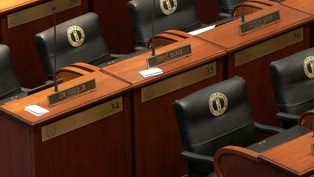
A new report from the League of Women Voters of Kentucky says state lawmakers continue to fast track bills, making it harder for everyday Kentuckians to follow and weigh in on the legislative process.
Our June Leffler reports on that report.
>> The league has studied the legislative process for three years in a row.
Volunteers say they noticed a trend that they needed to analyze.
>> I was gone for almost 20 years and came back and sat in some sessions and said this, this is different.
This is not what I remember.
And I had some colleagues from back in the day who were sitting there going, yeah, we thought it was different too.
But you know, when you're on a slow boil, you may not notice.
>> The league reported in 2023 and 2024 that the General Assembly had sped up the legislative process in recent years.
The League studied 860 day sessions occurring in even numbered years in 1998.
Lawmakers bent the rules to fast track 3% of all legislation passed that year.
That jumped to 37% in 2024.
This year, its report focuses on the short 30 day sessions happening in odd numbered years.
>> Particularly the 30 day sessions, if anything.
There was almost as much legislation proposed, so in fact, they had even less time to do their work, which meant they sped things up.
Now it's kind of a bumpy ride.
If you look at the trend, it's not a complete, steady way up.
It does go down some years, but oddly enough, one chamber goes up when the other one goes down, and we're still seeing a trend that's generally upward so that it can be as much as 50% of the time in a 30 day session, that all of these tricks come up and prevent people's participation.
>> What does the league consider fast tracking?
Essentially, when bills are read on the House or Senate floor before even being heard in committee, committee hearings are when members hash out a bill, they debate it and hear testimony from constituents and lobbyists.
>> Based on the process, they're supposed to be three readings on the floor.
After the committee meets and makes a recommendation.
But what is happening in these fast track maneuvers is that they've been removed from the committee before anyone's talked about it, and there can be as many as two readings before the committee's ever met and ever talked about it.
>> The league says these tactics get in the way of public input.
>> And accountability and transparency.
It's not Partizan.
I mean, this is vital to our healthy democracy.
We have the data.
We've looked at the process, we've made some recommendations.
And so now that we're aware of the problem, then we can take steps to correct it.
>> It's up to state lawmakers on what to do with these findings, to either stick to their rules or bend them or change them.
Another long legislative session starts on January 6th.
For Kentucky edition, I'm June Leffler.
>> Thank you June.
Now you can read the latest and previous reports from the Kentucky League of Women Voters online at LWC ky.org.
State Representative Joshua Watkins of Louisville is now part of the House Democratic leadership team.
Democrat's in Frankfort today named Watkins as House Democratic whip.
He'll replace Lindsey Burke, who moved up to become House Democratic Caucus chair, replacing Al Gentry, who stepped down to devote more time to a national adaptive golf initiative.
Charges have been dismissed against Madeline Fening.
A reporter with the Cincinnati CityBeat arrested during a protest at the Roebling Bridge in northern Kentucky, July 17th.
Covington police first charged with rioting.
Prosecutors dropped that charge, but some misdemeanor charges remain.
The ACLU says those have now been dismissed.
A jury found a CityBeat intern not guilty of three of the four charges against him.
According to an ACLU press release, Fening says she was just doing her job covering a protest in support of a man detained by Ice.
A chaotic scene seen on police body cameras included 15 arrests.
The federal government reopened this week, as you know, ending the longest shutdown in U.S.
history.
Still, there are lingering concerns about SNAP and food stamps and other programs needing funding.
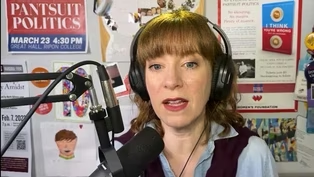
Yesterday I caught up with the pants Pantsuit Politics duo Kentuckians, Sarah Stuart Holland and Beth Silvers to discuss the political fallout, possibly of the shutdown and who voters may hold accountable for it.
Beth Silvers and Sarah Stuart Holland, thank you so very much for joining us.
I got the order reversed.
If you're looking at the screen.
Beth is on screen, right?
And and Sarah is on screen left.
So thank you so much for being with us.
>> Thank you for having us again.
>> So let's talk about this government shutdown and how revelatory this experience could have been for American voters who've watched this unfold for 43 days.
We've seen all kinds of snafus where it comes to other snap food stamp benefits or traveling federal employees were impacted.
How do you think the American public is perhaps resetting their perception of the function, or some would say dysfunction of Washington?
>> I think it depends on who you're talking about.
I think for voters in the middle who are detached from party identification and really distrustful of our institutions, already this confirmed all their worst instincts, right?
Like that they that the government is dysfunctional, that no one in Washington cares.
Like I'm really worried it will feed that that nihilistic narrative that so many people have about our government that it's dysfunctional because it has been dysfunctional over the last 43 days, and it affected people's lives.
People who are really disengaged from the media cycle.
I've really paid attention over the last few months to what I think bubbles up, not to all of us who follow it closely, but to people who are just absorbing something that actually affects their day to day, or something that they might catch in the waiting room TV or something like that.
I think this definitely broke through, but unfortunately, I think it broke through in a way that confirms that people's disengagement with the entire government and process.
>> Yeah.
You know, Beth, I'd heard from several people who say, you know, I just can't watch the news anymore.
And people can go back and watch our previous segment where we talked about news, agnostics and atheists.
But how do you think this is either going to reengage or further disengage people by what we've experienced these last couple of months?
>> I hope it reengages people who are thinking about running for office.
I hope there are a number of people out there who see this.
It doesn't have to be a lot who think, you know, I think I could do this job better.
I could approach it in a different way, and I hope that they try to do that next year.
To the extent that it breaks through with people who don't pay a lot of attention to news, I think that it will tell them more about the president than about Congress.
You know, we have thought about the president as a nation more over the last ten years than we have our Congress.
And President Trump specifically tells people, I alone can fix things.
I'm the one who can make everything happen.
Really, all you have to do is vote for me and know that things will get done.
And this was a reminder that that's not our system, that Congress does have a role to play, and Congress doesn't do it very well very often.
But hopefully remembering that that even this president, who takes a lot of liberty with his power, cannot do everything without the Congress.
And I hope it makes us kind of sit up straight and pay a little more attention to those races next year.
>> Many people are asking, who are the winners and who are the losers when it comes to party?
So do the Democrats come out faring better than the Republican Party and the president?
I mean, if we look at the election a week or so ago, Sarah, what does that foretell?
>> I think it is hard to detach the the election results from the overall shutdown, especially with the end of the shutdown coming so close.
I know there are a lot of Democrats furious at the way the shutdown ended, but I think overall, especially for those voters who are who are absorbing the vibe more than following it day to day.
I do think it was a win overall for Democrats.
I think they got some energy back.
They got some fight back.
I think it has definitely put on display the the factions of the party who are ready to fight and the factions of the party that are still operating, and a very dated status quo.
But I do think that overall, the idea that Democrats were fighting for health care, that Trump was shutting down snap benefits that Trump didn't care was off.
You know, even at Mar a Lago, at a Great Gatsby party or flying around the world, I think that landed.
I think that really got through to people.
>> Yeah.
How how do you see it?
>> Beth I really struggle with the win loss framework around shutdowns, because the government shutdown is a loss for the American people.
Any way you slice it, I hope that what happens next will give people a better sense of comfort.
At least that they know what each of the party stands for.
So I think what Sarah said is true.
If Democrats come out of this with a little bit of energy and a little bit of momentum and keep putting pressure on congressional Republicans to deal with those ACA subsidies, for example, that will be a good thing.
That will be some progress.
I think there's an equally viable scenario where things kind of go back to a status quo, and that would be very tough.
That would be, I think, a double loss for the American people.
>> Yeah.
And just we should put a note in the fact that, you know, two and a half months from now, we're going to be back at the same place, right?
That this was only until the end of January, and then we could be facing the danger of another shutdown again.
Last question to you.
And this is kind of a large one.
Will this even matter a year from now?
If we look at our watches, you know, this time next year in 2026 will be on the other side of the midterm elections.
Do these things have any longevity and the memory bank of American voters, or is there so much happening all the time, everywhere, that this will be just a blip?
And then when we get to this time next year, people will vaguely, vaguely remember what happened.
What do you think, Sarah?
>> I think that it builds.
Right.
It's not that I any American.
Some might.
I mean, I'm sure some federal workers will walk into the voting booth next November with a grudge and a well deserved one.
But I think it it more contributes to people's narratives.
They either already have or are building.
I think the narrative that was powerful in this election, and will still be powerful in the next election, is affordability and the idea that, you know, you might not walk in and say, I'm my prices are still high.
And he cut Snap benefits last November to the shutdown.
I don't think people's brains work that way in.
Their memories work that way, but it is evidence that contributes to a narrative people lock in on, right?
It could be that the government is dysfunctional and they stay out of the midterm process altogether.
We know that the Republican Party really has low frequency voters.
And so maybe those people continue to stay home.
Maybe the high frequency voters in the Democratic Party are still mad.
They'll be plenty of other things to be mad about by next November, but this will be a piece of it.
So I think it just builds on the whole, I don't think it will be a sole motivator, but I do think it will be a part of the stories that Americans are telling themselves as they walk into the voting booths next November.
>> Beth final word to you.
>> I think that's right.
I think candidates can make it matter by talking about the pain that this shutdown caused, and how important it is to have a government that functions for you, a government that doesn't make your life harder, but one that is there to serve you and to just allow you to do the basic things you need to do, like get on an airplane to visit your family around Thanksgiving and get your snap benefits at the grocery store to feed your children.
You know who who will win, I think next year.
I think the party that wins next year will be the party that is able to say, we are here to work for you and for government to be an addition to your life, not an obstacle.
>> All right.
On those wise words, we will end it there.
Thank you so much.
Beth Silvers and Sarah Stuart Holland Pantsuit Politics.
Listen to them on Substack and listen to their podcasts.
Pretty interesting.
Thank you ladies, as always, thank you.
>> Thank you Renee.
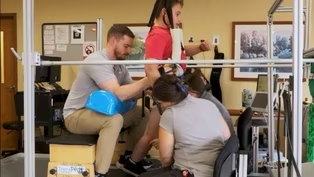
>> Five children with complete paralysis due to spinal cord injuries were able to take their first steps while taking part in a clinical study at the University of Louisville.
One of those children is Malcolm McIntyre, and we spoke with him and his mom about how the therapy sessions have improved their lives.
>> It turns out that the spinal cord is smarter than we ever thought.
We thought it was just a conduit or a cable that carried messages, but it actually works a lot like your brain.
It interprets them, receives information, and can help you move again.
So things about the size of a quarter.
These little electrodes we put on your back over your spinal column goes right to your spinal cord.
And there are these sensory nerves that go into the spinal cord once you charge it.
Then we tried to do several things with the child.
One is increasing the sensory input to the spinal cord.
And that's by doing some stepping on a treadmill.
And the other is asking the child to think about walking when the stimulation is on or taking steps.
So they had to actually, for several minutes at a time, really give their cognitive effort, will and intent to try and take those steps.
Now it turns out it worked.
>> After doing the therapy, he has a ton more trunk control, and he was actually able to hold himself up.
And then it just got better and better and better.
And he was able to find midline.
And he actually his scoliosis curve has actually started to reverse itself, which is unheard of with body weight support.
He can take a step as long as someone's holding one of his legs into extension and the other one back, he can swing it through.
So it's like that swing phase of when you're walking.
>> I've come a very long way to the research.
Studies have really, really helped me with this.
I mean, I could not do a lot of this before.
This is really helped me get back to do what I like to do.
>> And then what else?
And then he could kick a ball, which was really neat.
And that for a at the time eight year old kid was the coolest part.
>> One time.
Yeah, we used to, we used to have my red watch and we used to count my steps.
And one time I got like over a hundred.
It was a really big moment for me.
I also hit a target, I think spot on with the ball.
That was also a really big moment.
That might have been the biggest one overall.
It was like, like I can do this.
>> So from a scientific standpoint, we're changing their capacity and learning more about what's possible.
And so we tried some things then, but we've written a grant recently and have that under review, which would give us an opportunity to work with 6 or 7 more children who have a complete injury and, and very much target.
Can I weight bear?
Can we turn all the leg muscles that help you hold up against gravity?
And then we try and put them together, right.
Because we'd have swing and we'd have standing and and maybe that would help.
>> We want him to be healthy and happy, independent and functional, and everything we can do to help him get to that point is better and better and better.
And if he walks one day, amazing.
But it will not.
It will not change who he is.
This, this stuff has actually changed who he is and what he's able to do.
And being able to he's he's able to do a sleepover at a friend's house, you know, and kind of live in an 11 year old's life, which is pretty awesome.
>> So we hope for a lot of big moments for Malcolm.
During the study, children also had improved bladder function and experienced more sensations, which for some have lasted months and even years after the study.
Even though Christmas is more than a month away, we already have some Christmas themed events for you to enjoy.
Our Toby Gibbs has a list of them and this.
Look at what's happening around the Commonwealth.
>> Get ready for a holly jolly Christmas in Owensboro!
As Dolly Parton's Smoky Mountain Christmas Carol takes the stage November 15th.
Set in the 1930s, Smoky Mountains, the musical reimagines Ebenezer Scrooge's story with Appalachian charm and Dolly's signature songs.
Burnside is lighting up the season once again with the return of Christmas Island at General Burnside Island State Park.
The park will turn into a glowing mile long drive of holiday lights.
After taking in the lights, grab a treat and a photo with Santa.
There's also a vendor village with local shops and handmade gifts.
The display lights up next Tuesday and runs through December 31st.
Georgetown is stepping into history this weekend with a visit from the Mystic Wind Choctaw Social Dance Troupe.
The troupe will be sharing traditional dances, holding a drum circle for everyone to join and telling stories that highlight Choctaw history and culture.
A Native American stickball game will also be part of the celebration held in honor of Native American Heritage Month.
They're driving home the holiday spirit in Burlington with Light Up the Fair opening tonight.
The drive through display will have Boone County Fairgrounds glowing with more than 1.5 million lights.
The light show includes a 50 foot Christmas tree built from 25,000 lights, and a 300 foot snowflake tunnel.
You can drive through all synchronized to music you can listen to on your car radio.
Check out some new reads.
No library card required at the International Book Project's Free Book Friday, happening next Friday in Lexington, there will be hundreds of free titles, from fiction and nonfiction to kids books.
Guests can fill one box with books until 4 p.m.
and after that, there's no limit while supplies last.
A showcase of Kentucky craftsmanship in Somerset this weekend as the city hosts the 31st annual Sheltowee Artisans Art fair.
Everything from pottery and quilts to jewelry, photography and even handmade instruments made by more than 80 artists from across eastern and southern Kentucky will be on display.
There will also be live demonstrations at this two day event.
Soak in the sights of autumn at Audubon Park in Henderson this Sunday as it marks National Take a Hike Day.
Take a one mile guided walk led by the park's naturalist, and learn a little about the park's plants and wildlife along the way.
The hike is free and leashed.
Pets are welcome to join.
Versailles has a cause for celebration this weekend, as the Versailles Merchants Alliance hosts its 39th annual Christmas Open House.
Meet Santa, sip hot chocolate while shopping for holiday gifts, and kids can do a little shopping of their own at the Free Kids Market.
Ashland Central Park will be radiating with light as it flips the switch on the Winter Wonderland of Lights Festival.
Stroll through the park's 60 holiday displays that will be illuminated by 800,000 lights.
The festival kicks off Monday and runs for five weeks, and that's what's happening around the Commonwealth.
I'm Toby Gibbs.
>> Get you into the holiday spirit.
Well, join us in about an hour for comment on Kentucky.
Bill Bryant and a panel of Kentucky reporters will talk about the end of the federal government shutdown, the future of Kentucky's hemp industry, and a new face in the U.S.
Senate race.
That and more coming up at eight eastern, seven central right here on KET.
We appreciate you being with us all this week on Kentucky Edition, but hope you'll come back on Monday at 630 eastern, 530 central, where we inform, connect and inspire.
We hope you'll connect with us all the ways you see on your screen, Facebook, Instagram and X to stay in the loop on the social media channels.
And we always encourage you to send us a story idea by email to Public Affairs at ket.org and look for us on the PBS app that you can download on your smart devices.
Have a great weekend to come!
I'm Renee Shaw and I will see

Child Safety a Top Priority for AI Taskforce
Video has Closed Captions
Clip: S4 Ep100 | 3m 52s | The state's Artificial Intelligence Taskforce submits its policy recommendations. (3m 52s)
Video has Closed Captions
Clip: S4 Ep100 | 8m 18s | Pantsuit Politics hosts a talk about the fallout of the government shutdown. (8m 18s)
New Report Says Lawmakers Fast-Tracking Too Many Bills
Video has Closed Captions
Clip: S4 Ep100 | 3m 14s | A report asks if some state laws were rushed with little public input. (3m 14s)
UofL Researchers Help Paralyzed Children Take Steps
Video has Closed Captions
Clip: S4 Ep100 | 3m 56s | Learn how a University of Louisville study is helping children take a big step forward. (3m 56s)
Providing Support for PBS.org
Learn Moreabout PBS online sponsorship
- News and Public Affairs

Top journalists deliver compelling original analysis of the hour's headlines.

- News and Public Affairs

FRONTLINE is investigative journalism that questions, explains and changes our world.












Support for PBS provided by:
Kentucky Edition is a local public television program presented by KET