Vermont This Week
November 15, 2024
11/15/2024 | 26m 45sVideo has Closed Captions
UVM Health Network announces broad service cuts | Vermont’s health care costs
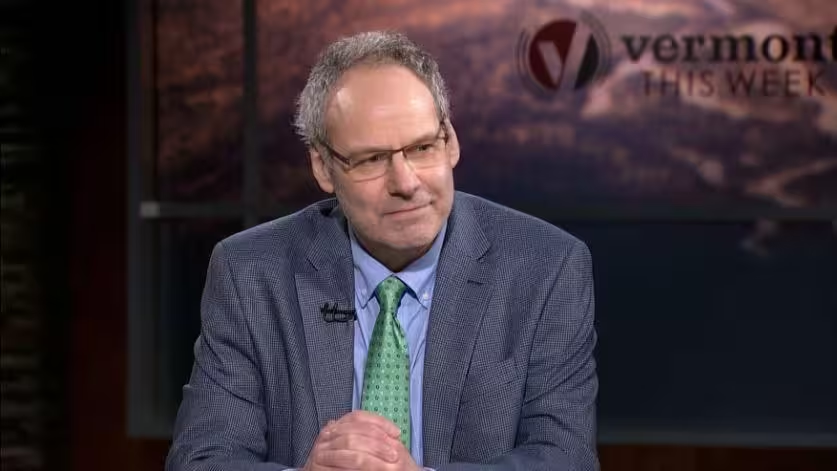
UVM Health Network announces broad service cuts | Vermont’s health care costs | Bennington House race heads for revote | Panel: Mitch Wertlieb - Moderator, Vermont Public; Colin Flanders - Seven Days; Lexi Krupp - Vermont Public; Calvin Cutler - WCAX.
Problems playing video? | Closed Captioning Feedback
Problems playing video? | Closed Captioning Feedback
Vermont This Week is a local public television program presented by Vermont Public
Sponsored in part by Lintilhac Foundation and Milne Travel.
Support provided by:


Vermont This Week
November 15, 2024
11/15/2024 | 26m 45sVideo has Closed Captions
UVM Health Network announces broad service cuts | Vermont’s health care costs | Bennington House race heads for revote | Panel: Mitch Wertlieb - Moderator, Vermont Public; Colin Flanders - Seven Days; Lexi Krupp - Vermont Public; Calvin Cutler - WCAX.
Problems playing video? | Closed Captioning Feedback
How to Watch Vermont This Week
Vermont This Week is available to stream on pbs.org and the free PBS App, available on iPhone, Apple TV, Android TV, Android smartphones, Amazon Fire TV, Amazon Fire Tablet, Roku, Samsung Smart TV, and Vizio.
Support the crew
Help Mitch keep the conversations going as a member of Vermont Public. Join us today and support independent journalism.Providing Support for PBS.org
Learn Moreabout PBS online sponsorshipCiting recent budget orders from the Green Mountain Care Board, the UVM Health Network announces cuts to a range of patient services not delivering care to patients who need care is not the way to to get to our cost containment issue.
With conversations about how to contain Vermont's rising health care costs continuing throughout the state, providers, businesses, schools and nonprofits question how long they can bear the expense.
Plus, a Bennington House race heads for a revote.
That and more ahead on Vermont this week.
From the Vermont public studio in Winooski, this is Vermont this Week, made possible in part by the Lintilhac Foundation and Milne Travel.
Here's moderator Mitch Wertlieb.
Hi.
Thanks so much for being with us.
I'm Mitch Wertlieb.
It's Friday, November 15th and joining us on the panel today, we have Colin Flanders from Seven Days.
Lexi Krupp from Vermont public and Callvin Cutler from Wcax.
Thank you all so much for taking the time to be here today.
We've got another big topic this week.
Last week it was politics.
This week it is health care, something that affects everybody of course in the state of Vermont, everywhere.
Colin, I want to start with you.
You had a very big article in seven days about this, the rising cost of health care, especially in Vermont, the average price of health insurance coverage for a family in Vermont, $25,000 last year.
That's double what it was a decade ago.
And it's 1500 bucks more than the national average.
What is driving these costs?
And I know it's a complex question with a lot of the answers, but in a general way, what's driving this?
Yeah, I mean, it is complex and it's not really it's like many of the problems we're facing here in Vermont, it traces back to demographics.
We have an aging population, which means more people are utilizing utilizing health care and also have complex, costly health care needs.
At the same time that we're losing a bit of the working age population that typically is on health insurance plans, that build them up enough so that there's enough of a risk pool to cover the payments of those growing costs.
So at the same time that hospitals are busier than ever before, treating more patients, older patients, costly patients, there are fewer and fewer people paying into insurance premiums able to cover those growing costs.
And so that puts the squeeze on somebody.
Insurance companies mainly, are paying exorbitant rates.
And people those trickle down to people.
So I mean, it's really world.
We're old and we're getting older now.
Those insurance costs that you're talking about, you know, the insurance companies come to the Green Mountain Care Board, five member board, and they say we want to increase our rates by X amount.
The Remount Care Board has to make a decision on that.
You've described this in your articles as a kind of a game of chicken in a way.
What did you mean by that?
Yeah.
So I mean, put your put yourself in the shoes of these regulators who are trying to balance two competing interests here.
It's hospital growth.
Hospitals say they need to grow to make sure that they're caring for these people.
And it's the pocketbooks of everyone at the dinner table.
It's the dinner table conversation.
It's the people looking at and wondering, how are we going to be able to afford these insurance premiums?
I mean, our average insurance premiums have doubled over the last five years, and that's mainly have businesses who are saying now that it's one of their fastest growing costs is health care.
They cannot find a way to make that sustainable.
And so the regulators have to look at this and say, how do we keep this cost growth contained?
And really, the only way that they can do that is to rein in hospital spending.
The challenge is that every time a hospital comes in asking for more money and does not get what it asks for, they say that they need to close services and so they run the risk of being blamed.
For example, we'll talk about later with UVM comes in and says, we're going to shut down an inpatient mental health unit.
Who do they blame?
The regulators.
And so it's a really tough position to be in.
It's tough.
It's like a game of Jenga or something.
You're removing one tile and it affects everything else.
There's like this ripple effect here.
We saw that graphic before, the rising insurance costs, you know, some of that covered by federal subsidies.
But who knows what's going to happen with those coming up.
Lexi Krupp, you did a story recently about UVM, health care, UVM, AMC announcing some broad service cuts.
What kind of cuts are we talking about here?
Yeah, and Collin just mentioned this, they on Thursday announced that they are going to close an inpatient psych unit at Central Vermont Medical Center.
They're closing three dialysis centers in Newport, Rutland and Saint Albans, and they're taking fewer patients overnight at the University of Vermont Medical Center in Burlington.
So that's around 450 people right now down to 400.
And they're consolidating some of their, primary care and rehab centers in the mad River Valley.
And then they said they're making all these administrative cuts as well.
Let's hear from the UVM, SMC president and the chair of the Green Mountain Care Board about this issue.
Patients that we can't accept, we'll go to other academic medical centers across the region.
We're going to move revenue to the other small community hospitals.
I'm not really sure this is going to achieve much health care savings for Vermont, but it will make access for Vermonters harder.
The report did not review these decisions by UVM.
We did not approve them.
And it's really important that the systems are making sure the decisions they make are the right ones.
As a system.
So it seems like there's a bit of a a lot of finger pointing going on here.
What have you found out from your reporting, Lexi, about who is bearing the blame on this or who's saying what about where these costs are going?
Yeah.
You know, I think that prior to this, UVM Health Network has said the Green Mountain cardboard cut our budget.
And I think the Green Mountain Care Board is saying there's a lot more nuance than that.
Actually, UVM, your budget is bigger approved than last year.
It's like 64 million, more dollars.
But, their operating expenses are going up way more than that.
And so what the Green Mountain Care Board did, and this is a little wonky, so I'm sorry to bring it up, but they said go for it.
That, UVM Health Network, you need, to lower the rate you're in charge.
You're charging insurance companies by 1%.
And that's sort of getting at some of these health care costs that we've been talking about.
Because that's what businesses are paying.
That's what individuals are paying on the, Vermont Health Connect.
So UVM is saying, we can't we can't afford that.
You know, we have these big expenses.
And in order to, comply with this budget order, these are the sort of changes that you're going to see.
And, it's going to hurt patients.
There's something else I want to get into here in a moment.
And I'm going to turn to Calvin on that, about one care.
Vermont.
But one more question, Lexi, on this when you're talking about, you know, UVM, MSK saying, well, we have to to cut some services or we have to do this.
There are actual workers at the hospital saying, well, no, it's the way the administration is, is dealing with these costs.
They're not dealing with it.
Right.
Isn't that that criticism coming from them?
Yeah.
Some union members put out, press release and this was actually from Central Vermont Medical Center.
An inpatient psych nurse there said, like, it's not fair to blame the Green Mountain Care Board.
There's all this finger pointing going on.
Yeah.
But, you know, ultimately, in order to have the hospital spend less money, something's got to get cut.
Calvin, you've been digging into this a lot, too.
And I know that you've been looking at something called one Care Vermont, which is going to shut down next year.
First, give us an idea of what one care Vermont provides.
What what it's supposed to do for people.
I always think of one care Vermont as a coffee filter.
In some, they don't provide any health care whatsoever.
What they do is they take money from Medicare, Medicaid, and private insurance, pool all of that money, and they pay providers a flat monthly.
Rate, essentially with the idea of getting away from fee for service for, for providers, you know, charging, for more procedures and instead focusing on preventative care, primary care, mental health, well-being, that type of thing.
The reform project, under, the all payer model was launched probably about maybe 8 or 9 years ago at this point, it was born out of the Affordable Care Act.
It, you know, essentially let states like Vermont try new forms of payment delivery.
We've been for the past few years have been extending the contract with one care Vermont, bit by bit.
And, they announced at the end of next year, at the end of 2025, one care Vermont as an entity will cease to exist.
It will close.
And but that doesn't mean that it's the end of value-based payments or health care reform.
We're still moving forward with something called the ahead model.
For you, exactly what it stands for.
But it's sort of the next iteration of, of value based care.
But, you know, this inflection point with our health care reform project has some wondering whether it's paid off.
Right?
I mean, we've invested hundreds of millions of dollars into one care, Vermont state tax dollars into, you know, having one care exist.
And, you know, there's been a lot of challenges.
We've a lot of them we've just talked about mental health, the pandemic, opioids, staffing.
And so the question is, you know, what would the results be if we did not have one care?
We don't we don't know.
We don't know that.
But it certainly is an interesting, piece of where we are right now.
So we're going to find out next year because one care is going away.
Right.
But we are still moving ahead with value based care.
So one care it's not so much about one care, but it's about the payment delivery payment model.
And I think this is why people get a little confused when we start talking about health care.
Because you hear so much about one care.
And and really the challenge that one care face is that it wasn't able to get enough people into its influence.
And so that that really limited its power.
I don't want to linger too much on the UVM thing, but I do want to say, I mean, there is a really important piece of this, and that is part of this is what the lawn care board's consultant that we have talked about, repeatedly over the last few weeks has been calling for the idea that maybe we don't need 450 beds, maybe we should have 400 beds.
And that's what I'm most interested about in this conversation moving forward is how does UVM whittle down its inpatient census?
Because we hear constantly there are too many people in the hospital.
There are people who should not be in the hospital, who could be cared for at home or in long term care facilities, or in other community based places that are a lot cheaper.
The challenge is how do we build up that part of the system in a way that can handle those patients?
There's not a lot of money to go around a lot of the moneys in the hospital.
So when you say it's like a Jane, it really is like Jenga.
We need to figure out a way to move some of that money.
I think the regulators would argue, move some of that money into other parts of the system so that we are not so reliant on our hospitals to care for 450 patients a night, because five years ago, before the pandemic, it was closer to 400.
And some of that because our aging population, some of it's because people cannot get mental health care, people cannot get opioid addiction treatment in certain areas.
It's because the system is cracking and the hospitals are catching all of that.
And I think it's an interesting point to, you know, the right sizing of our health care system.
Just like we talk about education funding and property taxes, it all gets back to housing the workforce.
I remember talking with folks in Randolph at Gifford Medical Center, when after that, act 167 report was issued and they said, we have local employers that are willing to hire up to 200 different employers in town that can hire 200 people.
Right now, we're willing to flip the switch.
We just need housing.
And that was their big message to state lawmakers of we need more regulatory relief.
We need more funding for, you know, affordable housing, subsidized housing of all shapes and sizes because getting back to that demographic question, you know, there's a right sizing to the system, but there's also the solution here.
If we want to keep our local hospitals, you have to grow your way out of it, too.
Well, Lexi, you were reporting on this with Gifford recently, right?
Yeah.
And just to jump on that after that report came out, you know, it was, critical of a lot of hospitals saying that you're not going to be, solvent in a few years, but.
And hospitals response to that was like, well, we don't know.
But we we agree with one thing.
There's not enough housing, you know, so we can all agree on that.
Yeah.
So I, went to a community forum in Randolph.
In response to, to that big report, where people were were coming up to talk about the importance of the hospital to their community.
And, and also hospital leaders were really saying, hey, we are getting serious about cutting costs.
We hear you and we are trying to do this.
So they said that, recently they closed the Euro gynecology unit at Gifford.
And they also stopped the chiropractic services there.
So much smaller scale than what's happening at UVM.
But but but similar.
And they're saying, you know, we're, we're cutting back these services in order to control costs.
The other thing that they're doing, which I thought was really interesting, is that they are starting to take patients from Dartmouth-Hitchcock Medical Center as transfers, patients that don't necessarily need that high level of care at the it's called a tertiary care hospital.
But Dartmouth is an academic medical center.
It has, you know, it's fancy, you know, all these specialists, and they're saying, well, some people, you know, could could come here where we have pretty small volumes in our, inpatient unit.
And they said that if that goes well, that they're going to start, conversation with the University of Vermont Medical Center, to try to get those transfers.
So not as cheap as getting care in a long term care facility or a nursing home, but but maybe cheaper than getting care at UVM.
But you mentioned those folks who came out in Randolph very much in support of Gifford.
And, you know, they must have been where they say they were specifically upset about the chiropractic unit shutting down.
You're gynecology, or was it more like, we are here for this hospital, we don't want it to go away.
And maybe that's what they're thinking the end game is going to be.
Yeah.
No, no one said anything about those service cuts.
People were there were 300 people who showed up to this gym and there was just, mass support for this hospital.
You know, I was born there.
I had my baby here.
I brought my dying loved one here.
I was, you know, treated for a heart attack, etc., etc.
I, you know, I, someone said like, I wouldn't be alive if it wasn't for Gifford, you know, and just really speaking to, the importance of that hospital in the community for the schools, for, the for Vermont State University.
Yeah.
So, that that was the resounding message is that we we really want our hospital to stay here.
And, and, you know, the CEO of Gifford Medical Center, Michael Costa, was saying, and we want to stay here, too.
And we're going to have to you know, we are serious about about trying to rein in costs in order to make sure that we're going to be here for our community.
Well, the open enrollment period for health insurance is going on right now, Colin.
And, it comes down again to affordability.
And there is are some potential problems coming because of what's happening federally, the national election.
What are some, potential risks here, when it comes to insurance and affordability?
Yeah.
I mean, the main thing is the what are known as the enhanced tax credits.
So during the pandemic, we expanded, the federal government expanded who is eligible for some relief for insurance premiums.
And that's why when you look at the chart that shows those numbers, not everyone is paying $948 a month for plans.
A lot of people are playing pay much, much less.
There used to be a cliff around 400% of the federal poverty line, so about $60,000 for a one person household.
That cliff no longer exists.
But there is fear that once the enhanced tax credits expire in 2025, at the end of 2025, which, president elect Trump has said he wants to happen, that that cliff will be reinstated, that overnight, people will be paying hundreds of dollars more sometimes even 506 hundred and $700 more a month for health insurance.
The risk there is that people are just going to go uninsured.
And that's that's a real concern, not only for the personal aspect, the element that we know people are struggling with medical debt already.
We know people are delaying care because of the cost.
That could happen to a lot more people.
But also the state.
The fewer people who are paying into health insurance, the more costs go up on everybody else.
And it's not healthy.
People who are sticking around healthy people look at their lives and say, I don't really need to be paying $15,000 a year.
When I see the doctor twice, it's the people who are sick who really need health care.
Their cost will go up because of it.
There's concerns to write about, preexisting conditions, which, you know, the Affordable Care Act made sure that health insurance companies could not, deny coverage for that.
But now there's talk that that that could go away, too.
Yeah.
And that that's a huge concern.
I mean, I don't think that there is we still don't know exactly what will happen under, Trump presidency.
The one thing that we've been reporting about is like, what will the incoming administration mean for health care policy, for immigration policy or housing policy?
We don't really have the answer yet.
But I mean, I think there is a real, real risk here.
I think, as Colin just said, about people going uninsured.
And what does that mean for people with a, you know, acute, medical conditions that take up time and resources in the, in the health care system?
I mean, it's a real big, big puzzle that I don't know what the solution is, but it's it's fascinating.
And hospitals need to be concerned about that, too, because the more uninsured people that impact hospital finances to and the concern I mean, I talked to this consultant, we've been talking about this report for weeks and weeks and weeks.
I mean, the big takeaway for me is he kept saying the status quo, people will go broke and then hospitals will follow.
If we continue along this path, it's a bleak outlook.
It is a bleak outlook, you know, and we've talked about this before.
I'm the one who keeps bringing it up.
But I remember when then Governor Peter Selman was talking about an all payer, you know, universal health care system in Vermont.
And he dropped that pretty quick.
It looked like the numbers couldn't work.
But this isn't working either.
And if the worst case scenario happen, I don't understand how people can afford private health insurance or the health insurance companies can stay viable given this entire situation.
Yeah, I don't see the state going back to a single payer.
Yeah.
Single payer model.
Like, you know, under Governor Shumlin that we explored.
But there is an appetite in the state House.
There is a bill still that's there on the wall.
I guess not really, because we're starting a new biennium, but there is still a health care caucus at the state House that, there is still an appetite politically among some to switch over to more government funded health care.
Because, as you point out, the system, it's spiraling in some ways.
That's the question is who's going to lead on this?
Because if we leave it up to individual communities to make all these decisions, that's a really hard decision for a local hospital leader to make is closing down units.
You can hear it.
So it's, similar to the school conversation.
The question is who's going to lead us on it?
I hope we can take some relief getting off health care for a moment.
We will be back to this topic in the future.
There's no question about that.
But we do have to get to some political news.
Calvin, there is a Bennington House race that looks like it's heading for a revolt.
What can you tell us about that?
Yeah, this is an interesting one.
It really kind of gets back to reapportionment back in or not reapportionment.
The redistricting that we did back in 2020 after the census.
And it turns out that when they were drawing the House district, so not the Senate, but for the House, there was, a few residents, basically a chunk of town that they, you know, put it in the wrong district.
And there was a race essentially that was called for one candidate.
And they went back, did the math.
They said, wait a minute.
Actually, there could have been about 50 votes that could have gone to the other candidate or could have decided this race, because of, an error that was made four years ago.
So that's now going to be fixed, and we're now going to have a pretty rare revote.
So it's going to be interesting.
That'll be see what happens.
Also, news that, Senator, Keisha from Hinsdale is making a bid for majority leader post a bit of a surprise.
A little bit.
I mean, this is a fascinating one, right?
I mean, you know, as we've talked about on Election Day, Vermont voters, the affordability concerns really cut through and helped spur more Republicans to, to House and Senate seats than we've seen in decades in Vermont.
And so with that, you know, this weekend, Senate Democrats are going to be caucusing.
They're going to be electing the third member, the majority leader, whip, and, pro tem, Senator Phil Ruth is expected to stay the, pro tem, but the majority leader has been Allison Clarkson for the last four years or so, 4 or 5 years.
And, Senator Keisha Rahm Hinsdale, is potentially going to be challenging her for that position.
I think this is significant in some ways because it really does.
You know, they're both Democrats.
They both have, by and large, very much the same shared policies.
But you've seen Senator Keisha Rahm Hinsdale work with Governor Phil Scott.
I'm thinking on issues like housing and act.
250.
She was part of this sort of tri partizan coalition, I believe last year or two years ago to move forward a housing bill.
And so the question, I think, is going to be what direction will the Senate want to go in?
How will they work now?
There's going to be 17 Democrats, 13 Republicans and a Republican lieutenant governor presiding over the chamber.
So I think we don't know exactly what it's going to look like.
But I think it is significant that, you know, Senator Rahm Hinsdale is potentially, could, it will she is challenging.
Senator Clarkson.
Yeah.
Interesting things happening in Montpelier.
Getting to Burlington.
Colin, you've been writing a little bit about, the lack of homeless shelter options in Vermont's largest city.
What?
What's happening there?
Yeah, I mean, this is becoming a perennial challenge for Burlington over the last few years.
Is trying to figure out a way to make sure that everyone has a place to go on the coldest nights.
I mean, part of this is tied in to the state's winding down, if we want to call it that, of the motel program this year in particular, what we know is the adverse weather, program is going to be taking less people.
The eligibility has changed in an attempt to get out of this system that we're in, where we're just putting people up in hotels every winter.
But the problem is, there's not a lot of local shelters.
Burlington has two on the horizon.
There is a hope that after Christmas, sometime after Christmas, we'll be able to have maybe 60 extra beds.
The problem is, there is an estimate that maybe 350 people are sleeping outside right now.
And so, even on the coldest night, if they were to open up, say, imagine like a National Guard, like set up, open up a big place, a gymnasium and put people up because it's -20 degrees.
They wouldn't even be able to fit everybody.
So desperate for some good news here.
Lexi Krupp, can we turn to you?
Scientists think that managing invasive plants might help with ticks and cutting down on their numbers and the diseases they spread.
Yeah, so this is, I'll say, only some invasive species.
But, there's been several years of studies showing, a species like Japanese barberry, which is really common in the understory.
They, it's an invasive, so they can become sort of a monoculture.
If you, cut, cut those down, there's where if your ticks, and, and you find, you know, way more there's, there was a study in Maine that found there's twice as many blacklegged ticks in, you know, forest with barberry compared to nearby forest without it.
So, there are, scientists, a group of researchers in Maine and Vermont who got $1.8 million from the National Science Foundation to look at this relationship over the next five years, they're going to be working with a couple dozen landowners to say, okay, what happens when we manage these species?
They're going to look at barberry.
They're also looking at honeysuckle and common buckthorn, and, and trying to develop best practices for landowners, to, to how can you manage these plants to cut down on the risk of tick borne disease?
I'm glad the two states are working together on that.
We also have some good news to end on here.
And, this is something that is happening at Seaview that hasn't happened in 20 years.
Let's take a look.
It feels like a high school should have a newspaper that students should be able to submit to.
And I think, I think that was the driving force.
Opening the box of 400 copies of the first issue was the most satisfying part, because we actually managed to do it.
Boy, that is good news.
Calvin Cutler, you were pumping your fist there during that video.
Local news coming back.
The Cvu student run newspaper for the first time.
How does that make you feel?
So, I mean, you know, I remember being in my first journalism class when I was in high school.
We didn't have a newspaper, but boy, oh, boy, we are in a much different place, you know, in terms of the First Amendment in journalism.
It's really inspiring to see this.
I think it's great.
I think that's a great note to end on.
And I appreciate you, reminding folks about the importance of the First Amendment, especially in the climate that we're in now.
That's where we're going to have to leave it for today.
I want to thank our wonderful panel, Collin Flanders from Seven Days, Lexi Krupp from Vermont Public, and Calvin Cutler from WCAX.
Thank you all so much for taking the time to be here today.
And thanks to you at home for watching and listening as well.
I'm Mitch Wertlieb.
We'll see you next week on Vermont this Week.
In the meantime, I hope you have a great week.

- News and Public Affairs

Top journalists deliver compelling original analysis of the hour's headlines.

- News and Public Affairs

FRONTLINE is investigative journalism that questions, explains and changes our world.












Support for PBS provided by:
Vermont This Week is a local public television program presented by Vermont Public
Sponsored in part by Lintilhac Foundation and Milne Travel.