
November 16, 2023 - PBS NewsHour full episode
11/16/2023 | 56m 45sVideo has Closed Captions
November 16, 2023 - PBS NewsHour full episode
Thursday on the NewsHour, Israeli forces continue to advance and search a hospital in Gaza, we speak with Secretary of State Blinken as calls for a ceasefire intensify in the U.S., election workers face threats of violence amid dangerous political rhetoric and new reporting shows Russian oil continuing to reach the U.S. market through a loophole in the embargo.
Problems playing video? | Closed Captioning Feedback
Problems playing video? | Closed Captioning Feedback
Major corporate funding for the PBS News Hour is provided by BDO, BNSF, Consumer Cellular, American Cruise Lines, and Raymond James. Funding for the PBS NewsHour Weekend is provided by...
November 16, 2023 - PBS NewsHour full episode
11/16/2023 | 56m 45sVideo has Closed Captions
Thursday on the NewsHour, Israeli forces continue to advance and search a hospital in Gaza, we speak with Secretary of State Blinken as calls for a ceasefire intensify in the U.S., election workers face threats of violence amid dangerous political rhetoric and new reporting shows Russian oil continuing to reach the U.S. market through a loophole in the embargo.
Problems playing video? | Closed Captioning Feedback
How to Watch PBS News Hour
PBS News Hour is available to stream on pbs.org and the free PBS App, available on iPhone, Apple TV, Android TV, Android smartphones, Amazon Fire TV, Amazon Fire Tablet, Roku, Samsung Smart TV, LG TV, and Vizio.
Providing Support for PBS.org
Learn Moreabout PBS online sponsorshipAMNA NAWAZ: Good evening.
I'm Amna Nawaz.
Geoff Bennett is away.
On the "NewsHour" tonight: Israeli forces continue to advance and search a major hospital in Gaza, and calls for a cease-fire intensify in the United States.
We speak to the secretary of state, Antony Blinken.
ANTONY BLINKEN, U.S. Secretary of State: We are determined to do everything we can to ensure that Israel does everything it can to minimize harm to men, women, and children, innocent men, women, and children.
AMNA NAWAZ: Election workers face threats of violence amid dangerous political rhetoric and questions about the future of American democracy.
And new reporting shows Russian oil continuing to reach the U.S. market through a loophole in the embargo.
(BREAK) AMNA NAWAZ: Welcome to the "NewsHour."
Communications with Gaza are mostly cut off tonight because of a lack of fuel to power the system there.
Israel is pressing its invasion in the north, and, today, the Israel Defense Forces discovered the body of one of the 240 hostages held by Hamas.
Her remains were found near Al Shifa Hospital, the main medical center in Northern Gaza.
Parts of it are now controlled by the IDF.
Leila Molana-Allen reports.
LEILA MOLANA-ALLEN: In Southern Gaza, thousands of Palestinians crowd tent cities after fleeing their homes in the north.
Now they fear they will have to leave again.
WOMAN (through translator): Today, in their leaflets, they are telling us to evacuate the south.
LEILA MOLANA-ALLEN: Early today, the IDF dropped leaflets over the southern city of Khan Yunis, warning residents to get out.
But many, like the Abu Jabal family, don't know where to go.
ATYA ABU JABAL, Displaced From Gaza City (through translator): They asked us, the citizens of Gaza, to go to the south.
We went to the south.
Now they are asking us to leave.
Where do we go?
We want to understand where exactly we should go.
LEILA MOLANA-ALLEN: In Northern Gaza, IDF forces stormed Al Shifa Hospital for the second day, searching for signs of Hamas.
MAN: We found a vehicle filled with ammunition.
LEILA MOLANA-ALLEN: Today, the IDF released another video of weapons they say were found in a car in the hospital compound and this video of what they claim is the entrance to a tunnel in the hospital complex, but have not shown evidence of their claim that Hamas runs a command center underneath Al Shifa.
Gaza's Hamas-run Health Ministry denies the claims and alleges IDF forces have shelled hospital rooms.
Doctors inside the hospital say lifesaving medical devices have been destroyed.
DR. NATALIE THURTLE, Doctors Without Borders: MSF is deeply shocked by what's happened at Shifa, the raid, with no guarantee of protection of civilians and medical staff and patients inside that hospital complex.
LEILA MOLANA-ALLEN: Dr. Natalie Thurtle is the deputy medical coordinator for international NGO Doctors Without Borders in Jerusalem.
MSF also denies Israel's claims of a Hamas command center.
DR. NATALIE THURTLE: We have worked in Shifa for many years.
We've never seen anything that has indicated that that is the case.
And regardless of the perception that that may be the case, it doesn't absolve anybody of the responsibility to protect civilians and patients and medical staff.
LEILA MOLANA-ALLEN: With the power cut off, dozens of premature babies don't have working incubators.
Six have reportedly died.
Hundreds of patients and thousands of displaced civilians remain trapped inside the hospital grounds, under siege for a week now.
MSF also has over 100 staff and their family members taking shelter in the vicinity.
DR. NATALIE THURTLE: They have run out of food and water, and we have got children here who are really quite sick.
Every time that we have tried to evacuate them, despite assurances that there is a safe path to the south, they have been faced with drones firing outside the door, crossfire and shelling ongoing.
And so they haven't been able to move.
LEILA MOLANA-ALLEN: There is no end in sight to Israel's invasion, which it says will eventually expand south.
With no fuel, Gaza's phone and Internet lines are dark again today.
Voiceless, Gazans bury their endless stream of dead and pray, with little hope left, for those still living.
For the "PBS NewsHour," I'm Leila Molana-Allen.
AMNA NAWAZ: And Leila joins me now here in the studio.
Leila, it is so good to say, good to see you in person.
LEILA MOLANA-ALLEN: Good to see you, Amna.
AMNA NAWAZ: So you have been covering this war every day since it began, nearly six weeks in now.
Just pull back the curtain a little bit.
Tell us about what that's been like, the experience of reporting on this as a journalist.
LEILA MOLANA-ALLEN: I mean, the first thing to say is, war is horrific anywhere.
And I have covered many conflicts over the last 15 years.
But this one is in such a small space.
So, to begin with, the number of people killed on October the 7th in the Hamas attacks, everybody in this country of just 10 million people knows someone, and then, of course, such an incredibly small land mass inside Gaza as well in a place the size of Rhode Island.
You have got nearly 2.5 million civilians living there.
Now, there's also the incredibly particular difficulty of access with this war.
So we were based in Israel.
We were going across Israel, across the Palestinian territories, but not inside Gaza.
Normally, it is closed, whenever there's a war every couple of years, as there always is in Gaza, and then journalists can go in.
But it's now been six weeks, and there's no sign we will be able to properly go in any time soon.
When we have been able to enter, it's with the Israel Defense Force, and, of course, they control what we are able to see.
We cannot speak to Gazans in that situation, no matter how close we are to them.
We can only see what we're able to see with the army.
And, of course, our colleagues who are covering Gaza are Palestinian journalists themselves; 37 have died already in six weeks, most deadly period for journalists since the Committee to Protect Journalists began.
They're giving their lives to show us what's happening.
AMNA NAWAZ: You have heard now, after more than five-and-a-half weeks of this war, President Biden is now saying the only way out of this will be a two-state solution.
What do you see?
Do you see any room for that happening?
LEILA MOLANA-ALLEN: This has been the idea now for years, but there's been no movement on the peace process at all since the end of the Second Intifada around 2005, 2007.
That was the last time we were really seeing conversations.
The first question is, where would it be?
The land mass that's available to Palestinians now is the West Bank, and that -- we have this huge issue with settlers, who are increasingly becoming violent against Palestinian villagers there.
I was there seeing hundreds of people being forcibly displaced from their land by violence, sometimes by actually being killed, 700,000 settlers there who are building on land where they're not supposed to build, supported increasingly by the government and the Israeli army, which many international NGOs say is a war crime if the government's actually sponsoring it.
Then, of course, you have got Gaza, which would theoretically be at least the economic capital of a state, because everyone there is the most highly educated.
It is the wealthiest part, in terms of it's access to a port if it wasn't under siege.
Gaza's gone.
Half of the housing units there are gone.
It's been completely leveled.
So where actually would this even take place?
AMNA NAWAZ: From the beginning of this war, there has been this concern it could broaden, it could spread in the region.
You have reported from across the region for years.
Is that concern still there?
LEILA MOLANA-ALLEN: That concern is still there, but much less than it was at the beginning.
It's become clear that, firstly, Iran has stepped forward and said, listen, to Hamas officials, we did not know this attack was going to happen.
You didn't let us know.
We didn't do it in coordination.
So, while they have been sponsoring Hamas, it's not the same as a fully staged attack.
The same with Hezbollah in Lebanon.
It's become clear that, while they are launching strikes, they are not escalating that to a full-scale war.
And they have their own interests to defend, which is, they are in a powerful political position in Lebanon, and they don't want to be seen as complicit in getting a lot of Lebanese people killed.
So, at the moment, those parties don't seem to be getting involved.
What's more of a question here is, what happens to Palestinians?
We are seeing scenes that remind everybody of the Nakba, the Catastrophe, what Palestinians and the Arab world call 1948, when Palestinians were forcibly moved from their land and never allowed to come back, these queues of people were seeing moving into South Gaza.
The IDF is saying they are going to spread that invasion into South Gaza.
So then where do people go?
Either they're trapped in a kill box or there is a humanitarian corridor into Egypt.
Will they ever be allowed to come back?
One-and-a-half-million Palestinian refugees already living across the region.
How many more?
Will this be another case of them losing their land for good?
AMNA NAWAZ: We know you're going to be back out there reporting for us very soon.
But, in the meantime, Leila Molana-Allen, it is great to have you here in studio with us.
Thank you.
LEILA MOLANA-ALLEN: Thank you, Amna.
AMNA NAWAZ: And now to my interview with U.S. Secretary of State Antony Blinken.
He's in San Francisco at the APEC summit of Asian economies hosted by President Biden.
I spoke with the secretary a short time ago.
Mr. Secretary, welcome back to the "NewsHour."
Thanks for joining us.
ANTONY BLINKEN, U.S. Secretary of State: Good to be with you.
AMNA NAWAZ: So one of the key agreements to come from that meeting between President Biden and President Xi was this pledge by China to curb fentanyl.
We know they have made that pledge before.
Fentanyl deaths in the U.S. have only increased every year since then.
So why do you believe they will act on that pledge now, when they haven't before?
ANTONY BLINKEN: Well, first, Amna, what's so important about the meeting yesterday is, it advanced in very concrete ways really two things that we're trying to drive at in this relationship with China.
We have got an intense competition with China.
We want to make sure it doesn't veer into conflict.
And, at the same time, where we can find places to cooperate that really advance the interests of the American people, we're going to do that.
When it comes to avoiding conflict, we have had a series of near-misses with Chinese planes, Chinese boats coming dangerously close in very dangerous ways to our own.
We hadn't had military-to-military contact between our countries in well over a year.
We reestablished that, both at the highest levels and also at the operational level.
That's an important way to avoid any mistakes, any miscalculations that could lead to conflict.
Second, when it comes to advancing the interests of the American people, what you just alluded to, fentanyl, the number one killer of Americans aged 18 to 49, not guns, not car accidents, not cancer, fentanyl.
And what we know is that, in recent years, the chemical precursors, the ingredients that go into making fentanyl are manufactured in China, and then sent to our own hemisphere, where it's turned into fentanyl, comes into our country and devastates our communities.
So, what has China has agreed to... AMNA NAWAZ: And so what leads you to believe they will act now?
ANTONY BLINKEN: So, two things.
One is, they have put out a public notice to all of their companies that engaging in this practice is forbidden.
But, beyond that, they have taken concrete action, going against -- we gave them a list of companies that we know to be engaged in this trafficking of chemical precursors, and they have actually taken action to disband these companies.
That is very important.
And it's, I think, a good demonstration of their seriousness.
Beyond that, though, we have set up a group between our two countries to monitor this going forward to make sure that this continues.
And as we and others get information about any companies involved, we expect, based on what they have said and based on what they have done, that China will take action.
And, by the way, this is something that I think China understands is important, that it be seen as playing a leading and productive role in dealing with the fentanyl crisis, because it's not only affecting us.
It's affecting increasingly countries around the world.
We're the canary in the coal mine for fentanyl, but we have synthetic opioids in Asia, we have them in Europe.
And China needs to be seen and wants to be seen as a responsible actor.
AMNA NAWAZ: I'd like to ask you as well about Israel's war in Gaza.
As you know, Israel showed what they said was evidence that Al Shifa Hospital was and is a Hamas command center.
They released these produced videos that show guns and ammunition and a laptop that they said they found inside.
Human Rights Watch has says the Israeli evidence so far is what they call insufficient to show that it was a command center to revoke Shifa's protection.
So, there is a lot of skepticism around this raid.
Why not share more evidence of what you have seen that convinces you this was a command center?
ANTONY BLINKEN: Well, two things.
First, if someone can explain why there are assault rifles next to MRI machines, that would be good to know.
We have information... AMNA NAWAZ: But is that your definition of a command center, the presence of weapons?
ANTONY BLINKEN: No.
So -- but, second, with regard to command centers, we ourselves have information that that's exactly what Hamas is doing.
And this is an ongoing operation.
And I fully expect that, as the operation is completed, Israel will show more evidence of what Hamas was doing in these hospitals or under these hospitals, because that's where the tunnels are.
What we know across the board is that Hamas embeds itself in civilian infrastructure, in and under apartment buildings, in and under hospitals, in and under schools.
And it uses people as human shields.
There's been a horrific loss of life in Gaza.
And we have to ask ourselves what we would have done in the same situation.
Imagine if terrorists had come across our border on October 7, slaughtered, proportionally, 40,000 Americans, and then retreated and were hiding themselves among civilians in all of the civilian infrastructure.
What would we have done?
At the same time, Israel has an absolute obligation to do everything possible to avoid harming civilians.
And, as you know, they have opened up corridors so that people could get out of harm's way.
More than a million people have left Gaza City.
They put in place some limited pauses to facilitate that.
They brought in assistance to the hospitals themselves.
But they can, they must do even more.
And this is something that we're on constantly.
AMNA NAWAZ: To your point -- to your point on the loss of life, the U.S. equivalent of the Gaza loss of life would be over 1.5 million people.
And, as you have noted, watching that death toll rise, as you said, watching children pulled from the rubble, that guts you every time.
Americans are increasingly feeling that way too.
I just want to put to you our latest poll numbers from this week when people were asked about their response, Israel's response to the Hamas attack; 38 percent said the Israeli response has been -- quote -- "about right," but 38 percent also said the Israeli response has been too much.
And that number is up 12 percent from -- or 12 points, rather, from just a month ago.
So I wonder what you would say to Americans who are increasingly uncomfortable with Israel's conduct in the war and U.S. support of it.
ANTONY BLINKEN: Look, I think so many of us feel the same way.
This is incredibly gut-wrenching and it's heartbreaking.
But we also have to ask ourselves, what would we do and what would any country do when faced with this terrorist organization that had slaughtered its people and then said very clearly that it intended to do it again and again and again, if given the ability to do that, the capacity and the ability to do that?
And that's the problem that Israel has to deal with.
It's a problem that any of us have to deal with.
The other thing is, I don't hear the hue and cry for Hamas to respect international humanitarian law, for Hamas to maybe get out of the buildings, to get out of the hospitals, to get out of the schools, so that civilians aren't in danger, for Hamas to surrender.
That would protect Palestinians civilians immediately.
I'm not hearing anyone say that.
The dilemma for any country in this situation is what to do to make sure that not only can you -- are you defending your people, but you're trying to make sure that this can't happen again.
AMNA NAWAZ: That is the U.S. secretary of state, Antony Blinken, joining us tonight.
Mr. Secretary, thank you.
Good to see you.
ANTONY BLINKEN: Good to see you too.
Thanks.
AMNA NAWAZ: In the day's other news: The House Ethics Committee reported there's overwhelming evidence that Congressman George Santos broke the law.
The panel said the New York Republican used campaign funds for expensive hotels and spas and lied on financial reports.
It said -- quote -- "Santos sought to fraudulently exploit every aspect of his House candidacy for financial profit."
In turn, Santos announced he won't seek reelection, but he could still be expelled from Congress.
He also faces federal criminal charges.
A federal jury in San Francisco convicted a man of assaulting Paul Pelosi, the husband of former House Speaker Nancy Pelosi.
David DePape was also found guilty of trying to kidnap the former speaker.
Federal prosecutors welcomed the jury's decision.
ISMAIL RAMSEY, U.S. Attorney, Northern District of California: What this guilty verdict on all counts sends is a clear message that, regardless of what your beliefs are, what you cannot do is physically attack a member of Congress or their immediate family for their performance in their job.
AMNA NAWAZ: DePape admitted breaking into the Pelosi home last year.
She wasn't there, but he attacked Paul Pelosi with a hammer.
He could get up to 50 years in federal prison and is also charged with state crimes.
An appeals court judge in New York state has set aside a gag order against former President Trump, for now.
The order barred him from speaking publicly about court staffers in his civil fraud trial.
The judge today cited free speech concerns and lifted the gag order while the appeals process continues.
The United Nations top court ordered Syria today to stop torturing its people.
It came in a case filed by the Netherlands and Canada against Damascus.
The order said the regime must -- quote -- "take all measures to prevent acts of torture and other cruel, inhuman, or degrading treatment or punishment."
There's no word on whether the Syrians will comply.
Kenya's high court has again blocked the deployment of police to Haiti to quell gang violence.
The court acted today, hours after Kenya's Parliament approved sending 1,000 officers.
Just yesterday, a heavily armed gang took hostages at a hospital in Haiti's capital of Port-au-Prince.
Police freed them, but activists said this shows just how bad things are.
PIERRE ESPERANCE, National Human Rights Defense Network, Haiti (through translator): Today, the country is controlled by gangs.
And the gangs have links with the authorities.
The biggest problem right now in Haiti is the absence of government and rule of law, and also all key state institutions have collapsed, even the police.
AMNA NAWAZ: If Kenyan police do go to Haiti, they would lead a multinational force.
Two top health agencies say deaths from measles jumped more than 40 percent last year to 136,000.
Most of the victims were children.
And the World Health Organization and the CDC blame a sharp drop in vaccinations during the pandemic.
Most of the large outbreaks were in Africa or the Eastern Mediterranean.
Back in this country, members of the United Auto Workers have ratified a new contract General Motors, but it was closer than expected.
The union announced the agreement won just under 55 percent of the vote.
Voting is still ongoing at Ford and Stellantis.
Meantime, Starbucks employees today staged what might be their biggest strike yet.
Organizers said the one-day walkout involved more than 5,000 workers.
It targeted more than 200 Starbucks locations nationwide.
The strike is part of a two-year effort to unionize the chain.
For the first time since 2005, a Major League Baseball team is pulling up stakes.
Baseball owners today unanimously approved the Oakland Athletics' move to Las Vegas.
The sport's commissioner, Rob Manfred, said the team tried for years to find a site and financing for a new stadium in the Bay Area.
ROB MANFRED, Commissioner, Major League Baseball: I know this is a terrible day for fans in Oakland.
That is -- I understand that, and that's why we have all had a policy of doing everything humanly possible to avoid a relocation.
And I truly believe we did that in this case.
AMNA NAWAZ: The A's plan to begin playing in the new stadium on the Las Vegas Strip in 2028.
Congress has left Washington for its Thanksgiving recess after ensuring the government won't shut down this weekend.
The Senate gave final approval to a temporary funding package last night.
It keeps spending at current levels into January for some agencies and into February for others.
And, on Wall Street, stocks drifted to fractional gains and losses.
The Dow Jones industrial average was down 45 points to close at 34945.
The Nasdaq rose nine points and the S&P 500 added five.
Still to come on the NewsHour: new reporting shows Russian oil continues to reach the U.S. market through a loophole in the embargo; a new book details the lies pushed by FOX to maintain the network's brand comedian Keegan-Michael Key and his wife, Elle, discuss the history of sketch comedy; plus much more.
Over the last two months, hundreds of thousands of Americans have come together in both pro-Israel and pro-Palestinian rallies and vigils.
The vast majority have been peaceful, but some have turned violent or included antisemitic or Islamophobic threats.
Laura Barron-Lopez reports.
LAURA BARRON-LOPEZ: Last night, protesters calling for a cease-fire in Gaza and police clashed outside the Democratic National Committee headquarters in Washington, D.C.
Lawmakers, including top House Democrats, we're evacuated from a fund-raiser after protesters blocked exits to the building.
According to U.S. Capitol Police, one person was arrested for assaulting a police officer and six officers were injured.
Yesterday, law enforcement said on social media that 150 people were -- quote -- "illegally and violently protesting."
But rally-goers, led by a coalition of groups including Jewish Voice for Peace Action and IfNotNow Movement, another American Jewish organization, say police initiated the confrontation.
DANI NOBLE, Jewish Voice for Peace Action: We were met with police officers pulling people, including folks that I was alongside with, down the stairs, met with pepper spray to the face, met with actions that led to concussion.
LAURA BARRON-LOPEZ: Last night's demonstration is the latest in a series of mostly peaceful pro-Palestinian and pro-Israeli rallies that have rippled across the country since Hamas killed some 1,200 Israelis on October 7.
On Tuesday, tens of thousands gathered on the National Mall to show support for Israel and condemn antisemitism.
YONINA KESCHNER, Protester: It's just really important to show that we are standing together, we are remaining strong, despite any threats.
LAURA BARRON-LOPEZ: Israel's President Isaac Herzog addressed attendees through a video link.
ISAAC HERZOG, Israeli President: As president of the state of Israel, I vow to you from Jerusalem, from the Kotel that we will heal.
We will rise again, and we will rebuild.
LAURA BARRON-LOPEZ: The rally was intended to bridge political and religious divides, with leaders from both parties and different faiths addressing the crowds.
PASTOR JOHN HAGEE, Christians United for Israel: We pray for the people of Israel and the leaders of Israel.
LAURA BARRON-LOPEZ: But the inclusion of controversial televangelist John Hagee drew criticism.
Hagee says he supports Israel, but he also has a record of antisemitic statements.
PASTOR JOHN HAGEE: Then God sent a hunter.
A hunter is someone who comes with a gun, and he forces you.
Hitler was a hunter.
And the Bible said, Jeremiah writing, they shall hunt them.
LAURA BARRON-LOPEZ: Earlier this month, pro-Palestinian crowds rallied outside the White House, calling for an immediate cease-fire.
MAHMOUD ABUNASSER, Protester: People are getting killed every minute, which is a very sad thing to see, humans die, with no wrong that they're doing.
It's just that they happen that they live where the missile hits.
LAURA BARRON-LOPEZ: And, yesterday, at Columbia University, hundreds of students and faculty protested an administration decision to suspend two pro-Palestinian student groups through the end of the semester.
DARALIZA AVILA CHEVALIER, College Student: The university should be taking a stance to protect speech and protect the right of faculty and students to address these issues in an open and frank way.
LAURA BARRON-LOPEZ: The university said it suspended the groups after they violated university policies relating to campus events, including threatening rhetoric.
While most rallies have not been violent, a November 5 protest in a Los Angeles suburb turned deadly.
Paul Kessler, a 69-year-old Jewish man, died after an altercation with a pro-Palestinian protester, according to California authorities.
The Ventura County Sheriff's Office today announced the arrest of a suspect in connection with Kessler's death.
For the "PBS NewsHour," I'm Laura Barron-Lopez.
AMNA NAWAZ: Election officials across this country have been under attack since 2020, falsely accused of conspiring to steal or rig the last presidential election.
This barrage has caused over one in 10 to say they are very or somewhat likely to leave their job before the 2024 election.
That's according to the Brennan Center, which tracks this issue.
William Brangham has more on these attacks and what they mean for our democracy.
WILLIAM BRANGHAM: That's right, Amna.
These attacks have stepped up to a dangerous degree in recent weeks, with election officials in five states receiving letters containing a white powder that in some cases was found to be the deadly drug fentanyl.
We spoke to two officials who received these mailings, Mary Hall, who's the auditor in Thurston County, Washington, and, in Oregon, Dena Dawson, who's the clerk of Lane County.
DENA DAWSON, Clerk, Lane County, Oregon: Those of us that were in contact with the suspicious piece of mail were advised to go home and bag our clothing and shower and leave our clothes in a bag outside and wait for further instructions from either hazmat or the FBI.
And so that was our day.
MARY HALL, Auditor, Thurston County, Washington: I used to be very proud of my position and telling people what I did for a living.
And I don't do that anymore, because you never know what reaction you're going to receive from the people on the other end.
WILLIAM BRANGHAM: So, what do these threats mean for the future?
David Becker is the executive director of the Center for Election Innovation and Research.
David Becker, great to have you back.
As someone who spends his job trying to make elections smarter and smoother and more accurate, what do you make of all of these offices receiving fentanyl-laced letters?
DAVID BECKER, Center for Election Innovation and Research: Well, sadly, these kind of threats and harassment have been going on now for over three years since the 2020 election.
This is just a new tactic that the efforts to terrorize these public servants -- and let's be sure, as we see these clerks talking about it, these are not jobs that people go into for fame and fortune.
They're doing this for service.
They are giving us all our voices and our democracy.
And they work very long hours all the time.
They don't just wake up on the Monday before an election and put on an election.
And for them to be subjected to constant abuse - - and it has been constant.
My organization runs a legal defense network, the Election Official Legal Defense Network, to help advise and assist election officials who need assistance in this environment.
And I can tell you, we have seen as many requests for assistance now, three years after that election, as we did when it was first established over two years ago.
WILLIAM BRANGHAM: Wow.
I mean, we should say, in addition to these mailings, the DOJ, I believe, has prosecuted or charged at least a dozen other people for making violent threats towards election workers.
Do you believe that these threats are a result of this constant barrage of lies and misinformation about the 2020 election?
DAVID BECKER: I think there's no question that it's largely due to the disinformation, the lies, the incitement that has gone on from candidates who may have lost that election, others seeking to grift and raise money off of lies about the election.
There are tens of millions of good Americans who were sincerely disappointed in the outcome of the 2020 election.
They're not insurrectionists.
They're people who just preferred the candidate who lost.
And, unfortunately, we're seeing now that they are the target for these lies and disinformation.
They are the people who are going to be angry and contribute and donate to people who continue to feed them these lies about the election, an election that by all objective measurements was the most secure, transparent and verified election in American history, more paper ballots than we'd ever seen before, more audits of those ballots confirming the results than ever before, more pre-election litigation confirming and clarifying the rules and more post-election litigation confirming the results.
We sit here three years from that election, over three years, and there's still not been a shred of evidence presented to any court and subjected to cross-examination that would indicate any problem.
WILLIAM BRANGHAM: Amna mentioned earlier the number of elections officials who are saying, in the face of all of this, they're thinking about getting out of this line of work.
How concerned are you about our ability to have a well-trained, nonpartisan group of people to run the next election?
DAVID BECKER: The pressures placed on these public servants are more than we should expect anyone to have to endure.
But I think back to that 2020 election, when election officials somehow, with all of that scrutiny, with all of that abuse, with the lies being spread and with a global pandemic, somehow managed 20 million more voters than we'd ever seen in American history.
It's one of the greatest triumphs of the American democratic process we have ever seen.
Despite that we should have been giving them a parade, they have been subjected to constant harassment.
And then, even then, as some decide they can't take it anymore, they have to leave, we have seen, in 2021 and 2022 and 2023, these election officials do what they have always done.
They step up and they give us all our voice.
WILLIAM BRANGHAM: How do we go about countering this?
I mean, we did see some election deniers in the last cycle lose their elections, but the former president continues his misinformation about his loss.
The Wall Street Journal just recently reported that Meta, which controls Facebook and Instagram, is going to allow advertisements to run on their social media networks to carry ads that raise questions about 2020.
How do we go about batting all of this down?
DAVID BECKER: First, we have to understand there's not going to be some magic wand here.
We're not going to fix this with a flip of the switch.
This is -- the damage that's been done here is significant, and it's going to take years, if not decades to fix.
There are tens of millions of people in this country who believe that, if their candidate lose in a 50/50 country that the election was stolen.
We just can't have that sustainable as a democracy.
That said, I think we're beginning to see some things changing for the better, and I think that largely comes from accountability.
There are people at the top who have been intentionally spreading the lies, who have profited off the lies, who seek to retain power and influence because of the lies, and some of them are being brought to justice criminally, civilly in defamation cases, where they're being made to pay very large damages, and even professionally in disbarment proceedings.
And if we keep seeing this, we may be able to reset the incentive structure, where those who would seek to continue to target a population of people who supported the losing candidate for lies, good Americans, target them so that they can get rich, maybe we can create an incentive structure where no longer they benefit from that.
WILLIAM BRANGHAM: David Becker, great to see you again.
Thank you.
DAVID BECKER: Thank you, William.
AMNA NAWAZ: After Russia's invasion of Ukraine, the U.S. and European allies banned the import of Russian oil and natural gas.
But a new report reveals that hundreds of millions of dollars worth of fuel, in part made from Russian crude, still ending up in American gas tanks.
Nick Schifrin and producer Teresa Cebrian report on a new investigation released today by the organization Global Witness.
NICK SCHIFRIN: In one of the country's biggest ports, in one of its largest cities, a ship full of ill-gotten gains.
Last month, the Balzani arrived in the New Harbor carrying more than 500,000 barrels of fuel made in part from Russian crude oil.
It turns out that U.S. imports are helping fuel Russia's war machine.
LELA STANLEY, Global Witness: For the first nine months of 2023, that crude oil was worth to the Kremlin at least $180 million.
NICK SCHIFRIN: Lela Stanley is co-lead for the Stop Russian Oil Campaign at Global Witness, an international NGO that tracked the shipments of fuel made with Russian crude oil and is today exposing their value to Moscow.
LELA STANLEY: It's enough for 105 Kalibr cruise missiles, 8,600 of the Iranian drones that have been attacking Kyiv, so it's a lot of money.
NICK SCHIFRIN: The story begins in Siberia, which holds the majority of Russia's oil reserves.
Russia produces 9.6 million barrels of crude oil per day, its single most important source of revenue.
And it sells that oil to countries outside the U.S. and European Union, including China, the United Arab Emirates, Turkey, and India, home to the world's largest oil refinery, the sprawling Jamnagar refining complex.
Before the war in Ukraine, Jamnagar imported almost no Russian crude.
Today, Global Witness found about one-third of its monthly crude imports are Russian.
At Jamnagar, the Russian crude is blended with other foreign crude and refined into gasoline, diesel, and other products that can be legally bought by American companies.
It's then shipped with vessels like the Balzani through the Red Sea, into the Suez Canal, the Mediterranean and Atlantic Ocean, and, in this case, New York's Upper Bay.
LELA STANLEY: After the invasion of Ukraine, the U.S. banned the direct import of Russian oil.
However, other countries that then started buying that oil can legally refine it and sell it to the U.S. That's the refining loophole, and that's what we're trying to change.
NICK SCHIFRIN: Global Witness found, between January and September of this year, the U.S. imported 30 million barrels of fuel from refineries running on Russian oil.
In total, that crude arrived in at least 13 cities in seven states.
Among the companies importing that oil, BP, Sunoco, and Shell.
LELA STANLEY: American companies are still linked to this revenue chain funneling money back to the Kremlin.
NICK SCHIFRIN: This is relatively a drop in the bucket for Russian exports and revenue and a drop in the bucket for American consumption.
So why is this important?
LELA STANLEY: It doesn't make any sense to support Ukraine and the Ukrainian people the way we have on the one hand and also allow this revenue of flow to continue.
REP. LLOYD DOGGETT (D-TX): We never anticipated this type of circumvention.
NICK SCHIFRIN: Texas Democrat Lloyd Doggett helped write the original legislation that banned Russian oil and natural gas from being imported into the U.S.
Yesterday, he introduced the Ending Importation of Laundered Russian Oil Act designed to close the loophole.
"All products that were produced at any refinery that uses crude oil originating in the Russian Federation shall be banned from importation into the United States."
REP. LLOYD DOGGETT: We're simply saying, don't accept refined products here in the United States from oil that is Russian that has been refined in a third country.
America led on this last year, and we need to lead on it again and try to close these loopholes and deny Russians any dollars that could go out there and be used for more attacks on Ukraine.
NICK SCHIFRIN: But what the U.S. hasn't tried to do, close off all Russian oil.
That would increase American gas prices.
JANET YELLEN, U.S. Treasury Secretary: A price cap on Russian oil is one of our most powerful tools.
NICK SCHIFRIN: Instead, the leading industrialized countries have tried to limit Russia's oil revenue, with a $60-a-barrel cap on oil sold with Western shipping or insurance.
But Russia has found ways around the price cap.
In October, it sold oil on average for more than $80 a barrel, and its total oil export revenues were $18.34 billion, among the highest since July 2022.
That's in part thanks to Russia's shadow fleet.
ELINA RIBAKOVA, Peterson Institute for International Economics: Russia built up its shadow fleet and moved away from the reliance on the G7 countries insurance and ship providers.
That makes the implementation of the world price cap very challenging.
NICK SCHIFRIN: Elina Ribakova is a senior fellow at the Peterson Institute for International Economics.
She says the price cap was originally a success, but now Russia is circumventing it, thanks to that shadow fleet and weak Western enforcement.
Last month and today, the U.S. has sanctioned five shipping companies for transporting oil sold above the cap.
And, this week, the U.S. sent notices to 100 vessels suspected of violating sanctions.
But, otherwise, it has failed to enforce its own rules, says Ribakova, who advocates for stronger punishment.
ELINA RIBAKOVA: We do need to think about the bold measures.
And we have put forward secondary sanctions, saying that, look, if an Indian company is circumventing sanctions, we're going to use sanctions on you.
So, basically, it's taking the legal system of the U.S., but applying it beyond the borders of the United States.
REP. LLOYD DOGGETT: I believe that we do need to do more.
We need to be looking at all countries that are not participating in the price caps and are doing other things to assist the Russians on oil.
NICK SCHIFRIN: But Doggett is the chair of the House India Caucus and argues punishing India might threaten other U.S. policy, especially toward China.
REP. LLOYD DOGGETT: The modest action that I propose in this legislation I think can be done without unsettling our relationship with India.
Going much further with full secondary sanctions could present a problem.
And it will take some time and some diplomacy to hopefully get more cooperation from the Indians.
NICK SCHIFRIN: In the meantime, Global Witness' exposure and the closing of the loophole could be small first steps to get Russian fuel out of American gas tanks.
For the "PBS NewsHour," I'm Nick Schifrin.
AMNA NAWAZ: After decades at the helm of News Corp, Rupert Murdoch officially stepped aside this week, taking on the new role of chairman emeritus.
What does this leadership change mean for the future of a network so deeply tied to and influential within the Republican Party?
Brian Stelter is the author of the new book "Network of Lies: The Epic Saga of FOX News, Donald Trump, and the Battle for American Democracy."
He's also a special correspondent for "Vanity Fair."
Brian, welcome back to the "NewsHour."
BRIAN STELTER, Author, "Network of Lies: The Epic Saga of FOX News, Donald Trump, and the Battle for American Democracy": Thank you.
Great to be here.
AMNA NAWAZ: So let's talk about this change, leadership change.
What does it mean for the company?
BRIAN STELTER: Well, it is, in effect, Rupert Murdoch giving his final wishes, presenting his plan for the future when he's longer with us.
He wants his son Lachlan, his eldest son, to run the companies, News Corp and FOX Corp.
I think he also wants them to recombine at some point and get re-merged.
He is presenting this plan in public.
And Rupert says he wants to remain active and involved.
He's going to say that again possibly on Friday when this takes effect at FOX Corporation.
But it is an end of an era.
It's the closest thing to him ever retiring.
AMNA NAWAZ: Do the father and son have vastly different views when it comes to what the role of FOX in particular should be?
BRIAN STELTER: Not politically.
Lachlan is conservative.
He doesn't like Donald Trump, but he doesn't hate Donald Trump the way Rupert reportedly does.
Rupert detests Trump.
Lachlan just doesn't care as much about politics.
He's much more of a businessman.
He wants to trains to run on time, that proverbial saying.
He wants to minimize headaches and maximize profits.
And so what that might mean is, that might mean a lack of oversight at FOX News, but we just don't know what 2024 really holds yet.
AMNA NAWAZ: Well, we know the role that FOX played in spreading the lie of the stolen election in 2020.
On that point, you write this in the book.
You say: "Rupert and Lachlan Murdoch let it happen.
If father and son have regrets, they have not expressed any publicly."
Was there any kind of internal reckoning after that and after the lawsuit that resulted from that and the $787 million they had to pay?
BRIAN STELTER: It was an incredible case, an incredible case.
And it's not the only one, Smartmatic and other companies still suing FOX.
There are numerous defamation lawsuits by individuals and there are shareholder lawsuits.
So I have only seen tinkering around the edges at FOX, no major changes, no major overhaul.
In fact, one of the biggest changes was the dismissal of several of the truth-tellers of FOX, several of the executives and staffers who were calling the election correctly in 2020.
AMNA NAWAZ: You mentioned Lachlan is more of a business-focused guy.
Was the firing of Tucker Carlson more of a moral decision or a business one?
BRIAN STELTER: Entirely a business decision.
But there were many reasons to do it.
Tucker Carlson was hurting the company's bottom line, because advertisers were not attracted to him.
He was putting conspiracy theorists on the air, causing the network to be sued.
There were lots and lots of reasons to cancel the show.
And what's happened in the six months since is, FOX has once again -- it's drawn that audience, it's brought that audience back.
FOX remains the beating heart of the GOP, which I think is why it deserves study and scrutiny.
AMNA NAWAZ: It was that Dominion lawsuit that ended up sharing so many of those internal messages.
BRIAN STELTER: Yes.
AMNA NAWAZ: We learned so much about the company.
You write about it and share so many of them in the book.
And there's one exchange when their White House correspondent, Jacqui Heinrich, tweets an accurate report about there being no evidence of voter fraud.
BRIAN STELTER: Right.
AMNA NAWAZ: Prime-time hosts Tucker Carlson and Sean Hannity in private messages say she should be fired.
BRIAN STELTER: Yes.
AMNA NAWAZ: They complain to executives.
And you write this: "Executive producer Robert Samuel responded that it's amazing how many FOX staffers seem to hate the audience.
'You don't have to love Trump,' he wrote, 'but you have to respect the audience.'"
What did you take away from that?
BRIAN STELTER: It's the most Orwellian phrase, respect the audience.
What they really mean is, we don't want to tick the audience off.
We don't want to tell them anything they don't want to hear.
We don't want to discomfort them or upset them with the truth, the truth that month - - and, remember 2020 -- was that Biden was the next president.
But FOX whispered the truth and shouted the lie instead.
They gave false hope about a second Trump term.
And I think really some -- I think we can say for sure that some people bought tickets to fly to Washington January 6 because of all that nonsense they were hearing on television.
So when you have these FOX producers, executives, Sean Hannity as well saying we need to respect the audience, what they really meant was, we're going to disrespect the audience, because we're going to hide the truth from them.
And I think it's -- one of the silver linings here is that at least these e-mails and texts have become public.
At least there is a public record, so we know what these hosts and producers were really saying and thinking.
AMNA NAWAZ: What do we know now about the relationship between FOX and the current front-runner for the GOP presidential nomination, Donald Trump?
BRIAN STELTER: In some ways, this is a broken marriage.
It's a sort of like a divorce, where they're sharing custody of a shared base, of a shared audience.
Both FOX and Trump, they're talking to the same constituents, talking to the same people, firing up the same base.
But Trump is not happy with what he sees on FOX.
He will never be happy.
He will never be happy with any media coverage.
He always wants more sycophantic media coverage.
And so he often rails about FOX on his TRUTH Social.
But, at the end of the day, in a general election, if he's the nominee, he will come home.
He always does.
AMNA NAWAZ: When you step back and look at how we today, journalists today are covering this election, do you feel like we have learned lessons from the past?
BRIAN STELTER: Well, I think your segment earlier this week about autocratic behavior, about the language Trump is using is really important.
We need to see that all across the American media, including in the right-wing media.
And that's where I doubt we're actually going to see the honest conversations that need to be had about the impact of Trump's rhetoric and his promises about a second term.
But let's take the non-FOX media for a moment.
Yes, we need fact-checking.
We need more of that.
But we also need history-checking.
We need reality-checking.
This is bigger than just facts at this point.
This is about two different realities that are colliding, one that is much more tied to truth and the reality, and then this other story that Trump is selling about revenge, about grievance, about retribution.
Look, I think we're very early in this primary, but I would like to see the coverage amped up quite a bit on that front in order to help people who are not news junkies.
I feel like I know what's going on, but most people are tuned out right now about the 2024 election.
It's time to tune in.
AMNA NAWAZ: Brian Stelter, he is the author of the new book "Network of Lies: The Epic Saga of FOX News, Donald Trump, and the Battle for American Democracy," a fascinating read.
BRIAN STELTER: Thank you.
AMNA NAWAZ: Brian, thanks for being here.
BRIAN STELTER: Thanks.
AMNA NAWAZ: From "Mad TV," to "Key & Peele," to "Schmigadoon!"
Keegan-Michael Key is a modern master of sketch comedy.
Now he and his wife, film and TV producer Elle Key, have taken a long look into the history of the art form.
They talked recently with Jeffrey Brown for our arts and culture series, Canvas.
GEORGE BURNS, Actor: Would you like to have me take you home in my car?
GRACIE ALLEN, Actress: Oh no thank.
I'm too tired, I'd rather walk.
JEFFREY BROWN: A scene from the legendary comedy team of George Burns and Gracie Allen.
GEORGE BURNS: I will tell you what you do.
You go home, get your coat, come back and I will give you a ride in my boat.
I have got a boat too.
GRACIE ALLEN: Oh, wait a minute.
My sister's got my coat.
GEORGE BURNS: That's all right.
My brother's got my boat.
GRACIE ALLEN: Oh, George, you're silly.
KEEGAN-MICHAEL KEY, Author, "The History of Sketch Comedy": You want to do it.
ELLE KEY, Author, "The History of Sketch Comedy": So we have established, he's going to be George.
KEEGAN-MICHAEL KEY: I will do George.
(LAUGHTER) JEFFREY BROWN: Nearly 100 years later, Keegan-Michael and Elle Key do their Burns and Allen.
KEEGAN-MICHAEL KEY: Do you like to love?
ELLE KEY: No.
KEEGAN-MICHAEL KEY: Like to kiss?
ELLE KEY: No.
KEEGAN-MICHAEL KEY: Well, what do you like?
ELLE KEY: Oh, lamb chops.
KEEGAN-MICHAEL KEY: Lamb chops?
Could you eat two big lamb chops alone?
ELLE KEY: Alone?
Oh, no, not alone.
But with potatoes, I could.
(LAUGHTER) KEEGAN-MICHAEL KEY: Say good night, Gracie.
ELLE KEY: And scene.
Good night, Gracie.
That's right.
(LAUGHTER) JEFFREY BROWN: It still works.
KEEGAN-MICHAEL KEY: It still works.
It works 100 years later.
ELLE KEY: You don't expect it.
KEEGAN-MICHAEL KEY: Yes, misdirection is misdirection, no matter whether it's 2023 or 1923.
JEFFREY BROWN: The Keys love to make these comedic connections.
KEEGAN-MICHAEL KEY: It's always nice to know where you're coming from or where you came from.
Even jokes have a history.
Even jokes have an origin, and not just necessarily and specifically where the joke came from, but also just humor.
ELLE KEY: That same thing that we're laughing at now, our parents laughed at, our grandparents, laughed at.
KEEGAN-MICHAEL KEY: Our great-grandparents laughed at.
ELLE KEY: And then you go, well, wait a second.
How far back does this go?
JEFFREY BROWN: They first explored all this in a podcast series titled "The History of Sketch Comedy."
KEEGAN-MICHAEL KEY: Ahead of us is a colorful and enlightening journey through the world of sketch comedy.
I'm not wearing any pants, film at 11:00.
(LAUGHTER) JEFFREY BROWN: And now in a new book by the same name, with a cover that has Keegan as some of the key characters along the way, from medieval jester to Blues Brother.
Elle came up with the idea.
ELLE KEY: So, from a how book publishing works, they're like, well, we want a picture of Keegan.
And I was like, well, I think the book covers so much history, I think just a picture of Keegan isn't enough.
Would you be OK with seven Keegans?
(LAUGHTER) JEFFREY BROWN: Keegan gained renown for his routines with longtime partner Jordan Peele on their Comedy Central show, and in numerous other shows and movies.
JORDAN PEELE, Actor: Now, this November I want every one of you to ask yourselves, what has changed in the last four years?
KEEGAN-MICHAEL KEY: Who killed Osama bin Laden?
JORDAN PEELE: What has my administration accomplished?
KEEGAN-MICHAEL KEY: Did we accomplish killing America's biggest enemy?
Check.
Did that.
Boom!
JEFFREY BROWN: The book is a tour from the ancient world to modern classics, with a focus on sketch comedy, the skits and short playlets that are acted out.
ABBOTT, Comedian: Who is on first.
COSTELLO, Comedian: Well, what are you asking me for?
ABBOTT: I am not asking you.
I am telling you.
Who is on first.
COSTELLO: I'm asking you who's on first.
ABBOTT: That's the man's name.
COSTELLO: That's whose name?
ABBOTT: Yes.
JOHN CLEESE, Actor: It's dead.
That's what wrong with it.
MICHAEL PALIN, Actor: No, no, it's resting.
Look.
JOHN CLEESE: Look, my lad, I know a dead parrot when I see one.
And I'm looking at one right now.
MAN: I would like to rent a car.
WOMAN: Gertz Rent-a-Car at your service, sir.
We are number one, you know.
WOMAN: Mavis Rent-a-Car.
We try harder.
(LAUGHTER) JEFFREY BROWN: Keegan describes in his youth seeing his normally stoic father dissolve into belly laughs while watching Eddie Murphy on "Saturday Night Live."
It would change his life.
KEEGAN-MICHAEL KEY: Watching others, it affected me and watching the power.
There's a power to comedy, the same way there's a power to drama, that you can touch other people and uplift other people with these art forms.
And I wanted to be a part of that, desperately.
JEFFREY BROWN: Do you think of yourself as a comedian or actor first, or both?
KEEGAN-MICHAEL KEY: I think of myself as an actor who does comedy.
JEFFREY BROWN: But the acting part is the important part to you.
KEEGAN-MICHAEL KEY: Yes, to me, the acting part is the important part, because a character in a sketch, much like a character in a drama, they have no idea that they're in the play.
They are living their lives and the actor gives over to the given circumstances of the play or the given circumstances of the sketch.
JEFFREY BROWN: And the greats, the Keys write, are all great students of the art form.
ELLE KEY: Keegan and I together call it comedy math, is where the turn is, how long of a setup do you have before you heighten to make the joke go even to a crazier place or a wackier place, and how do you get the audience to go along with you so that you don't go too far?
JEFFREY BROWN: But their favorite sketches are when things do go too far, what they call the, hey, you can't do that moment.
KEEGAN-MICHAEL KEY: A, hey, you can't do that moment is kind of one of those, I can't believe they went there moments.
ELLE KEY: Something wacky, ridiculous happens that you're like, no, that's just not right.
You can't just do that.
That's silly.
JEFFREY BROWN: Do you know when you are going to do that?
Do you know when you have hit that moment?
KEEGAN-MICHAEL KEY: Do I know when I have hit that moment?
(LAUGHTER) JEFFREY BROWN: Like, I can't do that, can I?
KEEGAN-MICHAEL KEY: Yes.
Yes, but I'm going to.
But I'm going to.
There are moments when it comes up organically and spontaneously.
And then there are moments when you absolutely know you're about to do it.
You know that you're about to do a zinger.
JEFFREY BROWN: But what about now, when the news is very, very serious?
Is there still a place for comedy?
The Keys think so.
KEEGAN-MICHAEL KEY: That involuntary reaction that happens within us when a joke is told, I think it's very therapeutic for us to guffaw, to belly-laugh.
It is not to take away from the seriousness of the times.
We can still seek out ways of helping the world and being philanthropic or trying to find a way to be helpful in navigating this darkness that we're kind of encountering right now.
But I do believe that we need a reprieve now and again.
And comedy can offer that.
ELLE KEY: I grew up here in New York City and my family's Jewish.
And I grew up in a family that told jokes.
And I was always told or led to believe that it came out of -- it didn't matter how difficult things were.
We use humor to get through tough situations.
And a lot of the humor that we talk about in the book comes from the culture where they used humor to kind of lighten really dark, challenging times.
JEFFREY BROWN: And that abides.
KEEGAN-MICHAEL KEY: That does abide.
ELLE KEY: Yes, it does.
KEEGAN-MICHAEL KEY: Yes.
JEFFREY BROWN: The book is "The History of Sketch Comedy."
Keegan-Michael Key and Elle Key, thank you very much.
KEEGAN-MICHAEL KEY: Thank you.
ELLE KEY: Thank you.
AMNA NAWAZ: The power of comedy, and a laugh we all need these days.
Remember, there is much more online, including a look at Oklahoma City's proposal for a new multimillion-dollar arena to keep the Thunder basketball team in town.
Voters there will soon decide whether it's worth it.
That is at PBS.org/NewsHour.
And that is the "NewsHour" for tonight.
I'm Amna Nawaz.
On behalf of the entire "NewsHour" team, thank you for joining us.
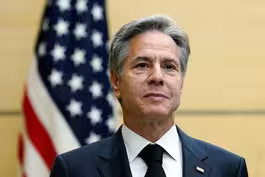
Blinken discusses relations with China, support of Israel
Video has Closed Captions
Blinken discusses improving relations with China, support of Israel amid ceasefire calls (7m 20s)
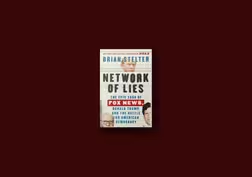
Brian Stelter on 'Network of Lies' and Fox's brand
Video has Closed Captions
Brian Stelter discusses 'Network of Lies' and how Fox maintains its brand (6m 3s)
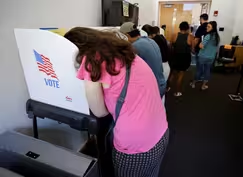
Election workers face violent threat and harassment
Video has Closed Captions
Election workers face violent threats and harassment amid dangerous political rhetoric (6m 53s)

Elle and Keegan-Michael Key trace sketch comedy's history
Video has Closed Captions
Elle and Keegan-Michael Key chronicle 'The History of Sketch Comedy' in new book (7m 15s)

Israel drops evacuation leaflets in southern Gaza
Video has Closed Captions
Israel drops evacuation leaflets in southern Gaza, signaling expansion of invasion (7m 51s)
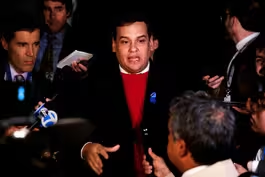
News Wrap: Committee reports evidence Rep. Santos broke laws
Video has Closed Captions
News Wrap: House Ethics Committee reports evidence Rep. Santos broke the law (5m 17s)
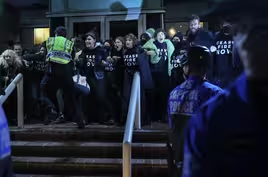
Rallies highlight U.S. tensions as Israel-Hamas war persists
Video has Closed Captions
Wave of protests and rallies highlight tensions in U.S. as Israel-Hamas war persists (4m 3s)

Russian oil reaches U.S. market through embargo loophole
Video has Closed Captions
How Russian oil is reaching the U.S. market through a loophole in the embargo (6m 42s)
Providing Support for PBS.org
Learn Moreabout PBS online sponsorship
- News and Public Affairs

Today's top journalists discuss Washington's current political events and public affairs.

- News and Public Affairs

FRONTLINE is investigative journalism that questions, explains and changes our world.












Support for PBS provided by:
Major corporate funding for the PBS News Hour is provided by BDO, BNSF, Consumer Cellular, American Cruise Lines, and Raymond James. Funding for the PBS NewsHour Weekend is provided by...