
November 18, 2025
Season 4 Episode 102 | 26m 30sVideo has Closed Captions
After months of debate, the House votes to force the release of the Epstein files.
The U.S. House votes overwhelmingly to force the release of the Epstein files, the NTSB wraps up its on-site investigation of the UPS plane crash in Louisville, thousands of people in Lexington are having their medical debt erased, and a look at some of the resources available for students after high school.
Problems playing video? | Closed Captioning Feedback
Problems playing video? | Closed Captioning Feedback
Kentucky Edition is a local public television program presented by KET
November 18, 2025
Season 4 Episode 102 | 26m 30sVideo has Closed Captions
The U.S. House votes overwhelmingly to force the release of the Epstein files, the NTSB wraps up its on-site investigation of the UPS plane crash in Louisville, thousands of people in Lexington are having their medical debt erased, and a look at some of the resources available for students after high school.
Problems playing video? | Closed Captioning Feedback
How to Watch Kentucky Edition
Kentucky Edition is available to stream on pbs.org and the free PBS App, available on iPhone, Apple TV, Android TV, Android smartphones, Amazon Fire TV, Amazon Fire Tablet, Roku, Samsung Smart TV, and Vizio.
Providing Support for PBS.org
Learn Moreabout PBS online sponsorship>> All right.
>> Do not muck it up in the Senate.
>> The US house says yes to releasing the Epstein files.
So what happens next?
>> We have all of the things needed that will address their individual needs as best we can.
>> Two weeks after the deadly crash, UPS says it's doing everything it can to help people affected.
>> I want to do everything I can to capture that beauty for people that's here, people away from here that don't understand where it come from.
>> And meet the man who makes Appalachia look picture perfect.
>> Production of Kentucky edition is made possible in part by the KET Millennium Fund.
>> Good evening and welcome to Kentucky edition for this Tuesday, November the 18th, I'm Renee Shaw, and we thank you for spending some of your Tuesday night with us.
The U.S.
House of Representatives says release the Jeffrey Epstein files.
The House voted 427 to 1 to release the files.
Several members didn't vote.
Clay Higgins of Louisiana was the only no vote.
All six members of Kentucky's congressional delegation voted to release the files.
The vote came after a majority of House members signed a so-called discharge petition requiring a vote.
Congressman Thomas Massie, a Republican from Kentucky's fourth district, helped lead that effort.
Over the weekend, President Donald Trump, who called the investigation a hoax, changed his mind and asked the House to vote to release the files.
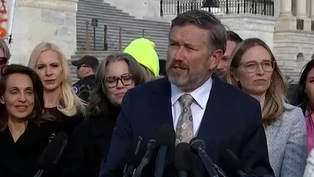
Congressman Massie spoke this morning before the vote.
>> I want to start by thanking the survivors.
I mean, they're giving everybody hope in this country.
There are survivors of other sex crimes in this country wondering if they should come forward.
They're clouded with shame and concern that law enforcement will do nothing.
And these survivors have stepped forth taking that same risk.
Worried that they will be defamed themselves, they have been defamed for stepping forward.
But we're going to get justice for them.
That's going to happen today.
And the people's House, the founders set up our government with three branches and and two branches of Congress.
And I don't think it's any coincidence that this fight is being started and it's being won in the House of Representatives.
I have people, other survivors of other sex crimes who come to me and say thank you.
You give me hope.
You give us hope.
There is hope here.
We fought the president, the attorney general, the FBI director, the speaker of the House, and the vice president to get this win.
But they never.
They're on our side today, though.
So let's give them some credit as well.
They've they are finally on the side of justice.
And as ro said, don't muck it up in the Senate.
Don't get too cute.
We're all paying attention.
If you want to add some additional protections for these survivors, go for it.
But if you do anything that prevents any disclosure, you are not for the people and you are not part of this effort.
Do not muck it up in the Senate.
>> Congressman Thomas Massie of Kentucky's fourth district, Senator John Thune, the Senate majority leader, says the Senate will try to pass the Epstein bill quickly, and if it passes there, it would need President Donald Trump's signature.
And he says he would sign it.
Epstein was a financier who killed himself in a Manhattan jail while awaiting trial in 2019 on charges he sexually abused and trafficked underage girls.
There's been speculation for years about the names and the files and other news.
Today marks two weeks since a deadly UPS plane crash at the Louisville airport.
Officials say the NTSB has now completed its on site part of the investigation.
A preliminary report about the crash could be released in the next month or so.
Dozens of workers are still on site, working to find pieces of the plane and make the area safe for nearby businesses.
Officials say 880,000 gallons of oil have been contained, and that water quality monitoring continues for the first time today.
We heard directly from UPS Airlines President Bill Moore.
He says UPS is committed to helping everyone impacted by the crash.
>> What I encourage all of those, those individuals and families and businesses impacted is to go to the Community Resource Center.
We have insurance adjusters there.
We have resources there.
We have all of the things needed that will address their individual needs as best we can for what they require.
That's going to be different for every person that comes through that door.
But we are committed to making this right.
>> Al Gentry is also working to replace a natural gas pipeline on nearby grade lane.
That work is expected to take several weeks.
That is music from the Louisville Orchestra.
The orchestra plans to pay tribute to the 14 people killed in the UPS plane crash, with a free concert planned for Thursday at 7 p.m.
Eastern time at Whitney Hall at the Kentucky Center.
In addition to honoring those killed, the orchestra says it wants to recognize the courage of first responders and the efforts of the many UPS employees who responded to the crash.
It's expected to be an hour long concert, and people planning to go are urged to RSVP.
You can find out more online at Louisville orchestra.org.
Louisville's mayor says public safety and housing are a few of his priorities ahead of the upcoming Kentucky General Assembly lawmaking session.
Mayor Craig Greenberg says his administration has been working closely with state lawmakers on the issue of housing.
He says the focus must be on helping families find and keep housing that they can afford.
>> We're particularly focused on housing here in the urban core, lowering cost barriers for construction, incentivizing affordable housing development, helping local governments build the infrastructure that makes housing possible, helping to strengthen our historic tax credit program that can create more housing in these vacant buildings in and around downtown Louisville.
We know that when we invest in housing, will reduce homelessness, will grow our economy, and will set families all across the city and state up for success.
>> Mayor Greenberg is also renewing a request for state lawmakers to give Louisville some autonomy when it comes to addressing gun violence, specifically.
He's hoping to limit concealed carry of guns for people under the age of 25, and to ban gun conversion devices.
Millions of Americans owe big money for medical bills, but almost 6500 people in Lexington will be off the hook.
The city of Lexington announced today that a partnership between the city and the nonprofit, Undue Medical Debt, means those 6500 will be forgiven of more than $12.5 million in debt.
Many people with big medical debts fail to get proper medical care, and they can suffer financial hardship and mental strain while dealing the impact of poor credit scores.
KET was there for this morning's announcement, which included personal stories about how debt affects people's lives.
>> At the clinic, I recently met a patient, a young mother of two, who was came in struggling with anxiety and insomnia.
She works two jobs, takes care of her young children, and somehow still finds time to take care of her aging parents.
When I asked what took her so long to come in to ask for help, she said, I thought I couldn't afford to get better.
That moment really stuck with me because she wasn't just talking about money, she was talking about hope, about the quiet, invisible pressure so many people feel when medical bills pile up and they start to believe that care is out of reach.
At the free clinic, we see this far too often people choosing between refilling their prescriptions and paying rent, groceries or therapy.
And what do we see when that burden is lifted?
We see the relief, the dignity and this space to finally focus on healing instead of just merely surviving.
That's why today's announcement means so much.
This isn't just a financial policy.
It's a statement of values.
It's our city saying you matter more than just your medical debt.
>> To qualify, people who live in Lexington have to have medical debt totaling more than 5% of their annual household income, or have an income of at least or less than 400% of the federal poverty line.
And no one has to do anything to get this.
People affected will be notified by mail.
A tenured professor at the University of Kentucky is suing the school.
Ramsi Woodcock was removed from his teaching position at UC's College of Law in July.
The university said it was because of an online petition he created that called for the destruction of Israel.
UK said the petition could be interpreted as anti-Semitic based on state and federal guidelines.
According to the Lexington Herald-Leader, Woodcock's federal lawsuit says UK violated his rights of free expression and due process because, quote, the president of the university disagrees with the content of my views.
End quote.
A spokesperson for the University of Kentucky told the paper, quote, if someone's views as stated threaten the safety and well-being of the university's students and staff, we are obligated to protect our community and our people.
End quote.
President Donald Trump has pardoned a Kentucky man for a second time on Inauguration Day last January, the president pardoned Dan Wilson of Louisville and others for their roles in the January 6th, 2021, attack on the U.S.
Capitol.
Wilson had pleaded guilty to a charge of conspiracy to impede or injure a federal officer, but Wilson remained in federal prison for his having firearms in his Kentucky home despite being a convicted felon.
The white House says since the FBI searched Wilson's home because of the events of January 6th, the president is pardoning Wilson for those charges as well.
Ice raids, police chases, and the loss of a federal courthouse.
Our Toby Gibbs has details about all three of those things, and this look at headlines around Kentucky.
>> Pikeville is losing its federal courthouse.
The Paintsville Herald reports.
Cases on the district court docket will be suspended December 31st, with all cases transferred to the federal courthouses in London and Ashland.
The chief judge of the U.S.
Sixth Circuit Court of Appeals signed the order October 29th.
Pikeville Mayor Jimmy Carter said this is an unfortunate development for Pikeville and all of eastern Kentucky.
20 people protested an ice arrest in Bowling Green last week.
Ice arrested Ismael Cruz Sanchez at a marathon gas station.
He was taken to the Grayson County Jail, according to the Daily News.
The protesters say the man deserves due process.
One protester told the newspaper it's illegal to take people away without a warrant signed by a judge.
Another protester said, quote, next, it could be you.
And there's concern about high speed police chases in McCracken County, the Paducah Sun reports.
That's after two recent incidents.
In one chase, a driver fired a shot and hit a police cruiser.
The chase ended with the suspect's car hitting a house.
In another, deputies and state police used a spike strip to stop a suspect.
A trooper injured his hand during that incident.
Some people have asked if these pursuits are putting the public in danger.
Sheriff Ryan Norman says public safety is always priority number one, and sometimes his deputies choose not to chase a fleeing car.
The Tennessee Valley Authority, or TVA, says for the first time ever, gas is its largest provider of electric power.
Wpln news says the TVA is getting 34% of its power from gas, with 33% from nuclear and 19% from coal, with headlines around Kentucky, I'm Toby Gibbs.
>> Staying active is a key to staying healthy.
But just how active do you need to be and what kind of movement is best?
Doctor Wayne Tuckson, host of KET Kentucky Health.
Get some answers from the director of the University of Kentucky Sports Medicine Research Institute.
>> There is this concept of 10,000 steps.
I don't really understand from where it originated or what it means, but somebody came up with it and now we are all slaves to it.
>> Yeah, there was some there was a research study where 10,000 the number did come from a research study.
Right.
But there's more nuance to that.
But the message is still correct, right.
We need some level of movement throughout the day in order to have enough exposure to physical activity to improve our health, because there's nothing in a bottle that's going to overcome the commitment it takes to keep moving and stay physically fit and physically active.
And 10,000 steps gives us a good, nice round number threshold to get up away from our desks and have a little bit of movement throughout the day.
Doesn't mean 10,000 works for everybody.
Some people need a little bit more, some people might not need that much, especially if you haven't been that active.
But the other thing too is once you reach 10,000, your body gets acclimated to it.
Guess what?
You probably should do a little bit more, right and keep your body moving.
If your body is adapting to it, that's a that's a good sign.
That means you're getting better.
You're getting fitter.
We need to increase that then.
>> Sounds like my cat.
I can pet him for five minutes and he always wants more.
>> Always wants more.
We should always be wanting to be able to do more, right?
>> You keep using this term movement.
So I'm thinking about the person at the desk.
What kind of movement am I doing?
>> Well, you can get up and walk around, right?
But you can also do other things right.
If you're in an environment where you can't get out of the building and walk around outside, my personal preference is to get outside, but it may not be feasible.
Everybody, you can get up, do some squats at your desk, right?
Or do some other exercises or things just every hour, right.
And you can set some better goals.
And that still counts as movement.
And even you may not be getting the traditional 10,000 steps, you're still getting the movement in that you need.
>> Some good advice there.
You can catch the full episode and hear Doctor Tuckson discuss ways to prevent injuries, and even what supplements to consider on the next Kentucky Health that airs Sundays at 130 eastern, 1230 central, right here on KET.
Kentucky has an early lead in this year's Big Blue Crush, an annual competition against Tennessee.
After one day, the Kentucky Blood Center has 412 donations.
A blood center, a blood center in Tennessee, has raised 402, so it's already a close contest.
Kentucky has won three years in a row and leads the competition 22 to 14, with one tie in the previous 37 contests.
You can give through Friday, and you're encouraged to make an appointment first.
Give and get a long sleeved white T-shirt while supplies last.
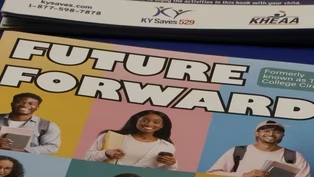
Students in Kentucky need more ways to learn after high school, so what can be done to give Kentuckians more post-secondary education opportunities?
To find some answers.
The Kentucky Council on Post-secondary education hosted a student access summit.
>> We wanted to do something with our partners in K-12, and that meant that we needed to look at all what we call barriers between each of those transitions between early childhood and into post-secondary.
In other words, what happens when you go from the eighth grade middle school into high school, from high school into college, even from K through three and then on up?
So this summit is about bringing K-12 folk.
Put them in the same room with higher ed people, policy people and talk about solutions.
We have to become what I call student ready.
We just can't expect our students to be college ready all the time.
So some of the barriers we experienced, like with many students graduating from high school, may not be fully academically ready socially or emotionally.
So the other thing too, if you tend to be low income or from other disenfranchized backgrounds, you may not have had all the opportunities to get all the inputs that you needed to.
Maybe a dual credit course or an AP course.
>> College didn't really seem like the answer for a lot of people.
That wasn't really something that was talked about as much as where I grew up in Northern Kentucky.
And so once I went, I kind of felt like the oddball out, like I kind of thought that that was always going to be on my tables, but I didn't necessarily know what that looked like.
But once, once I got to the high school and I feel like those conversations started occurring, I definitely think that's when students like you kind of you see the spark, you know, like when when you take it from this like huge dream and you make it seem like it could be a reality.
I think that's the difference.
And I think the only way that that's possible is if there are adults in people in their support system to facilitate those conversations.
>> What we know is that those individuals who have some type of credential or degree or degree find themselves to be able to secure employment that will help them take care of themselves and their families, and that they are able to have better health care.
They'll be better able to have child care, just be able to take care of their needs.
>> I think unless you ask a student, you don't know where can we improve?
And I think, I think bringing us in today, I think we're all at a different spot in our education and our paths are very, very different.
And so I think being able to have these conversations of like, well, let's highlight what we can do.
Good.
Absolutely.
And like, where are we succeeding.
Yes.
Like I think that's amazing.
But I think it's so vital that we have the conversations of where can we improve?
Like how can we better support students and how to better know than our students themselves.
And I think this is really allowing us to develop an action plan of like, we know we're having these conversations today, but what are we going to do about it tomorrow?
>> The CPE says they want 60% of Kentuckians to have a college credential by the year 2030.
If you've spent much time exploring our great state, you know the inherent beauty of Kentucky's landscape.
Our Chip Polston introduces us to a photographer who has captured some remarkable scenes around the Commonwealth in this Kentucky life.
>> Extra thanks much, and it's good to be with you again.
Appalachia is renowned for its beautiful scenery and terrain, whether it's the mountains and the valleys or the many lakes and creeks that fill eastern Kentucky, the natural elements of this area are truly something else.
Dean Hill is a photographer who has dedicated his life to capturing the beauty of this region.
Let's check out his work.
>> I'm pretty basic with my photography.
I've only got one camera body, two lenses.
I let Mother Nature do the work for me.
That means I have to be outdoors during inclement weather.
Rainstorms, snowstorms, cold weather, foggy weather, whatever.
If I'm in the elements, when all that is real dynamic, I will get a good photograph.
My name is Dean Hill.
I do fine art photography of mainly Appalachia.
I'm from this area, which is Eastern Kentucky Relief, Kentucky.
A first got into it when I was just a young kid using like a pocket camera or one of the hand-held instamatics that you hold, and it shows the photograph upside down and that my family owned.
First time I took I picked up the camera was just for fun.
It was a myself.
Some friends.
We were going out exploring, hiking at the Gorge or wherever, and we were just photographing each other or the landscape and just doing it for fun.
Photographing now as opposed to when I was, say, a younger kid when I ran the hills and camped and hiked, fished this area, it actually brought me back to a whole new level, because when I was a kid, I couldn't wait to get away from this area I wanted.
Not that it was bad, but I wanted to explore.
That involved several trips out West, the Peace Corps, several more trips in Southeast Asia, and when I came back to Eastern Kentucky, I had a whole new outlook on life here and the landscapes.
Everything looked refreshed, new, different.
And that just pulled me into wanting to explore even more.
I think Appalachia is an interesting subject because of one the people that are growing up here.
It's a special culture that you can only find in this region.
There are some places that are close to it, but these people are close to the land, the mountains.
It's a harsh environment to be living in, yet they somehow eke out a living.
It's beautiful country.
It does get abused every now and then, but for some reason, Appalachia endeavors to persevere.
You might say it's still got its beauty.
And I want to do everything I can to capture that beauty for the people away from here that don't understand where I come from.
In a sense, photography is therapeutic in that it gets me out in nature.
It gets me into a place where I don't have to get anything and still have a good day.
Kind of like fishing, I guess.
Worst day of fishing is better than the best day at work yet.
My work entails me to be out fishing all the time, so I'm fishing for a photograph.
If I don't get it, that's fine.
I've had a good day.
If I do get something, then I'm happy.
What does it mean to be Appalachian?
That's a tough one in a way, because it's second nature to me, because I'm born and raised here, so I just take it for granted that I am Appalachian.
Anywhere I go.
I'm from the mountains.
I'm from Appalachia.
The first time I left this country, I didn't really want to lean toward being an Appalachian.
But the farther away I got, the more I realized that being Appalachian is probably unique.
It's people from Appalachia.
When you're around them very long, you see that there's a uniqueness about them, and it will be that language, their mannerism.
They take a pride in where they're from.
So I do that now.
If I was going to describe Appalachia, beauty.
Beauty beyond beauty, I would call it that simple.
>> Great stories like this one come your way on our show each Saturday night at 8:00 eastern, 7:00 central, right here on KET.
As we continue to cherish this great Kentucky life.
Back to you.
>> Thank you Chip.
And on a special edition of Kentucky tonight, Monday night at eight, we talk about Eastern Kentucky tourism and you'll see great beauty shots just like you've seen in that piece.
But we hope to see you again tomorrow night at 630 eastern for Kentucky Edition.
Have a great night and
Summit Focuses on Student Learning After High School
Video has Closed Captions
Clip: S4 Ep102 | 3m 19s | Education leaders and students share ideas on learning after high school. (3m 19s)
U.S. House Votes to Release the Epstein Files
Video has Closed Captions
Clip: S4 Ep102 | 2m 49s | After months of debate, the House votes to force the release of the Epstein files. (2m 49s)
Providing Support for PBS.org
Learn Moreabout PBS online sponsorship
- News and Public Affairs

Top journalists deliver compelling original analysis of the hour's headlines.

- News and Public Affairs

FRONTLINE is investigative journalism that questions, explains and changes our world.












Support for PBS provided by:
Kentucky Edition is a local public television program presented by KET