
November 19, 2025
Season 4 Episode 103 | 26m 30sVideo has Closed Captions
Kentucky students show improvements across nearly all subjects and grade levels.
A new report shows improved academic performance among Kentucky students. Lexington once again considers a plan to relocate its city hall. The state’s six congressmen join in a moment of silence on the House floor. How KET is giving students across the commonwealth a chance to showcase their creativity.
Problems playing video? | Closed Captioning Feedback
Problems playing video? | Closed Captioning Feedback
Kentucky Edition is a local public television program presented by KET
November 19, 2025
Season 4 Episode 103 | 26m 30sVideo has Closed Captions
A new report shows improved academic performance among Kentucky students. Lexington once again considers a plan to relocate its city hall. The state’s six congressmen join in a moment of silence on the House floor. How KET is giving students across the commonwealth a chance to showcase their creativity.
Problems playing video? | Closed Captioning Feedback
How to Watch Kentucky Edition
Kentucky Edition is available to stream on pbs.org and the free PBS App, available on iPhone, Apple TV, Android TV, Android smartphones, Amazon Fire TV, Amazon Fire Tablet, Roku, Samsung Smart TV, and Vizio.
Providing Support for PBS.org
Learn Moreabout PBS online sponsorship>> And the results of this year show students perform better across several grade levels and subjects than they have in my recent memory.
>> Our Kentucky students making the grade.
What new test scores say about education in Kentucky.
And what brought all six of Kentucky's congressmen together on the U.S.
House floor.
>> Production of Kentucky Edition is made possible in part by the KET Millennium Fund.
>> Good evening and welcome to Kentucky Edition for this Wednesday, November the 19th, I'm Renee Shaw, and we thank you for winding down your Wednesday with us.
There's good news to report tonight about Kentucky classrooms.
This year.
Students in Kentucky perform better academically across nearly all subjects and grade levels than in recent years.
Today, the state Department of Education released its assessment and accountability data for the 20 2425 school year.
Our Mackenzie Spink tells us what the report says about the state of education in Kentucky.
More as we begin tonight's Making the Grade segment.
>> The results of the state testing are color based with green meaning proficient and blue meaning distinguished overall scores among students at every grade level have improved the number of schools hitting green and blue scores went down from 2023 to 2024.
But in 2025, both green and blue scores exceeded previous years.
High schools saw a sharp drop in the lower color ratings, while the blue scores nearly doubled in the last year.
The number of high schools scoring blue and college readiness also rose sharply from previous years.
Some scores in subjects like social studies and writing mechanics dropped slightly, but overall, Kentucky students are scoring higher.
>> Our students have really done a great job in this past year on their assessments, and the results of this year show students perform better across several grade levels and subjects than they have in my recent memory as commissioner or as a as a superintendent or as a as a principal.
As a matter of fact.
>> Doctor Fletcher attributes some of the success to training initiatives like the Kentucky Reading Academy, which started after the General Assembly passed the Read to Succeed Act in 2022.
A recent third party report indicated encouraging outcomes from that program.
>> If a student had a teacher that had been trained in the science of reading, and they had had a teacher that was trained in that manner for two consecutive years, the data and the increase for that student was much higher than a than a student that had a teacher that wasn't trained in the science of reading.
Again, especially in that two year consecutive years of data, KET and various partners have initiated numerous efforts also to advance the high quality numeracy instruction for the Kentucky Numeracy Act.
And to add, I would be remiss if I did not thank our legislators.
Our legislators have made a huge investment in our efforts in literacy and numeracy across the state.
And again, we're beginning to see that return on investment.
>> The rate of chronic absenteeism is down about 5% from the 20 2223 school year.
When a child misses 10% or more of their time in school, whether excused or unexcused, they are chronically absent.
This year, Kentucky Department of Education launched a public messaging campaign to let kids know you belong in the classroom.
>> This messaging is something to tell students you've missed school.
You miss more than lessons.
You miss connection with your school.
You miss connection with your your fellow students, and you miss on building on your own future.
>> There is also been progress on the educator workforce shortage.
This year, 34 districts reported that every licensed position was filled a small number, but progress nonetheless, says Doctor Fletcher.
>> Now, you may say 34 out of 171.
That that doesn't sound like great data, Doctor Fletcher, but the year before, we only had one district that reported no unfilled vacancies.
That's a huge that's a huge improvement.
And we've been working on efforts to recruit and retain new teachers with Go Teach Kentucky, including a new advertising campaign and website for educators who are interested in teaching.
>> Kentucky Department of Education says it's celebrating the progress made, but that there's still work to do.
>> I'd like to see improvement in every area.
So again, thankful for what we've seen so far.
I think you'll see a lot of anywhere from 1 to 2 to 3% increases in the percent of proficient distinguished, and that's a good statewide model.
But we would love to see that to be at much higher levels.
And again, because we want our students to be better prepared for what's next.
>> Doctor Fletcher says that he'd like to see the state funding for literacy continue, and hopes for an increase in funding for numeracy initiatives for Kentucky.
Edition.
I'm Mackenzie Spink.
>> Thank you.
Mackenzie.
Science scores improved dramatically among high school students, but Commissioner Fletcher says it's hard to compare the data properly because this year, a new type of science assessment started in 2023, the Academic Standards for science changed to emphasize deeper learning and the practical applications of science.
1 in 7 of Kentucky's public school kids attend Jefferson County Public Schools, and J-c-p-s is the state's largest district, serving more than twice as many students as Fayette County.
Our June Leffler has more on how learners in and near Louisville tested as we take a deep dive into whether Kentucky kids are making the grade.
>> Superintendent Brian Yearwood highlights progress at JCPS.
>> When we look at this data, our graduation rates rose to over 89.2%, or post-secondary readiness rates climbed to 84%.
Our intentionality, the intentionality is actually paying off.
As we look at our minority students and we look at their graduation rates reaching 90.8%, matching their white peers.
>> Lumping all grades together, the district found a one percentage point increase in students scoring proficient or distinguished in reading, social studies and writing, and a two percentage point increase in math.
>> The biggest positive is that we are maintaining in many areas, and we're showing promise and growth in other areas.
>> Science proves to be a more difficult subject for these students across grade levels.
While more than a third of students are proficient or distinguished in reading.
But Yearwood says that could and should be better.
>> Achievement gaps are still there.
They're still gaps that we do need to pay attention to.
>> Just like last year, new test scores show across grades and subjects.
JCPS students scored worse than the state average, something that has concerned leaders in Frankfort who fund the state's public schools.
Here is a Middletown state representative.
Speaking of the district last week.
>> Our problem is our school system is failing on far too many levels.
It's doing a lot of good.
What I'll say is I'm going to I'm going to give as much support and as I can to Doctor Yearwood, but if it doesn't turn around pretty soon, we must do something.
>> The number of JCPS schools that fall in the bottom 5% of schools statewide has grown, from 34 in 20 22 to 41 schools today.
>> These 41 schools represent our greatest opportunity for growth.
>> While the district has both the flexibility and responsibility to turn these schools around, according to the state, Yearwood says the designation does adversely affect a school's reputation.
>> If you start putting labels on schools like this one is low or this one's high, that's internalized by students and then their own expectations will mimic what they hear.
We have to do a much better job, and we will do a much better job in ensuring that regardless of where a school is located, what zip code a school is located in, what geographic location that we expect acceleration at a higher and higher level.
>> The student body of J-c-p-s is unique.
It has slightly more economically disadvantaged kids than the state as a whole, and students who speak English as their second language make up nearly a quarter of JCPS students.
For Kentucky Edition.
I'm June Leffler.
>> Thank you June.
Now we travel from Louisville, Jefferson County to Northern Kentucky, where one city school is celebrating growth.
Just a few years ago, Holmes High School in Covington was in the bottom 5% of all Kentucky schools.
Our Emily Sisk tells us how their scores are now moving in the right direction.
This as we round out our Making the grade reports.
>> When I saw the scores, I really just jumped out of my seat.
Couldn't help myself.
>> Holmes High School Principal Angela Turnock has been waiting to announce the results from last year's state test scores.
The high school is now classified in the yellow level, which is one category away from total proficiency.
Covington Independent Schools District Assessment Coordinator explained why this is a huge turnaround from just a few years ago.
>> We were at the bottom 5% of all high schools in the state of Kentucky, which was a red category as well.
>> Just a few years ago, Holmes High School received a red rating, which required them to develop an improvement plan every year since the Covington based school has grown, they are now nine points short of reaching that green proficiency level.
>> The years of work that we've put in over probably the last 5 or 6 years have really started to show.
In our scores.
>> We focus on every single area of school that needed to improve.
So that went from attendance to behavior to academics to social emotional learning.
>> So what's attributed to this growth?
The school leaders all referenced a district wide curriculum where all of its K through 12 schools share the same learning plan.
>> What was happening at the middle school aligned with the high school, and what was happening at the elementary schools aligned with what was at the middle school.
So our kids were coming to us prepared.
>> We did a lot of work to make sure that not only did we have that same curriculum in each classroom, but also that that curriculum was rigorous, that it was challenging our students.
>> The high school also implemented practice assessments and intervention for students who needed extra help.
>> We do three benchmarks every year, and those benchmarks are designed to show what they're going to score on the KSA.
>> If a student doesn't master a standard, they go and do some what we call wind time.
So what?
I need time.
And so during that time they work on that standard until they get that standard.
So they've mastered that standard.
>> Covington Independent Public Schools is the most diverse school district in Northern Kentucky.
It is also a low income district, with nearly 90% of students qualifying for free or reduced lunch.
Leaders in the school system say it can be difficult for urban school districts to see significant growth, but students at Holmes High School want to know how they can improve.
>> Kids want to know their scores, which is a huge change for where we used to be.
Every other day, I have a kid that says, hey, what did I do?
Do you know when I got on that test, what did I do on that?
How did I do on that?
They want to to see their improvement.
>> They want to know how to get to that next level.
So if they scored apprentice, they want to know how many points they were away from proficient.
>> And I sat down with a senior at the high school to see what he thought about the score improvement.
He gave all the credit back to his teachers.
>> Instead of just handing him a packet and saying go for it, they're actually helping them hands on, and students are actually learning a lot.
The more they improve and the higher test scores be, the better our school gets.
>> Principal said.
Sometimes you have to stay the course even when it takes time to see results.
>> We're celebrating all those small wins that are now equaling out to to bigger wins for us.
>> Holmes High School leaders said their expectation is to earn a green proficiency rating next year for Kentucky edition.
I'm Emily Sisk.
>> Thank you Emily.
So sticking with education news as the upcoming legislative session gets closer and closer, organizations have prepared their budget requests for state lawmakers to consider, and the Department of Education is no exception.
Commissioner Robby Fletcher talked about some of the department's legislative priorities yesterday.
At the top of the list is an accountability proposal that includes a more adaptive testing model for students.
>> So I can tell a parent that their student is proficient in math, and most are parents will understand that.
But all of our parents will understand.
If I got a third grade student and they're reading on the fifth grade level, that's something that they can connect to.
So that's one of the one of the changes that we're proposing in the new model.
Other things that are a part of that is emphasizing that every district, again, we have, I want to say, a little less than 40 districts that are in the local accountability work, but we believe that every district should have, shall or should have a local accountability model where they're involving parents, teachers, educators, local business leaders, our workforce.
It's hard for me not to stand in front of a podium and tell you that, not say that our teachers deserve more higher salaries.
They do.
I've talked to students personally, including my own son, who said it's not enough money.
I can't I can't raise a family on these funds.
I think it's very important to give our teachers supports.
So we need those literacy coaches.
We need those those also those numeracy coaches that are out in classrooms that are helping teachers to develop lessons, to observe and give feedback.
So I think, first of all, I would say continue that support on literacy, but also increase the numeracy funding.
Again, we're very thankful for what's there, but increase that numeracy funding I think would be a first start.
>> Earlier this year, the National Education Association ranked Kentucky 42nd in the country for average teacher salary, a notch below the year before.
The average teacher salary in Kentucky is just above $58,000 a year.
There's talk in Frankfort about tougher penalties for Kentuckians who use public resources to support or oppose ballot questions.
Last year, some school districts were criticized for using social media to directly advocate for the defeat of amendment two.
Now, that amendment would have allowed the use of public money for nonpublic schools.
The Kentucky attorney general said that violated the law.
The amendment lost, with 65% of the voters saying no.
Kentucky Public Media reports.
State Senator Steve Rawlings of Burlington, a Republican, will file a bill making it a class D felony for people using public resources to advocate for or against a ballot measure, and a class D felony is punishable with 1 to 5 years behind bars, and a person found guilty couldn't accept a government job for ten years, Rawlings says.
Right now, there's no real punishment at all.
It's been decades in the making.
This week, leaders in Lexington will once again consider a plan to move City Hall.
The city has proposed buying and redeveloping the Truist Bank building on West Vine Street.
The $86 million deal would include constructing a 10,000 square foot addition to the current building.
City council will vote on whether to approve the deal tomorrow.
Lexington Mayor Linda Gorton is the city's fifth mayor to try to find a new home for the government center.
The city moved into the current building on Main Street in 1982.
At that time, the move was intended to be temporary.
The city estimates the current building needs $55 million worth of maintenance and repairs.
Now moving on to national politics, the U.S.
Senate moved fast to pass a bill requiring a release of the Jeffrey Epstein files.
The Senate decided unanimously to pass the bill that came just hours after the 427 to 1 vote in the U.S.
House.
All six members of Kentucky's delegation, federal delegation voted for the release of the files with passage in the House and Senate.
The bill is now on President Donald Trump's desk, and he says he'll sign it.
Epstein was a financier who killed himself in a Manhattan jail while awaiting trial in 2019 on charges he sexually abused and trafficked underage girls.
There's been speculation for years about the names in the files.
Kentucky Congressman Thomas Massie of the fourth district was one of the leaders of the movement to release the files.
Here are some of his comments made Monday night.
>> The speaker, the attorney general, the FBI director, the president and the vice president could have saved us all this time and embarrassment, frankly, for our own party, if they'd just done the right thing four months ago.
>> Do you believe him, Congressman?
For weeks, he's been pushing against this.
Now he says he supports it.
Do you buy it?
>> He's only supporting it because president told him to support it.
That's what Mike Johnson does.
>> I'm talking about by President Trump saying that he wants the House to pass this resolution.
>> Well, I'm concerned that now he's opening a flurry of investigations, and I believe they may be trying to use those investigations as the predicate for not releasing the files.
That's my concern.
>> So you.
>> Don't think I'm trying to block it?
Well, they will, I'm afraid they're going to try to use a provision of the law that allows you not to release these materials if they're subject of an ongoing investigation and would harm the release of which would harm the ongoing.
>> So this is all about for President Trump.
First, he was blocking this, pushing Republicans to block this for so long.
Now he's reversing course and he has the power to release the files anyway.
>> It's pretty simple.
For four months, he thought the best thing for him was to keep the files secret.
And somebody convinced him that the best thing for him was to release the files.
And if they're serious about it, they should release them right now.
It's that simple.
>> If President Donald Trump does sign the bill, the Department of Justice would have 30 days to release the files.
Yesterday marked two weeks since the UPS plane crash in Louisville that left 14 people dead.
Last night, the congressman for the Louisville area, Morgan McGarvey, led a moment of silence on the U.S.
House floor.
He was joined by five other members of the Kentucky House delegation.
>> Two weeks ago tonight, our community of Louisville, our state of Kentucky, was absolutely rocked when a cargo plane taking off from Louisville, Muhammad Ali International Airport bound for Hawaii, crashed.
38,000 gallons of jet fuel exploded in our community.
In a scene that can only be described as apocalyptic.
All three crew lost their lives, as well as 11 people on the ground.
14 of our neighbors, 14 of our community gone.
The first responders were incredibly brave, rushing headfirst into the inferno to save everything they could.
Our community, our state, our delegation.
We did what Louisvillians and Kentuckians do and lifted each other up as best as possible.
But tonight, we want to express our gratitude for those who went head first into that danger.
For those who lifted each other up.
And we want to offer a moment of silence for the 14 people who lost their lives.
>> The U.S.
Food and Drug Administration has announced new guidance on the labeling for all hormone replacement therapies, beginning early next year.
Black box warning labels will be gone from hormone replacement creams, pills and other products prescribed to ease the symptoms of menopause and perimenopause.
The FDA says the change comes after, quote, more than two decades of what they say is fear and misinformation surrounding hormone replacement therapy.
Erica Martignetti, an advanced practice registered nurse specializing in women's health at UK Health Care, tells us more.
>> So before this change, the warnings had there was a broad black box warning about heart disease, breast cancer and dementia and blood clots.
That really caused a lot of concern.
And that was that was added as a black box warning in 2003 after the Women's Health Initiative or the study that was really looking at oral synthetic hormones that were used in this study and in the women in that study, were on average age about 63 years old.
So they were well past the typical menopausal age in America, which is around 51 to 52.
And so these women were started on hormones a lot later than maybe we typically should do it now.
This black box warning is, is really what has driven the fear in most women and even providers.
They feel like it's just not been safe.
It hasn't been taught in medical school to prescribe hormone therapy, even from what I've heard.
You know, gynecology doesn't spend a lot of time, even in their programs learning about menopause care.
And so every woman is just very different.
And so I think there is we're in the middle of a menopause movement right now and women are starting.
And this has helped, you know, this is one of the many things that is helping that the black box warning is removed.
And there's we have lots of great providers that are advocating the menopause.
Leaders are advocating in America for women to have access to hormone therapy.
You know, women come to me and they are in tears.
A lot of times they're in tears with their symptoms.
They're they are miserable.
They don't feel like themselves.
And you really can't measure that.
Like, how do we measure?
I don't feel like myself anymore.
And so they come to me and they're very upset.
And so I allow space for them to tell me their story.
And they tell me what they've been going through.
And some women have been dismissed for a long time, and that's what's what's really hard.
And that's what I would love to see.
Shift is that women would not get dismissed any longer, that we have safe hormone treatments available for women that do not raise the risk of blood clots.
You know, transdermal estrogen, your risk of blood clot is is similar to baseline with with the transdermal.
It doesn't get processed through the liver.
So if we can start women on these really safe hormone therapies and have them feel better, they're more likely to exercise.
They're more likely to be happy every day and be a part of their families and be able to thrive.
>> Systemic estrogen alone products are not included in the guidance change, according to the FDA.
The Black boxed warning for endometrial cancer will remain on those products.
Well, the Big Blue Crush continues with Kentucky.
Oh, now behind Tennessee in this annual blood competition.
After two days of donating, Tennessee leads 868 to 832.
The drive helps blood centers in both states say stocked with blood through the Thanksgiving holiday.
Now, Kentucky has won this competition the last three years and leads 22 to 14 with one tie over the past 37 years.
So we got to get it together, give and get a long sleeved white T-shirt while supplies last, and you're urged to make an appointment before giving.
But the Kentucky Blood Center will accept walk in business as space allows.
Go Big Blue with the holidays coming and effects of the recent federal government shutdown, it's also a good time to give food.
The annual Cram the Cruiser campaign started today and it runs until December 5th.
You can drop off nonperishable food items at any of Kentucky's 16 state police posts.
Troopers will be stationed at stores throughout the state accepting donations.
Governor Andy Beshear says, quote, no family should have to face hunger or worry about where their next meal will come from, especially during the holiday season.
Every year, I'm proud to see the Love Team Kentucky shows through its participation in this food drive, and hope anyone who is able will help us give back to our neighbors in need.
End quote.
KET is giving students across the state a chance to showcase their creativity with the KET Young Writers Contest.
Submissions are now open for the contest, with categories ranging from illustrated stories and poetry to graphic novels and persuasive writing.
And in honor of America's 250th birthday, a new special civics subcategory has been added, spotlighting work that explores participation, community, and shaping the future.
Students can submit entries through March 15th, 2026.
Now, you can learn more by going online at.
Education dot Ket.org dot and good luck!
The Dare to Care program has been feeding the Hungry and Louisville for 56 years.
We'll talk about how that program started and how it works today.
As Kentucky's largest city deals with hunger.
That story and more tomorrow night on Kentucky Edition.
And
FDA Announces Change to Hormone Therapies
Video has Closed Captions
Clip: S4 Ep103 | 3m 23s | Menopause specialist says FDA change could lead to better care for women. (3m 23s)

JCPS Sees Improvement in Student Test Scores
Video has Closed Captions
Clip: S4 Ep103 | 3m 25s | State's largest school district releases its assessment and accountability scores. (3m 25s)
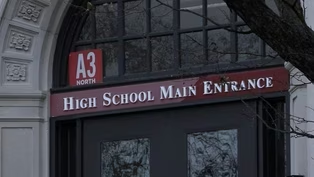
Test Scores on Upward Trend at Northern Kentucky High School
Video has Closed Captions
Clip: S4 Ep103 | 3m 36s | Once testing in the bottom 5%, high school in Covington now moving in the right direction. (3m 36s)
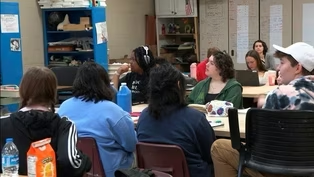
What New Test Scores Say About Education in Kentucky
Video has Closed Captions
Clip: S4 Ep103 | 4m 40s | Kentucky Dept. of Education releases 2024-2025 school assessment and accountability data. (4m 40s)
Providing Support for PBS.org
Learn Moreabout PBS online sponsorship
- News and Public Affairs

Top journalists deliver compelling original analysis of the hour's headlines.

- News and Public Affairs

FRONTLINE is investigative journalism that questions, explains and changes our world.












Support for PBS provided by:
Kentucky Edition is a local public television program presented by KET