
November 20, 2026
11/20/2026 | 55m 50sVideo has Closed Captions
Andrew S. Natsios; Twiggy; Olivia Harrison
Former USAID Administrator Andrew S. Natsios discusses Donald Trump's shutdown of USAID and explains why he believes the decision will be detrimental to American interests for generations to come. British model and actress Twiggy on the new doc about her life as an icon. George Harrison's wife, Olivia Harrison, shares never-before-seen photos taken by her husband of the Beatles' rise to fame.
Problems playing video? | Closed Captioning Feedback
Problems playing video? | Closed Captioning Feedback
November 20, 2026
11/20/2026 | 55m 50sVideo has Closed Captions
Former USAID Administrator Andrew S. Natsios discusses Donald Trump's shutdown of USAID and explains why he believes the decision will be detrimental to American interests for generations to come. British model and actress Twiggy on the new doc about her life as an icon. George Harrison's wife, Olivia Harrison, shares never-before-seen photos taken by her husband of the Beatles' rise to fame.
Problems playing video? | Closed Captioning Feedback
Where to Watch Amanpour and Company
Amanpour and Company is available to stream on pbs.org and the PBS app.
Watch Amanpour and Company on PBS
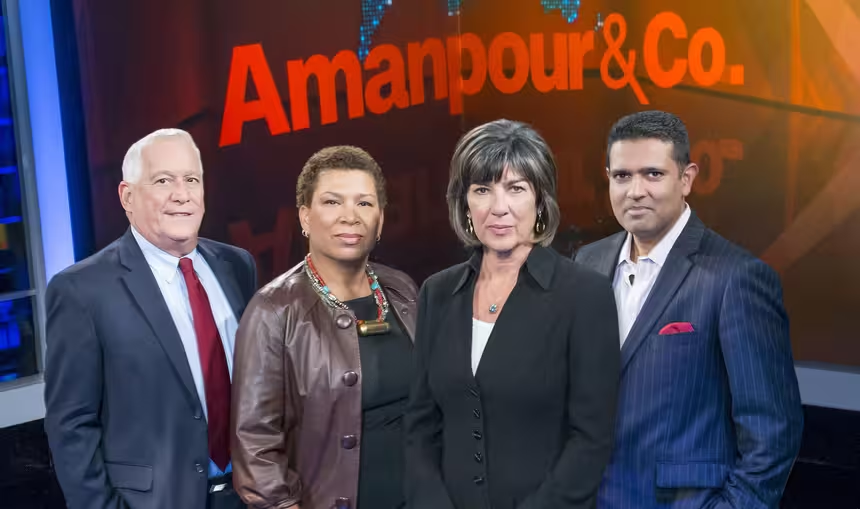
PBS and WNET, in collaboration with CNN, launched Amanpour and Company in September 2018. The series features wide-ranging, in-depth conversations with global thought leaders and cultural influencers on issues impacting the world each day, from politics, business, technology and arts, to science and sports.Providing Support for PBS.org
Learn Moreabout PBS online sponsorshipHello everyone and welcome to Amanpour & Company.
Here's what's coming up.
People don't realize how powerful soft power is and AID is one of the most important tools we have of soft power in the United States.
Guns are not enough.
Why Americans are losing out after the dismantling of USAID.
Then... I don't know about being a star.
It's just good fun.
The original "It" girl.
My conversation with a British cultural powerhouse, Twiggy.
And... There's a great feeling of, you know, when I'm looking at these photographs, I feel like I'm right on George's shoulder.
Another British superstar, George Harrison.
His widow, Olivia, protects his legacy as she digs into this Beatle guitarist's photo archives.
(upbeat music) - Amanpour & Company is made possible by The Anderson Family Endowment, Jim Atwood & Leslie Williams, Candace King Weir, Charles Rosenblum, Norma C. Warner, and Paul D. Warner, Monique Schoen Warshaw, The Sylvia A.
& Simon B. Poita Programming Endowment to Fight Anti-Semitism, The Straus Family Foundation, the Peter G. Peterson and Joan Gantz Cooney Fund.
Ku and Patricia Ewan, committed to bridging cultural differences in our communities.
Barbara Hope Zuckerberg.
And by contributions to your PBS station from viewers like you.
Thank you.
- Welcome to the program, everyone.
I'm Christiane Amanpour in London.
We're almost halfway through Trump 2.0 and it's a good time to take stock.
Amid the president's many drastic changes is, of course, the dismantling of USAID, a legacy of John F. Kennedy.
It was a geopolitical tool of soft power for the United States, a Cold War bastion of American generosity around the world when the U.S.
was competing with the Soviet Union for hearts and minds.
Conservative estimates suggest that more than 700,000 people in developing countries died last year because of slashed funds and programs.
Two-thirds of them were children.
A widely reported study by The Lancet suggests nearly 14 million people will die by 2030.
And my first guest tonight argues that Americans themselves are losing out, that no action of the Trump administration may prove more consequential over the long term to the health, safety, and prosperity of the American people.
Andrew Natsios led USAID from 2001 to 2006, and he's just written "Guns Are Not Enough, "Foreign Aid in the National Interest," which he told me about when he joined me a little earlier.
Andrew Natsios, welcome to the program.
- Thank you very much.
- So firstly, the title of your book, "Guns Are Not Enough."
This comes directly from the former Defense Secretary James Mattis.
He had said it when he was talking about the need for diplomacy as well.
So why did you choose that title for your book?
- I think that people don't realize how powerful soft power is, and AID is one of the most important tools we have of soft power in the United States.
It is not prominent in the United States.
AID was not well known until it was abolished.
But in the developing world, it is the dominant, it was the dominant US institution.
And we had 60 field missions, the administration, the Trump administration, and Elon Musk abolished them all and shut them all down, fired all the staff.
And the programs collapsed, civil society organizations collapsed around the world.
And the consequences in terms of health, in terms of disaster relief, in terms of agricultural programs, there was a program to bring electricity to rural Africa that collapsed.
It's been a disaster for the United States.
I think for our image, people don't trust us anymore as a result, and people are dying.
There's a study done by Lancet, the leading journal of public health in Britain, that AID did not fund.
It was funded by the Spanish government.
Between 2001 and 2021, AID health programs alone saved 92 million people's lives.
The Green Revolution, which AID principally implemented in Asia, saved 245 million people's lives.
President Obama attempted to bring that revolution to Africa, and they abolished all those programs, too.
You know, I find it very interesting because you're talking about how AID flourished under both political parties, you know, whether a Democrat was president or a Republican.
I'm going to get into the Doge woodchipper in a moment, but I want to just ask you, because I think it's important to know, from somebody like yourself, who describes himself as a conservative Republican, you came into government with the first George H.W.
Bush, you served, you know, he was vice president under Reagan, and remember, Reagan famously said, and I'm going to quote, "The nine most terrifying words in the English language are, 'I'm from the government, and I'm here to help.'"
Do you think those words connected the dots all these decades later to give Trump and Musk the excuse to do what they did?
>> That was a campaign speech, but Ronald Reagan was a big supporter of foreign aid.
He said it publicly repeatedly.
In fact, he is the one that developed the doctrine that we still use until Trump was president, "A hungry child knows no politics," that we should not discriminate because we don't like the government of a country when there's a famine going on.
We need to feed kids regardless of politics or religion or anything else.
That's a Ronald Reagan doctrine.
- I think it's really interesting 'cause as you said, it was created in the Kennedy administration at the height of the Cold War.
It was a major force multiplier in terms of soft power for the United States.
Just go back a little bit and expand on that, and then I'm gonna ask you some more specifics.
But I don't think the American people understood that it wasn't just about charity.
It was about much more than that.
- It's really not about that.
You could say that the disaster relief programs, or we go in and after an earthquake or a famine or a civil war and we help people, it's charitable.
But even that, we try to build capacity, even in the middle of disasters like that.
Most aid programs are designed over the long term to be sustainable.
After the program ends, we want something left after the program is all over.
And an excellent example of that is the Green Revolution that was developed by Dr.
Norman Borlaug, who won the Nobel Prize for Peace in 1970 because of it.
It was half the aid budget in the 1970s was spent on the Green Revolution.
As I said earlier, President Obama more recently tried to extend it to Africa and it was working, but they shut it down.
Those programs are designed to be permanently sustainable.
One should get the improved seed varieties out.
They replicate themselves and the agricultural system is much more productive.
One of the studies by the National Academy of Science said the Green Revolution increased food production by 300% in Asia.
It was extraordinarily successful.
Our scholarship program is what built modern Korea, South Korea, and Taiwan, Indonesia.
These countries made huge, South Korea is one of our closest allies and most important, has their own aid program now.
We spent $6 billion in the 1960s and 70s making modern Korea what it is today.
And the same is true with Taiwan.
They're both very poor countries before.
So these are not shared.
These are in the national interests of the United States.
I might also add the Ebola outbreak in East Africa that took place, in West Africa that took place, I think it was 2013 or 14.
It was out of control.
11,000 people had died.
Mets and Sun Frontier, the French NGO said, "We're leaving.
We can't stop this.
It's out of control.
Only Americans can stop it."
President Obama sent in a DART team, Disaster Assistance Response Team, DART team from AID, with support from the U.S.
military, but AID was in charge.
And we work with the NGOs and the Ministry of Health, and we stopped the epidemic.
There's a new epidemic right now in the Congo.
It's spilling over into Kenya.
And some cases have been discovered in France.
The administration thinks they're going to stop the pandemic at the borders of the United States.
That is utter nonsense.
You cannot stop pandemics at the border.
You stop them where they start.
And the only way to do that is to dispatch a large, robust, dark team with support from the U.S.
military.
And they haven't done that.
They destroyed the whole apparatus of disaster response, and 90% of the staff was fired.
How do you respond if there's no staff left?
People think that you just give money away.
You have to have staff to manage these programs.
And that's putting all of us at risk.
Ebola is going to get to the United States unless it's stopped, and they are not stopping.
So I want to ask you this, and you alluded to it.
You begin your book with an anecdote.
Back in 2004, you met a young man who had recently returned from Iraq.
He wanted to talk to you about USAID, and he basically said, "Why is the work of USAID so visible and influential abroad but practically invisible in the United States?"
And that, I wonder why none of you made a much bigger deal of promoting USAID when it was doing all its brilliant work.
And furthermore, you know, because every administration complains about it, that most Americans, apparently, you know, average Americans believe that at least 20% of the federal budget goes to foreign aid, but in fact it's only 1% or less than the budget.
You know, it's really, really minimal compared to what people think.
So there's a real communications problem that I think has let this lot now, you know, just say, "Yeah, I mean, it's inefficient.
Nobody knows about it.
We spend too much on it, and let's take the woodchipper to it."
- Well, a U.S.
Senator, Jesse Helms from North Carolina, was chairman of the Senate Foreign Relations Committee, and he got a law through prohibiting AID from educating the American people about AID.
We were not allowed to talk about it by law domestically in the United States.
We can in the developing world.
AID is very well known.
I started a branding campaign in 2003, and our visibility across the developing world rose dramatically as a result.
But we could not talk to the American people by law.
And people were afraid to talk to the news media, believe it or not, and domestically because of that statute.
The ridiculous law.
- Wow, I'd never heard that.
I'd never heard that.
That is shocking.
What would motivate Jesse Helms, a conservative Republican, to do that?
Why was that an important law for him?
- Because he didn't want us to survive.
He was trying to abolish us, and the best way to do that is to make people ignorant, or to leave people unaware of what AID is doing.
That's why.
He was trying to abolish the agency or merge it into the State Department.
Brian Apton, my good friend, who was the head of aid under Clinton, he prevented that from happening, but it was a very close fight.
You know, what they've done now is to merge the programs into state.
I was a diplomat for a while.
I was President Bush's envoy to Sudan.
I have enormous respect for the State Department.
I think our diplomats are the best in the world.
State Department has been gutted by this administration too, but State Department is a diplomatic institution.
It should not be managing these aid programs.
It is not set up to do that.
AID was set up to do that, 'cause that's what development is, running programs.
- To that point, all right, the people who defend the woodchipper method, and this is Elon Musk, what we have here is not just an apple with a worm in it, but we have actually just a ball of worms.
Obviously, you and most beneficiaries would disagree with that characterization.
But what would you say to somebody who came to you and said, "Andrew Natsios, you tell me why we should contribute "to all this waste, fraud, mismanagement."
Is that the case?
- Well, Jeremy Lewin was the point person for, he was a young lawyer, 31 years old from Silicon Valley.
He was on the DOJ team that disassembled AID.
He took over, a year and a half into it.
The New York Times interviewed him and said, "How much fraud did you find in AID?"
He said, "Well, actually very little."
That's what he said.
That was a DOJ person, an assistant to Elon Musk.
Okay, there are two objective standards for how well managed a federal agency.
What did the audit say from the inspector general's office?
AID had clean audits with no management findings for eight years.
The Pentagon, and I'm a retired lieutenant colonel, I'm pro-military, I'm not hostile to the military, they haven't had a clean audit in eight years in either Republican or Democratic administrations.
Now I know it's bigger, but the fact is that it's not well managed.
AID is.
Secondly, there's an independent institute that all they do is judge how well run federal agencies and departments are.
AID was ranked the third most best run federal department and agency, run based on the merits and not political, not making decisions on a political basis.
If it's the third best run federal agency, how can you say it's full of fraud?
If the inspector general says, now, are there instances of people stealing money?
Of course there are.
You know what?
People are falling.
We have corruption, but AID has so many layers of accountability.
The career people usually catch the people trying to steal money, and they turn them over to the courts, and they get convicted and put in jail.
But it's a very small amount.
When people think that the AID money is being stolen, it's complete nonsense.
- Can I ask you a bigger question about what you're talking about?
The hollowing out, the destruction of USAID, as you said, also the hollowing out of the State Department.
There is a total hollowing out of the entire U.S.
government bureaucracy.
What do you think, whether it's, you know, all the other departments, you're a former administrator, you've served different presidents.
What do you think is the result?
And what are we gonna see, you know, at the end of the Trump administration in terms of the ability of government to function?
- Well, I'll tell you, we're having crises right now with the FAA, the Federal Aviation Administration, and no one's asking the question.
Musk laid off hundreds of people from FAA.
We're seeing the consequence of it right now.
They claimed that the Social Security Administration was full of fraud, but they couldn't find any.
They made all these charges, not just in AIB, across the federal government.
And, you know, I believe in a smaller government, but I want a competent government that's well-run with career people who are recruited based on the merits, not based on politics.
I have to say, I've run seven institutions the last 45, 50 years.
The most competent managers that I've managed are the people in AID.
Highly skilled, it was the most educated of all workforces in the federal government.
And they laid them all off.
It was a catastrophe for the United States and for the American people.
- And finally then on USAID, do you think it's possible to bring it back from the dead in a new administration, even a new Congress?
Do you think they'll recognize the value added?
And is it physically and administratively and financially possible to bring it back?
- Well, we thought that, we don't know what's happened to all the archives.
There are hundreds of thousands of documents.
I'm worried that they deleted them.
And that's all of the evidence that we've amassed that what works, what doesn't work.
We're very worried about the archives.
Number two, there was a procurement system called the Glass System, which I started installing when I was administrator.
I thought they had destroyed it.
It appears they moved it to state, but we're not sure of that.
Then there's a financial management system, which took 10 years to implement.
I'm worried where that is.
I don't know what they've done to it.
So the business systems, which no one talks about, are extremely important to create a new department that can run this stuff.
And we're not entirely sure.
They're not, no, these agreements that I told you they're writing with these 19 countries, in the most corrupt countries, they're secret.
They haven't, they won't disclose what's in the agreements, which I think is outrageous.
We don't know what's happened to all of the systems in AID that were necessary.
The career people, I think many of them would come back to work, but yet many of them are finding other jobs.
They're very competent people, but I know I've talked to some of them.
They said they miss AID.
I understand why.
There's a sense of satisfaction in doing the work that they did.
So I think we can restore a department.
I don't think, I think this is a chance to fix the dispersion of aid programs across the federal government, which is by the way, why Jack Kennedy created AID in 1961 is because there were aid programs all over the federal government and they conflicted with each other and he said, "No, we need to merge them all "in one place," and he did.
And it helped us win the Cold War.
I think AID helped win the Cold War.
And so we could do that again, but Congress has to act.
The president's not gonna do this.
- I just think it's so important that you end with, "It helped us end the Cold War," as President Trump is meeting two highly authoritarian competitors right now, Putin and Xi this week.
So, it was a force multiplier.
Let's hope something can be restored.
Andrew Natsios, thank you very much for being with us.
- Thank you.
- Now to a true British national treasure.
From London's working class, to fashion superstar, to the silver screen.
Legend of the 60s, Twiggy, has had quite a life.
She completely rewrote the rules of being a model and is a symbol of a seminal time in British culture.
And it's all being told in a documentary film by Sadie Frost.
Take a look at a bit of the trailer.
What happened to me, you couldn't plan in a million years.
This child.
Something that we had not ever seen before.
What you sold was what you got.
And her name came like a lightning bolt, Twiggy.
Twiggy.
It was really exciting because that didn't happen to people like me.
She is someone that is a true British icon.
She epitomises an era.
People like Sonny and Cher, Steve McQueen.
Oh my God, David Bowie just said my name!
Who's your favourite philosopher?
Who's yours?
I like them all.
She had a gender fluid little elfin face.
Blurring the lines between male and female.
Who you want to be, how you want to say who you are.
Got any pictures on the beach, in the bikini?
I'd like to see that.
Your life changes... completely.
It mustn't have been easy then.
She embraces every era of her life.
And she's remained an enduring presence.
Twiggy herself sat down with me here in London to describe and talk about her extraordinary rise.
Twiggy, welcome to the program.
Thank you for having me.
What's your real name?
I was born Leslie, which is still my real name, Leslie Hornby.
I'm now Leslie Lawson, but everyone, apart from my sisters, everyone calls me Twiggy or Twigs.
And why?
How did it happen?
I was a schoolgirl and a friend of a friend suggested I should go and see a lady on a magazine because she thought I had an interesting look.
Because I invented that eye makeup.
That was my... not at school, we weren't allowed it.
And you followed the rules.
Oh yeah, yeah I was good.
And so I went to see this lady at a magazine and she said, "Your hair's a mess, I want to do some test shots."
Sent me off to a very posh hair salon in London called Leonard's and he saw me across the room and came over and said, "Can I cut your hair?"
And I didn't want my hair cut, I was a mod and I had long hair parted in the middle, but I was so shy and slightly intimidated in this very posh salon.
So I kind of nodded and said, "Yeah, okay."
And he cut my hair, thank goodness, into that little boyish bob, sent me off to his photographer to have it photographed, and he hung it in his salon, the haircut.
I went back to school, I mean that should have been the end of it.
How old were you?
Just 16.
And one of his clients was an eminent journalist, fashion journalist for the Daily Express, which in England is a national newspaper.
And she saw the photograph and said to Leonard, "I love your new haircut, but who's the girl?
I've never seen her before."
And he said, "Oh, she's a school girl and her nickname is Twiggy."
And Deidre McSharry, who sadly we lost this year, she said, "I want to meet her."
So my mum got a phone call in Neesden.
Oh, let me ask you that.
So you grew up in Neesden, North West London.
I did.
Working class parents.
It's a Cockney accent, right?
Or not?
That's more East End.
Yeah, really, real Cockney, you have to be born within the sound of Bow Bells.
That's right.
But it's a London accent.
So mine's a North London accent.
North London accent.
And were you discovered, did your parents want to push you into modelling?
How did it happen?
You were a school girl.
I promise you, it was one of those things that on paper shouldn't have happened.
I often think that.
But one little moment led to another moment, which led to... And Deirdre saw the photograph.
She was the journalist.
Yeah, she was a journalist.
I went to meet her.
I didn't even know what an interview was.
I met this really nice lady.
She talked to me and said, "I'm going to write about you."
And it's like, "Oh, it's so exciting."
And then my dad, bless him, used to go down to the local shop every day to get the newspaper.
Nothing, nothing.
And then three weeks in, he came back and went, "Les, Les."
It's a whole page.
Lesley Hornby, right?
That was my first name.
Then your nickname is Twiggy and that's stuck.
That's it.
So, what was it like?
Because to me and to my memory, you know, you go back to the 60s, I was slightly younger than you, but it was the best period for mods and fashion and music.
Everything actually.
Everything, everything, everything.
Were there... Especially in London.
Yeah, especially in London.
It was the epicenter, much more than the United States.
Yeah, absolutely.
Were you what's known as a supermodel?
How did that work?
I say, I don't know for sure, but they say I was probably the first soup that they called a supermodel where the word came out of because I think up until me, although they, I mean, my hero at that time was Jean Shrimpton, who to me was another beautiful model.
But they were only known within the fashion world.
What happened to me catapulted me not only into the modeling world, but into the kind of celebrity world.
So by the time I went to New York a year later in 1967, and Bert Stern, the eminent fashion photographer, did a documentary on my trip to America, and I nearly got mobbed and squashed and things like that.
So it took me out of just being known in the fashion world into being known, you know, and I went on the Johnny Carson Show, which was the big American short talk.
So it sent me into kind of a celebrity zone.
And I think that's why the word supermodel kind of came about, I think.
- And just before I get to one of these clips from a documentary that was done on you that went viral and is still a talking point.
But what made you so visible?
Why did you go to the United States?
I was bought to go.
It was a job.
I was bought by Diana Vreeland, who was the editor of American Vogue in those days.
She was like the queen of the fashion world.
Anything that Diana Vreeland said, you know, if that's the girl, that's the photographer, that's the designer, that was it.
A bit like Anna Wintour today, but Diana Vreeland was all-powerful and she saw all the press about me in England and she wanted me into New York, thank goodness.
So she flew me to New York to work with Richard Avedon, one of the other great, great fashion photographers.
So I went literally from obscurity into working with these amazing photographers.
So given that obscurity, school girl, all of that, you were very, very young.
You were, you know, new to America, new to New York.
And then this documentary is done on you.
And the guy doing the interviewing, and we all know what's happened around him since, is Woody Allen back then, who was not really the famous Woody Allen at that time.
Did you even know who he was?
No, no.
And he wasn't really very well known.
This was 1967.
And Bert Stern, who was a famous photographer, and he was doing the documentary on my trip to America, and he said to me one day, "I want to put you in the studio.
I've got this friend, and he's an up-and-coming comedian and a jazz musician, and I want him to interview you."
And I said, "Oh, great."
You know, I was used to people... I was used to being interviewed, you know, like saying, "How did you get your name?
And what did you have for breakfast?
Do you eat anything?"
because I was so skinny.
And so I thought it would just be like that.
So he put me in a studio with this up-and-coming guy called Woody, who was very sweet, but it was in front of an audience.
And now I'm going to play the clip.
OK.
What are your views on serious matters?
About what?
I don't know.
Who's your favourite philosopher?
I haven't got one.
I don't know, really.
Who's yours?
Oh, I, you know, I like them all.
Who?
All your basic philosophers.
Who?
Just all of them.
I like them.
They're nice.
I love them.
Oh, you see, there's a host of them.
Oh, we're not going to do our life.
That was scary for you, but a tour de force.
I mean, you thought quick on your feet.
What was going through your mind when he asked you about your philosophers?
Panic, because I was embarrassed because I was in front of an audience.
I kept thinking, I mustn't cry.
That was, I remember that.
He said you smiled a lot.
Yeah, and I can remember pleading with him with my eyes, you know, "Help me."
That's why I said to him, "Well, who's yours?
What are their names?"
Because I thought if I look at him, he'll see that I don't know any.
And I was really embarrassed 'cause there was an audience.
And he didn't.
He didn't help me.
And it was like- And what did you think when he didn't help you?
It's just really cruel, I think.
But I wasn't, people say, "Oh, you were so clever to come back in."
I thought that.
I mean, I knew you were... It was through panic.
I knew that... Because I could see your eyes in the clip, right?
Yeah.
But I just thought you had such presence of mind to throw it back on him and to not let up.
No, no.
What are their names?
He couldn't come up with an answer either, which surprises me to this day.
I know.
He must have known them, but I think I threw him into panic.
I mean, I don't want to go on about him, but I mean... You must have... That's like, as you say, cruelty, it's misogyny, it's diminishing and belittling a young, basically, schoolgirl.
So how did you survive in this basically cutthroat business?
I don't know.
I look back, because it was an amazing time.
I mean, you've got to remember, I'd only ever been to school and lived at home in a nice suburb.
It was a happy home with my mum and dad and my two sisters.
And suddenly I was in New York, I was in Japan, I was travelling the world, I was working for American Vogue with people like Richard Avedon and Bert Stern, Helmie Newton, Cecil Bitt.
I mean, it was bonkers, really.
How did you keep your head straight?
Well, I lived at home for a couple of years, and then I moved in with my first boyfriend in my late teenage years.
I don't know, I just kind of... I loved what I was doing.
And then I met the amazing Ken Russell, the director.
I'm going to get to that in a moment.
Because first I want to ask you about... The fashion journalist Suzy Menke said that Twiggy changed the face of fashion by one simple thing, she smiled.
Actually I think Deidre in the documentary that you'll see, Deidre McSharry who was the one who wrote the first piece, she said, it made me laugh actually because I didn't know this all those years ago.
But she said the day before she met me, she'd been working with a model who she said was really unpleasant and really miserable and moany.
And I went to meet her and she said in came this young girl who was smiling and laughing and she said it was like a breath of fresh air.
But you know, that was I just met met this nice lady and she was nice.
She gave me tea and biscuits.
It was it was lovely.
And then as you by interrupted you, you were discovered by Ken Russell, the great director.
Yeah.
How what how did you go from being, you know, Twiggy the model to Well, I did again, I didn't plan to go into acting, but I met Ken.
And he wanted to cast me in a film of The Boyfriend, which was a big stage play set in the 1920s with lovely music.
And and I, I, you know, I said, I've never done anything like that.
But he obviously saw something.
And he he sent me to dance class and he sent me to singing lessons, but he wouldn't let me go to acting class.
Yeah.
So he obviously had a vision.
And he fought with the studio for a year because they didn't want me because, you know, to them, I was just I was just a model.
And but in the end, he had the power to say, bless him, he said, I won't do it without her.
Bless him.
Yeah.
But let me ask you, because you did that funny thing.
I was just a model.
Did you face that kind of, "Oh, she's a dumb blonde"?
Yeah, of course.
Absolutely.
It makes me crazy because I know so many women who've been models because they're very beautiful or they're very photogenic, but they're also very bright and very good at other things.
Just because God has been kind to you doesn't mean that you're thick and stupid, I don't think.
But why I love Ken, I mean I owe him so much because he changed my life really.
And you got Golden Globes, you got a BAFTA and a nomination for a Tony after that.
Yeah that was for Broadway.
And what was on Broadway?
Am I One and Only with Tommy Tune.
Oh yes, yes, yes.
Yeah we ran for 18 months.
So tell me how Ken changed your life.
Well by giving me the chance to, because I'd never done anything like that.
I was still modelling.
I was like 19, 20 years old.
And so to do the film, I had to stop modelling.
I was still getting bookings and I hadn't even thought of going into acting.
I was still so young.
I could have gone on just modelling for probably another 15, 20 years.
Actually, now models work at a much older age than they did then.
But because Ken gave me that chance, I always say, for me, it was like going into the secret garden.
It was so exciting.
I loved it.
And he says of you, you've obviously described him as everything, including your mentor.
Of all the people I've worked with, she comes nearer than anything to perfection in someone that I've ever met.
He's very sweet.
Just a quick question, because one has to ask these questions.
In all the revelations of the not just misogyny, but the abuse of young girls on film sets or in industries or businesses, you know, whatever.
And in the modelling world.
Was that a thing when you were coming up?
No.
Well, I think it was with other girls.
I wasn't aware because what happened to me happened so overnight and I didn't go through the stages of going around and working with lots of other girls.
Once I was discovered, I was getting bookings mainly on my own.
So I didn't really mix with other girls.
It's only when one looks back and one here sees the documentaries on how they were treated.
But I my good old dad who was a good old Lancashire man, very sensible, very down to earth.
And I loved him to bits.
And they were lovely parents.
But he said because I had to have permission to leave school and he said, I'll give you permission, you know, after the article came out, because he said, this is a chance in a lifetime because I was getting bookings.
They were ringing my mum in Neasden to book me.
Your mum was your agent?
Yeah.
And he said, "I'll let you do it, but I know about these blooming photographers, so you're going to have a chaperone wherever you go."
So, wherever I worked, either my then boyfriend or my mum or my dad would come with me.
So, I was protected.
I didn't know why.
I didn't... It didn't... You know, I was so free.
So, a level of freedom and security for you.
And it was only years later when we saw these documentaries of how some of the girls were treated.
You told me before we started rolling that you get a lot of outreach letters, fan mail, from very young, younger generation people.
Yeah, absolutely.
Who are fascinated by you, by the 60s.
Tell me a little bit about what they say to you and what you think it was about that time.
I've always got fan mail as people in the public eye do.
But it's mainly been from Europe and England and America and sometimes Australia and things and Japan.
But now since the docu has gone out because it's gone out all around the world.
I mean, my last batch, you know, from Russia, from Chile, from lots from South America.
And they're usually from girls, not always, sometimes boys, but usually girls between the age of 16 or 15 and 23.
And they're obsessed with the 60s.
So obviously I fall into that category.
And they love my makeup and my clothes.
And let's close with your makeup.
You said that you invented the... Tell me what, what did you invent?
Describe it.
Okay, so like most teenage girls at weekends, me and my mates used to get together.
This is pre being discovered.
And as I said, I couldn't wear makeup at school.
And I had a rag doll in my bedroom.
And it had, you know, all the painted eyelashes.
So I was just copying that.
We were mucking about with makeup.
And I used to put three pairs of force eyelashes on.
It used to take an hour and a half to do.
I mean, I can do this makeup in about 15 minutes, but that used to take an hour and a half and then draw the what got known as Twiggy's underneath those eyelashes.
But that was all me.
We didn't have makeup artists then.
I think the first time I worked with a makeup artist was in the late '60s, early '70s.
Well, I could talk to you forever.
Twiggy, thank you so much indeed.
Thank you.
And congrats on the documentary.
Thank you.
Twiggy, the film is available on digital platforms in the United States, Australia, New Zealand, Japan and Russia, and in the UK in December.
Now to another British icon.
It doesn't get more culturally important than the Beatles.
And while John Lennon and Paul McCartney always get their dues, guitarist George Harrison, who died in 2001, is perhaps less explored.
Well now his widow, Olivia Harrison, is digging into his personal archives, curating more than 200 photographs and film stills, many never before published, into the new book, "The Third Eye."
She's joining Walter Isaacson to discuss what these photographs actually reveal about George Harrison's personality, his artistic curiosity, and how she has worked to preserve her husband's legacy.
- Thank you, Christiane and Olivia Harrison.
Welcome to the show.
- Thank you.
Thanks for having me.
- You just published this book of your late husband's photographs, 250 of them.
And you found them a couple of decades ago in a cupboard.
Tell me what you thought then and why you decided to publish it now.
Well, then I thought, being a very organized person, that his, George's slides, photographs, cameras, stuff was sort of shoved into a cupboard.
And one day I opened that cupboard and everything just sort of fell out.
And I took these transparencies from this book and I organized them into binders.
And I think then we forgot about them.
He certainly did, which is amazing that after all these years and me being here 50 years, I never saw them again.
I don't know why or how, because George did the anthology with the Beatles.
He didn't contribute these photographs.
He did a lyric book.
He didn't contribute these photographs.
Somehow I stuck them away and recently discovered them.
Actually Ringo did a beautiful book several years ago.
Paul McCartney did a book a couple of years ago, stunning photographs.
And I looked at these and I thought, "Isn't that amazing?
They're in the same room, in the same car, in the same airplane.
They're all different photographs.
And they each had their own viewpoint, their own eye."
You talk about the other two Beatles having done it.
First of all, when you saw that, why are George's pictures different?
And maybe someday you could publish them all together so that we could see all three eyes of the Beatles?
That's a great idea.
I actually said that to Paul the other day and he said, "Yeah, we should do that."
You know, you just see they're all in Miami.
They're all in, you know, sequestered in a hotel room.
But there's a great feeling of, you know, when, when I'm looking at these photographs, I feel like I'm right on George's shoulder and there's such a great ease amongst them.
There's such a trust.
There's, there's a real warmth that I'd never actually, never actually absorbed before.
- Let me read you something from "The Third Eye" that you wrote.
You wrote, "George's images take me not only behind his Pentax viewfinder, but into his mind's eye, the third eye and beyond."
What have these photographs revealed to you about George?
- Well, his desire, and I suppose like all artists, looking for something different in the moment, something extraordinary, or something that somebody else might miss.
And he had this, I always saw that he had this way of looking at the big landscape, and then suddenly he'd be focusing in on literally a grain of sand.
So, you know, people have called him a searcher, and he was.
He was always looking for something a little different in the world.
And I think ultimately that curiosity led him to his inner journey.
I don't think they were separate.
The Beatles were just becoming famous when they were given these Pentax cameras.
First of all, why were they given the cameras?
Isn't that funny?
I mean, of course, when they were young, who could afford a camera like that, right?
I think the rank organization who represented Pentax gave them cameras.
Why wouldn't they?
You had the greatest sort of product placement you could get.
But they were obviously, the four of them fascinated.
You can see in the photographs, they're all four of them with cameras in their hands, standing a few feet apart even.
How did photography change the way George saw the world?
He liked to distort it.
You know, he had this, he says, "I got this fisheye lens, and it's really great."
He also said, "You know, I like photographs because you can make things look the way they feel instead of how they are."
And so he had this fisheye that was like a simple device.
Then he got a red filter, which was like a really big deal.
And, you know, nowadays you could do whatever you like on a phone or with a camera.
Then it was a big deal.
And, you know, I think every photographer, you don't know what you're getting, especially if you're not really a professional photographer, until you get your film back.
You know, that's what's so funny about it.
He set shots up.
You wouldn't even know if you chopped your head off.
How would you know if you didn't, you can't see it.
You have to wait.
So he had a lot of, he put a lot, he put thought into the simplest photograph.
- Well, what you have is four young guys just on the verge of fame, having cameras with George, and he's using the fisheye filter, fisheye lens, and then the different filters.
Do you think he was doing it just to have fun to document what they were all doing, or was he trying to do an artistic endeavor?
I think both.
You know, he, that's the person that's never really satisfied with what's going on.
There could be something better in the moment.
There could be something different in the moment.
You know, that was how he was.
He wasn't really easily, you know, entertained.
He always wanted, there must be something better around here.
I think, and also, you know, when you're behind the lens of a camera, nobody's going to tap you on the shoulder and bother you.
And I think it became, I know it became a cocoon for him.
So, you know, I did a talk with, in New York, with a director, with Martin Scorsese, and I said to him, "Do you think anyone would tap Martin Scorsese on the shoulder if he was behind a movie camera?
Never."
And I think for George, it was like that.
Once I have a camera up here, nobody's going to bother me.
And, you know, if you're going through what they were going through, it's a perfect place.
Just right there, hiding behind in your little world.
You know, it's like flipping the script in a way.
They had just become so famous, and they're being observed.
Everybody's watching them.
They're always sort of on camera, so to speak, and yet when he puts himself behind the camera, he can change the way it is.
Do you think psychologically that was interesting for him?
Oh, absolutely.
And I think, you know, they were sequestered a lot of the time in a hotel room somewhere.
But I love the pictures.
I love the ones he shot at the base of the Eiffel Tower of workmen there.
And you see the sort of openness and joy in the people he's photographing.
Certainly, they were reflecting back what they were getting from him.
You know, if he were being critical, they would not be responding like that.
If he was being, you know, condescending or anything, they wouldn't be responding like that.
This is an exchange.
And the same thing with the fans.
You know, I know Ringo took some great photos, you know, they're like three feet away from fans separated by a window of a car.
And there's joy on both sides.
You know, you see them, they're, they're sharing this moment trying to capture something, some crazy phenomenon.
But if they were scowling at them, they wouldn't be, they wouldn't have those looks on their faces, you know.
There's, it was a mutual, mutual joy in those moments.
You know, one of your favorites, I think, and one of the favorites I saw when I looked at the book is the four beetles on the balcony in India.
And they look so young and enthusiastic.
When you look at that picture, and then you look back and know what you know now, what do you think of that picture?
And what do you think the other three beetles may have been thinking with that picture?
They're so enthusiastic.
You see that they got stranded in India over, it's funny, in a layover when somebody sold their flights on back to London, which is kind of hysterical.
They got bumped from a flight.
They got bumped.
And now they're in, you know, this is before they went back to India to meditate.
But they're there just you could see they're like tourists.
They're excited.
They still have this excitement about life.
And there's, you know, there's no there's no cynicism or jadedness.
They're just with their cameras, three of them pointing at George, him pointing at them.
"We're here.
Isn't this great?"
And I think you can't... That's what I see.
And it's kind of funny, actually.
You met George, I think, in like 1974.
You were working at A&M Records.
Tell me how you met him and how your relationship evolved.
- Well, I'd been working there, I was actually leaving and his business person randomly, I thought randomly called me into his office and said, "We'd like you to come and, you know, work at George's coming here with his record label."
And I knew that that was happening and I knew there were lots of people trying to get that position, but I decided not to try.
- And by the way, how big of a Beatles fan were you and from when?
- Oh, well, I saw the Beatles come on on Ed Sullivan's show.
And my brother actually was stationed in Germany.
And he said, "There's this band over here.
"There's this thing going on."
He sent me the albums.
So I had them quite early.
Of course I loved their music.
But I think at A&M, somebody must have known that I was a meditator and a vegetarian and the yoga girl or something.
And I think he probably thought, "You know what?
She'll be perfect for this role."
And they were right.
So we sort of had the same goals in our life.
You have two great writers doing essays for this book.
Tell me about them and why you chose them and what they say.
I couldn't, you know, be happier.
You know, Cone told me to be, he was Chancellor of the University of Liverpool, but he said, he told me, I knew those cheeky boys.
I knew what they were like, they were tough, you know.
Born in during the years of World War II, I went to where George lived, where he was born and stood under the stairs, under the staircase where his mother used to pull up a mattress when the air raid sirens were going off.
You know, she's holding him, he's a baby under the stairs.
I'm thinking, she must have been so scared.
You know, a young mother with two little kids, and two others who had been evacuated.
So, you know, you they grew up in that post war, those years, and English people are very resilient.
And they're tough.
And I think Colm and the Irish, you know, so there was a lot of discrimination.
And I think Colm really explains where George came from, and why he would have not liked certain aspects of, of life of school, you know, wanting to play music.
And George Saunders, I think, is wonderful in that he really could relate to George in his later life and his inner journey and his interest in, you know, trying to get, you know, more enlightenment in his life.
The George Saunders essay is really about spirituality, too.
It is.
It is.
It's about George's dedication to, you know, manifesting his higher self and about meditating and what he, you know, what he felt was important to him in his life.
George Stoners explains it, I think, very well in detail.
And you know, when George was 22, 23, he wrote a letter to his mother.
There's one letter in the book, but you know, one he writes to his mother.
He's at the peak of this mania.
And he's saying, telling her, he said, "Like when I was younger," I'm looking at this letter now, "I knew I was going to make it, although I couldn't have proved it.
It was a feeling inside of me.
And now I know I'm going to make it to the real top, which is full self-realization, the highest attainment that man can make."
This is his goal.
He's 22 or 23 years old.
He's right at the pinnacle of all this fame.
He's going, "This isn't it."
He's so sincere.
He actually says to his mother, "Don't think I've gone off my rocker because I haven't, but I now love you and everybody else much more than ever."
It's not that bad, is it?
He liked taking selfies.
This is in the era before you had cell phones, he could do it so easily.
Why did he love selfies?
Well, I think he was just, cause he was on his own with his camera.
I was like, okay, there's nobody here to take my picture.
I'll take one myself and experimenting.
But you know, I thought it was, he went through a lot of effort to capture himself between two blinds of a screen or, or whatever they are, railings and a fence.
How do you even know you're going to be in it?
You've got, you won't know until you develop the film.
Do you think there's something deeper in a way about him wanting to see himself in a picture and to be able to understand who he was?
I think George had a pretty good idea who he was.
I think he always wanted a little more out of this existence.
He really did.
And that's why he was a dedicated meditator and a seeker and he had so much curiosity.
But I don't think he gave himself enough credit for who he really was, even in 1995, when there was a documentary on the Beatles.
And it was a, you know, huge, positive reaction to it.
He said to me, Well, I guess it's not going away.
I said, No, it isn't.
It isn't going away.
You know, this was in the 90s.
He still couldn't understand that the scope of, of who they were, what they did or the impact they had.
He had a humility that maybe blinded him to that, or maybe he didn't want to acknowledge it.
It still hasn't gone away.
Olivia Harrison, thank you so much for joining us.
You're welcome.
And that's it for our program tonight.
If you want to find out what's coming up on the show every night, sign up for our newsletter at pbs.org/amanpour.
Thank you for watching and goodbye from London.
 New
The Beatles Through George Harrison’s Eyes Revealed in New Photo Book
Video has Closed Captions
Olivia Harrison discusses the new photo book "The Third Eye." (17m 17s)
Providing Support for PBS.org
Learn Moreabout PBS online sponsorship New Episode
- News and Public Affairs

Top journalists deliver compelling original analysis of the hour's headlines.
 New Episode
- News and Public Affairs

Today's top journalists discuss Washington's current political events and public affairs.
 New Episode

 New Episode
 New Episode
 New Episode

 New Episode

 New Episode

 New Episode
Support for PBS provided by: