
November 2021: Al Nixon
Season 2021 Episode 10 | 26m 46sVideo has Closed Captions
We sit down with St. Pete's Al Nixon to hear his inspirational story.
St. Petersburg resident Al Nixon sits at a waterfront bench in Vinoy Park every day to watch the sunrise. On the next Up Close, we sit down with Al to hear his inspirational story and learn how he's lifting up his neighbors with his gentle demeanor and listening ear.
Problems playing video? | Closed Captioning Feedback
Problems playing video? | Closed Captioning Feedback
Up Close With Cathy Unruh is a local public television program presented by WEDU
November 2021: Al Nixon
Season 2021 Episode 10 | 26m 46sVideo has Closed Captions
St. Petersburg resident Al Nixon sits at a waterfront bench in Vinoy Park every day to watch the sunrise. On the next Up Close, we sit down with Al to hear his inspirational story and learn how he's lifting up his neighbors with his gentle demeanor and listening ear.
Problems playing video? | Closed Captioning Feedback
How to Watch Up Close With Cathy Unruh
Up Close With Cathy Unruh is available to stream on pbs.org and the free PBS App, available on iPhone, Apple TV, Android TV, Android smartphones, Amazon Fire TV, Amazon Fire Tablet, Roku, Samsung Smart TV, and Vizio.
Providing Support for PBS.org
Learn Moreabout PBS online sponsorship(upbeat instrumental music) - [Announcer] This is a production of WEDU PBS.
Tampa, St. Petersburg, Sarasota.
(upbeat instrumental music) - [Cathy] It's the season of giving, but for one St. Petersburg resident, acts of kindness are a way of life, an inspiration to passers-by.
Meet Al Nixon, a charismatic figure who can be counted on to lend a smile or lend an ear to any who passed by his signature park bench.
Coming up next.
(upbeat instrumental music) One day, Al Nixon needed to take a break to clear his head.
He found a bench in Vinoy park, overlooking the St. Petersburg waterfront, and he sat down.
That was about seven years ago, and since then this respite has become a near daily ritual.
Al still use this as time there to unwind, but his presence has also come to symbolize peace and hope to others.
Welcome to "Up Close."
I'm Cathy Unruh.
And we are joined today by Mr. Al Nixon.
- Hello, Cathy.
- [Cathy] As someone who walks by you in the park on a fairly frequent basis, it's lovely to have you here in the studio.
- Always a pleasure.
- Share with us what you can of why you went to that bench for the first time seven years ago?
- Well, I've always believed if you have a lot on your heart or on your mind, you find a place of natural beauty.
With me, preferably with water to kind of sort it out, and it doesn't fix the problem, but it allows you to put it in the right perspective.
So I knew I needed to go somewhere to get centered and find my own peace.
- And what you do is you go to the bench in the morning from 6:30 to 8:00, roughly.
- Uh-hmm.
- And watch the sunrise.
Was that the time that you went for the first time?
- [Al] Yes.
Watching the sun come over the horizon, I can't think of a more peaceful way to see the day come and go.
So I knew I needed to start being thankful for the new gift of life.
- So that first day it soothe your soul?
- [Al] Uh-hmm.
- And why'd you keep going back?
- Because I realized that a lot that I was dealing with at the time would seem to bounce off of me easier.
I could process it easier if I had a really good start, and I just keep repeating.
- And you go there before work in the morning?
- Uh-hmm.
- And I have to say that everyone else, pretty much everyone else, is walking, jogging, biking, you know everybody's in exercise clothes, and there you are, in your fedora and your sport coat, you look pretty snazzy sitting there.
- Yes.
I spent a lot of time in Atlanta, and more colder regions.
So I mean you just wear more clothes, and it just becomes part of you so.
I think I may have started when it was cooler.
So you put on more clothes.
I wore more of my clothes from Atlanta, and it became a thing.
- Yeah it definitely became a thing.
- I didn't go in the beginning five days.
It was four to five days.
I didn't go on the weekends like I do now.
- And we're gonna talk about how many people you interact with now, which is a lot.
But when you first started going, what made you come back?
What made you begin to interact with the people that were walking, running, jogging by?
- Well, I'm kind of old school that way.
So I was raised in my family, my parents came from farms and more rural areas, and that's what you do.
You kind of speak to people as they pass.
So that was in me.
I've always, you don't ignore people.
So you make eye contact.
And I learned that through sales.
So that's part of who I am, and I knew whatever whatever I was going through, it was critical that I didn't impose that on other people.
We are energy sources.
So when we interact with people, sometimes willingly, sometimes unwillingly, we exchange energy in a positive way or negative way.
And we are also receptors of energy.
So I knew that whatever I was going through, had to stop with me.
- And there was one experience in particular, where someone said something to you, where I would assume that you felt the positive flow very strongly.
The person said, "I know when I see you sitting there, that everything is going to be all right."
- It was one of those moments in life that you never, ever, ever forget.
And it came from a stranger, someone I had never, a lot of people, not everyone that comes by I have an opportunity to speak to.
This woman I had never seen before, and never saw her again, that walked up to me and said, "I know when I come here, everything's gonna be okay."
So I was baffled.
I would expect that from someone I would you know see on a regular basis.
And she quickly said, "Don't say anything.
Just keep coming."
And right square in my eye, I thought I knew in that millisecond, this is a moment in my life, and I have to process it.
This is something special here.
- Is that what sort of sealed the deal for you, that you were going to be there every morning that you could be and be there for people?
That comment?
- Days later, it kept haunting me.
You have to go now, you want it to go before.
You have to go now.
- So tell us a typical morning between 6:30 and 8:00 as you get there before the sunrise, you watch the sunrise depending on whether it's daylight savings time or not of course, but you watch the sunrise.
And what happens?
Do you reach out to anyone or do people reach out to you?
How does the interaction occur?
- As people walk by you, I'm a big person on eye contact, and I think that's the way you show respect.
So you feel that warmth, they feel yours.
You get to know each other.
And our lives are so simple but complicated.
- [Cathy] But people will actually be walking by on the sidewalk.
And it's one thing to make eye contact, and say hi, but it's another to come over, and chat, chat, chat, and sit down with you, and develop a relationship with you, and share their stories with you.
How's that happen?
- [AL] It just happens.
Now I can see them walking up, never seen them before, and know they wanna sit.
I will know this person has something really heavy on them, or once you share what they're going through, good or bad, and they just sit or stand up and talk, or they want, some people watch the energy that's exchange, and they want a part of that.
They want you know what's going on with this, this man and these people that are laughing, and you know, so they'll come over.
And when they have a moment, when maybe there's not you know, no one there, they'll come over and introduce themselves.
Other than pleasant, hello I try not to reach out because everyone has their own thing in the morning.
They usually approach.
- [Cathy] And you develop personal relationships- - [Al] Oh, for sure.
- [Cathy] with people that continue and go on.
Do those relationships go on beyond the park bench?
- Some of them do.
- [Cathy] Okay.
So you make a lot of friends that way?
- They are strong friends.
- And has anyone ever treated you rudely?
- Hmm.
During the political season?
Yes.
That was interesting.
- Okay.
- So 2016 and this last cycle.
- I don't quite get how that, I know everything's political these days, but I don't get that one?
What's about you sitting on the park bench talking to people?
- I mean I've had a man asked to sit down, and told me he wished that everything go back to 1950s, and I will be sitting , I could sit on a bench three miles south of the park.
- Oh, my.
- And I thought that was fascinating.
- [Cathy] Oh, what a generous heart, you thought it was fascinating.
How did you respond to that?
- I said, "Sir.
Why do you feel that that's okay?
Did you think that would make me angry?
That doesn't make me angry.
I'm really glad that some people in all cultures, and all races listened to their conscience, and did the right thing so good people still exist, and that's why I'm sitting here today."
He was embarrassed.
He was.
He was embarrassed.
Because essentially I was saying, "You wouldn't say that if you were a good person."
- But you didn't say it?
- Uh-hmm.
- But the message got there.
Let's talk a little bit about your background.
And first I'll say that generally speaking now, you go to the park almost every day.
- Everyday.
- About 360 days of the year?
- Uh-hmm.
Yeah.
- You grew up in St. Petersburg?
- Uh-hmm.
Give me your quick biographical sketch.
- I grew up in St. Petersburg, graduated high school here.
Went to St. Pete college, junior college at the time.
Finished there, went to Florida.
University of Florida.
Finished there, went to the University of West Florida, Got involved with some student politics.
Anyway, I left the University of West Florida, moved back home to St. Pete.
And I got into the jewelry business, fine jewelry business for a couple of years, and decided I want to then I had a family, and I wanted to move to Atlanta for more opportunity.
I was there for about 20 plus years.
- [Cathy] Came back to St. Pete in 2010?
- In 2010, after the great recession.
- [Cathy] Uh-hmm.
- I had a business most of those years, that dissipated in 2009.
And I moved back for a fresh start.
- And you currently work for the City of St. Petersburg.
And so you go to that job after you finished your bench sessions.
So growing up, I would guess you probably had a lot of friends?
Here's the point, where you always the kind to guy, the guy who reached out to other people if you were that person growing up, I would think that would lead to friendships, but maybe this developed later in life.
- As far as I can remember back, what value does it have to hurt someone?
that never made sense to me?
To steal from someone.
To lie to someone.
I mean, that never, I don't know.
Maybe I'm weird.
That never made sense to me.
Maybe it was being around a lot of elderly people when I was growing up, and those values were just instilled by parents.
- You're in, I'm sorry, your parents, did you wanna say something key about your parents?
- They did a great job with me with that, as far as the manners, and how people mean and do the right thing.
- Yes.
Because beyond saying, well these things are wrong, and they're clearly wrong, you have a sensitivity that not everyone possesses clearly to be able to do what you do.
You're almost like an advisor or a counselor, but you give one reason.
I read one reason that you said for why you do it.
And you said, "Mostly people just wanna be heard."
- Yes.
- And so you have some rules for yourself when you're on the bench, and they include being a listener only?
- The number one thing.
- Okay.
Tell us about it.
- Most people carry a lot around, and they can't tell even their closest confidante.
They don't think they will get, they think they will be judged.
And we do.
We judge our friends and family.
So it is easier for them to tell a stranger what do you think about.
This is my problem if they ask me.
This is the rule, I will impart.
- Give me a few examples of the types of problems that are shared with you.
- [Al] It's all over the board.
Issues at work.
Relationship is a big one.
People have, that's a big one.
Children in school business.
Their business.
You have to be open to any kind of situation that they bring, because it's all to them very personal.
Every issue is very personal.
It could be talking about work and a boss, and should they, how should they interact with their boss given the boss treating them a certain way?
And I would give them my thoughts on it.
- So you are definitely exuding some sort of energy or charisma or attitude that would make a complete stranger sit down on the bench, and talk to you about their personal relationship.
"I don't know what to do with my job?"
And just like start talking about that.
How does that magic happen?
- Fate.
- That's to be honest with you, Cathy, most of the time, it's not me if you will, it's something that's been given to me.
So that comes out and I have to listen to them.
Most of the time I feel them.
I feel sometimes years of pain, decades of pain.
But I know it long before or before they actually tell their story.
I know what level of pain they're going through.
And that's a big part of me is who I am in my relationship with God.
It's a huge part.
That's really the reason I do it every day.
- [Cathy] It's your calling.
That calling that was unexpectedly discovered.
One of the rules you have though, is you don't give advice?
- Unless it's ask for, I do give advice.
- [Cathy] Okay.
When it's asked for.
- So if I say, "Boy, I'm having a terrible time at work, and here's a situation, blah, blah, blah, what do you think I should do?"
Then you will say?
- I will say define terrible time?
I need more information.
Tell me, I try to ask open-ended questions.
- Do you have any training in this?
- Life.
I think I always knew somehow this moment would come.
So all my life had been observing people.
I mean when I was in college, I was a bartender.
So you get a lot of stories, you know what I mean?
You got it going.
And then I went into sales, and you have to listen.
People that listen well, sell a lot.
- [Cathy] What is one of the most significant interactions that you recall of somebody who shared something with you, and that maybe your interaction with them helped change their life?
- Hmm.
So many stories.
I remember, a young lady was walking along the sea wall with I suppose there's a significant other.
She was in her early twenties, and they were walking towards me along the sea wall.
And I got the feeling, there's something up with them.
Their, just their mannerisms.
So when she got right in front of me, she made a right turn, and came straight to my bench.
I mean right to my bench.
And at the time I was sitting there, and I watched her walk through the palm trees, and I was having a cigarette, and she sat out Indian style and face me, and she said, "You know that's not good for you."
And I laughed.
And I said, "No.
But that's not why you sit down, sat down."
- And then did she say?
- She just, opened up.
I mean, probably for 10 minutes crying.
I said "Now tell me what's on your heart?
And she told me she felt like she needed to leave.
She was compelled to leave by something within her, but she didn't want to break someone's heart, and they couldn't go.
She didn't want them to leave with her.
And she said, "I don't know what to do?
What would you say?"
And I said, "You should go.
Because if you stay, he will resent you.
You will resent him.
I think you should go.
Because when something compels you that deep within you, that's an innate calling that you have to go do something, and it doesn't include someone you love very much."
- And do you know how that turned out?
- It's almost like she needed that blessing.
- [Cathy] Do you know where she left him?
- I'm pretty sure when she left, she was leaving him.
Yeah.
She's like, "But that's what I needed to hear."
She was happy as a Lark.
I mean her whole disposition changed.
- So last year, there were a few days in a row where you didn't make it to the bench.
And so you were not helping people as you did that young woman.
And when you came back you were surprised to see.
- [Al] A plaque.
- [Cathy] A plaque on the bench that says, "Al, a loving and loyal friend, and a confidant to many forever and always."
Where you used to sit in whoever's mind, put the plaque up.
What did that say to you?
- Did I die?
(Al and Cathy chuckles) No.
That is the most incredible thing.
I mean the most incredible thing.
So who did this?
And I read the verbiage, and I think it said A friend we always love or something like that.
And I was like, I know someone said that, I know someone uses that term.
And then I figured out who it was.
And I called her and said, "Thank you.
That means a lot."
- And was that the first time that you were really aware that, "Gosh, I sort of have a fan club out here.
I need to do this."
- Well she said, "Al, I don't know if you understand.
You mean a lot to me.
I met you there.
You mean a lot to me as a friend, but you mean a lot to a lot of people 'cause I've sat with you.
So it's not just for me.
It's not just me saying that.
I'm saying that for people I've seen you with."
- And what about the pandemic, has that changed things?
- That was tough for me.
Because you hear about a lot of loss.
You hear.
Oh, you hug people.
You cry.
People went through, are going through.
- [Cathy] Uh-hmm.
- But you stayed there.
You stayed on the bench, through it all - One day I said, "Is it really good for me to go?"
And very quickly something within me and said, "You have no choice.
How could you not?"
- So in the couple of moments that we have left, share with all of us, how can we be kinder?
How can we develop some of these skills?
What would you tell us how to be with other people?
- I will say very clearly.
I think in my lifetime, my mortality, I was always aware of, when we take our last breath, the only thing we're gonna think about is how we treat other people.
How we, our lifetime of interacting with other people and how we treated them, that's the only thing that's gonna matter.
Not wealth, not possessions, how we treated each other.
And if you can project that out now while you're still living, if you can be cognizant of that now, and know that there is no greater level of success than to be kind to other human beings, you have already reached the pinnacle of life success and your purpose.
- For someone who's not sitting on the bench every day, but just going about their daily life.
How do they do that on the day-to-day model?
- Smile.
Smile as you walk past people.
Open your hearts, look in their eyes.
If there is people, if you care about you will be able to see the good, and the bad, the pain, the joy, and let those that you cross know that you care.
That's all.
It doesn't take much.
Really smiling.
- And not everyone's gonna respond positively to the smile, but I would guess the vast majority- - No, it's not about them doing it.
It's about you doing it.
And do you think that's especially important in these times?
Will that help us as we work to become a community again?
- I think, unfortunately the misery quotion is high now.
And there are a lot of people that are struggling to find their purpose to have a meaningful life.
So I think it's really important now to go back to know, the only thing that matters is how we, what we give to other human beings.
- And for you, there's no such thing as a stranger, should we all have that attitude?
- We are connected.
Anyway, I mean whether we know it or not.
We're all connected.
We're all go back to the same genome.
We all.
So no.
Our lives are so much alike more likely than their not's.
We go to the same issues, love, deaths, all the major ones.
We all go through disappointment, heartache, joy, being silly.
And when we do that together, it's kind of funny.
At Christmas time we come close, we all try to create that magic in it's the most beautiful time of the year, because we're all trying, at least we are trying to make that connection.
- Well, thank you Al.
During this season of giving thanks, and of giving, you are a fine example for us, and we appreciate you.
- Thank you.
- [Cathy] Keep sitting on the bench.
- Thank you, I will.
(Cathy chuckles) - Okay.
You can see Al, mornings at Vinoy Park, overlooking the water front at his special bench, and you can also find him on Facebook, Al Nixon.
This episode of "Up Close."
May be viewed in its entirety wedu.org Thanks for watching.
I'm Cathy Unruh, and I will see you next time on "Up Close."
(upbeat instrumental music)
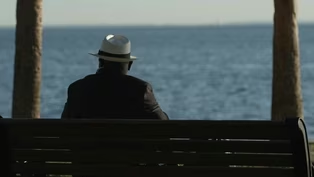
Preview: S2021 Ep10 | 29s | On the next Up Close, we talk with Al Nixon of St. Pete to hear his inspirational story. (29s)
Providing Support for PBS.org
Learn Moreabout PBS online sponsorship












Support for PBS provided by:
Up Close With Cathy Unruh is a local public television program presented by WEDU