Compass
November 2021 Edition
Season 5 Episode 14 | 26m 46sVideo has Closed Captions
A story from The Guardian about the AFA and a look at Rebuilding Together Minnesota.
The November edition of Compass features a story produced by The Guardian about the Asatru Folk Assembly and a look at an organization that helps people age safely at home.
Problems playing video? | Closed Captioning Feedback
Problems playing video? | Closed Captioning Feedback
Compass is a local public television program presented by Pioneer PBS
Compass
November 2021 Edition
Season 5 Episode 14 | 26m 46sVideo has Closed Captions
The November edition of Compass features a story produced by The Guardian about the Asatru Folk Assembly and a look at an organization that helps people age safely at home.
Problems playing video? | Closed Captioning Feedback
How to Watch Compass
Compass is available to stream on pbs.org and the free PBS App, available on iPhone, Apple TV, Android TV, Android smartphones, Amazon Fire TV, Amazon Fire Tablet, Roku, Samsung Smart TV, and Vizio.
Minnesota’s Alt-Meat Revolution
“Minnesota’s Alt-Meat Revolution" is a year-long video and print journalism collaboration project, looking into the roots and impact of the plant-protein phenomenon that’s exploding across the globe.Providing Support for PBS.org
Learn Moreabout PBS online sponsorship(light electronic music) - Funding for Compass is provided in part by...
The Otto Bremer Trust, The McKnight Foundation, and members of Pioneer PBS.
Thank you.
(light piano music) Good evening and welcome to the November edition of Compass, the regional public affairs show on Pioneer PBS.
I'm Amanda Anderson, and it's great to have you here.
First up, for the past year, Compass has been following the Asatru Focus Assembly and their move into Murdock, Minnesota.
The Asatru Focus Assembly which only accepts white people as members, is an exclusive offshoot of the heathen religion Asatru, which doesn't have a race requirement to their membership.
In October, The Guardian published a story about the organization using some footage from Compass's reporting.
The Guardian explored this whites-only group and distinguished between inclusive and exclusive Heathen and Asatru organizations.
- I want this to be a place that brings spiritual connection.
- [Amudalat] This may look like an average religious gathering, but this is no ordinary church service.
This is the Asatru Folk Assembly, known simply as the AFA, a fringe, heathen group that mandates their members have Northern European heritage, a whites-only church in 21st century America.
They represent a disturbing trend in contemporary white nationalism, the co-opting of heathen symbols and myths, to promote racial purity and fears of a white genocide.
- We must secure the existence of our people and a future for white children.
- [Amudalat] I'm on a journey to understand how this group is gaining influence across the country.
- So, the requirements to be part of the Asatru Folk Assembly, you do have to be of native European descent.
- You know, and they say they're good people.
So, I'm gonna take their word for it.
- [Amudalat] And to meet the anti-racist heathens who are fighting to reclaim their religion from extremists.
- I'm doing everything that I can do, that shows their evil deeds that they do behind those doors.
- The vast majority are white men who are fragile, weak, and need a sense of purpose.
And they find that in the fact that they say they can celebrate their whiteness.
It's foul.
It's disgusting.
(mellow orchestral music) (upbeat acoustic music) - [Amudalat] Murdock, Minnesota is a rural town with a population of less than 300.
It's predominantly white, but there is a small Latino population that lives in the surrounding area.
It was here that in 2020, the AFA attempted to purchase an abandoned Lutheran church as a temple for their group.
The city council held a meeting to let representatives make their case.
- A hundred thousand years from now, we'll want there to be blonde hair and blue eyes.
It's like any other tradition, I want to preserve.
And it's worthy to be preserved, our own heritage and our own people are worthy of preservation.
- [Amudalat] In the end, the council and a three to one vote, granted them a provisional use permit.
This is now the group's third temple.
The council was warned that blocking the acquisition would violate the AFA's First Amendment right to freedom of religion.
Pat Thorston was one of the members that granted the permit.
- And they have every legal right to... buy the building.
You know, and they say they're good people.
So, I'm gonna take their word for it.
- But what about the uncomfortability that people of color now have in this community because of this church that is excluding them-- - Well.
- based off of their color.
- One of the members that, when we had the public hearing, was saying like, if a colored person or... Comes to their church, they would just...
Play that you say, you know, while we really... Aren't welcome or however they put it, you know, it was not of any violence.
So, if that's what they are, well, then be it.
- And you said that they haven't done anything wrong, but isn't the act of creating a whites-only church in America where race has been such a tension-- - Oh yeah, I mean, with all the crap going on around this country, in the world, you know, I'm not for it.
But I'm not going to create any havoc for them.
You know?
I mean, I don't want them coming up against us if something does go wrong, you know?
- After the vote, Pat received calls from people upset with his decision.
And you said that people have called and called you a white supremacist-- - Yes.
And I called him back, and he said, F you, F you.
How did this person get my number?
A guy from California.
Bizarre.
(laughs) - You were more worried about them having your number, then the fact that they were calling you like a white supremacist.
- Do I look like a white supremacist to you?
- I don't really know what a white supremacists looks like-- - Neither do I.
(laughs) - I don't know if it's a particular look, yeah.
- That's exactly that, you know.
- [Amudalat] By exploiting their religious status under the First Amendment, the AFA is given the same protections as any other religious group in America.
For those living nearby, especially people of color, this sent a disturbing message.
Christian and Catheryn Duruji live a few miles away from the church.
- Hey, come on in.
- Thank you for having me.
- Yes!
- If it was a bunch of people that came in and said, hey, we're satanists, and we're going to be worshiping Satan.
There would be all kinds of outcry and uproar.
And I think these people that come in and they say, you know, hey, whites only, we hate interracial, you know, interracial things shouldn't fly.
And it's kind of like, you know, you had some people protest, but at the end of the day, you know, they're there.
The fact that that sort of racism isn't looked at the way that it should, like this cancer that can kill.
This isn't a, we just want to worship in peace.
I mean, it's an ideology.
- Do you have any fears about your daughter growing up in this area?
- I guess, in general, I always have some fears.
We might be sending her to the Murdock Grade School in a few years, you know?
So it's just...
It's uncomfortable to have them in town.
I do feel like it's a little bit of a threat to the safety of black and brown people that live in Murdock.
I feel like it's a threat to their safety.
- [Amudalat] In the months since the church's opening, hundreds of members have traveled from across the country to assemble here.
They host monthly services where small groups called kindreds worship together and celebrate their European heritage.
Despite their whites-only policy during ceremonies, they did allow me to go inside to see the church.
- So, this is our main sanctuary.
- The church uses folkish imagery and myths from a bygone Viking era to romanticize white European heritage and the importance of its preservation.
For them, that preservation involves the exclusion of people that look like me.
On any given Sunday, I couldn't just come in and try to become a member.
- No, you wouldn't be able to come in and just join.
There is a membership process that is required in order to be part of the assembly.
So, the requirements to be part of the Asatru Folk Assembly, you do have to be of native European descent, because we are considered a folk religion.
A lot of people will call us white supremacists, which is not true.
A lot of people will call us racist, we're not racist.
We're not out here trying to take over anything.
We're here to gather together to call our brothers and sisters who are called to this religion.
We want them to have a place to go where they can do those things and they can save those traditions and save that culture.
- Do you think with this emphasis on race and white heritage, that it attracts people that believe in white supremacy and practice those ideals to this church then?
- This church is not a political movement.
It is a church.
You know, we focus on honoring our gods.
Are we doing anything that would be considered white supremacy?
No, I mean, I guess I don't...
I don't know why people would be coming to a church for politics.
- [Amudalat] But that clearly clashes with the vision of the original founder, Stephen McNallen, who has consistently drawn on white nationalist rhetoric since the group's founding in 1994.
- I will defend my race.
I will fight for my race, primarily with words and ideas, but I will fight more literally if I have to.
The existence of my people is not negotiable.
- This explicitly political messaging was co-opted by white nationalists in Charlottesville, where shields covered in Norse symbology were displayed.
- Something that unites us all, is that we believe that white heritage and white culture is something that's vastly important and worth fighting for.
- And by Jake Angeli, otherwise known as the QAnon Shaman, a capital insurrectionist.
In 2017, Matthew Flavel took over as the group's national leader.
He claims that members of the AFA weren't at the Charlottesville rally.
But I was curious to hear his thoughts about heathen symbols being used there.
When you saw the pictures of people waving Asatru symbols in Charlottesville, other groups have denounced that in this group.
- Well, I don't denounce that.
I'm not in the denouncing business.
I think that was a very complicated situation.
There's a lot of things going on there, but we encourage members of our faith to participate in legal and appropriate ways however they'd like in the political process.
- Would you consider what happened in Charlottesville to be a white supremacist rally?
- No, I would not.
- What would you call it?
- I'm not sure, I think I would call it a...
Peaceful protest rally.
- It was disturbing to hear someone speak so positively about a rally where white supremacists chanted racist slogans and a counter protestor was killed.
(yelling foreign language) To combat the AFA's messaging, a collective of local protesters formed the Murdock Area Alliance Against Hate.
Victoria Guillemard is one of its co-founders.
Do you think the people of Murdock came together to oppose this church?
Do you think it was a general connecting point?
- No, I think it fractured Murdock.
There are definitely people who silently oppose it.
I think the vast majority of Murdock would never have anything to do with it, but they did not like that they had to be held accountable for their silence on these issues.
Murdock didn't suddenly become racist because the Asatru Folk Assembly arrived.
There have been systems of oppression and racism that have not been called out for many generations in Murdock.
This was a wound that is now festering, but it's always been there.
- Do you feel unsafe being in Murdock?
- Yes, absolutely.
They're a group that has connections to the KKK, they're a group that has connections to really violent, white supremacist groups.
Their ideology is very tantalizing to those who are impoverished, those who feel like they've suffered, and those who feel like they don't have a place.
It preys on our natural instinct to want to feel special.
(upbeat acoustic music) - But there is another very different side to the heathen faith.
I've come to the Annual Asatru Festival in Indiana, a place where those who oppose the extremism of the AFA come to celebrate the heathen religion.
They worship the same Nordic gods, but this is an inclusive and anti-racist event where people of color and members of the LGBTQ community are encouraged to join.
(horn bellowing) That's prime.
- Thor's hammer, actually, if you would think about it, it's pronounced tour, not Thor.
- I've come to meet a man named Topher, in his day job, He's an HR manager at Kroger's, but here, he's a major figure in American heathenry.
You must be Topher.
- I am Topher.
- I'm Amudalat.
- Hi, Amudalat, very nice to meet you.
I'm the President of The Asatru Community.
We are a worldwide, Asatru group that is completely inclusive.
We allow anyone into our group.
We have over 5,000 members worldwide, and these are like a list of things that we try to live by, things such as kith and kin, frith, truth, honor, knowledge, diligence, independence, and fortitude, all things that we strive to work to be better for.
- A few weeks before, Topher and members of his kindred went to Murdock to directly protest the AFA outside the church.
- We are asking the community of Murdock to stand up against racism.
Do not allow this church to be defiled by the AFA.
- Do you think people connect your form of Asatru religion to the Asatru Folk Assembly?
- Unfortunately, we do get lumped in with them often.
And one of the reasons is we use a lot of the same symbology.
I mean, it's technically the same religion, except for they're picking little things out that they believe says that you have to be Caucasian Northern European descent.
There's nothing in any of our literature that says that that's how it should be.
- Do you think that there's a sort of battle for what the real Asatru religion is?
- Absolutely, believe there is.
And our group is the largest heathen group organization in the United States, but we all know it's not always the biggest group that wins out.
I'm doing everything that I can to make sure that we do win that battle.
And we do shine that light on them which they don't want to have shined on them, that shows their evil deeds that they do behind those doors.
- Topher and his wife were preparing for an important ceremony.
he was transitioning from a warrior to a sage, one of the most significant positions in heathenry.
- So, I'm going to get ready for... And get ready and put this on, and get myself all prettied up and ready for the bloat.
- Can you put it up?
- Yeah, can you put it like, up... Like do the top up.
- Hello, everybody.
- [Member] Hello.
(leader speaking foreign language) - [Member] Heil!
- [Crowd] Heil!
- After my experience in Murdock, I didn't know what to expect from this group of heathens.
I was concerned that because the religion is so connected to European ancestry, I would continue to feel excluded, but this gathering felt very different.
Topher's group didn't obsess over heritage.
This was more about community, ritual, and connecting with the past.
Why I'm not a part of the Asatru religion, thank you for allowing us to be a part of this and a part of your saging, and to really allow people to see what the Asatru can really be about.
Heil Topher.
- [Crowd] Heil Topher.
- Topher.
- [Topher] Yes.
- When you are ready, open your eyes and see the world as a sage.
- I see the world again for the first time, and I see many points of light that I will touch.
Heil to you, that come here for me.
Heil to the gods.
Thank you all.
(crowd clapping) I need more mead.
(Topher laughing) - One of our overarching questions with this film is whether or not you can celebrate your heritage without being exclusionary and racist.
Do you think that's possible?
- Absolutely.
I'm not a full-blooded Norse, you know?
I'm more British and Celtic than I am anything else, but...
It just would make no sense to me at all, to tell somebody that they couldn't worship with me.
I want to stop them.
This is their third temple that they're building.
And I don't want to see hate continue to spread in the United States.
I want to be part of, not to sound cheesy, but I want to be part of the solution, not the problem, you know?
So, I think we can win.
(crickets chirping) - A special thanks to Tom Silverstone from The Guardian for reaching out to Compass and for letting us broadcast this story.
You can find it on The Guardian's YouTube page and we've also shared a link to the story on our own Facebook page.
Next, Rebuilding Together Minnesota recently opened an office in Southwest Minnesota in Wyndham.
The organization specializes in helping people live and age safely in their homes by making home modifications at no cost to the homeowner.
We recently visited one home in Wyndham that was receiving some shower modifications as part of Rebuilding Together's Safe at Home Program.
- [Judy] Ooh, they look nice!
Way to go!
- And I was just showing them... - Ooh, look at that.
- I weigh a lot.
I'm not gonna say-- - [Judy] More than me?
(all laughing) They would easily support me.
- Oh, nice.
Oh, thank you.
Thank you, thank you.
- [Amanda] Judy Mutts is 73 and has operated daycare out of her home for 25 years.
- There's always kids out there looking for daycare, looking for daycare.
You know, moms can't get a job because there's no daycare.
- [Amanda] I guess you said you're retiring in a couple years, but will this... Having this here help you stay open longer?
- Oh, it could very well, you know, less chance of an accident.
- [Amanda] On the day we visited, some kids were eating breakfast, some were waiting for the school bus to pick them up, and Galen Kauffman and Steve Fresk from Rebuilding Together Minnesota, were installing safer grab bars in her shower.
- This is what we love to replace.
They were a nice idea, but they're not safe.
- [Amanda] This is part of the Safe at Home Program where Rebuilding Together staff and volunteers help with things like putting in handrails up and down stairs and installing ramps, all at no cost to the homeowner.
- A lot of it is really quite simple stuff and it's nothing big, but if we can prevent a fall, that is very big.
If we can keep someone in their home for another, even if it's only one or two years, those are one or two really good years.
- [Amanda] A report by the Minnesota Housing Partnership found that 57% of single-family homes in the Southwest Minnesota region were built before 1970, the highest percentage in the state.
Jennifer Ho, the Commissioner of Minnesota Housing, said that there have been struggles with high lumber costs and contractor and builder availability in rural areas.
- In our work with the legislature, we have some programs that really are targeted to greater Minnesota, smaller places.
The question of more is a persistent question and everything that we face in housing, we need more housing, we need a lot more housing.
I...
But how is it that we put together kind of agency capacity plus investment tools that make sense on a scale for cities large and small?
I think that's a real challenge.
- [Amanda] Ho said that home is personal.
She said that studies have shown that people want to age in their homes and at least in their communities.
And so having a single floor home, isn't always people's first concern.
- And so figuring out how do we create affordable options that are attractive to, you know, a generation of folks that's gonna live healthier.
They're gonna live longer and... You know, they're gonna want to exercise a lot of choice.
And so, I think it's really important to be responsive to what people say they want.
- [Amanda] Originally called Rebuilding Together Twin Cities, the organization is expanding.
They've partnered with the city of Wyndham, where Judy Mutts lives, and opened an office there.
Galen Kauffman is the program manager working out of that office, which serves Cottonwood, Jackson, and Nobles counties.
A housing study done in 2014 identified the need for single family and multifamily homes and residential rehab in Wyndham.
Rebuilding Together isn't in the business of building homes, but Drew Hagge said this partnership is meant to be part of a greater effort to address housing challenges.
- Our goal for Rebuilding Together would be a long-term, stable source of getting residential rehab done for income-qualifying individuals.
- The main thing is we work with folks who already own a home.
We're working on owner-occupied housing.
And then we're looking at low-income.
So, our guideline is 50% of area median income.
- [Amanda] And then they prioritize homes with children, homes with people over the age of 55, homes that have someone living with a disability, or have someone who has served or is serving in the Armed Forces.
Kathy Greiner is the Executive Director of Rebuilding Together Minnesota.
- Our mission is repairing homes, revitalizing communities, and rebuilding lives.
Also, for the homes of seniors, we look in their home and we look to see and correct the things that would might cause them to fall.
So, our main mission is we want to keep them in that home that they already own as a stable part of the community so that they can age in place for years to come.
- [Amanda] Rebuilding Together relies on volunteers of various levels to complete projects ranging from minor home accessibility enhancements, like installing ramps and shower grab bars, to landscaping.
- And this is the beauty.
It's like people helping people, older, retired people, helping older people.
- I'm one of the volunteers here.
So, what I'm doing is I'm installing grab bars for Judy, Put in two 24... 18-inch ones on the ends and a 24 one at an angle here so that she can be secure when she gets into the shower.
- [Amanda] All of these projects are free to the homeowner.
Rebuilding Together gets a combination of funding from private and public organizations, including from Minnesota Housing, the Department of Human Services, the Southwest Initiative Foundation, and other private and individual funders.
- So there, so that's the finished product.
So, now our homeowner has got good, solid...
I weigh almost 300 pounds and I'm not even moving things here.
- [Amanda] In addition to the Safe at Home installations, Rebuilding Together also facilitates larger projects like roofing.
- Those projects, we subcontract out, we love our volunteers.
We love them too much to put them on a roof.
We also have to subcontract out some specialty things like electrical work, plumbing work.
We are a licensed contractor in Minnesota, but not for plumbing or electrical.
- [Amanda] Minnesota Housing Commissioner, Jennifer Ho, said that in addition to programs like Rebuilding Together, being open to new building technologies and looking into city zoning laws that would allow for things like accessory dwelling units, for example, can help address these housing challenges.
- I mean, even in my lifetime, you know, what housing looks like has changed enormously.
We have smaller households and we have bigger homes.
I mean, so that kind of conceptualization of what we need, what we can afford, and trying to get that to line up with what we want.
I think that that's a, you know, something worth putting some energy into.
- [Amanda] This housing story was made in partnership with the Minnesota River Area Agency on Aging.
Over the past few months, we've been broadcasting and sharing stories about people and programs in Southwest, Minnesota, and throughout the state designed to help people age with dignity.
You can watch all of the stories in the series online at pioneer.org/compass/agingwell.
And that concludes the November edition of Compass.
Thanks to all who watch here and online.
Please head over to our social pages and website and interact with us.
And a heads up, the December edition of Compass will air on December 9th on Pioneer PBS.
See you then!
- Funding for Compass is provided in part by the Otto Bremer Trust, the McKnight Foundation, and members of Pioneer PBS.
Thank you.
(upbeat music)
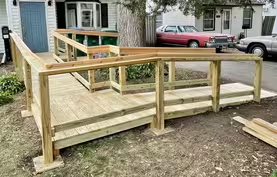
Aging with dignity: Rebuilding Together Minnesota
Clip: S5 Ep14 | 7m 2s | Repairing homes, revitalizing communities, rebuilding lives. To help people age safely in (7m 2s)
Video has Closed Captions
Clip: S5 Ep14 | 6m 1s | Pioneer PBS recently hosted an event to provide resources for rural caregivers. (6m 1s)
Preview: S5 Ep14 | 30s | Watch the November 2021 Edition on Nov. 11 at 9 p.m. on Pioneer PBS or the PBS Video App! (30s)
Providing Support for PBS.org
Learn Moreabout PBS online sponsorship
- News and Public Affairs

Top journalists deliver compelling original analysis of the hour's headlines.

- News and Public Affairs

FRONTLINE is investigative journalism that questions, explains and changes our world.












Support for PBS provided by:
Compass is a local public television program presented by Pioneer PBS