
November 2021: Tampa Bay Pro Sports Impact On Economics
Season 7 Episode 1 | 26m 46sVideo has Closed Captions
Exploring impacts of the recent success of Tampa Bay area sports teams.
Exploring the connections, if any, between the recent success of Tampa Bay area sports franchises and the economics of our region.
Problems playing video? | Closed Captioning Feedback
Problems playing video? | Closed Captioning Feedback
That's All I'm Saying is a local public television program presented by WEDU
November 2021: Tampa Bay Pro Sports Impact On Economics
Season 7 Episode 1 | 26m 46sVideo has Closed Captions
Exploring the connections, if any, between the recent success of Tampa Bay area sports franchises and the economics of our region.
Problems playing video? | Closed Captioning Feedback
How to Watch That's All I'm Saying
That's All I'm Saying is available to stream on pbs.org and the free PBS App, available on iPhone, Apple TV, Android TV, Android smartphones, Amazon Fire TV, Amazon Fire Tablet, Roku, Samsung Smart TV, and Vizio.
Providing Support for PBS.org
Learn Moreabout PBS online sponsorship- [Narrator] This is a production of WEDU PBS, Tampa St. Petersburg, Sarasota.
(upbeat music) Premiere Eye Care is a leader in National Managed Eye Care with 4 million insured members nationwide through its network of optometrists, ophthalmologists, and specialists, recognized for best practices and delivery of care, associate engagement and commitment to the community.
Premier Eye Care is proud to support That's all I'm saying with Ernest Hooper.
For more information, go to PremierEyeCare.net.
(upbeat music) - Our motivation every day, is the people around us in this community and making better.
- [Speaker] Workforce development, healthcare, education.
- [Panelist] Getting out there and making a difference in the lives of that need it the most.
(cheerful music) (train passes) - Hi, I'm Ernest Hooper and we're here at Amalie Arena, one of the epicenters of an incredible sports renaissance taking place in our area.
In the last 14 months, we've watched Tampa Bay transform into Champa Bay.
The Tampa Bay Lightning entered the season as the two-time defending Stanley Cup champions.
The Tampa Bay Rays have won consecutive AL East titles and the Tampa Bay Buccaneers are looking for a repeat performance after winning it all last season.
Boat parades have become vogue, and there's a palpable buzz about our sports franchises every day.
But as championship success led to championship dollars for our local businesses, has winning on the field, translated into winning off the field for our economy.
On this episode of That's all I'm saying, we'll ask a panel of experts, those questions.
And we'll talk to a man who works every day to bring major sports events to Tampa Bay.
But first let's go inside the Arena and talk to someone who's all too familiar with the success of the Lightning and the burgeoning mini city arising around the Arena that we call, Water Street.
(upbeat music) I'm here with Lightning president and CEO, Steve Griggs, and Steve, the Lightning or the two-time defending Stanley Cup champions, they entered this season as a favorite again and meanwhile, Water Street is blossoming into a mini city.
Does it get any better than this for you?
- Well, I think Mark Twain once said it's the best of times it's the worst of times and you know, on the best of times you win two Stanley Cups over the last 290 days, we won two cups, galvanized the community, and then obviously Water Street's been been growing all around us over the, you know, the last 18 months when you think about the pandemic.
But, with the pandemic, you know, the first Stanley cup, we watched it from our couches, but we were with our families and then the second ones gradually we're getting there with more fans in the building.
And finally when we won the Stanley Cup here in front of all our fans in July that was the best of times.
So, you know, it's really changed and and we've seen a lot of change with Water Street over the last 18 months and we've been able to watch it grow around us and there's more to come and now people are moving into the Heron, JW is coming together, with more and more occupants in sea.
So it's really been fun to watch.
- Do you allow yourself at all to think about what winning back to back Stanley Cups would have been like, without the pandemic?
- Well, It's not just the Stanley Cup wins for the hockey team.
It was also all the other events we have in Amalie Arena.
So we've missed out on almost two years of, you know, family shows, concerts, you know, with the hockey as well.
So, yeah we we we miss all those people gathering with us.
Obviously there's some economic shortfalls, sports and entertainment has been devastated through this pandemic, but you know, we've endured through it and we see a light at the end of the tunnel.
- When Jeff first came here he began to develop the vision for what eventually would become Water Street.
Is it fair for me to say Water Street doesn't come about, if the Lightning doesn't attract Jeff Vinik to Tampa Bay?
- Well, he came to Tampa and he saw an opportunity.
This is a great place to live, it's a great place to work, and he had other places that he could have looked at and he chose Tampa.
And then what were the Arena was, you were able to see this huge 50 acre footprint of opportunity and you know, I think the attractors were here before, when you think about the Convention Center, the Aquarium, the history center and the Arena, there was the attractors here but people were just coming into them, visiting and leaving.
And now, you know, the cliche is live, work, play you know, people come, they live downtown, they can live in the Heron, they can live in the new residents, they're going to open up in a couple of months here, stay at the new JW or the Marriott, and then, you know, all the different retail and hospitality opportunities that are going to be throughout the district, including Sparkman Wharf.
That's what he saw for the future, and obviously working with Bill Gates and SPP has been able to, we've been able to really, you know, develop 50 acres fast, you know, with the first phase almost being completed.
- How much did it help for the Lightning to turn things around and begin enjoying success and begin selling out games?
Was that a factor in creating the energy behind Water Street?
- Well, I mean, you know, when we were here in 2010, there wasn't a lot of energy around the Lightning team.
We transformed not only the building, Jeff put a lot of money into the building.
We created an, really a community center here in downtown Tampa.
The team started to get really good on the ice and therefore you had this galvanized brand in this community, that allowed us to then look at doing other things in the community i.e not only Water Street, but when you look at where we were up at USF running the Yuengling center there.
So all these different opportunities come because yeah, the team was starting to play well, but really from a business perspective, we had really pushed the brand forward, done all the great things in the community and really entrenched ourself as a big community partner here in downtown Tampa.
- So you see that philanthropic piece and the, like the Lightning community hero program, where you give $50,000 to a community hero every game, you see that as a key part in all of this success that you're enjoying now?
- There's so many pieces of what Jeff and Penny have done in this community from Boys & Girls clubs, to Metropolitan Ministries, to feeding Tampa Bay, to the arts.
But the staple really has been the community hero, and I think if you go back to 2010, when it was dreamed up, it was like, how do you bring people into the building, whether we win or lose.
We're honoring somebody who's doing God's work in this community and, you know, we're up to 452 community heroes now, north of $23 million dollars in grants giving out and there's another 10 million coming.
So with that, you know, that's a lot of money being infused in the community, but more importantly, I think people are coming to games and they're seeing these heroes and seeing what they're doing in the community and they're saying, okay, how do I step in and become a better human, better community partner in this community?
And I think it's really resonated in this community, where you see a lot of people really stepping up these days.
- There remain needs in the community.
Transportation, infrastructure, affordable and workforce housing.
Do you feel like the presence of a sports franchise and its success can create a rising tide that lifts up the entire community?
- Well, first and foremost, we're engaged in those important discussions as well, with all for transportation, you know, micro transportation, working with the Mayor on that, as well as affordable housing.
So we're involved in all of those initiatives as well.
But when you look at a sports team, you know, really when I look at the last 18 months to, how do you unite people?
How do you bring people together?
Is, you know, Amalie Arena is like a community center, not just for hockey, but for all the other events we have in this building.
And so it's a uniter and it helps galvanize a community, helps lift the community, you know, with the Bucks winning the Super Bowl, and there, they have a boat parade, all these things make this community feel really, really good and then it allows you to go out and push new initiatives.
- So you make a connection between that feel good spirit and the economic infusion as needed to help with these different issues.
- You know, if they see us leaning forward as the Lightning organization or Jeff Vinik's organization, other people who are feeling really, really good about our organization, know, it's probably the right thing to be involved in and so for us, Jeff always says, always do the right thing and that's what we always do and you know, it's not just Jeff and myself, it's our entire leadership team that's involved in all of these different community initiatives around the Tampa region.
- All right.
Well, thanks Steve, for being with us today on That's all I'm saying, I know you're busy, so I really appreciate it and good luck - Go bolts.
(calm music) - Rob Higgins, executive director of the Tampa Bay sports commission.
Thanks so much for being here with us and I want to start by talking about the latest major events that Tampa bay has hosted.
You had the Super Bowl in January of 2021, you had Wrestle Mania in April of 2021, but you had to help the city host these events and deal with the pandemic at the same time.
How much of a challenge was that?
- Certainly there were challenges, but more so than anything, it was an opportunity.
It was an opportunity to become the very first community to host both of those events in the same year, and you think about the magnitude of, of hosting a Super Bowl and then the magnitude of hosting a Wrestle Mania, both of those are world-class events that any city in the world would love the opportunity to host, but to think that we had them back to back really when we needed it, the most is really, was critical to being a part of our community's recovery.
- Why do you believe so strongly that hosting major sports events is a boost in the arm for the entire community?
- First, it's the economic impact, the tourism spending that takes place and it's not just the major events which we have been just on a great run with and getting an opportunity to host one or two of those, year, it's the, you know, a hundred to 120 youth and amateur events that we bid on and work to host really on an every weekend type of basis.
Then there's the social impact that takes place when you host these events.
I mean, the college football playoff National championship back in 2017 generated a million dollar infusion into the local education system and it went so well, in 2018, the college football playoff foundation donated another $200,000 to our local education system.
For Super Bowl, we had Forever 55, our social legacy initiative, which focused on six different really critical pillars that helped it.
We were able to help touch a lot of different lives.
That was a 2 million dollar investment into our local communities.
Third, is the marketing visibility.
When you get a chance to be on the world's biggest stages, tell your community's story.
- What's your response to economists who say that numbers are exaggerated or the impact isn't as great as we're led to believe?
- Well, we really focus on the tangible factors that we are able to determine what the true ROI for an event is, and it's things like hotel visitor room nights, or you look at the airline passenger traffic.
You're able to really look at that and compare it to other events, you can compare it to similar times of the year, you know, during the pandemic, the hotel revenue for a three-day weekend was between ... - Falling dramatically - Yeah falling dramatically.
It was between 6 and 7 million dollars.
For Super Bowl weekend, it was 31 million dollars.
So you look at a 25 million dollar incremental increase in hotel revenue.
That's, those are actual dollars.
We want to know what actually happens so that we can understand what the events do, how the ROI is for the community and that's what our focus has been and will continue to be.
- Rob Higgins, executive director to the Tampa Bay sports commission.
Thanks so much for being here with us today.
I know you only sleep about four or five hours a day, so I'm really thrilled that you took out time to be with us.
Coming up next, we'll delve further into the relationship between sports and business with a very special panel.
And we'll talk more about the possibility of the Tampa Bay Rays splitting their season between Montreal and Tampa Bay.
(calm music) Tampa Bay's three professional sports teams are certainly a source of community pride.
Who doesn't enjoy cheering on their home team, especially, when they bring home big time championships, but do pro sports teams really make cities economic winners?
Let's separate truth from hype with our very special panel.
Joining me now are, Dr. Michael Mondello a professor at the university of South Florida, School of Marketing & Innovation.
Louis Llovio and editor from the Business Observer, and Lakendria Robinson, a consultant and the director of Business Connect and Community Outreach for this year's Super Bowl 55 Host Committee.
Thanks for being here panel, glad to have you.
Louis, let's start with you kind of set the table for us and share your perspective.
Do you think hosting these major events and the success of our sports franchises has translated to more business and economic success?
- Well, Ernest, first of all, thanks for having me.
I appreciate it.
That is a really complicated question.
It seems easy on its face, but the fact of the matter is, is that sports in what it generates is not always as simple as an economic impact study will show.
For example, if you know, you'll see studies that show that a certain event brings in a hundred million dollars, but the truth of the matter is in a lot of cases, that's not really what happens.
So, local businesses, a T-shirt shop when the the Bucks do well, they do great, the restaurant near a stadium, it does fantastic as well.
But what happens is, the money that is spent at the restaurant, let's say, you know, near, near Tampa state or near Raymond James, that's money, that would have been somewhat spent somewhere else in the community.
So it's not really new economic impact money.
So the restaurant that does well near Raymond James, yeah, it sees an impact, but it locked at the restaurant in countryside where the person that drove to the stadium lives doesn't see that they lose that money.
So that same $200 that you would have spent in countryside is now being spent in Tampa.
So it does, yes, it does generate a little bit of money for one location, but it hurts in other places as well.
- Okay.
I appreciate that.
Look, Andrea, you kind of been on the inside, what's your perspective on the impact of major sports events?
- Yeah, absolutely.
And thanks again for having us here, you know, with my role with the throughout 65 host committee, I've gotten the chance to really see how these large events, these major sporting events and activities that come into our community, how they do have a positive impact on the community, whether it be from the hospitality side or from the local business side, and so one of the things that I was able to do in my role was really engage and intentionally engage, local diverse businesses, minority, and woman, and veterans, LGBTQ owned businesses in the buying and the procurement process.
And so as these metric, that's coming to our city and even when our sports teams are doing well, there is an opportunity for those events and for those sports teams to really engage the local business community, to help fuel their local economy, to help fuel their business and so through the host committee, we were able to see and prove just that.
- So moving forward, do you think these woman owned and minority owned businesses that were involved in the super bowl will continue to enjoy success?
- I think so, you know, it's one thing for the event or for a large sporting event to come to our community.
But it's another thing for that event to come to our community and local businesses benefit from that, you know, it's a great resume builder.
It really is a wonderful opportunity for these local businesses to perform at an even higher level that they're performing to really get mentorship and one-on-one training from really great professionals that produce these amazingly events on a large scale.
And so it really is this continuous impact for local diverse businesses When major events and sporting events are hosted here because they receive so many benefits outside of those that are financial.
- So Dr. Mondello, Lewis described sort of a shifting of dollars and not necessarily generating more dollars, Lekendria has seen on the other hand, some tangible benefits.
What does the data tell us from your research perspective?
- So again, thank you for the invite.
I'm happy to be here.
I think Lois hit it really on the head.
I think it's, it's a really complex question that is not easily answered.
You can put 20 economists in a room and they don't agree with anything.
And the one thing that there does seem to be some consensus in that, you know, sporting advance, big time, sporting events, mega events, they do certainly bring attention to a community.
I think what you see is some of the economic benefits.
It really depends on the data that you use as your input and what you're going to get on the output.
I think I'm somewhere in the middle.
I believe they do have an impact.
I do challenge some of the reports that I see that are done by stakeholders who have a, specific message to try to send, but to say there's no impact, I think is a little bit naive.
I think one thing to think about which I've done some research to try to capture is what's the non-financial benefits, right?
And so those are tough to quantify, but I think they certainly exist as our other guests mentioned.
She has certainly seen tangible benefits.
It's always hard to say Ernest that there's a cause and effect, right?
Because there's other things that are happening in the community at the same time that model the data a little bit.
So it's hard to say X cause Y but certainly I think, you know, having big events for Tampa and the community can have quite a few benefits beyond just the financial ones.
- Well, Dr. Mondello, that's going to be such an important question, when we continue these discussions about the Tampa Bay Rays.
There's a possibility that a new stadium will be built for the Rays in Ybor city.
There's going to be great debate.
Let me start with you.
Is that a wise move for our municipalities and our region, or should we be more concerned with some other issues?
- Yeah, that's a great question, right?
Because anytime these public financing questions come up, there's always that question of opportunity costs.
Meaning what project are we not going to fund if we decide to fund a stadium?
So I think the rays are smart in what they're trying to do.
I think the fact that there has been some recent talk of relocating, a new stadium to Ybor city, úmakes the the most sense.
You know, I think each city has to make a decision, is that the best investment to, for their tax dollars or public monies?
And I think at some point there has to be some agreement that's both public and private dollars that benefits all parties involved.
I do think the stadiums that are publicly financed that are used for multiple events throughout the year, where many people in the community can enjoy a benefit.
Those types of situations, I think make more financial sense than stadiums that are publicly financed that sit empty for 340 days a year.
Right?
So I think each city has to make that decision.
I do think if the rays were to go to Ybor, their attendance situation would improve, and again, if they make it a multi-use facility where more people can get access to use the building, I think that's the good way to start the message.
- And our last minute, let me get Lekendria and Louis, both of you to weigh in on the race situation, Louis, what do you think?
- Well, first of all, I think the sister city plan is, is a good plan, but I think it's dead on arrival.
You have, you have two issues.
Number one is the rays have already tried three times to build a new stadium and have failed.
The attendance issues, even with the winning team have not improved at all.
In fact, maybe you've gotten those worse.
And then the third part is Montreal is the same, the same reasons that Montreal lost their baseball team in the first place, those issues have not changed.
There's still not support for public money.
There's still not support for a site.
And there's no guarantee that the fans will come out there either.
So I think the focus needs to be on building a stadium here in Tampa, or, to be a spoil sport, the team may have to look elsewhere if they want to succeed.
- Look, Andrea, just real quick, what do we lose if the rays end up leaving Tampa bay?
- You know, I think we lose the engagement of our local business community, and to Michael's point, if you know, the Rays does go to stadium in Ybor city, and it is simply a stadium that sits empty for half the season, I think that could be detrimental.
Having a multi-use facility that can really re-energize and engage our local community and give opportunities for businesses and our community to grow, I think it's probably going to be the best win-win for everybody.
- All right.
Thanks so much panel.
I really appreciate it.
Louis Llovio from the Business Observer, Lekendria Robinson and University of South Florida professor Michael Mondello.
Thank you all three for being here with us, and coming up, I'll have some closing thoughts.
(calm music) Championships success can inspire an enchanting euphoria, strangers hugging strangers, people filling the river walk on a Workday in even a future hall of fame quarterback throwing the Vince Lombardi trophy from one boat to another.
As a former sports writer and a lifelong sports fan, I love the excitement winning teams can generate, the bucs, Lightning and Rays half transformed Tampa bay into champa bay.
And I appreciate the philanthropic efforts of the teams and many of their players, but I also appreciate the success yielded by quality public schools, a well-funded transportation system and a housing stock, that includes plenty of affordable and workforce options.
When the cherries subside, we're still returning to a reality of traffic woes, unprepared kinder gardeners and families living on the edge of economic woes.
I'm not suggesting we have to pit sports against societal needs and make it us versus them.
But I am suggesting we have to Dole out public tax dollars to teams with prudence and work to infuse projects like a new stadium with clear advantages for the greater public.
Let's not get so carried away with that winning euphoria, we ignore our area's daily demands.
Teams succeed with a balanced approach, and so do communities.
I'm Ernest Hooper, That's all I'm saying.
(melodic music) - Premiere Eye Care is a leader in national managed eyecare with 4 million insured members nationwide through its network of optometrists, ophthalmologists and specialists recognized for best practices in delivery of care, associate engagement and commitment to the community.
Premier eyecare is proud to support, That's all I'm saying with Ernest Hooper.
For more information, go to PremierEyeCare.net.
- Our motivation every day is the people around us in this community and making better.
- [Speaker] Workforce development, healthcare, education.
- [Panelist] Getting out there and making a difference in the lives of that need it the most.
(triumph music)
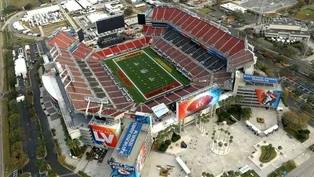
Preview: S7 Ep1 | 30s | Looking at Tampa Bay area pro sports, on the next That's All I'm Saying. (30s)
Providing Support for PBS.org
Learn Moreabout PBS online sponsorship
- News and Public Affairs

Top journalists deliver compelling original analysis of the hour's headlines.

- News and Public Affairs

FRONTLINE is investigative journalism that questions, explains and changes our world.












Support for PBS provided by:
That's All I'm Saying is a local public television program presented by WEDU