
November 2023
Season 8 Episode 2 | 26m 17sVideo has Closed Captions
Learn about the Northern Cheyenne’s connection to Akron plus local cultural museums.
Host Blue Green visits Sam Chestnut of the Lippman School to learn about the Northern Cheyenne and their connection to Akron, Ohio. He then visits the Institute for Human Science and Culture and the Cummings Center for the History of Psychology — both located at The University of Akron.
Problems playing video? | Closed Captioning Feedback
Problems playing video? | Closed Captioning Feedback
Around Akron with Blue Green is a local public television program presented by WNEO
November 2023
Season 8 Episode 2 | 26m 17sVideo has Closed Captions
Host Blue Green visits Sam Chestnut of the Lippman School to learn about the Northern Cheyenne and their connection to Akron, Ohio. He then visits the Institute for Human Science and Culture and the Cummings Center for the History of Psychology — both located at The University of Akron.
Problems playing video? | Closed Captioning Feedback
How to Watch Around Akron with Blue Green
Around Akron with Blue Green is available to stream on pbs.org and the free PBS App, available on iPhone, Apple TV, Android TV, Android smartphones, Amazon Fire TV, Amazon Fire Tablet, Roku, Samsung Smart TV, and Vizio.
Providing Support for PBS.org
Learn Moreabout PBS online sponsorship- Hey, other Akronites, welcome once again to "Around Akron with Blue Green."
And yes, we have an amazing show ahead of us today.
I'm gonna head up to the University of Akron and learn all about curation and what it takes to make an amazing gallery display.
Then I'm gonna head over to the University of Akron to visit the National Museum of Psychology.
And then I'm gonna check out some amazing galleries at the Institute of Human Science and Culture.
Now, to kick this show off today, I'm headed over to the John Brown House to meet up with Sam Chestnut and learn all about the Lippman School and their connection to the Northern Cheyenne.
Let's go see what Sam Chestnut's all about.
- My dad was an amazing guy.
He was an attorney for a small American Indian firm in Seattle, Washington, where I grew up, and he got connected to the Northern Cheyenne in the early to mid '70s, when they were fighting an important legal battle to push coal development off their reservation.
And that's how he initially got connected with 'em.
And actually, that case went to the Supreme Court, that my father argued, overturning other court cases that were supportive of coal development, that US Supreme Court case overturned that and became precedent for the tribe holding onto their mineral rights, which is critical for their cultural expression moving forward.
(soft atmospheric music) Kind of an interesting, I grew up in a Jewish home in Seattle, Washington, and through my father's legal work, we became sort of family friends with the Northern Cheyenne, almost extended family, almost, in that 38 year relationship.
And through that experience, my father and my family, and certainly I, through this work, I've seen all these interesting parallels.
Not that everything's the same, but there's so many cultural traditions that are rooted in ancient traditions and tribal understandings of certainly the Northern Cheyenne people, but even the Jewish people as we go back to the time of wandering through the desert, for instance, and living in a bit of a nomadic lifestyle, and all the traditions connected to the Earth that many Jewish people have actually lost, and the Northern Cheyenne are keeping those, their own traditions connected to the Earth sort of alive in more real ways today.
So using this as sort of a cultural mirror actually allows Jewish people or other people with Earth-based traditions, as we all have, to kind of reconnect and see ourselves in things we've lost in our own traditions that used to root us better and more connected to the Earth.
(rhythmic drumming and chanting) ♪ I've been waiting for far too long ♪ ♪ Waiting for you to come around ♪ ♪ I think I'm done waiting for you ♪ ♪ I know you'll never ♪ Find another mind to tangle (man sings in foreign language) - The event started about, I think it was nine years ago.
It was the eighth walk, but I believe we took a year off.
I lose track a little bit, but the history of the event is actually a friend of mine, Rabbi Lee Moore, who's from Kent, Ohio.
When she was early on involved in the partnership, she said, "You know, there's this path, we should walk it."
Of course, I knew the path, I knew the Portage path, I knew the work of Dave Lieberth, Summit County Historical Society, and Leianne Neff Heppner, who really helped to illuminate that for our community.
But it was only street signs and arrowheads, so it wasn't alive.
It was marked but not alive.
And so Lee encouraged us to think about walking the path.
So the first person I talked to is Dave Lieberth, who would know how to pull something like this off.
So what you see here is really the work of our partnership and the work of Dave Lieberth and the Historical Society and trying to bring something to the community in a big way.
And it's always been big, just in different ways.
What has been bigger about it since the beginning is many more partners have come on board.
I think particularly as, in our country, we're sort of coming to grips with our really terrible past in terms of how we treated native populations.
So I think people are trying to figure out, how do we reconnect with this?
How do we make, you're not gonna make it right, right?
But you're gonna say, you know what?
This history of these people, this history is important.
And even more important, the people today, the contemporary issues of tribal members, keeping their language alive, keeping their traditions alive, this is important work.
So what I'd like to see in the future, I don't know.
I try to follow a path that seems kind of bigger than us all, and certainly, I don't know where this might lead, but I think it'll lead to larger and larger opportunities.
I would hope other communities would use this as an example to do the same work in their own communities and look, what is the native history that they can illuminate and bring to life and partner with tribes who might have some connection to that area.
(rhythmic drumming) (participant shouts) It takes a lot of effort.
Our school and community, the Lippman school and Jewish Akron's very supportive of bringing tribal members here.
They see the importance of that.
The Akron Community Foundation helps support a grant that helped to bring folks here for a day of learning on Monday that is not only for the community as this is, but also for Akron Public Schools in particular, who will benefit from some direct in-class work at the Cummings Center at the University of Akron.
So bringing them here is not easy, but more and more people are supportive, interested, and engaged.
It just feels like work that is important for all of us and important for the Cheyenne, the Northern Cheyenne, too.
This is really great for them to be in a place where their culture's received well.
Living on a reservation and historically with border towns and the non-native communities, those relationships were historically really difficult and today still challenging.
So to come to a place like this where they are embraced, welcomed, where people are interested, it's a powerful thing for us all.
(bright gentle music) My advice is to find people who have like-minded interests or a connection to the thing you are interested in, and just be open to the path that that might lead, the journey that that might take you on.
Because I could have never predicted the people I've met and the places we've gone and the things we have accomplished when we set out to do this eight, nine, 10 years ago.
I think it's just, you have to have an open mind.
You have to be willing to collaborate and work together as a team and know that you're gonna get somewhere great.
It just may not be clear where you're going.
(rhythmic drumming and chanting) - Next, it's off to the University of Akron to learn all about curation.
It always amazes me how much artists need someone to curate their work or they need to learn to curate their work themselves.
Because without curation and proper display, no one's really gonna see it.
Let's go see what curation is all about.
- The Institute for Human Science and Culture is a hands-on Humanity Center on the corner of Campus and Community.
So we open our spaces, our classes, our collections to faculty, students, staff at the University and also to community members of the City of Akron.
We have four key collections and all of our work here at the Institute centers around the objects in those collections.
The Oak Native American Ethnographic Collection.
We also have a collection of 12,000 bags.
The Lee L. Forman Collection of Bags.
And we have a collection of 250,000 postcards.
Each one of those collections was somebody's personal collection that they spent lifetimes collecting and then donated to us in their entirety.
(bright soft music) - [Francisca] We are an educational institution above all else.
So when we decide to put anything on the walls, we need to make sure that it's accurate and it's informative and it's respectful, especially when talking about Indigenous materials.
We spend a lot of time writing, editing, addressing any cultural issues, before we even put anything on the wall.
So the, this Oak Native American gallery is different from our Metzger galleries, in that we do make the point of including a lot of interpretation.
It is very key to contextualize the artwork, the art, the objects that are on display in this gallery, right?
So in this space, the text that you see on the wall is integral because we wanna make sure people are getting the right information or the right context about the object.
(relaxed upbeat music) - Museums and archive students work with our reference archivists to learn about archival research.
They work with our historian to learn about interpretive writing, using that research, and they work with our curator, and the three of them together create a large scale museum exhibition that students install at the end of the spring semester.
This is the only program that we can find in the country where students are getting an undergraduate certificate in museums and archives.
So there are programs in museums and programs in archives, but this is the only one that seems to be in museums and archives at the undergraduate level.
And I have to say, we're really proud that students get to come into a fully functioning museum and archives and do this work with professional staff, with actual archival collections, and actual museum collections.
We teach, one of the primary things I do here at the Institute is to design and teach museums and archives.
So we have three certificate programs on site, two undergraduates and one graduate certificate in public humanities.
Our museums and archive study certificate, this is currently our ninth cohort of students who come in here on site and get to have a fully hands-on experience learning about behind the scenes and front of house in museums and archives.
(relaxed upbeat music) - Curating, to me, curation is putting things together in an interesting way that it's multi-layered and engaging and surprising, and that it's layered, right?
So you're working with different, within one topic, how are you talking about that topic inside these parameters?
What other layer can you bring in to look at it through a different context?
But there's also consistency.
So you wanna make sure that when you make, you know, there's a lot of, it's like playing with, I like to think of it as like a game of snake, right?
And you're bouncing from this limited options you have.
But, you know, telling an interesting story, that it's cohesive, right?
That you have to take the visitor experience into account.
It's not just art in which you're gonna just say, "Put these things together.
It is what it is."
We are, in the exhibition context, have to consider the visitor experience in the decisions that you make in terms of placement and connections and are these inherent connections that are gonna be made by the visitor?
So you really have to take a step back from what's obvious to you and take a few steps behind and be like, "Okay, somebody else may not make that connection."
So it's the art of making connections.
But in a interesting, creative, but simple way.
(relaxed upbeat music) - Did you know that the National Museum of Psychology, located at the University of Akron, has one of the largest collections of psychological related material in the world, and people do travel from all over the world to study it.
Let's go see what the National Museum of Psychology is all about.
- Our focus is on the history of psychology in the United States, and our collections mostly reflect psychology in the United States.
That said, we think we are probably the only archives in the museum in the entire world that is solely focused on collecting psychology's history.
Historians of psychology do call it the mecca of the history of psychology.
So if you're gonna do research in the field, you end up here.
And we do host researchers all the time, sometimes for three months at a time, sometimes for three days at a time.
But we are really the only museum of psychology in the world, and the only archives focused on collecting psychology's history in the world.
So it's definitely a one of a kind institution.
And it's right here in Akron.
(soft jazz music) We are located on the corner of College and Mill Street.
So if you're coming from downtown Akron to the west, you're just gonna go up the beautiful Mill Street bridge.
And right at the end of the foot of that bridge is where we're located.
The address is 73 South College Street.
But again, if you're coming from downtown, you can't miss us if you come up the Mill Street bridge right up the hill, you'll see a big huge lit building at the top.
And that's us.
(soft jazz music) This is a museum for everyone.
And I like to tell folks that everyone will find something interesting here, whether you are somehow involved in the field of psychology, whether you are a student here at the University of Akron, or whether you're a tourist with no background in psychology at all.
The museum is open to everyone.
We are open from Tuesday through Saturday.
So Wednesdays is our late night.
We're open one to eight.
Saturdays we're open 11 to four.
Every other day we're open 11 to four as well.
And you know, you just come on in.
There's a small admission fee, unless you are a University of Akron student or faculty member, then it's free.
Otherwise, for the public, there is a small admission fee that helps us keep our doors open and run programming.
So you're welcome to visit any time, and we offer a number of different events throughout the year, whether that be tours, exhibit openings, public programming.
We love to see the Akron community here in our space, and we try to celebrate that community in our programming as well.
So we hope everyone will come visit.
(soft jazz music) The interactives were something that we knew we wanted to be part of this museum from the beginning.
One of the things I think that's really interesting to a lot of people about psychology is what it can tell them about themselves, right?
So some people come here, and sure, they wanna learn about the history of mental health care or the history of some of these famous studies in psychology.
But a lot of people come here because they wanna learn more about themselves and the people around them.
And the interactives are kind of meant to do that, right?
The interactives give you a chance to test your reaction time, to take personality tests or intelligence tests that you would've taken in the early 1900s.
One of our most popular exhibits is actually an exhibit on Babe Ruth, a famous baseball player.
And in the 1920s, a group of psychologists decided to try to figure out what made Babe Ruth so great.
So they gave him a series of psychological tests that focused on motor skills and reaction time and memory and all these other kinds of things.
And one of the things you'll find if you come to the museum is that you can actually take those exact same tests that Babe Ruth would've taken in the 1920s and compare your own results to those of Babe Ruth.
Almost nobody beats Babe Ruth, in case you're wondering.
He was pretty phenomenal.
So I think that was the goal of the interactives, was really, you know, it's good to be able to read about some of these early tests and some of these early measures, but to actually take part in them and to be able to test yourself and maybe compare yourself to your friend who came with you, that's a really spectacular part of the museum.
And I think it's also something that draws people to psychology.
(soft atmospheric music) There is a larger purpose to this museum, right?
It's fun, it's engaging, it's a space where people can learn a little or learn a lot.
But I think it's important for me for folks to understand, well, to me it's important for people to understand, that our goal here at the museum is to provide a space where people can kind of explore our shared humanity, right?
So I think by taking some time to sort of engage with the exhibits, people can start to ask themselves some important questions.
At the end of the museum, you'll see an exhibit where we ask people to write what makes us human.
So we ask our visitors, you've gone through this whole museum, you've looked at all these different aspects of psychology.
For you, what does it mean to be a human being?
And I think history and psychology together are just the perfect place, the perfect platform for people to think about the things that we share in a world where we're so busy thinking about our differences and talking about our differences, and sometimes arguing about our differences.
I think psychology and its history give us a space to sort of really think about our shared humanity and the things that we all have in common.
Whether that's language, whether that's empathy, whether that's community.
It's just a real opportunity for that, and I hope that when people kind of come away from this museum, they've taken some time to really absorb that and think about it.
(soft atmospheric music) - Now, to wrap this show up today, I'm gonna head over to the Institute of Human Science and Culture and visit some amazing galleries.
You just gotta see it to believe at how just truly incredible these gallery settings are.
Let's go see what the Institute of Human Science and Culture is all about.
- When you come to the Institute for Human Science and Culture of Public Spaces, you'll come into the Oak Gallery, which is the permanent home for the Oak Native American collection.
But then we'll have a number of rotating exhibitions on our Metzger galleries in our hallway spaces.
(soft orchestral music) The objects in this exhibition are the Oak Native American Ethnographic Collection.
And it is the reason why the Institute for Human Science and Culture exists to begin with.
All of these objects and more came together from one collector.
And so they came to the University of Akron, we gave them a home, this is their permanent exhibition space.
And this is the current iteration of the display, of the exhibit, you know, of how we're displaying, the story we're telling currently of these objects is this one.
But it all came curated previously.
So we didn't really select the objects that came here.
So when it came to doing these exhibitions, we had that limit, that constraint of working with what we had and finding a story in between these seemingly non-connected objects.
So it was an interesting challenge because it's not a massive collection and there's definitely lots of gaps in it.
So how do you tell not just one, but multiple stories using these objects?
(haunting orchestral music) The current exhibit that you're in right now, it's actually two exhibitions that were previously designed by my mentor, Dr. Lynn Metzger, who took me under her wing when I first started working with this collection.
So on the wall, it's mostly her words, and I just took them and adjusted them to fit this space and to create a new narrative using the same information.
So we're looking to keep this exhibit for probably another five plus years.
In the meantime, our goal is to really maximize the educational potential, creating more experiences for grade school and other ages.
We're just developing a tour with Summit Metro Parks, we're very excited about.
But our next goal will be to look at the entire collection again from a totally different lens and tell a different story.
And so in that process, we are currently starting to think about that, and we really wanna make sure to bring Indigenous voices into the curatorial process and the storytelling.
I think one of the important things that we can do here at the Institute as stewards of this collection is not only to show these historical objects for what they are and the information they carry and what they say about the people they represent, but it's really to create a space for Indigenous people to speak for themselves.
And in any opportunity we have to invite our Indigenous friends to use the collection and the space, it's really what we find to be really important work that we very slowly do.
We're trying to do.
(soft piano music) These objects were all in their multiple homes.
They lived with them everywhere.
And I think that's lovely, and they wanted to find a home that reached more audience, like a bigger, broader audience than their family members, right?
So that's why I came to the University.
And so the moment that it came to the University, these objects took a new life.
They become what's called, they become musealized, in which that we no longer treat them like the functional object that it is.
They're now a museum object and we treat them with the respect of, you know, the oldest thing in the world.
The rarest object that you could find.
The little bowl that was used for eating, we are gonna treat it the same way.
Yeah, it gets a brand new life here, because not only they get to be used in exhibits, but in our storage, it's an open storage and we bring the public so they can see our objects down there.
We get the opportunity of like, on the spot storytelling, from people that understand these objects.
And students get to work with them also.
So the University of Akron's Anthropology Department, we work with a lot of their students and they get the opportunity to do research, to conduct scholarly research as part of their learning that benefits us too.
So it's a really symbiotic relationship we have with the opportunities for learning we have within campus in our collections.
So they not only learn about the content, the object itself, but how to take care of it, how to photograph it, how to measure it, how to store it, all in that process of being in this space.
So this collection teaches in multiple levels.
(soft orchestral music) The Metzger Gallery, it's a large space that's divided into four quadrants.
So at any one time we can have one large exhibition or four separate ones.
And so in there, every year, we have our contemporary featured Native American artist.
So right now we have Peter Jones.
Then I can either host an external exhibit from a community member.
We had curated storefront in here for a little bit.
But we use the space to host our museums and archives exhibition.
The Metzger galleries are a space that is more transitional, so you'll have more rotating exhibitions throughout the year versus the Oak Gallery, this is permanent and it's kind of how it's gonna look for a while.
We make subtle changes here and there.
We always update information if we find that, you know, certain language is no longer acceptable or make updates that new knowledge has been found, we will make those updates to the collection.
(instrument rattling) (audience applauds) - Thank you once again for watching this episode of "Around Akron with Blue Green."
Now if you have any questions or any comments, you can reach me on social media.
Thank you and have an amazing day.
(upbeat music) Woo-hoo.
That's the 80th episode!
The 80th episode!
That's almost two full days of "Around Akron with Blue Green," woo-hoo!
(Blue laughs) But anyway, I love you and thank you.
(upbeat music) Did you know that the National Museum.
The Nationals .
.
.
Did you know that the (clears throat).
Did you know that the National Museum of Psychology has one of the largest.
(upbeat music) Then it's off to the.
Then it's off to the.
Then it's off to the National Psych, ah.
(upbeat music)
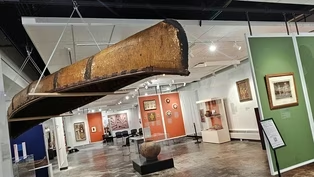
Preview: S8 Ep2 | 30s | Learn about the Northern Cheyenne’s connection to Akron plus local cultural museums. (30s)
Providing Support for PBS.org
Learn Moreabout PBS online sponsorship













Support for PBS provided by:
Around Akron with Blue Green is a local public television program presented by WNEO