
November 2024
Season 9 Episode 1 | 25m 37sVideo has Closed Captions
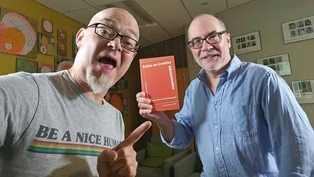
From choreography to the written word, Blue celebrates local art in this season premiere.
Hear about the work and rich history of NCCAkron before sitting down with the director of the University of Akron Press for insight into publishing. Next, discover how Kimmy Henderson is using artwork to advocate for mental health with the Bipolar Butterfly Project. Plus, visit downtown’s newest mural with the artist and hear from the executive director of Curated Storefront, Rick Rogers.
Problems playing video? | Closed Captioning Feedback
Problems playing video? | Closed Captioning Feedback
Around Akron with Blue Green is a local public television program presented by WNEO
November 2024
Season 9 Episode 1 | 25m 37sVideo has Closed Captions
Hear about the work and rich history of NCCAkron before sitting down with the director of the University of Akron Press for insight into publishing. Next, discover how Kimmy Henderson is using artwork to advocate for mental health with the Bipolar Butterfly Project. Plus, visit downtown’s newest mural with the artist and hear from the executive director of Curated Storefront, Rick Rogers.
Problems playing video? | Closed Captioning Feedback
How to Watch Around Akron with Blue Green
Around Akron with Blue Green is available to stream on pbs.org and the free PBS App, available on iPhone, Apple TV, Android TV, Android smartphones, Amazon Fire TV, Amazon Fire Tablet, Roku, Samsung Smart TV, and Vizio.
Providing Support for PBS.org
Learn Moreabout PBS online sponsorshipHey out there Akronites!
Welcome to the season nine premiere of Around Akron with Blue Green.
And yes, we have an amazing show ahead of us today.
I'm going to head down to the University of Akron to learn all about choreography.
Then I'm going to head over to the University of Akron Press.
Then it's off to learn all about the Bipolar Butterfly Project, and we'll wrap up the show today with a visit to Downtown Akron to look at that new mural.
Now to kick this show off today, we're going to go down to the University of Akron to learn all about choreography and how it's intricate to every part of your life.
Let's get to see what the NCC Akron is all about.
Choreography, in my opinion, is everywhere and it takes a lot of different shapes and forms.
Choreography is editing, you know, making a choice.
How many people do you want to fill that space?
Do you want to have a dancer stand alone?
What is their relationship to sound?
To music?
To now production design and augmented reality.
All the different bells and whistles are tools and choreography is decision making.
Which ones to include, which ones to omit.
And a big part that's been such a gift to be here on a research university's campus has been that I can offer professional choreographers the same opportunities to experiment for research and development that scientists are offered in the lab.
But choreographers do it in a studio.
NCC Akron is one of two national centers for choreography in this country.
And the first question I often get asked when artists come here is, why is this in Akron?
And a big part of that is the long history for arts and culture and innovation in the region.
So it goes back.
I often will ask people that they know who Heinz Poll is, and maybe they've been to the Heinz Poll Summer Dance Festival.
And I will explain in the larger national dance ecosystem, Hines was a contemporary of Robert Joffrey, and he and his partner Tom Skelton Heinz and Tom coming here doing free performances in the park.
That was innovation.
There was no sidelight for dance.
Before Tom and Heinz were like, how are we going to light these performances?
That history is often why there is a dance program here at the University of Akron, because the young dancers they were working with became of college age, and their families wanted them to get a college degree.
The building that we are in was expanded with the idea in mind that there would be a professional dance company here on campus.
Ohio Ballet used to be in the church across campus.
At the turn of this century, the university said, let's build you something more proper.
They have seven studios and additional offices and the Dance Institute downstairs.
And three months before the building opened in 2006, the Ohio Ballet closed because Heinz had passed on and the new leadership didn't have the same connections to make payroll at the last minute.
So there has literally was designed a big footprint for dance here in Akron and for professional dance.
With that in mind, follow up a year later, Dance Cleveland, one of the only dance only presenters in the country.
Just 45 minutes north in Cleveland doesn't own their own space, and they brokered a partnership with the University of Akron to open their season here at E.J.
Thomas and in exchange, would also provide an educational residency.
So Alonzo King LINES ballet from San Francisco, or MOMIX from the New England area would come here, do a residency, taking over classes for the week, and then do a performance at the end of the week.
The third component, so you have the University of Akron, Dance Cleveland, And then of course, the John S and James L Knight Foundation.
And they have been supporting that educational residency between Dance Cleveland and the University of Akron.
And they had a new CEO at the time.
This was in around 2012.
And Alberto Ibarguen loves dance when he went and had been on the board of directors for former dance companies.
So the program officer asked Dance Cleveland's executive director at the time, Pam Young, do you have any big ideas for dance?
And she said, well, yes.
Do you know that France has 19 choreographic centers because of course, in the European model and support for the arts, the arts is more of a state funded in form of propaganda.
But she said, you know, we have one national center for choreography here in this country.
It's down in Florida.
I think it's time we have a second one.
And I think it could be here in Akron, Ohio.
And the Knight Foundation seeded a feasibility study that then, three years later, led to a $5 million endowment setting up the National Center for choreography here in Akron.
We are a separate nonprofit institution.
The Knight Foundation provided our seed capital dance Cleveland established a working board and eventually created my position.
And I was the first employee.
And we operate in donated space on the University of Akron’s campus.
Now that we've learned all about the NCC Akron, we're going to head over to the University of Akron Press and learn about how they make academic books and how they teamed up with the NCC Akron to make their latest book.
Let's go see what the University of Akron Press is all about.
The University of Akron Press is one of about 150 university presses in North America.
We are not for profit academic publishers, and we're aligned with institutions of higher learning and museums and work to advance that broad mission of creating and disseminating knowledge.
And the University of Akron Press is a small university press.
The difference between a small university press and a big one, like Oxford University Press or MIT University Press is not the quality of books that are published, but the quantity of books.
And then also the numbers, the number of areas in which you publish books.
So, we have what we call, lists, or series, and you might think of them as like a shelf of books.
And what it really is, is a community of experts, because in order to make really high quality books, you need, you need help from, from experts.
So we're always looking for communities of experts in areas that are aligned with the University of Akron.
So the University of Akron is very good at some things.
So we publish, for example, in political science, the Bliss Institute.
We publish books in the history of psychology with the Cummings Center and with, the, with NCC Akron.
We've, you know, recognized like we see a community of experts who goes, wait, you're doing this dance writing thing on campus?
We would love to talk about that at the press to understand, you know, how can we help?
And this also further cemented NCC Akron's relationship with the University of Akron.
They have different skill sets and knowledge and expertise to support helping us realize the vision for distribution of these stories.
That led to being named a series editor, both myself and NCC Akron n are the series editor for a dance series of books with the University of Akron Press.
And I'm really proud of the village behind it.
There are 30 contributing authors, so that in itself feels like a major intervention to disrupt the the single author hierarchical mindset.
And then we also paid all of our authors to write, which is its own disruption with academic publishing, because in conventional academic publishing, the purpose that people want to publish is because they need to have the those books for their curriculum vitae.
They are on the tenure track and need proof of that.
And so the only compensation in many times might be copies of the book or some minimal royalties.
But this is not a moneymaking enterprise.
It is about the distribution of knowledge.
This new book that it's just been published is a edited collection, and that's very exciting because of, you know, there are dozens of experts involved.
And so, you know that the knowledge is very good in high quality when you have a, you know, community of people who really, know the field, reading it and, you know, providing feedback and people, help each other.
And, you know, there's an exchange of ideas and you get growth.
And, you know, people get smarter and you get, books that are very interesting to read.
The books are printed elsewhere.
People will come to the press if you come.
And, a funny thing that we sometimes observe is they look around and, and are surprised at how quiet it is, like they expect that there will be these giant printing machines running in the background, you know, like in the the old Spider-Man cartoons or something.
We make computer files, basically, with Adobe InDesign books, our PDF files more or less with, with additional cover files.
And we print in, we were printing in Ashland, and now we're starting to print, at different places around the country because that industry is constantly changing.
But printing is always changing.
So our books are for sale everywhere you buy books.
For sure people buy books on Amazon, but people also buy books, our books in town at Elizabeth's bookshop.
Other online retailers.
We sell a lot of books at events.
We love to do the sort of goes with, you know, building a community of experts and also a community of readers.
We, we really like to do books where we can have an event, at a public library or on campus, you know, anywhere, and bring the books and sell them, usually at a discount for the event, to the community.
Next up is a topic that touches us all - mental health.
I'm going to meet up with the Bipolar Butterfly Project and learn what it's all about.
After becoming a mom, I found an old window in the basement of our apartment, and I wanted to use it to decorate.
It was a really cool window, so I decided to try painting it, and I learned that I can paint.
So I started with windows and mirrors, and I got involved with our arts and starts First Fridays down in Canton.
And, I was selling, I wanted to stay as a glass artist on the front to get myself from the other canvas artists, cause there's tons of those, it’s saturated.
So I focused on glass, and people would call me and be like, hey, there's windows on sixth and whatever avenue.
And I would go out and, you know, jump in and dig in their trash and pick up their stuff and then turn it into art.
One day, I painted a set of wine glasses as a gift for someone, and I found my niche.
So turns out their wine glasses are very popular.
So I built my brand which is called Makiki's art, which is Mama and Kiki mushed together.
That's all I heard when I started painting.
And through the social media, Facebook especially, I grew my brand.
And, I ended up shipping worldwide and I was featured in success magazine, which was funny because I entered the six week, workshop, and they would teach you things and you would write your homework was how you would implement them in your business.
I was not business.
I was literally just painting my dining room table.
And I wrote it's all hypothetical.
And out of thousands of entries, I came in the top three and they featured me.
My business on Success magazine, which made a big deal for me.
So then I was shipping, like I said, worldwide, and I was offered to sell with the National Brand Store, but you had to supply a region, a minimum of 11 stores, and I could not possibly do that myself because it takes time to make these.
So I was researching, licensing and hiring people, and business was just snowballing before I had my first major manic episode, and that pretty much derailed my business.
I rebound from mania with depression, and I didn't want to paint Wineglasses anymore, and I struggled with creativity.
Period.
But during that episode, I painted a butterfly.
Butterflies represent metamorphosis.
Excuse me in self-growth.
And for some reason, I cannot explain other than my manic brain.
I made the one side dripping away.
So I shared this with my Makiki's art crowd and I was overwhelmed by the outpour.
People are like, you're so brave and I needed to hear this.
And they had loved ones and that helped them relate and I was just overwhelmed by it.
So I decided to paint a series.
So one day while I was painting that series, I heard a segment on NPR and it was discussing mental illness and violence, and there was a lot of awful statistics, but the one that I cannot get over was the number two cause of death for 10 to 34 year olds is suicide.
I had a ten year old and a 13 year old at the time.
I know the genetics, but they might struggle because of me, and I decided that I'm going to use this design to make change for them and their entire generation.
I had a really bright and shiny childhood.
I was really socially active, I cheered, I did theater and speech team and Model United Nations and, on August 15th, 1998, coming home from a family vacation, we had a very tragic car accident, and I found myself with casts on both my shoulders to my thumbs, cast on my left legs.
They tore out my tendon, patellar tendon, and third degree burns.
Actually, fourth degree acidic burns from hot antifreeze.
And I fell into depression.
That was very circumstantial.
Clearly, that's a lot for a 19 year old to go through.
But overall, no, I did not recognize I had a problem until I was 35 when I had that first major manic episode.
So I wasn't diagnosed til I was 35.
But looking back, I can see the ups and downs of creativity.
Like it's it's like, oh, okay, I recognize it.
[positive music] I submitted for Open Call for murals at Belden Village Mall, and I was accepted for my signature birch trees.
Painted it.
It was done.
Notice on the flip side of the wall there was just this big empty wall.
So I shared my story with the board and they agreed to let me paint the first one.
Now I wasn't paid for it.
It was a donation, but it was worth it to me to do it.
So that was the first one.
It kind of grew from word of mouth.
So I got offered to do one here and there.
And then we saw a sculpture call at Stan Hewitt, and I was like, how can we make these 3D for screens, green space.
So we decided metal is the best material.
And I reached out to a handful of different fabricators and one got back to me, Falls Metal Fabricators.
The owner wanted to be a part of the story.
People are touched personally by mental health and they want to be part of it.
So they helped me install the first two.
I mean, he donated tens of thousands of dollars in labor and materials and helped me get the first two sculptures, ones at Akron Zoo still.
And, we just kind of grew from there.
We started getting funding and different entities were able to get sponsorship to buy more.
So I've done six total.
The next one is going in downtown Hudson on three, oh three and 91 for Peg's Foundation.
And sadly, I just lost my studio, so we're taking a pause on the sculptures, but people are asking for them and there's some on hold, but I just don't have the space right now to create them anymore.
So once I get that all figured out, we'll be making more in the future.
It represents all mental illness to me.
So on one side, we're trying to show our best, most beautiful selves, even if we're crumbling on the other side.
It turns out almost everybody and I can't say everybody, but pretty much almost everybody, is struggling with something that you don't see, whether it's themselves or a loved one or just something.
With neurodivergent and mental health, there is something that everybody is dealing with.
Now to wrap this show up today it's down to Lock Four where I’m gonna meet with with Rick Rogers from Curated Storefront and learn all about the newest mural from world renowned artist Peeta Let's go see what Peeta and curated storefronts new mural is all about.
We are here at lock Four, downtown Akron, just off of Bowery Street, across the street from Cascade Plaza, about a block to the west of Main Street.
I believe that we need to elevate the street edge and the tenor of the city of Akron, and murals are one of the best ways to improve Akron's downtown.
It is somebody that we have we've had on a radar screen for about seven years now, he was one of the finalists for the lock three mural on the other side of the Civic Theater.
Here.
Yeah, for some reason, like, it's been postponed and change.
And then there was the Covid in between and, you know, and then finally, I, you know, everything worked out, and, they could manage to fly me here.
And so we're happy to have him in Akron at this point in 2024.
We're really, really lucky to have him.
I started like about 30 years ago as a graffiti artist.
I was doing it like, like tagging, going out at night and doing illegal things a little bit.
But sooner than later, I started to ask for permission to, by all laws that I could paint in the daytime and improve the quality instead of quantity.
I focus more on quality and that evolved over time into bigger and bigger surfaces and bigger murals.
Especially lately in the last, say, ten years, it's been increasingly popular to for cities and institutions or private companies to to paint larger scale murals.
And which was not something that was so popular at, the time when I started, I been familiar to painting in urban environments for a very long time.
And over time, I refined my technique, in a way that really I want my artwork to blend with the environment and really take into consideration not just by - by design, but also the, the environment and try to, to blend as much as possible with the architecture, and create some sort of illusion of, art during the perception of vertigo.
[upbeat music] Process starts with photograph, 3D scanning of the space.
Understanding your point of view, the standing environment, how people leave the space.
So the process is way, way longer than the time it took me to paint.
Actually took twice as much.
Probably half of the work is done on the computer analyzing photos and simulating how that work looks like from certain point of views and so on.
And then there's a lot of preparation with paint and mixing paint to find the right gray scales and all the colors.
Then there's a lot of work on, computer having this plan sketched out perfectly, like every line has a perfect has to be measured, and the beginning is a little bit tricky.
And, pay a lot of attention, a lot of precision.
So I go up there with my laptop and I follow a plan, I follow the measurements, and they start from a reference point and they start to recreate the exact proportions, on a larger scale, and then, yeah, then the work becomes a little bit more intuitive when I start spraying or brushing, I work, the shades.
Yeah.
That's the most, fun part with the big the all the way up before is a very technical, very methodic, airway.
Our plan is to bring a mural once a year during the summer, to various spots.
And downtown we have about 2 or 3 spots in mind for next year.
I think, this place has a lot of potential for more murals, and, the environment is just perfect.
I think, for, I think, yeah, as I said before, it's this place has helped me to really focus.
There was not much distraction going on.
And, and if other artists are more, probably they will find it, like some sort of, residency, I don't know, like where they can explore and develop their work, without, having too many people around.
I would say I'm painting in places like, say, Hong Kong, where the amount of people around me were, just, like, incredible.
It could be quite distracting a little bit, but that's the way it is here.
And, I love it.
So I think any other artists will love it as well.
Thank you Akrones for eight years of around Akron with Blue green.
This is the premiere of the ninth year, and hopefully we have many more to come.
Now, if you have any questions or any comments, you can catch me on social media.
Thank you and have an amazing day.
Thank you once again for watching this...
Thank you Akron for eight amazing years of around Akron with Blue Green and now we're kicking.
Thank you once.
Thank you Akron.
The seed curated..bleh And then we'll wrap up the show.
And then we're going to head.
Then we're going to wrap up the show.
Preview: S9 Ep1 | 30s | From choreography to the written word, Blue celebrates local art in this season premiere. (30s)
Providing Support for PBS.org
Learn Moreabout PBS online sponsorship













Support for PBS provided by:
Around Akron with Blue Green is a local public television program presented by WNEO