
November 21, 2023 - PBS NewsHour full episode
11/21/2023 | 57m 46sVideo has Closed Captions
November 21, 2023 - PBS NewsHour full episode
November 21, 2023 - PBS NewsHour full episode
Problems playing video? | Closed Captioning Feedback
Problems playing video? | Closed Captioning Feedback
Major corporate funding for the PBS News Hour is provided by BDO, BNSF, Consumer Cellular, American Cruise Lines, and Raymond James. Funding for the PBS NewsHour Weekend is provided by...
Support provided by:

November 21, 2023 - PBS NewsHour full episode
11/21/2023 | 57m 46sVideo has Closed Captions
November 21, 2023 - PBS NewsHour full episode
Problems playing video? | Closed Captioning Feedback
How to Watch PBS News Hour
PBS News Hour is available to stream on pbs.org and the free PBS App, available on iPhone, Apple TV, Android TV, Android smartphones, Amazon Fire TV, Amazon Fire Tablet, Roku, Samsung Smart TV, and Vizio.
Providing Support for PBS.org
Learn Moreabout PBS online sponsorshipGEOFF BENNETT: Good evening.
I'm Geoff Bennett.
AMNA NAWAZ: And I'm Amna Nawaz.
On the "NewsHour" tonight: Israeli forces battle Hamas in a refugee camp in Gaza, as hostage negotiations continue.
GEOFF BENNETT: Congress struggles to contain the federal debt and deficit, as another potential government shutdown looms.
AMNA NAWAZ: And a program in Thailand looks to counteract the increasing trend of grandparents raising grandchildren, as farming becomes a less reliable source of income.
SARA VIGIL, Stockholm Environment Institute Asia: What climate change is doing is exacerbating impacts on other, more traditional economic and political drivers of migration.
(BREAK) AMNA NAWAZ: Welcome to the "NewsHour."
A day of waiting, watching and worry for the families of hostages held Hamas in Gaza.
GEOFF BENNETT: Weeks of negotiations have led to an agonizing day, as talks continue to free some of the nearly 240 hostages.
Under a proposed deal, Hamas would reportedly exchange 50 women and children they hold for 150 women and children in Israeli detention.
Nick Schifrin has the latest.
NICK SCHIFRIN: In Tel Aviv today, the families of Israeli hostages united in prayer.
They don't know if their loved ones are alive, but they hold onto hope they might come home soon.
MATAN ESHET, Relative of Israeli Hostage: I think the only thing that I could call justice is bringing everyone back home.
NICK SCHIFRIN: After more than a month of negotiations between Israel, Hamas and the U.S. mediated by Qatar, every side indicated today a deal was closer than ever.
JOE BIDEN, President of the United States: We're now very close, very close, and could bring some of these hostages home very soon.
But I don't want to get into the details of things, because nothing is done until it's done.
NICK SCHIFRIN: Israeli Prime Minister Benjamin Netanyahu: BENJAMIN NETANYAHU, Israeli Prime Minister (through translator): The return of the hostages we are making progress.
I don't think it is worth saying too much, not at even this moment.
But I hope there will be good news soon.
NICK SCHIFRIN: Hamas political official Khalil Al-Hayya: KHALIL AL-HAYYA, Hamas Political Bureau Member (through translator): We believe that we are in decisive moments in this matter, and we all hope, God willing, that this truce will be the cessation of aggression for days and the entry of relief for our people.
NICK SCHIFRIN: Israeli and U.S. officials tell "PBS NewsHour" Hamas would release 50 women and children and Israel would release 150 women and children currently detained in Israeli prisons, hold fire for four to five days, increase humanitarian assistance into Gaza, and restrict drone surveillance flights over Gaza.
But the war goes on.
Today, Israel attacked the Jabalia refugee camp in Northern Gaza.
It's a tightly packed area full of Palestinian families who fled from present-day Israel when Israel gained independence.
Today, it's a moonscape.
The IDF says they have killed dozens of Hamas militants who fled to Jabalia from Gaza City.
IDF spokesman Admiral Daniel Hagari: REAR ADM. DANIEL HAGARI, Spokesperson, Israeli Defense Forces (through translator): We completed the encirclement of Jabalia, which is a significant combat zone.
We have the upper hand in every battle.
We will continue to eliminate Hamas terrorists wherever they are.
NICK SCHIFRIN: Including Hamas' infrastructure in hospitals.
At the Al-Aqsa Hospital in Central Gaza, Israeli drones are constant.
And the neonatal intensive care unit is full of babies fighting to survive.
DR. ASHLEEN, Al-Aqsa Hospital: Their lives are endangered because we have a shortage of fuel, we have a shortage of electricity.
NICK SCHIFRIN: Dr. Ashleen says the fuel that powers the incubators that keeps them alive is running low.
She says this 2-week-old baby girl was left in orphan and in critical condition with a brain injury after her family was killed in an airstrike.
DR. ASHLEEN: She is in very critical condition.
Hopefully, we -- we try hard to keep her alive.
But if -- even if she is kept alive, so who to care with her?
She lost the parents.
NICK SCHIFRIN: Five thousand miles away, Chinese Communist Party General Secretary Xi Jinping spoke to a virtual gathering of the BRICS, Brazil, Russia, India, China, and South Africa, about the war and a path to peace.
Xi called for a two-state solution.
XI JINPING, Chinese President (through translator): There can be no sustainable peace and security in the Middle East without a just solution to the question of Palestine.
NICK SCHIFRIN: Russian President Vladimir Putin blamed the war on the U.S. and said the BRICS should be negotiating.
VLADIMIR PUTIN, Russian President (through translator): The loss of thousands of lives, the mass expulsion of civilians and the resulting humanitarian catastrophe are of grave concern.
All these events are a direct consequence of the United States' desire to monopolize the mediation.
NICK SCHIFRIN: As for the hostages, there is no monopoly on these negotiations, to be sure, only risks.
And, at this hour, Amna with no word from the White House, Jerusalem or Doha, our wait continues.
AMNA NAWAZ: A painful wait for so many.
But, Nick, walk us through what we know about a potential deal here.
How would it work?
NICK SCHIFRIN: So, part of the negotiation that has been happening is for safe passage for these hostages to go from Hamas control into Israel.
And in the past, a kind of pilot was done by the U.S., Israel, Hamas, Egypt, and Qatar that released two Americans.
And that pilot allowed the ICRC to bring those two hostages from Hamas into Israel and hand them over to Israeli troops.
The idea this time is that they would be handed over to Israeli troops and, from there, go to about half-a-dozen hospitals that Israel has already been -- has already identified.
Many of them will need medical attention.
The National Security Council staff today said they'd been held in abhorrent conditions.
Some, of course, have preexisting conditions that will need to be addressed.
And then, depending on the nationalities, they would go, of course, and be repatriated.
In total, we believe that, as many as about 30 children and 60 women are being held by Hamas.
This deal only allows for 50 of them to be released.
We're not sure which 50.
We're also not sure of which of the 10 Americans will be released, but we know that there are three Americans in this category, beginning with a 3-year-old, 3-year-old Abigail Mor Idan.
You see her there.
Her parents were both killed on the morning of October 7.
And there are two American women being held.
Liat Beinin Atzili was a tour guide at Israel's Holocaust Museum, Yad Vashem.
And Judih Haggai was kidnapped from the kibbutz Nir Oz in Southern Gaza.
That's her right there.
but, again, we don't have -- do not have the confirmation of who exactly will be released.
AMNA NAWAZ: Nick, any hostage negotiation is fraught and high-stakes.
Why has this one been so particularly difficult?
NICK SCHIFRIN: The first reason is shuttle diplomacy.
Of course, Israel is not talking to Hamas.
The United States is not talking to Hamas.
And so in the middle are Qatar and Egypt, and they have been the one passing messages to and from all the sides.
And Hamas, I'm told, is not always reliable.
It is a terrorist organization, after all.
Secondly, it's not only Hamas.
Palestinian Islamic Jihad have been holding hostages.
And some Israeli officials believe even civilians are holding some of these hostages separate from Hamas.
And, thirdly, on the other side, there's been Israeli resistance.
Tonight, Benjamin Netanyahu is meeting with his government, the coalition.
There has been resistance from especially the far right parties in that coalition to hold cease-fire at all as part of the deal, let alone any reduction in surveillance flights that might have to happen as well.
But the bottom line, Netanyahu made clear tonight that a cease-fire will not be the end of this war.
He actually called that - - quote -- "nonsense."
Instead, he said: "We will continue the war until we achieve all of our war aims after the hostages are released."
AMNA NAWAZ: Nick Schifrin reporting on the latest on this imminent, hopefully, hostage deal.
NICK SCHIFRIN: Hopefully.
Nick, thank you.
AMNA NAWAZ: Thanks, Amna.
Now to the families of people held by Hamas and this agonizing six weeks of horror and worry.
Five of Abbey Onn's family members were kidnapped on October 7.
Her grandmother, Carmela Dan, an American-Israeli dual national, and her 13-year-old niece, Noya, were found dead just inside Gaza one month ago.
Carmela's son-in-law, Ofer, and his two other children, 16-year-old Sahar and 12-year-old Erez, are still held hostage.
Liz Hirsh Naftali is awaiting the return of the youngest American hostage, her grandniece, 3-year-old Abigail Mor Idan.
Abbey and Liz, welcome to you both.
And thank you for joining us.
I just want to begin by asking both of you to share what this moment is like, knowing that a deal to release some of the hostages, at least, could be imminent.
Liz, why don't you begin?
LIZ HIRSH NAFTALI, Great-Aunt of Hostage: Well, first, thank you for having us on the show.
I think it's important for us to just keep talking about the hostages and reminding people that these are innocent civilians that were taken hostage, were abducted on October 7.
And my grandniece Abigail is 3 years old.
And I am thankful for all the work that President Biden, the administration has been leading.
I'm thankful to whatever support the Qatar government is and everybody that's involved.
But what I feel tonight is, like, we started this morning with this excitement that we were going to have a hostage deal.
And it's now the evening, and we don't necessarily have a hostage deal.
And what it is a reminder of is that, until we see Abigail and other children and mothers leaving Gaza, we cannot let go.
We cannot stop doing this work, and we can't believe it until we actually see it.
AMNA NAWAZ: Abbey, what about you?
You have already lost family members.
We are so sorry for that loss you have already suffered.
But this hope that the remaining family members could be released, what's this moment like?
ABBEY ONN, Relative of Hostages: I think Liz says it well, but it's almost like a knot, like you're waiting for something to untie, but it's not there yet.
It feels really fragile.
There's so many things that have to come into place at the right time.
And then there's the kind of -- I think it's 30 hours where people can appeal, and that -- the notion that any sort of military mishap could put this in danger as well.
And so we have a lot of hope, I think more hope than we have had at any other point in the process, in terms of a diplomatic resolution for the 50, but we still feel like, until we can see them with our eyes, until we can touch them, the knot is still in our stomachs.
AMNA NAWAZ: And, Abbey, do you know, have you gotten any indication that this would mean at least the two youngest, Sahar and Erez in this case, would be released as part of a potential deal?
ABBEY ONN: There's no confirmation of names right now.
As far as I understand it, the government will be getting a list of 10 names the night before each release if this is to move forward.
I hope that they would then share the names with the families, because, as I understand, the first thing that's going to happen is medical care and then right to the families.
And so I think the families will need some sort of preparation.
But there's speculation that they would be among the children released.
AMNA NAWAZ: Liz, of course, that would mean the release of 3-year-old Abigail, the youngest American there.
And you're wearing that 45 on your shirt to remind everyone just how long she and the others have been held.
But I need to ask you as well about some of the opposition in the Israeli government.
There are some who say a deal is not a good idea, you shouldn't be negotiating with terrorists, a cease-fire could just allow time for Hamas to regroup.
What do you make of that argument?
LIZ HIRSH NAFTALI: I make of it no argument.
We need to have these children come home.
These are 30-plus innocent civilians who are children.
This is not political.
This is humanitarian.
They have been abducted.
They are somewhere in the dark in Gaza for over 45 days now.
Enough is enough.
They need to come home.
This is not about politics.
This is about children that should not be in the middle of a war, that did nothing.
Abigail is 3 years old.
Her birthday is on Friday.
No child should spend their birthday as a hostage.
None of these children should be there.
So I pivot and I don't go to the politics, and I just remind everybody that is listening and I hope our leaders who are listening we need to bring these children home, and we need to bring them home now.
AMNA NAWAZ: Liz, I should ask you too.
I know her two older siblings survived.
They were rescued by IDF forces.
How are they doing?
What do you tell them about what's going on?
LIZ HIRSH NAFTALI: These children watched both their parents be murdered by Hamas terrorists on October 7.
They then went and they buried their parents.
They are blessed to be with loving family, cousins, aunts, uncles, grandparents.
But these children, they know what is going on.
They're very articulate about what happened.
And the family is very honest about what is going on.
And, really, their hope, the one thing that they are holding hope and faith is that Abigail is going to come home to them really soon and run around and play soccer, eat ice cream and do what three little kids do, siblings do.
And so the thought of a 6- and 10-year-old having witnessed that, as a mother, I can't bear it.
But I also know that the one thing that they are waiting for right now is her little sister to come home, so that they can hug her and celebrate her fourth birthday with her.
AMNA NAWAZ: Abbey, Erez is just 12, I understand.
And Sahar is just 16.
And I know there's a lot of uncertainty throughout the last six weeks, but there is video that you have seen.
You see Erez.
He was alive when he was taken.
ABBEY ONN: Yes.
AMNA NAWAZ: I can only imagine what's going through his mind when he's in the hands of those terrorists there.
But what can you tell us about this 12-year-old boy, about his 16-year-old sister?
ABBEY ONN: As we said, no one should celebrate their birthday in captivity, and Erez turned 12 there in October.
So we deeply believe that it's the job of the Israeli government and all of our governments to bring them home.
Erez is now the same age as my son.
He is a horseback rider and he's a bike rider.
He plays the trumpet and he loves LEGOs.
He is the baby of four siblings.
Sahar is 16.
She has another year left of high school.
She and her older sister are best friends.
They -- if you don't look closely, you would mistake them for one another.
They're both beautiful and look like twins.
She's an artist.
She plays the bass.
And they need to be brought home to their siblings and to their mother.
AMNA NAWAZ: If there is a deal, I should ask you both, it will likely mean some, not all the hostages come home.
And I know there is this bond now between you and all the other families enduring the unimaginable right now.
I just want to ask each of you what that conversation is like between you and the other families, knowing some of you will be able to see your loved ones soon, but not everyone.
Liz?
LIZ HIRSH NAFTALI: It is a cruel and terrible conversation, but I will say that I really believe that everybody understands that the children need to come out first.
The little kids need to come out first.
I know that, once Abigail comes out, I and other parents and relatives of these hostages will continue to work every day to ensure that all 230-plus hostages come home to their families.
So I pray that we get these kids out and that we then continue, and we will, and these families are together in this process.
And it's just -- I'd like everybody to come out.
And they will.
We just have to do this thing that actually takes care of our little children first.
AMNA NAWAZ: Abbey, what would you say to that?
ABBEY ONN: Look, we have seen four people be released already and one person be rescued.
And every single one of them was a success and a celebration and we rejoiced.
And I think, at this point, we all are close with one another, and it weighs heavy on our hearts to think that some will come out and others won't.
In my situation, God willing, Erez and Sahar come out, but Ofer won't, right?
He is a grown man, so he would not be among this list.
And so, as Liz is saying, whoever comes out, it doesn't stop the fight for any of us.
We will fight until every single hostage is home.
And I think we will all have more motivation knowing that there was a diplomatic resolution, that something can be solved and that we can fight to bring every single one of them home.
AMNA NAWAZ: That is Abbey Onn and Liz Hirsh Naftali.
We are thinking of you and of your families.
And we thank you so much for joining us tonight.
Thank you both.
ABBEY ONN: Thank you.
LIZ HIRSH NAFTALI: Thank you for having us.
AMNA NAWAZ: In the day's other headlines: The world's largest cryptocurrency exchange, Binance, pleaded guilty in a sweeping U.S. securities investigation and agreed to pay $4.3 billion in fines.
The charges were similar to those against FTX, the crypto company that collapsed last year.
Attorney General Merrick Garland said Binance let drug gangs and terror groups launder money.
MERRICK GARLAND, U.S. Attorney General: Using new technology to break the law does not make you a disrupter.
It makes you a criminal.
This Justice Department has no tolerance for crimes that threaten our economic institutions and undermine public trust in the fairness of those institutions.
AMNA NAWAZ: Also today, the founder of Binance, Changpeng Zhao, pleaded guilty to failing to prevent money laundering.
He said he is stepping down as CEO.
North Korea claims it launched a spy satellite into orbit today on its third try.
There was no independent confirmation, but the U.S., Japan and South Korea condemned the attempt, which violated a U.N. ban.
The North said its leader, Kim Jong-un, watched the launch and said the satellite is a response to hostile military moves by the U.S. and Japan.
The Philippines and the U.S. have started joint naval and air patrols in waters near Taiwan in a move to counter China.
Beijing has claimed much of the South China Sea inside the so-called nine-dash line.
The Philippines and other regional countries dispute that boundary.
Just last month, a Chinese coast guard ship rammed a Filipino vessel in the South China Sea.
Top European officials made new shows of support for Ukraine today in its war with Russia.
Germany's defense minister, Boris Pistorius, laid flowers at the Maidan uprising memorial in Kyiv.
It marks pro-Western protests that toppled a pro-Russian president 10 years ago.
And European Union President Charles Michel met with Ukrainian President Volodymyr Zelenskyy.
In a recorded message, Zelenskyy warned against accepting a stalemate with Moscow.
VOLODYMYR ZELENSKYY, Ukrainian President (through translator): When the civilized world starts looking for compromises with terrorists and making concessions to tyrants, then we will all lose.
Ukraine, Europe, the world, we lose naively thinking that there can be a draw with them.
A draw is impossible.
AMNA NAWAZ: In Washington, the White House warned there are signs that Iran may provide ballistic missiles to Russia.
And the U.N. Human Rights Office reported more than 10,000 civilians have died in Ukraine in nearly two years of war.
Back in this country, there's word that House Speaker Mike Johnson met with former President Donald Trump last night in Florida.
It's widely reported that Johnson traveled to the Trump estate at Mar-a-Lago a week after endorsing Mr. Trump's presidential bid.
The new speaker is already taking fire from hard-right Republicans for relying on Democrats to pass a government funding bill.
Millions of people began boarding flights and hitting the highways today for what may be a record Thanksgiving travel season.
Airports anticipated more than five million passengers before Thursday, and AAA predicted 55 million Americans will drive at least 50 miles from home.
In the East, travelers face a storm moving up the Atlantic Coast that could disrupt both air and ground traffic.
In economic news, sales of existing homes in October were the slowest in 13 years, as high mortgage rates and high prices took a toll.
And on Wall Street, stocks came up short.
The Dow Jones industrial average lost 62 points to close at 35088.
The Nasdaq fell 84 points.
The S&P 500 slipped nine.
Still to come on the "NewsHour": 14th Amendment case challenge Donald Trump's eligibility for the 2024 election; earthquakes rattle Southwestern Iceland, as a volcanic eruption maybe just days away; plus much more.
The U.S. government remains open this Thanksgiving week, thanks to a temporary funding deal Congress passed last week.
But that deal starts to expire in January.
And conservatives are signaling they won't pass another funding deal without addressing a bigger issue, the swelling U.S. national debt, this as what the U.S. pays in interest costs is soaring.
Geoff is with our Lisa Desjardins to make sense of the trillions involved.
GEOFF BENNETT: Amna, thank you, Lisa, it's good to see you.
LISA DESJARDINS: Great to see you.
GEOFF BENNETT: So, we know the top-line number.
The total national debt is almost $34 trillion.
But economists have noticed that something is changing, right?
So what is it?
LISA DESJARDINS: It's the cost of the debt.
And if you look at the markets, you know why.
To fight inflation, the Federal Reserve has been increasing interest rates.
Well, that means what the U.S. is paying for its loans is also going up.
I wanted this to be very understandable.
So I want to look at interest costs that we pay on our national debt per day.
Now, I have calculated these numbers, thanks to some help from the Joint Economic Committee and Dave Schweikert's office; $1 billion, that's how much we were paying in interest two years ago.
Let's watch the curve.
Here we go after the pandemic.
Interest rates go up a little bit, $1.4 billion a day.
Look at the last six months.
As we see interest rates go up, look at what the U.S. is paying, more than twice in interest costs per day that we did two years ago.
Now, $2.6 billion, what is that?
Think about this.
In a week, what we're paying on interest is enough for everything President Biden has requested for border security for a year.
GEOFF BENNETT: Wow, so what about the total number?
LISA DESJARDINS: Right, OK, another big number.
What does this mean overall?
Right now, the U.S. in a year, looking November to October in the past year, spent $749 billion on interest.
What does that number mean?
Department of Defense budget.
How much we spent on that in fiscal 23?
-- $782 billion.
So, right now, just the interest on our debt is so large that it is almost the entire Department of Defense budget.
GEOFF BENNETT: And, Lisa, we hear lawmakers talk all the time about the debt and deficit.
How much does that debate on the Hill actually get at the core of the problem here?
LISA DESJARDINS: So excited to get into this, because, of course, Congress, as you know -- we have covered it together -- congress only controls part of the budget agencies, by and large.
But let's look at what the three largest drivers of the debt are in reality, these three things, Social Security there in yellow at the bottom, Medicare in blue, and interest, those costs right there.
This is the percentage of the budget these things make up now.
In 2033, all three of those things are going to grow.
Look at that, Social Security especially, Medicare growing.
These are mandatory costs that Congress isn't even talking about when we talk about a government shutdown or discretionary funding.
The green, that is what Congress controls.
That money is suspected to go down.
So really what's happening here is Congress is not addressing the big drivers of the debt at all.
And when you talk to economists like Mark Zandi of Moody's Analytics, he says Congress needs to pay attention to you and they need to stress the real stakes in all of this.
MARK ZANDI, Chief Economist, Moody's Analytics: The lawmakers need to be able to connect in the minds of the voter that, if we don't make changes, if we don't do things that are tough, like raise taxes or restrain spending, then interest rates are going to rise.
And, therefore, we're not going to be able to -- many Americans, most Americans won't be able to afford to buy a home and become a homeowner or even buy a vehicle.
So I think it's going to take some pressure, some economic pressure for lawmakers to really come to terms.
But, so far, they haven't done that.
GEOFF BENNETT: So, Lisa, what are lawmakers proposing as potential solutions here?
LISA DESJARDINS: Yes.
We went back and listened to the last couple of weeks of debate about fiscal policy, about a potential government shutdown that we just avoided this time around.
And, first, I want to note that there are more members of Congress talking about this issue.
So let's listen, first of all, of what they had to say.
REP. MIKE JOHNSON (R-LA): The greatest threat to our national security is our nation's debts.
SEN. JOE MANCHIN (D-WV): We have been spending more than we bring in, in our government every year for the past 21 years.
SEN. MAGGIE HASSAN (D-NH): As a nation, we must be concerned about the growth in the national debt.
REP. CHIP ROY (R-TX): When is it going to be enough?
Is $34 trillion of debt, not enough, $2 trillion deficits not enough?
REP. DAVID SCHWEIKERT (R-AZ): If you don't like math, if you don't want to deal with reality, please stop watching.
LISA DESJARDINS: Keep watching, because math is important, reality is important.
And the reality is, though, as much as these members have lots of graphs, they're pointing out the problem, there really are not yet specific plans to deal with this.
It comes down to two things, Geoff you know well.
Either you have to cut spending, cut benefits, or you have to increase revenue.
Most every smart economist says you have got to do some combination of both.
But it has become a partisan debate.
There is a potential commission on the horizon.
Speaker Johnson mentioned that in his first speech.
He wants a commission.
My reporting is, however, that that is stuck at the moment because they can't agree on what kind of teeth a fiscal commission could have.
It's fine to propose recommendations, but if the Senate doesn't really have to take a vote, what does it matter?
Until they can agree on that, even a commission itself is in gridlock, even as our debt continues to get more and more at the moment.
GEOFF BENNETT: Lisa Desjardins, thanks so much for this great reporting and analysis.
LISA DESJARDINS: You're welcome.
AMNA NAWAZ: A Civil War-era clause in the Constitution is at the center of a major legal question for 2024: Is former President Donald Trump qualified to be on the ballot?
White House correspondent Laura Barron-Lopez takes a deeper look at the lawsuits over the 14th Amendment.
LAURA BARRON-LOPEZ: The legal war continues over whether former President Trump should be disqualified from the ballot in Colorado.
The case is over Section 3 of the 14th Amendment, which bars a person from future office if they have taken an oath to the Constitution and later engage in an insurrection or aid the Constitution's enemies.
On Friday, a Colorado district judge ruled that Trump did engage in an insurrection by inciting the January 6 attack on the U.S. Capitol, but said the little-known clause doesn't apply to the presidency.
Now both Trump and the plaintiffs in the case, backed by the nonprofit Citizens for Responsibility and Ethics in Washington, have filed appeals.
Joining me now to discuss is Laurence Tribe.
He's a constitutional scholar at Harvard Law School and first backed the 14th Amendment theory earlier this year.
Professor Tribe, thank you so much for joining the "NewsHour."
The judge ruled that Trump engaged in an insurrection, a notable ruling, but that, for the purposes of the 14th Amendment, the president is not -- quote -- "an officer of the United States."
To the average person, that might be pretty confusing, that every other public official, senator, congressmember, qualifies under this, but the president doesn't.
Can you explain that?
LAURENCE TRIBE, Professor, Harvard Law School: Well, it's quite confusing, and, in fact, it was confusing to the trial court judge herself.
She conducted a very elaborate weeklong trial.
There was a great deal of evidence, on the basis of which she carefully found, by clear and convincing evidence, that Donald Trump, not only on January 6, but in the lead-up to January 6, having taken an oath to support the Constitution, turned against it and engaged in an insurrection against it.
But, amazingly, she said, the language of the 14th Amendment, which was designed to protect the country and protect democracy from insurrectionists who had taken an oath to the Constitution, exempts the president.
She said that that may sound preposterous.
And it does, because it is.
The language clearly covers the presidency as an office under the Constitution.
It's described that way throughout the Constitution.
Donald Trump himself described it that way in his filings in other cases.
And, in fact, exempting the presidency would turn the Constitution upside down.
It would mean, among other things, that Jefferson Davis, having led the Confederacy, could then have turned around after the Civil War and been president again.
That's not the way the Constitution was designed or written.
LAURA BARRON-LOPEZ: There's a few other things I want to get to, but this is being appealed to the Colorado Supreme Court now.
So what do you expect to happen next?
LAURENCE TRIBE: Right.
Well, I think the Colorado Supreme Court, which is on a very expedited schedule, is quite likely to reverse the bizarre holding that exempts the president, a holding that would, among other things, mean that presidents could accept emoluments from foreign countries, that you could have a religious test for the presidency.
Having done that, the question is, will they find some basis to overturn the really important holding of the trial court, that this was an insurrection against the Constitution and that Donald Trump engaged in it?
If they don't overturn that holding, they will order that Trump not be on the ballot.
And he will then seek review in the U.S. Supreme Court, which will undoubtedly agree to hear the case on an expedited basis, because the primary election is going to occur really quite soon, in early 2024 in Colorado.
LAURA BARRON-LOPEZ: Professor, Michael Mukasey, the former attorney general under George W. Bush, argued in an op-ed recently that Trump is not an -- quote -- "officer of the United States," which is some of the language that they use in the 14th Amendment.
And he cited a 2010 ruling by the Supreme Court where Chief Justice John Roberts said that the people do not vote for officers of the United States.
So what's your response to that argument?
LAURENCE TRIBE: It's completely wrong.
Judge Luttig, Michael Luttig, a very distinguished former federal judge, a conservative, and I have examined that argument and find it, frankly, empty.
It just doesn't make sense.
Of course, the people don't vote for other officers.
That's why the Constitution specifies that the senators and members of the House are subject to this.
And then it says, so are officers of the United States, those who are not elected.
It's true that presidents aren't elected.
Neither are Cabinet members.
Yet no one doubts that they are subject to this restriction.
It just doesn't make the slightest sense.
And with all due respect to former Attorney General Mukasey, he wouldn't get a high grade on turning that answer in.
LAURA BARRON-LOPEZ: If these challenges to former President Trump's qualification fail, and if Trump is granted absolute immunity from criminal prosecution for conspiring to overturn the 2020 election, which is something that he's arguing in the federal January 6 case, what does that mean for the presidency and accountability?
LAURENCE TRIBE: Well, if that were to happen -- and I very much hope it doesn't -- it would turn the presidency into a dictatorship.
It would basically mean that the revolution that we fought against King George failed, and that the American experiment in constitutional democracy, with no one being above the law, lasted 225 years, and then ended.
I don't want that to happen.
I think it would be a disaster for the freedom of every one of us to have anybody completely above the law.
We have in this case someone who said he would terminate the Constitution.
He will make his presidency about vengeance.
It's what fascists do.
It's what is happening in many parts of the world, in Russia, quite recently.
It looks like Argentina is moving in that direction, in Hungary.
We really should not join those that have turned their backs on freedom and liberty.
That's what would happen if absolute immunity were granted to the president and if he were allowed to take power again.
LAURA BARRON-LOPEZ: Professor Laurence Tribe of Harvard Law School, thank you so much for your time.
LAURENCE TRIBE: Thank you so much.
AMNA NAWAZ: The number of households where grandchildren are being raised by grandparents has been on the rise for decades in lower and middle-income countries.
Parents have moved abroad or into urban areas for job opportunities and higher wages, in part because agricultural jobs no longer provide a reliable income due to climate change.
Special correspondent Fred de Sam Lazaro looks at one program in rural Thailand aimed at keeping families together by providing alternative sources of income.
It's part of Fred's series Agents For Change.
FRED DE SAM LAZARO: In millions of households across rural Thailand, this is what the dinner hour looks like, grandma and grandpa feeding the little ones, mom and dad nowhere in the picture.
PRAMAI LUERSUEBCHART, Grandfather (through translator): Every day, I fetch food for the two kids, and I take the children to and from school.
FRED DE SAM LAZARO: At 74, Pramai Luersuebchart says he has little choice raising his grandchildren, 3 and 7, left in his care while his daughter works in the capital, Bangkok.
Aside from a couple of visits a year, it is phone calls like this that keep the family connected.
PRAMAI LUERSUEBCHART (through translator): The kids miss their mom.
It's the way it is.
Life is difficult.
We have to survive.
She left two years ago.
There is no money, no jobs here.
FRED DE SAM LAZARO: And no way mom, with a factory job, could afford the day care and high living costs of Bangkok to bring her children along.
So, Luersuebchart and his second wife, Tongtri Pulatakam (ph), also raising her daughter's newborn, make do on a combined pension of about $36 a month and an increasingly unproductive rice field they farm on rented land.
People in rural Thailand have for decades spent a few weeks each year away in the city earning extra income in between planting and the harvest.
But in recent times, agriculture, the rice crop, in particular, has become unreliable as a source of income, and that's forced longer and longer absences from home.
SARA VIGIL, Stockholm Environment Institute Asia: What climate change is doing is exacerbating impacts on other, more traditional economic and political drivers of migration.
FRED DE SAM LAZARO: Sara Vigil is a research fellow at the Stockholm Environment Institute at Chulalongkorn University in Bangkok.
SARA VIGIL: Migration should be a choice.
There are communities that would like to remain in place, that it's really a question of, we lack the resources to diversify our incomes, which is becoming more and more difficult, of course, in the context of climate change.
So family separation is one of the very violent kind of social impacts.
Women have been denied the basic human right of being a mother.
Mechai Viravaidya is on a mission to reunite families.
We met him at the temple in Nansuang (ph) near Thailand's border with Cambodia, where a group of elderly residents were gathered.
MECHAI VIRAVAIDYA, Chair, Mechai Viravaidya Foundation (through translator): How many of you have children that have left for the city whom you would like to return home?
FRED DE SAM LAZARO: Mechai, now 82, is a world-renowned social innovator credited earlier with designing Thailand's successful family planning campaigns.
An economist by training, he started the Bamboo School nearby in 2009 to inspire rural youth in horticulture and entrepreneurship.
Now he's trying to address the social impacts of internal migration in a country where some three million children are raised by family other than their parents.
MECHAI VIRAVAIDYA: We are fighting out that more and more are willing to come home, especially if there's an alternative.
FRED DE SAM LAZARO: He started a pilot program called Homeward Bound that allows parents to return to their villages, provides them small loans and training to build and run a small business.
MECHAI VIRAVAIDYA: This would give very, very good profit, mushroom care.
You pick it every day for three months.
Just this much space will earn you 900,000 baht in a year.
FRED DE SAM LAZARO: Or 25,000 U.S. dollars.
He says farmers would be financially secure on a lot less.
MECHAI VIRAVAIDYA: Most farmers are rice farmers.
And the income from growing rice once a year is five baht per square meter, which is horrendous.
So we need to diversify.
FRED DE SAM LAZARO: His school partners with nearby temples and hospitals where farmer's markets are held.
Bamboo School students bring their training to teach new techniques on how to grow profitable crops in small spaces.
Mechai says the market is potentially huge.
School lunches, for instance, could be supplied from small enterprises like the ones started in the Nansuang temple, planting vegetables and selling snacks prepared here.
There are some 40,000 temples across this predominantly Buddhist country.
MECHAI VIRAVAIDYA: We have 25 billion baht budget for school lunch.
If the Ministry of Education is willing, they could use part of that money to buy vegetables from the elderly.
So that will help.
And that's part of the market system.
You have got hospitals all over the place in Thailand.
You have got schools.
You have got temples.
And we will take a look at any other organization that wants to work with us.
FRED DE SAM LAZARO: And tapping into that economic cycle would, he thinks, be enough to help more people like 39-year-old Sukanya Ninpayak, who returned in January from her city job as a baker's assistant.
The Homeward Bound project allowed her and husband Prakai Tisantier (ph), himself laid off from a city job, to reunite with their daughters, 2 and 10, and her parents.
SUKANYA NINPAYAK, Participant, Homeward Bound (through translator): My family was so excited when I returned, because visits before were infrequent.
FRED DE SAM LAZARO: They have set up a small farm at home, growing mushrooms and sunflower microgreens that she sells at a nearby hospital farmer's market.
At a workshop explaining the Homeward Bound program, there was no shortage of eager applicants, driven by the financial reality of their work situation and the pain of separation.
SUMITRA RITNARONG, Retail Worker (through translator): Last time I left, my kid ran after the car, but to stay was not an option either.
PAKONG CHANAKUL, Factory Worker (through translator): If I stayed, I would have no livelihood to sustain them.
SAKNARIN TINTHONGLANG, Factor Worker (through translator): I earn about $8.50 a day, but a plate of rice is $1.40, so there's little extra money.
FRED DE SAM LAZARO: Pramai Luersuebchart is urging his daughter to return to enroll in Mechai's Homeward Bound program.
WOMAN (through translator): I have a contract.
I have to wait.
FRED DE SAM LAZARO: His daughter, Samlit, says she feels out of place amid the bustle and bright lights of Bangkok, where she lives with her new husband, Suthi Sankamrad (ph).
They are contract-bound for the next two years at their factory jobs.Leaving early would mean financial penalties.
SAMLIT LUERSUEBCHART, Factory Worker (through translator): I wish I could have raised my own children, but it hasn't been possible.
I don't want to stay in Bangkok.
I'm happiest when I can visit my children.
My saddest memory is when I left my kids, but I didn't have any money to buy food.
FRED DE SAM LAZARO: For Mechai Viravaidya, the next step is scaling up.
MECHAI VIRAVAIDYA: We can bring in the banking system, where the government bank, Bank of Agriculture and Cooperatives -- we need financial resources and business skills we can help with, and the other one is access to credit at a normal rate.
FRED DE SAM LAZARO: Affording parents enough money, he says, so they can stay close and parent.
For the "PBS NewsHour," I'm Fred de Sam Lazaro in Bangkok.
AMNA NAWAZ: And Fred's reporting is a partnership with the Under-Told Stories Project at the University of St. Thomas in Minnesota.
GEOFF BENNETT: Scientists in Iceland say a major volcanic eruption could occur within days, but they are increasingly optimistic that it may spare a town 40 miles southwest of the capital, Reykjavik.
Special correspondent Malcolm Brabant has the story.
MALCOLM BRABANT: Listen to the roar of Mother Earth.
That's the sound of magma, molten rock, bubbling away beneath the town of Grindavik, causing hundreds of earthquakes a day.
ARI TRAUSTI GUDMUNDSSON, Geophysicist: The outlook is rather bleak, in my opinion.
MALCOLM BRABANT: Geophysicist Ari Gudmundsson: ARI TRAUSTI GUDMUNDSSON: The ground in Grindavik is still subsiding, but you cannot really make or prognosis how is eruption going to affect the town.
MALCOLM BRABANT: After being ordered to abandon Grindavik a week ago, its people have been allowed back to rescue key possessions.
The owners of this craft store worked quickly to salvage stock, while other residents like Ingibjorn Gretarsdottir awaited their turn.
INGIBJORN GRETARSDOTTIR, Grindavik, Iceland, Resident: I'm not sure about the town.
It looks awful.
My house is OK, but it's on the red area.
The earth has collapsed about one meter or something, so the lava is under our house.
We don't know if we're going to have a home or what.
EINAR DAGBJARTSSON, Pilot: It's hard to digest.
MALCOLM BRABANT: Pilot Einar Dagbjartsson.
EINAR DAGBJARTSSON: For the last four days, I have been just -- when I wake up after kind of bad sleep, you know, it's so worrying.
I check the news, check the news.
I have been expecting it to start.
But I am getting a little bit more hopeful that it's not going to erupt in the town.
MALCOLM BRABANT: If it happens, this eruption is not going to manifest itself in the classic way, from the top of a fiery mountain.
Instead, scientists expect lava will burst through fissures in the ground somewhere above a wide volcanic field.
Kristin Jonsdottir is the head of Iceland's volcanoes department.. KRISTIN JONSDOTTIR, Head, Icelandic Volcanoes, Earthquakes and Deformations Department: Every day, what we're seeing is a decline in the rate of earthquakes and also in the rate of energy release from the earthquakes.
However, this does not mean that an eruption is less likely.
We have actually seen a similar decline just before the onset of eruptions in Fagradalsfjall.
MALCOLM BRABANT: Fagradalsfjall is the volcano that erupted in 2021 after being dormant for 800 years.
That spectacular renaissance is being blamed for the current seismic activity, although the 1,200-feet-high crater appears to be sleeping.
With scientists monitoring the volcano, the priority of Prime Minister Katrin Jakobsdottir is the 4,000 displaced people.
KATRIN JAKOBSDOTTIR, Icelandic Prime Minister: We have put forward a bill to the Parliament to ensure the salaries for the inhabitants of Grindavik, at least for the next three months.
We are working to secure housing, because 1,200 homes, people do not have guaranteed housing.
So we are working on that.
MALCOLM BRABANT: Rikke Pedersen heads the Nordic Volcanological Center at Iceland University.
What sort of scenarios do you envisage?
RIKKE PEDERSEN, Iceland University: Currently, we have two main scenarios.
One is that the current deformation that we see on the surface will slow down, decline and eventually stop.
But maybe a more likely scenario, as it's looking now, the pressure rises enough for it to actually open a vent at the surface and an eruption will start.
MALCOLM BRABANT: So when the molten rock, the magma, reaches the surface and becomes lava and hot, does that mean that things are going to catch fire?
Is the town going to burn to the ground?
RIKKE PEDERSEN: Oh, of course, it really depends on where the fissure opens.
So the most likely area is several kilometers north of Grindavik.
MALCOLM BRABANT: That scenario threatens the Blue Lagoon, a volcanic grotto and a thermal spa beloved by tourists and currently closed.
The Icelanders are also trying to protect one of five geothermal power stations that generate electricity from underground heat.
Vidir Reynisson leads Iceland's civil defense units.
VIDIR REYNISSON, Director General, Icelandic Civil Defense: The barriers that we are building around the power plant is going quite well.
We are a little bit ahead of schedule in that.
So, the first phases of the barriers are ready.
So, even if we would have an eruption in the dike at this moment, we are -- we would at least to delay the lava flow to the power plant.
MALCOLM BRABANT: In 2010, another Icelandic volcano created an enormous ash cloud, causing the suspension of air travel in Europe and across the Atlantic.
How is this likely to compare to the eruption of Eyjafjallajokull?
I think I pronounced it correctly.
RIKKE PEDERSEN: Eyjafjallajokull is really not comparable to this at all.
So when an eruption commenced there in 2010 in the top crater, it interacted very directly with the meltwater from the glacier and creating a very violent and explosive eruption, so very fine-grain ash that could be carrying thousands of kilometers from the vent.
This is not at all what we're going to see if we have an eruption on land.
MALCOLM BRABANT: The residents of Grindavik wonder whether they will ever be able to return to what is for now a ghost town, where scientists are monitoring the seismic activity.
Volcano department spokesman Benedikt Ofeigsson: BENEDIKT OFEIGSSON, Iceland Meteorology Office: If an eruption will occur, it's probably within days, rather than weeks.
MALCOLM BRABANT: Like this geyser, Icelanders are waiting to see whether the latest seismic activity is nothing but a damp squib.
They're preparing for the worst, but hoping the volcano goes back to sleep in the land of the Northern Lights.
For the "PBS NewsHour," I'm Malcolm Brabant.
GEOFF BENNETT: Jonathan McCrory has served as the artistic director at the National Black Theatre for more than 10 years and along the way earned three Obie Awards.
That's the highest honor for off-Broadway theater.
Tonight, he shares his Brief But Spectacular take on love, joy and the pursuit of happiness.
JONATHAN MCCRORY, Artist: I am a creative doula.
A doula is a person who actually helps to birth.
The idea is the child.
The playwright or the director are the mother and the father.
And I'm helping them to birth that thing so the world can see it and the world can be changed by it.
Music my work at the National Black Theatre is a 50-year-old organization.
I have been there for about 11 years.
We have been able to dream up and to believe into Dr. Barbara Ann Teer's original vision, which was to create a space where people can live, serve and work.
And we use our theory of change as a way in which to make that happen, which is Black liberation plus art, plus placemaking equals the conditions for humans to be transformed.
If we imagine ourselves as butterflies, what is possible?
If we imagine ourselves to be butterflies, what is possible?
Who are we then if we imagine ourselves to be unfelt, unfettered, and unreleased from that husk?
Imagining that maybe three years was a cocoon for us.
Three years was an imagination for us to be able to see, witness, and become something new.
Who did you become?
When I think about what it means to be full-bodied and fully present, I really have a conversation with, how are we reckoning with some of the Western traditions that have actually allowed us to commodify ourselves, instead of seeing ourselves as really powerful beings?
Everything around us, everything that we're able to cultivate is of our own doing and is our own becoming.
You are the cultivation of wisdom wrapped in flesh.
You are the cultivation of possibility made real.
In every breath that you get to take, something is shifting inside this planet.
Futures are being written that we have never even known.
And those futures that are being written is what I need, is what our future needs, is what our children need.
I was crafted from that kind of technology that my ancestors, ancestors of slaves, ancestors of people who were born into fortitude, also ancestors who were kings and queens, but those ancestors actually said, one day, there would be a Jonathan, and I'm going to show up for him in this moment.
I'm going to wrap my words with joy, and, from that joy, allow for something magical to show up.
That is what I'm asking for you to understand, that your presence right here is a gift.
That's really what I mean about the power of presence, the ability to share love and to show love to any and everything, that you understand that there is only good in the world, and that, through that good, you're radically transformed.
And transformation doesn't mean that it's always comfortable.
It means you live in the discomfort of your growth.
Remember, that breath was a gift.
The next one is a gift, energy turned into manifesting something real.
What realness will you do with the time you have, with the seconds that you're given?
(CHEERING AND APPLAUSE) JONATHAN MCCRORY: My name is Jonathan McCrory, and this is my Brief But Spectacular take on love, joy, and the pursuit of happiness.
AMNA NAWAZ: And later this evening on PBS, "Frontline" presents a film that takes an unfiltered look at the war in Ukraine, With reporting by Associated Press journalists, "20 Days in Mariupol" offers a vivid, harrowing account of civilians caught in the siege, as well as a window into what it's like to report from a war zone.
MAN: Someone once told me, wars don't start with explosions.
They start with silence.
MAN (through translator): I have a visual.
Tanks have entered with the letter Z.
MAN (through translator): The city of Mariupol is surrounded from all sides.
MAN: Russians have entered the city, the war has begun, and we have to tell its story.
MAN (through translator): It is good the press is here.
Keep filming.
MAN: This is painful to watch, but it must be painful to watch.
AMNA NAWAZ: "20 days in Mariupol" premieres tonight at 10:00 p.m. Eastern on PBS, and is available to stream on YouTube and the PBS app.
GEOFF BENNETT: And that is the "NewsHour" for tonight.
I'm Geoff Bennett.
AMNA NAWAZ: And I'm Amna Nawaz.
On behalf of the entire "NewsHour" team, thank you for joining us.

A Brief But Spectacular take on the pursuit of happiness
Video has Closed Captions
A Brief But Spectacular take on love, joy and the pursuit of happiness (3m 15s)

Constitutional scholar discusses Trump's ballot eligibility
Video has Closed Captions
Constitutional scholar discusses legal battle surrounding Trump's ballot eligibility (7m 34s)
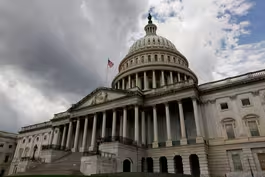
Disputes over debt, deficit could lead to federal shutdown
Video has Closed Captions
How disputes over the federal debt and deficit could lead to a government shutdown (5m 15s)

Families of hostages held by Hamas discuss potential deal
Video has Closed Captions
Families of hostages held by Hamas discuss weeks of agony and hope for release (9m 29s)
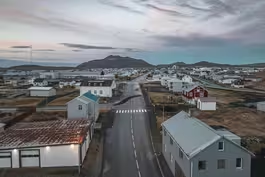
Iceland readies as major volcanic eruption appears imminent
Video has Closed Captions
Iceland scientists optimistic volcano may spare town as major eruption appears imminent (6m 22s)
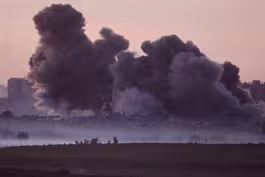
Israeli forces battle Hamas as hostage deal appears close
Video has Closed Captions
Israeli forces battle Hamas in Gaza refugee camp as deal to free hostages appears close (7m 12s)

Program reunites families split by climate-driven migration
Video has Closed Captions
Thailand program looks to reunite families separated by climate change-driven migration (8m 12s)
Providing Support for PBS.org
Learn Moreabout PBS online sponsorship
- News and Public Affairs

FRONTLINE is investigative journalism that questions, explains and changes our world.

- News and Public Affairs

Amanpour and Company features conversations with leaders and decision makers.












Support for PBS provided by:
Major corporate funding for the PBS News Hour is provided by BDO, BNSF, Consumer Cellular, American Cruise Lines, and Raymond James. Funding for the PBS NewsHour Weekend is provided by...