
November 22, 2023 - PBS NewsHour full episode
11/22/2023 | 57m 46sVideo has Closed Captions
November 22, 2023 - PBS NewsHour full episode
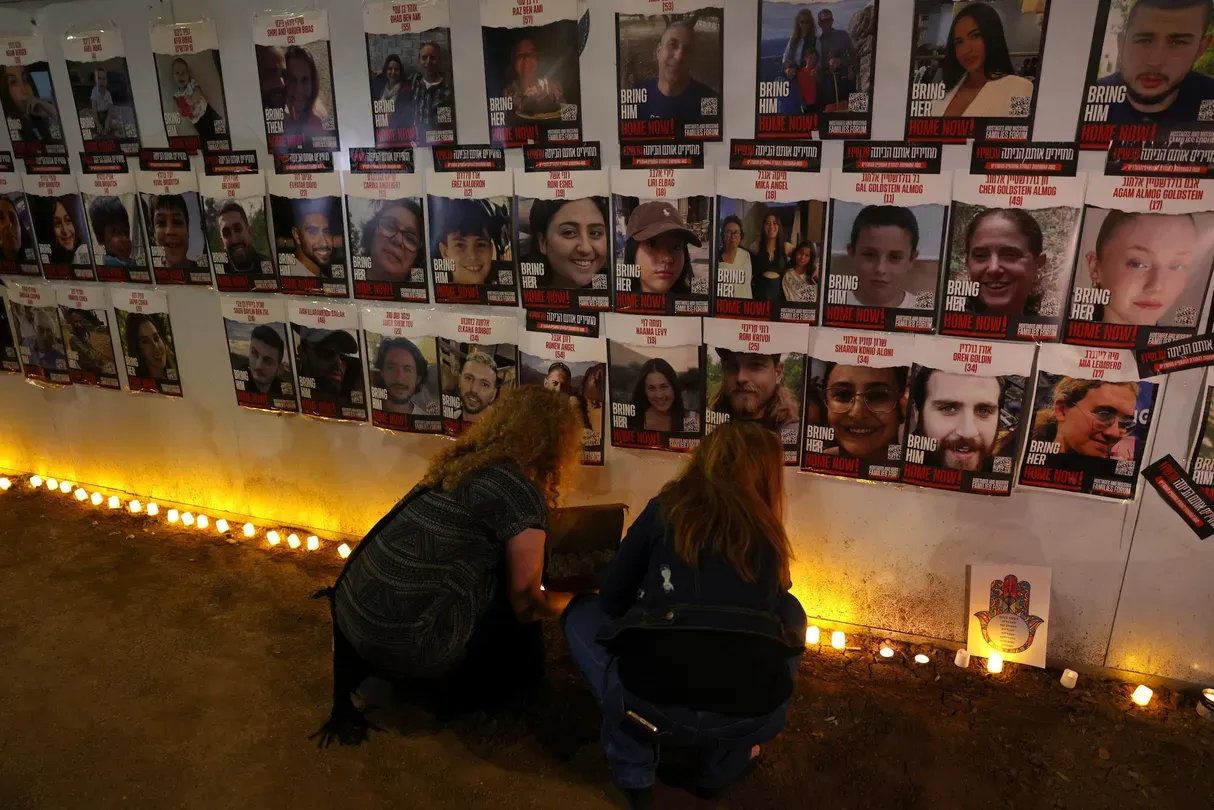
Wednesday on the NewsHour, Israel eagerly awaits the return of dozens of hostages after striking a deal with Hamas for a multi-day pause in the fighting. Sam Altman returns as the CEO of OpenAI just days after the company's board ousted him. Plus, as many prepare for a bountiful Thanksgiving holiday, a growing number of American families rely on food banks.
Problems playing video? | Closed Captioning Feedback
Problems playing video? | Closed Captioning Feedback
Major corporate funding for the PBS News Hour is provided by BDO, BNSF, Consumer Cellular, American Cruise Lines, and Raymond James. Funding for the PBS NewsHour Weekend is provided by...
November 22, 2023 - PBS NewsHour full episode
11/22/2023 | 57m 46sVideo has Closed Captions
Wednesday on the NewsHour, Israel eagerly awaits the return of dozens of hostages after striking a deal with Hamas for a multi-day pause in the fighting. Sam Altman returns as the CEO of OpenAI just days after the company's board ousted him. Plus, as many prepare for a bountiful Thanksgiving holiday, a growing number of American families rely on food banks.
Problems playing video? | Closed Captioning Feedback
Where to Watch PBS News Hour
PBS News Hour is available to stream on pbs.org and the PBS app.
Providing Support for PBS.org
Learn Moreabout PBS online sponsorshipAmna Nawaz is away.
On the "NewsHour" striking a deal with Hamas for a multiday pause in the fighting.
Sam Altman returns as the CEO of OpenAI just days after the company's board ousted him, raising questions about the future of artificial intelligence.
And as so many prepare for a bountiful holiday, a growing number of American families are relying on food banks.
CLARENCE ALLEN, New York Resident: Food sta ai But when I come down here, they give me enough to make it through the month.
(BREAK) GEOF After more than six weeks of heavy fighting, a pause in the battle between Israel and Hamas in Gaza will have to wait at least one more day.
Israeli officials tell "PBS NewsHour" there will be no hostages released or mi litary campaign until at least Friday.
The deal would lead to the release of at least 50 women and c and 150 Palestinians detained by Israel.
Nick Schifrin has the latest.
NICK SCHIFRIN: In the hours leading up to temporary peace, there's intensified war.
Israeli jets bombed several targets across Gaza today, including Khan Yunis in the south, where many from Northern Gaza had fled for safety.
When the bombing began, some were praying in a mosque, including Abu Ahmed Al-Agha.
ABU AHMED AL-AGHA, Gaza (through translator): This is an entirely residential area.
They bombed it completely.
The ones who were in these home here to find safety.
NICK SCHIFRIN: In Northern Gaza, Israeli soldiers fought This is fighting on Hamas' home turf inside the residential neighborhoods they use as bases.
The army released video filled with rocket launchers, tunnel shafts and hundreds of rockets.
MAN: Now we are in the tunnel just below the... NICK SCHIFRIN: And the IDF escorted journalists through what Israel calls extensive tunnels underneath Gaza's Shifa Hospital that Hamas used to move and fight.
All of this fighting will pause no earlier than Friday for carefully choreographed hostage and prisoner releases.
Hamas promises to release a dozen wo a total of 50.
And for each additio for an additional day.
Israel promises to release about 35 P A senior administration official said this round was supposed to include all 90 kidnapped children and women, but Hamas could only deliver 50, in part because it's not holding all of them, National Security Adviser Jake Sullivan told CBS Mornings today.
JAKE SULLIVAN, U.S. National Security Adviser: We do assess that other militant groups, even potentially criminal organizations, are holding some of the hostag to try to ensure that it can deliver on its side of the bargain.
NICK SCHIFRIN: In Israel, there remains a tension, the desire to see through th operation and its goal of Hamas' complete destruction and fulfilling the Jewish saying, saving one life is like saving an entire world.
RUEBENA GREENBLAT, Israel: Whatever deal they will come to, whatever number of people will come back, we are agreeing to everything.
Just, we need all the people back, children, mothers, elder, soldiers, everybody, everybody NICK SCHIFRIN: But some politicians opposed holding fire at all, and some Israelis who've lost family in previous terrorist attacks consider released Palestinian prisoners a threat.
MEIR SCHIJVESCHUURDER, Lost Family Members in B to Jerusalem.
This means that th don't know we can tolerate.
NICK SCHIFRIN: Today, the Israeli war cabi BENJAMIN NETANYAHU, Israeli Prime Minister (through translator): I want to be clear.
The war is continuing.
We will continue until we achieve NICK SCHIFRIN: In the occupied West Bank, the Abu Maria family is hoping their teenage son, Ube (ph), is on the list of released Palestinian prisoners.
FIDA ABU MARIA, Mother of Prisoner (through translator): I wish all the prisoners would be released, like those NI CK SCHIFRIN: The deal will also allow 300 humanitarian aid trucks to enter Gaza each day, more than three times the current limit.
Inside Gaza, for the displaced packed into overwhelmed shelters, that assistance and a pause in the fighting cannot come soon enough.
SAMEEH AL KAFARNA, Displaced From Beit Hanoun (through translator): We want many humanitarian cease-fires.
We want a full c NICK SCHIFRIN: For both sides, this was a da war, 47 days of waiting.
For the "PBS NewsHour," I'm Nick Schifrin.
GEOFF BENNETT: The Biden White House played a key role in negotiating the hostage deal.
I spoke with National Security Council spokesman John Kirby a short time ago.
Admiral John Kirby, welcome# back to the "NewsHour."
JOHN KIRBY, NSC Coordinator For Strategic Communications me.
GEOF And how many Americans are expected to be in this group?
JOHN KIRBY: We don't know exactly who's going to be in this first increment that will co out.
They will come back in smaller groups over the next few days.
We know that there are three Americans that we expect to be in this inst the whole group of 50.
We just don't kn And we certainly hope that they will be in at least one incre There are two American women and then there's young 4-year-old Abigail Mor -- actually, she turns 4 on Friday, as a matter of fact.
That's her birthday.
So we have every expec are women and children, that those two American women and young Abigail will be among them.
That's our hope.
GEOFF BENNETT: There be missing.
What more do JOHN KIRBY: We don't know a whole heck of a lot.
There are 10 total that we are An d we don't know for sure how many are all in that hostage pool, but we believe there are more Americans that are being held hostage, somewhere up to about 10 total.
And, again, we just don't know exactly where they are.
We don't have information about what condition We 're doing the best we can to get as much information as possible.
But, again, the focus on this first negotiation will be on women and children.
GEOFF BENNETT: Well, as you mentioned, the hostages are expected to be released over a period of four days.
Take us through the chor JOHN KIRBY: So, sometime over the next 24 hours or so, hopefully sooner than that, we will start to see the first hostages move.
And that will be commensurate with a humanitarian pause, a pause to allow for the safe passage of those hostages.
And when that safe passage -- it'll be announced by Qatar.
When that safe passage -- or -- I'm sorry -- when that humanitarian pause starts, then we can expect the hostages will start to move and we will be able to start moving more trucks of aid in over the course of those four days.
We're looking at hopefully several hundred trucks of food, water, medicine be included in the humanitarian assistance over those four days.
GEOFF BENNETT: Israel has said that, for every 10 additional hostages that are Is rael would pause the fighting for another 24 hours.
Could this pause then be extended indefinitely?
Is that something that the U.S. wants?
JOHN KIRBY: Well, the pause could be extended in accordance laid out.
I don't know that we c more hostages, it certainly would appear that Israel would be willing to keep the pause in place.
That would be a women and children.
We wan They shouldn't have been held hostages in the first place.
But we have to see.
I got to tel is for the four days, the 50-plus women and children, and getting that additional hum assistance in.
GEOFF BENNET What is the plan t aid into Gaza and into the hands of innocent civilians, the folks who need it the most?
JOHN KIRBY: We're working with the U.N., we're working with the government of Egypt and, of course, Israel to stack up as many trucks loaded as heavily as they can be with food, water, medicine, and now again fuel, which the Israelis have committed to, allowing to go in tens of thousands of gallons per day over the course of this pause.
And we're gettin in place -- and we're all obviously waiting# with bated breath to see# if it will g -- those trucks can be ready to roll through that R Before the war started, about 500 trucks a day were going into Gaza, not Ra fah, but about 500 trucks.
And now it's a combat zone, so it's a little bit mo But we have thus far been able to get roughly about 100 a day.
We fell short a few days.
We have exceeded i We think that this deal, if it's trucks in over the course of the next few days.
GEOFF BENNETT: Are there concerns that Hamas will use and to reorient for the potential fight to come?
JOHN KIRBY: That's always a concern.
When you're dealing wi allow them to regroup, refit, retrain, resource their troops.
That's always going to be a concern.
I know the Israeli They will certainly be watching An d that's why this negotiation does There was certainly an aspect here of some moral courage by the war cabinet and President -- I'm sorry -- Prime Minister Netanyahu to allow for this pause, because that could be a concern there, that Hamas might use that time.
That's one of the reasons why, quite frankly, we're not in favor o because that does benefit# Hamas to a fare-thee-well,# to allow them additional time and breathing space to prepare and plan for other attacks.
GEOFF BENNETT: Admiral, does this deal, once it's implemented, does i for future agreements, potentially?
JOHN KIRBY: It could.
It certain Again, we're foc The president was personally engaged in helping broker this deal.
We want to see it implemented.
And now we're at that moment.
So our focus is on the next few days and making su But could it open up other opportunities?
We certainly hope so, in terms of getting other hostages out assistance in.
GEOFF BENNETT: Understanding that the day after, on day five, when this pause lifts?
JOHN KIRBY: Well, again, we will have to see where we are.
I wish I could answer that It's difficult for us to put ou We want to see more hostages come out.
And if, at the end of the four days, there's to extend the pause, to extend the agreement, to allow more hostages to get out, that would be a great thing.
And we But, again, I don't want to get ahead of where We really are in the very early stages here of implementation And it's really important to all of us and I know it's important to all the families out there, the families of these hostages,# that this deal get implemented,# and get impl well.
GEOFF BE John Kirby, thanks for your time, We appreciate it.
JOHN KIR GEOFF BENNETT: In the day's other headlines: A vehicle exploded on the U.S. side of the border with Canada at Niagara Falls, killing two people and disrupting cross-border It happened at the Rainbow Bridge across Niagara River.
Officials then closed four other border crossings while they investigated on one of the travel days of the year.
Local officials said the ve did not appear to be an attack.
GOV.
And we have been on heightened alert since Th at's why it's so important for me to stand here and tel know at this moment -- and, again, anything can change -- there is no sign of terrorist activity with respect to this crash.
GEOFF BENNETT: Three of the affected crossings reopened later, but the in some rail travel.
The U.S. military has ca militia for a second day.
The strikes hit just south of Ba The militant group claimed eight members were killed and w This is the fourth round of U.S. retaliatory airstrikes in response to a near-daily spate of attacks on U.S. forces in Iraq and Syria by Iran-backed groups.
North Korea reportedly fired a ballistic missile into the sea today, but South Korea said the test ended in failure.
It came a day after the North lo oking on.
Meantime, the a show of solidarity.
Seoul also resumed aerial su In the Netherlands, the Dutch populist Geert Wilders appeared headed for a landslide election win tonight in the latest far right victory across Europe.
Supporters celebrated this evening in The Hague as projections showed Wilders' anti- anti-immigration party winning the most seats in Parliament.
He called for a governing coalition.
GEERT WILDERS, Candidate for Prime Minister, Netherlands (through translator): Now the And now we will also have to look for agreements with each other.
From a wonderful position with 35 seats, we can no longer be ignored by GEOFF BENNETT: Before the election, mainstream Dutch parties largely dismissed any talk of a coalition with builders.
Back in this country, Republicans he election Tuesday.
Celeste Maloy claimed vi delegation since 2019.
She succeeds Congressman Chris Stewart, w for his ailing wife.
And today marks 60 years since Sc enes from that day in 1963 of the presidential motorcade rolling through Dallas are still seared into the collective memory of an entire generation.
But historians say the passage of decades has taken a toll.
STEPHEN FAGIN, Curator, The Sixth Floor Museum: What has really shifted, though, for the 60th anniversary is the sad, but inevitable loss of sto So many of the voices that were here even 10 years ago to share their memories, law enforcement officials, reporters, eyewitnesses, those voices from history are rapidly fading away.
GEOFF BENNET a display of the flag that draped his coffin.
On Wall Street today, stocks got back in the plus column ahead of The Dow Jones industrial average gained 184 points to close at 35273.
The Nasdaq rose nearly 66 points.
The S&P 500 added 18.
And still to come on the "NewsHour": new reporting ri fle has in mass shootings; Columbia University faces intense scrutiny over its handling of hundreds of sexual abuse allegations; and the National Museum of Women in the Arts looks forward after a major renovation.
Sam Altman is back as the chief executive of OpenAI.
The hot tech start-up behind ChatGPT not only brought Altman back; it's also overhauling the board that fired him with new directors, ending a dramatic five-day standoff that's transfixed Silicon Valley and the artificial intelligence industry.
Mike Isaac is back with us.
He covers tech for The N All right, Mike, so Sam Altman was asked by By Monday, Microsoft announced that they'd hired him, which is when we last spoke.
And then, late yesterday, OpenAI says, actually, Sam Altman's coming back as chief executive.
What is going on?
(LAUGHTER) I do series of events over the past five days.
Basically, the subtext, I think, here is, essentially Microsoft, w partnership with OpenAI, was using their hiring of Sam and a lot of his executive team as a kind of bargaining chip to basically keep OpenAI still alive.
It's a very important A.I.
company for Microsoft.
A lot of investors have a lot of money tied up in it.
And they would have rather used an independent OpenAI than build the whole thing inside of Microsoft from scratch.
So, essentially, it was a bargaining sort of negotiation between OpenAI's small bo of directors versus Sam Altman and his sort of allies, as well as Microsoft.
And it seems like Sam Altman at least won for today.
We will see what the board looks like in the future, as they begin to expand it more beyo what's called a preliminary board that they just appointed.
GEOFF BENNETT: So what can you tell us about this new board, its current member their vision aligns with Sam Altman's vision?
MIKE ISAAC: Totally.
that, the composition of the board.
The previous board, basically, some of the cr Sam had been slowly whittling it down.
The new board is very revamped.
One person remains.
His name's Adam D'Angelo, fo He was the person trying to reign in Sam Altman for not being consistently candid, which is the reason they fired him.
And the other two are a ma who's seen kind of as a Switzerland, pretty neutral and pretty respectable guy in the valley, as well as Larry Summer, the former Treasury -- sorry -- Larry Summers, the former Treasury secretary of the United States and someone who actually sits on a number of other tech company boards and has a real, deep interest in A.I.
and how it'll affect the future of work and jobs across the world.
GEOFF BENNETT: So, when we spoke on Monday, you sort of fram versus safety versus the acceleration of the technology.
So now where do we stand?
What does all of this mean f sector?
MIKE ISAAC: So I think this -- the figh about.
their idea is push the tech forward as fast as possible so we can use it to help humans.
And there are the folks who are essentially like, let's slow this down and keep it safer.
And I think the newly reformed board, which will expand in the days ahead, is probably going to be more balanced and in the favor of checks and balances that weren't necessarily there before around Mr. Altman, who kind of plays fast and loose with safety, according to his critics.
I do think want this to happen ever again if they don't want the company to be killed by a revolt from its employees and its former CEO, now returning CEO.
GEOFF BENNETT: Yes.
to speak to you twice in# one the opportunity.
(LAUGHTER) MIKE ISAAC: Thanks, Geoff.
GEOFF BENNETT: We are going to shift our focus now to gun violence in America and the fraught question over whether the news media should show graphic images of the carnage it causes.
Does avoiding those images conceal the horror of that violence, or does showing them cause further trauma to people who have already suffered so much?
William Brangham picks up that conversation.
WILLIAM BRANGHAM: Last week, The Washington Post waded into this debate an images of the damage caused by AR-15-style weapons.
We're going to show a few of them in a moment.
Please be warned, they are very hard to look Th e series is called "Terror on Repeat" and includes some never-befo of recent mass shootings, like how this weapon punched clean through a metal door at Robb Elementary in Uvalde, Texas, where 21 were murdered, or how it can in just moments spray countless bullets across a church in Sutherland Springs, Texas, where 26 people were killed.
The images get worse, the corner of a classroom at Robb Elementary where wounded children and teachers waited over an hour for any help, in Las Vegas, the dead and wounded laying on a grassy concert field; 60 people were killed that night.
The last image in the series shows some of the victims in Uvalde gathered in a hallway waiting to be carried away.
Matea Gold is a managing editor at The Was Thank you so much for being here.
Extremely difficult reporting that you all have done.
There are more images in this series and a great deal of testimony from so me of these tragedies.
Could you help us understand a MATEA GOLD, The Washington Post: Sure.
We have been spending the last year examining the role And as part of that, in the spring, we actually did a piece that looked through illustrations at the impact that an AR-15 has on a human body.
That was a piece we managed very carefully.
We consulted with family members of victims.
We wanted to make sure in that process But we did want to try to illustrate the really specific destructive force of this w The reaction we got to that piece prompted us to have further conversations, because many in the public actually said we should be going further, that we were actually sanitizing the impact on the body.
And they wanted us t public.
So t Post newsroom, really wrestling with what we owed the readers and the public to show them about the impact of this weapon at a time when mass shootings are on track to really hit record numbers in the United States.
We are balancing that public service mission to rea real challenge with the desire to minimize harm as much as we could, to make sure we were sensitive to family members and survivors.
WILLIAM BRANGHAM: So, is it your sense that the American population does what these weapons, which were designed for the military, as you report, what they really do?
MATE this series is that there's a small group of Americans who have a unique th e destruction caused by AR-15s.
They are the victims, the family members, an And over and over again, we heard from them that what they saw was th at was something that will affect them the rest of their lives.
And it's something we realized that is sort of walled off from the public, jo urnalists don't have access to these crime scenes.
Much of the -- many of the crime scene folks th are kept private, in part because of new laws passed in the wake of the Newtown shooting.
And so, really, what the public usually sees are sort of the iconic images of the crime scene tape and then the memorials.
And we thought there was more to explore and wh at damage was really caused by these weapons.
It was very specific to the force of this gun.
WILLIAM BRANGHAM: A year or so ago, we had a conversation with Sandy Phillips, wh you know, is a mother who lost her daughter Jessi in the Aurora ma And Sandy is very pro cracking down on these weapons.
She has spoken very viscerally about what that weapon did to her daughter physically.
But she did not like this idea of images of readily identifiable individuals getting out there.
SANDY PHILLIPS, Mother of Shooting Victim: They can go online and to a watermelon and how it explodes a watermelon.
They can go online and see that damage that it does to a mannequin.
They can see damage that it does to a deer.
They don't need and they aren't privileged to see what that d And I don't want that image ever to be out there for anyone else to see.
So is that something that we as a society really want to do to the families that have already lost so much, had so much taken from them?
I hope not.
WILLIAM BRANGHAM: You did not show images of# any readily identifiable individuals.
But what do you make o be re-traumatizing to people?
MATEA GOLD: That was something we took incredibly seriously, and we had conversations with dozens and We heard from family members who felt that they thought very strongly that bo be shown, that that would wake the public up to the damage caused.
WILLIAM BRANGHAM: Should be shown.
Others f We made a decision in our reporting very early on that, if we were going to show bodies, we would only do that with the full consent of family members.
In the end, we decided it wasn't necessary for really the public to get a fu ll scope of the destruction caused by these weapons.
I think some of the power of the images in this piece are what is a see in the aftermath of what happens after the bodies are carried out of the room.
And we tried as much as possible to weigh how much we needed to put in this story against the effort to really make sure families did not feel traumatized by this.
The other step we -- we took a couple other steps, I think it's important to note.
One is that we went through a process of notifying survivor communities these mass shootings took place that we refer to in the piece days in advance to try to make sure we could spread the word as wide as possible that we'd be publishing this piece, that it could be something very difficult to see if you or someone you love has been in a mass shooting.
We wanted to give We also built in very specific warnings to readers and tried to use very clear language about what they would experience if they decided to go through the story and continue to scroll through each piece of it.
At every step, we want people to be ma they are ready to look at these images.
One of the things that's been so striking about th have written to say that they actually learned something very profound from this piece.
They felt that they did not fully understand what was happening in these incidents, and that was really, I think, what we were trying to achieve, which was a sense of real, clear understanding about what so many Americans have gone through.
WILLIAM BRANGHAM: That is the principal goal, in your mind, to hel as you described, this -- what this small circle of people understand?
MATEA GOLD: I think, if we are going to wrestle with this issue as a country, and it's impor for everyone to have sort of a shared sense of what we are talking about, our goal is just to present information, to present clear, powerful journalism that helps people underst the challenges that we face as a nation.
And that was really what we saw as our through line throu And I think the response has been very gratifying, because I think many, many people the fact that they have had the opportunity to understand what so many Americans have gone through.
WILLIAM BRANGHAM: MATEA GOLD: Thank you for having me.
GEOFF BENNETT: Data out from the federal government last week showed inflation eased through October.
And according to the Farm Bureau, the average cost of a Thanksgiving dinner actually decreased slightly this year to about $61.
But as special correspondent Fred de Sam Lazaro reports, s squeezing some families this holiday season.
FRED DE SAM LAZARO: More than an hour before it opens, the line starts to grow outside Today's Harvest in the St. Paul suburb of Oakdale.
Some have used the food pantry for year.
Others are visiting for the first time.
All are welcome, no questions asked, which, in a still challenging economy, me has gone through the roof.
JESSICA FRANCIS, Executive Dire about 420 families a week on FR ED DE SAM LAZARO: Jessica Francis is executive director of Open Cupboard, the nonprofit that runs Today's Harvest.
The organization's food comes from gro And it relies on volunteers to keep everything running.
JESSICA FRANCIS: We have faith every day that it's going to work out and that to have enough food for everybody that's going to come through our door today.
And, every day, it does.
But there are days, probably, FRED DE SAM LAZARO: Thirty-seven-year-old Lisa relies on Today's Harvest for fruits, vegetables, and meat.
Are these just outside of your budget in a LI SA, Mother: Oh, yes.
And it's like, well, one pound is good for a meal.
(LAUGHTER) a homeless shelter with her son.
She's been sober for three years and has LISA: I envision being independent from all of this and being able to help people with it instead.
But, right now, I need the I can help other people.
FRED DE SAM LAZARO: Across Minnesota, v have skyrocketed from about 3.6 million in 2021 to more than 5.5 million last year.
And that number is expected to reach seven million this year.
COLLEEN MORIARTY, Executive Director, Hunger Solutions Minnesota: It's just not an e food system anymore.
It started out to be t But now it is the way many, many f FRED DE SAM LAZARO: Colleen Moriarty leads the St. Paul nonprofit Hunger Solutions.
She points to inflation driving up the cost of food coupled with the rollback of federal benefits like SNAP, once known as food stamps, which were temporarily increased during COVID.
COLLEEN MORIARTY: Not being able to count on the fact that you're going to have enough money and the cost of food to replace whatever it is that you need is unattainable for many people.
FRED DE SAM LAZARO: Despite explosive growth re latively well off when it comes to food security.
Many other regions of the country are seeing far greater need.
In East Harlem in Manhattan, New York Common Pantry had already been a big provider o food assistance before COVID, supplying grocery packages every two weeks and a daily hot meal for those in need.
Like in the Twin Cities, the easing of the Stephen Grimaldi is the executive director of New York common pantry.
STEPHEN GRIMALDI, Executive Director, New York Common Pantry: Before the pandemic, we were serving abo We're on pace to serve about 11 million meals this year.
FRED DE SAM LAZARO: About 40 percent of each package given out is fresh fruits and vegetables.
The Pantry supports nearly 200 locations around the city, but this is its biggest location and the line stretches all the way around the block.
The organization is distributing 6,000 turkeys this Thanksgiving.
DOLORES MARTINEZ, New York Resident (through translator): The turkey and the other goods that I get today.
FRED DE SA She immigrated from the Dominican Republic and lives with her son in Manhattan.
She has big plans to share the food she's getting today with her extended family.
DOLORES MARTINEZ (through translator): I'm taking the turkey and other items we will need from this cart, because they don't have much money either.
This is a great, great help.
STEPHEN GRIMALDI: So we're seeing increases Th ere is a big spike in demand from asylum seekers.
Last year, we saw a good number of asylum seekers.
But we're at a pace about a 600 percent increase this year.
FRED DE SAM LAZARO: Since last spring, more than 126,000 asylum seekers have arrived in New York City.
And, as of last month, m One of those shelters is a former jail around the corner from New York Common Pantry housing up to 500 people.
The influx of asylum seekers comes as New high levels of food insecurity.
An estimated 14.6 percent of New York City residents experien Nationwide, the figure is almost 13 percent, which is up from just over 10 percent in 2021; 74-year-old Clarence Allen lives on a fixed income and has been coming here to stretch his budget since the onset of COVID.
Like one in five New Yorkers, he also relies on SNAP.
CLARENCE ALLEN, New York Resident: Well, food stamps ain't enough.
All right.
And, But when I come down here, they give me enough to make it through the month.
FRED DE SAM LAZARO: Like in Minnesota, Grimaldi says the rollback of pandemic era benefits and inflation have been hurting everyone.
STEPHEN GRIMALDI: You have got folks who now can't afford to buy the serve here.
And a for them as well.
So it's th to buy more food to help folks who are really struggling.
FRED DE SAM LAZARO: That struggle persists nationwide and year-round.
COLLEEN MORIARTY: I really admire all the efforts to bring more at this time of year, because, certainly, when you sit down to a huge meal and you think of someone having nothing, that's a problem.
And the donations go up at that time of year So what I want to say is this.
Hunger can strike anyone.
FRED DE SAM LAZARO: And those tackling this Fo r the "PBS NewsHour," I'm Fred de Sam Lazaro in Oakdale, Minnesota.
GEOFF BENNETT: Fred's reporting is a partnership with the Under-Told Stories Project at the University of St. Thomas in Minnesota.
A new expose is revealing years of abuse and assault by a respected doctor at a top university medical center.
And the Ivy League sch to stop him.
Amna recorded this c AMNA NAWAZ: Columbia University has apologized to thousands of women for allowing a to continue practicing medicine unchecked after he sexually assaulted patients for over two decades.
The university h Dr. Robert Hadden was convicted in federal court last January and sentenced to 20 year in prison for enticing four patients to cross state lines, where he examined and assaulted them.
about his behavior.
Laura Beil is the co-autho Women, Undermined Prosecutors and Protected a Predator For More Than 20 Years" and host of the Wondery podcast "Exposed," which brought to light Hadden's assaults and the university's failure to act.
Laura, welcome.
Than LAURA BEIL, Host, "Expos AMNA NAWAZ: So, before we# role, help us understand the ex abuse between the early 1990s and his first arrest in 2012.
What were women saying happened, and how many women are we talking about?
LAURA BEIL: Well, to the last question, we actually don't know how many women we're talking about.
thousands, given the length of time of his practice.
He came to Columbia in the late 1980s as a resident and started practicing a member of the faculty.
And from what we can tell, he The earliest patient that we talked to was a patient of his in 1992.
She was 16 years old at the time.
And so, during the course of two decades, he saw thousands and thousands of women.
And we really don't know yet the extent of his abuse, but we do know that it was pretty extensive.
AMNA NAWAZ What is it that women were sa They were being abused during LAURA BEIL: Yes, they were being abused during the medical exams.
He did have certain patterns.
Sometimes -- a typical pattern is that he an d then the chaperone would leave, and he would find an excuse to reenter the room and saying, "Oh, I forgot something that I needed to do."
And when he was alone with them, he would abuse them.
But, that said, there were also women who said that they were abused while a chaperone was in the room.
So he pretty much took e a medical exam.
AMNA NAWAZ: And some What was the response for all those years?
LAURA BEIL: Yes, we documented women who tried to tell people at Columbia for ye Sometimes, the women would# have trouble articulating# it, as you might imagine, given the breach of trust and the trauma.
And they would try to Dr. Hadden, I find him creepy."
But there were instances where women we One woman in 1993 had one appointment with him just befor She sat down and wrote a multipage letter to the chairman of the department describing in detail what had happened to her.
So, it varied, but there were definitely warnings.
Columbia failed to act.
The warnings were dismissed.
The women were not believed.
If you're going to protect your patients from is to actually believe that someone like Hadden can exist at your institution.
And so, on multiple occasions, the women's complaints were just dismissed or ignored.
AMNA NAWAZ: In 2012, there's a woman named Laurie Kanyok, who'd recently had a baby.
She went in for a follow-up, an exam with Hadden, and she was assaulted.
She reported it immediately.
That, in 2012, is what leads to He gets a plea deal then, and he avoids jail time.
And you talked to Laurie as part of your podcast.
This is a clip from your podcast in which she's remembering when she wo uldn't go to jail.
LAURIE KANYOK, Patient: And she sa He's taking a plea deal, and yo And she goes: "The thing is, he's not going to have any jail time, but he is going to lose his medical license around the world.
And that's what you wanted to happen.
Am I right?"
And I was like, what -- why is that a AMNA NAWAZ: Laura, what happens to Hadden after that arrest and plea deal?
LAURA BEIL: He went home.
He went home.
And that was just one of I mean, another huge one in Laurie's case was, after she called the police, after Hadden was arrested in his office the day of her assault, Columbia made the decision to let him go right back to work.
And he continued to see women fo AMNA NAWAZ: There is this turning point, when Evelyn Yang, who is actually the wife of former presidential candidate Andrew Yang, who was also assaulted, comes forward.
This is actually how she described her assault in a CNN interview.
EVELYN YANG, Patient: I was confused, and then I realized what was happening.
And then I just kind of froze, like a deer in headlights, just frozen.
I knew it was happening.
I remember trying to f his face as he was assaulting me.
I was just waiting for it to be over.
AMNA NAWAZ: Laura, why was that interview so i LAURA BEIL: And, at the time, her husband was running for presiden that she had a platform to reach a lot of women.
And she made the very difficult decision to go public on CNN.
And that interview aired in January of 2020.
And immediately after that interview aired, women started coming forward in At the time of the interview, there were maybe about 30 women who had come forward.
A couple of months later, there were 90.
And so, when that happened, the scope, the true scope o clear.
predator in New York history.
The scope became clear, and that caught the attention of the fed The FBI started investigating him.
And then, in the fall of 2020, he was recharged AM NA NAWAZ: Laura, Columbia has announced# the settlement fund, also# an exter But how do the survivors that you talk to feel about those act LAURA BEIL: The survivors I have talked to have mixed feelings about it.
On the one hand, they're happy that Columbia is finally taking steps to do th notifying women, an independent investigation.
These are things that they have called for, for a long time.
They are skeptical about the settlement fund, about the amount of They have healthy skepticism, but they're also happy to see Columbia finally moving in the right direction and trying to do the right thing.
AMNA NAWAZ: That is Laura Beil, host of the Wondery podcast "Expos Laura, thank you for your extraordinary reporting and for joining us today.
LAURA BEIL: Thank you.
GEOFF BENNETT: In leading museums these days, women artists are gaining more prominence, including in major exhibitions, but studies of acquisitions and overall exhibitions show just how much the gender gap remains.
One institution, the National Museum of Women in the Art dedicated to the creativity and work of women,# and recently reopened after# an extensive renovation.
Jeffrey Brown paid a visit for our arts and culture series, Canvas.
JEFFREY BROWN: When Petah Coyne was just starting out as a young unknown artist in New York in the early 80s, both the work and the artist herself took some by surprise.
PETAH COYNE, Artist: When I was doing proposals for other cities, I would write what I wanted to do, and then they would be at the airport with my name on a sign, and I would get off and they would go: "Oh.
Oh, we didn't think you were a woman."
And I said: "Oh, you thought I was a man."
"Well, no, we didn't think you were a man, And I'm like: "OK. Well, here we are."
JEFFREY BROWN: Today, Coyne's he re at the newly renovated and reopened National Museum of Women in the Arts in Washington, D.C.
They're extraord and, important to Coyne, they take up space.
PETAH COYNE: I just -- I feel like the work has to be big.
And it's all about scale.
If this was small and petite, I think it would look goofy.
It would look like a little Christmas decoration.
I'm not into Christmas decorations.
I'm into, like, I want you to feel wha I want you to walk up near it and have it there in your space, the same way it felt to me.
JEFFREY BROW that greets the visitor, Niki de Saint Phalle's Pregnant Nana, following a two-year $70 milli overhaul that has opened up its floor plan, enlarged its galleries, and given it the ability to show and hang larger works.
And it's an experience with a very specific missio Katie Wat.
wa nted I think there are conventional ideas about what women artists do or how their art looks.
JEFFREY BROWN: And what is the statement?
KATIE WAT: The statement# is that women's is illimitable.
It just doesn't know any bou JEFFREY BROWN: The museum, the first in the U.S. solely dedicated to wom in 1987 by Wilhelmina Cole Holladay in what had been a Masonic temple, ironically a building from which women were once barred.
As the story goes, on visits to European museums of 17th century Flemish artist Clara Peeters, a contemporary of Rembrandt, but were shocked to find no mention of her in art history books.
They set about to collect art by women, which became the basis for the museum.
Now its galleries are arranged around themes showing how women have tackled certain subjects, materials, even colors over time.
Artists of the past such as Lavinia Fontana, Frida Kahlo, Berthe Morisot are connecte to contemporaries such as Petrina Hicks, Jaune Quick-to-See Smith, and Faith Ringgold.
There are artists such as Amy Sherald, whom the museum showed before she became well-known for her portrait of Michelle# Obama, and large-scale# works by artists including Sonya Clark, Alison Saar, and Rina Banerjee in a special inaugural exhibition Katie Wat curated th e Limit.
KATIE WAT: And it's sort of inspired by the landscape of Rio de Janeiro and Carnival and so forth in terms of its color and vibrancy the shapes of it and so forth.
It weighs 450 pounds.
JEFFREY BROWN: What you're feeling is that people still don't expect this th e scale of work, from women.
KATIE WAT: Yes, I think it's true.
I think toward working on a smaller, more diminutive scale.
We want to blow that idea out of the water with this kind of show.
JEFFREY BROWN: But is a museum dedicated to women's art still need been in the 1980s, when the art collective# Guerrilla Girls were creating# their direct-confrontati advocacy art?
Much has changed.
As seen in exhibitions we an d contemporary Americans such as Sarah Sze, and for Petah Coyne herself.
You're exhibited in galleries and museums around the country, around the world.
Is it still important for you to have work here in this museum?
PETAH COYNE: Oh, absolutely.
JEFFREY BROWN: Why PETAH COYNE: I think it's sad that we have to This is what's sad.
I am one of the privileged, I am.
And maybe becaus that are not blessed, I -- and are good -- there are so many good women artists that do not get airplay.
And it's just -- it's terrible.
So, they -- this museum must exist, and I think it shouldn't be the only JE FFREY BROWN: Coyne and museum officials cite damning statistics, including a recent survey of 31 U.S. museums showing that just 11 percent of acquisitions and about 15 percent of exhibitions between 2008 and 2020 were of work by women.
KATIE WAT: I have seen changes over the past# couple of years, and they# ha But I don't know if this is a sea change or if this is the swing o I think that remains to be seen, and so I think our work is still very critical.
JEFFREY BROWN: Is it possible to you to imagine a day when this museum is no KA TIE WAT: My hope is that we will reach that day.
I do think, though, that there's always going th e leaders on this topic, and keeping it in the forefront of folks' mind as we go forward, leading not just for sort of gender equity in the arts, but all kinds of equity in the arts.
JEFF in the Arts in Washington, D.C. GEOFF BENNETT: And that's the "NewsHour" for tonight.
Remember, there's much more online, including a look at seasonal affective disorder, or SAD, which affects some people as the days get shorter, and what treatment options are available.
That's I'm Geoff Bennett.
Thanks for spending part of your eve Have a good evening.
Columbia slammed for ignoring complaints about OB-GYN
Video has Closed Captions
Columbia Univ. faces scrutiny for ignoring complaints about OB-GYN who abused patients (8m 10s)
Fighting continues in Gaza ahead of hostage release
Video has Closed Captions
Fighting between Israel and Hamas continues in Gaza ahead of pause for release of hostages (11m 53s)

Inside the renovated National Museum of Women in the Arts
Video has Closed Captions
A look inside the National Museum of Women in the Arts after its major renovation (7m 10s)

More American families rely on food banks amid high prices
Video has Closed Captions
More American families rely on food banks as high prices squeeze budgets (7m 1s)

New report reveals graphic aftermath of mass shootings
Video has Closed Captions
Report showing graphic aftermath of mass shootings raises questions about avoiding images (8m 36s)

Why OpenAI brought Sam Altman back as CEO
Video has Closed Captions
Why OpenAI reversed course and brought Sam Altman back as CEO (4m 27s)
Providing Support for PBS.org
Learn Moreabout PBS online sponsorship New Episode
- News and Public Affairs

Today's top journalists discuss Washington's current political events and public affairs.
 New Episode
- News and Public Affairs

FRONTLINE is investigative journalism that questions, explains and changes our world.
 New Season
 New Episode
 New Episode
 New Episode
 New Episode
 New Episode

 New Episode
 New Episode
Support for PBS provided by:
Major corporate funding for the PBS News Hour is provided by BDO, BNSF, Consumer Cellular, American Cruise Lines, and Raymond James. Funding for the PBS NewsHour Weekend is provided by...