Vermont This Week
November 22, 2024
11/22/2024 | 26m 37sVideo has Closed Captions
State officials peg shelter cost at $3M, with large share for contract staff
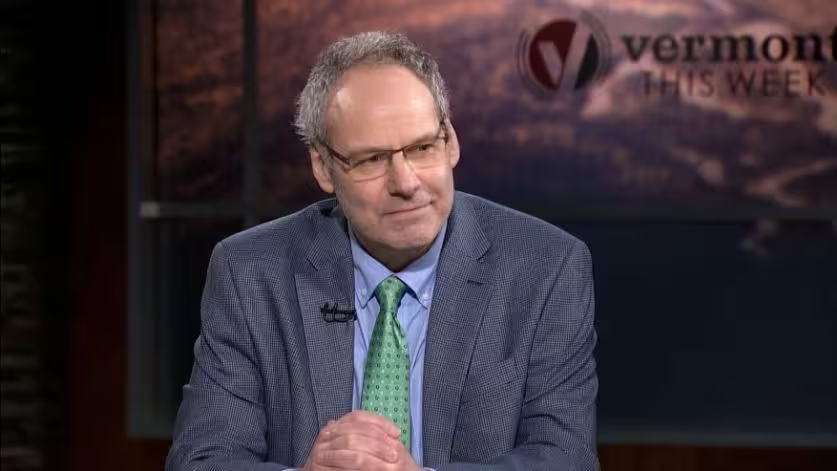
State officials peg shelter cost at $3M | Trump deportation plan spurs calls for protections for Vt. farmworkers | Burlington police chief won’t seek reappointment in 2025 | Panel: Mikaela Lefrak - Moderator, Vermont Public; Carly Berlin - Vermont Public/VTDigger; Peter Hirschfeld - Vermont Public; Katharine Huntley - WCAX.
Problems playing video? | Closed Captioning Feedback
Problems playing video? | Closed Captioning Feedback
Vermont This Week is a local public television program presented by Vermont Public
Sponsored in part by Lintilhac Foundation and Milne Travel.
Support provided by:


Vermont This Week
November 22, 2024
11/22/2024 | 26m 37sVideo has Closed Captions
State officials peg shelter cost at $3M | Trump deportation plan spurs calls for protections for Vt. farmworkers | Burlington police chief won’t seek reappointment in 2025 | Panel: Mikaela Lefrak - Moderator, Vermont Public; Carly Berlin - Vermont Public/VTDigger; Peter Hirschfeld - Vermont Public; Katharine Huntley - WCAX.
Problems playing video? | Closed Captioning Feedback
How to Watch Vermont This Week
Vermont This Week is available to stream on pbs.org and the free PBS App, available on iPhone, Apple TV, Android TV, Android smartphones, Amazon Fire TV, Amazon Fire Tablet, Roku, Samsung Smart TV, and Vizio.
Support the crew
Help Mitch keep the conversations going as a member of Vermont Public. Join us today and support independent journalism.Providing Support for PBS.org
Learn Moreabout PBS online sponsorshipOfficials say two temporary state run shelters for families experiencing homelessness will cost an estimated $3 million for five months of operation.
Plus, president elect Donald Trump's deportation plan spurs calls for protections for Vermont farm workers.
And Burlington's police chief announces he won't seek reappointment in 2025.
That, and more ahead on Vermont this week.
From the Vermont public studio in Winooski.
This is Vermont this Week.
Made possible in part by the Lintilhac Foundation and Milne Travel.
Thanks for being with us.
I'm Mikaela LeFrak.
It's Friday, November 22nd.
Joining us on Vermont.
Vermont, this week's panel.
Today we have Pete Hirschfeld from Vermont Public, Carly Berlin from VtDigger and Vermont Public, and Katherine Huntley from WCAX.
Thanks, everyone for being here.
So let's start, Carly, with some reporting that you have been working on recently.
Now, viewers might remember that a few months ago, the state evicted over 1000 people from motels and hotels as part of this downsizing effort of the emergency motel housing program.
Now we're heading into winter and the state is starting to get ready to open up some new temporary shelters for families.
First, why this shift from the emergency motel housing program towards temporary shelters?
Right.
So these shelters opened at the beginning of this month or two.
One in Waterbury, one in Williston.
And they came on the heels, as you're saying, of this massive of evictions from the motel program.
We saw a similar move from the governor's administration back in March to stand up shelters for people to go to.
When we went through another round of, you know, motel policy program changes and and the reaction here, you know, came after calls from lawmakers and service providers and, you know, just the public generally, after seeing particularly families experiencing homelessness, living outside after losing their motel rooms.
So we saw these, these shelters, open up for the winter months, you know, beginning of November through now, at the end of March.
It takes a lot to stand up a temporary shelter.
Do we know how much these are going to cost?
Right.
So these will cost an estimated $3 million to operate for those five months through the winter.
And where when they, they're open now and the costs are from your report it sounds like they're primarily coming from staffing needs.
Can you explain how how that all works.
Yeah.
Exactly.
So these shelters are run by the state directly which is kind of unusual.
But the state wanted to try and find local service providers to run them, and they failed at doing that.
Providers said they simply didn't have the bandwidth to turn around so quickly to operate new family shelters this winter.
And so, in the absence of that local provider coming through, the state sought an out-of-state contractor to help them staff these shelters, enter and I saw that in your reporting.
You have some documentation about this contract, and you reported that a, a so-called shelter team member will be paid, $107.50 an hour.
That's before overtime.
Is is that industry standard?
No, it's definitely a lot higher than what shelter workers make in Vermont.
And when I asked the Department for Children and Families Commissioner Chris Winters about this, he said, basically, you know, on, a quick turnaround for a temporary time frame, they had to pay a premium to get these shelters staffed, and that's what it would cost you.
It.
Well, in just a moment, we'll talk a bit more about some longer term solutions to Vermont's housing shortage that you've been covering.
But first, Catherine, in Burlington, there is this community of shelter pods for people who are experiencing homelessness.
And you've been following this, this kind of housing experiment since it first opened.
How does it appear to be faring?
Well, it was really sort of touch and go at the beginning, because there are pretty strict rules that people have to follow to be in there.
And Champlain Housing Trust can essentially evict people when they want.
So and anyone that lives sort of in the neighborhood knows it was pretty rough the first summer where there was lots of issues around there.
A lot of people loitering and stuff, but I was just speaking with Michael Monte and kind of in this next year of it, it has been much calmer and people have really seemed to settle in.
He was very happy to report that six people, around six people, have moved out into actually permanent housing.
And I was lucky enough to go into some of these, permanent housing to speak with them, you know, from the pods to permanent housing, how they've been faring.
And they told me that, you know, the the pods really gave them the stability to be able to take that next step, to get out of a bad situation and take that next step, you know, and other people, you know, haven't, haven't enjoyed the pods, I guess, as much.
But ultimately they have been a roof over people's head and a city that desperately needs roofs over people's heads.
So originally this contract, I believe, was supposed to run out after three years and, you know, Champlain Housing Trust was interested in maybe building a permanent housing building.
But, it seems as though the crisis is so bad right now of people just needing somewhere to be that they are going to look into extending this pod shelter community for at least a few more years is especially important right now as we head into those cold winter months.
Carley, one more question for you about the the, temporary shelters and that contract said it's going to cost about $3 million.
So the state is is trying to to cut down on costs going towards housing people who are experiencing homelessness.
So how does the administration, how does Governor Scott Square that that 3 million.
Where does it come from?
Exactly?
Right.
I mean, I think that's that's a great question.
You know, it is pretty clear that, you know, on a per household, per night basis, these shelters are more costly than, you know, simply keeping people in motel rooms.
The idea here is that, you know, people will be more connected to services at these shelters and will hopefully be able to move into more stable, long term housing as they come out of them.
So that's that's the kind of gamble here.
We also recently got some positive news from the housing world.
A developer is moving to preserve subsidized senior housing in Morrisville.
What happened there?
Yeah, sort of an interesting story.
So Copley Health Systems, which owns Copley Hospital in Morrisville, also owns this subsidized senior apartment complex there.
Around this time last year, they were trying to, to use some of the apartments in that building to house hospital staff, basically kind of traveling, you know, travel nurses, things like that in that building.
They had built the apartment complex 40 years ago with some funding from HUD that basically said it has to be affordable for 40 years.
That 40 years came up.
They were looking to see if they could do something a little bit different with that building.
Meanwhile, you know, the older folks living there, many of whom on fixed incomes were really worried about the future of of, you know, being able to stay there even though the health system had said, you know, we're not going to kick people out.
Fast forward to now, the affordable housing developer Evernorth, is moving to acquire that building, to keep those apartments, permanently affordable.
Yeah.
It's so interesting to hear how, you know, the, the importance of preserving that type of housing for, for folks who are elderly and need subsidized housing.
But then there's this, you know, kind of equivalent, shortage of, of housing for hospital workers, too.
And the, the state's housing shortage is really, you know, sometimes pitting two groups who are very much in need.
Yeah, absolutely.
A push and pull there.
Exactly.
Well, let's turn now to national news and the ways in which our region is preparing for the next presidential administration.
In just over two months, Donald Trump is going to be inaugurated for his second term.
And on the campaign trail, Donald Trump repeatedly made a promise to carry out, quote, the largest deportation program in American history.
And his borders are.
Tom Homan is now actively getting those plans in place.
Pete, you have been looking into how this policy could affect Vermonters.
What have you learned?
Yeah.
So as you mentioned, the president has made this grand campaign promise multiple times over the course of the campaign that he's going to deport all of the estimated 11 million or so, Americans who are living in the country without legal authorization.
And, he's also simultaneously referred to this population as being bloodthirsty criminals.
He's used the word words like vermin to describe them.
And so there's there's a bit of a lack of clarity, right now on what did he really mean?
Right.
Is he talking about going after everybody that's in the country illegally, or is he only talking about people, that have committed crimes?
That's an unanswered question that we don't have yet.
But folks who live in Vermont, say, in the meantime, we need to take him at his word, and we need to assume that when he's talking about doing this, that that deportation effort is going to include, for instance, the 1500 immigrants who live and work on Vermont's dairy farms.
And so we've got groups like migrant justice groups like the ACLU saying the state leaders, look, if we want to protect these folks and make sure that they are continue, you know, can continue to live in our communities.
Provide their labor to our agriculture industry, then we need to take some steps to make sure that that doesn't happen.
So what kind of control can local and statewide authority have over this, if it's coming down from the federal government?
Yeah.
One thing that everybody agrees on is that if the federal government were to succeed in an endeavor like this, this sort of mass deportation that Donald Trump has talked about, it would require an unprecedented level of cooperation and collaboration from state and local police agencies.
So what we've already done in Vermont is there's a state law that says they can't, enter into contracts with with Ice, for instance, that would allow them to become de facto arms of federal immigration enforcement.
We've also adopted a fair and impartial policing policy that says, hey, state and local cops.
There's a bunch of information that we're not going to allow you to share with federal immigration authorities if, for example, you pull somebody over for speeding, what we have not, prohibited in Vermont is the sharing of a person's immigration status or citizenship status.
That's one key.
Ask for migrant farm workers and their allies.
They say, look, we need a fair and impartial policing policy that says state cops.
Local cops cannot share information about a person's immigration or citizenship status with Ice.
With Border Patrol, state officials, including Attorney General Charity Clark, including the executive director of the Vermont Criminal Justice Training Council, say, look, we're we have the same goal here.
We don't want to see these folks deported, but there's a federal law that prevents us from instituting that kind of prohibition.
And so that's the tension right now in the back and forth.
And some, some ground, that Migrant Justice and the ACLU were looking to gain as this conversation continues.
And one of the most interesting parts of your story to me was what's happening in one town, Richmond.
Can you tell us a little bit about that?
Yeah.
So so Richmond has heard the same legal argument, that federal law says you cannot adopt a policy that prevents the sharing of citizenship and immigration status.
But they said we've had hundreds of people turn out to local forums about this precise issue.
And they've told us they don't care what the law says.
A lot of them think that that that law is unconstitutional.
And they say the priority needs to be making sure that everybody in our jurisdiction knows that they are they are safe here, that if they reach out to public safety authorities, for any reason, they're not going to, put themselves in danger of being arrested and deported by the feds.
And so they submitted a fair and impartial policing policy, that was in conflict with federal law, but because it said you can't share immigration status with a federal authority.
But they were told by the Criminal Justice Training Council that they could not adopt that policy.
That policy couldn't be certified because of that conflict with federal law.
So they're pondering next steps right now and trying to figure out how to move forward as a community in ways that, honor the principles, of that town.
And, and also are in harmony with state and federal law.
Well, it was a fascinating look at what one specific town is doing, in the face of this major change that our whole country is facing here in Vermont.
We are in, I don't know what you would call it, a pre-season or spring training.
Ahead of the next legislative session, which kicks off at the beginning of January.
And Pete, I think what we can all agree that the topic at hand this session is going to be property taxes.
Property taxes, property taxes.
Right.
Certainly at the outset, Senate Democrats met for the first time last weekend, after the election.
And Senate President Pro Tem Phil Berreth said to his colleagues, the governor isn't and isn't going to declare a public emergency over property taxes, but we are going to treat this issue as though it is a public emergency, and we're going to devote the first two weeks of the session exclusively to that issue, at least in the big money committees and in the education committee.
So, the pro tem said, what we've heard from the public in this election is that they want us to put Governor Phil Scott's ideas as it relates to property tax relief at the top of the agenda, he said.
That's literally what they're going to do.
And the Vermont Democrats have also been shaking up their, shaking things up in terms of their leadership as well.
They recently elected a new majority leader, Keisha Rahm Hinsdale, a state senator from the Chittenden County area.
Carly Mitchell was a major force on a committee that you had to follow closely for your beat around housing and land use and zoning.
Tell us a little bit about what this shift means for her.
I'm really curious to see.
I mean, we'll we'll see if she gets to continue chairing the committee now that she's majority leader.
Definitely some some conflict and tension around that.
But she has been really influential in shaping things like the Home Act in 2023, which effectively up zoned the whole state, loosened zoning to to encourage more housing growth.
So it's been a real, you know, she's been often in alignment with the governor's administration on housing policies.
And so I think she's looking to to work closely with the administration and, and, you know, continue championing some of those things.
And it seems like this change in leadership in the state Senate is is part of a piece of what we're seeing nationally with Democrats right now, like what just happened?
You know, you have all the postmortems.
People are trying to figure out what went wrong for Democrats nationally in their own states.
And, a lot of leaders are paying the price by by losing those leadership positions.
The folks that wanted to see Karen from Hinsdale become majority leader next year felt like Democrats need to do a much better job communicating with the public about what they're doing and why.
And you hear a lot of that right?
Concerns about communication.
What we obviously weren't it's not that what we were doing is wrong is that we weren't helping people understand exactly what it was we were doing and why.
So they think that she is going to be somebody who can, land on the kind of succinct, compelling messaging that is going to be able to reconnect with the party, you know, with the working class voters that it's going to need to, to be successful in the future.
And it sounds like she will be stepping down from that committee chairmanship.
So we'll see soon.
I don't know if we're the only people who really care about this stuff, and it's exciting to me to figure out who's going to be on all of these committees as we head into the next legislative session.
So I guess we're all in the right jobs.
Let's turn out to some big news out of Vermont's biggest city.
Catherine, you've been reporting on how Burlington's police chief, John Murad, is not going to be seeking reappointment in 2025.
This is a major implications for his department, which is it sounds like he's been rather beleaguered in recent months and even even years.
Tell us a little bit more context here.
Yeah, months and years, I think is a great way to put it.
Even morale is definitely at the top of the list of something.
I think a new chief will want to attack first.
I mean, even before 2020, morale was still pretty low in the department.
I've heard from the police union, and it seems as though, you know, Chief John Murad has had kind of this really tumultuous time.
I mean, he took over weeks after the murder of George Floyd, you know, in this, like, era of racial reckoning.
And when he took over July 1st, 2020, the Burlington Police Department had 92 sworn officers.
Two years later, on July 1st, 2022, they had 61 sworn officers.
And those aren't the officers on the streets.
Those are the officers sworn.
You know, there's officers who are deployed, there's officers at the airport, you know, so the Burlington Police Department has had a significant, you know, time trying to just figure out how to bridge this gap.
They have under his tenure, they have really expanded unarmed positions, community service officers, you can respond to, you know, lower level, lower tier, issues in the city, community service liaisons, people who are going on social workers.
So the department has as it's kind of shrunk, it's expanded in other ways, but after all this time, he's now decided after more than four years on the job, he doesn't want to seek reappointment.
But this creates kind of a power vacuum, I guess, of sorts, because he announced that he's leaving.
One deputy chief, one of the two deputy chiefs, just retired in September, and another one is set to retire.
In the springtime, right around when Murad is supposed to be leaving.
So we have the top three members of the Burlington Police Department will not be here come April.
So now what does a search look like?
The last search that was done, resulted in really two candidates, one of which dropped out, the other of which was John Murad.
So I think, the police union is worried about morale and how that will attract or detract people from coming to the police department.
But, other community leaders want someone who's going to be really socially minded and want to come in and, you know, continue work that's been done and communicate with the public and kind of get the department on a path where they can, you know, recruit the officers that they really say they need.
And as the Burlington Police Department works to recruit officers and a new chief there, they're in competition with other local police forces.
And nationwide there, there seems to be, a shortage of people who will fill these roles totally.
And I just spoke with the union this week, and they said that at the academy, they they pulled people that were, you know, vying for positions in Chittenden County and lived in Chittenden County, and very few of them, even thought to apply to the Burlington Police Department.
Because of, you know, everything that has sort of unfolded in the last several years.
And, you know, they're worried about just like a potential chief googling Burlington Police Department and kind of what comes up that's that's transpired.
So it's definitely it'll definitely be an interesting time to see how they undertake the search.
The mayor's office has not yet come up with a plan that they've been able to share with me about exactly what they're looking for, but it will be a nationwide search.
And at the same time that this is happening, there's also a voter approved police oversight measure that is now headed to the legislature.
Can you tell us about that?
Yeah, it's very nuanced.
But for years they've been wanting and the progressives, have been really pushing for this oversight measure.
There's been a couple other failed ones, one that failed and council and another that failed actually on the ballot two years ago.
But now this has been passed.
It was on the ballot for Election Day.
And it's going to go to the legislature.
I know that the union really hopes that there will be some changes that happen there, but essentially it's the first time that the police chief, whoever they will be, will not have total say over officer discipline.
There can be this independent panel that is triggered if the police commission disagrees with the police chief.
So how often that will be happening?
I'm not sure, but it's definitely it's definitely kind of a new a new look for Burlington police oversight.
And, Pete, can you remind us this, measure is a charter change?
Again, with the minutia of Vermont.
That fascinates me, but can you explain how exactly these works?
It's not just that, you know, voters can approve it and that it's a done deal.
Right?
Exactly.
Any time a municipality wants to change its municipal charter, it has to go to the legislature and get approval for that.
And that is not a rubber stamp.
There are plenty of instances in which lawmakers have either declined to take up a proposed charter change, and there are other instances.
And when they when they've, it's gone to a vote on the floor and it is not passed.
So, I think we have heard that Burlington Police are going to be spending some time in the legislature next year lobbying lawmakers, about why this would be such a bad idea.
So, so certainly this this, question is not yet resolved, and it's unclear whether or not that legislative approval is going to be forthcoming.
And in Burlington, there's also a proposal on the table to ban guns from city bars.
This proposal has come up before, and it's back.
Great.
Catherine.
Yeah.
If you think you've heard this before, it turns out you are.
You definitely have, because voters voted on the exact same charter change back, I believe, in 2014.
So a decade ago, it was like 60 some percent of the city voted to approve it.
No guns and bars.
That went to the legislature and it just sat there.
It's been there because, you know, as we know, you know, Governor Phil Scott doesn't want piecemeal gun legislation in the state.
So it's just kind of out there.
So after, this summer's really unfortunate, homicide outside of a Church Street bar that started in the bar and the altercation, you know, I think the city council really wanted to kind of make a statement that people in Burlington don't want to have guns in bars.
They want to have stronger gun legislation because of this, you know, really public homicide that happened and other issues that have come up.
So they're hoping, I guess, that the legislature will, I guess, take the hint from them and take it up.
But I am not sure if that will happen.
While there is lots going on in Burlington right now that you are covering Catherine, as well as a $200 million water infrastructure bond proposal that comes on the heels of some pretty massive, increases to taxes.
So if people are going to have a lot to talk about, in Burlington in the months ahead, we are, coming up on the Thanksgiving holiday when many of us will be gathering with friends and family for a meal.
Many local food shelters and food banks are working right now to gather donations to make sure that everyone can enjoy the holiday together with a warm meal.
It has me thinking about my favorite Thanksgiving traditions from when I was a kid and mashed sweet potatoes with the marshmallows on top is like, it transports me right back.
Well, I was going to ask our panel.
Let's end on a delicious note.
What is one dish that either you're really excited for this Thanksgiving or that, or that brings you that Thanksgiving nostalgia?
That was going to be mine, Mikayla.
But I it can be.
You're still going to be making a cottage cheese cake that I've been playing with at home for my family.
So excited for that.
Tell us how it is.
Yeah.
Half the people are like, whoa, yeah, he can keep the cottage cheese cake.
The thing about Thanksgiving dinner is it's not about each component in isolation.
It's about the bite.
So turkey gravy, cranberry sauce and stuffing is my go to.
You're a holistic.
Okay.
Yeah.
All right.
As much as I love the actual meal, my mother in law makes Thanksgiving paninis the day after Thanksgiving in the morning for us.
And it's literally everything in the meal is in a panini with a little cheese.
And that is just like the most perfect thing on the plate.
The leftovers.
They definitely the best phone call.
That is a great place to leave it for today.
Thank you to everyone for listening and watching it to Vermont this week.
Our thanks to the panel.
Peter Hirschfeld from Vermont Public, Carly Berlin from VtDigger and Vermont Public, and Katherine Huntley from WCAX.
Thanks to all of you for being here with me today.
You can tune in next week for a special edition of Vermont This Week, where we'll sit down with representatives from three Vermont animal shelters to hear about the challenges that they're facing and how you can help.
I'm Mikaela LeFrak.
Thank you to all of you at home for watching and listening.
And we'll see you next week.

- News and Public Affairs

Top journalists deliver compelling original analysis of the hour's headlines.

- News and Public Affairs

FRONTLINE is investigative journalism that questions, explains and changes our world.












Support for PBS provided by:
Vermont This Week is a local public television program presented by Vermont Public
Sponsored in part by Lintilhac Foundation and Milne Travel.