
November 22, 2024 - PBS News Hour full episode
11/22/2024 | 57m 46sVideo has Closed Captions
November 22, 2024 - PBS News Hour full episode
November 22, 2024 - PBS News Hour full episode
Problems playing video? | Closed Captioning Feedback
Problems playing video? | Closed Captioning Feedback
Major corporate funding for the PBS News Hour is provided by BDO, BNSF, Consumer Cellular, American Cruise Lines, and Raymond James. Funding for the PBS NewsHour Weekend is provided by...
November 22, 2024 - PBS News Hour full episode
11/22/2024 | 57m 46sVideo has Closed Captions
November 22, 2024 - PBS News Hour full episode
Problems playing video? | Closed Captioning Feedback
How to Watch PBS News Hour
PBS News Hour is available to stream on pbs.org and the free PBS App, available on iPhone, Apple TV, Android TV, Android smartphones, Amazon Fire TV, Amazon Fire Tablet, Roku, Samsung Smart TV, LG TV, and Vizio.
Providing Support for PBS.org
Learn Moreabout PBS online sponsorshipAMNA NAWAZ: Good evening.
I'm Amna Nawaz.
Geoff Bennett is away.
On the "NewsHour" tonight: Pam Bondi steps in as Donald Trump's new pick to lead the Justice Department -- her record as Florida's attorney general and as a Trump loyalist.
The Texas Board of Education moves forward with a plan to incorporate Bible stories into school curriculum.
And stolen childhoods in Haiti, where girls face sexual violence and boys are recruited into gangs that have overrun the country.
BOY (through translator): It makes me so scared.
I tell my mother I want to leave the neighborhood, but she has no money, so we have to stay.
AMNA NAWAZ: Welcome to the "News Hour."
President-elect Donald Trump's new pick to lead the Department of Justice is receiving a much warmer reception Capitol Hill and within the Republican Party.
Trump announced former Florida Attorney General Pam Bondi just hours after his first choice, scandal-plagued former Congressman Matt Gaetz, withdrew his name from consideration.
Laura Barron-Lopez is here with more on Bondi's backgrounds.
Laura, who is Pam Bondi?
What should we know?
LAURA BARRON-LOPEZ: Well, she has a long resume and a lot of experience working with Donald Trump.
So let's start from the beginning.
From 2011 to 2019, she was the first female Florida attorney general in that state.
And then, in 2019, she worked on Donald Trump's first impeachment defense team.
From 2019 to 2023, Bondi was a lobbyist with Ballard Partners, which is the firm of a top Republican fund-raiser.
And it's also where Donald Trump's chief of staff, Susie Wiles, used to work.
And then, in 2024, Bondi chaired the legal arm of the Trump-aligned America First Policy Institute.
So she's overseen -- being attorney general in Florida, she's overseeing an office that both prosecutes and defends civil and criminal actions on behalf of that state, Amna.
And so that's something that could ultimately work in her favor because she has a lot more experience than her predecessor, Matt Gaetz, had.
She also is a notable TV contributor, especially on FOX News, which is something that also works in her favor with Donald Trump.
AMNA NAWAZ: So what does the fact that Mr. Trump picked her say about his plans for the Justice Department?
LAURA BARRON-LOPEZ: Ultimately, a lot of these picks, even Pam Bondi, goes back to the fact that Donald Trump wants someone who he considers a staunch ally, someone who he considers a loyalist.
And she is definitely that.
And as one source close to the transition put it, they really believe that she will be -- she will execute exactly what Donald Trump wants.
And Pam Bondi herself has talked extensively about what she thinks should be done at the Justice Department.
PAM BONDI (R), Former Florida Attorney General: The Department of Justice, the prosecutors will be prosecuted, the bad ones.
The investigators will be investigated, because the deep state, last term for President Trump, they were hiding in the shadows.
But now they have a spotlight on them.
LAURA BARRON-LOPEZ: Despite comments like that, despite the fact that she is very much a loyalist and appears ready to execute exactly what Donald Trump wants when it comes to potentially persecuting his enemies, it appears as though she is someone who Republicans are much more responsive to.
AMNA NAWAZ: Well, you mentioned that they go back years, the relationship between Bondi and Trump.
What should we know about that?
LAURA BARRON-LOPEZ: So they have had a long relationship, as we said.
I spoke to Eric Lipton, a reporter at The New York Times who's done extensive work exposing growing relationships between state attorneys general and lobbyists who were trying to curry favor with attorneys general specifically to get them to stop investigations that they may have been pursuing.
And Lipton highlighted one incident in particular that stood out regarding that was in 2020 -- that was 2013 regarding Donald Trump's charity.
ERIC LIPTON, The New York Times: Pam Bondi was being asked, are you going to investigate Trump University as well?
And it turns out, at just about that same time, she solicited a donation from Donald Trump for her reelection effort in Florida, and she ended up receiving a $25,000 donation from the Trump Foundation to a political action committee associated with her.
And then, ultimately, her office decided not to investigate Trump University.
So Pam Bondi, it was a sequence of events that drew a lot of scrutiny.
LAURA BARRON-LOPEZ: That donation that was made by Donald Trump's charity to Pam Bondi's political action committee was illegal Amna, and it was one as well as a number of other similar donations that Trump's charity made that he ultimately ended up being fined for by the IRS and having to pay a penalty on.
Again it doesn't appear, though, as that history and that scrutiny that she received then and that Trump's charity received may ultimately hurt her nomination.
So AMNA NAWAZ: we also mentioned a warmer reception on Capitol Hill so far.
What have you seen in the way of reaction from senators to Pam Bondi's nomination?
LAURA BARRON-LOPEZ: Republican Senator Lindsey Graham, who sits on the Judiciary Committee, is expected to become the chairman of the Judiciary Committee, called Bondi a grand slam.
And he posted on X that she will be confirmed quickly because she deserves to be confirmed quickly, so very different sentiment there than compared to Matt Gaetz.
And then Josh Hawley, another Republican, told FOX last night that he believes that Pam Bondi is a great pick, that she's up to the task and that he hopes that she overhauls the Justice Department.
One source close to the transition that I spoke to said that they are feeling good about her chances, that they ultimately believe that a lot of Republican senators trust her in a way that they didn't Matt Gaetz.
AMNA NAWAZ: So Pam Bondi is replacing Matt Gaetz, who dropped out of consideration.
You have also been continuing reporting on that House Ethics Committee report into Matt Gaetz.
What should we know?
LAURA BARRON-LOPEZ: So sources that I spoke to today said that they still expect a December 5 meeting of the House Ethics Committee to take place unless it's ultimately canceled.
Again, that's about the sexual misconduct report that the committee was putting together.
And the source that I was spoken to said that there are more details in that report that have not come to light, even though some have, about Gaetz's sexual misconduct, and also that ultimately they think -- a number of the members on the committee believe that that report does need to come out, that it's so egregious that they believe it's in the public interest, even though Matt Gaetz withdrew.
AMNA NAWAZ: All right, that's our Laura Barron-Lopez.
Great reporting on the Trump transition, as always, Laura.
Thank you.
LAURA BARRON-LOPEZ: Thank you.
AMNA NAWAZ: President-elect Trump also begins the day's other headlines.
The New York judge overseeing his criminal hush money trial has postponed his planned sentencing, which was scheduled for next week.
Judge Juan Merchan is allowing time for Trump's team to file a motion to dismiss the case entirely after his election victory.
Prosecutors will then have until December 9 to respond.
They have already signaled a willingness to wait until Trump's second term ends for him to be sentenced.
In a statement, a Trump spokesman said -- quote -- "All of the sham lawfare attacks against President Trump are now destroyed," calling the matter finished.
Trump was convicted in May of 34 counts related to falsifying business records.
He has denied any wrongdoing.
In Azerbaijan, the COP 29 climate summit went into overtime today after a draft deal for funding fell flat.
On what was supposed to be the last day of the gathering, wealthy countries pledged to give poorer nations $250 billion per year to address the effects of climate change.
That is more than double the goal of $100 billion set 15 years ago.
But it's less than a quarter of what developing countries were seeking.
Donor countries called the figure a realistic target, while activists and developing nations, which are often hit hardest by extreme weather, say it's a slap in the face.
JASPER INVENTOR, COP 29 Greenpeace Delegation: The developed countries are offering $250 billion, when developing countries need trillions.
It's like bringing a garden hose into a wildfire.
It is outrageously inadequate for the climate crisis that we are facing.
We need fire trucks.
We don't need buckets of water.
AMNA NAWAZ: However, a senior U.S. official cautioned that even meeting the proposed $250 billion figure will be an extraordinary reach.
This year's conference was clouded by uncertainty over America's future role in climate mitigation efforts once president-elect Trump takes office in January.
Here at home, nearly 200,000 people in Washington state and California are still without power, as crews scramble to clear fallen trees that were toppled in this week's unrelenting storm.
Utility officials say that power may not be restored until the weekend.
RICHARD THOMASELLI, Storm Victim: The wind was swirling and trees were cracking, and it was pretty intense.
AMNA NAWAZ: The storm dropped record rainfall in Northern California, and it's still raining in parts of the Northwest, leaving cars stranded and communities underwater.
Elsewhere, it's not rain, but snow, that's the problem.
MAN: It's still snowing like you wouldn't believe.
AMNA NAWAZ: More than a foot of snow has blanketed higher elevations in parts of the region, like here in California's Mount Shasta.
More unsettled weather is expected from mid next week, with the Midwest and East Coast expected to see snow and heavy rain just in time for Thanksgiving.
In Minnesota, a jury has found two men guilty of charges related to human smuggling for their roles in the deaths of a family of Indian migrants in 2022.
The parents and their two children died in a blizzard as they attempted to cross from Canada to the U.S. Officials found their frozen bodies some 40 feet from the border.
Prosecutors say Harshkumar Ramanlal Patel orchestrated the operation, while Steve Shand was a driver.
The two were part of a larger scheme that has brought increasing numbers of Indian migrants to the U.S.
They each face up to 55 years in prison.
Both have pleaded not guilty.
Two Colorado funeral homeowners pleaded guilty to corpse abuse today.
They were accused of letting nearly 190 bodies decay in a room temperature building for years.
Prosecutors say Jon and Carie Hallford began storing bodies in their Colorado Springs funeral home in 2019.
They gave grieving families dry concrete, instead of cremated remains.
The charges say that the couple used customers' money and pandemic relief funds to buy fancy cars, trips and other luxury items.
They each face up to 20 years in prison and sentencing is scheduled for April.
The United Nations says that a record number of aid workers have been killed this year, with a month still left to go in 2024.
The Office for the Coordination of Humanitarian Affairs says 281 such employees have died around the globe.
Of those, the vast majority, 230 people, were killed in occupied Palestinian territories.
The fatalities include aid workers, health care staffers, delivery personnel, and other humanitarian-related employees.
On Wall Street today, stocks ended the week on a winning note after some reassuring economic data.
The Dow Jones industrial average rose more than 400 points, or nearly 1 percent.
The Nasdaq added about 30 points, so a smaller gain there.
The S&P 500 also ended higher on the day.
And in Washington, the capitol lawn was spruced up this morning, with the arrival of the annual Christmas Tree.
The 80-foot-tall Sitka spruce made the journey from Alaska's Tongass National Forest to Capitol Hill.
The tree is nicknamed Spruce Wayne and will be decorated with 10,000 lights and ornaments before a lighting ceremony on December 3.
Two Teamsters drove the tree 4,000 miles across the nation, showing it off along the way.
(CHEERING) FRED AUSTIN, Truck Driver: Welcome, everybody.
We are glad you are all here together.
The highlight of the trip is the show-and-tell.
Driving the truck is just plain work.
But every stop we went at was happy faces.
It's a happy way to make a trip.
AMNA NAWAZ: The display of the Capitol Christmas tree, also known as the People's Tree, began in 1964, making this the 60th anniversary of the tradition.
Still to come on the "News Hour": the scope and potential pitfalls of Elon Musk and Vivek Ramaswamy's plan to reduce government spending; David Brooks and Jonathan Capehart weigh in on the week's political headlines; and actor John Leguizamo on his new play that aims to remedy a lack of Latino stories on Broadway.
The Texas State Board of Education took a key vote today on adopting a new statewide curriculum that would incorporate biblical teachings into the state's public schools.
William Brangham has more.
WILLIAM BRANGHAM: Amna, in an 8-7 vote, Texas School Board officials approved these new course materials.
Called Bluebonnet Learning, parts of these materials include religious lessons that critics say undermine religious freedom and could isolate non-Christian students.
Lesson plans as early as kindergarten highlight Christian religious teachings like Jesus' Sermon on the Mount.
This new curriculum in Texas follows Republican-led efforts in other neighboring states to similarly give Christianity a stronger presence in public schools.
Following this all closely is Jaden Edison.
He's the education reporter for The Texas Tribune.
Jaden Edison, so good to have you on the program.
So, this measure passes today.
When could this curriculum get rolled out and do schools have to adopt it?
JADEN EDISON, K-12 Education Reporter, The Texas Tribune: Yes, so in our conversation with education officials earlier this year, it was made clear that if approved by the state Board of Education, which is what happened today, then the materials will become available as early as spring 2025, right, which is early next year.
And then from there, obviously, school districts will then order of the materials, and they will be available for usage as soon as the '25-'26 school year.
And so to the question of whether or not they're required, it is optional, right?
But if school districts adopt those materials, they will receive up to a $60-per student incentive to purchase the textbooks and then also go on to print those materials.
The reason why that's obviously relevant and important to note is because Texas school districts really have gone about a half-a-decade, right, with no significant boost in state funding.
WILLIAM BRANGHAM: Help us understand what the rationale is.
For the proponents of this, why do they argue that infusing education with more Christian teachings is helpful in a multicultural, multireligious state and nation?
JADEN EDISON: Right.
Well, I think you have seen a lot of arguments that students need to learn more about the nation's founding, right?
And they frame it around this argument that obviously the Bible played an integral role in the founding of the country, right?
So I think that's one part of it.
But, obviously, it's important to understand the kind of political dynamics, right, where you have had state officials who have criticized how school districts teach about America's history of racism and gender and its diversity.
And so, in many ways, too, when you look at the larger kind of ideological conversation being had, there are many people who believe this is also an attempt to kind of infuse more Christianity in the schools, right, but also to accomplish what many people say is a problem, which is the fact that the Bible and Christianity is not present enough in schools.
WILLIAM BRANGHAM: And the critics of this, of which there are many, and your reporting has detailed their concerns, help us understand, what are they upset about?
JADEN EDISON: Yes, so I think it's two-pronged right?
I think on one level there is concern that by emphasizing, placing a heavy emphasis on Christianity, right, this could lead to the isolation and bullying of children who are not Christian, right, who subscribe to other faiths or no faith at all.
And so I think that's one part of it.
But then there was also a legal kind of concern, right, with the Constitution obviously prohibiting the government from endorsing a particular state religion.
Well, obviously, there are religious scholars and public education advocates here in Texas who believe that this particular curriculum crosses the line, right?
And so I think it's two-pronged.
And I also want to make clear, right, people are not saying, from what I hear, right, that religion shouldn't be taught.
But I think they're trying to draw a line between teaching and preaching, right?
And I think many people feel that this is doing the latter.
WILLIAM BRANGHAM: If I'm a parent in Texas and my school district chooses to implement these, do I have any say?
Like, are those going to come to my child in school no matter what or can I opt out?
What are the options there?
JADEN EDISON: Obviously, these materials are going to be optional, as we just noted here before.
And so, really, what it's going to come down to is local school board politics, right?
It's like the decision is going to be up to school districts.
And I think, obviously, we know here in Texas and across the country that parents who want to have a say in their child's education.
And so you have to imagine that if it gets to that point where a school district is seriously adopting or seriously considering adopting these materials, then parents certainly will have something to say about it.
WILLIAM BRANGHAM: How does this fit into this larger trend?
Texas is not alone in this.
We have seen several efforts in other states to inject Christianity more overtly into public schools.
How does this fit into that larger trend going on?
JADEN EDISON: There's almost a national kind of playbook right now.
I mean, we have heard Louisiana's governor say, I can't wait to be sued as it relates to laws that would obviously implement the Ten Commandments on posters in classrooms.
That's something obviously that's been considered here in Texas.
But I think part of what legal scholars have warned is that, given that you have a Supreme Court of the United States that has been more friendly to some of these arguments about religion and have kind of eroded decades of precedent, things like implementing this curriculum obviously can prove to be testing grounds on where the Establishment Clause stands, right, where the separation of church and state precedent, where that goes from here.
WILLIAM BRANGHAM: All right, Jaden Edison, education reporter at The Texas Tribune, thank you so much for helping us get through all this.
JADEN EDISON: Yes, I really appreciate you.
Thanks so much.
AMNA NAWAZ: Among president-elect Trump's promises for his second term is a pledge to slash the size and spending of the federal government.
He's appointed Elon Musk, the world's richest man, and Vivek Ramaswamy, a biotech company founder and former presidential candidate, to run an advisory commission to make that happen.
It's called the Department of Government Efficiency, or DOGE, for short, also seen as a nod to the Musk-backed cryptocurrency Dogecoin.
In an op-ed this week, the pair said that they're taking aim at $500 billion in annual spending.
But there are big questions about how and if they can reach that big goal.
Maya MacGuineas watches federal spending and debt as the president of Committee for a Responsible Federal Budget.
She joins me now.
Thanks for being here.
MAYA MACGUINEAS, President, Committee for a Responsible Federal Budget: Yes, thank you.
AMNA NAWAZ: So, $500 billion was tossed out in this op-ed.
At one point, Elon Musk said cutting $2 trillion was sort of off the top of his head a number he was aiming for.
MAYA MACGUINEAS: Yes.
AMNA NAWAZ: What would it take to meet those kinds of numbers?
MAYA MACGUINEAS: Yes.
So I know that all these numbers are huge and it's sort of hard to put them in context.
But our federal budget is about $7 trillion a year.
And I still think that they're talking about that $2 trillion number with serious purpose, that that's what they're looking at.
And it would be unimaginable that we could find $2 trillion in savings out of seven in one year.
That said, a lot of time budget windows are 10 years.
So if you were talking about $2 trillion in savings over 10 years, eminently reasonable, doable, and I bet you that they could find more than that.
That $500 billion that they're talking about is something specific, unauthorized spending programs.
And I think this is a really good example of where outsiders would look at that and say, it's unauthorized.
We shouldn't be spending it.
Let's get rid of it.
But what they probably don't realize is that a lot of those programs are not authorized because they sail through Congress.
They skip a process.
They make it more efficient.
But they have a lot of political support, bipartisan support even, because these are things like spending on veterans programs or dollars for our embassies abroad.
So it's not going to be so easy to cut those kinds of programs when you get down to the nuts and bolts of it.
AMNA NAWAZ: Well, let me also ask you because president-elect Trump has said that he's not going to touch Social Security or Medicare.
How would that impact any of these plans for big cuts?
MAYA MACGUINEAS: Yes.
And just taking a step back, that was one of the more troubling things about this whole campaign actually is the promise not to touch Social Security and Medicare.
Those are the two largest government programs.
Both of them are headed towards insolvency, which means there will be going to be across-the-board cuts in those programs in about a decade if we don't do something.
We have to fix them.
We shouldn't cut spending to save money necessarily for the overall government, but they do need to be addressed and fixed.
So promising not to touch them is not a good start.
But by saying that those things aren't on the table, you are tying their hands behind their back in terms of where the real savings are.
The biggest savings in the federal government are in our biggest government programs.
Social Security is a different issue.
Most of that is just checks going to people who've paid in.
But in the health care field, that's probably where the biggest areas of savings are.
And so we should have all health care on the table.
I'd say the same thing for national security, lots of other areas of the budget.
So you should not start by taking anything off the table and you should go through with a fine-toothed comb and figure out whether a program makes sense or not.
AMNA NAWAZ: So even if cuts can be identified, can this commission, as it's been set up by Mr. Trump, can they make those cuts or doesn't it have to go through Congress in the first place?
MAYA MACGUINEAS: Well, in their op-ed, they talked a lot about doing as much as possible through executive actions.
And that's something we have seen growing in recent presidencies.
We saw a lot of activity with that from the Biden administration on student debt forgiveness, for instance.
The Supreme Court found some of that was not allowed.
So they are looking at trying to do things that bypass Congress.
I don't think that's the right thing to do, though.
This is actually something where you want fresh ideas.
I think they're going to have a lot of great fresh ideas to bring in.
But then you need people who are accountable to the public, to the voters, to be making those decisions.
One thing we have seen recently is Congress doesn't like to cut spending that much.
Maybe they will nudge them in the right direction, but $2 trillion, a year, again, I think that is a very high number to expect Congress to sign off on anything close to that.
AMNA NAWAZ: We know Elon Musk has a reputation for slashing spending at his companies, right, his private companies, when he's felt he needed to.
MAYA MACGUINEAS: Right.
AMNA NAWAZ: The federal government is different.
And neither Mr. Musk nor Mr. Ramaswamy have ever run a federal bureaucracy of any kind.
Some people think that's an asset.
Is that kind of outside approach useful in trying to make some of these big cuts?
MAYA MACGUINEAS: I think it will be.
I think going in this and saying a lot of times they say, well, we can't do that.
That's not the way we do things.
Well, the way the government does things is not the most efficient.
If you talk to people in agencies, in the bureaucracy, they will say, yes, it is too slow.
There are too many people here.
It is not done efficiently.
That said, there are a lot of things that are actually part of the political process, that you can't just go in with an axe and slice out all of these programs.
Voters care.
Politicians are accountable.
They're going to know what their constituents want.
AMNA NAWAZ: You are also among some of the most consistent voices calling for lawmakers to address the ballooning debt, which is now at $26 trillion.
Could all of these cuts in some way help towards that end?
MAYA MACGUINEAS: Absolutely.
I think this is one of the great things that could move us in the direction.
I don't think we should start by taking things off the table, particularly health care, which is going to be a big part of this.
Likewise, we shouldn't take revenues off the table.
We're not going to fix the budget on slashing spending.
It's going to be thoughtful combinations of spending reductions and revenue increases.
And another area they might look at is we have spending of about $2 trillion a year that runs through the tax code.
It's tax expenditures, deductions, credits, exclusions.
There is a great deal of savings and efficiency that could be found there as well.
So, yes, I think this could be a good step in the right direction of bringing our debt down.
Listen, nobody's been talking about that recently.
Both candidates ran on plans that would increase the debt by a lot.
And President Trump and -- coming President Trump had a plan that would increase the debt massively.
So that is going to be at odds with plans that cut deficits and cut government spending.
We will see if he is really willing to kind of sign up with the specifics that they come up with.
AMNA NAWAZ: All right, we will see.
MAYA MACGUINEAS: We will see.
AMNA NAWAZ: Maya MacGuineas, the Committee for a Responsible Federal Budget, always great to see you.
Thank you.
MAYA MACGUINEAS: Thank you.
AMNA NAWAZ: Now we return to the chaos in Haiti.
Earlier this week, we looked at the gang warfare ravaging the nation, where more than 700,000 people, more than half children, have been displaced by street warfare.
Tonight, we look at the plights of those children and more.
The fighting has sent poverty and hunger skyrocketing.
Children are caught between the gangs and their tenuous futures.
Special correspondent Marcia Biggs and videographer Eric O'Connor report from the capital, Port-au-Prince.
And a warning: Accounts of abuse and sexual violence in this story may disturb viewers.
MARCIA BIGGS: A typical morning scene in Haiti, children going to school, their uniforms ironed, hair tied in cheerful bows.
But this is also an image that is often seen on social media, gangs taking over areas with what look to be children in their ranks.
This is an area at the beginning of the Champ de Mars which sees fighting almost daily, and it can break out at any time.
There used to be kids at this intersection, begging, washing windows.
Now they have disappeared, leading some to wonder where they have all gone.
JEAN REBEL DORCENA, National Commission for Disarmament, Dismantling and Reintegration (through translator): The children don't have anyone looking after them.
They're in the street.
When they're starving, they go to the gangs' bases.
The gangs give them food and afterwards the kids become informants.
MARCIA BIGGS: Jean Rebel Dorcena is a member of the National Commission of Disarmament, Dismantlement and Reintegration.
Among other things, it works to create a dialogue between the state and armed groups.
He referred us to this video, the leader of the 400 Mawozo gang handing out what equates to almost 200 U.S. dollars to young children.
"The state should be taking care of these kids, not me.
If they don't," he taunts, "they will all be gang members."
JEAN REBEL DORCENA (through translator): These kids don't go to school.
Who do they have as a role model?
Guys with guns.
When they go on social media, they see the men with guns have the upper hand over the state, because the state is weak.
MARCIA BIGGS: According to the U.N., 30 to 50 percent of armed group members are children, often used as informants or to do odd jobs in exchange for protection or money to support their families.
One of those boys is this 14-year-old, whose identity we are protecting.
BOY (through translator): I am used to seeing people hurting other people, killing people right in front of me.
It happens near my home.
MARCIA BIGGS: He lives in an area held by the 5 Second gang, which uses social media posts like these to recruit children as young as 10.
BOY (through translator): It makes me so scared.
I tell my mother I want to leave the neighborhood, but she has no money, so we have to stay.
MARCIA BIGGS: The boy tells us about the day he was pulled into a car and promised food in exchange for his work as an informant on members of a rival gang.
BOY (through translator): The man said: "I'm giving you a walkie-talkie."
I started to cry and he forced me to take it.
He said: "If you don't take it, I will shoot you."
MARCIA BIGGS: For a week, he says, he worked for the gang until his mother found him and convinced the leader of the gang to let her take him home.
WOMAN (through translator): When I arrived there, he just hugged me.
He hugged me.
I have absolutely no support.
I have no help.
I have no one to call.
I only have God in heaven.
MARCIA BIGGS: Her son claims that he's determined to stay away from the gang.
BOY (through translator): I don't want to be the one who will make my family ashamed.
I don't have thieves in my family.
I don't have family members who are in gangs.
I don't like when people are violent to other people.
I have to go to school so that I can learn to build something for tomorrow.
It's the best thing for me now.
MARCIA BIGGS: His mother said he did well in school, but recently he stopped going because they couldn't afford it.
Now he has little to distract him from the lure of the gang.
WOMAN (through translator): He's not a violent kid.
But he's a kid with bad friends who can influence him.
When a child spends his days at home, he has nothing to do.
He walks around the neighborhood.
He hangs out with his friends.
If he were in school, he would come back home and study.
MARCIA BIGGS: Dorcena believes the fate of these children should be an urgent priority of the state.
JEAN REBEL DORCENA (through translator): These kids are the future of the country.
If they let children cross to the other side, what do you think is going to happen?
In 20 years, things will be worse than they are now.
MARCIA BIGGS: He says he has proposed solutions, but so far has received no response from the government.
In the absence of the state, it is the small organizations that have had to step up.
Lamercie Charles Pierre Fontaine is a psychologist and the general coordinator at OFAVA, an organization that, with the help of UNICEF, takes in young girls who've been victimized by gangs.
LAMERCIE CHARLES PIERRE FONTAINE, General Coordinator, OFAVA (through translator): The majority of girls who have survived sexual violence, they were kidnapped.
Then they were beaten, detained and raped.
MARIANNE, Victim of Gang Violence (through translator): They came into our house.
They took my father.
They held him.
And they took me together with my stepmother.
They beat us.
They raped us.
Then they killed my father in front of us.
They shot him.
Then they burned him with the house.
MARCIA BIGGS: Marianne, not her real name, says the horror, didn't end there.
MARIANNE (through translator): They blindfolded us.
They put me in a very dirty place full of garbage that smelled terrible.
I saw six young girls like me.
They had tied them to a chair.
They did the same to me.
They abused us sexually every day.
MARCIA BIGGS: After seven days, she and some of the other girls escaped while the men were out fighting.
Lamercie eventually found her and brought her here to the OFAVA house, where she was able to find community with other girls in her same situation.
For the first week, she didn't speak and barely ate.
MARIANNE (through translator): I was traumatized.
I felt like I was living in hell on Earth.
I felt like my life was over.
Sometimes, I want to commit suicide.
I want to go far, far, far away.
MARCIA BIGGS: She says working with a psychologist at OFAVA has helped her begin to heal.
MARIANNE (through translator): They give us therapy that helps us understand that, despite what has happened to us, life isn't over.
We must have a lot of courage.
We are brave women.
We are supposed to overcome this.
MARCIA BIGGS: Lamercie says a quarter of the girls who come to her are pregnant.
We sat down with another 14-year-old girl who didn't feel comfortable with a formal interview.
Gang members kidnapped her last year and, for 40 days, different men took turns raping her.
They burned her arms for fun.
She finally escaped.
And by the time she arrived at OFAVA, she was three months pregnant.
Her daughter, Fatima, was born in February.
"I should be in school," she told us, through tears.
"I shouldn't be carrying a baby."
She talks about killing herself.
"The burn scars are getting better," she told us.
"But what's inside me, you cannot see.
I'm carrying everything that's happened to me and those things will never leave me."
LAMERCIE CHARLES PIERRE FONTAINE (through translator): The majority of these girls, even after six months, need major in-depth psychological support.
And it's happening every day.
Sexual violence against women and girls in Haiti remains a major challenge, and day by day the number of cases of violence is increasing.
For young girls, it used to be 10, 15.
Now it's risen to almost 50 percent.
MARCIA BIGGS: Do you think that this is the biggest problem in Haiti today?
LAMERCIE CHARLES PIERRE FONTAINE (through translator): Yes, for me.
The problem is lack of security.
The majority of the rapists are bandits, members of armed gangs.
The lack of security has increased the cases of rape all over Port-au-Prince.
MARCIA BIGGS: As gangs continue to hold the upper hand, Lamercie says she doesn't have the resources to meet the needs.
LAMERCIE CHARLES PIERRE FONTAINE (through translator): I received so many calls this week about taking in some girls, but, unfortunately, I just don't have room.
To provide mental health care for survivors, we need psychologists and social workers, but we cannot afford to pay them.
MARCIA BIGGS: But for those she can help, there is hope for a brighter future.
Considering her ordeal, Marianne is thriving.
She told us: "I have found a new home and a new mother who loves me a lot."
She wants to continue school so that she can become a psychologist and help other girls the way she has been helped.
MARIANNE (through translator): Everything they have said to me has given me the courage to fight for my education, to fight for my life, and for all the things my parents wanted for me, so that, even though they are not here, I can still make them happy.
MARCIA BIGGS: But as the violence rages on, there are so many more children who have not found their way home and are still trapped in a world of violence and abuse.
For the "PBS News Hour," I'm Marcia Biggs in Port-au-Prince, Haiti.
AMNA NAWAZ: President-elect Donald Trump faced a momentary setback this week when his initial pick to serve as attorney general backed out of consideration.
The moment cast a spotlight on the controversy surrounding Trump's potential Cabinet.
On that, we turn to the analysis of Brooks and Capehart.
That is New York Times columnist David Brooks, and Jonathan Capehart, associate editor for The Washington Post.
Great to see you both.
Let's start with the latest on this Trump transition.
And, Jonathan, I want to ask you about Matt Gaetz dropping out last evening, Pam Bondi being named as his replacement not long after.
Jonathan, there were so many questions and concerns around Gaetz, even from Republicans.
Was his dropping out really inevitable?
JONATHAN CAPEHART: Yes.
In normal political times, Matt Gaetz wouldn't have been nominated in the first place.
In these times that we're in, especially with Republican senators actually taking a stand and saying, we don't think this -- we could vote for this guy, yes, it was inevitable.
I mean, the way he got the nomination, quite honestly, reflected sort of the chaos of the first Trump administration.
But I think that Gaetz dropping out and Pam Bondi being selected as Donald Trump's new pick for attorney general to me says that Trump 2.0 is more organized chaos, because you can't make that selection that quickly if you hadn't been planning -- scenario-planning ahead of time.
AMNA NAWAZ: David, what do you make of that?
DAVID BROOKS: Yes, I think the one of the good news stories or comforting news stories for those of us who are not big fans of President Trump is that he was elected by -- in the primary vote, as my colleague David French put it, 17 million Republicans voted for him.
In the general election, 70-odd-million voted for him.
And David makes the point that those 17 million, the primary voters, are hardcore Trump people.
Those are MAGA people.
A lot of the 70 million, they just want the economy of 2019 back.
They're not supporting the whole MAGA thing.
And so there's some hope that, as Trump does MAGA-type stuff, like appointing Matt Gaetz, then a lot of the people who are his supporters, but not really on board for the whole circus, will pull back and he will begin losing popularity.
And Trump wants nothing more than to preserve his popularity, and he will hear the voices of the Republicans who are pulling back and he will do some U-turns.
And that's one sort of comforting way to think about how this administration is going to play out.
The less comforting version of that is Matt Gaetz was so uniquely hated by Republicans on Capitol Hill that they were happy to walk away from that guy.
AMNA NAWAZ: Yes.
DAVID BROOKS: But they may not feel the same way about RFK Jr. or any of the others.
AMNA NAWAZ: Well, there is the point I want to ask you about with Pam Bondi, because she is known as a loyalist.
The Washington Post is now reporting tonight, citing two sources close to Trump's transition, that he plans to fire the entire team behind special counsel Jack Smith, who brought two federal prosecutions against him, and then use the Department of Justice to probe the 2020 election.
Does having someone like Bondi in place mean he can use the DOJ like that?
DAVID BROOKS: Yes.
These are anti-institutionalists.
That's the theme of the whole group of people.
And so many have scandals because they are outside the pale of polite society.
So there are not going to be a lot of the Trump appointees like Jim Mattis, who want to be liked, who want to do a responsible job for the government.
When you pick somebody who has a sex scandal or a financial scandal, they are totally on your side, because they have no other route to a career in their lives.
So they are going to be total Trump loyalists.
And their mission is to disrupt the institutions.
Now, some of the -- I happen to think a lot of our institutions need some disrupting.
We have got a lot of, like, why can't we make -- why can't we build subways in this country?
Why can't we build fighter planes in this country?
A lot of these institutions have gone creaky.
And so they need reform, but they don't need a blowtorch.
And especially in the attorney general's office, what we're talking about is not reforming the Justice Department.
That's not cleaning out the bureaucracy.
That's taking a blowtorch to the neutral institutions of justice.
AMNA NAWAZ: Well, Jonathan, back on the Trump transition here, because there's still a lot of questions around the nominee for secretary of defense.
That is Pete Hegseth, some questions about allegations of sexual assault and some troubling details that came out in a recently released police report related to that.
We saw a number of senators voice concerns over Gaetz and the allegations that he was facing.
Do you expect those senators to stand up and voice the same concerns about Hegseth?
JONATHAN CAPEHART: Yes, I expect them to do that.
Do I actually think they will do that?
I'm not sure.
I haven't heard much from the senators when it comes to the nomination of Hegseth in the way that we saw with former Congressman Gaetz.
And to just jump on something that David was saying, I'm all for disrupting the bureaucracy and disrupting sleepy agencies.
But with all of these -- with most of these appointments that we have seen, these folks aren't just about disruption.
They're about destruction.
And that's what I'm most worried about, that the blowtorch that David is hopeful won't happen, I think that they're off to the sideline flicking the match, trying to get the blowtorch to work in time for them to take their places in the administration once he's inaugurated on January 20.
AMNA NAWAZ: David, there is the point in all of this, especially with Hegseth, as we're speaking about, when Gaetz was still running, there were four people who had been named to key posts by Mr. Trump, who all had some kind of sexual assault or misconduct allegation that they'd faced or were facing, not even counting Mr. Trump himself.
It begs the question, is it that hard to find qualified candidates who haven't faced some of these allegations?
DAVID BROOKS: Yes, well, narcissists like to appoint people like themselves.
So maybe that's a tie.
But, like I said, the fact that they're scandal-ridden makes them super valuable for Trump, because it proves they're permanent outsiders.
The thing -- the Hegseth nomination is one that alarms me almost as much as any, because we're in a very complicated moment in defense history, where the drone technology is here.
It's making our traditional weapons systems ranging from tanks to aircraft carriers not obsolete, but really much less important.
So we need a secretary of defense who can adjust from the kind of weapons systems and the kind of military we have had for decades to something completely different.
And so a whole series of incredibly important decisions have to be made about how we handle energy information flow, how we do the signals that come across the 5G systems, do we have an efficient 5G systems.
All these things are super technical decisions that have to be made by the secretary of defense.
And a guy without long experience is just not going to be able to make them competently.
And facing the Chinese and God knows what's going to happen there over the next two years, it's tremendously alarming to have basically a novice.
And, in general, I worry about incompetence more than authoritarianism from this group.
AMNA NAWAZ: Jonathan, meanwhile we know votes in this election are still being counted, right?
We have been reporting over the last two weeks.
We know Trump, of course, won the electoral count.
But we were also saying that it was likely he would win the popular vote and be the first Republican to do so since 2004.
When you look at the latest AP figures now, they show that Trump received 76.8 million votes, right, about 50 percent of voters.
Harris received about 74.2 million votes.
That's 48.4 percent of the electorate.
We have seen Mr. Trump repeatedly say he won in a landslide, that he has a mandate now as he steps into govern.
His margin of victory is the smallest popular vote margin since 2000.
Do you see this as a mandate for him?
JONATHAN CAPEHART: No, I don't see it as a mandate, but I see how he thinks it is.
Also, I remember President George W. Bush.
Republican presidents always say that they have a mandate simply because they have been elected.
But when looking at Donald Trump's victory, again, as you pointed out, it's the smallest victory in about 20 years.
Some news outlets are reporting that he -- when all the votes are counted, he will be below 50 percent.
But they say that they have a mandate simply because he won the White House, Republicans held onto the majority in the House, and they retook the majority and have 53 seats in the Senate.
And so a governing trifecta in Washington, I think, is fueling this idea that they have a mandate.
But what we're going to see once he comes into office and starts acting on all of the things he told us he was going to do, we will see whether the American people believe he has a mandate to do all the things he's promised, including mass deportations on day one.
AMNA NAWAZ: David, is it a mandate?
DAVID BROOKS: It's -- a mandate, it's what you make of it.
And presidents always overread... AMNA NAWAZ: It's a mandate if you call it a mandate?
Is that the rule?
DAVID BROOKS: I mean, I don't even know what a mandate is.
But Joe Biden overread his mandate.
I assume Donald Trump will overread his mandate.
Biden won a pretty close election.
He decided it was time for New Deal 2.
And he ended up losing because some of the policies he enacted were overreaching.
And I fully expect Donald Trump will overreach.
He doesn't care about the middle.
And I expect there will be some blowback.
And we should say, in the midterms, one of the things we have learned about the midterm elections is that college-educated voters really vote in them, and high school educated voters vote less frequently.
So the Democrats have a natural advantage in the midterms.
And so there's likely to be some blowback here before short -- long.
AMNA NAWAZ: Jonathan, I have less than a minute, but I have to ask you, because I know you have been talking to your sources when Democrats are in their postelection postmortem.
Have they reached any consensus about a way forward?
JONATHAN CAPEHART: No, because Democrats are going to Democrat.
Look, my -- no, they have not reached a consensus.
But what I would say to them is, it's only been almost three weeks.
It's not enough time to understand and fully internalize the results of this election.
And what they should do is take a page out of what President Clinton told me in the interview on Wednesday, and that is to go across the country, talk to people, listen to them, and then figure out how you best can reach them in the next election.
AMNA NAWAZ: We will see if they take your advice.
That is Jonathan Capehart and David Brooks.
Always great to see you both.
Thank you.
DAVID BROOKS: Thank you.
JONATHAN CAPEHART: Thanks Amna.
AMNA NAWAZ: Comedian, actor, producer, playwright, and advocate John Leguizamo has appeared in more than 100 films, while also telling a distinctly Latino story, in documentaries, one-man shows, and now full-scale dramas.
Senior arts correspondent Jeffrey Brown met him recently at the Arena Stage in Washington to talk about his latest work on stage, his larger goals, and his response to the recent election.
It's for our arts and culture series, Canvas.
JOHN LEGUIZAMO, Actor and Playwright: I just don't understand how everybody gets to fail up but us.
JEFFREY BROWN: In the new play "The Other Americans," set in Queens, New York, in the late 90s, 59-year-old Nelson Castro, born in Columbia, raised in the U.S., is struggling.
His laundromat business is on the brink of failure.
His family is reeling in the aftermath of a shocking attack on his son.
JOHN LEGUIZAMO: He's dreaming, hustling, grinding, doing everything you can, you're supposed to do to get that American dream, and yet falls short of it all the time.
JEFFREY BROWN: The man who plays the role and wrote the play, John Leguizamo, aiming to set a distinctly Latino story within the American theater tradition of family and work dramas that includes Arthur Miller's "Death of a Salesman" and August Wilson's "Fences."
JOHN LEGUIZAMO: I had the whole American canon in my mind.
How do you create an American classic was my goal.
JEFFREY BROWN: That's a big goal.
JOHN LEGUIZAMO: I dream big, just like Nelson.
(LAUGHTER) JEFFREY BROWN: Yes?
JOHN LEGUIZAMO: Just like all Latin people dream big, and then hopefully we hit the mark someday.
JEFFREY BROWN: So this was personal for you?
JOHN LEGUIZAMO: Oh, yes, of course, it was very personal in many, many ways.
JEFFREY BROWN: Now, 64 Leguizamo, who was himself born in Colombia and raised in New York, has been a major presence on screen for decades in dramatic going back to 1993's "Carlito's Way" to the voice of Sid the sloth... JOHN LEGUIZAMO: Why?
Doesn't anyone love me?
JEFFREY BROWN: ... in the animated "Ice Age" series, while also telling his own and the larger Latino story in one-man shows... JOHN LEGUIZAMO: What is the life expectancy of a Latino man?
JEFFREY BROWN: ... and in documentaries such as the recent PBS series "VOCES: The Untold History of Latinos."
JOHN LEGUIZAMO: It all starts here, the Olmec, the Taino, the Maya, the Inca, the Aztec.
JEFFREY BROWN: Even with his success, he's experienced the limited roles and opportunities available to Latinos.
And he's been an outspoken advocate for more representation in TV, film and theater, including at this year's Emmy Awards ceremony.
JOHN LEGUIZAMO: And for years I didn't complain about the limited roles my people were offered, the spicy sex pot, the Latin lover, the maid, the gangbanger.
Turns out not complaining doesn't change anything.
We Latin people are equal to white people in population in New York City, but less than 0.06 percent of the actors on stage.
There's no Latin story up on Broadway right now.
What's going on?
That's been going on since I was a little kid.
That's not OK.
I have always felt that incredible sort of erasure and invisibility, like we're living this shadow parallel life.
JEFFREY BROWN: So here you are writing plays.
I mean, your attitude was, if it's not out there, I'm just going to do it myself?
JOHN LEGUIZAMO: I had to do it myself, because here I am seeing all these amazing Latin people in my community that are not represented anywhere.
JEFFREY BROWN: And is the bigger goal to create a new canon?
JOHN LEGUIZAMO: Yes, yes, because why not?
Why the hell not?
I mean, I know it sounds daunting and maybe perhaps egotistical, but that wasn't what was motivating me.
What was motivating me was to put Latin people on the marquee, to put them on the boards, to put them on the great Broadway.
JEFFREY BROWN: But, right now, Leguizamo, a big supporter of Kamala Harris and other Democratic candidates, is also absorbing the election loss amid strong gains Donald Trump made with Latino voters.
Did the results surprise you?
JOHN LEGUIZAMO: Shocked me, yes, shocked me.
I didn't expect that, I mean, especially with all the hate rhetoric against Latinos, Mexicans and Puerto Ricans.
I -- it was shocking, you know?
But it goes with sort of the lack of interest in Latin culture and what's going on.
They don't do enough studies.
They don't fund the grassroots organizations.
I talk to all of them all the time, Chicanos Por La Causa, Voto Latino.
They don't get the money and the funding to go out and do what they need to do best.
I mean, the Democrats have to work much harder to get the Latin vote.
They have not worked hard enough.
JEFFREY BROWN: But why do you think that Trump and the Republicans got more of the Latino vote this time, a much higher proportion than last time?
(CROSSTALK) JOHN LEGUIZAMO: Yes, because their talk was easier to grasp, was clearer, was about big business.
And Latin people only care about business.
That's the most important thing in their lives, because they need to make a living because we're at the bottom of the economic food chain.
JEFFREY BROWN: On our show recently, Pastor Samuel Rodriguez -- he's a conservative evangelical -- he said: REV.
SAMUEL RODRIGUEZ, National Hispanic Christian Leadership Conference: I really do believe that what we experienced at this election was the official breaking up of the Latino community with the Democratic Party.
JEFFREY BROWN: He said it didn't have to be permanent, but it's happened.
What do you think?
JOHN LEGUIZAMO: I think that's B.S.
And that's not -- Latinos did not break with the Democrats.
They broke for their wallets.
Unfortunately, people have a short-term memory and they forget that we came from a terrible economy under Trump and COVID, and all his lack of response caused this inflation that Biden had to try to fix.
No, it's not a break with the Democrats in the Latino community.
There's still too many things that we're fighting for that are the same.
We have to celebrate the wins too.
We had about 50 seats we got as Latinos, Ruben Gallego, the first Latino senator in Arizona, which is 30 percent Latino, but incredibly racist.
We had huge wins all over the place.
So I'm celebrating that.
JEFFREY BROWN: And he's continuing to work on this play about a man, a family, a community he calls "The Other Americans."
JOHN LEGUIZAMO: I keep working on it and retooling it and try to write some more stuff, and keep doing what I do as an artist.
That's -- my success is my revenge against this blight that just happened.
JEFFREY BROWN: Your success is to continue as an artist, to keep writing these plays?
JOHN LEGUIZAMO: Yes.
To keep going is the revenge.
That's right.
And it's also the panacea, for me.
JEFFREY BROWN: For the "PBS News Hour," I'm Jeffrey Brown at Arena Stage in Washington, D.C. AMNA NAWAZ: A news update now.
President-elect Trump has chosen hedge fund manager Scott Bessent to be his nominee for secretary of the Treasury.
Bessent runs the Key Square group and would bring Wall Street experience to the highest economic role in the incoming administration.
He was also a key economic adviser to Trump during the campaign.
And that is the "News Hour" for tonight.
I'm Amna Nawaz.
Thank you for joining us, and have a great weekend.

Boys forced into gangs, girls face sexual abuse in Haiti
Video has Closed Captions
Boys forced into gangs, girls face sexual abuse as Haiti violence robs childhoods (10m 17s)
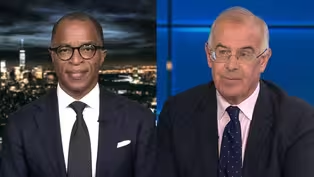
Brooks and Capehart on Trump’s anti-institutionalist Cabinet
Video has Closed Captions
Brooks and Capehart on Trump’s 'anti-institutionalist' Cabinet (10m 30s)
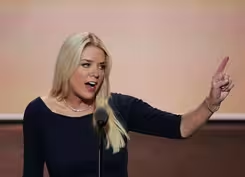
Examining the record of Pam Bondi, Trump's new pick for AG
Video has Closed Captions
Examining the record of Pam Bondi, Trump's new pick for attorney general (5m 53s)

Leguizamo aims to remedy Broadway' lack of Latino stories
Video has Closed Captions
John Leguizamo's 'The Other Americans' aims to remedy Broadway’s lack of Latino stories (7m 20s)
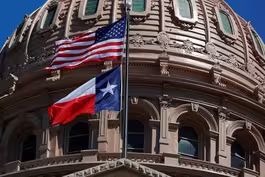
New course work in Texas schools to include Bible passages
Video has Closed Captions
Texas school board approves new course material that includes Bible passages (5m 49s)

The scope and potential pitfalls of Trump's spending cuts
Video has Closed Captions
The scope and potential pitfalls of Trump's and Musk's plans for spending cuts (6m 15s)
Providing Support for PBS.org
Learn Moreabout PBS online sponsorship
- News and Public Affairs

Today's top journalists discuss Washington's current political events and public affairs.

- News and Public Affairs

FRONTLINE is investigative journalism that questions, explains and changes our world.












Support for PBS provided by:
Major corporate funding for the PBS News Hour is provided by BDO, BNSF, Consumer Cellular, American Cruise Lines, and Raymond James. Funding for the PBS NewsHour Weekend is provided by...